An extended abstract of this paper appears in Advances in Cryptology — ASIACRYPT ’06, Lecture Notes in Computer Science Vol. 4284, Xuejia Lai ed., Springer-Verlag, 2006. This is the full version.
On the Generic Construction of Identity-Based Signatures with
Additional Properties
David Galindo1 Javier Herranz2 Eike Kiltz3
1
University of Luxembourg, Luxembourg City, Luxembourg
[email protected] http://www.dgalindo.es/
2
IIIA-CSIC Bellaterra, Spain
http://www.iiia.csic.es/∼jherranz/ 3
CWI Amsterdam The Netherlands
[email protected] http://kiltz.net
Abstract
It has been demonstrated by Bellare, Neven, and Namprempre (Eurocrypt 2004) that identity-based signature schemes can be generically constructed from standard digital sig-nature schemes. In this paper we consider the following natural extension: is there a generic construction of “identity-based signature schemes with additional properties” (such as identity-based blind signatures, verifiably encrypted signatures, ...) from standard signa-ture schemes with the same properties? Our results show that this is possible for a number of properties including proxy signatures; (partially) blind signatures; verifiably encrypted signatures; undeniable signatures; forward-secure signatures; (strongly) key insulated signa-tures; online/offline signasigna-tures; threshold signasigna-tures; and (with some limitations) aggregate signatures.
Using well-known results for standard signature schemes, we conclude that explicit identity-based signature schemes with additional properties can be constructed, enjoying sometimes better properties than specific schemes proposed until know. In particular, our work implies the existence of identity-based signatures with additional properties that are provably secure in the standard model, do not need bilinear pairings, or can be based on general assumptions.
Contents
1 Introduction 1
1.1 Our Results . . . 2
1.2 Organization of the Paper . . . 3
2 Digital Signatures 3 2.1 Standard Signatures . . . 4
2.2 Identity-Based Signatures . . . 4
3 Generic Construction of Identity-based Signatures 5 4 Generic Construction of Identity-Based Signatures with Additional Proper-ties 5 4.1 Verifiably Encrypted Signatures . . . 6
4.2 (Partially) Blind Signatures . . . 7
4.3 Undeniable Signatures . . . 8
4.4 Forward-Secure Signatures . . . 10
4.5 (Strongly) Key Insulated Signatures . . . 11
4.6 Proxy Signatures . . . 11
4.7 Online/Offline Signatures . . . 12
4.8 Threshold Signatures . . . 12
4.9 Aggregate Signatures . . . 14
4.10 Limitations and Extensions . . . 15
5 Generic Construction of Identity-Based Blind Signatures 15 5.1 Blind Signature Schemes . . . 16
5.2 Identity-Based Blind Signature Schemes . . . 17
5.3 Construction . . . 18
5.4 Security Analysis . . . 19
5.5 Example Instantiation . . . 22
1
Introduction
Digital signatures are one of the most fundamental concepts of modern cryptography. They provide authentication, integrity and non-repudiation to digital communications, which makes them the most used public key cryptographic tool in real applications. In order to satisfy the needs of some specific scenarios such as electronic commerce, cash, voting, or auctions, the original concept of digital signature has been extended and modified in multiple ways, giving raise to many kinds of what we call “digital signatures with additional properties”, e.g. blind signatures, verifiably encrypted signatures, and aggregate signatures.
Initially, all these extensions were introduced for the framework based on standard Public Key Infrastructures (PKI), where each user generates a secret key and publishes the matching public key. In practice, digital certificates linking public keys with identities of users are needed to implement these systems, and this fact leads to some drawbacks in efficiency and simplicity. For this reason, the alternative framework of identity-based cryptography was introduced by Shamir [57]. The idea is that the public key of a user can be directly derived from his identity, and therefore digital certificates are avoidable. The user obtains his secret key by interacting with some trusted master entity. Shamir [57] already proposed an identity-based signature scheme. In contrast, the problem of designing an efficient and secure identity-based encryption scheme remained open until [16, 56]. Identity-based cryptographic tools started to be commercialized recently, and a first standard is forthcoming [1].
From a theoretical point of view, results concerning identity-based encryption schemes are more challenging than those concerning identity-based signatures (IBS). In contrast to the identity-based encryption case, it was already pointed out by Shamir [57] that a standard PKI-based signature scheme already implies an identity-based signature scheme by using the signature scheme twice: for generating user secret keys and for the actual signing process. More precisely, the user secret key of an identity consists of a fresh PKI-based signing/verification key and a certificate proving the validity of the signing key. The latter certificate is established by the master entity by signing (using the master signing key) the new verification key together with the user’s identity. In the actual identity-based signing process the user employs the new signing key to sign the message. The identity-based signature itself consists of this signature along with the certificate and the public verification key.
Shamir’s certificate-based idea was formalized by Bellare, Neven, and Namprempre in [9], where they proposed a generic and secure construction of identity-based signature schemes from any secure PKI-based signature scheme. However, some specific identity-based signature schemes have been proposed and published, mostly employing bilinear pairings and random oracles, without arguing if the proposed schemes are more efficient than the schemes resulting from the generic construction in [9]. In fact, in many papers the authors do not mention the generic approach from [9] and in spite of Shamir’s work from more than two decades ago [57] it still seems to be a popular “opinion” among some researchers that bilinear pairings are inherent to identity-based signatures.
papers employ bilinear pairings and the security proofs are given in the random oracle model [11] (with its well-known limitations [20]).
1.1 Our Results
In this work we formally revisit this intuitive idea outlined in the last paragraph. Namely, if
s
is a secure PKI-based signature scheme ands
P is a PKI-based signature scheme with some additionalproperty
P
, we pursue the question if for a certain propertyP
the combination of those two signature schemes can lead to a secure IBS schemeS
P enjoying the same additional propertyP
. We can answer this question to the positive, giving generic constructions of signature schemes with the following properties:• Proxy signatures (PS)
• (Partially) blind signatures (PBS/BS) • Verifiably encrypted signatures (VES) • Undeniable signatures (US)
• Forward-secure signatures (FSS) • Strong key insulated signatures (SKIS) • Online/offline signatures (OOS)
• Threshold signatures (TS) • Aggregate signatures (AS)1
Implications. By considering well-known results and constructions of PKI-based signatures
s
P with the required additional properties, we obtain identity-based schemesS
P from weakerassumptions than previously known. A detailed overview of our results can be looked up in Table 1 on page 6. To give a quick overview of our results, for nearly every property
P
listed above, we obtain (i) the firstS
P scheme secure in the standard model (i.e., without randomoracles); (ii) the first
S
P scheme built without using bilinear pairings; and (iii) the firstS
P based on “general assumptions” (e.g. on the sole assumption of the existence of one-way functions), answering the main foundational question with regard to these primitives. Our results therefore implicitly resolve many “open problems” in the area of identity-based signatures with additional properties.Generic Constructions. For some properties
P
the construction of the schemeS
P is the same as in [9] and a formal security statement can be proved following basically verbatim the proofs given in [9]. But as the limitations of the generic approach indicate, this approach does not work in a black-box way for every possible propertyP
. For some special properties the certificate-based generic construction sketched above has to be (non-trivially) adapted to fit the specific nature of the signature scheme. This is in particular the case for blind signatures and hence in this case we will lay out our construction in complete detail.Limitations. On the other hand the generic way of constructing identity-based signatures with additional properties is not sound for every property. In particular, it does not seem to be applicable when, in the PKI-based scheme
s
P, an additional public key different from that ofthe signer has to be used in the protocol. This includes ring, designated verifier, confirmer, nominative or chameleon signatures. For these kinds of signatures, therefore, it makes more sense to consider specific constructions in the identity-based framework.
Discussion. We think that in some cases the constructions of identity-based signatures with additional properties implied by our results are at least as efficient as most of the schemes known
1
before. However, because of the huge number of cases to be considered, we decided not to include a detailed efficiency analysis of our generic constructions. Note that, in order to analyze the efficiency of a particular identity-based scheme resulting from our construction, we should first fix the framework: whether we admit the random oracle model, whether we allow the use of bilinear pairings, etc. Then we should take the most efficient suitable PKI-based signature scheme and measure the efficiency of the resulting identity-based signature. Our point is rather that this comparison should be up to the authors proposing new specific schemes: the schemes (explicitly and implicitly) implied by our generic approach should be used as benchmarks relative to which both existing and new practical schemes measure their novelty and efficiency.
We stress that we do not claim the completely novelty of our generic approaches to construct identity-based signatures with additional properties. Similar to [9] we rather think that most of these constructions can be considered as folklore and are known by many researchers. However, the immense number of existing articles neglecting these constructions was our initial motivation for writing this paper. We think that our results may also help better understanding IBS. To obtain a practical IBS with some additional properties the “standard method” in most articles is to start from a standard IBS and try to “add in” the desired additional property. Our results propose that one should rather start from a standard signature scheme with the additional property and try to make it identity-based. We hope that the latter approach may be used to obtain more efficient practical schemes.
1.2 Organization of the Paper
In Section 2 we recall the basic definitions (protocols and security requirements) about signature schemes, in both the PKI-based and the identity-based frameworks. We recall the generic construction of identity-based signatures of [9] in Section 3. Then we present our main results in Section 4: we list those additional properties
P
which can be preserved by a generic construction of identity-based signatures and present the transformations. We also discuss why this approach does not seem to work for other additional properties. As a representative example, we give in Section 5 the details concerning the (identity-based) blind signature case, including the generic construction, security analysis, and a specific (and very efficient) realization. Finally, some concluding remarks are given in Section 6.2
Digital Signatures
In this section we recall the well-known syntax and definition of standard (PKI-based) and identity-based signature schemes. We make the convention that everything related to standard signatures is written in lower-case, whereas for everything related to identity-based signatures we use upper-case.
We introduce some notation to be used throughout this paper. If x is a string, then |x| denotes its length, while if S is a set then |S| denotes its size. If k ∈ N then 1k denotes the
string of k ones. If S is a set then s ←$ S denotes the operation of picking an element s of
S uniformly at random. We write A(x, y, . . .) to indicate that A is an algorithm with inputs
2.1 Standard Signatures
A standard signature [36] (SS) scheme is defined as a tuple of PPT algorithms
s
= (kg,sign,vfy). The first two may be randomized but the last is not. The key generation algorithm kg, on input 1k, generates a key pair (pk,sk). The signer creates a signature on a message m via
sig ←$ sign(sk,m), and the verifier can check the validity of a signature by testing whether vfy(pk,m,sig) = 1. Correctness requires that vfy(pk,m,sign(sk,m)) = 1 with probability one for all m ∈ {0,1}k whenever the keys (pk,sk) are generated as indicated above.
For security we consider the notion of unforgeability under chosen-message attacks [36], which is defined through an experiment with a forgerF, parameterized with the security parameterk. The experiment begins with the generation of a fresh key pair (pk,sk)←$ kg(1k). The forger F is run on input the public key pk, and has access to a signing oracle:
• sign(·): On inputm ∈ {0,1}∗, this oracle returns a signaturesig $
←sign(sk,m).
At the end of its execution, the forger outputs a message m∗ and a forged signature sig∗. We say that F wins the game if sig∗ is a valid forgery of message m∗ (i.e., if 1←vfy(pk,m∗,sig∗)) and if m∗ 6=m for all the messages mfor which F queried the signature, during the attack. We define the advantage of such a forger FasAdvforges,F (k) = Pr [F succeeds ]. A SS scheme is called secure if the advantage of any PPT forger F is a negligible function in k.
For the notion of strong unforgeability under chosen-message attacks we relax the second condition such that we require (m∗,sig∗)= (6 m,sig) for all the tuples (m,sig) thatFhas obtained during the attack. Again, a scheme is called strongly secure if the respective advantage is a negligible function in k, for any PPT forger F.
2.2 Identity-Based Signatures
An identity-based signature (IBS) scheme is a tuple of PPT algorithms
S
= (KG,EXT,SIGN,VFY). The first three may be randomized but the last is not. The trusted key distribution center runs the key-generation algorithm KG on input 1k to obtain a master public and secret key pair (PK,SK). To generate a user secret keyUSK[id] for the user with identityid ∈ {0,1}∗, it runs the key derivation algorithm EXT on inputSK and id. The user secret key is assumed to be securely communicated to the user in question. On input USK[id] and a messagem, the signing algorithmSIGNreturns a signatureSIG ofm. On inputPK,id,m, and a signatureSIG, the verification algorithm VFY returns 1 ifSIG is valid forid and m, and returns 0 otherwise. Correctness requires that VFY(PK,id,m,SIGN(USK[id],m)) = 1 with probability one for all
k∈Nandid,m ∈ {0,1}∗ whenever the keysPK,SK,USK[id] are generated as indicated above.
For security we consider the notion of existential unforgeability under chosen-message and chosen-identity attacks [35], which is defined through an experiment with a forger F, parame-terized with the security parameter k. The experiment begins with the generation of a fresh master key pair (PK,SK) ←$ KG(1k). The forger F is run on input the master public key PK, and has access to the following oracles:
• EXT(·): On input identityid ∈ {0,1}∗, this oracle first checks if it has already established a user secret key USK[id] for id. If so it returns this same user secret key; otherwise, it returns a fresh user secret key USK[id]←$ EXT(SK,id).
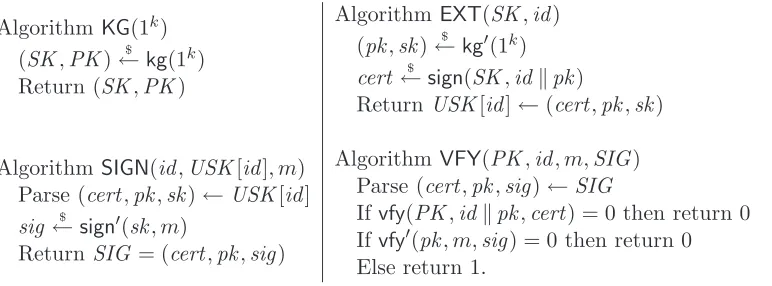
AlgorithmKG(1k) (SK,PK)←$ kg(1k) Return (SK,PK)
AlgorithmSIGN(id,USK[id], m) Parse (cert,pk,sk)←USK[id]
sig ←$ sign′(sk, m)
Return SIG = (cert,pk,sig)
Algorithm EXT(SK,id) (pk,sk)←$ kg′(1k)
cert ←$ sign(SK,idkpk)
ReturnUSK[id]←(cert,pk,sk) Algorithm VFY(PK,id, m,SIG)
Parse (cert,pk,sig)←SIG
Ifvfy(PK,idkpk,cert) = 0 then return 0 Ifvfy′(pk, m,sig) = 0 then return 0 Else return 1.
Figure 1: Generic transformation SS-2-IBS from standard signatures to identity-based signa-tures.
At the end of its execution, the forger outputs an identity id∗, a message m∗ and a forged signatureSIG∗. The forger is said to win the game if VFY(PK,id∗,m∗,SIG∗) = 1 and Fnever queried EXT(id∗) or SIGN(id∗,m∗). The advantage Advforge
S,F (k) is defined as the probability
thatF wins the game, and
S
is said to be secure if this advantage is negligible inkfor any PPT forger F.3
Generic Construction of Identity-based Signatures
In this section we first outline the generic transformation [57, 9] from two standard signature schemes
s
,s
′ into an identity-based signature schemeS
. Subsequently we study the question whether, for different types of signature schemess
P with additional propertiesP
, we have a(similar) generic transformation that combines
s
withs
P to obtainS
P, whereS
P is anidentity-based signature scheme with the same additional property as
s
P. Lets
= (kg,sign,vfy) ands
′ = (kg′,sign′,vfy′
) be two (possibly equal) standard signature schemes. We build
S
= (KG,EXT,SIGN,VFY) =SS-2-IBS(s
,s
′) as given in Figure 1.Bellare, Namprempre, and Neven [9] prove the following result:
Theorem 3.1 If
s
ands
′ are both secure standard signature schemes thenS
=SS-2-IBS(s
,s
′) is a secure identity-based signature scheme.Let
s
P be a standard signature scheme with the propertyP
. We extend the abovecon-struction to an IBS with additional properties
S
P in a straightforward way: as with sign-ing/verification, all functionality provided bys
P is “lifted” to the identity-based case. Thatmeans that (analog to SIGN and VFY) any protocol additionally provided by
s
P is executedusing the corresponding secret/public key pair (sk,pk) contained in USK[id]. We will refer to the latter construction as the “generic construction of identity-based signatures with additional properties” or simply “generic construction”.
4
Generic Construction of Identity-Based Signatures with
Ad-ditional Properties
Signature type Existence of identity-based signature schemes with additional properties at all (formal proof)? w/o random oracles? w/o pairings? general assumptions?
VES§4.1 ⋆ ⋆ ⋆ ⋆
BS§4.2 ⋆/⋆a ⋆b
⋆ ⋆
US §4.3 ⋆ ⋆ ⋆ −
FSS §4.4 ⋆ ⋆ ⋆ ⋆
SKIS§4.5 ⋆ ⋆ ⋆ ⋆
PS§4.6 ⋆ ⋆ ⋆ ⋆
OOS§4.7 ⋆ ⋆ ⋆ ⋆
TS§4.8 ⋆ ⋆ ⋆ ⋆
ASc
§4.9 ⋆ − − −
a
against concurrent adversaries.
b
recent result, [53].
c
no interaction among the signers, signature length≤ O(#signers).
Table 1: A summary of the practical implications of our results. Here “⋆” means that a scheme was known before, a “⋆” means that our construction gives the first such scheme, and a “−” means that no such scheme is known.
(US); forward-secure signatures (FSS); strongly key insulated signatures (SKIS); online/offline signatures (OOS); threshold signatures (TS); and aggregate signatures (AS). Since for most properties the generic construction can be applied without many difficulties (maybe excepting undeniable, blind and aggregate signatures), we decided to present our results in a rather infor-mal way. However, as a representative example we will provide a full forinfor-mal treatment of the generic construction of identity-based blind signatures in Section 5. We stress that we can treat the rest of our results at the same level of formality.
In Table 1 we summarize the practical impact of our results, i.e., we show what types
S
P ofnew identity-based signature schemes are implied by our general constructions.
4.1 Verifiably Encrypted Signatures
VES schemes enable a user Alice to create a signature encrypted using an adjudicator’s public key (the VES signature), so that it can be publicly verified whether the encrypted signature is valid. The adjudicator is a trusted third party, who can reveal the standard signature when needed. VES schemes provide an efficient way to enable fairness in many practical applications such as contract signing.
An efficient VES scheme in the random oracle model based on pairings was given in [17], while the scheme in [49] is secure in the standard model. It was further noted in [49] that VES schemes can be constructed on general assumptions such as trapdoor one-way permutations.
Identity-based verifiably encrypted signature (IB-VES) schemes were introduced in [37], where also a concrete security model was proposed. In contrast to [37], here we only consider a weaker (but still reasonable) model where the adjudicator has a fixed public key apk, i.e., it is not identity-based.
Compared to a standard signature scheme
s
, a VES schemes
VES = (kgVES,signVES,vfyVES,asignVES,avfyVES,adjVES) has three additional algorithms: VES signing asignVES and verifica-tion avfyVES (both with respect to an adjudicator’s public key apk), and adjudication adjVES.
Here the adjudication algorithmadjVES inputs an adjudicator’s secret keyask and transforms a
Algorithm ASIGNVES(apk,id,USK[id], m)
Parse (cert,pk,sk)←USK[id]
sigVES
$
←asignVES(apk,sk, m)
ReturnSIGVES = (cert,pk,sigVES)
Algorithm ADJVES(ask,id,SIGVES)
Parse (cert,pk,sigVES)←SIGVES sig ←$ adjVES(ask,sigVES, m)
ReturnSIG = (cert,pk,sig)
Algorithm AVFYVES(PK,id, m,SIGVES)
Parse (cert,pk,sigVES)←SIGVES
If vfy(PK,idkpk,cert) = 0 then return 0 If avfyVES(pk,apk, m,sigVES) = 0 then return 0
Else return 1.
Figure 2: Generic construction of identity-based VES.
first four algorithms are the same as in Figure 1. Only KGVES aditionally generates the ad-judicator key-pair (ask,apk). VES signing and verification algorithms can be lifted to the identity-based case in the same way as in the generic construction, i.e., in the IB-VES signing protocol ASIGNVES one replaces sig with its VES counterpart sigVES obtained by running the
VES signing algorithm asignVES on sk,m, and the adjudicator’s public keyapk. IB-VES verifi-cation AVFYVES first checks the certificate and then the VES signature using the standard VES
verification algorithm avfyVES. Details can be found in Figure 2. We remark that since we only
consider a standard (non identity-based) adjudicator there is no need to make the adjudication process “identity-based”. We can prove the following theorem:
Theorem 4.1 If
s
is a secure standard signature scheme ands
VES is a secure verifiably en-crypted signature scheme then the generic construction gives a secure identity-based verifiably encrypted signature schemeS
VES.A pairing-based IB-VES scheme secure in the random oracle model was given in [37]. We note that the IB-VES scheme from [24] does not have a formal security proof. Using our generic construction we get an IB-VES scheme, in the standard model, based on any trapdoor one-way function [49]; a more efficient scheme, in the random oracle model, can be obtained by using the construction in [17].
4.2 (Partially) Blind Signatures
In blind signature (BS) schemes [21] a user can ask a signer to blindly sign a (secret) message
m. At the end of the (interactive) signing process, the user obtains a valid signature onm, but the signer has no information about the message he has just signed. A formal security model of blind signatures was introduced in [42, 54]. Partially blind signature schemes are a variation of this concept, where the signer can include some common information in the blind signature, under some agreement with the final receiver of the signature. This concept was introduced in [2] and the security of such schemes was formalized in [3].
case of partially blind signatures can be analyzed in a very similar way. Summing up, and quite informally, we will obtain the following general result (see Section 5 for the details).
Theorem 4.2 If
s
is astrongly secure standard signature scheme ands
P is a secure (partially) blind signature scheme then a secure identity-based (partially) blind signature schemeS
P canbe constructed.
Here the IB-BS scheme inherits the security properties of the BS scheme — if BS is secure against concurrent adversaries so is IB-BS. In particular, we obtain new IB-BS schemes provably secure against concurrent adversaries in the standard model (by using the results from [19, 52, 32]); we obtain IB-BS schemes which do not employ bilinear pairings [10] and we obtain IB-BS schemes from any one-way trapdoor permutation [42, 32]. Furthermore, as we will show in Section 5.5, our generic construction, when instatiated with the Boneh-Lynn-Shacham signature scheme [18] and Boldyreva’s BS scheme [13], leads to a very practical IB-BS scheme, in the random oracle model.
4.3 Undeniable Signatures
In undeniable signature schemes [23] (US), it is not possible to check the validity or invalidity of a signature without interacting with the signer. Undeniable signatures are used in applications where signed documents carry some private information about the signer and thus it is desirable to limit the ability of verification, to protect the privacy of the signer.
Following [28], an undeniable signature scheme
s
US consists of five algorithmss
US = (kgUS,signUS,confUS,disavUS,simUS), where confUS and disavUS are the confirmation and disavowal
protocols respectively, both being interactive algorithms run between a prover and a verifier. The inputs of the verifiers in both confUS and disavUS protocols are a message m, an alleged
signature sig and a public key pk, while the input for the provers is the secret key sk. If confUS(sk,(pk,sig, m)) = 1, then the pair (m,sig) is valid; ifdisavUS(sk,(m,sig,pk)) = 1, then
the pair (m,sig) is invalid. The role and syntax of the algorithmsimUS are explained below.
The basic security properties are (standard)unforgeability,non-transferability and simulata-bility. By non-transferability it is meant that no adversary should be able to convince any third party of the validity/invalidity of a given message/signature pair after having run the confirma-tion and disavowal protocols with the legitimate signer. Intuitively, this is captured by requiring the confirmation and disavowal protocols to be “zero-knowledge,” so that no information is leaked beyond validity/invalidity. Simulatability is aimed at ensuring that signatures (repre-sented as binary strings) can not be recognized by an attacker as such (i.e., distinguished from a uniform string). More formally, this property is fulfilled if there exists a simulator algorithm simUS, which on input a public key and a message, outputs a simulated signature sig. This
signature should look like a “real undeniable signature” to anyone who only knows public infor-mation and has access to confirinfor-mation/disavowal oracles. An additional security property for US schemes is that of anonymity. Roughly speaking, a scheme
s
US is said to beanonymous [33]if for two randomly generated key pairs (pk0,sk0),(pk1,sk1) and a messagem, it is infeasible to distinguish the two distributions signUS(sk0, m) and signUS(sk1, m).
Extending the previous definition to the identity-based setting, an identity-based undeniable signature (IB-US) scheme consists of a tuple of six algorithms
S
US = (KGUS,EXTUS,SIGNUS,CONFUS,DISAVUS,SIMUS), where CONFUS and DISAVUS are interactive algorithms run
be-tween a prover P and a verifier V. The generic construction of IB-US is as follows. Algorithms KGUS and EXTUS are as in Figure 1 and algorithms SIGNUS and SIMUS are depicted in Figure
3. It remains to describe CONFUS and DISAVUS. The interactive algorithmCONFUS works as
AlgorithmSIGNUS(USK[id], m))
Parse (cert,pk,sk)←USK[id]
sigUS
$
←signUS(sk, m)
Return SIGUS =sigUS
Algorithm SIMUS(PK,id, m)
(pk′,sk′) $
←kgUS(1k)
ReturnsimUS(pk′, m)
Figure 3: Generic construction of identity-based US.
and sends (cert,pk) to the verifier. The verifier, on input (id,SIGUS, m), receives (cert,pk) and
checks the validity of the certificate by running vfy(PK,idkpk,cert). If it is correct, prover and verifier execute the interactive protocol confUS. The construction of DISAVUS is exactly the
same, with the difference that, in the last step, prover and verifier run the protocol disavUS.
The basic security properties for an IB-US (unforgeability, non-transferability and simulata-bility), are defined by suitably adapting the standard US security notions to the identity-based scenario. In particular, the identity-based simulatability property is defined in terms of the exis-tence of an additional simulation algorithmSIMUS. On input the public system parametersPK,
an identityid and a messagem,SIMUS(PK,id, m) outputs a simulated identity-based signature SIG, which is indistinguishable from a real identity-based signature for someone having access to confirmation/disavowal oracles for the identity id.
In contrast to the generic construction from Figure 1, we construct an identity-based unde-niable signature as SIG ←$ signUS(sk, m), i.e., certificate cert and pk are not included. Instead,
in the interactive identity-based confirmation and disavowal protocols, the signer sends his cer-tificate cert and the public key pk to the verifier, who can then verify the link between SIG
and idkpk. Then prover (usingsk) and verifier (using pk) execute the standard US confirma-tion/disavowal protocol. It is easy to see that a generic construction that would includecert and
pk in the signature would not be simulatable. Would this have been the case, the identity-based signature simulator should simulate the certificate cert based on the master public-key only, which is infeasible since the signature scheme
s
is assumed to be unforgeable.Note that we define the output of SIMUS(PK,id, m) as simUS(pk′, m), where (pk′,sk′)
$ ← kgUS(1k) is a fresh key pair generated by the simulator. The simulatorSIMUS(PK,id, m) does
not input the user secret key USK[id], and therefore the public key pk assigned toid is infor-mation theoretically hidden from the simulator’s view. In contrast, an adversary may learn this public key pk by running the confirmation/disavowal protocol. It turns out that to ensure that our generic IB-US construction satisfies the simulatability property it is sufficient to require the scheme
US
to be anonymous in the sense of [33]. More formally, we can prove the following theorem:Theorem 4.3 If
s
is a secure standard signature scheme ands
US is a secure anonymousundeni-able signature scheme then
S
US as outlined above is a secure identity-based undeniable signaturescheme.
To the best of our knowledge, only one IB-US scheme has been previously presented in [48]. This scheme uses bilinear pairings and it is proved secure in the random oracle model. We stress that the security model in [48] seems to be incomplete, as the authors do not consider simulatability.
AlgorithmEXTFSS(SK,id)
(pk,sk0) $
←kgFSS(1k) cert ←$ sign(SK,idkpk)
Return USK[id]0 ←(cert,pk,sk0) AlgorithmUPDFSS(USK[id]t−1)
Parse (cert,pk,skt−1)←USK[id]t−1
skt $
←updFSS(skt−1)
Return USK[id]t= (cert,pk,skt)
AlgorithmSIGNFSS(m, t,USK[id]t)
Parse (cert,pk,skt)←USK[id]t (sigFSS, t)
$
←signTS(m, t,skt)
Return SIGFSS = (cert,pk,sigFSS, t)
AlgorithmVFYFSS(PK,id, m,SIGFSS)
Parse (cert,pk,sigFSS, t)←SIGFSS
Ifvfy(PK,idkpk,cert) = 0 then return 0 IfvfyFSS(pk, m,sigFSS, t) = 0 then return 0
Else return 1
Figure 4: Generic construction of identity-based FSS. 4.4 Forward-Secure Signatures
In a forward-secure signature (FSS) scheme the verification key remains fixed but the signing key is updated at regular intervals, in such a way that compromise of the signing key at a certain time period does not allow to forge signatures pertaining to any previous period.
A forward-secure signature scheme
s
FSS = (kgFSS,updFSS,signFSS,vfyFSS) has fouralgo-rithms. The key generation algorithm kgFSS outputs a public key pk and an initial secret
keysk0. For each time periodt= 1, . . . , T, the update protocolskt $
←updFSS(skt−1) produces a new secret key from the previous one. The protocols for signature and verification must include as input/output the time period where the signature has been computed. FSS schemes were introduced in [8], in order to mitigate the damage caused by key exposure without requiring redistribution of keys. Shortly after their introduction, a construction of FSS schemes from any signature scheme was proposed in [44]. In particular, this result implies that FSS schemes can be obtained from any one-way function.
To the best of our knowledge, the concept of identity-based forward-secure signature (IB-FSS) schemes has not been previously considered in the literature. In a IB-FSS scheme, the identityid of the signer remains fixed, while the signing key for thet-th time interval,USK[id]t, is updated. The initial signing keyUSK[id]0 is delivered to the user by the master entity, while the signing keys for the subsequent periods are generated by the user itself. Notice that this approach favorably compares with the usual way to defend against key exposure in identity-based cryptography, in which the master entity issues new private keys USK[idkt] to the user with identity id at every time period t. The latter approach heavily relies on the master entity and increases the (costly) communication between the entity and the users. Our generic construction allows us to obtain an identity-based forward secure signature scheme
S
FSS = (KGFSS, ,EXTFSS,UPDVES,SIGNFSS,VFYVES), starting from a standard signature scheme
s
= (kg,sign,vfy) and astandard forward secure signature scheme
s
FSS. The protocol KGFSS is exactly the same as inFigure 1, resulting in a pair of keys (SK,PK) for the master entity. The other protocols are described in Figure 4.
Theorem 4.4 If
s
is a secure standard signature scheme ands
FSS is a secure forward-securesignature scheme then the generic construction gives a secure identity-based forward-secure signature scheme
S
FSS.4.5 (Strongly) Key Insulated Signatures
The concept of (strongly) key insulated signatures (SKIS) was introduced in [30] and is quite similar to the concept of FSS. The main difference is that the update protocol is jointly executed by the user (signer) and an external entity (helper); in this way, compromise of the signing key at a certain time period t∗ does not allow now to forge signatures pertaining to any other periodt6=t∗. We can easily adapt the generic construction of identity-based FSS that we have described in the previous section and we obtain a generic construction of identity-based SKIS.
SKIS signatures can be built from any one-way function [30], which implies that our generic construction yields based SKIS schemes from any one-way function. Previously, identity-based SKIS using bilinear pairings and random oracles have been proposed in [66, 39].
4.6 Proxy Signatures
In proxy signature (PS) schemes, an original signerAdelegates its signing capabilities to a proxy signer B, in such a way thatB can sign (some specified set of) messages on behalf of A. The recipient of the final message verifies at the same time that B computed the signature and that
A had delegated its signing capabilities to B.
The concept of proxy signatures was introduced in [51]. The first formal analysis of the security of standard proxy signatures was done in [12], where it was shown that a secure proxy signature scheme can be constructed from any secure digital signature scheme (and therefore, in particular, from any one-way function). The first identity-based proxy signature (IB-PS) schemes appeared in [64], but they lacked of a formal security analysis, since the first formal security model for IB-PS (which was adapted from the one in [12]) came later, in [62].
A proxy signature scheme
s
PS = (kgPS,signPS,vfyPS,delegPS,p.kgPS,p.signPS,p.vfyPS) hasfour additional algorithms, when compared with a standard signature scheme
s
: PS delegation, delegPS, is run by the original signerA, taking as input his secret keyskA, a warrantωindicating the general terms of the delegation, and the public key (or identity) of the proxy signer B; PS proxy key generation,p.kgPS, is run by the proxy signer, taking as input his secret keyskB and the output of the delegation algorithm delegPS, and obtaining a proxy secret keypsk as output;the proxy signing protocol, sigPS
$
← p.signPS(m,psk), executed by the proxy signer, and the
proxy verification protocol, 1 or 0←$ p.vfyPS(m,sigPS,pkA,pkB, ω), complete the picture. Our generic construction of an identity-based proxy signature (IB-PS) scheme
S
PS = (KGPS,EXTPS,SIGNPS,VFYPS,DELEGPS,P.KGPS,P.SIGNPS,P.VFYPS) from any standard PS scheme
works in general, provided the public key of the proxy signer B is not strictly needed in the delegation phase of the underlying standard PS scheme. This is usually the case, because the public key is only used as an identifier of the proxy, and hence pkB can be replaced with idB. The first four algorithms are the same as in Figure 1 (note that protocolEXTPS is run for both
the originalidAand the proxyidBsigners). The final identity-based proxy signature will include the proxy signature resulting from PS, along with the certificates on the messages pkAkidAand
pkBkidB, signed by the master entity. Details can be found in Figure 5. Summing up, we obtain the following result.
Theorem 4.5 If
s
is a secure standard signature scheme ands
PS is a secure proxy signature scheme then the generic construction gives a secure identity-based proxy signature schemeS
PS.Algorithm DELEGPS(idA,USK[idA], ω,idB) Parse (certA,pkA,skA)←USK[idA]
delω $
←delegPS(skA, ω,idB)
ReturnDEL= (idA,certA,pkA, ω,delω) Algorithm P.KGPS(USK[idB],DEL)
Parse (idA,certA,pkA, ω,delω)←DEL Ifvfy(PK,idAkpkA,certA) = 0 then fail Parse (certB,pkB,skB)←USK[idB]
psk ←$ p.kgPS(skB,delω)
ReturnPSK = (ω,psk,certB,pkB,certA,pkA)
Algorithm P.SIGNPS(m,PSK)
Parse (ω,psk,certB,pkB,certA,pkA)←PSK Ifm does not satisfyω then fail
sigPS
$
←p.signPS(m,psk)
Return SIGPS = (certB,pkB,certA,pkA,sigPS)
Algorithm P.VFYPS(PK,idA,idB, ω, m,SIGPS)
Parse (certB,pkB,certA,pkA,sigPS)←SIGPS
Ifvfy(PK,idAkpkA,certA) = 0 then return 0 Ifvfy(PK,idBkpkB,certB) = 0 then return 0 Ifp.vfyPS(m,sigPS,pkA,pkB, ω) = 0 then return 0 Else return 1.
Figure 5: Generic construction of identity-based PS. 4.7 Online/Offline Signatures
In online/offline signatures the signing algorithm is split into two phases: the offline phase and the online phase. The idea is to shift the major computational overhead to the offline phase, which does not need as input(s) the message(s) to be signed in the future, whereas the online phase requires only a very low computational overhead. Online/offline signatures were introduced in [31], were the authors presented a general method for converting any signature scheme into an online/offline signature scheme. This method was later improved, in [58].
The generic construction of identity-based signatures can be directly applied to the case of online/offline signatures, by splitting the corresponding signing protocol into two phases. We therefore omit the explicit description of the protocols in this case.
Theorem 4.6 If
s
is a secure standard signature scheme ands
OO is a secure online/offlinesignature scheme then the generic construction gives a secure online/offline signature scheme
S
OO.We are only aware of one identity-based online/offline signature scheme [63] in the literature, which is secure in the random oracle model and uses bilinear pairings. Applying the known generic construction [31, 58] to our construction results in identity-based online/offline signature schemes based on one-way functions. A more efficient scheme can be obtained by using, e.g., the pairing-based online/offline signature scheme from [15].
4.8 Threshold Signatures
Threshold signatures (TS) are used whenever the ability to sign must be decentralized. The idea is to share the signing power among a number of different players, in such a way that signing is possible only when a large enough number of honest players cooperate together.
A threshold signature scheme
s
TS = (tkgTS,part.signTS,combTS,vfyTS) has four algorithms:the threshold key generation algorithm, tkgTS, takes as input a set of players P and a
thresh-old t, and outputs a single public key pk and a secret share skj for each player Pj ∈ P. To jointly sign a message m, each player Pj in some subset A ⊂ P executes the proto-col sig(j)TS ←$ part.signTS(m,skj), obtaining a partial signature sig(j)TS. After that, if |A| ≥ t,
the combining algorithm sigTS
$
← combTS({sig(j)TS}Pj∈A) can be executed to obtain a
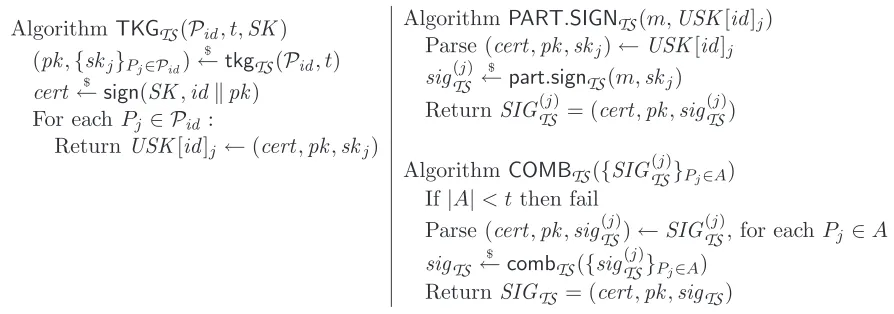
Algorithm TKGTS(Pid, t,SK)
(pk,{skj}Pj∈Pid)
$
←tkgTS(Pid, t) cert ←$ sign(SK,idkpk)
For each Pj ∈ Pid :
Return USK[id]j ←(cert,pk,skj)
AlgorithmPART.SIGNTS(m,USK[id]j)
Parse (cert,pk,skj)←USK[id]j
sig(j)TS ←$ part.signTS(m,skj) Return SIG(j)TS = (cert,pk,sig(j)TS) Algorithm COMBTS({SIG(j)TS}Pj∈A)
If |A|< tthen fail
Parse (cert,pk,sig(j)TS)←SIG(j)TS, for each Pj ∈A
sigTS
$
←combTS({sig(j)TS}Pj∈A)
Return SIGTS = (cert,pk,sigTS)
Figure 6: Generic construction of identity-based TS.
1 or 0 ←$ vfyTS(m,sigTS,pk). A non-interactive threshold signature scheme in the standard
model and without pairings has been recently proposed in [27]. Here non-interactivity means that each player can individually compute his partial signature, without interacting with the other players.
Identity-based threshold signatures (IB-TS) were introduced in [6], to be used in a context where the signing key USK[id] is shared by a collective Pid of signers with a common identity id (for example, the name of a company). These users will hold secret shares USK[id]j of the signing key, and they will be able to use them to compute partial signaturesSIG(j)TS of a message. A sufficiently large fraction of such correct partial signatures can be combined to obtain a full signatureSIGTS. More IB-TS schemes have been proposed in [25].
Here we show how to use our generic construction to obtain an identity-based threshold signature (IB-TS) scheme
S
TS = (KGTS,TKGTS,PART.SIGNTS,COMBTS,VFYTS) starting fromany standard signature scheme
s
= (kg,sign,vfy) and a standard threshold signature schemes
TS as described above. The protocols KGTS and VFYTS work exactly as in Figure 1. Afterexecuting KGTS, the master entity holds a pair of keys (SK,PK). The rest of protocols of
S
TSare described in Figure 6.
Note that, if the signing phase of the standard threshold signature scheme
TS
is non-interactive, we obtain a non-interactive identity-based threshold signature scheme (comparable to that in [6]). Furthermore, if schemeTS
has mechanisms to achieve robustness (i.e. to detect incorrect partial signatures coming from dishonest players), then such mechanisms can be easily included in our construction of the schemeS
TS.Theorem 4.7 If
s
is a secure standard signature scheme ands
P is a secure threshold signature scheme then the generic construction gives a secure identity-based threshold signature schemeS
P.4.9 Aggregate Signatures
The idea of an aggregate signature (AS) scheme is to combine n signatures on n different messages, signed byn(possibly different) signers, in order to obtain a single aggregate signature which provides the same certainty than the n initial signatures. Besides the three algorithms that form a standard signature scheme, an aggregate signature scheme
s
AS = (kgAS,signAS,vfyAS,aggregAS,agvfyAS) contains two additional protocols: the aggregation protocol, aggregAS, takes as inputntuples{(pki, mi,sigi)}1≤i≤n and outputs an aggregate signaturesigAS; the aggregate
verification protocol, agvfyAS, takes as input an aggregate signature sigAS, along with n pairs
{(pki, mi)}1≤i≤n and outputs 1 if the aggregate signature is valid, 0 otherwise.
The main goal in the design of such protocols is that the length of sigAS is constant,
inde-pendent of the number of messages and signers. Of course, to check correctness of an aggregate signature, the verifier will also need the messages mi and the public keys pki, but this is not taken into account when considering the length of sigAS.
The idea of aggregate signatures was introduced in [17], where a scheme with constant-length aggregate signatures was presented and analyzed, based on the signature scheme of [18]. In the identity-based framework, the only proposal which achieves constant-length aggregation is that of [34]; however, this scheme only works in a more restrictive scenario where some interaction or sequentiality is needed among the signers of the messages which will be aggregated later (in the same direction as [50, 49], for the PKI-based scenario). With respect to strict aggregate signatures (without any kind of interaction among the signers) in the identity-based setting, the most efficient proposal is that in [38], which does not achieve constant-length aggregation: the length of the aggregate signature does not depend on the number of signed messages, but on the number of different signers.
We can achieve exactly the same level of partial aggregation by using our generic con-struction. We start from any standard AS scheme
s
AS (assumed to produce constant-length aggregate signatures) and obtain an identity-based aggregate signature schemeS
AS = (KGAS,EXTAS,SIGNAS,VFYAS,AGGREGAS,AG.VFYAS). Again, the first four algorithms are the same
as in Figure 1, replacing
s
′ with the protocolskgAS,signAS,vfyAS of the inherent AS scheme
s
AS.In an identity-based aggregate signatureSIGAS, besides the standard aggregate signaturesigAS,
we will have to include the pairs (certi,pki) for all the signers idi. If the standard signature scheme
s
, which is used to generate the signatures certi, admits constant-length aggregation (for example, ifs
=s
AS), then all thecerti can be aggregated into a single cert. But the public keys cannot be aggregated; this is why the length of the identity-based aggregate signature will depend on the number of different signers (and not on the number of signed messages), as it happens in the scheme of [38]. Details of the generic construction of identity-based aggregate signatures can be found in Figure 7.Summing up, we obtain the following result.
Theorem 4.8 If
s
is a secure standard signature scheme ands
AS is a secure aggregate signaturescheme then the generic construction gives a secure identity-based aggregate signature scheme
Algorithm AGGREGAS({(idi, mi,SIGi)}1≤i≤n) Parse (certi,pki,sigi)←SIGi, for each i
If vfy(PK,idikpki,certi) = 0, for somei, then fail
sigAS
$
←aggregAS({(pki, mi,sigi)}1≤i≤n)
cert ←$ aggregAS({(PK,idikpki,certi)}1≤i≤n) Return SIGAS = (sigAS,cert,{pki}1≤i≤n) Algorithm AG.VFYAS(SIGAS,{(idi, mi)}1≤i≤n)
Parse (sigAS,cert,{pki}1≤i≤n)←SIGAS
If agvfyAS(cert,{(PK,idikpki)}1≤i≤n) = 0 then return 0 If agvfyAS(sigAS,{(pki, mi)}1≤i≤n) = 0 then return 0 Else return 1.
Figure 7: Generic construction of identity-based AS.
constant-length signatures: this length will always depend on the number of different signers. Therefore, an optimal solution to the problem of identity-based aggregate signatures will have to be based on a different approach.
4.10 Limitations and Extensions
Our generic approach to construct identity-based signature schemes with special properties does not work in situations where the signing procedure (in the corresponding PKI-based scheme) involves other public keys than the one from the signer, and interaction between the signer and the owners of these public keys is not mandatory. Our approach fails in this case because in the identity-based framework the signer only knows the identity of the other users, and needs some interaction with them in order to know the public key that they have received in the key extraction phase.
Some examples of signature schemes with special properties falling inside this group are: ring signatures [55, 64]; designated verifier signatures [40, 59]; confirmer signatures [22]; chameleon signatures [45, 5]; and nominative signatures [60].
We are aware of the fact that the list of properties where the generic approach can be applied is not complete and it obviously can also be applied to other concepts (like one-time signa-tures [47], strongly secure signasigna-tures, homomorphic signasigna-tures [41], etc.) as well. Furthermore, combinations of different additional properties are possible. For example, it is possible to give a generic construction of identity-based threshold undeniable signatures based on the existence of threshold undeniable signatures. We also note that our generic construction can be extended to the case of hierarchical identity-based signatures (HIBS), by using certificate-chains [43].
5
Generic Construction of Identity-Based Blind Signatures
5.1 Blind Signature Schemes
Blind signature schemes were introduced in [21] with electronic banking as first motivation. The intuitive idea is that a user asks some signer to blindly sign a (secret) message m. At the end of the process, the user obtains a valid signature on m from the signer, but the signer has no information about the message he has signed. More formally, a blind signature scheme
s
BS = (kgBS,signBS,vfyBS) consists of the following (partially interactive) PPT algorithms. The key generation algorithm kgBS generates, on input 1k, a key pair (sk,pk). The blindsigning algorithm signBS is an interactive protocol between a userU and a signer S with public
keypk. The input for the user isInpU = (m,pk), wherem is the message he wants to be signed by the signer. The input InpS of the signer is his secret key sk. In the end, the output OutS of the signer is ‘completed’ or ‘not completed’, whereas the output OutU of the user is either ‘fail’ or a blind signature sig. We use notation (OutU,OutS)
$
← signBS(InpU,InpS) to refer to one execution of this interactive protocol. Finally, the verification algorithm vfyBS is the same
as for standard signatures.
Blindness. Intuitively, the blindness property captures the notion that a signer cannot obtain any information about the messages he is signing for some user. Formally, this notion is defined by the following game that an adversary (signer) B plays against a challenger (who plays the role of a user).
First the adversary B runs the key generation protocol (sk,pk) ←$ kgBS(1k). Then the
adversaryBchooses two messages m0 andm1 and sends them to the challenger, along with the public keypk. The challenger chooses at random a bitb∈ {0,1}and then the interactive signing protocol is executed two times (possibly in a concurrent way), resulting in (OutU,b,OutS,b)
$ ← signBS(InpU,b,InpS,b) and (OutU,1−b,OutS,1−b)
$
← signBS(InpU,1−b,InpS,1−b), where adversary B plays the role of the signer S, and the challenger plays the role of the user, with inputs
InpU,b = (pk, mb) andInpU,1−b = (pk, m1−b). Finally, the adversaryBoutputs its guessb′. Note that the adversary in the above security game is in the possession of the secret key sk.
We say that such an adversary B succeeds if b′ = b and define its advantage in the above game as AdvblindsBS,B(k) =|Pr [b
′ =b]−1/2|. A scheme
s
BS has the blindness property if, for all
PPT adversaries B,AdvblindsBS,B(k) is a negligible function (with respect to the security parameter k). If AdvblindsBS,B(k) = 0, for any (possibly computationally unbounded) adversary B, then the
blindness of the scheme is unconditional.
Unforgeability. Unforgeability captures the intuitive requirement that a user obtains a valid signature from the signer only if they complete together an execution of the blind signature protocol. Among the different (but equivalent) formal definitions of unforgeability for blind signature schemes (see, e.g., [42, 54]), we consider the one from [42], which is given by the following game that an adversary F(user or forger) plays against a challenger (signer).
First the challenger runs the key generation protocol (pk,sk) ←$ kgBS(1k) and gives pk
to F, whereas the secret key sk is kept secret by the challenger. During its execution the forger F adaptively chooses messagesmj, then the interactive signing protocol (OutU,OutS)
$ ← signBS(InpU,InpS) is executed (possibly in a concurrent way), where the adversary F plays the role of the user U, with input InpU = (pk, mj), and the challenger plays the role of the signer, with input the secret key sk. Let ℓ be the number of such queries that finish with
OutS =‘completed’. Eventually, adversary F outputs a list of ℓ′ tuples {(mi,sigi)}1≤i≤ℓ′. We
• 1←vfyBS(pk, mi,sigi), for alli= 1, . . . , ℓ′.
We say that such an adversaryFis an (ℓ, ℓ′)-forger and define its advantage asAdvforge
sBS,F(k) =
Pr [F succeeds ]. The scheme
s
BS is unforgeable if AdvforgesBS,F(k) is a negligible function in k for
all PPT (ℓ, ℓ′)-forger F.
5.2 Identity-Based Blind Signature Schemes
Analogously, an identity-based blind signature scheme is defined as a tuple of PPT algorithms
S
BS = (KGBS,EXTBS,SIGNBS,VFYBS). The first three may be randomized but the last is not.The key generation algorithm KGBS generates, on input 1k, a master key pair (PK,SK). The
key extraction algorithm EXTBS takes as inputs PK and an identity id ∈ {0,1}∗, and returns
a secret key USK[id] for the user with this identity. The blind signing algorithm SIGNBS is an
interactive protocol between a userU and a signer with identityid. The common input for them is PK. The input for the user isInpU = (id, m) wherem is the message he wants to be signed by id. The inputInpid of the signer is his secret key USK[id]. In the end, the outputOutid of the signer is ‘completed’ or ‘not completed’, whereas the outputOutU of the user is either ‘fail’ or a signatureSIG. We use notation (OutU,Outid)
$
←SIGNBS(PK, InpU, Inpid) to refer to one
execution of this interactive protocol. Finally, the verification algorithm VFYBS takes as input PK, a messagem, an identityid and a blind signatureSIG; it outputs 1 if the signature is valid with respect to the master public key PK and the identityid, and 0 otherwise.
An identity-based blind signature scheme must satisfy the requirements of correctness, blind-ness and unforgeability, that we now explain in detail.
Correctness. For any execution of the setup protocol (SK,PK)←$ KGBS(1k), the key extrac-tion protocol USK[id]←$ EXTBS(SK,id), and the interactive signing protocol (OutU,Outid)
$ ← SIGNBS(PK,InpU,Inpid), where InpU = (id, m) and Inpid = USK[id], the following property must be satisfied:
Outid = ‘completed′ =⇒
1 ←VFYBS(PK,id, m,OutU)
.
Blindness. Blindness of an identity-based blind signature scheme is defined by a game played between a challenger and an adversary. This adversary B models the dishonest behavior of a signer who tries to distinguish which message (between two messages chosen by himself) is being signed in an interactive execution of the signing protocol with a user. The game is as follows.
First the challenger runs the setup protocol (SK,PK)←$ KGBS(1k) and givesPK to B. The
master secret key SK is kept secret by the challenger. The adversary B is allowed to query for secret keys of identities id of its choice. The challenger runs USK[id] ← EXTBS(SK,id)
and gives the resulting secret key USK[id] to B. If the same identity is asked again, the same value USK[id] must be returned by the challenger. At some point, the adversaryB chooses an identity id∗ and two messagesm0, m1, and sends these values to the challenger. The challenger chooses at random one bit b∈ {0,1} and then the interactive signing protocol is executed twice (possibly in a concurrent way), resulting in (OutU,b,Outid∗,b)
$
← SIGNBS(InpU,b,Inpid∗,b) and (OutU,1−b,Outid∗,1−b)
$
← SIGNBS(InpU,1−b,Inpid∗,1−b), where adversary B plays the role of the signer id∗, with input Inpid∗,b = Inpid∗,1−b = USK[id∗], and the challenger plays the role of
the user, with inputs InpU,b = (mb,id∗) and InpU,1−b = (m1−b,id∗). Finally, the adversary B outputs its guess b′.
We say that such an adversaryBsucceeds ifb′ =band define its advantage in the above game asAdvib-blindSBS,B (k) =|Pr [b′=b]−1/2|. A scheme
S
adversaries B, Advib-blindSBS,B (k) is a negligible function (with respect to the security parameter k). If Advib-blindSBS,B (k) = 0, for any (possibly computationally unbounded) adversaryB, then the
blindness of the scheme is unconditional.
Unforgeability. Our definition of unforgeability for identity-based blind signatures is adapted from the concept of (ℓ, ℓ′)-unforgeability introduced in [42] for standard PKI-based blind sig-natures. A forger FIB against the unforgeability property of an identity-based blind signature scheme is defined by means of the following game that it plays against a challenger.
First of all, the challenger runs the setup protocol (SK,PK)←KGBS(1k) and givesPK toF.
The master secret keySK is kept secret by the challenger. Then the forgerFcan make two kinds of queries to the challenger. On the one hand, F can ask for the secret key of an identity id of its choice; the challenger runs USK[id]←$ EXTBS(SK,id) and returns the resulting user secret
key USK[idi] to F. If an identity id is asked twice, the challenger must return the same secret key USK[id]. On the other hand, the forger F can ask for the execution of the blind signing protocol: F chooses pairs (idj, mj), then the challenger first runs USK[idj]←EXTBS(SK,idj)
to get the secret key USK[idj] for this identity. After that, the interactive signing protocol (OutU,Outid) ← SIGNBS(PK,InpU,Inpid) is executed (possibly in a concurrent way), where the adversary F plays the role of the user U, with inputInpU = (idj, mj), and the challenger plays the role of the signer idj, with input the secret key USK[idj]. Let ℓ be the number of such queries that finish with Outidj =‘completed’. Eventually, the adversaryF outputs a list of
ℓ′ tuples{(id
i, mi,SIGi)}1≤i≤ℓ′. We say that F succeedsif:
• ℓ < ℓ′;
• 1 ←VFYBS(PK,idi, mi,SIGi), for alli= 1, . . . , ℓ′;
• the pairs (idi, mi) included in the output list are pairwise different; and • F did not ask a secret key query for any of the identities idi in the output list. We say that such an adversaryF is an (ℓ, ℓ′)-forger and define its advantage as Advib-forge
SBS,F (k) =
Pr [F succeeds ]. The scheme
S
BS is unforgeable if Advib-forgeSBS,F is a negligible function in k for
any PPT (ℓ, ℓ′)-forger F.
5.3 Construction
Let
s
= (kg,sign,vfy) be a standard signature scheme and lets
BS = (kgBS,signBS,vfyBS) be ablind signature scheme. We construct an identity-based blind signature scheme
S
BS = (KGBS,SIGNBS,EXTBS,VFYBS) as follows.
The description of the algorithmsKGBS andVFYBS is the same as in the generic construction
of identity-based signatures from Figure 1. Recall that the master key pair output byKGBS is a
key pair (PK,SK) of the standard signature scheme
s
obtained by runningkg. The description of algorithm EXTBS is also the same as in Figure 1 with the difference that it makes sure thatonly one USK[id] is established for each identity id. This can be done, for example, by storing all computedUSK[id] in a table. See also Remark 5.2.
The interactive blind signing protocol SIGNBS between a user U and a signer with identity id consists of the following steps. Recall that PK is a common input for user and signer, the input of the user is (id, m) and the input of the signer isUSK[id] = (cert,pk,sk).
1. User U sends the query (id,‘blindsignature?′) to the signer.
2. If the signer does not want to sign, the protocol finishes withOutU =‘fail’ andOutid =‘not
3. The user first verifies the certificate on pk by running {0,1} ← vfy(PK,id||pk,cert). If the output is 0, then the protocol finishes with OutU =‘fail’ andOutid =‘not completed’. Otherwise, user and signer interact to run the blind signature protocol of
s
BS, result-ing in (Out′U,Out′id)
$
← signBS(InpU,Inpid), where InpU = (pk, m) and Inpid = sk. If
Out′
U 6=‘fail’, then it consists of a standard blind signature sig on m under secret key sk. The final output for the user is in this case OutU =SIG = (cert,pk,sig), which is defined to be the identity-based blind signature on message m coming from identityid.
Remark 5.1 If, in an execution of the blind signing protocolsignBS of the scheme
s
BS, the userdoes not need to know the public key of the signer when computing the information that he (the user) sends in the first round, then the two first steps of our generic signing protocol SIGNBS
can be left out. In this case, the sent information and the necessary computations of these two steps can be moved to step 3 (i.e., injected into the execution of the PKI-based protocolsignBS).
In this way, the round complexity of the resulting scheme
S
BS would be exactly the same as in the underlying PKI-based schemes
BS. This modification does not affect the security analysis that we explain in next section. An example of this fact will be illustrated in the concrete instantiation that we describe in Section 5.5, because Boldyreva’s blind signature scheme [13] satisfies the required condition: the user does not need to know the public key of the signer to compute the first message of the interactive signing protocol.Remark 5.2 In our generic construction, the master entity must store a list of pairs (id,USK[id]) to avoid that the same user obtains two certified (signed) but distinct public keys. This is nec-essary to ensure blindness of the scheme. This solution increases the key management cost for the master entity. To solve this drawback, we can use the following standard technique to make EXTBS deterministic. The master secret key SK additionally contains some randomness that
is used as the seed of a pseudorandom generator to generate the random coins for kgBS when
generating the key pairs (sk,pk). 5.4 Security Analysis
In this section we prove that the identity-based blind signature scheme
S
BS constructed in the previous section satisfies the three required security properties. It is very easy to check the correctness of the protocol. Let us prove in detail that blindness and unforgeability also hold, assuming that the schemess
ands
BS employed as primitives are secure.Theorem 5.3 Assume the signature scheme
s
is strongly unforgeable and the blind signature schemes
BS is blind. Then the identity-based blind signature schemeS
BS constructed inSec-tion 5.3 is blind.
Proof: To prove this result, we show that if there exists a successful adversary BIB against the blindness of the scheme
S
BS, then there exists either a successful forger Fagainst the signature schemes
or a successful adversaryBagainst the blindness of the blind signature schemes
BS. Inparticular we show that
Advib-blindS
BS,BIB(k)≤Adv blind
sBS,B(k) +Adv
sforge
s,F (k).
We now constructF and B.
Setup. Forger F receives as initial input some public keypk for the standard signature scheme