BRATTON, KEVIN M. Thought Suppression: Divergent Implications for Explicit and Implicit Memory. (Under the direction of Katherine W. Klein.)
by
KEVIN MICHAEL BRATTON
A dissertation submitted to the Graduate Faculty of North Carolina State University
in partial fulfillment of the requirements for the Degree of
Doctor of Philosophy
PSYCHOLOGY
Raleigh, North Carolina 2007
APPROVED BY:
__________________________ _________________________
Dr. Douglas Gillan Dr. Denis Gray
__________________________ _________________________
Dr. Kitty Klein Dr. Chris Mayhorn
BIOGRAPHY
Kevin Michael Bratton was born in Champagne-Urbana, Illinois on August 12, 1969. He graduated from Northmont Senior High School in 1987 and entered the University of Toledo in the fall of 1995. He graduated in the fall of 1999 with a Bachelor of Arts in Psychology.
ACKNOWLEDGMENTS
This research has been a lengthy collaborative experience including many faculty, graduate, and undergraduate students. There have been a number of people who assisted in developing the design, collecting the data, and statistical analysis. This research is a product of these very talented individuals and I wish to express my gratitude.
First, I would like to thank my advisor, Dr. Katherine Klein. Dr. Klein was essential for the completion of this study. She was intimately involved with every phase of this research, and made herself tremendously available to me for the numerous glitches that occur when conducting research. She gave me access to the laboratory and the tools I would need to complete this research. Moreover, her gentle prodding was very helpful in motivating me to complete this work.
I would like to thank Dr. Lynne Baker-Ward for always making time for me. I spoke with her early in my graduate career about my research and she showed great interest. She continually encouraged me in my research.
Dr. Denis Gray was a key component in this research. I counted on him to analyze my proposal and find any design errors that could contaminate the research. He was also occasionally sought for critical statistical information.
I would also like to thank Elwyn Martin, Christina Costanzo-Mendat, Phillip Braddy, Sara Wren, and Kyle Huff for their contributions to conversations about the design and the interpretation of the results.
TABLE OF CONTENTS
LIST OF TABLES………vi
LIST OF FIGURES………..vii
INTRODUCTION ... 1
Cost of Suppression on Cognitive Tasks ... 5
Individual Differences in Working Memory (WM); Influence on Cognitive Tasks ...17
Individual Differences in Suppression Ability; Relationship with WM...24
METHOD ...31
Participants...31
Materials ...31
OSPAN ...32
Process Dissociation Task...33
Thought Control Ability Questionnaire...35
Impact of Events Scale...36
Apparatus ...36
Procedure ...36
RESULTS ...38
DISCUSSION ...48
REFERENCES ...60
APPENDICES………...67
AND SET SIZES ...69
APPENDIX C: STUDY LISTS ...70
APPENDIX D: STEM COMPLETION LIST ONE...71
APPENDIX E: STEM COMPLETION LIST TWO ...72
APPENDIX F: STEM COMPLETION LIST THREE...73
APPENDIX G: STEM COMPLETION LIST FOUR ...74
APPENDIX H: STEM COMPLETION LIST FIVE ...75
APPENDIX I: STEM COMPLETION LIST SIX ...76
APPENDIX J: STEM COMPLETION LIST SEVEN ...77
APPENDIX K: STEM COMPLETION LIST EIGHT...78
APPENDIX L: THOUGHT CONTROL ABILITY QUESTIONNAIRE...79
APPENDIX M: IMPACT OF EVENTS SCALE...80
APPENDIX M: IMPACT OF EVENTS SCALE (cont.) ...81
LIST OF TABLES
1. Mean Suppression Failures, OSPAN Scores, and Baseline Scores of the PD Task…..40
2. Repeated Measures ANOVA with Recollection and Familiarity Scores as a Function of Study and Test Conditions……….41
3. Intercorrelations Between OSPAN Scores and Baseline Estimates of the PD Task………...44
4. Intercorrelations Between OSPAN Scores and Suppression Failures ...…..45
5. Intercorrelations Between Suppression Failures in all Periods………….…...46
LIST OF FIGURES
Introduction
Stressful experiences tax an individual’s ability to adapt to their environment. McKinnon, Baum, and Morokoff, (1988) conclude that, “stressful events include the threat of being harmed, strong environmental demands or loss of something valued” (p. 43). Experiencing these stressors often leads to intrusive thoughts. Intrusive thoughts are thoughts that are brought into conscious awareness without being consciously requested. These intrusive thoughts are often unwanted for two reasons. First, they may interfere with the task the person is consciously engaged in at the time. This interference may cause deficits in sustaining controlled attention, or may impair one’s ability to inhibit stimuli that are unrelated to the task at hand. Second, intrusive thoughts are associated with increased negative affect (Wenzlaff, 1991, cited in Wenzlaff & Wagner, 1998). Because intrusive thoughts about stressful experiences are unwanted, we try to avoid them (Manne, 1999).
of unwanted intrusive thoughts, and it will become important to distinguish the characteristics of this particular strategy of dealing with intrusive thoughts.
How suppression is accomplished may be more complex than it first appears. Wegner (1994) proposed an Ironic Process of Mental Control that described the structural components and processes involved with intentional thought suppression. Wegner’s theory states that there are two processes that work together to suppress an unwanted thought: an operating system and an ironic monitor. The operating system is a controlled process, which “endeavors to create the desired state of mind” (Wegner 1994, p.37). The operating system is used to bring items into conscious awareness, such as a controlled distracter, that will temporarily replace the unwanted intrusive thought. The controlled characteristic of the operating system brings with it limitations. It takes mental resources to initiate the system and therefore, when resources run low, the operating system’s effectiveness declines. Time pressure (Wegner & Erber 1992, Exp. 1) and imposition of a cognitive load (Wegner & Erber, 1992 Exp. 2; Wegner, Erber, & Zanakos, 1993, Exp. 1 and 2) have been shown to decrease an individual’s ability to suppress or cause
impairment on another controlled concurrent task.
The irony of this theory involves the interplay between these two processes. The monitor will keep looking for anything not associated with the desired state. Because of the increased activation mentioned earlier, and the fact that this process does not use mental resources, the monitor will eventually find an item in consciousness that is associated with the thought to be suppressed. The monitor will then alert the operating system to run again to find a new suitable distracter. Once the operating system has found a new distracter, the monitor begins searching again. In the absence of a cognitive load, people are capable of suppressing unwanted intrusive thoughts by temporarily distracting themselves.
Wegner’s research suggests that while suppression may not be effective over long periods of time, it may be successful temporarily (Wegner 1994; Wegner, Schneider, Carter, & White, 1987). Suppression of unwanted intrusive thoughts may be successful and may lead to alleviation of the negative feelings associated with them. However, when suppression fails, the unwanted thought will return to conscious awareness along with the negative feelings associated with them.
infringe on the resources needed to complete the task at hand. Thought intrusions are believed to occur automatically. Interestingly, once the intrusive thought has entered consciousness, intentionally controlled thought suppression may temporarily remove it from conscious awareness at the expense of reducing the available resources for
completing the task. Working memory includes both aspects of controlled attention and inhibition.
Inhibition requires attentional resources as well (Hasher & Zacks, 1998). Considering the limited capacity of working memory, the amount of mental resources available for controlled, sustained attention is negatively related to the amount of mental resources available for inhibition. When the ‘pool’ of mental resources runs low, there is likely to be a failure in either controlled attention or inhibition, with both resulting in the interruption of the task at hand. While some working memory theorists only consider the ability to sustain controlled attention (Conway & Engle, 1994), the consequences of diminished resources will be the same. Suppression of stressful intrusive thoughts may drain the resource pool and increase the probability of intrusions due to a lack of controlled attention, resulting in a failure of inhibition, or may cause impairments on other consciously controlled mental tasks. The purpose of this study is to investigate individual differences in suppression ability and working memory, and the effects suppression may have on other concurrent cognitive tasks.
instructions are reversed for both groups. They are also instructed to ring a bell on the table whenever a white bear comes to mind in both the express and suppress conditions. The results indicate that the numbers of thoughts about a white bear are more prevalent in the expression condition, although thoughts of the white bear are more frequent in the expression period following initial suppression than in the initial expression period. A similar effect is not found in the suppression period following initial expression. The authors conclude that initial suppression appears to produce a rebound effect. A negative cue hypothesis has been developed to explain this phenomenon. The negative cue
hypothesis suggests that thinking without focus is difficult and proposes that participants attempt to distract themselves by using cues in the environment. However, in the
following expression period, these negative cues constantly remind one of what was previously forbidden to think about. While the rebound effect helps us to understand the persistence of unwanted intrusive thoughts, the consequences of suppression on other cognitive tasks need to be further examined.
I will begin by examining the empirical research related to the differential cost of suppression on other non-related tasks. Next, I will review the literature concerning individual differences in working memory and the influence working memory has on different cognitive tasks. Finally, I will discuss the research on individual differences in people’s ability to suppress unwanted thoughts and how this difference is related to working memory.
Cost of Suppression on Cognitive Tasks
asked to suppress or think about a recent personal success or failure. The Stroop words were either related or unrelated to the personal experiences. Under low cognitive load, participants’ speed at naming the color of the words on the task was unaffected by
suppression. Under high cognitive load, participants who had been asked to suppress their personal experiences were slower to name the color of the experience-related words compared to participants asked to think about their personal experiences. These results suggest that suppression of a success or failure under cognitive load makes that success or failure more accessible than other irrelevant thoughts, and resulted in slower task performance.
conducted under cognitive load may cause the suppressed information to become “hyperaccesible” mirroring the results of Wegner and Erber, (1992).
Macrae, Bodenhausen, Milne and Wheeler (1996) investigated the relationship between stereotype suppression and a probe reaction task. The authors asked participants not to suppress descriptions of a skinhead, suppress a less stereotypic description of a skinhead, or suppress a highly stereotypic description of a skinhead. The group who was suppressing a highly stereotypic description of a skinhead had slower response times on a concurrent probe reaction task compared to the other two groups. Unfortunately,
suppression failures of the skinhead were not measured and the slower response times could be due to the distraction of the intrusions or to the cognitive cost of suppressing stereotypes. Nevertheless, participants attempting to suppress a highly stereotypical description of a skinhead experienced either unwanted intrusive thoughts or impairment on another controlled cognitive task.
Wegner, Quillian and Houston (1996) predicted that one of the effects of intentional suppression is the disruption of episodic memory for extended event sequences. First, participants were shown a film clip of a coal miners’ strike that had a clear beginning, middle and end. Participants were then assigned to a control condition with no instructions, a suppression condition with the instructions, “Do not think about the film clip today”, or an expression group with the instructions, “Think about the film clip all day”. Five hours later, participants were asked to complete a number of memory measures. There were no group differences in overall memory or reports of the vividness of the memory of the film. Interestingly, participants who were asked to suppress
sequence of events depicted in the film compared to participants told to think about the film all day or to the control group who received no instructions. These results suggest that thought suppression may also interfere with the temporal order of memories.
Richards and Gross (2000) investigated the ‘cost’ of suppressing emotional reactions to a film (Exp. 1) and to a slide show (Exp. 2). In experiment one, participants were assigned to a watch condition (where they were asked to watch and listen to the film clip carefully) or an expressive suppression condition (where they were asked to ‘hide’ their emotional reactions to the film clip). They were then asked to watch a film clip that depicted an argument between a husband and wife about an extramarital affair in front of their children. Participants in the expressive suppression condition showed poorer
memory for the visual and auditory details compared with participants asked to merely watch the film clip. Moreover, participants asked to suppress their emotional reactions to the film clip reported less confidence in their memory compared to those asked to watch the film clip. Apparently suppressing emotional reactions produces a cognitive
impairment in memory and a reduction in confidence for that memory.
To address a few methodological concerns from the previous study, Richards and Gross (2000) included a reappraisal condition and a second level of emotional intensity in experiment two. Participants were assigned to a watch condition, an expressive
had healed). Participants in the expressive suppression condition showed poorer memory for verbally encoded information presented during the high emotion slides compared to participants in the watch condition. Interestingly, the reappraisal condition enhanced non-verbal memory. These results also suggest that suppression of emotions may drain resources available for ongoing processing.
In a study by Klein and Bratton (in press) participants were randomly assigned to a neutral personal experience, a non-personally relevant negative experience, a personally relevant negative experience thought condition, or a non-suppression control condition. The control group simply completed the dependent measures which included a sentence verification task; a modified version of the Speed and Capacity of Language Processing Test (Baddeley, Emslie, & Nimmo-Smith, 1992). After practicing the sentence
suppression may have a ‘cognitive cost’ on other controlled mental tasks, and that these costs increase as task difficulty increases.
Harvey and Bryant (1999) investigated the role of anxiety in attempted thought suppression. The authors categorized participants as high or low in anxiousness.
Participants were then assigned to a neutral or distressing film condition. After watching the film clip, participants were assigned to a ‘think about anything’ group or a “suppress thoughts about the film” group. Next, the participants were asked to monitor their thoughts for any film-related thought while completing a lexical decision task. There were no differences between suppressors or non-suppressors in the number of film related intrusions for those in the high anxiousness group during the concurrent task period. However, those given suppression instructions in the low anxiousness group during the concurrent task period experienced significantly more film-related intrusions compared to those given no such instructions. The authors concluded that participants who were categorized as highly anxious engaged in defensive suppression, which reduced the paradoxical effects seen in other studies. While there were no significant group
differences in the lexical decision task, the cost of suppression in this study apparently resulted in the increased number of film-related thoughts during the concurrent task.
Most previous research examining the cognitive costs of thought suppression has used explicit memory tasks. Performance on explicit memory tasks refers to those mental processes involved in controlled cognition. Controlled cognition implies that the
information is available to conscious awareness, and can be purposely retrieved from memory if there are adequate resources available. In contrast, performance on implicit memory tasks refers to those mental processes involved in uncontrolled cognition. This uncontrolled (automatic) cognition implies that the information is not available to conscious awareness and therefore, is not subject to conscious retrieval. Because
uncontrolled cognition does not draw from the resource pool, performance on the implicit task should not be affected by suppression attempts. Current theories of working memory and competition for resources suggest that suppression uses cognitive resources and that this diminished resource pool has effects on other consciously controlled mental
processes, but should leave the more automatic processes unhampered. To the extent that these premises are true, directed suppression should have effects on the performance of explicit memory tasks, but performance on implicit tasks should remain intact. I will now cover previous research that has investigated separating the influences of controlled versus automatic processing and research that has employed memory tasks that include both explicit and implicit components.
Jacoby, Woloshyn & Kelley (1989) sought to separate the independent influences of conscious recollection versus familiarity in memory tasks. The participants were first asked to read a list of non-famous names with full or divided attention. Next, the
recognized a name from the first list it must be non-famous. Those who studied the list under full attention were later less likely to call an old non-famous name famous than new non-famous names. This was due to the fact that the participants presumably remembered some of the old names from the first list. On the other hand, those who studied the list under divided attention, were more likely to call an old non-famous name famous than new non-famous names. The divided attention condition interfered with the level of processing which lowered the probability of remembering the old names from the first list. The divided attention condition caused the participants to call old names famous due to familiarity and not recollection. However, placing recollection and familiarity in opposition to each other may cause one to underestimate the process of familiarity. Results suggest that it is possible to separate the independent contributions of recollection and familiarity in memory tasks.
To investigate the possibility that placing recollection and familiarity in opposition to each other causes an underestimation of familiarity, Jacoby, Toth, and Yonelinas (1993) discussed a general approach to separating the influences of controlled and automatic cognition on laboratory tasks. The process-dissociation procedure defines conscious control as the “difference in performance between conditions where one is trying to do something versus trying not to do something” (Kelley and Jacoby, 1998 p.131). The authors suggest using both an exclusion condition to estimate familiarity and an inclusion condition to estimate recollection. The inclusion score is “the probability of recollection (R) plus the probability of the word automatically coming to mind (A) when there is a failure of recollection (1-R):
The exclusion score involves the probability that the word automatically comes to mind (A) and a failure to recollect that it was seen earlier (1-R):
Exclusion = A (1-R).
The probability of recollection is equal to the inclusion score minus the exclusion score: R = I-E.
The probability of familiarity is equal to the exclusion score divided by the equation for when there is a failure to recollect:
A = Exclusion/ (1-R).
The previous equation estimate reflects both the automatic influences of memory (M) and the baseline probability of responding with a particular word:
A = M + B.
Given that these premises are true, one can calculate the independent influences of automatic memory by subtracting the baseline probability of responding with a particular word from the estimate of A:
M = A – B.
to estimate the independent contributions of recollection and familiarity in laboratory memory tasks.
intermixed. Participants were instructed that if the prompt was “OLD”, their job was to use a recalled word as a completion. If the prompt was “NEW”, their job was to not use a recalled word as a completion, and they were further instructed to use a different word to complete the stem. For participants in the GR condition, word stems were presented without prompts, and the inclusion and exclusion tests were blocked. Participants in this condition were asked to check each completion word that came to mind and make sure it was not presented earlier for the exclusion condition. For the inclusion condition,
participants were asked to complete the word stem with the first five-letter word that came to mind that fit the stem. Inclusion test scores were higher for the DR condition compared to the GR condition, and were higher under full attention compared to divided attention during study. Exclusion test scores were higher for the GR condition compared to the DR condition, and were higher under full attention compared to divided attention during study. Of specific interest, analysis of A revealed a process dissociation. Results from the DR instructions revealed that dividing attention during study produced a decrease in R, but left A unhampered. An opposite dissociation was found from the GR instructions. Results revealed a decrease in R, but an increase in A. For words studied under full attention, A was “significantly below baseline” (p.8), which is a sign that the assumptions of independence and equality of R had been violated. The authors concluded that direct-retrieval instructions were the appropriate choice when conducting research on process dissociations.
list first. After the first study list was presented the participants were reminded to read the words aloud and try to remember them for a future memory test. Jacoby also included the remember-know procedure during the stem completion phase. As word stems were presented to the participant, they were instructed to use the stem as a cue to recall a word from the study list. If the participant could not recall a word from the study list, they were to complete the stem with the first five-letter word that came to mind and fit the stem. Once a stem was completed, the participant evaluated their response as remember, know or new. The participant would respond with “remember” if they could consciously remember details of the word from one of the study lists. A “know” response was to be given if the participant knew that the word had been presented in one of the study lists but could not remember any details of the word from the study list. If the participant believed that the word had not been presented on either of the study lists they were asked to respond, “New”. Combining “know” and “new” responses (direct-retrieval), reducing study time decreased R, but left A invariant. Combining “know” and “remember” responses (generate-recognize), reducing study time decreased R, and increased A. Jacoby concluded that the difference in outcomes due to the different procedures used to estimate R and A explains the disagreement in the current research literature; combining know and remember responses instead of know and new response violates the assumption of the process dissociation procedure.
procedure, it is important that instructions encourage participants to exclude items only because they recollect (remember) earlier studying the items” (p.17).
Individual Differences in Working Memory (WM); Influence on Cognitive Tasks The next issue involves investigating individual differences in working memory. There are individual differences in people’s capacity to control attention (Engle, Kane & Tuholski, 1999) and this difference manifests itself on laboratory tasks. Fink and
Neubauer (2004)examined the relationship between working memory and subjective time estimations and found that individuals with higher WMC made more accurate time estimations on a task than those with lower WMC. It is not known if people with higher working memory will experience lower dual task costs arising from efforts to suppress a personal memory.
Oberauer, Lange, and Engle (2004) examined the relationship between WMC and the ability to resist interference. Participants’ working memory capacity was assessed with four standard measures in a previous study. Participants were asked to complete a number of verbal and spatial tasks, which included either a single or dual task
on dual task costs. More importantly, there were no significant correlations between dual tasks costs across the domains. The researchers suggest that these results lend no support for the idea of a domain-general central executive. However, the researchers used content from the same domain for the secondary task. The authors propose that the difference between simple and complex span tasks cannot be explained by the added component of a central executive or general executive attention. Results suggest that there is a
relationship between WMC and the ability to resist interference.
Rosen and Engle, (1998) investigated individual differences in working memory capacity and how they are related to people’s ability to inhibit information in two
experiments. In experiment one, participants were prescreened with a modified version of Operation Span Task (OSPAN; Turner & Engle, 1989). Next, the participants were assigned to an interference condition or a non-interference condition for the paired associate task. The paired associate task involved participants learning three lists of twelve word pairs. Participants were instructed that speed was crucial and that their goal was to say the correct response before the deadline. High span participants needed fewer trials to reach the criterion level, produced fewer total intrusions, and produced fewer intrusions per trial on the second-list compared to low spans. Results from experiment one imply that there is a negative relationship between WMC and vulnerability to intrusions.
correct response”. High span participants in the interference condition took longer to retrieve response items from the first-list on the first trial of the third-list compared to their control. Low span participants were faster than their control. Moreover, high span participants in the interference condition took longer to retrieve response items from the first-list on the first trial of the third-list compared to when they first retrieved the same response items on trial one of the first-list. Low span participants in the interference condition showed little difference in response times between the first and third-lists. The authors concluded that, “high span participants in the interference condition had
suppressed first-list response items during second-list learning, whereas the low span participants had not” (p.430). Taken together, Rosen & Engle’s (1998) two experiments provide strong support for the notion that WMC has a negative relationship with
group’s scores slightly improved on the high difficulty equations. The authors suggest that those with higher working memory may be disadvantaged when high difficulty levels and high pressure demands are concurrent, but that lower working memory individuals may not suffer the same diminishment in performance due to their scores already being near floor effects. These findings suggest that when high span participants’ working memory resources are depleted due to psychological pressure that performance on a controlled task with a high cognitive load may suffer.
Unsworth and Engle (2005) conducted a study to examine individual differences in working memory and their relationship to both incidental and intentional learning. The participants were pre-screened with the OSPAN for working memory capacity.
Participants were then asked to practice a serial reaction time task involving locating an asterisk on the computer screen in one of four locations. Next, participants completed twelve blocks of trials with five blocks consisting of random sequences of asterisks locations and seven blocks consisting of repeating sequences of asterisks locations intermixed. Results of the practice trials showed that those in the high working memory condition were faster than those in the low working memory condition. During the repeating sequences, the high span group was faster, but both of the groups’
Pulos and Denzine (2005) investigated individual differences in working memory and planning behavior using a computerized version of the Tower of London task
(Welsh, Satterlee-Cartmell, & Stine, 1999). The participants completed a visuo-spatial span task, a verbal-span task, a trail making task, a standardized version of the Stroop task (Trenerry, Crosson, DeBoe, & Leber, 1989), and the Tower of London (TOL) task. The average solution time of the TOL was significantly correlated with both the visuo-spatial-span task and the verbal-span task (.41 and .26 respectively). The number of excess moves was not significantly related to any of the working memory tasks. The authors suggest that individuals with higher working memory scores develop more efficient online planning strategies by making larger partial plans and therefore do not need as many iterations of the partial plan-execution cycle. Those with lower working memory tend to make smaller partial plans and thus must engage in more cycles to attain the desired outcome. The authors also point out that the correlation between the visual and verbal WMC tasks was only .07 suggesting that these make independent
contributions to the TOL task. Apparently, individuals’ working memory capacity is also significantly related to planning behavior.
distant). On the invalidly cued trials, individuals with high span compared to low span condition showed poorer location of the displaced letter when it was presented on a ring closer to the fixation point than the one cued. The authors concluded that the low span WMC participants used their attention much like Posner et al.’s (1980) spotlight
metaphor, and that high span WMC participants were able to inhibit the non-cued rings. Low span WMC participants were less able to ignore the non-cued rings, which allowed the participants to correctly locate the letter when it was presented on a ring closer to the fixation point. However, the design of this study did not allow the researchers to specify whether the high span WMC participants inhibited information on the uncued rings, focused their attention on the cued rings or some combination of both explanations. Nevertheless, results are consistent with previous research that suggests WMC is related to controlled attention and inhibition of non-goal relevant information.
Unsworth, Schrock, and Engle (2004) investigated the relationship between working memory capacity and inhibition ability with a prosaccade and antisaccade task. The authors pre-screened participants using the OSPAN. In the prosaccade task,
participants were asked to make their first eye movement in the direction of the flashing square. In the antisaccade task, participants were asked to make their first eye movement in the opposite direction of the flashing square. On the prosaccade task, working memory span was not related to speed or accuracy during the task. Moreover, both groups were faster on the prosaccade versus the antisaccade tasks. On the antisaccade tasks,
experienced more difficulty inhibiting the natural response to move their eyes in the direction of the flashing square.
In their second experiment, the researchers presented the participants with trials of prosaccade and antisaccade tasks intermixed to increase the demands on attention on both the antisaccade and prosaccade tasks. The procedure was similar to experiment one except that the white plus sign was replaced with either a white circle or a white diamond to indicate if the trial was prosaccade or antisaccade, and after 80 trials the symbol meaning was switched. Results replicated those in study one as prosaccade trials were completed faster and more accurately than antisaccade trials for both groups. More importantly, low span participants made more errors on both prosaccade and antisaccade tasks compared to the high spans. There was only a marginal difference in speed between the high and low spans. These two studies suggest that low span individuals are poorer at controlling attention to directions and inhibiting natural response to stimuli that are non-goal relevant compared to high span individuals.
Conway, Cowan, and Bunting (2001) examined the relationship between participants’ working memory spans and their ability to inhibit irrelevant, non-goal directed information using a dichotic listening task. The participants were given headsets and were then asked to listen to the message in their right ear and ignore the message in their left ear, and to shadow each word out loud that was presented in their right ear. Participants were randomly assigned to a condition where the authors inserted their first name in their left ear after either four or five minutes of shadowing. Immediate
authors propose that the low span individuals were less able to block information from the irrelevant message compared to high spans. Interestingly, shadowing errors before presentation of their names were equal between the groups, but errors were significantly higher after the presentation of their names for both groups relative to those who had not heard their names. The authors concluded that previous research supports the
interpretation that high span individuals are better at inhibiting distracting information. Individual Differences in Suppression Ability; Relationship with WM I have presented evidence that thought suppression can impair performance on concurrent cognitive tasks, that a dissociation paradigm can be used to separate deliberate and automatic influences in memory, and that differences in working memory capacity are related to individuals’ performance on laboratory tasks, their ability to attend to laboratory tasks and their ability to inhibit irrelevant information while completing a task. There is also evidence that differences in individual’s working memory capacity are linked to the ability to suppress unwanted thoughts. It is reasonable to believe that some people have either a larger resource pool (Just & Carpenter, 1992) or they use the resource pool more efficiently, and this should be related to an individual’s ability to suppress unwanted thoughts.
Brewin and Beaton (2002) investigated the relationship between working memory, intelligence, and suppression ability. The authors measured fluid intelligence using Raven’s Standard Progressive Matrices (Raven, Court, & Raven, 1977),
specifically asking them to describe what they were thinking and not to justify their thoughts. During the next five-minute period (suppression period) participants were asked to suppress thoughts about a white bear and to continue reporting their stream of consciousness. If a thought about a white bear occurred, the participants were instructed to ring a bell. During the third five-minute period (expression period) participants were asked to think of a white bear and to ring the bell each time it came to mind. Recurrent thoughts of the white bear were significantly related to both fluid intelligence and working memory (-.55 and -.51 respectively). Multiple regression analysis revealed that working memory capacity and fluid intelligence made significant independent
contributions to predicting individuals’ suppression ability.
Brewin and Smart (2005) conducted a study to examine the relationship between working memory capacity and suppression of intrusive thoughts. The authors
working memory had fewer suppression failures compared to those with lower working memory scores.
Klein and Boals (2001a) investigated the relationship between life event stress and WMC. The authors assessed WMC with Turner and Engle’s (1989) arithmetic operation-word memory task. The Life Experiences Scale (LES; Sarason et al., 1979) measured the amount of life stress participants were experiencing. Results showed that, “people reporting more negative life stress also made more intrusion errors and did more poorly on the WMC task, particularly on the lengthier sets” (p.572). Also of importance, participants who performed poorly on the working memory task reported having more intrusive thoughts about stressful experiences. Moreover, there is some evidence that reducing these intrusive thoughts improves working memory (Klein & Boals, 2001b). Results suggest that WMC is an important predictor of suppression ability, and will therefore be related to the number of unwanted intrusive thoughts a person experiences.
These studies lend support to the notion that differences in individuals’ working memory capacity are linked to their ability to suppress unwanted thoughts. So there appears to be relationships among working memory capacity, suppression ability, and the cost of thought suppression on other cognitive tasks. A key concern of this proposal is whether all cognitive tasks are susceptible to these costs.
In addition to suppression costs and individual differences, a research question for this proposal is the degree to which people can self-report their ability to control
number of personality and behavioral questionnaires and the Thought Control Ability Questionnaire (TCAQ; Luciano, Algarabel, Tomas, and Martinez 2005). An exploratory factor analysis revealed a single factor solution for their Thought Control Ability
Questionnaire (TCAQ). The researchers examined the relationship of the TCAQ and the other measures and found that neuroticism and trait anxiety had the highest significant and negative relationship. The TCAQ and WBSI (White Bear Suppression Inventory; Wegner) were also significantly and negatively related suggesting that those with high levels of thought control ability would probably not rely on thought suppression. The TCAQ was also significantly and negatively related to depression, worry, guilt, and obsessive-compulsive symptoms. The authors suggest that the TCAQ should be examined in the future to see if those who have low scores would suffer more
‘paradoxical effects’ than those who have high scores on the TCAQ. I will use the TCAQ to investigate how well people can estimate their ability to control their thoughts.
suppression. Avoidance was not significantly related to either suppression ability or the cost of suppression.
The proposed research will investigate the relationship between working memory capacity and people’s ability to suppress unwanted thoughts, the relationship between working memory capacity and performance on a memory task, and the differential ‘cost’ of suppression on controlled (explicit) versus automatic (implicit) memory tasks. I will use Jacoby’s (1998) process dissociation task to measure both controlled and automatic memory. In the process dissociation task, participants first study a list of words.
sessions of the dependent measure. I will assess working memory with a standard measure of working memory: The Operation Span Task (Turner & Engle, 1989). I will assess an individual’s ability to suppress a memory by counting the number of
suppression failures during suppression periods. I will assess the differential costs of suppression among the combined conditions by comparing initial baseline scores on the process dissociation task to scores obtained while concurrently suppressing a negative experience. If participants’ scores on the explicit memory task during concurrent suppression are significantly lower than at baseline compared to the control group, suppression has a cognitive cost on an unrelated explicit mental (memory) task. If participants’ scores on the implicit task do not vary significantly as a function of time (baseline versus during concurrent suppression) compared to the control group, suppression does not have a cognitive cost on implicit tasks.
The proposed research has several hypotheses:
impairment or least improvement on the explicit portion of the task during the test session compared to the three other conditions. There should be no significant differences in participants’ scores between session one and session two on the implicit portion of the process dissociation task. Such findings will replicate Jacoby’s (1998) findings that both divided attention during study and decreased study time caused deterioration in
recollection but left more automatic influences of memory unhampered.
2) The next hypothesis concerns participants’ WMC scores and performance on the process dissociation task. Participants who score higher on the WMC measure will perform significantly better on the explicit portion of the process dissociation task compared to those who score lower on the WMC measure, and this advantage will be absent on the implicit portion of the memory task.
3) A third hypothesis involves participants’ WMC scores and suppression failures. I hypothesize that participants who score higher on the WMC measure will experience fewer suppression failures compared to participants whose WMC scores are lower. This will replicate previous research findings in which working memory capacity and suppression ability was positively related (Brewin & Beaton, 2002; Brewin & Smart, 2005).
The second research question that the proposed study hopes to answer concerns the TCAQ, the IES, and actual number of suppression failures. It is reasonable to expect that participants who have higher scores on the TCAQ will have lower scores on the sub-scales of the IES, and will experience fewer suppression failures compared to those who have lower scores on the TCAQ.
5) Lastly, the fifth hypothesis is that the level of intrusiveness and avoidance of participants’ negative experience (as assessed by the IES) and the number of suppression failures during the second suppression period will predict participants’ performance on the explicit portion of the process dissociation task.
Method Participants
A power analysis was conducted to estimate the necessary sample size for the proposed study. Using Jacoby and colleagues’ (1993) divided attention experimental results, I calculated the effect size (.3) from their analyses using their MSEs. I adjusted the power down from the conventional level of .8 to .7 due to the repeated measures nature of the proposed study. Because eight iterations of the study and test lists allow for complete counterbalancing, it was be desirable to have a sample n divisible by eight. These considerations yield a sample size of 96 participants. The study included 97
participants (Males = 42, Females = 55) from Introduction to Psychology classes at North Carolina State University. The participants received extra course credit for their
The materials used in this study included: a personal computer, the E Prime computer program (Schneider, Eschman, & Zuccolotto, 2002), a stopwatch, a hand-held clicker, pen and paper, the Operation Span Task (Turner & Engle, 1989), Jennings & Bickham’s (unpublished) modified process dissociation task, the Thought Control Ability Questionnaire (Luciano, Algarabel, Tomas & Martinez, 2005) and the Impact of Events Scale (Horowitz, Milner, & Alvarez, 1979).
screen during the math portions of the task. The OSPAN program computed the scores for each participant at the end of the task and displayed the results on the computer screen. The scores include an absolute score, a total correct, math errors, speed errors, and accuracy errors. I used participants’ total correct score as the measure of WMC, and I recorded the participants’ scores as displayed on the screen at the conclusion of the task.
word that would fit the word stem (exclusion instructions). The participants were told that if the prompt was “NEW” and the only word they could think of to complete the stem was from the study list they should say, “Pass”. The participants were instructed that it was better to say, “Pass” than to complete a word stem with the accompanying prompt “NEW” with a word from the study list. They were instructed that not all of the word stems could be completed with a word from the study list. If the participants could not recall a word that would fit the stem from the study list, they were instructed to produce the first five-letter word that came to mind and fit the word stem. The participants were told that they would have fifteen seconds to produce a word for each stem. If they had not given a response within that time period the program would automatically move on to the next word stem. All responses were given orally and I recorded the responses by hand.
prompt is new) M = .42, range = .40 to .44. The words and their associated frequencies, set sizes, and base rates appear in Appendix A & B. The remaining 20 words were used as buffer items at the beginning and end of each study list. Five words were presented at the beginning and end of all study lists to minimize primacy and recency effects. These words remained constant through all formats. All study lists included 40 words (30 critical and 10 buffer words). The eight study lists appear in Appendixes C.
The test lists included 60 three-letter word stems including 30 studied words and 30 new words. Half of these sets of 30 words were presented as inclusion and half as exclusion items. Each word stem could be completed with more than one legal word, but only one of the completions was the target solution. All test list presentations had items intermixed in a set random order with the restriction that no more than three items were presented in a row (inclusion, exclusion and new). The eight test lists appear in
Appendixes D - K.
The Thought Control Ability Questionnaire (TCAQ; Luciano, Algarabel, Tomas and Martinez, 2005). The TCAQ measures individual differences in the ability to suppress unwanted intrusive thoughts. The questionnaire includes 25 items with the response scale options ranging from “strongly agree” to “strongly disagree”. The items are statements such as “It is often difficult for me to fall asleep because my mind keeps going over personal problems”, “I am usually successful when I decide not to think about something”, and “Frequently, some thoughts or images take over my mind”. The
Impact of Events Scale (IES; Horowitz, Wilner & Alvarez, 1979). The IES measures reaction to memories about past life events. The IES consists of 15 items and asks about the frequency of unwanted intrusive thoughts in the last seven days. Seven questions ask about the frequency of unwanted intrusive thoughts (intrusiveness), and 8 questions ask about how often the respondent tried to avoid thinking (avoidance) about the event in the last 7 days. The response scale ranges from “not at all” to “often”. The developers report test-retest reliabilities of .89 with internal reliability estimates ranging from .79 to .92. Participants completed the IES (Appendix M) in regard to the experience they nominated in the current experiment.
Apparatus
The OSPAN and the process dissociation task including the study lists and word stems were presented with a desktop computer controlled by the E-Prime, version 1.1 (Schneider, Eschman, & Zuccolotto, 2002). Responses to the OSPAN were recorded by the E-Prime program.
Procedure
Participants were asked to complete an informed consent form. Participants then completed the working memory measure (OSPAN). The next step involved the first administration of the process dissociation task. The participants were verbally instructed on how to perform the study and test sessions of the process dissociation task. The participants then completed the first word list study session. Next, the participants completed the first word stem completion session orally while I recorded the responses.
details or associated thoughts that came to their minds when they thought of a coat rack. The participants were then asked to try not to think about the coat rack for two minutes. They were instructed to click the hand-held clicker if thoughts about the coat rack came to mind. Suppression failures were assessed by number of clicks.
The participants were then randomly assigned to one of four conditions (from the two study conditions and the two test conditions) based on when they would be asked to suppress thoughts about their personal negative experience. The conditions were
associated with the second study and test sessions of the process dissociation task. One group acted as controls with no suppression during either the second study or test session of the task (condition 1). One group suppressed their personal negative experience during the second study session (condition 2), one group suppressed their personal negative experience during the second test session (condition 3) and one group
suppressed their personal negative experience during the second study and test sessions (condition 4). To minimize differences in the time between the two word stem
think about their personal negative experience for two minutes, and to write down any details or associated thoughts that came to their minds when they thought of the experience. Next, the participants were asked to try not to think about their personal negative experience for two minutes. They were instructed to click the hand-held clicker if thoughts about their personal negative experience came to mind. Suppression failures were assessed by number of clicks. Next, all of the participants then completed the second study session of the process dissociation task followed by the second test session according to their experimental condition. For those in the three suppression conditions, they were again instructed to click the hand-held clicker if thoughts about their personal negative experience came to mind during the second study and/or test sessions of the task. The participants were then asked to complete the TCAQ and the IES in a counter-balanced order. After completion of the two questionnaires, the participants were thanked and de-briefed.
Results
recollection (M = .50) and familiarity estimates (M = .52) with Jacoby’s (1998,
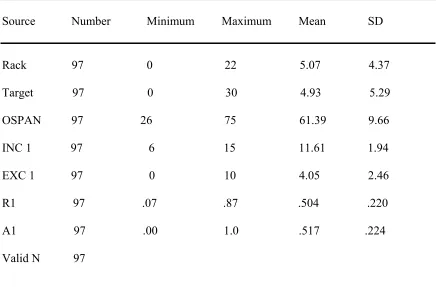
experiment 3) previous study and found them to be comparable (M = .44, and M = .59) respectively. I conducted a Multivariate GLM with study and test conditions as between subjects factors and OSPAN scores, rack clicks when participants were practicing suppression, target clicks when the experimental groups were suppressing a personal negative experience and the control group suppressed a telephone pole, and baseline scores from the process dissociation task as dependent variables. While there were no significant differences between groups, F (8, 86) = .97, p > .47, 2 = .083, the Univariate tests revealed that differences in baseline inclusion scores approached significance, F (1, 93) = 3.909, p < .051, 2 = .04. Baseline scores for exclusion, base rate inclusion, and base rate exclusion were not significantly different between groups. Nor did the primary variables of interest, the baseline recollection and familiarity scores, differ between groups, F (1, 93) = .632, p > .429, 2 = .007. Finally, there were no significant differences between groups in OSPAN scores, suppression failures or baseline scores on the process dissociation task before randomly assigning to condition. Table 1 (see below) displays the overall means for each of these variables.
The first hypothesis test investigated whether suppression had cognitive costs on either the recollection or familiarity component of the process dissociation task. I
Jacoby (1988). Neither the study, F (1, 93) = .77, p > .38, 2 = .008 nor the test, F (1, 93) = .00, p > .99, 2 = .000 main effects was significant. However, the interaction between
Table 1
Mean Suppression Failures, OSPAN Scores, and Baseline Scores of the PD Task
Source Number Minimum Maximum Mean SD
Rack 97 0 22 5.07 4.37 Target 97 0 30 4.93 5.29 OSPAN 97 26 75 61.39 9.66 INC 1 97 6 15 11.61 1.94 EXC 1 97 0 10 4.05 2.46 R1 97 .07 .87 .504 .220 A1 97 .00 1.0 .517 .224 Valid N 97
________________________________________________________________________
scores, I computed recollection change scores by subtracting recollection scores from session two from recollection scores from session one. I then computed familiarity change scores by subtracting familiarity scores from session two from familiarity scores from session
Table 2
Repeated Measures ANOVA with Recollection and Familiarity Scores as a Function of Study and Test Conditions
________________________________________________________________________ Source df F 2 p
Study 1 .765 .008 .384 Test 1 .000 .000 .995 Study X Test 1 8.04 .080 .006 Error 93
________________________________________________________________________
one. I conducted Univariate analyses on changes across time in Recollection and Familiarity scores as a function of the Study and Test Conditions separately. The study condition was not significantly related to changes in recollection or familiarity scores, F (1, 95) = 1.40, p < .240, 2 = .014, and, F (1, 95) = 1.18, p < .280, 2 = .012 respectively. The test condition was significantly related to changes in recollection scores, F (1, 95) = 8.61, p > .004, 2 =.083, and to changes in familiarity scores, F (1, 95) = 3.97, p < .049 2
changes in recollection scores revealed a significant difference, F (1, 95) = 8.25, p < .005,
2 = .08. Thus, changes in recollection scores of control group participants differed from
those participants assigned to experimental conditions. A One-Way ANOVA pitting the three experimental groups against each other revealed no significant differences, F (2, 69) = 1.411, p >.2, 2 = .039 in changes in recollection scores across time. Figure 1 presents the mean recollection scores by condition, across time. Analysis of the means revealed that the no suppression group experienced a significant increase in recollection scores, and the suppression during study only group experienced a nonsignificant increase in
0 0.1 0.2 0.3 0.4 0.5 0.6 0.7
Condition
R
eco
ll
ec
ti
o
n
Base Test
Base 0.427 0.525 0.519 0.547
Test 0.576 0.564 0.464 0.472
1 2 3 4
Figure 1
Mean Recollection Scores by Study and Test Conditions across Time
recollection scores. The suppression during test only group and the suppression during both study and test group experienced a decline in recollection scores.
against the other three groups on changes in familiarity scores. The results revealed a significant difference, F (1, 95) = 5.88, p < .017, 2 = .058. A One-Way ANOVA pitting the three experimental groups against each other revealed no significant differences, F (2, 69) = .258, p >.7, 2 = .007. Interestingly, the no suppression group experienced a
significant decrease in familiarity scores and the suppression during study only group experienced a nonsignificant decrease in familiarity scores. The familiarity scores for the suppression during test only group and the suppression during both study and test group remained the same. Figure 2 presents the mean familiarity scores by condition, across time. These results lend partial support for my first hypothesis. The control group did experience a significant increase on the explicit portion of the process dissociation task compared to the other three groups. There were no significant differences between the three experimental conditions. The prediction that there would be no significant differences in the implicit portion of the process dissociation task was not fully supported.
0 0.1 0.2 0.3 0.4 0.5 0.6
Condition
F
amilia
ri
ty
Base Test
Base 0.513 0.556 0.548 0.452
Test 0.335 0.502 0.546 0.45
1 2 3 4
Figure 2
The control group did experience a significant decrease on the implicit portion of the process dissociation task compared to the other three groups. There were no significant differences between the three experimental conditions.
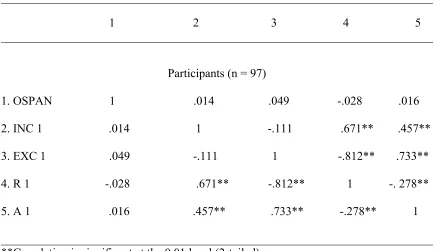
The second hypothesis, that there would be a relationship between working memory capacity (WMC) and performance on the process dissociation task was tested by correlating participants’ OSPAN scores and recollection and familiarity estimates during the first stem completion session of the process dissociation task. The OSPAN was not significantly related to the baseline scores on the process dissociation task (see Table 3), which does not lend support to my second hypothesis. In an additional
quasi-experimental analysis, I computed a quartile split of the OSPAN scores to verify that Table 3
Intercorrelations between OSPAN Scores and Baseline Estimates of the PD Task
________________________________________________________________________ 1 2 3 4 5 ________________________________________________________________________
Participants (n = 97)
the scores were not significantly related to the baseline scores on the process dissociation task. As with the correlational analysis, the quartile split analysis did not indicate any differences in the baseline recollection scores, F (1, 46) = .007, p > .9, 2 = .00 or the familiarity scores, F (1, 46) = .401, p > .5, 2 = .009 on the process dissociation task.
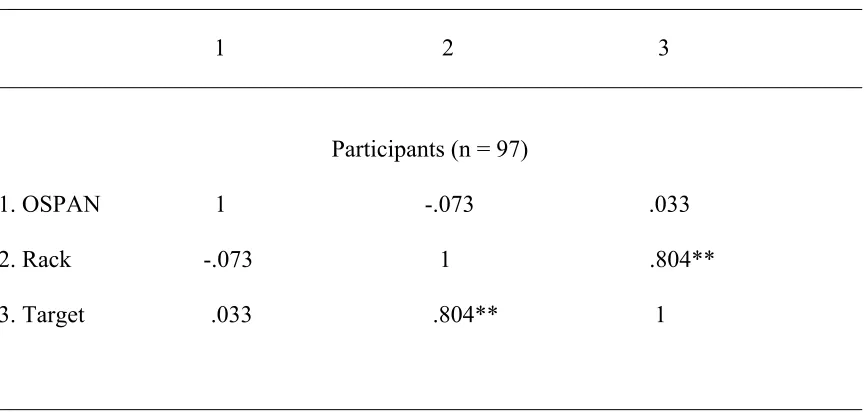
The third hypothesis test investigated the relationship between WMC and suppression ability. I correlated participants’ OSPAN scores and suppression failures to the coat rack and the participants’ target thought. The OSPAN was not significantly related to suppression failures to the coat rack or to the participants’ target thought, (see Table 4) which does not lend support to my third hypothesis. To extend this finding, I computed a quartile split of the OSPAN scores to verify that the scores were not
significantly related to suppression failures to the coat rack, F (1, 46) = 5.14, p > .4, 2 = .011 or to the participants’ target thought, F (1, 46) = .018, p > .8,
Table 4
Intercorrelations between OSPAN Scores and Suppression Failures
________________________________________________________________________ 1 2 3 ________________________________________________________________________
Participants (n = 97)
1. OSPAN 1 -.073 .033 2. Rack -.073 1 .804** 3. Target .033 .804** 1
2 = .000. The quartile split analysis also did not produce differences in suppression
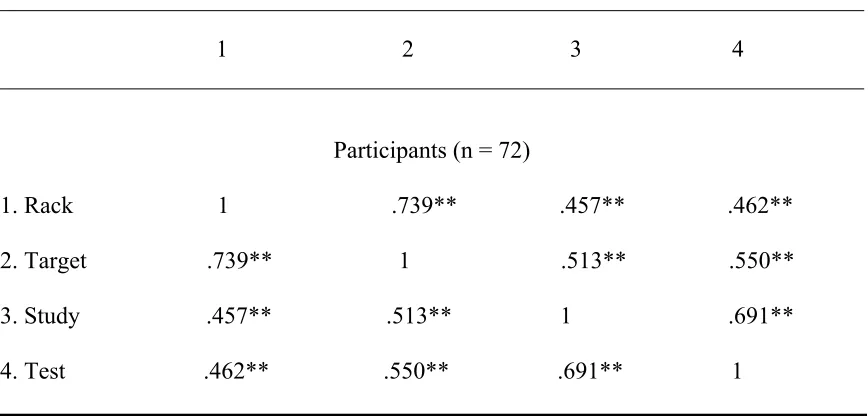
failures to the coat rack or to the participants’ target thought as a function of WMC. The remaining analyses only included the three suppression groups. The fourth hypothesis, that participants who experienced more suppression failures during the practice suppression period would continue to have difficulties with suppression in the following periods, was tested by correlating suppression failures to the coat rack,
suppression failures to the target experience, suppression failures during the second study period and suppression failures during the second test period. Participants who had greater difficulty suppressing the coat rack also had greater difficulty suppressing their personal negative experience, r (70) = .739, p < .000, r² = .55, suppressing their personal negative experience during study, r (46) = .457, p < .001, r² = .21 and suppressing their personal negative experience during test, r (46) = .462, p < .001, r² = .21. Moreover, suppression failures during all periods were significantly related (see Table 5). Table 5
Intercorrelations between Suppression Failures in all Periods
________________________________________________________________________ 1 2 3 4 ________________________________________________________________________
Participants (n = 72)
These results do provide support to my fourth hypothesis that there are individual differences in suppression ability.
Next, the research question, whether participants’ self-reports of their thought control ability would be related to their observed thought control ability in the proposed study, was tested by correlating participants’ TCAQ scores, IES scores, and suppression failures during all suppression periods. Participants who scored higher on the TCAQ experienced more suppression failures to their personal negative experience during the target suppression period, r (70) = .261, p < .027, r² = .07. Participants who scored higher on the intrusion sub-scale of the IES tended to experience more suppression failures during the second study session but his difference did not reach significance, r (46) = .283, p < .051, r² = .08. Participants who scored higher on the TCAQ
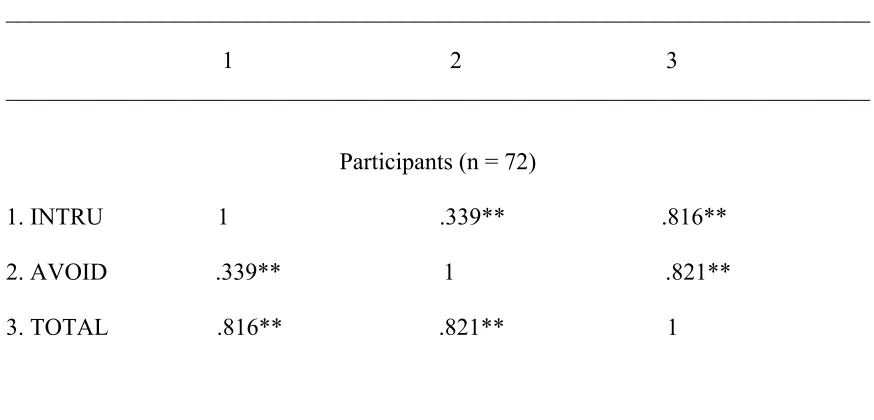
Table 6
Intercorrelations between the IES Sub-scales and Total IES
________________________________________________________________________ 1 2 3 ________________________________________________________________________
Participants (n = 72)
1. INTRU 1 .339** .816** 2. AVOID .339** 1 .821** 3. TOTAL .816** .821** 1
also scored higher on the intrusive sub-scales of the IES as well as the total IES, r (70) = .362, p < .002, r² = .13, and r (70) = .316, p < .007, r² = .10, respectively. All correlations between the IES sub-scales and the total IES were significantly related (see Table 6).
The fifth hypothesis, that the level of intrusiveness and avoidance of participants’ negative experiences and the number of suppression failures during the second
suppression period will predict participants’ performance on the explicit portion of the process dissociation task was tested by conducting a regression analysis on the estimates of recollection from the process dissociation task with IES scores and suppression failures as predictor variables. Neither the IES scores nor suppression failures during the target suppression period predicted performance on the process dissociation task. These results do not lend support to my fifth hypothesis.
Discussion
system at the same time, and more importantly, to consider using dependent measures that place explicit and implicit memory in opposition.
The first hypothesis test examined the ‘cost’ of suppression, during encoding and retrieval, on an explicit and implicit memory task. Previous research has concentrated on manipulations during encoding. I also examined the effects of an experimental
manipulation during retrieval. Thought suppression is a consciously controlled and effortful mental process that consumes cognitive resources. When the ‘pool’ of resources runs low, thought suppression will fail or performance on other unrelated cognitive tasks will suffer. Specifically, I hypothesized a quadruple interaction between study condition, test condition, type, and time. I expected: the no suppression group would either
experience the least impairment or an increase over time in their recollection scores due to practice effects, the suppression during study only and suppression during test only groups would experience more impairment or less improvement in their recollection scores compared to the no suppression group, and the suppression during study and test group would experience the greatest impairment or least improvement in their
recollection scores. I also expected that the familiarity scores would remain unchanged for all groups as was found in Jacoby (1993).
Results from the current study provided partial support for this hypothesis. While the main effects of study and test conditions did not reach significance, the interaction between the study and test effects was significant, and was partially qualified by the Type X Time X Test interaction. Investigation of the Univariate analyses and the means
I found that the no suppression group did experience a significant improvement in recollection scores over time compared to the suppression during test only group and the suppression during study and test group. The suppression during study only group also experienced a nonsignificant improvement in recollection scores. The recollection scores of the suppression during study only group did not differ significantly from the
recollection scores of the control group or the suppression during test only group and the suppression during study and test group, which entails the first part of the primary research question. The suppression during test only group experienced a moderate decrease in recollection scores, and the suppression during study and test group experienced the largest impairment in recollection scores; both of which were significantly different from the no suppression group.
However, my prediction that familiarity scores would remain unchanged was not fully supported. The no suppression group experienced a significant decrease in their familiarity scores compared to the suppression during test only and the suppression during study and test groups. While the suppression during study only group did experience a slight decrease in familiarity scores, there was no significant difference in familiarity scores between the no suppression group and the suppression during study only group. Moreover, there were no significant differences between the three
experimental conditions, by time, in familiarity scores, which entails the second part of the primary research question. The suppression during test only group and the
In summary, suppression of a personal negative experience had differential impacts on recollection and familiarity scores of the process dissociation task regardless on when the suppression was conducted.
The second hypothesis test examined the relationship between participants’ working memory capacity scores and their baseline scores to the process dissociation task. I hypothesized that participants who score higher on the WMC measure will perform significantly better on the explicit portion of the process dissociation task compared to those who score lower on the WMC measure, and this advantage will be absent on the implicit portion of the memory task. Results from the current study
provided partial support for this hypothesis. The OSPAN was not significantly related to either recollection or familiarity baseline scores. I compared the mean OSPAN proportion score from the present study (M = .82 SD = .13) with the mean OSPAN proportion score from Klein & Boal’s (2001) experiment (M = .57 SD = .10) which used student
participants from the same University. Participants in the present study scored approximately 43% higher as a sample compared to Klein & Boal’s (2001) previous study. One might speculate that: the ceiling effect aforementioned may have hidden the relationship between WMC and recollection scores, the automated OSPAN used in this study may not be equivalent to the OSPAN administered by an experimenter, or because all data collection was finished by the fifth week of the semester my sample may not be representative of the population.
The third hypothesis test examined the relationship between participants’ working memory capacity scores and suppression failures. Specifically, I hypothesized that