Automatic Drip-Irrigation And Security System By Using
Raspberry-Pi
Payal M. .Dhumale*1
Student, Department of Electronics Engineering, SSPACE, Wardha, India.
[email protected]
Trupti S. .Bhoyar*2
Student, Department of Electronics Engineering, SSPACE, Wardha,
India.
[email protected]
Vaibhavi I. .Asutkar*3
Student, Department of Electronics Engineering, SSPACE, Wardha,
India.
[email protected]
Swati G.. Charode*4
Student, Department of Electronics Engineering, SSPACE, Wardha, India.
[email protected]
Dr. R. M. Tugnayat
Principal of SSPACE, Wardha, India.
[email protected]
Abstract
Indian agriculture is dependent on the monsoons which is not a reliable source of water. Irrigation is a
well-established procedure on many farms and is practiced on various levels around the world. Irrigation system
provides water to the farms according to their soil types. This paper represents the prototype design of
Raspberry Pi based on automatic drip irrigation and security system. It will allow irrigation to take place in
zones where watering is required and security when there is any object present in the farm. A model of
controlling irrigation and security facilities to help millions of a people. This model uses sensor technology
with Raspberry Pi to make a smart switching device. The model shows basic switching mechanism of water
motor using sensor from any part of field by sensing the moisture present in soil.
Keyword :
Drip Irrigation; Raspberry Pi; Soil Moisture Sensor; PIR Sensor.
1. Introduction
India is an agriculture country where 60-70% economy depends on agriculture. Water is most important resource of our living. Water occupies 70% of total capacity in this world. Due to growing population there is much stress on the water requirement and the shortage of water is growing day by day. So that there is a need of save the water. By using Drip Irrigation system we can save the water. So to help them we are making an attempt by introducing our project “Automatic Drip Irrigation and Security System by using Raspberry Pi”. By using sensors in our work we will make them aware about changing conditions of humidity level according to weather so according to changing conditions of humidity they will be able to schedule the proper timing for water supply.
The objective of system is to a) Water resources
b) Power conservation
c) Handles the system automatically
d) Detect the level of water
e) Detect the object is present
Drip Irrigation is done in two ways: Manually and
Automatically. The system is to propose in this paper is
automated. The Irrigation system is used only when
there is not sufficient moisture in the soil and Raspberry
Pi decides when should the pump be turn on or off,
water for the farmer. Sometimes the animals are entered in the farm and devastate all the crops present in the farm. Due to this farmer get losses their yield so that we used here security system. Security is done with the help of PIR(Passive Infrared Receiver) sensor. By using PIR sensor it detects whether the object is present or not. If the object is present the PIR sensor gives the output to
the buzzer and the object will go out from the farm.It help the farmer to protect the yield in the farm.
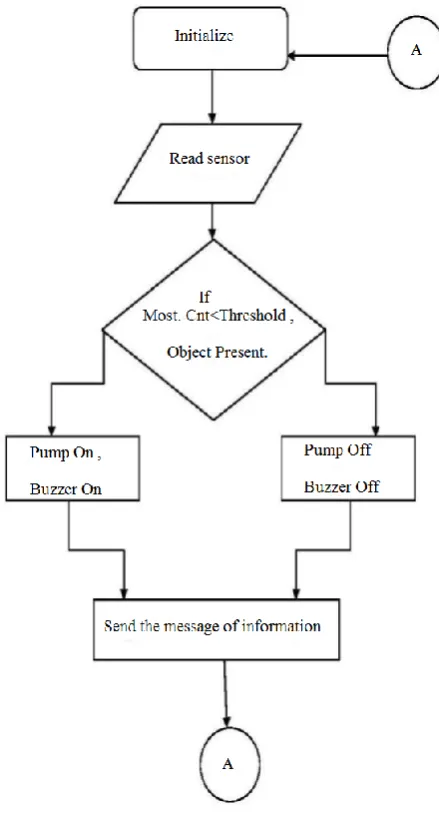
Figure 1: Flow Chart
Why to used Drip Irrigation?
a) Soil erosion is prevented
b) Each plant gate equal amount of water
c) Reduce snail population
d) Save 20-80% of water and fertilizer bills
e) Prevention from flooding
2. Literature Survey
Existing System: At present there is no proper method or device to analyze the moisture content of an agriculture field. Farmers are analyzing moisture content based their experience in the agriculture field. This method is not scientific and also needs an extra effort. Using this method it is not possible to keep agriculture field in continuous observation.
In December 2012,K. Prathyusha & M. Chaitanya Suman proposed design of embedded systems for the automation of drip irrigation.[1] The microcontroller based drip irrigation system proves to be a real time feedback control system which monitor and control all the activities of Drip Irrigation system efficiently. The present system is a model to modalized the agriculture industries at a mass scale with optimum expenditure. They can provide Irrigation to larger areas of plant with less water consumption and lower pressure. Using this system one can save man power, water to improve production and ultimately profit.
will use in these we can measure different parameter that is pressure, temperature and humidity of soil.
Different amount of water requirements for different types of soil in this according to the type of crop and water resistance capacity in different seasons, system provide definite amount of water to the plant hence we can save larger amount of water.
In December 2014, Prashant S. Patil&Shubham R. Alai proposed an intelligent and automated drip irrigation system using sensors network control system [3]. In present Drip Irrigation system water is provided to root zone of plants drop by drop which result in saving of huge amount of water. The objective of the system is to a)Saves water resources b) handles the system manually and automatically c) Detects the level of water d) Builds such system which enhances crop productivity. e) Learn selection methods of irrigation based on different parameter.
In March 2015, AdityaBhake proposed Sensor Based Irrigation System [4]. In calibration, we have introduced in this system based on some standard values for different crops and different soils will definitely lead to the increase in the productivity of crops along with accuracy, preciseness and efficiency in watering, for the farmers in the regions like Vidharbha where the availability of sufficient water is the biggest problem, this system will act as boon for taking the both quality as well as quantity crops in minimum amount of water.
In May 2015, SnehaPunia proposed drip irrigation system using embedded systems: an initiative of saving water [5]. In this paper we have discussed how Drip Irrigation would bring revolution in farming techniques using least amount of water, improves quality, increasing productivity of crops making Irrigation practices automatic and accurate.
3. Concept of Modern Irrigation
System
The conventional irrigation methods like overhead sprinklers, flood type feeding systems usually wet the lower leaves and stem of the plants. The entire soil surface is saturated and often stays wet long after irrigation is completed. Such condition promotes infections by leaf mold fungi. The flood type methods consume large amount of water and the area between crop rows remains dry and receives moisture only from incidental rainfall. Water is supplied frequently, often daily to maintain favorable soil moisture condition and
prevent moisture stress in the plant with proper use of water resources.
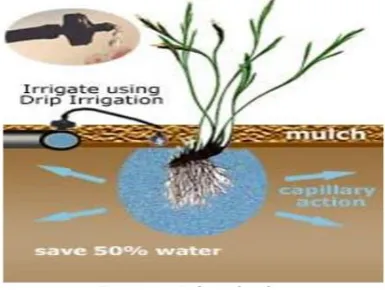
Figure 2: Drip Irrigation
Drip irrigation requires about half of the water needed by sprinkler or surface irrigation. Lower operating pressures and flow rates result in reduced energy costs. A higher degree of water control is attainable. Plants can be supplied with more precise amounts of water. Disease and insect damage is reduced because plant foliage stays dry. Operating cost is usually reduced. Federations may continue during the irrigation process because rows between plants remain dry. Fertilizers can be applied through this type of system. This can result in a reduction of fertilizer and fertilizer costs. When compared with overhead sprinkler systems, drip irrigation leads to less soil and wind erosion. Drip irrigation can be applied under a wide range of field conditions. A typical Drip irrigation assembly is shown in figure (2) below. Drip irrigation is popular because it can increase yields and decrease both water requirements and labor.
4. Components of Raspberry Pi Drip
Irrigation and security
The component of Raspberry Pi Drip Irrigation and security system are as follows :-
a) Pump b) Drip lines
c) Soil moisture sensor
d) PIR sensor
e) Buzzer
f) Raspberry Pi unit (The brain of the system ).
The Raspberry Pi unit is now explained in detail :-
The Raspberry Pi is a low cost, credit-card sized computer that plugs into a computer monitor or TV, and uses a standard keyboard and mouse. It is a capable little device that enables people of all ages to explore computing, and to learn how to program in languages like Scratch and Python. It’s capable of doing everything you’d expect a desktop computer to do, from browsing the internet and playing high-definition video, to making spreadsheets, word-processing, and playing games.
What’s more, the Raspberry Pi has the ability to interact with the outside world, and has been used in a wide array of digital maker projects, from music machines and parent detector to weather stations and tweeting birdhouses with infra-red cameras. We want to see the Raspberry Pi being used by kids all over the world to learn to program and understand how computers work.
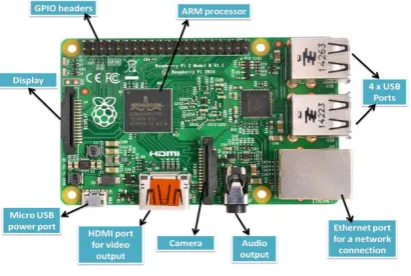
Figure 4: Raspberry Pi model
5. Working
In our project we used Raspberry Pi to control whole system. Raspberry Pi is the brain of this system. There is different sensor used for different input purpose.
The working of this system starts with the soil moisture sensor which senses the moisture level of the soil and
based on the input of the sensor
.
Soil water fills about 25% of the space in the soil. Different soils have different available water holding capacities.
Table 1: Ranges of available water by soil texture
Here we used two sensors namely: a) Soil moisture sensor
b) PIR (Passive infra-red receiver)
At first, soil moisture sensor senses the moisture in the soil which is present in the farm. If the moisture is below than the threshold value of that soil then it gives input to the Raspberry Pi. After that Raspberry Pi will decides the pump will be turn ON or OFF through relay.
Now another part is security which is done with the help of PIR sensor. PIR sensor is placed in the farm. At this point if any object is present in the range of PIR sensor, then PIR sensor sense that object and provide input to the Raspberry Pi. It sends instruction to the buzzer and buzzer will ON. If the farmer is present at that time, the farmer will be alert. Otherwise by hearing buzzer’s sound the object will fear and go out from the farm.
DTMF (Dual Tone Multi Frequency) is connected to the Raspberry Pi. DTMF is a device which will help to send the SMS (Short Message Service) to the farmer.thi SMS Soil texture Available water capacity
(AWC) in/ft
will give information about condition of the farm to the farmer.
Figure 4 : Block Diagram
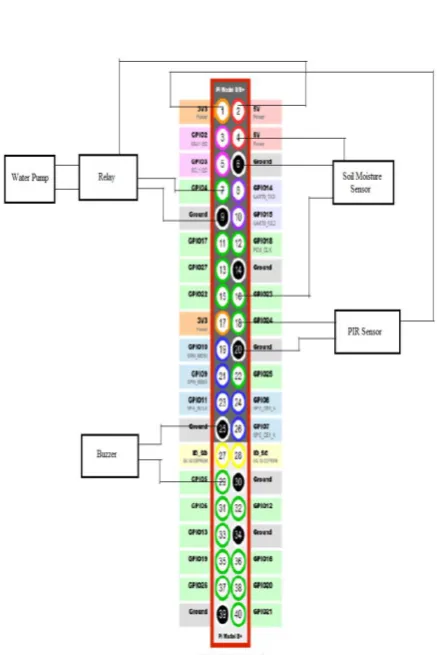
Figure 5 : Pin Connection Diagram
6. Advantages:
This makes increase in productivity and reduces water consumption.This is safest and no manpower is required. Permit other yard and garden work to continue when irrigation is taking place, as only the immediate plant areas are wet. Weed growth reduce to almost zero, usage of weedicides gets reduced. Reduce soil erosion and nutrient leaching. It is time saving device. A famer at night can save his time by operating pump automatically security is another advantage. Farm security concepts are used here.
8. Conclusion:
The Raspberry Pi based drip irrigation system proves to be a real time feedback control system which monitors and controls all the activities of drip irrigation system efficiently. The present proposal is a model to modernize the agriculture industries at a mass scale with optimum expenditure. Using this system, one can save manpower, water to improve production and ultimately profit.