Gerber Method Automation
Gayatri Phade1, Sayali Suryawanshi 2, Namrata Suryawanshi 3, Vrushali Nehate4
HOD, Department of ECE, Sandip Foundation College, Nashik, India1
U.G Student, Department of ECE, Sandip Foundation College, Nashik, India2
U.G Student, Department of ECE, Sandip Foundation College, Nashik, India3
U.G Student, Department of ECE, Sandip Foundation College, Nashik, India4
ABSTRACT: Milk is the primary source of nutrition for infants to mammals. The adulteration of milk with water is a very common problem, which reduces its nutritional value and industrial yield, and can also represent a major risk of contamination. The adulteration of milk is done to derive undue profit by adding water or extraction of fat. Besides this, milk is also adulterated with urea, detergent. The quality of milk is mainly measured with the help of two components Fats and SNF. So to determine the fat content present in milk sample we are developing our project by automation of the existing Gerber method.
Gerber method is the widely preferred method in small scale and large scale industries as it gives accurate and precise value of fat. Also the Electronic Milk Fat tester available in the market is very expensive and cannot be afforded. So the objective of making this project is to help society to obtain the quality milk with precise rates.
KEYWORDS: Electronic Milk Tester (EMT), Gerber Method.
I.INTRODUCTION
Milk is a primary source for nutrition in many young mammals before they are able to digest. As such milk has several naturally added substances to help the baby in terms of both nutrition and immunity. Thus milk becomes a very valuable agricultural product. In figures, India is the largest producer and consumer of milk. Also, this sector happens to have a considerable share of the Gross Domestic Product that is generated by the agricultural sector. However, the Indian dairy sector is not technologically up to date [2].
One of the main problems faced in the grass-root level of the milk industry is the quality scale the methods that are used to fix the price. The quality of the milk is the measure of its nutritive value. These contents are broadly divided into 2 categories – FAT and SNF (solid not fat). The price of the given sample of milk is set by giving the money on the basis of the amount of these two components. This is called the Dual Axis price system. Hence for a milk farmer to get paid the amount that is correct, the calculations of these components must be as accurate as possible [2].
II.RELATEDWORK
A. Problems analysis
In our day to day life we are facing various issue regarding the adulteration in milk l. The main problem is that the people are not getting the milk of appropriate quality even though they are paying sufficient amount and also it has affected health of many humans. So, we decided to find solution on this problem.
Firstly, we surveyed across the street milk vendors and found out the standards they use to fix the milk rate. Then we came to know that there were no standards established and they just fix the rate randomly. Also the people are not all concerned regarding the milk quality and its rate accordingly.
Gerber method is the widely preferred method in small scale and large scale industries as it gives accurate and precise value of fat. Also the Electronic Milk Fat testers available in the market are very expensive and cannot be afforded.
B. Solution:
In order to avoid all these problems so that people will not have to face problems related to the milk adulteration we also visited various industries where we came to know the Gerber Method which they perform manually to test the milk quality. The manual interference lead to time consumption and may also sometimes lead to inaccuracy.
So it is necessary to find the solution over it and that’s why we decided to atomize the Gerber Method to reduce the human efforts and also to increase the rate of milk fat testing along with the accuracy.
We are designing a system in which we will be automating the Gerber Method using a circular plate which will be rotating and the chemicals will be added to it automatically when the plate will be sensed by the three sensors.
C. Design Overview:
The system we have proposed is the automation of the Gerber Method in which the tedious manual chemical method has been automated. With the automation of this method the manual efforts will be minimized and the accuracy in calculating the milk fat contents will also be increased. The automated system will also increase the rate of milk fat testing and will prove beneficial for the Indian dairy sector and also the farmers.
D. Methodology:
1. In this project we will be using a rotating disc on which we will be placing the butyrometer. 2. The butyrometer will be containing 10ml of milk sample whose fat content we have to find.
3. The butyrometer containing10 ml of milk sample will move with the rotating disc which will be rotated with the help of dc motor.
4. The rotating disc assembly will have 3 IR pair sensors which will sense the butyrometer at the activation of each IR sensor.
5. As the first sensor will get activated the rotating disc will stop and 10ml of H2SO4 will be poured in the butyrometer from the container through the solenoid valve.
6. As the second sensor gets activated again the rotating disc will stop and 1ml of Iso-Amyl alcohol will be poured in the butyrometer.
7. After the activation of the third sensor the rotating disc will be stopped and the lock stopper will be inserted in the butyrometer.
8. After all the samples are being added to the butyrometer the butyrometer will be rotatedwith help of dc motor rotating at the speed of around 1100 rpm for 5 minutes.
9. After the centrifuge the butyrometer will be taken out and clearly the milk fat content will be observed.
E. Modules & Components Required for the System:
Automated Gerber system is implemented by using following modules: Rotating Disc/Plate
Solenoid Valve LCD Module DC Motor
PIC Microcontroller Butyrometer IR Sensors
1) Rotating Disc/Plate: This rotating disc is the place where the butyrometer will be placed on the plate which will be rotated and accordingly sensed by the IR sensors where it will be stopped and the chemicals will be poured in it.
2) Solenoid Valve: A solenoid valve is an electromechanically operated valve. The valve is controlled by an electric current through a solenoid: in the case of a two-port valve the flow is switched on or off; in the case of a three-port valve, the outflow is switched between the two outlet ports. Multiple solenoid valves can be placed together on a manifold
.
Solenoid valve is used to control the flow of fluid which is to be poured in the butyrometer.3) LCD module: Alphanumeric displays are used in a wide range of applications, including palmtop computers, word
processors, photocopiers, point of sale terminals, medical instruments, cellular phones, etc. The 16 x 2 intelligent alphanumeric dot matrix display is capable of displaying 224 different characters and symbols. It is used for displaying the information regarding the bus which is getting to be arrived at that depot.
4) DC Motor: A DC motor is any of a class of rotary electrical machines that converts direct current electrical energy into mechanical energy. The most common types rely on the forces produced by magnetic fields. Nearly all types of DC motors have some internal mechanism, either electromechanical or electronic, to periodically change the direction of current flow in part of the motor. We use the DC motor in our circuit to rotate the plate. And the centrifuge machine also includes the DC motor.
5) PIC Microcontroller: PIC microcontrollers are a family of specialized microcontroller chips produced by Microchip Technology in Chandler, Arizona. A typical microcontroller includes a processor, memory, and peripherals. We are using the microcontroller to control the functions of our circuit like to control on and off function of solenoid valve. 6) Butyrometer: Butyrometer is a measuring instrument used to measure fat content in milk or milk products in general.
The method used in the determination is Gerber's method as invented by Swiss chemistNicolas Gerber. Made of
borosilicate glass, plain neck or ring neck, closed bulb with a frosted label, without stopper. In our project we required this butyrometer in which we took the milk sample and chemicals to measure the fat content.
7) IR Sensors: An infrared sensor is an electronic device that emits in order to sense some aspects of the surroundings. An IR sensor can measure the heat of an object as well as detects the motion. These types of sensors measure only infrared radiation, rather than emitting it that is called as a passive IR sensor. We used the IR sensors in our project to detect the motion of the butyrometer over the conveyor belt and as 1st sensor senses the butyrometer then 1st solenoid valve will get open and drop down the milk the same process is further for the H2SO4 and Amyl alcohol.
F. Software Part:
1) MPLAB Compiler: MPLAB® XC Compilers produce highly optimized code. Subscription licenses unlock
PRO-level optimizations, which produce the best execution speed and code size for all PIC® microcontrollers (MCUs) and dsPIC® Digital Signal Controllers (DSCs) along with the best in compiler features.
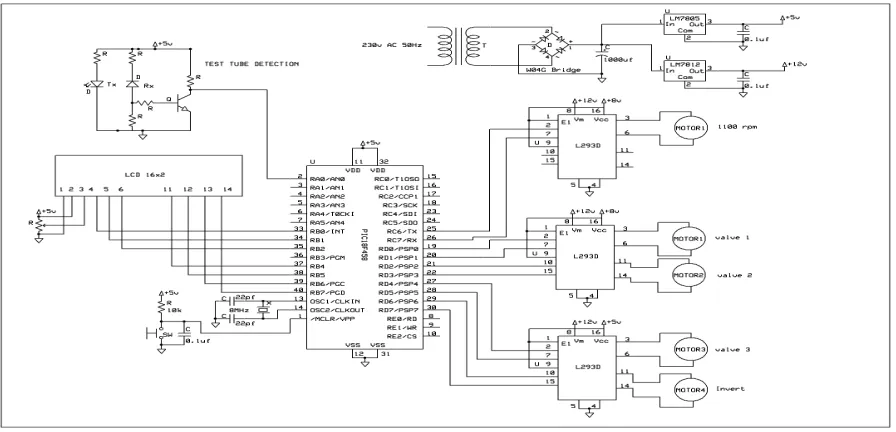
III.CIRCUIT DESIGN
Figure 1- Circuit diagram
IV.PERFORMANCE ANALYSIS
Figure 2- Fat observation
V. RESULT AND DISCUSSION
Thus in this project we are able to detect the fat content of milk to decide the milk quality as well as price of the milk. The automation of the Gerber System reduced the human efforts and also increased the accuracy of the method.
VI.CONCLUSION
With the help of this system we are able to judge the quality of milk accurately as well as farmers get the proper benefit according to the quality of milk. With the help of this system the consumer can get the quality milk. Being an economical system it can be easily afforded by the common small scale dairy industries.
REFERENCES
[1] Kejal shah1, Rajeshri kelkar1, Amruta sarda1, M.S.Chavan2 ,” Photometric Based Sensor for Detection in Fresh Milk” International Journal of Innovative Research in Computer and Communication Engineering Vol.3,Issue4,April2015.
[2] Anish Unnikrishnan M. , Anoop Ravindran,” Electro-Milktestera Novel Method for Analysis of Milk Quality” International Journal for Innovative Research in Science & Technology| Volume2 , Issue 04 | September 2015 ISSN (online): 2349-6010.
[3] Dr.D.Sundaresan, Dr. N.C.Ganguli,” Indian Standard Determination of fat by Gerber Method” IS1224 (part1)1977.
[4] SteFano Sabbatucci, Daniel Riordan,” Development of Milk Analysis Reliable Embedded System For Dairy Farmer” ISSC 2014/CIICT 2014. [5]https://alchetron.com/Gerber-method
[6]http://www.rs.uky.edu/regulatory/milk/milk_lab/LabTestProcedures.php