Available online:
https://edupediapublications.org/journals/index.php/IJR/
P a g e | 1514Dr.G.Shankar Lingam
Professor, Dept. of CSE, Chaitanya Institute of Technology & Science, Warangal, Telangana, India E-mail: [email protected]
ABSTRACT: Smartphones with touchscreen-based interfaces are more and more used by non-technical organizations which includes the elderly. However, application developers have little understanding of just how senior customers interact with their goods and of how you can design senior-friendly interfaces. However, the incorporation on the most basic' ease of using for all' front is nevertheless really lagging. Although new exciting features are actually innovated and developed on pace, however there remains an enormous gap for adequately supplementing the usability quotient of smartphones that's currently inferior in comparison to the desktop computer methods. Humans with varying ages, cognitive structures, experience based psychological models as well as perceptions of reality eye smartphones differently. This inherent heterogeneity is actually one of the most burdening issues in smartphone adaptability as well as usability occurrence. To focus on this crucial and highly practical usability problem, a relative investigation of the usability analysis for the smartphone platforms (iOS & Android) thinking about the requirements of older individuals is actually conducted.
KEYWORDS- Mobile, Smartphones, Touchscreens, usability evaluation, older adults, swipe, tap, interaction gestures.
I. INTRODUCTION
Technology is playing an enormous role in the life of humans. He technology evolution progresses in three stages; tools, machines and automation. This progressive elaboration of technology moves from physical labor to machine controlling and then towards computerization. In third stage humans controlling factor removed with automatic algorithms. The work load and burden of human life
is reduced with the use of technology. Mobile Phone is one example of automation which uses for mobile telecommunication. The mobile phone invention makes the lives easier as it finished the distances. Now a day mobile phones are not only using for telecommunication but also providing many other functionalities e.g. SMS, GPRS, MMS etc. According to International Telecommunication Union (ITU), more than 60% of world's population owns mobile phone [1]. Mobile Phone has broken the restrictions of fixed telephone and allows the people to move anywhere and stay connected all the time. The independence of movement is increased specially in elderly; they can enjoy independent life, travelling without the fear of insecurity due to having mobile phone. According to Kurniawan et. al., Young mobile phone users are increasing very fast but elder users are not growing with expected rate due to unfamiliarity with new mobile phones. This gap of unfamiliarity with mobile phones causes serious side effects to elder. The use of mobile phones in people of age 75 and above is only 24%. Elder people use mobile phones only for calling to their relatives and sometime for emergency. This gap of unfamiliarity with mobile phones is harmful for both elderly and mobile phone manufacturing companies.
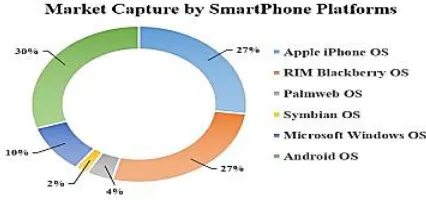
Figure 1: Smartphone Platforms
One session of the focus group discussions was used to reveal the group’s learning process and strategies.
Available online:
https://edupediapublications.org/journals/index.php/IJR/
P a g e | 1515 Quantitatively, findings from the online questionnairedesigned in collaboration with the focus group were explored. By combining the analysis of the survey, the learning process and the focus group discussions, the study aims to arrive at a more nuanced understanding of the nature of the use of mobile phone among older women to meet their needs. This combination is expected to be able to complement the pictures provided by individual methods.
II. RELATED WORKS
Much studies have been done to assess the usability for elderly individuals of desktop or perhaps laptop computer PC user interfaces [9][10]. Guidelines for developing accessible Web user interfacesfor aging adults individuals have been recommended [11]. In comparison, developing design guidelines for the aged using such brand new interfaces as movable terminals with touchscreen interfaces is actually ongoing work. Design guidelines for basic touchscreen-based mobile interfaces have just recently been used and guidelines which consider elderly users are still to be investigated [12].
We have seen a selection of user evaluation scientific studies of touchscreen interfaces. Leonardi et al. created a tabletop touch panel interface and discovered that the direct interaction metaphor was very easy to understand as well as had a good effect that attracted and also driven seniors participants in their study [13]. Lepicard et al. discovered twohanded touchscreen input was hard for seniors customers [14]. Stobel et al. compared old people to younger owners in 42 distinct gesture inputs for touch surfaces and measured their quickness and accuracy. They discovered that older users are a bit slower but generally there was no great variation in accuracy and recommended that older adults favor accuracy over quickness [7].
Numerous scientific studies of elderly people and mobile terminals have been conducted. Seiket al. compared the overall performance by using PDA uses between younger adults and older adults. Their results proved that both earlier as well as younger participants performed at the exact same level [5].
Darroch et al. examined the recommended font sizes on PDA screens, comparing older as well as younger adults. There was no substantial differences in reading performance and precision between the older as well as young adults, but the ideal dimensions of the font was somewhat bigger for the earlier participants [15]. Kurniawan investigated the issues that older individuals face when using mobile phones and assessed a number of qualities associated with a cell phone for the aged [16]. Seniors are fairly passive adopters with fears of the effects of using unfamiliar technologies, such as decreased face to deal with communications, or perhaps of accidents caused by careless use, like by speaking while driving. They like features that support their declining functional capabilities.
Usability research for brand new smartphones with touchscreen interfaces have just started. Stone proposed a particular free text input method for aging adults individuals [17]. There have been several accessibility-related evaluations of movable touchscreens for visuallyimpaired or perhaps motor-impaired customers [18][19]. Stobel et al. compared earlier customers and younger users in just how they interacted with touchscreens including multi-touch methods.
They concentrated on symbolic gestures and immediate manipulations. Their results showed that older users favor immediate manipulations. There was no age-related differences in direct manipulations, but significant age differences in the usage of symbolic gestures.
Symbolic gestures are comparatively much more accepted by older people. Additionally, they found no age-related disparities in single-finger gestures, but young customers were much more likely to make use of double-fingers gestures [8].
III. RESEARCH FRAMEWORK
Available online:
https://edupediapublications.org/journals/index.php/IJR/
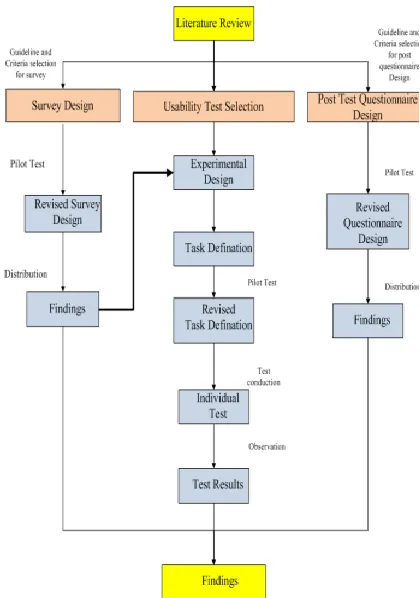
P a g e | 1516 actually followed the quantitative research strategycan be used to do the experiment and the qualitative investigation strategy is actually used to evaluate the wide open ended questions and participants comments [17]. This particular research study is carried through in multiple measures like the literature review, survey layout play around layout, pilot assessments studies, experiment execution, choice of appropriate evaluation techniques, and ultimately the evaluation of gathered information.
A. Survey Design
To find usability issues, survey technique is used. The objectives of the survey are:
1. To validate issues regarding the usability of smartphone platforms according to older adults. 2. To get input for the experimental design. 3. To find out the users’ view points.
In order to collect feedback from the users regarding the smartphone platforms, a survey is categorized into demographics, systems (Iphone & Galaxy) information, applications information; touch screen features (especially swipe and tap gestures) and
accessibility functionality. Figure 2: Proposed Research Framework
B. Experimental Design
Experimental design is the process of planning astudy to meet already specified objectives. The following aspects are considered while performing experimental design on smartphone platforms: 1. Participant Selection
2. Hypotheses 3. Task Definition 4. Procedure
5. Experimental Material e.g. videos, paper, pencil etc.
C. Post test questionnaire
Available online:
https://edupediapublications.org/journals/index.php/IJR/
P a g e | 1517 o First, by evaluating the usability of currentsmartphone platforms’ usability for older adults through the survey approach.
o Second, by experimental method to find the difference of performance measure for smartphone platforms targeted at various older adults’ participant level.
o Third, by post evaluation method to investigate the overall issues and improvement of performance in smartphones for older people.
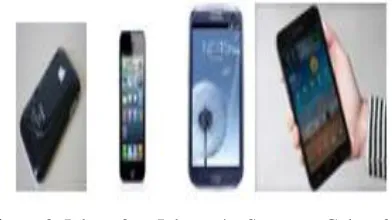
In order to evaluate the practical results of different smartphone platforms, different version of iOS (iphone 3gs, 4s) and Android (Samsung Galaxy 2 and note2) smartphones are chosen for experimentation (Figure 3).
Figure 3: Iphone3gs, Iphone 4s, Samsung Galaxy2, note2
The data is gathered from 100 older participants categorizing them in three different groups(novice, intermediate & experienced) in the user study whose ages range from 55 to 75+ years old (64% male and 37% female). To investigate the usability, each participant was asked to perform ten different tasks((1) scroll to unlock smartphone, (2)panning screens , (3) change the location of an item, (4) select application , (5) use application , (6)
zoom-in, (7) zoom-out, (8) make call, (9)make text message, and (10) close smartphone.) on both platforms.
IV. CONCLUSION
On the basis of evaluation it is concluded that there is a need to provide a new design framework in which these commercial smartphone platforms interface
overcome the gap of adaptability quotient of older adults. In short, a new user interface that should be established on a new design framework will bring new customer retention to these platforms which are different from past and worthy for the designer to make further study and practice.
REFERENCES
[1] IDC report, "IDC Worldwide Quarterly Mobile Phone Tracker," Press Release on May2013. Online available [http:// www.idc.com /getdoc.jsp?containerId=prUS24108913]
[2] K.Drotner, "Difference and diversity: trends in young Danes media uses”, Handbook on Media, culture and society, Sage publication, p.149-166, March 2010.
[3] V.Oksman, "Young People and seniors in Finnish' Mobile Information Society," Journal of Interactive Media in Education, vol. 2, 2006.
[4] P.Tomas and U.Villasece, "Usability of mobile devices for elderly people," Published thesis in National University of Ireland Galwat, Ireland, 2010.
[5] Hazrina Hassan, Mohd Hairul Nizam and Mohd Nasir, "Mobile phones increasingly popular among the elderly:A Malaysian study," in Accessibility and computinh archive ACM library, issue 92,p.11-16,September 2008.
[6]. Coates, H.: Mobile Phone Users: A Small-Scale Observational Study (2001). http://www.aber.ac.uk/media/Students/hec9901.html
[7]. Gibbs, A.: Focus Groups. Social Research Update 19. Department of Sociology, University of Surrey, Surrey, UK (1997). http://www.soc.surrey.ac.uk/sru/ SRU19.html
[8]. Goss J.D., Leinbach T.R.: Focus groups as alternative research practice. Area 28, 2 (1996), 115-123
Available online:
https://edupediapublications.org/journals/index.php/IJR/
P a g e | 1518 Users. In: Proceedings of the 7th MexicanInternational Conference on Computer Science (ENC’06), pp. 142-150 (2006)
[10]. Mahmud, M. and Kurniawan, H.: Involving Psychometric Tests for Input Device Evaluation with Older People. In: Proceedings of the 19th Conference of the ComputerHuman Interaction Special Interest Group (CHISIG) of Australia on Computer-Human
Interaction: Citizens Online: Considerations for Today and the Future, November 21-25 (2005)
[11]. Web Accessibility and Older People: Meeting the Needs of Ageing Web Users, http://www.w3.org/WAI/older-users/
[12]. iOS Human Interface Guidelines, http://developer.apple.com/library/ios/documentation / userexperience/conceptual/mobilehig/
[13]. Leonardi, C., Albertini, A., Pianesi, F., and Zancanaro, M.: An Exploratory Study of a Touch-Based Gestural Interface for Elderly. In: Proceedings of the 6th Nordic Conference on Human-Computer Interaction (NordiCHI’10): Extending Boundaries, pp. 845-850 (2010)
[14]. Lepicard, G. and Vigouroux, N.: Touch Screen User Interfaces for Older Subjects: Effect of the Targets Number and the Two Hands Use. In: Computers Helping People with Special Needs, LNCS, Volume 6180, pp. 592-599 (2010)
[15]. Darroch, I., Goodman, J., Brewster, S., and Gray, P.: The Effect of Age and Font Size on Reading Text on Handheld Computers. In: Human-Computer Interaction – INTERACT 2005, LNCS, Volume 3585, pp. 253-266 (2005)
[16]. Kurniawan, S.: Older People and Mobile Phones: A Multi-Method Investigation. In: International Journal of Human-Computer Studies, Volume 66, Issue 12, pp. 889-901 (2008)
[17]. Stone, R.G.: Mobile Touch Interfaces for the Elderly. In: Proceedings of ICT, Society and Human Beings, July 22-24 (2008)
[18]. Guerreiro, T., Nicolau, H., Jorge, J., and Goncalves, D.: Towards Accessible Touch Interfaces. In: Proceedings of the 12th International ACM SIGACCESS Conference on Computers and Accessibility (ASSETS’10), pp. 19-26 (2010)
[19]. McGookin, D., Brewster S., and Jiang, W.: Investigating Touchscreen Accessibility for People with Visual Impairments. In: Proceedings of the 5th Nordic Conference on HumanComputer Interaction (NordiCHI’08): Building Bridges, pp. 298-307 (2008)
[20]. Masui, T.: POBox: An Efficient Text Input Method for Handheld and Ubiquitous Computers. In: Proceedings of the 1st International Symposium on Handheld and Ubiquitous Computing (HUC’99), pp. 288-300 (1999).
BIOGRAPHY