DIXON AND DIXON DIALYTIC MATRICES
SEYEDMEHDI KARIMISANGDEHI
SEYEDMEHDI KARIMISANGDEHI
A thesis submitted in fulfilment of the requirements for the award of the degree of
Doctor of Philosophy (Mathematics)
Faculty of Science Universiti Teknologi Malaysia
DEDICATION
ACKNOWLEDGEMENT
In the Name of Allah, Most Gracious, Most Merciful
First and foremost, I would like to express my heartfelt gratitude to my supervisor Associate Professor Dr Ali bin Abd Rahman for his constant support during my study at UTM. He inspired me greatly to work on this research project. His willingness to motivate me contributed tremendously to the completion this thesis. I have learnt a lot from him and I am fortunate to have him as my mentor and supervisor.
ABSTRACT
Extraneous factors are unwanted parameters in the resulting polynomial which is extracted, in the process of eliminating variables in a symbolic polynomial system. The main aim of this research is to reduce the number extraneous factors via optimising the size of Dixon matrices and its modified version, Dixon Dialytic matrices. This enhances the process of computing the resultant which is a tool for solving polynomial equations. An optimisation algorithm has been designed based on the sensitivity of the size of the Dixon matrix to the support set of the associated polynomial system. Some new polynomials introduced in this research are used to replace the original polynomials in the system to suppress the effects of the supports of the polynomials on each other. Moreover, in order to find the best position of the support hulls, in relation to each other, appropriate monomial multipliers were constructed and used to multiply each of the polynomials. The Dixon matrix for a generic mixed polynomial system can be optimised using these multipliers. Furthermore, the optimisation of the size of Dixon Dialytic matrix calls for the computation of an optimal arbitrary parameter in the construction
ABSTRAK
TABLE OF CONTENTS
CHAPTER TITLE PAGE
DECLARATION i
DEDICATION ii
ACKNOWLEDGEMENT iii
ABSTRACT iv
ABSTRAK v
TABLE OF CONTENTS vi
LIST OF TABLES x
LIST OF FIGURES xi
LIST OF SYMBOLS Error! Bookmark not defined.
LIST OF APPENDICES xv
1 INTRODUCTION 1
1.1 Background of study 1
1.2 Preliminary concept 5
1.3 Problem formulation 17
1.4 Objectives of study 18
1.5 Scope of study 19
1.6 Significance of study 19
1.7 Related works 20
1.8 Thesis overview 21
2 LITERATURE REVIEW 24
2.5 Bernstein’s theorem 35
2.6 Bezout-Cayley formulation 40
2.7 Concluding remarks 43
3 RESEARCH METHODOLOGY 44
3.1 Introduction 44
3.2 Assumptions 44
3.3 Research framework 45
3.3.1 Phase 1: Background study 46
3.3.2 Phase 2: Problem formulation 47
3.3.3 Phase 3: Algorithm formulation 48 3.3.4 Phase 4: Algorithm analysis and
implementation 52
3.4 Catalogue of problems 52
3.5 Simulation tool 55
3.6 Concluding remarks 56
4 THE DIXON METHOD 57
4.1 Introduction 57
4.2 Simplex form of Dixon polynomial 62
4.3 Rank sub-matrix computations (RSC) 66
4.4 The generic -Degree case 69
4.5 Extraneous factors 75
4.6 Degree of the resultant and the size of the Dixon
matrix 76
4.7 Supports converting and its effects on Dixon
matrix 78
4.8 Variable order 81
4.9 Problematic issue in minimizing of Dixon matrix 82 4.10 Complexity of Dixon matrix construction 86
5 DIXON DIALYTIC RESULTANT 88
5.1 Introduction 88
5.2 Theoretical issues in the choice of 98 5.3 Determinant of Dixon Dialytic matrix is a
projection operator 101
5.4 Complexity of Dixon Dialytic matrix
computation 102
5.5 Concluding remarks 104
6 OPTIMIZING THE DIXON MATRIX 105
6.1 Introduction 105
6.2 Optimizing method for Dixon matrix 106 6.3 Complexity analysis for the optimization
algorithm 114
6.4 Concluding remarks 115
7 OPTIMIZING THE DIXON DIALYTIC MATRIX 116
7.1 Introduction 116
7.2 The criteria for the choice of 116
7.3 Optimizing Dixon Dialytic matrix 118
7.4 Complexity analysis for the optimization method 124
7.5 Concluding remarks 125
8 NUMERICAL EXPERIMENTS 126
8.1 Introduction 126
8.2 Empirical examples 127
8.3 Concluding remarks 144
9 SUMMARY AND CONCLUSIONS 146
9.1 Introduction 146
9.2 Summary of the thesis 146
9.2.1 Contribution of thesis 148
LIST OF TABLES
TABLE NO. TITLE PAGE
4.1 Steps for finding and by Chtcherba’s method with
assumption for Ex 4.9.1. 86
8.1 Steps for finding using presented method with
, Ex 8.2.1. 133
8.2 Steps for finding using presented method, Ex 8.2.1. 133
8.3 Steps for finding using presented method with
assumption , Ex 8.2.2. 135
8.4 Steps for finding by new presented method, Ex 8.2.2. 135 8.5 Steps for finding by new presented method, Ex 8.2.2. 136 8.6 Steps for finding conversion vector by Chtcherba’s
method, Ex 8.2.2. 137
8.7 Steps for finding conversion vector, Ex 8.2.3. 139 8.8 Steps for finding conversion vector, Ex 8.2.3. 140 8.9 Steps for finding conversion vector by Chtcherba’s
method, Ex 8.2.3 . 140
8.10 Steps for finding , Ex. 8.2.4. 141
8.11 Steps for finding , Ex. 8.2.4. 142
8.12 The size of Dixon Dialytic matrix and its sub matrices, Ex
8.2.5. 143
8.13 Summary of the results gained from implementing of optimization algorithm for Dixon matrix and
implementing of Chtcherba’s method. 145
8.14 Summary of the results gained from implementing of optimization algorithm for Dixon Dialytic matrix with
LIST OF FIGURES
FIGURE NO. TITLE PAGE
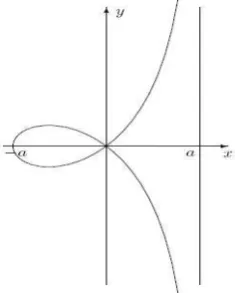
1.1 Strophoid for Ex 1.2.2. 14
2.1 Computation of the resultant. 26
2.2 Support hulls of polynomials in Ex 2.5.1. 39
2.3 Minkowski sum in Ex 2.5.1 39
3.1 Research procedure diagram. 45
3.2 Processes of optimizing the size of Dixon matrix. 49 3.3 Processes of optimizing the size of Dixon Dialytic matrix. 51 4.1 Flowchart for optimizing of Dixon matrix presented by
Chtcherba. 83
6.1 Flowchart for optimizing of Dixon matrix. 108
6.2 Support hulls of optimized system resulted from new
algorithm by choosing in Ex 6.2.2. 111
7.1 Flowchart for optimizing of Dixon Dialytic matrix. 120 7.2 Support hulls of optimized system resulted from the
optimization algorithm choosing in Ex. 6.2.2. 124
8.1 Support hulls of system, 127
8.2 Support hulls of system which is ready for starting the process to find , Ex. 8.2.1. is support hull of virtual
polynomial. 128
8.3 Support hulls of polynomials which are ready for starting
the process to find , . 130
8.4 Support hulls of optimized system, . 132
8.6 Support hulls of optimized polynomial system, Ex. 8.2.2. 136
8.7 Triangle for Heymann’s Problem. 138
LIST OF SYMBOLS
‒ Support of a polynomial system
‒ The degree of the resultant over variety
‒ -dimensional vector space over complex number ‒ Complex numbers without origin
‒ A polynomial produced by the set ‒ The total degree of a polynomial
‒ The degree of a polynomial in terms of variable
‒ Support of Dixon polynomial of generic polynomial system with support
‒ The determinant of square matrix
‒ Polynomial system
‒ Ring of polynomials with coefficients from domain
‒ Set of d-tuples with nonnegative integer values ‒ A maximal size non-singular submatrix of
‒ Mixed volume of polytopes ‒ Minkowski sum of supports
‒ Resultant of polynomial system over projective
variety
SPARC station 10 ‒ A workstation computer made by Sun Microsystems announced in May 1992
‒ The Dixon polynomial
‒ The Dixon polynomial
of
‒ The Dixon matrix
‒ -dimensional Euclidean volume
‒ A monomial , where
‒ Set of d-tuple with integer values
‒ Ring of polynomials with coefficient set from
‒ Ring of polynomials with coefficient set from and variable set
‒ Set of solutions polynomials have in
LIST OF APPENDICES
APPENDIX TITLE PAGE
A 161
B
1 INTRODUCTION
1.1 Background of study
In recent years, the search for finding efficient algorithms for solving systems of polynomials has received renewed attention due to their importance in both practical and theoretical interests including robotics, kinematics, computational number theory, solid modeling, quantifier elimination and geometric reasoning problems. One possible theory, which is commonly used to solve such a systems, is elimination of the variables. Evidence to this is recent breakthroughs in elimination theory such as development of fast algorithms for solving polynomial systems with finitely many solutions (Faug'ere et al., 1992), variations of classical constructive techniques for eliminating the variables (Boole, 2003; Canny, 1990), development of elimination methods, which exploit the structure of polynomial systems to solve them efficiently (Canny and Pedersen, 1993; Canny and Emiris, 2000; Emiris, 1994; Sturmfels, 1991) and development of efficient techniques for numerically solving nonlinear systems (Morgan, 2009; Verschelde et al., 1994).
The currently known elimination techniques for solving a polynomial system are classified into symbolic, numeric and geometric techniques. Matrix methods, characteristic set construction and Gr bner basis construction are three methods
(1.1)
be a system of polynomials in variables with the real coefficients. Solving such a system means to determine a set of -dimensional points , which satisfy
all of the polynomials in the system. If a system of polynomials is a symbolic or parametric form, it means that some of the coefficients or all of them are arbitrary parameters, which are chosen from specified number set. The problem of solving such a polynomial system is to find conditions on the coefficients under which the system has a set of solutions called resultant.
The Gr bner basis algorithm and the characteristic set method are not
streamlined for finding resultant (Kapur and Saxena, 1995). They can rewrite a given polynomial system in such a way that the resultant can be easily extracted. Even though these methods compute resultants, they are not suitable in general for that purpose, because even on simple examples, these methods take an unpredictable time to compute, often running out of memory (Kapur et al., 1995). Example 1.1.1 from (Chtcherba, 2003) highlights this disadvantage in case of Gr bner basis algorithm.
Example 1.1.1 (Li et al., 1989) The Gr bner basis computation of the following polynomial system, presented in
,
where , are variables and , , , , , , and are parameters, quickly
system with 2GB memory. Yet the 12×12 resultant matrix can be set up in around 10
seconds using other methods by same system.
On the other hand, the effectiveness of matrix-based methods has been demonstrated in a variety of applications (Chionh, 1990; Emiris, 1994; Kapur et al., 1995; Kapur et al., 1994; Manocha, 1992; Michel et al., August 1996; Sederberg and Goldman, 1986), and the methods involving resultants offer an acceptable real-time solution (Manocha, 1992). Therefore, in case of symbolic polynomial systems, the matrix based methods are preferred.
There are two major classes of Matrix-based constructions to compute univariate or multivariate resultants called Sylvester type and Bezout-Cayley type constructions (Chtcherba and Kapur, 2003). Dixon method (Dixon, 1908), that is the subject of this thesis, is of Bezout-Cayley type, while its modified method, Dixon Dialytic (Chtcherba, 2003), is a combination of two above major types. All of these formulations try to eliminate variables from polynomials by constructing resultant matrices.
Dixon method can be considered as one of the best matrix-based methods for finding the polynomial including the resultant of a polynomial system (Chtcherba, 2003) which is called projection operator. This capability is due to certain properties such as producing a dense resultant matrix implied as not existence of a great number of zeros in rows and columns of the matrix and also producing small resultant matrix considered as lower dimension of created matrix. Besides, the Dixon method's being uniform implied as computing the projection operator directly without considering a particular order of variables, and also the method's being automatic referred as eliminating all the variables at the same time (Chtcherba, 2003; Kapur et al., 1994) can be taken into consideration.
All multivariate resultant methods, except in some special cases (Faug'ere et al., 1992), compute a non-negligible multiple of the resultant which does not provide
also suffered by this disadvantage (Chtcherba and Kapur, 2004b; Chtcherba and Kapur, 2003).
A useful property of Dixon method is the sensitivity of Dixon matrix size to exponents of the variables in the polynomials of a polynomial system. In other words, if we change the power of the variables in the polynomials of a system, the Dixon matrix size changes. Another remarkable property of Dixon formulation is that, the computational complexity of Dixon formulation is not governed by the total degree of polynomials, unlike the Macaulay resultants (Kapur and Saxena, 1996). See Example 1.1.2.
Example1.1.2 In the following polynomial system,
the size of Dixon matrix is and Dixon polynomial has 50 terms (monomials).
By multiplying to , to and to , we have a converted system of
polynomials as
and the Dixon matrix size increase to with Dixon polynomial, which
includes 72 terms. While by choosing multipliers , and for , and , respectively, the size of Dixon matrix decreases again to with 39
As illustrated in Example 1.1.2 above, the Dixon matrix responds to any conversion of the exponents of the polynomials in the polynomial system. As long as the Dixon matrix has this property, it is possible to optimize (minimize) the size of the Dixon matrix. As future illustrations, the size of Dixon matrix has direct dependency on the number of extraneous factors, which implies that the fewer dimension of the Dixon matrix results in fewer extraneous factors and vice versa.
Using this property, this thesis is intended to optimize the size of Dixon matrix in order to decrease the solving process and getting more accurate in process of finding results.”
1.2 Preliminary concept
This section introduces some basic concepts, which are needed to develop a resultant and its formulation.
Consider a multivariate polynomial in the expanded form
(1.2)
with as a monomial, which can be written in the simplified form as
The set , which is a finite set of exponents, is called the support of
The total degree of a multivariate polynomial is the maximum degree of any monomial in , where the degree of a particular monomial is the sum of the
variable exponents.
Example 1.2.1 The polynomial
has support with coefficients over ,
hence . The terms , and are called monomials of the polynomial and the total degree of is .
To link algebra and geometry, we will study polynomials over a field. The basic intuition is that a field is a set where one can define addition, subtraction, multiplication, and division with the usual properties. Standard examples are the real numbers and the complex numbers , whereas the set integers is not a field since
division fails (3 and 2 are integers, but their quotient 3/2 is not). A formal definition of field can be found in (Baez et al., 1992; Cox et al., 2006).
We now introduce affine space and projective space.
Definition 1.2.1 (Chtcherba, 2003) Consider a field and a positive integer , define the -dimensional affine space over to be the set
For an example of an affine space, consider the case . A coordinate
system for the -dimensional affine space is determined by any basis of vectors, which are not necessarily orthogonal. Therefore, the resulting axes are not necessarily mutually perpendicular or have the same unit measure. In this sense, affine space is a generalization of Cartesian or Euclidean space. In general, we call
the affine line and the affine plane.
Definition 1.2.2 (Chtcherba, 2003) Consider a field , and be polynomials in
is called the affine variety of .
An affine variety is the set of all solutions of the system of polynomials in an affine space. We will use the letters , , etc, to denote affine varieties. In case of , the conic sections studied in analytic geometry (circles, ellipses,
parabolas, and hyperbolas) are affine varieties. Likewise, graphs of polynomial functions are affine varieties (the graph of is ). More examples of affine variety can be found in (Cox et al., 2006).
Definition 1.2.3 (Saxena, 1997) The projective plane over , denoted , is the set
meet at a point in ; if they are parallel, they meet at their common point at .
Thus far, our discussion of the projective plane has introduced some nice ideas, but it is not entirely satisfactory. For example, it is not really clear why the line at should be called a projective line. A more serious objection is that we have no unified way of naming points in . Points in are specified by coordinates,
but points at are specified by lines. To avoid this asymmetry, we will introduce homogeneous coordinates on .
To get homogeneous coordinates, we will need a new definition of projective space. The first step is to define an equivalence relation on nonzero points of by setting
,
if there is a nonzero real number such that . One can easily check that is an equivalence relation on (where , refers to the origin in ). Then we can redefine projective plane as follows.
Definition 1.2.4 (Chtcherba, 2003) is the set of equivalence classes of on . Thus, we can write
A clarification on the equivalence of above two definitions of projective plane is presented in (Cox et al., 2006).
Homogeneous coordinates are different from the affine coordinates in that the former are not unique. Indeed the distinction between affine and projective spaces arises especially when comparing coordinates. For example, the triples and are the affine coordinates of two distinct points of the affine space ,
but are the projective coordinates of the same point of the projective plane , since projective coordinates are determined up to proportionality.
The construction of the real projective plane given above can be generalized to yield projective spaces of any dimension over any field . We define an equivalence relation on the nonzero points of by setting
,
if there is a nonzero element such that . If we let denote the origin in , then the projective space is defined as follows.
Definition 1.2.5 (Kapur et al., 1994) An -dimensional projective space over the field , denoted , is the set of equivalence classes of on .
Thus,
Each nonzero -tuple defines a point in ,
general, we will write to denote that are homogeneous coordinates of . We can think of geometrically as the set of lines through the origin in .
Definition 1.2.6 (Chtcherba, 2003) A polynomial of a certain total degree is homogeneous if every monomial term in is of degree .
Definition 1.2.7 (Chtcherba, 2003) Let be a field, and let be homogeneous polynomials in . Then
is called the projective variety defined by .
For example, in , any nonzero homogeneous polynomial of degree ,
,
defines a projective variety called a hyperplane.
The polynomial system can be written as
, (1.3)
where
. (1.4)
The first polynomial is indexed at , so that the last index is equal to the
number of variables, i.e. the dimension of the problem.
Let be the support of the polynomial . We consider the collection to be the support of a polynomial system . Generally, we will classify polynomial systems according to the
properties of their supports.
Definition 1.2.8 (Kapur et al., 1995) A polynomial system with
support is called unmixed if , and
mixed otherwise.
Definition 1.2.9 (Saxena, 1997) A set of polynomials are algebraically independent if and only if there does not exist a non-zero polynomial such that .
where are variables and are parameters. This system is not generic because the coefficient of in is not independent, and also the coefficient of in
depends on coefficients in .
Definition 1.2.10 (Emiris, 1994) The objective of eliminating the variables for solving a polynomial system is obtaining a polynomial purely in the coefficients of
. The vanishing of such polynomials is a necessary condition for the existence of solutions for . We will call any such polynomial a projection operator.
One of the simplest cases of a polynomial system is when all polynomials are of total degree , which corresponds to following linear system
, (1.5)
where each is a real coefficient or parameter. Note that if the set of variables be considered as , we can rewrite the above system in the matrix form with coefficient matrix of size as follows.
.
From linear algebra, we know that the solution of exists in affine space
.
The determinant will be called the projection operator and as we shall see
later, is the resultant. The vanishing of provides a necessary and sufficient condition for the above linear polynomial system to have a nontrivial solution.
A resultant for a polynomial system may be reducible under certain conditions relating to its coefficients. A simple example is the resultant of and which with respect to is . A point arises then as
to the irreducibility of the resultant for a generic polynomial system.
The presence of extraneous factors is closely related to the projection operator. As matter of fact the extraneous factors are all of the factors in a projection operator apart from the resultant. In other words, in a projection operator of a polynomial system, the extraneous factors are all of the factors in the ratio of the projection operator and the resultant. Example 1.2.2, which follows, illustrates the case.
Example 1.2.2 Consider the strophoid, a curve widely studied by mathematicians of 17th and 18th century, which can be written in a parametric form as follows.
Figure 1.1 Strophoid for Ex 1.2.2.
To find an implicit equation for the strophoid using resultant, we have to restate the equations in terms of polynomials instead of trigonometric functions, as follows.
Letting , the trigonometric equations of the
strophoid can be written as
. (1.6)
We wish to eliminate and to get a single equation in terms of and . We can treat the monomials and as separate variables to
make the above equations linear so that we can employ the tools of Linear Algebra. Unfortunately, in this case, the number of variables is six and the number of equations is only four that is the system is not well-constrained. To get more equations, we can pre-multiply some of the polynomials by some monomials; for example, will still have all solutions of ; hence we can add it to the
next chapter, there is lower bound on the size of the presented resultant matrix in any Dialytic resultant formulation which for above polynomial system it is (computed
in (Chtcherba, 2003) in page 220). It means that for this example, any Dialytic formulation does not admit resultant matrix smaller than . To be sure, for
some of the most important ones, presented in the ensuing chapters, such as Dixon Dialytic method, Macaulay method, Subdivision method and Incremental method, the size of resultant matrix for this particular example is , , and respectively. As a sample, if we multiply by , by and , by and , and by and (which can be obtained
using Dixon Dialytic method presented in chapter 5) we get the following system of polynomials ,
which contains exactly monomials. If we treat each monomial as independent variable, we obtain the following linear system (in matrix form):
the original polynomial system are also solutions of , it follows that the vanishing of the determinant of can present a condition for the original polynomial system to have a solution. In general, not every solution of is a solution of the
original polynomial system, hence the condition of vanishing of the determinant is only necessary but not sufficient for the original polynomial system to have a solution. The factors, which account for these extra solutions are called extraneous factors. Hence, the determinant of the above matrix must be a multiple of the resultant. The determinant of the coefficient matrix, denoted by matrix for the
above linear system, is
.
Note that although the linear system has a solution whenever
or or when , the original polynomial system will only have a solution when . The solutions and , are already accounted for in . Then the factors and are extraneous factors. Thus equations
.
are solvable for , whenever , and therefore it is an implicit
equation of the strophoid.
As illustrated in Example 1.2.2 above, there are three steps in computing the resultant through a resultant matrix:
Construction of a resultant matrix.
Identification of the resultant in the projection operator.
These three steps are common for all matrix-based method for finding resultant.
1.3 Problem formulation
Dixon (Auzinger and Stetter, 1988) defined his method for eliminating a large number of variables for a vast class of polynomial systems and computing a polynomial which includes all solutions of the polynomial system. A modified formulation of Dixon method is presented by Chtcherba (Chtcherba, 2003) which is called Dixon Dialytic. Some research found, Dixon methods show the superiority of this method in performance on a wide variety of problems(Chtcherba, 2003).
As shown in previous section since the presented resultant contains all information about the solutions of a polynomial system, the extraneous factors in a projection operator do not offer any additional information. Moreover, they make it harder for the resultant in a projection operator to be identified. Each factor in a projection operator must be checked as to whether it is an extraneous factor or is part of the resultant. This checking can be time-consuming. This issue is encountered for both Dixon and Dixon Dialytic (Chtcherba and Kapur, 2002).
The projection operator of the Dixon matrix related to Example 1.2.2 is as the following
Therefore, developing or constructing techniques that can eliminate, or at least reduce, the number of extraneous factors is an important problem of research, which when solved adequately will yield handsome dividends.
1.4 Objectives of study
From the formulated problem, which is addressed in the past section, the objective of this research work could be stated as follows
1) To determine how the information about the sensitivity of the size of Dixon/ Dixon Dialytic matrix with respect to the variables’ power in the polynomials of the original system can be used to produce a smaller resultant matrix.
2) To propose a method for managing these variables’ power so as to produce smaller Dixon matrix and to construct an algorithm to implement the method.
1.5 Scope of study
The focus of this thesis is on the application of algebraic geometry, which is related to the study of geometric objects defined by polynomial equations using the tools of algebra. Although one can choose coefficients of polynomial systems from any arbitrary field of numbers, in this work, real coefficients has been considered. In order to achieve the objectives of thesis the following scope of work has been carried out:
Identifying the applications of polynomial systems and the needs for
solving them.
Using Bezout-Cayley type construction which is taken from matrix-based method, on generic-mixed polynomial systems.
Studying the Dixon and Dixon Dialytic formulation and their
advantages and properties.
Considering the determinant of the produced Dixon/Dixon Dialytic
matrix and finding a polynomial that includes the resultant (projection operator) and its properties.
Identifying a method to manage the total degree of the polynomials in
the system in order to reduce the extraneous factors in the projection operator, which exist besides the resultant.
Producing algorithms to eliminate or at least decrease the extraneous
factors from the projection operators, implementation and analysis of the results.
1.6 Significance of study
additional information in a projection operator. The Dixon formulation, being the major subject of this thesis, is no exception from rule of extraneous factors. The contribution of this study is minimizing the number of extraneous factors for the Dixon based resultant formulation.
1.7 Related works
For generic polynomial systems, Macaulay devised a technique which, he determined a sub-matrix of the resultant matrix and computed its determinant to identify the extraneous factor exactly, but his method does not work in the non-generic case and for other formulations (Kapur and Saxena, 1996).
Chtcherba and Kapur presented a hypothesis for optimizing the size of Dixon matrix that is based on Corner Cutting method (Chtcherba and Kapur, 2002). They devised a heuristic for presenting the best variable order for the construction of the Dixon resultant matrix, but it stays in heuristic realm due to some limitations. Besides, in the unlikely case which is explained in their paper, the method might not present the best variable order (Chtcherba and Kapur, 2004a).
Saxena in (Kapur and Saxena, 1996) suggested a general method for reducing total degree of polynomials in the given polynomial system. His suggestion is computing the projection operator of a polynomial system with polynomials of less total degree than original polynomial system. Given a polynomial system , first one should compute , the greatest common divisor (GCD) of all powers of
basically finds the smallest system that can scale down to, and then, works with that smaller system. Since such a procedure reduces the total degree of the input polynomials, it requires less computational resources than directly computing the projection operator of the larger system. But, this technique works when the GCD of powers are not equal to one.
Chtcherba in (Chtcherba and Kapur, 2004a) presented another heuristic for minimizing the size of Dixon matrix. He introduced some polynomial multipliers for the polynomials in a system to get smaller Dixon matrix, but his method does not work properly for general polynomial systems. Besides, in the course of implementing his method, only the number of columns of the resultant matrix is considered as a character to get a smaller Dixon matrix size. In fact, a method, which is based solely on the number of columns as the only condition contributing to the recognition of smaller matrix, is likely to be misleading.
1.8 Thesis overview
The central point of the present thesis is the notion of the resultant of a polynomial system. This thesis has been built on the success of optimizing the Dixon resultant formulation by recent researchers such as Chtcherba and Saxena. This research presents a new method for finding smaller Dixon matrix to get smaller total degree of the projection operator, which signifies less extraneous factors in the decomposed form.
framework, procedures, and simulation tools are covered in this chapter. Moreover, a list of problems which are applied to test the presented algorithms and compare the achieved results of optimization methods for Dixon and Dixon Dialytic matrices is presented.
The major objective of this research is built on the definition of Dixon formulation. Therefore, chapter 4 is assigned to illustrate the properties of this formulation by definitions and theorems. Besides, fundamental issues are raised which include the relationships between degrees of projection operator and size of Dixon matrix and effects of supports conversion on the size of Dixon matrix.
Chapter 5 is devoted to explaining the modified method of the Dixon formulation called Dixon Dialytic. Useful details which are used for optimizing Dixon Dialytic formulation are presented in this chapter, which include the relationships between degrees of projection operator and size of Dixon Dialytic matrix and relation between the size of Dixon matrix and the size of Dixon Dialytic matrix.
Chapters 6 and 7 present the main algorithms of the present research for optimizing the size of Dixon matrix and Dixon Dialytic matrix. Furthermore, some examples are presented in order to check if the algorithms work properly. Each chapter ends with a complexity analysis of the optimization algorithms.
Finally, summary and conclusions of the thesis, some future directions and open problems are presented in Chapter 9.
Theory, New York, Springer-Verlag.
Auzinger, W. and Stetter, H. J. (1988). An elimination algorithm for the computation of all zeros of a system of multivariate polynomial equations. International Series of Numerical Mathematics, 80, 11–30.
Awange, J. L. (2010). Algebraic geodesy and geoinformatics, Berlin ; New York, Springer.
Baez, J. C., Segal, I. E. and Zhou, Z. (1992). Introduction to algebraic and constructive quantum field theory, Princeton, N.J., Princeton University Press.
Becker, T., Weispfenning, V. and Kredel, H. (1993). Gröbner bases : a computational approach to commutative algebra, New York, Springer-Verlag.
Bernshtein, D. (1975). The Number of Roots of a System of Equations. Funktsional’nyi Analiz i Ego Prilozheniya, 9(3), 1-4.
Bézout, E. and Reynaud (1812). Cours de mathématiques : à l'usage de la marine et de l'artillerie. Seconde partie, contenant la géométrie, la trigonométrie
rectiligne et la trigonométrie sphérique, Paris, Mme. Ve. Courcier.
Bikker, P. (1995). On Bezout’s method for computing the resultant. Research Institute for Symbolic Computation - Linz Report Series.
Boole, G. (2003). The laws of thought, Amherst, N.Y., Prometheus Books.
Buchberger, B. (1985). Groebner bases: An algorithmic method in polynomial ideal theory. Multidimensional Systems Theory - Progress, Directions and Open Problems in Multidimensional Systems. Reidel Publishing Company,
Dodrecht - Boston - Lancaster.
Buse, L., Elkadi, M. and Mourrain, B. (2000). Generalized resultants over unirational algebraic varieties. Symbolic Computation, 29, 515–526.
Canny, J. and Emiris, I. (1993). An efficient algorithm for the sparse mixed resultant. Applied Algebra, Algebraic Algor, 263, 89–104.
Canny, J. and Pedersen, P. (1993). An Algorithm for Newton Resultant. Technical Report, 1385-1394.
Canny, J. F. and Emiris, I. Z. (2000). A subdivision-based algorithm for the sparse resultant. Journal of the Acm, 47, 417-451.
Cardinal, J. P. and Mourrain, B. (1996). Algebraic approach of residues and applications. Am. Math. Soc. Press, 32, 189–210.
Cattani, E., Dickenstein, A. and Sturmfels, B. (1998). Residues and resultants. J. Math. Sci. Univ. Tokyo, 5, 119–148.
Cayley, A. (1865). On the Theory of Elimination. Cambridge and Dublin Mathematical Journal, 3, 210-270.
Chionh, E. (1990). Base Points, Resultants and Implicit Representation of Rational Surfaces. Ph.D, Univ. of Waterloo.
Chionh, E., Zhang, M. and Goldman, R. 1999. Transformation and Transitions from the Sylvester to the Bezout Resultant. In: University, R. (ed.).
Chou, S.-C. (1988). Mechanical geometry theorem proving, Dordrecht ; Boston Norwell, MA, U.S.A., D. Reidel Pub. Co. ;
Sold and distributed in the U.S.A. and Canada by Kluwer Academic Publishers. Chtcherba, A. (2003). A new Sylvester-type Resultant Method based on the
Dixon-Bezout Formulation. PhD, State University of New Mexico.
Chtcherba, A. and Kapur, D. (2000a). Conditions for exact resultants using the Dixon formulation. International Symposium on Symbolic and Algebraic Computation, 62-70
Chtcherba, A. and Kapur, D. 2000b. Extracting Sparse Resultant Matrices from theDixon Resultant Formulation. 7th Rhine Workshop (RCWA’00).
Chtcherba, A. and Kapur, D. (2002). On the Efficiency and Optimality of Dixon based Resultant Methods. Proceedings of the international symposium on Symbolic and algebraic computation, 1, 29-36.
Chtcherba, A. and Kapur, D. (2004a). Constructing Sylvester-Type Resultant Matrices using the Dixon Formulation. Journal of Symbolic Computation, 38, 777-814.
Symbolic Computation, 36, 289-315.
Cox, D., Little, J. and O’shea, D. (1998). Using Algebraic Geometry, Springer-Verlag.
Cox, D., Little, J. and O’shea, D. (2006). Ideals, Varieties, and Algorithms, springer. Cox, D. A., Little, J. B. and Schenck, H. K. (2011). Toric varieties, Providence, R.I.,
American Mathematical Society.
D’andrea, C. and Emiris, I. (2001). Hybrid sparse resultant matrices for bivariate systems. ISSAC, 24–31.
Dickenstein, A. and Emiris, I. (2002). Multihomogeneous resultant matrices. ISSAC, 46–54.
Dixon, A. L. (1908). The eliminant of three quantics in two independent variables. London Mathematical Society, 6, 468–478.
Dixon, A. L. (1909). The Eliminate of Three Quantics in Two Independent Variables, Proceedings of The London Mathematical Society.
Emiris, I. (1994). Sparse Elimination and Applications in Kinematics. Doctoral Thesis, University of Calif.
Faug'ere, J. C., Gianni, P., Lazard, D. and Mora, T. (1992). Efficient Computation of Zero-Dimensional Grobner Bases by Change of Ordering. Journal of Symbolic Computation, 16, 329-344.
Foo, M. C. and Chionh, E. W. (2004). Corner edge cutting and Dixon A-resultant quotients. Journal of Symbolic Computation, 37, 101-119.
Gao, X. S. and Wang, D. K. (1992). On the Automatic Derivation of a Set of Geometric Formulae. Mathematics Mechanization Research Preprints, 8, 26-37.
Gelfand, I. M., Kapranov, M. M. and Zelevinsky, A. V. (1994). Discriminants, Resultants and Multidimensional Determinants, Birkhauser, Boston.
Goldman, R., Sederberg, T. and Anderson, D. (1984). A Technique for the Implicitization, Inversion, and Intersection of Planar, Parametric, Rational Parametric Curves. Computer Aided Geometric Design, 1, 327–356.
Hofman, C. M. (1990). Algebraic and Numeric Techniques for Ofsets and Blends. Kluwer Academic Publishers, 3, 110-118.
Kapur, D. and Lakshman, Y. N. (1992). Symbolic and Numeric Computation for Artificial Inteligence, Computational Mathematics and Applications.
Kapur, D., Lakshman, Y. N. and Saxena, T. 1995. Computing Invariants using Elimination Methods. IEEE International Symposium on Computer Vision. Albani: Inst. of Programming & Logics, State Univ. of New York,.
Kapur, D. and Saxena, T. (1995). Comparison of various multivariate resultants. ACMISSAC, 95, 89-96.
Kapur, D. and Saxena, T. 1996. Sparsity considerations in the Dixon resultant formulation. ACM Symposium on Theory of Computing. Philadelphia.
Kapur, D., Saxena, T. and Yang, L. (1994). Algebraic and geometric reasoning using the Dixon resultants. ACM ISSAC, 94, 99–107.
Khetan, A. (2002). Determinantal Formula for the Chow Form of a Toric Surface. ISSAC, 145–150.
Khovalskii, A. G. (1978). Newton polyhedra and the genus of complete intersections. Funct. Anal. Appl., 12, 51-61.
Kushnirenko, A. G. (1975). Newton polytope and the number of solutions of a system of k equations in k unknowns. Usp. Math. Nauk., 30, 266-267.
Lewis, R. H. (2010). Comparing acceleration techniques for the Dixon and Macaulay resultants. Mathematics and Computers in Simulation, 80, 1146-1152.
Lewis, R. H. and Bridgett, S. (2003). Conic tangency equations and Apollonius problems in biochemistry and pharmacology. Mathematics and Computers in Simulation, 61, 101-114.
Lewis, R. H. and Coutsias, E. A. (2007). Algorithmic search for flexibility using resultants of polynomial systems. Automated Deduction in Geometry, 4869, 68-79.
Lewis, R. H. and Stiller, P. (Feb 2001). Solving the recognition problem for six lines using the Dixon resultant. Elsevier, 49, 205-219.
Lewis, R. H. and Stiller, P. F. (1999). Solving the recognition problem for six lines using the Dixon resultant. Mathematics and Computers in Simulation, 49, 205-219.
Manocha, D. (1992). Algebraic and Numeric Techniques for Modeling and Robotics. Doctoral, University of Calif.
Mayr, E. and Vasilevich, E. (2005). Computer Algebra in Scientific Computing, Springer.
Michel, J. D., Nandhakumar, N., Saxena, T. and Kapur, D. August 1996. Using Elimination Methods to Compute Thermophysical Algebraic Invariants from Infrared Imagery. 13th National Conference on Artificial Intelligence (AAA 96). Portland-Oregon-USA.
Morgan, A. P. (2009). Solving Polynomial Systems Using Continuation for Scientific and Engineering Problems, SIAM.
Pedersen, P. and Sturmfels, B. (1993). Product formulas for resultants and chow forms. Math. Zeitschrift, 214, 377–396.
Robert, H. L. (2007). Heuristics to accelerate the Dixon resultant. Mathematics and Computers in Simulation, 77, 400-407.
Salmon, G. (1924). Lessons introductory to the modern higher algebra, Dublin Hodges, Foster.
Saxena, T. (1997). Efficient variable elimination using resultants. PhD, State University of New York.
Sederberg, T. and Goldman, R. (1986). Algebraic Geometry for Computer-Aided Design. IEEE Computer Graphics and Applications, 6, 52-59.
Shafarevich, I. R. (1994). Basic Algebraic Geometry., New-York, Spring-Verlag. Sturmfels, B. (1991). Sparse elimination theory. Algebraic Geom. and Commut.
Algebra, 1, 377–396.
Sturmfels, B. (1998). Polynomial equations and convex polytopes. American Mathematical Monthly, 105, 907-922.
Sylvester, J. (1853). On a theory of synergetic relations of two rational integral functions, comprising an application to the theory of strum’s functions, and that of the greatest algebraic common measure. Philosophical Trans, 143, 407–548.
Verschelde, J., Gatermann, K. and Cools, R. (1996). Mixed volume computation by dynamic lifting applied to polynomial system solving. Discrete and Computational Geometry, 16, 69–112.
Verschelde, J., Verlinden, P. and Cools, R. (1994). Homotopies Exploiting Newton Polytopes for Solving Sparse Polynomial Systems. SIAM Journal of Numerical Analysis, 31, 915-930.
Wang, D. (1996). Automated deduction in geometry, springer.
Wu, W. T. (1986). Basic Principles of Mechanical Theorem Prooving in Elementary Geometry. Journal of Automated Reasoning, 2, 219–252.
Yang, L., Zeng, Z. and Zhang, W. (2012). Differential elimination with Dixon resultants. Applied Mathematics and Computation, 218, 10679–10690.
Yushkevich, A. P. and Winter, E. (1965). Leonhard Euler and Christian Goldbach, Berlin, Briefwechsel.
Zhang, M. (2000). Topics in Resultants and Implicitization. PhD, Rice University. Zhao, S. Z. and Fu, H. G. (2005). An extended fast algorithm for constructing the
Dixon resultant matrix. Science in China Series a-Mathematics, 48, 131-143. Zhao, S. Z. and Fu, H. G. (2009). Three kinds of extraneous factors in Dixon