Corner Supports
EDGE BEAMS USING MICROSOFT EXCEL
Indrajit Ghosh1
1Adjunct Professor, Indian Institute of Technology, Gandhinagar, India
ABSTRACT
Since the development of Finite Element Method (FEM) in 60’s and 70’s, its application to structural analysis of nuclear power plants witnessed a tremendous impetus, and gained popularity soon. Now-a-days with the advent of high-speed digital computers its popularity has become even more universal. Even for a minor modification to an existing structure such as change in loading on a concrete slab in a room, engineers take resort to FEM which most of the time becomes very time-consuming and uneconomical. In this paper the author shows how local analysis of slabs be performed using classical structural mechanics principles described in many text books such as Timoshenko and Woinowsky-Krieger (1959). Although some partial derivations are required to solve the governing equations provided in the text books, Microsoft Excel software can be used, and the equations solved. Once the Excel software is developed any one can use it without having to learn the FEM techniques and applications. An example of a slab supported on elastic edge beams under uniformly distributed load has been demonstrated in this paper using Excel. Advantages of using Excel software are many: (a) Excel is available in any office environment, and everyone is familiar with this software. (b) No special training or experience is required to run such an analysis. (c) Maximum deflections are calculated. (d) Unlike FEM there is no need to worry about element size. (e) Results are more accurate than obtained using FEM.
DESCRIPTION
Analysis of a rectangular plate loaded uniformly and supported on four elastic edge beams have been considered in this paper (Fig. 1). The beams are supported rigidly at the corners of the plate. Two beams parallel to each other have the same flexural rigidity. No torsional moment is transferred to the beams.
Figure1. Plate supported on elastic edge beams and on four corners
X
Y
b/2 b/2
Y
The deflection equation as given by Timoshenko and Woinowsky-Krieger (1959) is as follows:
4 2 2 4 4 2 2 4
n n
n n
4 2 2 4 4 2 2
q
w = (16x - 24a x + 5a ) + (16y - 24b + 5b ) 384D(γ + δ)
n y n x n x n y
A cosh cos + B cosh cos
a a b b
n y n x n x n y
+ C y sinh cos + D x sinh cos
a a b b
Converting 16x - 24a x + 5a and 16y - 24b +
y
y
2 4
4 2 2 4 4 2 22 44
(16x - 24a x + 5a ) + (16y - 24b4 2 2 4 4 2 22 + 5b )44 (1 4 2 2 44 44 22 22 44 (16x - 24a x + 5a ) + (16y - 24b 22 + 5b )44 (16x - 24a x + 5a ) + (16y - 24b44 22 22 44 44 22 22 + 5b )44
n n
n y
A coshnn hn ycosc + B coshnn cos
a a b b
n n
n y h cos
hn yn yc + + B coshB cosh coscosn y
n n
A cn n
n n
n y
+ C y sinhnn n ycos + D x sinhnn cos
a a b b
n n
n n
n y coss n y n y
s + D x sinh cosn y s + D x sinh cos
s h c
4
5b into cosine series, this equation can be writtem as
a a
b b
where,
q = Unit load on plate
a = Length of short side (X-Direction); b= Length of long side (Y-Direction)
E I = flexural rigity for beam along X-direction
E I = flexural rigity for beam along Y-direction
h =
3 p
p 2
a a b b b b
a a 4
5 5
Thickness of plate;
ν = Poisson's Ratio
E h
D =
where E = Young's Modulus of plate
12(1
ν )
E I
E I
δ
E I
a
γ =
,
δ =
, therefore,
=
aD
bD
γ
E I b
4qa
γ
n
n
n
R =
sin(
), p =
, and q =
; Note: sin
2
a
b
n D(
γ + δ)
n
n
n
), p =
, and q =
; Note: sin
n
n
n
n
n
n
5 5 5 5
n D(
5 5 5 5 5 5γ +
whe
2ν )
22n-1 2
n
(
) = (
1) for n = 1,3,5,7,...
2
) = (
n-1 2
1) for n
21)
Boundary conditions
By applying appropriate boundary conditions along the edges y =
b2
, and x =
a2
in Equation (2)
below values of
the constants An, Bn, Cn and Dn can be determined for n = 1, 3, 5, 7,….. the following equations are obtained:n + Bn
n n
n n
n BBn
4 4
5 5
n n
n n
4qa γ n n x δ b n y
w = sin( ) cos + cos
2 a γ a b
n D(γ + δ)
n y n x n x n y
+ A cosh cos + B cosh cos
a a b b
n y n x n x n y
+ C y sinh cos + D x sinh cos (1)
a a b b
γ n
γ n
) c
γ n
γ n
γ n
γ n
5 5 5n D(5 5 5 5 5 5 5 γ +
4
γ n
γ n
γ δ b n
γ n
γ 44 n y
γ δ b n
γ n
γ 4 n y
γ n
γ n
γ n
γ n
γ n
γ n
γ n
γ n
γ n yy
) cos + cc
γ n
γ n
γ n
γ n
γ n
γ n
γ n
γ n
γ n
γ n
γ n
γ n
γ n y
γ n
γ n
γ n
γ n
γ n
γ n
γ n
γ n
γ n
γ n yy
γ n
γ n
γ n
γ n
γ n
γ n
γ n
γ n
γ n
γ n
γ n
γ n
γ n
γ n
γ n
γ n
γ n
γ n
γ n
γ n
γ n
c c c c
γ n
cos c
γ n
cos
γ n
γ n
c
γ n
) cos + c ) cos + c
b b
c c cos c
γ a
2 ) c) c) c a γ aγ aγ aγ aγ a bbbbbbbb
n n
n y
+ A coshnn n ycos + B coshnn cos
a a b b
n n
n y coss n y
s + B cosh cosn y s + B cosh cos
s h c
n n
n y
+ C y sinhnn n ycos + D x sinhnn cos
a a b b
n D x sinhn inh coscos
n n
n y coss n y n y
s + D x sinh cosn y s + D x sinh cos
2 2
2 2
b y=
2
2 2
2 2
a x=
2
3 3 4
3 2 4
b b
y= y=
2 2
3 3 4
3 2 4
a a
x= x=
2 2
d w d w
+ = 0 (2a)
dy dx
d w d w
+ = 0 (2b)
dx dy
d w d w EI d w
+(2 ) = (2c)
D
dy dx dy dx
d w d w EI d w +(2 ) =
D
dx dy dx dy (2d)
Development of equations using boundary conditions
Equation 2a:
4 2
2 2
2 n n
2
2 2
b n
y= 2 2
n n
2 2
n n
p A cosh(py)+2pC cosh(py)
d w d w b
+ = q R cos(qy) + cos(px)
+p C ysinh(py) a
dy dx
q B cosh(qx)+D x sinh(qx) cos(qy)
p Rcos(px) p A cosh(py)+C y sinh(py) +
n n
n n
n n
n n
2 2
(qx) s(qy) (qx) s( ) q Bnnn nnn
2 2
2 2 py)+C y sinh(py))+C y inh( ) p Rcos(px) p
p Rco
p R s(2222 ) p2222 A cosh(A c h(A c h(h(h(pyh( p Rcos(px) p
p Rcos(px) p A cosh(nnnnnnnnn h(pypy)+C y sinh(py)C yC ynnnnnnnnn h(py)h(py) p R s(px) p nnnnnnnnnnnn C ynnnnnnnnnnnn h(py) p R nnnnnn nnnnnn
2 2
n n n
cos(px)
= 0 + q B cosh(qx)+2qD cosh(qx)+q D x sinh(qx) cos(qy)
n n n
b qb n
Putting y = , and cos(qy) = cos( ) = cos( ) = 0, and eliminating cos(px)
2 2 2
from the equation we get,
pb 2 pb b pb
(1 )A cosh( ) + C cosh( ) + (1 )C sinh( ) = R (3a)
2 p 2 2 2
Similarly,
2 2
2 2
4
n n n
d w d w
From + = 0, we get dx dy
qa 2 qa a qa b
(1 )B cosh( ) + D cosh( ) + (1 )D sinh( ) = R (3b)
2 q 2 2 2 a
Development of Eq. 2c:
3 3 4
3 2 4
b b
y= y=
2 2
d w d w EI d w +(2 ) =
D
Referring to Eq. 2a
2 2 2 2
2 2 2 2
d w d w d w d w
+ = 0 can be written as =
dy dx dy dx
3 3
3 2
d w d w Differentiating with respect to y, we get =
dy dx dy
3 3 3 3 4
3 2 3 2 4
3 4
a a
2 4
b b
y= y=
2 2
d w d w d w d w EI d w Now, substituting = in +( 2 ) =
D dy dx dy dx dx dy dx
E I
d w d w
Eq. (2c) takes this form: = 2D(1 )
dy dx dx
2
2
n n n
2
2 2
n n n
4
4 4
b b b b b b
n n
4
Now, d w
= p pA sinh(py)+C sinh(py)+pC y cosh(py) cos(px) dx dy
q q B cosh(qx) + 2qD cosh(qx) + q D x sinh(qx) sin(qy), and
E I d w E I E I
= p Rcos(px) + p A cosh(py) + C 2D(1 ) dx 2D(1 ) 2D(1 )
4 4
4 4A c h( ) + C
4 4
n n
n n
n n
p nnnnn nnnnn p A cosh(py) + C p A cosh(py) + C p A cosh(py) +
4 4
4 4
n n
n n
n n
n n
n n
4 3 4
b b
n n n
y sinh(py) cos(px)
E I
+ q B cosh(qx) + 4q D cosh(qx) + q D x sinh(qx) cos(qy) 2D(1 )
Therefore,
2
n n n
2 2
n n n
4 4
b b b b
n n
4 b b
n
p pA sinh(py) + C sinh(py) + pC y cosh(py) cos(px)
q q B cosh(qx) + 2qD cosh(qx) + q D x sinh(qx) sin(qy)
E I E I
= p R cos(px) + p A cosh(py) + C y sinh(py) cos(px)
2D(1 ) 2D(1 )
E I
+ q B cosh
2D(1 )
n n
p A cosh(py) + C ynn nn 2
n n n
p pA s2 n n n
2 2
q q22222 q D22222 sinh(qx) sin( )
q q2222B cosh(qx) + 2qD cosh(qx) + q D x sinh(qx)nnnnnn nnnnnn 2222 nnnnnn sin(qy)
q q B c22 nn nn 22 nn
= p
= b b p b
= p n n
= p R cos(px) + p A cosh(py) +
= b bb b p b bb p nn nn
) 2D(1 )
= p (px) p
= p (px) p
b b
)
3 4
n n
(qx) + 4q D cosh(qx) + q D x sinh(qx) cos(qy)
4 3 4
4
q B cosh4 nn (qx) 4q D333 n sh(qx) 444D x inh(n ) c (qy) q B cosh4 n
q B conn
q Bn (qx) + 4q D cosh(qx) + q D x sinh(qx) cos(qy)33 nnn 44 nnn
2
n n n
2 2
n n n
4
b b b
qb n
Rearranging and putting cos(qy) = cos( ) = cos( ) = 0,
2 2
we get, p pA sinh(py) + C sinh(py) + pC y cosh(py) cos(px)
q q B cosh(qx) + 2qD cosh(qx) + q D x sinh(qx) sin(qy)
E I E
= p Rcos(px) +
2D(1 )
) = 0,
Rcos
b b b
b b b
2
n n n
p pA s2 n n n
2 2
q q22222 22222 sinh(qx) sin( )
q q222B cosh(qx) + 2qD cosh(qx) + q D x sinh(qx)nnnnnn nnnnnn 222 nnnnnn sin(qy)
q q B c22 nn nn 22 nn
= p
= b b p b
= p
= p Rc
= b bb b p bb
)
= p
= p Ib p A cosh(py) + C y sinh(py) cos(px)4 n n
2D(1 )
4 4
p A4 nnn sh(py) Cnnn sinh(py) s( ) p A cosh(py) + C y sinh(py) cos(px)4 nnn nnn
p A conn nn
b
m
2 2 2 2
m=1,2,3,..
n x
n x
a
a
Converting cosh(
) and x sinh(
) into Fourier cosine series at interval
< x <
,
b
b
2
2
we get,
n x
2b
n
πa
4nab
nπa
2mπx
cosh(
) =>
sinh(
) +
(
1) sinh(
)cos(
)
b
n
πa
2b
π(n a +4m b )
2b
a
n x
n x
) and x sinh(
) into Fourie
n x
n x
r
n x
2
) =>
n x
2
n x
a
< x
a
2
m
1) sinh(
)
mm(
m=1,2,3,..4nab
2 2 2
4nab
m=1,2,3,.
2 2 2
π(n a +4m
2222 2222 22222 2
m
2 2 2 2 2 2 2
m=1,2,3..
2 2 2 2
2 2 2 2
n x
and, x sinh(
)
b
b
n
πa
b
nπa
2ab
cosh(
)
sinh(
) +
(
1)
2n
π
2b
n
a
2b
(n a + 4m b )
n
πa
nπa
n a
4m b
nπa
2mπx
cosh(
)
2
sinh(
) cos(
)
b
2b
n a + 4m b
2b
a
See Appendix A for Fourier
n x
)
n x
m=1,2,3..
a
2b
m=1(n a + 4m b )
2 2
m
b
22nπa
2ab
22sinh(
) +
(
1)
2 2 2
b
nπa
nπa
2ab
2 2 2
2 2 2
2 2
sinh(
) +
2(
2 2 2 2 2 2 2
2 2 2
2 2 2
2 2 2
2 2 2
(
+ 4m b )
2 2 2 22 22 22 2
2 2 2 2 2 2 2
2 2 2 2 2 2
2b
2 2 2
2 2 2
2 2 2
2 2 2
2 2 2
2 2 2
2 2 2 2
2 2 2
2 2 2
n
πa
nπa
n
n a
22222222222222 222222222222224
4m b
22222222222222 222nπa
nπa
a
2mπx
) cos(
(
2mπx
2mπx
2
)
)
) cos
a
)
aa
4m b
4m b
cosh(
)
n
πa
nπa
h(
nπa
nπa
)
2
2
n a
n a
n a
4
4
4
sinh(
sinh(
sinh(
i h(
i h(
n
nπa
nπa
) cos
cosh(
)
2
) cos
s(
)
2 2 2 2
sinh(
2 2 2
2 2 2
)
b
(
(
(
2b
)
)
(
2b
)
(
(
(
a
)
b
(
)
22(
2b
)
m b
2 2 2
2 2 2
2 2 2
2 2 2
))
2 2 2 2
2 2 2 2
2 2 2
(((((
2b
2b
2b
n a + 4m
2222222222222222 2222222222222222 22222222222222222 2
2 2
2 2
m=1,2,3..
(n a +
m=1,2,3..2ab
2 2
2 2
2ab
2 2 2 2 2 2
(n a +
2 2 2 2 2 2
2 2 2 2 2 2
2 2 2 2 2 2
2 2 2
transformations.
b b
3
n n n n 2 n 2 n 4
E I p
qb
b
n
Substituting y =
, x = 0,
= P and cos(qy) = cos(
) = cos(
) = 0, we get
2
2D(1- )
2
2
pb
1
pb
b
pb
q
2
qb
A sinh(
) + C
sinh(
) + C
cosh(
)
B K +
D K +D K sin(
)
2
p
2
2
2
p
q
2
= PR + P A
) = 0, we
= P an
- )
3 3 3qb
)
qb
b
b
b
b
b
333pb
pb
pb
pb
A i h(
pb
pb
pb
q
q
q
q
in(
in(
qb
)
)
A sinh(
) + C
sinh(
) + C
cosh(
)
A sinh(
pb
b
) + C
sinh(
pb
pb
b
) + C
cosh(
pb
pb
b
)
q
q
q
B K
B K
B K
K +
K +
K +
22222+
+
+
D K +D K si
D K +D K si
nnnnn 22 nn 44q
in(
((
2
2
)
2
p
2
2
2
2222q
q
nnnn 2222 nnnn 4444si
2
p
2
2
2
n n
A
nn nn nn nn2
p
2
2
2
n n n n
n n n n
n n n n
n n n n
n n n n 222222222 nnnnnnnnn
p
p
p
p
n n n n n n n n n n n n n n n n n n n n n n 3n n 2
n
n 2
pb
b
pb
cosh(
) + C
sinh(
)
2
2
2
Rewriting this equation we get
pb
pb
q
qb
A sinh(
)+Pcosh(
) + B K
sin(
)
2
2
p
2
pb
pb
pb
1
b
b
+ C
sinh(
) +
cosh(
) + P
sinh(
)
p
2
2
2
2
2
q
2
+ D
K
q
p
b
b
A
h(
pb
pb
b
pb
pb
)
A cosh(
) + C
sinh(
)
A cosh(
p
p
) + C
sinh(
p
p
)
2
2
2
A
nnncosh(
) + C
nnnsinh(
)
2
2
2
n n
n n
((
n n
n n
n n
b
b
33333b
b
pb
pb
sinh(
pb
pb
pb
pb
q
q
q
q
q
q
q
n(
q
qb
q
q
q
qb
q
qb
q
qb
q
qb
q
q
qb
b
b
b
b
b
b
)
))
)
)
sinh(
)+Pcosh(
) + B
sinh(
p
p
)+Pcosh(
p
p
) + B
K
K
K
q
sin(
sin(
sin(
sin(
sin(
n(
n((
n(
n(
((
)))))
2
2
n
sinh(
)+Pcosh(
) + B
nn n n n
2
2
n n n n n n n nn n
K
222sin((
sin(
((
))
2
2
2
2
2
2
2
2
2
(
2 2p
p
p
p
(
b
b
pb
1
pb
pb
)
pb
p
1
1
pb
pb
pb
pb
pb
sinh(
) +
cosh(
) + P
sinh(
)
sinh(
pb
pb
) +
cosh(
pb
pb
) + P
sinh(
pb
p
)
1
1
pb
pb
pb
pb
pb
p
sinh(
2
) +
2
cosh(
2
) + P
2
sinh(
2
)
p
(
(
2
)
)
2
(
(
2
)
)
2
(
(
2
3 3
4
qb
q
qb
sin(
) + K
sin(
) =
PR (3c)
2
p
2
3 3
3 3
2
q
3333333333q
qb
q
qb
b
q
q
3333333333qb
q
qb
q
b
((
K
2
2
K
2
PR
PR
q
qb
q
q
qb
q
P
P
qb
qb
q
q
q
q
q
)
qb
qb
)
qb
i (
qb
qb
q
qb
q
i (
qb
q
q
q
q
q
q
q
q
qb
)
P
i (
qb
q
b
q
q
q
) =
qb
) + K
sin(
qb
q
b
) + K
q
sin(
q
) =
) =
sin(
) + K
sin(
sin(
sin(
(
(
n 2
n
K
2n 2
n 2
sin(
sin(
((
) + K
)
)
)
) K
4444sin(
sin((
(
(
(
)
)
) =
P
P
P
PR
PR
q
(
n 2
q
p
p
p
(
2
2
2
2
2
)
)
44p
p
p
p
p
(
(
2
2
2
2
2
)
m
2 2 2 2 2 2
m=1,2,3,.. 2
4 4 2 2
2
2 2 2 m=1,2,3..
where,
2b n a 4n n a
K [K corresponds to cosh(qx)] = sinh( ) + ( 1) sinh( ) n a 2b (n a + 4m b ) 2b
b n a b n a
K [K corresponds to x sinh(qx)] = cosh( ) sinh( ) +
2n 2b n a 2b
2ab
(n a
ab
2b 2b
2b nn aa 2b
2 2 2 2
m
2 2 2 2 2 2
n a n a n a 4m b n a ( 1) cosh( ) 2 sinh( )
b 2b 2b
Similarly, (2d) can be written as 3
a a
n 1 n
3 3
n 1 3
n
E I q
p np qa qa
A K sin( ) +B sinh( )+ cosh( )
q 2 2 2D(1 ) 2
2 p np p np
+C K sin( )+K sin( )
p q 2 q 2
1 qa a qa a qa
+D sinh( )+ cosh( )+Q sinh( ) =
q 2 2 2 2 2
4
b
QR (3d)
a
m
1 1 2 2 2 2
m=1,2,3,.. where,
2a n b 4nab n b
K [K corresponds to cosh(py)] = sinh( ) + ( 1) sinh( )
n b 2a (n b + 4m a ) 2a
2
3 3 2 2
2 2 2 2 2
m
2 2 2 2 2 2 2 2 2
m=1,2,3..
a n b a n b
K [K corresponds to y sinh(py)] = cosh( ) sinh( ) +
2n 2a n b 2a
2a b n b n b n b 4m a n b ( 1) cosh( ) 2 sinh( )
a 2a 2a
(n b + 4m a ) n b + 4m a
Let us make the following substitutions:
4
b b a a
5 5
1 1 2 2
1 2
3 4
5
E I p
E I q
4qa
n
P =
;
Q =
; R =
sin(
)
2D(1
)
2D(1
)
n D(
)
2
n
2m
n
2m
p =
, q =
, p =
and q =
a
b
b
a
pb
qa
T = (1
)cosh(
);
T = (1
)cosh(
)
2
2
pb
pb
qa
qa
2
b
2
a
T =
cosh(
) + (1
)
sinh(
);
T =
cosh(
) + (1
)
sinh(
)
p
2
2
2
q
2
2
2
T
sin(
)
=
)
2
sin(
)
(
n
2m
n
2m
, q =
, p =
and q =
1 1 2 2
1 1 2 2
n
2m
n
2
2
2
2
q
2
2
2
E I p
b bb bE I q
a aa a;
Q =
; R =
b b a a
E I p
b bb bE I q
a aa a2D(1
; R =
a a
=
)
2D(1
)
555555 555555 b b;
Q =
a a; R =
)
;
;
Q
Q
2D(1
)
;
;
)
sin(
sin(
(
2
1 2
1 2
1 2
pb
qa
)cosh(
);
T = (1
)cosh(
)
1 2
1 2
pb
b
qa
2
2
1 2
1 2
(
)
(
1 2
1 2
1 2
3 4
3 4
3 4
qa
pb
qa
pb
qa
)
sinh(
);
T =
cosh(
) + (1
)
sinh(
3 4
3 4
pb
qa
pb
qa
pb
qa
pb
qa
pb
qa
)
2
2
q
2
2
2
3 4
3 4
(
(
)
)
(
(
)
)
(
3 4
3 4
3 4
6
pb
pb
qa
qa
= sinh(
) + Pcosh(
);
T = sinh(
) + Qcosh(
)
3 3
7 2 8 1
9
10
11 2 4
q qb p pa pa n
T = K sin( ); T = K sin( ) NOTE: sin( ) = sin( )
p 2 q 2 2 2
pb pb pb
1 b b
T = sinh( ) + cosh( ) + P sinh( );
p 2 2 2 2 2
qa qa qa
1 a a
T = sinh( )+ cosh( ) + Q sinh( )
q 2 2 2 2 2
q 2
T = ( K +K )
q p
( )
( )
3 3
3 3
q 3 q 3
q 33 qb p 33 pa
q qb p pa
q q
q qb p pa
q qb p pa
q q
q q
q qb p pa
q qb p pa
q qb p pa
E: s
q qb p pa
q qb p pa
q q
OTE:
sin( ); T = K sin( ) NOT
q qb p pa
q qb p pa
p 2
7 2 8
7 2 8
p 2
7 2 8
7 2 8
7 2 8
7 2 8
p 2 q 2
p 2 q 2
p 2 q 2
p 2 q 2
7 2 8 1
7 2 8 (( ))
7 2 8 1
7 2 8
7 2 8 (( ))
7 2 8 1
7 2 8
7 2 sin( ); T = K8 K sin(s ( ) NOT)
7 2 8 1
7 2 8 1 (( ))
7 2 8 1
7 2 8
7 2 sin( ); T = K8 sin( ) NOT
q q q q p q p 3 3
12 1 3
4 4
1 2 3 4
qb 2 p pa
sin( ); T = ( K +K ) sin( )
2 p q 2
b b
P = R; P = R ; P = PR; P = QR
a a
1 R; P = R2 3
1 2 3
1 2 3
3 3 3 3 3 3 p p 3 3 3 3 p p 3 3 a p pa p p p p p pa
( a)
p pa p pa p p p p p p p p p p p p ( )
); T = ( K +K ) s
); sin( sin(n(n( sin(
sin(qbqbqbqbqb 1212 ( K11 33
2 p
2 p
2 p
2 p
2 p
2 ););); 121212 (pK111 33) s ((( ))) a ( ) p pa p p p p p p
) p s p
) pp sin(pp )
q 2
q ( 2 )
q ((((((( 2 )))))))
q 2 q 2 ) s ) s ) s ) s ) s q 2 q 2 q 2
) s ( )
) s ( )
) sin(( ))
) s ( )
) sin( )
4 4
4 4
4 4
b b
b 4 b 4
b 44 b 44
b b b b b b b b b b b b b b b b b b
1 2 3
1 2 3
1 2 3
b b b b b b b b b b b b b b b b b b b b b b b b b b
; P = P
; P
; P = P
b b
b b
; P
b b
= PR; P = QR
b b
= PR; P = QR
b b
b b
1 2 ; P =3 P
1 2 3
1 2 ; P3
1 2 ;;;; P =PP =P =3== PR;PR;PR;PP P =P =P =44 QRQRQR
1 2 3
1 2 3
1 2 3
1 2 3
1 2 3
1 2 3
1 2 3
1 2 3
1 2 3
1 2 3
1 2 3
1 2 3
1 2 3 P =P =444 QRQR
1 2 3
1 2 3
1 2 3
1 2 3
1 2 3
1 2 3
a a
a a
a a
1 2 3
1 2 3
1 2 3
a a
a a
a a
a a
1 2 3
1 2 3
1 2 3
1 2 3
1 2 3
1 2 3
1 2 3
1 2 3
1 2 3
1 2 3
a 4444 QRQR a
Then, re-writing (3a) through (3d), we get
n n
n 1 n 3 1
pb 2 pb b pb
(1 )A cosh( ) + C cosh( ) + (1 ) sinh( ) = RL
2 p 2 2 2
Or, A T + C T = P (4a)
2 p pb pb pb pb n n pb )A cosh(nn (pbpb) + C) nn
2 p n n n n n n n n n n pb pb pb
( ) RL
pb pbpb
pb pb pb
cosh(( ) + (1) ) sinh(( ) = RL) cosh(pbpbpbpbpb) + (1 ) sinh(pbpb) = RL
2 p 2 2 2
2 p 2 2 2
2 pcosh( 2 ) + (1 )2sinh( 2 ) = RL 2 p (( 2 ) (1) (1 ))2 (( 2 ))
4
n n
n 2 n 4 2
qa 2 qa a qa b
(1 )B cosh( ) + D cosh( ) + (1 ) sinh( ) = R
2 q 2 2 2 a
Or, B T + D T = P (4b)
2 q
4 4 4 4
2 a bb 4
n n
qa )B cosh(nn (qaqa) + D) nn
2 q n n n n n n n n n n
2 qaqaqaqa a qaqaqa bbbbbbb cosh(( ) + (1) ) sinh(( ) = R) cosh(qaqaqa) + (1 ) sinh(qaqaqa) = R bb
2 q 2 2 2 a
2 q 2 2 2 a
2 qcosh( 2 ) + (1 )2sinh( 2 ) = R a 2 q (( 2 ) (1) (1 ))2 (( 222222222222222222222 )) aaaaaaaaaaaaaaaaaaaaa
3
n n 2
n
3 3
n 2 4
pb pb q qb
A sinh( ) + Pcosh( ) + B K sin( )
2 2 p 2
pb pb pb
1 b b
+ C sinh( ) + cosh( ) + P sinh( )
p 2 2 2 2 2
q qb q qb
2
+ D K sin( ) + K sin( ) =
q p 2 p 2
pb pb 33333 bb
pb pb
A sinh(pbpb pbpb qqqqqqqqqqqqqqqqqqqqqqqqqqqqqqqqqqqqqqq ((((((((qqqqqqqqbqqqqqqqqqqbqbqqqqqqbqqqqqbqqqqqqqbqbqbbbbb)))))))) A sinh( ) + Pcosh( ) + B
A sinh(pbpb) + Pcosh(pbpb) + B KKKKKKKKKKKKKKKK qqq ss (ssin(sin(ssssin(ssin(sssssin((((((((((((((((((((((((((qqq )))))))))))))))))))))))))))))))
2 2
n n 2
A sinh(nn ) + Pcosh( ) + Bnn 22
2 2
n n 2
n n 2
n n 2
n n 2
n n K2 s
n n 2
n n K2 s
n n 2
n n KKKK2 sin(sin(s (s (((( )))))))
p 2
p 2
p ( 2 ) p (( 2 ))
p 2
p 2
p 2
p 2
p ( 2 )
n n 2
n n 2
p 2 p 2 p 2 p 2 p 2 p 2 p 2 p 2 p 2
p ( 2 )
pb pb pb
1 pb b pbpb
C 11sinh(pbpb) + bbcosh(pbpbpb) + P sinh(pbpb) C sinh( ) + cosh( ) + P sinh( )
C s ( ) ( )
C 11sinh(pbpbpbpb) + bbcosh(pbpbpbpbpb) + P sinh(pbpb)
p 2 2 2 2 2
C sinh( ) + cosh( ) + P sinh( ) p h(h( 2 ) ) 2 (( 2 )) 2 (( 2 ))
3 3
2 qqqqq 33333 qbqbqqqb qqq 33333 qbqbqb
D K
D 22K
Dnn 2K22 qqqqqqqqqqqqqqqq sin(sin(sin(qbqqqbqbqbqqbqbqqqbqbqbqbqb) + K) + K) + KK44 qqqqqqqqqqq s (sin(sin(sin((((qbqbqbqbqbqbqbqbqbqbqb) =)))) =) =) =
D K
Dnnnnnnnnnnnnnnnnnnn K2222222222222222222 sin( ) + KK4444444444444444444 s (sin(((((((((( )))) =))))))) =
q p
n 2 4
n 2 4
q p
n 2 4
n 2 4
q p
q p
q p
n 2 4
n 2 4
2 p 2
2 p 2
2 p 2
2 p ( 2 )
2 p 2
n 2 4
n 2 4 (( ))
n 2 4
n 2 4
n 2 4
n 5 n 7 n 9 n 11 3
PR
Or, A T + B T + C T + D T = P (4c)
PR PR P P P PR P
3 3 3
a a
n 1 n n 1 3
n
E I q
p np qa qa 2 p np p np
A K sin( ) + B sinh( )+ cosh( ) + C K sin( ) + K sin( )
q 2 2 2D(1 ) 2 p q 2 q 2
qa qa qa
1 a a
+ D sinh( ) + cosh( ) + Q sinh( )
q 2 2 2 2 2
3 3 3
3 3 3
3 3 3
3 3 3
3 3 3
3 3 3
3 3 3
E I
3 3 3
3 3 3
2
E I q 2
p n np p np
p npp qqa E I qE I q qaaa 2 ppp np A K
An K1 pppppppppppppppp sin(sin(sin(npnnnnpnpnpnpnpnpnnnpnpnpnpppppppppppppp) + B s) + B s) + B sB sinh(B sinh(B sinh(n qqaqaqqaqqaqaqaqaqqaqqqqqaqaqaqqaqqqa)+)+)+ E I qE I qE I qE I qa aa aa aa aa aa aa aa aa aa aa aqqqq cosh(cosh(cosh(cosh(cosh(((((((qaqaqaqaqaqaqaqaqaqaqaqaqaaaaaaaaaaaaa) + C)))))))) + C) + C) KKKK ppppppppppppppppppppppppp sin(sin(s (sin(((((npnpnpnpnpnpnpnpnpnpnpnpnpnpnpnpnpnpnpnpnpnpnpnp)) + K)))) + K)) + K pppppppppppppppppppppp sisin(sin(n(nnnnpnpnnpnnpnnnpnnpnnnpnnnnn ))))))
Annnnnnn K1111111 nnnnnnn )
q 2
n 1 3
n 1 3
n 1 3 n(n( )
q 2
n 1 3
n 1 3
n 1 3 sin(
n 1 3
n 1 3 n( )
q 2
n 1 3
n 1 (( ) + K) 3 sin(n(
n 1 3
n 1 3 n( )
n 1 n
n 1 n
n 1 n
n 1 n
n 1 n
n 1 n
n 1 n
n 1 n
n 1 n
n 1 n
n 1 sin( ) + B sn
n 1 n
n 1 B sinh(n )+ cosh((((( ) + C)))) nnnnnnnnnnnnnnn KK111111111111111 sin(s ( )) 333333333333333
n 1 n
n 1 n
q 2 q 2
q 2 q 2
q 2 q 2
q 2 q 2 )
q 2 q 2
n 1 3
n 1 3
n 1 3
n 1 3
n 1 3 n(n(
q 2
q 2
n 1 n
n 1 n
q 2
n 1 n
n 1 n
q 2
q 2
q 2
q 2
q 2
n 1 n
n 1 n
n 1 n
n 1 n
n 1 n
2 p q 2
2 p
2 2D(1 ) 22 pp q 2
2 2D(1 ) 22 pp q 2
2 2D(1 ) 222222 nnnnn pppppp 11111 qqq 222 33333 2 2D(1 )
2 2D(1 ) 2 2D(1111111111111 )))))))))))))
qa
1 qa a qaqa a
) + cosh( ) + Q sinh( )
qa qa qa
qa qaqa
qa qa
1 qa a
D 11s qa aa D sinh(
D s
D 11sinh(qaqa aa
q 2
D sinh( q h(h( 2
4
n 8 n 6 n 12 n 10 4
b = QR
a
Or, A T +B T +C T +D T = P (4d)
4 4 4 b 4 Q
QR bbb = Q = QQRQR = QQR
aa
n n n n
3 1
n n
1 1
2 4
n n
2 2
T P
A = C from (4a) (5a)
T T
P T
B = D from (4b) (5b)
T T
3
T3
C f
C 3 f
n n
n n
T3
T T
n n
n n
2 4
P22 T44
D f
D f
2 4
2 4
n n
n n
2 4
2 4
T T
n n
n n
n n n n
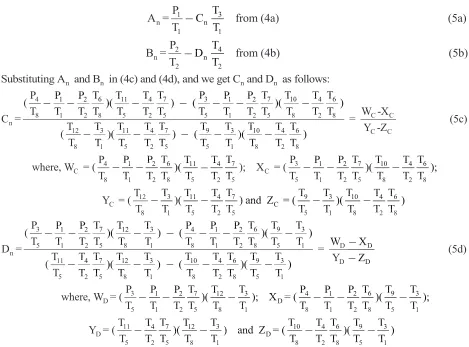
Substituting A and B in (4c) and (4d), and we get C and D as follows:
6 7 3 7 10 6
4 1 2 11 4 1 2 4
8 1 2 8 5 2 5 5 1 2 5 8 2 8 C C
n
3 7 9 3 10 6
12 11 4 4 C C
8 1 5 2 5 5 1 8 2 8
6 7
4 1 2 11 4
C
8 1 2 8 5 2 5
T T P T T T
P P P T T P P T
( )( ) ( )( )
T T T T T T T T T T T T T T W -X
C = = (5c)
T T T T T T
T T T T Y -Z
( )( ) ( )( )
T T T T T T T T T T
T T
P P P T T
where, W = ( )(
T T T T T T T
6
T T6
P44 P11 P22 TT6666666 T TT7777777 PP3333333 TT777777 TT101010101010 TT
( )( ) ( )( )
( )
( )
( 444 111 222 66666666666666 )((( 77777777777777 ))) (((( 33333333333333 77777777777 )))()(( 1010101010101010101010 666 )))
T T T T T T T T T T T T T T W
-( )( ) ( )( )
( )( ) ( )( )
6 T T66 T121212 TT3333333 T111 TT7777777 TT9999999 TT333333 TT101010101010 TT
( )( ) ( )( )
( 12121212 3333333333333 )((( 1111 7777777777777 ))) (( 9999999999999 33333333333 )()(( 1010101010101010101010 666 )))
T T T T T T T T T T
( )( ) ( )( )
( )( ) ( )( )
6 11 4 7
6 7
6 7
T6666666 T7777777 P44 P11 P22 TT66666 T TT77777
)(
4 1 2 66 77
4 1 2
4 1 2 666 777 T T T T )( T T T
3 1 2 7 10 4 6
C
5 1 2 5 8 2 8
3 7 9 3 10 6
12 11 4 4
C C
8 1 5 2 5 5 1 8 2 8
P P P T T T T
); X = ( )( );
T T T T T T T
T T T T T T
T T T T
Y = ( )( ) and Z = ( )( )
T T T T T T T T T T
0 6
P3 T7 T10000 T6666
P T T T
P3333333 T7777777 T101010101110 T66666
( )( );
( )
( )
( 33333333333333333 11 22 77777777777777777 )((( 11110110101101010101110110000 44 666666666666 )))
T T T T T T T
( )( )
( )( )
6
T T6
T121212 TT3333333 T111 TT7777777 TT9999999 TT333333 TT101010101010 TT
( )( ) and Z = ( )( )
( 1212 333)((( 1111 44 777 ))) (( 999 333 ))((( 101010 44 6 )))
C C
C C
6 6 12 3333 1 7777 9999 333 101010
12 1
12 33333 1 77777 99999 3333 10101010
T T T T T T T T T T
C C
C C (( )()( ))
C C
C C
C C
3 1 2 7 12 3 4 1 2 6 9 3
5 1 2 5 8 1 8 1 2 8 5 1 D D
n
7 3 10 6 9 3
11 4 12 4 D D
5 2 5 8 1 8 2 8 5 1
P P P T T T P P P T T T
( )( ) ( )( )
T T T T T T T T T T T T W X
D = = (5d)
T T T T T T
T T T T Y Z
( )( ) ( )( )
T T T T T T T T T T
6 9 3
P3 T7 T3 T66 T99 T33
P T T T
P3333333 T7777777 T3333333 T
( )( ) ( )( )
( )
( )
( 3333333333333333333 7777777777777777777 )(( 3333333333333333333 )) (((( 66666 ))())( 99999 33333 ))
T T T T T T T T T T T T
( )( ) ( )( )
( )( ) ( )( )
WD XD WDD XDD
(
D D
D D
D D
D D
( (
D D
YDD ZDD ((((
D D
3
( T0000 T6666 T9999 T33
T1111 T44 TT7777777 TT3333333 TT101011011010 TT66666 99999
( )( ) ( )( )
( )
( 111111 444 777777777777 )(( 1212 333333333333 )) ((( 11010101101011101010000000 44 66666666666666 )))(( 99999999999999 333 ))
T T T T T T T T T T
( )( ) ( )( )
( )( ) ( )( )
3 1 2 7 12 3 4 1 2 6 9 3
D D
5 1 2 5 8 1 8 1 2 8 5 1
7 3 10 6 9 3
11 4 12 4
D D
5 2 5 8 1 8 2 8 5 1
P P P T T T P P P T T T
where, W = ( )( ); X = ( )( );
T T T T T T T T T T T T
T T T T T T
T T T T
Y = ( )( ) and Z = ( )( )
T T T T T T T T T T
6 9 3
P3 T7 T3 T66 T99 T33
P T T T
P3333333 T7777777 T3333333 T
)( ); X = ( )( );
3 1 2 7 12 3 4 1 2 66 99 33
3 7 3
3 7 3
3 7 3
D D
D D
3 7 3 666 999 333
3 7 3
3 7 3
3 7 3
3 7 3
3 7 3
3 7 3
3 7 3
3 7 3
3 7 3
3 7 3
3 7 3
3 7 3
3 7 3
T T T T T T T T T T T T
D D
D D ( )(
D D
D D
D D
3 T0000 T6666 T9999 T33 T1111 T44 TT7777777 TT3333333 TT101011011010 TT66666 99999
( )( ) and Z = ( )( )
( )
( 11 4 777 )(( 1212 333 )) ((( 1010100 44 6666 )())( 9999 3 ))
D D
D D
0 6 9 3
0 6 9 3
0 6 9
0 6 9
0 6 9
11 4
11 4 777777777 333333333 10110101011110 66666 99999
T T T T T T T T T T
D D
D D (( )()( ))
D D
D D
D D
Substituting values of Cn and Dn from (5c) and (5d) in (5a) and (5b), values of An and Bn can be found.
Given the values of dimensions a and b, loading q, plate thickness, h, Young’s Moduli of plate, Ep, Beams, Ea and Eb, Moments of Inertia of beams, Ia and Ib, Poisson’s ratio, , numerical values of An, Bn, Cn and Dn are found out using Microsoft Excel for n = 1, 3, 5, 7…..
Verification of Excel software
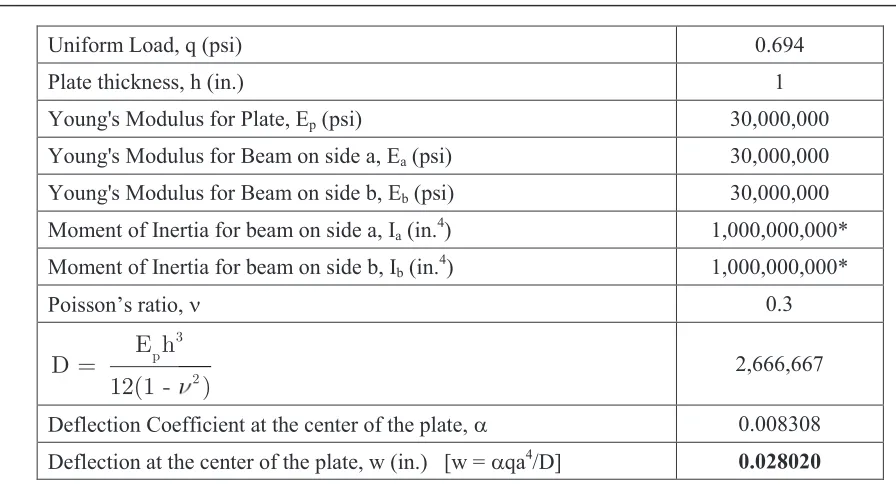
Let us consider an example: A rectangular plate simply-supported on four rigid edge beams with the input data (lengths of sides, load on plate, plate thickness, Young’s moduli, moments of inertia of the beams and Poisson’s ratio) shown in Table 1. Maximum deflection is calculated at the end of Table 1.
Table 1: Input data and maximum deflection.
Length in X-Direction, a (in.) 60
Uniform Load, q (psi) 0.694
Plate thickness, h (in.) 1
Young's Modulus for Plate, Ep (psi) 30,000,000 Young's Modulus for Beam on side a, Ea (psi) 30,000,000 Young's Modulus for Beam on side b, Eb (psi) 30,000,000 Moment of Inertia for beam on side a, Ia (in.4) 1,000,000,000* Moment of Inertia for beam on side b, Ib (in.4) 1,000,000,000*
Poisson’s ratio, n 0.3
3 p
2
E h
D =
12(1 - )
2,666,667
Deflection Coefficient at the center of the plate, a 0.008308 Deflection at the center of the plate, w (in.) [w = aqa4/D] 0.028020
*High values of Ia and Ib signify that the beams are robust and rigid, and thus the plate is effectively simply supported on its edges.
Table 2 provides a comparison of maximum deflections of plates with various a and b dimensions with the same boundary conditions (i.e., rectangular plates simply-supported on four rigid edge beams) as above. Results are almost the same as given in Table 8 of
Timoshenko and
Woinowsky-Krieger (1959).
Table 2: Comparison of maximum deflections - EXCEL vs. Timoshenko and Woinowsky (1959)* Short Side, a (in.)
(X-Direction)
Long Side, b (in.) (Y-Direction)
Deflections (in.) (Using Excel)
Deflections
(in.)* % Difference
60 60 0.013700 0.013694 -0.05%
60 72 0.019058 0.019023 -0.18%
60 84 0.023895 0.023779 -0.49%
60 96 0.028020 0.027995 -0.09%
60 108 0.031419 0.031401 -0.06%
60 120 0.034160 0.034167 0.02%
* Table 8, Timoshenko and Woinowsky-Krieger (1959)
CONCLUSIONS
1. Maximum deflections are calculated using classical plate theory formulation as given in Timoshenko and Woinowsky-Krieger (1959).
3. Fourier transformations (see Appendix A) have been used for hyperbolic functions in the equations.
4. No high speed computer is required to solve this problem.
5. Excel is commercial Microsoft software. No special skill is required to use this software.
6.
Commercial Finite Element software (such as SAP, STAAD, ANSYS, etc.) can be used to solve such problems. Unfortunately procurement of such software, and special training, skill and experience may not be always available to the advantage of the user.REFERENCE
Timoshenko, S.P. and Woinowsky-Krieger, S. (1959), “Theory of Plates and Shells,” International Student Edition,McGraw-Hill Book Company, Inc., Second Edition, New York.
APPENDIX A: Fourier Transformations
The following are Fourier transformations of cosh(n y) a
n y
( )
(n y), cosh(nπx) b ,
nπy y sinh( )
a and
n x x sinh( )
b
n x ) n x
in cosine series:
m
2 2 2 2
m=1,2,3,..
n y
b
b
(i) cosh(
), at interval range
< y <
a
2
2
2m y
2a
n b
4nab
n b
Fourier =
sinh(
) +
(
1) sinh(
)cos(
)
n b
2a
(n b + 4m a )
2a
b
n y
) at int
n y
2m
n b
4nab
n b
) +
(
1) sinh(
)cos(
2m
)
n b
4nab
n b
n b
4nab
n
m y
)
m y
sinh(
n b
(
2
b
< y
b
2
y
1) sinh(
)
m(
1) sinh(
mm m=1,2,3,..2 2 2
m=1,2,3,.
2 2
4m
22 2 2
2 2 2
2 2 2
2 2 2
4nab
4nab
2 2 2
2 2 2
(n b + 4
2222 2222 2222m
2 2 2 2
m=1,2,3,..
n
πx
a
a
(ii) cosh(
), at interval range
< x <
b
2
2
2b
n a
4nab
n a
2m
πx
Fourier =
sinh(
) +
(
1) sinh(
)cos(
)
n a
2b
π(n a + 4m b )
2b
a
n a
4nab
n a
2m
m
m
πx
) +
(
1) sinh(
)cos(
)
n a
4nab
n a
2m
n a
4nab
n a
2
m
πx
sinh(
n a
s
(
2
a
< x
a
2
1) sinh(
) s
m(
1) sinh(
mm m=1,2,3,..2 2 2
m=1,2,3,.
2 2 2
π(n a + 4m
2222 2222 22224nab
4nab
2 2
m
2 2 2 2 2 2 2
m=1,2,3..
2 2 2 2
2 2 2 2
n
πy
b
b
(iii) y sinh(
) at interval range
< y <
a
2
2
a
n
πb
a
nπb
2a b
Fourier =
cosh(
)
sinh(
) +
(
1)
2n
π
2a
n
π b
2a
(n b + 4m a )
n
πb
nπb
n b
4m a
nπb
cosh(
)
2
sinh(
)
a
2a
n b + 4m a
2a
+
b
< y
b
2
y
m
a
22nπb
2a b
22sinh(
) +
(
1)
2 2 2 2 2 2 2
2 2 2
a
nπb
b
2 2 2
2 2 2
2 2 2
2 2 2
(n b + 4m a )
2 2 2 22 22 22 22
2 2 2 2 2 2 2
2 2
2a
2 2 2 22 2 2
2 2 2
2 2 2
2 2 2
2 2 2
2 2 2
2 2 2 222 222
+
222b
)
b
2 2 2 2
4m a
2 2 2 2
2 2 2 2
4m a
b
2 2 2
2 2 2
2 2 2
2 2 2
2 2 2
2 2 2
n
πb
nπb
2
n
2 2 2
2 2 2
2 2 2
4
2 2 2
2 2 2
n b
22 22 22nπb
i h(
nπb
n
cosh(
n
πb
cosh(
n b
n b
22 224
4
22 222sinh(
sinh(
sinh(
)
m a
2 2 2
2 2 2
2 2 2
sinh(
sinh(
((
2a
2a
2a
n b + 4m
22222222222222 22222222222222 22222222222222cosh(
a
cosh((
(
2 2
m=1,2,3..
2 2
2 2
m=1,2,3..
(n b +
2a
2 2
2 2
2 2 2
2a
2 2 2
2 2 2
2 2 2
(n b +
2 2 22 2 2 2 2 2
2 2 2 2 2 2
2 2 2 2 2 2
2 2 2 2 2 2
2m
πy
cos(
)
b
2m
m
m
πy
cos(
cos
cos
s(
2m
m
πy
πy
cos
s(
2m
m
πy
coss(
b
s(
cos
2 2
m
2 2 2 2 2 2 2
m=1,2,3..
2 2 2 2
2 2 2 2
n x
a
a
(iv) x sinh(
) at interval range
< x <
b
2
2
b
n
πa
b
nπa
2ab
Fourier =
cosh(
)
sinh(
) +
(
1)
2n
π
2b
n
a
2b
(n a + 4m b )
n
πa
nπa
n a
4m b
nπa
cosh(
)
2
sinh(
)
b
2b
n a + 4m b
2b
n x
) at inte
n x
m=1,2,3..
a
2b
m=1(n a + 4m b )
a
< x
a
2
2 2
m
b
22nπa
2ab
22sinh(
) +
(
1)
2 2 2
b
nπa
n
2 b
2 2 2
2 2 2
2 2
sinh(
) +
2(
2 2 2 2 2 2 2
2 2 2
2 2 2
2 2 2
2 2 2
+ 4m b )
2 2 2 22 22 22 22
2 2 2 2 2 2 2
2 2
2b
2 2 2 22 2 2
2 2 2
2 2 2
2 2 2
2 2 2
2 2 2
nπa
(
nπa
nπa
)
a
a
)
)
2 2 2 2
4m b
2 2 2 2
2 2 2
4m b
2 2 2
2 2 2
2 2 2
2 2 2
2 2 2
n
πa
nπa
2
2
n
2 2 2
2 2 2
4
2 2 2
2 2 2
n a
22 22 22nπa
i h(
nπa
n
cosh(
n
πa
cosh(
n a
n a
222 2224
4
222 2sinh(
sinh(
sinh
sinh(
sinh(
)
cosh((
)
2b
(
)
(
2
22 22 22 222sinh(
)
m b
2 2 2
2 2 2
2 2 2
sinh(
sinh(
((
2b
2b
2b
n a
2222222222222 22222222222224m
2222222222222b
cosh(
(
b
(
2 2
2 2
2 2
m=1,2,3..
(n a +
m=1,2,3..2ab
2 2
2
2ab
22 2 2
(n a +
2 2 22 2 2 2 2 2
2 2 2 2 2 2
2 2 2 2 2 2
2 2 2
2m
πx
cos(
)
a
2m
m
m
π
2m
m
π
cos(
s(
cos
cos
cos
s(
2m
m
π