MOBILE LEARNING IN MALAYSIA
Rozita Abdul Jalil, Zaidatun Tasir
INTRODUCTION
NowAdays, mobile and wireless technologies are the fastest growing areas of technology. It offers an opportunity for learners to transcend the knowledge through accessing alternative source of information. Pocket size minicomputer; can be carried around easily; increases the pace and scale of attempts to innovate learning and teaching process. Through innovative technologies, one can develop learning applications, which will lead to a new learning model that offers people the opportunity to learn at anytime and anyway. A new era of mobility in learning can be achieved nowadays by using a mobile device, such as cell phones, tablet computers and smartphones.
educators. Therefore, a research on mobile learning in Malaysia context should be explored.
This paper has had five sections organized as follows. Section 1, Introduction, in section 2, mobile learning definition. Section 3, explore on the mobile operating system market (worldwide and Malaysia). Section 4 is an overview of mobile learning in Malaysia with a further look on government policy and selected research of technology acceptance and readiness and Section 5 is a conclusion.
MOBILE LEARNING
Mobile Learning has become more important in 21stcentury (Hwang & Tsai, 2011; Wu et al., 2012). Previous researcher has been conducting studies on the use of mobile technologies in education, where these technology-supported learning approaches recognized as Mobile Learning by researchers (Hwang & Tsai, 2011). Different researcher and organization give the different definition of mobile learning. A commonly accepted definition of mobile learning (M-learning) is using mobile technologies to facilitate and promote learning anywhere and at any time’ (Hwang & Tsai, 2011).
M-learning is a powerful approach to enhance learning experiences and engage learners by different learning situation. These few definitions share the same idea on how it applied in learning activities either classroom setting or any field. It becomes the current trend in future learning.
MOBILE OPERATING SYSTEM MARKET
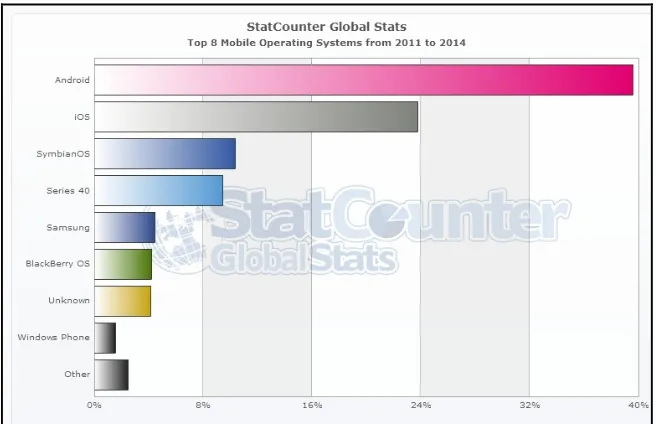
developer needs to determine the target Operating System (OS) platform for mobile learning. The market share visual presentation can provide the overview of the current trend of mobile operating system (m-OS). Figure 1 displays of top eight m-OSs' worldwide market share from year 2011 to 2014.The results show that Android and iOS clearly lead the table. Android conquer more than 40% of market share follow by iOS with 24%, and remaining SymbianOS, Samsung, Blackberry OS, Windows Phone and others. The graphic line display trend of the market is constantly changing and evolving throughout the year.
Figure 1 Mobile Operating System Worldwide from 2011 to 2014 (source :StatCounter Global Stats)
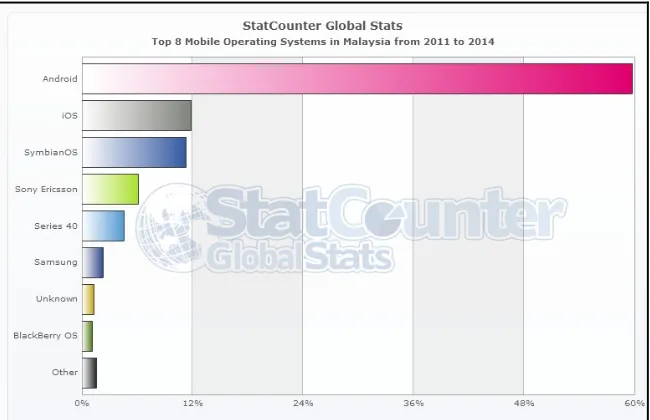
features give chance for the m-OSs' in low rated position to climb the top. Based from the previous figures, the most promising mobile OSs in Malaysia are Android follow by iOS. Both two m-OSs' to consider for any development of mobile learning in Malaysia.
Figure 2 Mobile Operating System in Malaysia from 2011 to 2014 (source :StatCounter Global Stats)
MOBILE LEARNING IN MALAYSIA
OVERVIEW OF GOVERNMENT EFFORT
progress PSPTN stages. Each of these CAPs has three main items (strategic objective, indicator, target) to be achieved through various planned activities. Mobile learning has been spot as one of CAPs and key Result Area (KRA) of MoE. In the context of developing country like Malaysia, using portable technologies as learning enhance technologies often remain unrealized.
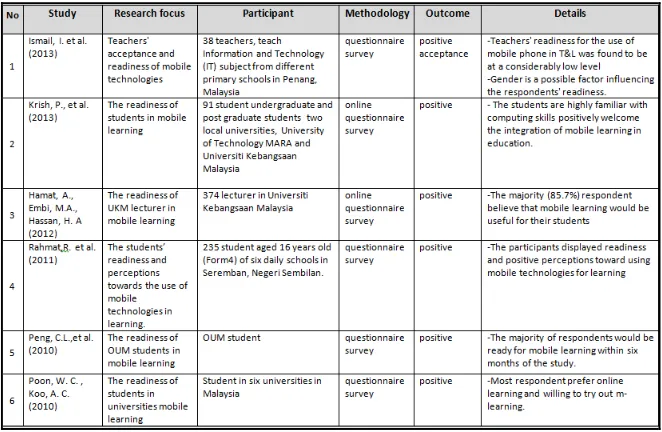
Malaysia Education Blueprint 2013-2025 is a new document by MOE on context of raising international education standards. This Blueprint written 11 strategic and operational shift of a vision of the government's aspiration of better preparing education system with consider student both needs and deserves. "Leverage ICT to scale up quality across Malaysia" in Shift 7, positively encourage the mobile learning technologies to grow. Therefore, a brief discussion of some selected research studies on technologies acceptance and readiness Mobile Learning in Malaysia is relevant here.
TECHNOLOGIES ACCEPTANCE AND READINESS
Figure 3 Analysis of selected studies on technologies acceptance and readiness Mobile Learning in Malaysia
CONCLUSION
Based on the availability of mobile technology globally, educators have had the opportunity to allow individuals from around the world to access educational resources to enable education for all. Facilitated by many initiatives, making educational resources available as open educational resources. Thus, it provides access to learning more affordable for anyone who wants to learn. The highest demand on mobile technology in the worldwide market with the support by government gives opportunities for more and more mobile learning development. Readiness of learners and educators to facilitate the transformation of education using mobile technology is aligned with the needs of learners in the 21st century through the concept of New Academia.
REFERENCES
Hamat, A., Embi, M. A., & Hassan, H. A. (2012). Mobile Learning
Readiness Among UKM Lecturers. Procedia - Social and
Behavioral Sciences, 59(0), 406-410.
Hwang, G.-J., & Tsai, C.-C. (2011). Research trends in mobile and ubiquitous learning: a review of publications in selected journals
from 2001 to 2010. British Journal of Educational Technology,
42(4).
Ismail, I., Bokhare, S. F., Azizan, S. N., & Azman, N. (2013). Teaching via mobile phone: A case study on Malaysian teachers'
technology acceptance and readiness. Journal of Educators
Online, 10(1).
Krish, P., Hussin, S., Manap, M. R., & Amir, Z. (2012). Mobile learning readiness among Malaysian students at higher learning institutes.
Asian Social Science, 8(12), 276-283.
Kukulska-Hulme, A. & Traxler, J. (2005). Mobile learning: A hand
book for educators and trainers.Routledge.
Ministry of Education, Malaysia(2013). Malaysia Education
http://moe.gov.my
Ministry of Education, Malaysia(2013). Executive Summary
Malaysia Education Blueprint 2013-2025.Retrieved Jun 2014,
from http://moe.gov.my
Rahamat, R., Shah, P.M., Din, R., Aziz, J. (2011) Students`
Readiness and Perceptions Towards Using Mobile Technologies for Learning the English Language Literature Component. English Teacher, 40 (pp 69)
Peng, C. L., Abas, Z. W., Goolamally, N. T., Yusoff, Y., & Singh, H. K. D. (2010). Implementation of mobile learning at the Open
University Malaysia Mobile Technologies and Handheld Devices
for Ubiquitous Learning: Research and Pedagogy (pp. 170-186):
IGI Global.
Poon, W. C., & Koo, A. C. (2010). Mobile learning: The economics
perspective. International Journal of Innovation and Learning,
7(4), 412-429.
Wu, W.-H., Wu, Y.-C. J., Chen, C.-Y., Kao, H.-Y., Lin, C.-H., & Huang, S.-H. (2012). Review of trends from mobile learning studies: A