1,2,4,5,
Faculty of Education, Universiti Teknologi Malaysia, 81030 Johor Bahru, Malaysia. 3
Faculty of Chemical Engineering, Universiti Teknologi Malaysia, 81030 Johor Bahru
Assessment
for
Learning :
Supervisory Feedback Practice in Higher Education
Rohaya Talib1
Hawa Syamsina Md Supie2
Mohd Zaki Kamsah3
Hamimah Abu Naim4 Sanitah Mohd Yusof5
ABSTRACT
Assessment for learning is a term used to denote a continuous assessment of student’s
progress with accompanying feedback to improve learning. So, this paper aims to investigate
the assessment feedback (AFB) practices among supervisors in one of Higher Education (HE)
institutions in Malaysia on three specific dimensions; Timeliness, Meaningfulness and
Specificity. It also examined the significant mean difference of perceived Supervisory AFB
practices in relation to postgraduate (PG) students’ gender, mode of study (MOS) and field of
study (FOS) using cross-sectional survey design. A total of 306 PG students who were
currently pursuing their research studies have been selected using multistage cluster sampling
technique. A self-developed instrument known as Supervisory Assessment Feedback
Questionnaire (reliability index .92) which consisted of 38 items was used to collect the data.
Overall result shown that Supervisory AFB practices were at the highest level for
Meaningfulness (M=4.35, SD = .69), followed by Timeliness (M=4.35, SD =.69) and finally
Specificity (M=3.85, SD= .53). The AFB forms practiced among supervisors resulted in
verbal form (M=2.87, SD= .69) higher compared to written (M=2.77, SD= .71) meanwhile
the PG students’ preferences were in both. Besides, the supervisory AFB practiced seems to
be significantly differed on gender factor. In summary, these results revealed some insight to
be considered in order to establish an effective Supervisory AFB practice in Malaysian HE.
INTRODUCTION
Assessment for learning (formative assessment) is vital to ensure the quality of teaching and
learning particularly in Higher Education (HE). The continuous/ regular mode of checking
student’s progress with accompanying feedback is to improve the student’s performance.
Basically, the aim of feedback is to enable the gap between the actual level of performance
and the desired learning goal to be bridged (Lizzio & Wilson, 2008). Within the
socio-constructivist paradigm, feedback is seen as facilitative which involves provision of
comments and suggestions to enable students to make their own revisions and through the
dialogue which helps students to gain new understanding. According to Berry (2008), when
assessment is for learning, it takes a bigger importance to include social communication
between educator and students while Brown (2004) stated that assessment for learning is
fundamental when the impacts of appraisal practices are based on progressiveness as opposed
to being judgmental.
Much has been discussed about the principles of good assessment and feedback practice
but there is no general agreement regarding what type of feedback is most helpful and why
(Nelson and Schunn, 2009). A number of writers have argued that AFB is
under-conceptualized in the theoretical literature in HE and that makes it difficult to design effective
feedback practices (Yorke, 2003). Most approaches to feedback remained persistently
focused on simple ‘transmission perspectives’ – educators transmit feedback messages to
students about strengths and weaknesses in their work assuming that these messages are
easily decoded and turned into action which underpinned by narrow conceptions of the
purposes of feedback (Maringe, 2010).
Along with teaching the students what the lecturers/supervisors desired and what is
emphasized to satisfy the requirements set by the courses, AFB is seen as a crucial way to
facilitate students’ development as independent learners who are able to monitor, evaluate
and regulate their own learning, allowing them to feed-up and go beyond graduation into
within assessment design, occurring within and beyond the immediate learning context, being
overt or covert (actively and/or passively sought and/or received), and importantly, drawing
from a range of sources. While Berry (2008) recommended that the guiding principles for
making effective assessment is to provide precise and constructive feedback to students
learning. Furthermore, AFB is also viewed as a system for guidance which gave assurance
and the importance of student-supervisor dialogue with available or approachable supervisor
in the process. Most university tutors concurred that AFB is a consistent dialogue within a
cyclical assessment (Beaumont et al., 2011). Within the context of this study, supervisors
should play an important role in facilitating high-quality feedback to optimize learning. As
for that, Brown (2004) pointed out that AFB given to student needs to be detailed,
comprehensive, meaningful to the individual, fair, challenging and supportive, which is a
tough task for busy academicians. Even though it is time-consuming, it is significant that
effort must be invested in helping students to understand not only where they have gone
wrong but also what they need to do to improve.
Higgins et al (2002) mentioned the challenges of AFB in today’s HE. For example,
students with workload may not have ample time to reflect on the feedback. Then, if the
feedback is subject-specific, it might be hard for the students to develop further skills for their
future learning. Furthermore, if the feedback is not timely, then it may be distanced from the
given assignments. Some empirical evidence stated that students perceive AFB negatively if
it is rendered in the form of personal critique, not specific and vague to any of formative uses
(Higgins et al., 2002). As noted by Blair and McGinty (2010), students faced problems to
understand feedback while the lecturers are having problems to provide good feedback to
assist their students. On the supervisors’ perspective, Beaumont et al (2011) found that most
of the university lecturers agreed that AFB need to be specific and detailed. Supported by the
study of Berry (2008), comprehensive and timely AFB is important for students to achieve
students as soon as possible after the assignment is submitted (Higgins et al., 2002). In most
cases, the incomprehensible/ignored feedback is caused by overdue AFB. Another scenario,
study done by Tamby Subahan and Lilia (2011) indicated that lecturers at the university are
often too occupied to provide AFB, total size of class and the assorted nature of their work
have prevented them to write the AFB and return promptly. So, they elicited the use of peer
to strategize AFB in learning and what kind of changes they would prefer. A similar report to
this was a reflection done by Hattie (2009) where he realized that lecturers typically did not
provide AFB to the students although they claimed they did all the time. Also, Carless et al
(2011) argued that AFB is clearly a critical issue which need further investigation although
the student evaluations of AFB reflect wider concerns on lecturers-student relationships
rather that the nature of promoting learning in HE. Rosaitimah and Mohd Afiq (2013) in
their study related to AFB among accounting students discovered that AFB is not given on
the ideal time and beyond the way the students expected it being communicated to them.
After a systematic reviewing, there is a dire need to revisit the AFB practice particularly
among supervisors in HE since AFB is an inevitable part of assessment for learning.
In the context of this study, the term AFB conceptually refers to the information or the
comments received by PG students from their supervisors from three dimensions;
Meaningfulness, Timeliness, and Specificity to further improve their research work also for
the purpose of research completion. Therefore, the aims of the study are; i) to examine the
perceptions of PG students towards Supervisory AFB practice from three dimensions
(Meaningfulness, Timeliness and Specificity), ii) to investigate the form of AFB practiced
by PG students’ supervisors (verbal, written, or both form), iii) to investigate the preference
of AFB forms among PG students, and iv) to investigate the mean difference among PG
METHOD
This study utilized cross-sectional survey design. The target population is 9760 PG
students on the enrollment list. The researchers employed multi-stage cluster sampling
method with 5.0% margin of error. The population firstly narrowed down based on the norm
of graduation, 1464 students enrolled for final semester for 2014/2015 academic year. The
second stage was done based on fields of study; i) Social Science, ii) Engineering, and iii)
Science and Technology. Based on Krejcie and Morgan Table (1970), finally, a
representative sample of 306 PG students who were currently pursuing their research studies
were randomly selected. A set of self-developed Supervisory Assessment Feedback
Questionnaire (SAFBQ) is used with 38 items consists of five sections; 1) Section A:
Perception on Supervisory AFB practice (6 point Likert-type Agreement Scale: Strongly
Disagree – Strongly Agree), 2) Section B: Forms of AFB Practiced by Supervisors (5 point
Likert-type Frequency Scale : Never - Always), 3) Section C: Preferences on AFB (3
Closed-ended Question : Written, Verbal, Both), and 4) Section D: Demographic : Gender, MOS and
FOS. SAFBQ which was ensured its content validity by panel experts were then distributed
to 37 respondents for pilot study. The data were analyzed for dimensionality based on Rasch
Analysis which resulted reliability index at .92. Four items were determined to be
inappropriate, thus, they were deleted and SAFBQ was improved for actual study. The
SAFBQ were then both distributed manually and administered online upon request. The raw
data obtained were processed and analyzed through SPSS software for descriptive and
inferential statistics.
RESULTS
Perceptions on Supervisory Assessment Feedback Practice
SAFBQ was analyzed based on 306 PG students from three different fields of study with a
100% response rate. Table 1 illustrates the PG students’ agreement on the AFB given by
by Timeliness (M=4.35, SD= 69) and finally by Specificity (M=3.85, SD= .53). Although
Meaningfulness dimension has the highest mean but it has the largest dispersion of
agreement. In contrast, Specificity has the lowest mean of all three dimensions yet it has the
smallest dispersion of scores.
Table 1 : Level of Perception towards AFB on Three Dimensions (N=306)
Dimensions M SD
Meaningfulness 4.78 .71
Timeliness 4.35 .69
Specificity 3.85 .53
*Based on a 6-point Likert-type scale
Assessment Feedback Forms Practiced by Supervisors
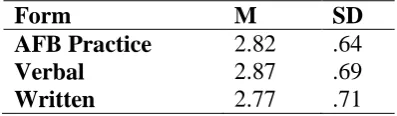
Overall mean score showed that AFB practiced by the supervisors are at the level of
‘sometimes’ (M=2.82; SD= .64). In terms of forms of AFB, the verbal form (M=2.87; SD=
.69) practiced is slightly higher than the written form (M=2.77; SD= .71) as the result shown
in Table 2.
Table 2 : Form of AFB Practiced by the Supervisors (N=306)
Form M SD
AFB Practice 2.82 .64
Verbal 2.87 .69
Written 2.77 .71
*Based on a 5-point frequency scale
Preferences on Assessment Feedback
Analysis on Table 3 showed that a total of 88.9% (272/306) of the PG students prefer to
have both verbal and written form of AFB from their supervisors. Only 8.5% (26/306) and
2.6% (8/306) would like to have AFB by their supervisors in the form of only written and
only verbal respectively.
Table 3 : AFB Form Preference (N=306)
AFB Form f Percentage
Verbal 8 2.6%
Written 26 8.5%
Perceptions Towards AFB Based on Demographic Factors
A statistical test was conducted to determine any significant mean differences on three
demographic factors - independent t-test for gender, ANOVA one-way for mode of study
(MOS) and field of study (FOS). It was found that only gender factor resulted in a significant
mean difference of Supervisory AFB practice. The results were generated after a few tests on
normality and homogeneity assumptions were met. Firstly, the data was tested for normality.
The original mean for male (4.21) had minimal difference with the new 5% trimmed mean
(4.23). The result shown for the mean of female, the original mean (4.38) had very minimal
difference with the new trimmed mean (4.39). Hence, the assumption for normality is not
violated. The study further conducted Levene’s Test for Equality of Variances. The t-test
resulted as F=2.635, p > 0.05, which suggest equal variances assumed and assumption for
homogeneity is fulfilled.
Table 4 : Independent T-test of Perception towards AFB Based on Gender Levene's Test for
Equality of Variances
T-test for Equality of Means
F Sig. t df Sig. (2-tailed)
Mean Difference
Std. Error Difference
AFB
Equal variances
assumed 2.635 .106 -2.868 304 .004* -.17989 .06271 Equal variances
not assumed -2.763 202.001 .006* -.17989 .06510
*p=0.05
The result in Table 4 clearly shown that there was a significant mean difference in
perception towards Supervisory AFB practice due to gender factor - Male (M=4.21, SD=
.57); Female, (M=4.38, SD= .49); t (304) = -2.86, p = .004(two-tailed). In conclusion, gender
influences the perceptions of Supervisory AFB practice in PG students’ current research
DISCUSSIONS
As to address the objectives of the study, Supervisory AFB was looked from three
dimensions; Meaningfulness, Timeliness and Specificity. These three dimensions were
highlighted by several researches to be investigated since students have perceived it as
unclear, lack of guidance, hardly understandable, not timely, and not specific enough to make
improvement (Higgins, Hartley & Skelton 2001; Spiller, 2009; Duncan, 2007; Hounsell,
2007). However, the findings in this study shown an agreement on Supervisory AFB highly
on meaningfulness and timeliness. Meanwhile, Specificity seems to be the lowest agreement
in AFB given by the supervisors. Meaningfulness achieved the highest perceived AFB could
be related to the practices of the AFB itself. This is agreed by Rust et al (2005) who stated
that a social constructivist approach to attain significant comprehension of assessment obliges
a dynamic engagement with the criteria by both lecturers and students. Timeliness was
perceived the second next due to the understanding that timely AFB helps them to make
improvements (Higgins et al., 2002). However, if the feedback is not timely, then it may be
distanced from the given assignments. On the other hand, Specificity is the least agreed AFB
could be caused by supervisors who are too focused on judging the grades and marks-focused
feedback. In this context, the PG students might understand why they have to improve on yet
not so much on what/where to progress. This will hinder the PG students from making further
improvements. This is in agreement with what Glover & Brown (2006) mentioned that most
feedback only shows what are the expected answers but lacking to explain why. This is also
agreed by Higgins et al (2001) that some feedback given were just lack of specific advice on
how to improve. The lack of specificity in providing AFB could cause the students to
misunderstood the AFB. Hence, supervisors should take the initiative to give specific
comments to improve AFB provided to the students as this motivates them to make further
improvements. In fact, supervisors must comprehend how the students perceive feedback
future practice and development of students’ identity as learners as highlighted by Eraut
(2006);
When the students enter HE, the type of feedback they receive intentionally / unintentionally will play an important part in shaping their learning futures. Hence, we need to know much more about how their learning, indeed their very sense of professional identity is shaped by the nature of the feedback they receive. We need more feedback on feedback.
AFB can be given in the form of verbal or written comment. Referring to the results, the
written form and verbal is practiced almost equally. This could be caused by the consultation
sessions whereby the lecturers provided both forms of feedback simultaneously and not in
isolation. However, when the items were analyzed separately, it was made apparent that
verbal form was practised most by the supervisors. This is due to discussions via meetings
was the nature of AFB practiced for the current population. Another reason for this result is
that various supervisors practiced different form of AFB which is more practical between
them and their students. Perhaps, the PG students’ perceptions towards AFB practice should
also take into consideration of the supervisors’ point of view. In addition, supervisors are
advisable to utilize various medium such as reaching the students virtually through social
media other than merely practicing the traditional supervisor-students meetings. This will add
on the frequency as well as the impact of the supervisory AFB on students’ progress.
The AFB form preferred by the respondents is useful to determine whether what is desired
by the PG students is practiced by the supervisors. The PG students prefer to have both
verbal and written form of AFB, but this is not what actually practiced among supervisors of
PG students. Supervisors tend to provide verbal AFB more compared to written AFB. This
further justifies the low specificity mean of scores on the PG students’ perception towards
AFB. Blair and McGinty (2010) found that in the PG students’ perspective, they are facing a
hard time to refer back to the given oral feedback. Additionally, Hattie and Timperley (2007)
gap between the intended goal of learning and their current state, specificity has to be
addressed in both forms.
The result also showed a significant mean difference of AFB perceptions based on
genders, but not for mode of study (MOS) and field of study (FOS). It shows that male and
female has different view of how they perceived AFB provided by their supervisors. Female
depicted significant mean difference compared to male as female tends to be more emotional.
This is opined by Higgins et al (2001) that students make an emotional effort on their work
progress so they expect a “return” on the investment. So, the females tend to have an
emotional state of mind when perceiving AFB. Hence, it is recommended for the supervisors
to employ a balanced practice of the form of AFB to their PG students. It is best for
supervisors to improve their duration on giving assessment feedback to the supervisee.
Supervisors should make time to provide AFB since students have the tendency to get
emotional on the feedback of their research progress. A well-balanced and well-practiced
AFB encourages students to continuously construct their own learning and to counter the
dissatisfaction of students on AFB practice in HE.
Finally, it is recommended that the faculty/university to have a dialogue between the
supervisors and the PG students as to what they comprehend on the purpose of supervisory
AFB. This will serves the purpose of nurturing a mutual understanding of AFB among them.
On top of that, an effective design of supervisory AFB is recommended to improve the
implementation of AFB in HE.
CONCLUSIONS
This study has given an account of PG students’ perceptions towards AFB which is vital in
HE as the students are engaged in the learning process. Therefore, there is a need to develop a
comprehensive mechanism to cater the Outcome-Based Education (OBE) since the
assessment is created to support the intended outcome. OBE proposes that students are
was taught. Therefore, the standard of students in HE can be achieved through a
comprehensive practice of AFB. The academic and the social experience incorporated in
completing research work assist students’ development and AFB contributes part of that
experience. Intellectual, spiritual, emotional, and physically fit student can be the product of
HE for a better human capital development. AFB has to be aligned to its theoretical ground
with respect to what is preferred and practiced in the teaching and learning process. This is to
ensure an upright assessment is implemented for an effective learning progress. AFB
supposed to be meaningful, timely and specific enough for students to move on to the next
stage of the learning process. Consequently, a good practice of AFB is designated to provide
PG students with the best opportunities in improving as well as completing their research
works successfully within the time frame.
ACKNOWLEDGMENTS
We wish to thank various parties for their contributions to this study; Ministry of Higher Education (MOHE- Exploratory Research Grant Scheme Vot No : 4L109), School of Postgraduate Studies, UTM and the PG students for providing the data needed for this study.
REFERENCES
Brown, S. (2004). Assessment for learning. Learning and teaching in higher education, 1(1), 81-89.
Berry, R. (2008). Assessment for learning. Vol. 1. Hong Kong University Press. Beaumont, C, O’ Doherty, M. & Shannon, L.. (2011) Reconceptualising
Assessment Feedback: A Key to Improving Student Learning? Studies in Higher Education 36 (6), 671-687.
Blair, A. and McGinty, S. (2010), 'It's Good to Talk? Developing Feedback Practices', Gateway Journal, 1, 18-26
Carless, D. et.al. (2006) How Assessments Supports Learning.: Learning-Oriented Assessment in Action. Hong Kong: Hong Kong University Press
Carless, D. et.al. (2011) Developing Sustainable Feedback. Studies in Higher Education 36 (4), 395-407
Duncan, N. (2007). Feed-Forward: Improving Students’ Use of Tutor Comments.
Assessment & Evaluation in Higher Education, 3, 271-283.
Evans, C. (2013). Making Sense of Assessment Feedback in Higher Education.
Review of Educational Research, 83 (1), 70-120.
Eraut, M. (2006). Feedback . Learning in Health and Social Care, 5, 111-118.
Ferguson, P. (2011). Students Perceptions of Quality Feedback in Teacher Education.
Glover, C. & Brown, E. (2006). Written Feedback for Students: too much, too
detailed or too incomprehensible to be effective? The Higher Education Academy Journal, (7)
Hattie, J. (2009). The Black Box of Tertiary Assessment: An Impending
Revolution. In L. H. Meyer, S. Davidson, H. Anderson, R. Fletcher, P.M. Johnston, & M. Rees (Eds.), Tertiary Assessment & Higher Education Student Outcomes: Policy,
Practice & Research (pp.259-275). Wellington, New Zealand: Ako Aotearoa Hattie (2009) Visible Learning: A Synthesis Of Over 800 Meta-Analyses Relating
To Achievement. New York: Routledge
Higgins, R., Hartley, P. & Skelton, A. (2002) The Conscientious Consumer: Reconsidering The Role of Assessment Feedback in Student Learning.
Studies in Higher Education 27 (1), 53-64.
Hounsell, D. (2003) Student Feedback, Learning And Development, in: M. Slowey & D. Watson (Eds). Higher education and the lifecourse. Maidenhead:Open University Press.
Krejcie, R. V., & Morgan, D. W. (1970). Determining Sample Size For Research Activities.
Educational and Psychological Measurement, 30, 607-610.
Lizzio, A, & Wilson, K. (2008). Feedback on Assessment : Students’ Perceptions of Quality and Effectiveness. Assessment and Evaluation in Higher Education, 33, 267-275. Nelson, M.M., & Schunn, C.D. (2009). The Nature of Feedback. How different Types of
Peer Feedback Affect Writing Performance. Institutional Science, 37, 375-401. Nicol, D. & Macfarlane-Dick, D. (2004). Rethinking Formative Assessment in HE : A
Theoretical Model and Seven Principles of Good Feedback Practice. Centre for Academic Practice, University of Strathclyde.
Perkins, D. (1999). The Many Faces Of Constructivism. Educational Leadership. 5(3), 6-11.
Rosiatimah Mohd Isa & Mohd Afiq Azero (2013). Assessment Feedback to Accounting Students. Procedia-Social and Behavioral Sciences (90), 651-659 Rust, C., O’Donovan, B. & Price,M. (2005) A Social Constructivist Assessment
Process Model: How The Research Literature Shows Us This Could Be Best Practice.
Assessment and Evaluation in Higher Education 30 (3), 231-240
Spiller, D.(2009). Assessment: Feedback to Promote Student Learning. Accessed online February 19, 2014 from
http://www.waikato.ac.nz/tdu/pdf/booklets/6_AssessmentFeedback.pdf Swan, K. A. (2005) constructivist model for thinking about learning online. In J.
Bourne & J. C. Moore (Eds), Elements of Quality Online Education: Engaging Communities. Sloan-C, Needham, MA,.
Tamby Subahan Mohd Meerah & Lilia Halim (2011) Improve Feedback on
Teaching and Learning at the University through Peer Group. Procedia-Social and Behavioral Sciences (18), 633-637.