G
UIDELINES FOR THEP
REPARATION ANDS
UBMISSION OFW
ORKS
CHEDULE FORC
ONSTRUCTIONP
ROJECTRosli Mohamad Zin
*, Mohamad Ibrahim Mohamad,
Shaiful Amri Mansur, Donald Chan Bing Tee
Construction Technology Management Research Centre (CTMC) 1Universiti Teknologi Malaysia, 81310 UTM Skudai, Malaysia
*
Corresponding author: [email protected]
ABSTRACT: The lack of standardised guidelines for the preparation and submission of work schedule has contributed to several problems in construction project especially the extra efforts that have to be put in before parties involved in the project accept the work plan. This paper explores the current practice in project scheduling in the Malaysian construction industry and proposes guidelines that will alleviate the current problems in project scheduling. The methodology adopted was through interviews and questionnaire survey. The questionnaire survey findings form a basis for the formulation of the proposed guidelines. It consists of four main aspects of project scheduling which are process of acceptance of work schedule, responsibilities of the contracting parties, application of work schedule, and implications of work schedule. With the establishment of the guidelines a standardised approach for the preparation and submission of work schedule can be achieved thus minimising some of the problems that are currently hinder the full application of project scheduling. The proposed guidelines will pave the way for the inclusion of work schedule as part of the contract document.
Keywords: Work Schedule, Guideline, Construction Contract
1.0 Introduction
(Sundra Rajoo, 2000; Harban Singh, 2004). These clauses are Sub-clause 3.4 to 3.6: PAM’98 Forms (with and without quantity), Clause 5: CIDB Form, and Clause 7: IEM Condition of contract for Mechanical and Electrical contract works.
In general there are no detail guidelines that can be used for the purpose of preparing and submitting the work schedule. However the clauses stated above provide some general information on this matter. For example under Clause 5.1(a): CIDB Form (CIDB, 2000), it is stated that:
The contractor shall no later than Date of Commencement submit for
the approval of the Superintending officer a work programme related
to the Time for Completion, clearly identifying the sequence, logic and
critical path in which he proposes to carry out the works, including the
various work activities and milestones to be achieved…
Likewise, under Clause 7.1: IEM.ME 1/94 Form (IEM, 1994), it is stated that:
The contractor shall submit to the engineer for his approval the Programme which include the sequence and timing in which the contractor proposes to carry out the works (including the design, manufacture, delivery to site, erection, testing and commissioning, The times when submission and approval of the contractor’s drawing are required, and the times by which the contractor requires the employer: 1. to furnish any drawings or information
2. to provide access to site
3. to have completed any necessary civil engineering or building work, to be provided by the employer
4. to have obtained any way leaves, consents and approvals necessary for the construction of the works
2.0 Methodology
The study was carried out in two main stages. The initial stage involved interviews to experienced individuals that have sound knowledge in planning. The next stage involved questionnaire survey to active players in the construction industry. The respondents were selected randomly that represent the clients, consultants, contractors, subcontractors and academicians who have at least several years of experience in the construction industry.
2.1. Design of Questionnaire and Analysis of Data
The final questionnaire was developed after a series of initial interviews and information gathered from literature. Recommendations solicited through these initial queries formed the base for refining the final questionnaire. The questionnaire comprised five parts; the first part consisted of general question such as the current practice of project scheduling and the common problems that occurs. The second part consisted of questions related to the acceptance of work schedule as a formal contract document. The third part consisted of questions related to responsibilities of the client and contractor once work schedule has been prepared. The fourth part dealt with the level of application of work schedule in project implementation. The last part consisted questions related to the right of each parties involved in the project. A Likert type scale comprising five points (Strongly Disagree to Strongly Agree) was provided against each question for the respondents to evaluate.
The data collected from the questionnaire survey exercise were analysed using the frequency analysis and Relativity Index. The Relativity Index can be calculated by using the following equation:
N1(1) + N2(2) + N3(3) + N4(4) + N5(5)
R.I = ---
N(5) (1)
Where,
R.I. = Relativity Index
N1 = Number of respondents choosing 1 (strongly disagree)
N2 = Number of respondents choosing 2 (disagree)
N3 = Number of respondents choosing 3 (neutral)
N4 = Number of respondents choosing 4 (agree)
N5 = Number of respondents choosing 5 (strongly agree)
3.0 Results and Discussion
During the initial stage of the study, five respondents participated in the interview sessions. Two of the respondents at the time of the interviews were working with Class A contractor and have more than 20 years of experience. The other three individuals were a lecturer and two senior engineers. Based on the preliminary interviews it was found that scheduling has been an important element of project planning. The most common scheduling techniques used in project planning and scheduling are the Bar Chart and Critical Path Method. The purpose of having work schedule is for monitoring work progress, cost, materials and work sequence. It seems that the current practice in project scheduling have been found to be quite effective. Nevertheless there are still weaknesses in term of formal guidelines for the preparation and submission of work schedule.
In the questionnaire survey exercise the respondents were mainly targeted to those based in Kuala Lumpur, Perak, Sarawak, and Johor. There were four critical areas that had been investigated with respect to the preparation and submission of work schedule namely process of acceptance, responsibilities of contracting parties, application of work schedule, and implications of work schedule.
3.1 Process of Acceptance
Table 1 shows the response to the question related to preparation of work schedule. It can be seen that majority of respondents agreed work schedule should be prepared and updated continuously before the final schedule is accepted by the client and contractor. The contractor should take the responsibility to prepare the work schedule while the client will do the final checking. Work schedule has to be prepared by someone with vast knowledge and experience in planning and scheduling. This will minimize error during the early stage of the schedule development.
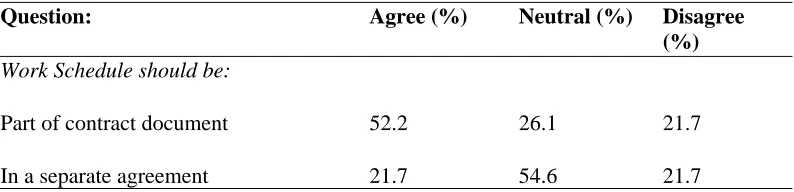
In term of the legality of work schedule, the result of the survey as shown in Table 2 shows that work schedule should be considered as part of the contract document. The scope of project scheduling should include the as-planned and as-build schedules while network technique should be adopted. It is also agreed that the work schedule produced through the usage of planning software is preferable by the respondents (refer to Table 3). The survey also confirmed that Bar Chart should only be limited to representation of main work activities.
Table 1: Preparation of work schedule
Questions:
Agree (%) Neutral (%) Disagree (%)
Work Schedule should be:
Prepared and updated until
thecontracting parties agree 91.3 4.4 4.3
Reviewed by client 87.0 8.7 4.3
Part of contractor’s responsibility 69.6 26.1 4.3
Prepared by someone qualified 65.2 26.1 8.7
Table 2: Work schedule and the contract
Question: Agree (%) Neutral (%) Disagree
(%) Work Schedule should be:
Part of contract document 52.2 26.1 21.7
In a separate agreement 21.7 54.6 21.7
Table 3: Form of work schedule
Questions: Agree (%) Neutral (%) Disagree (%)
Work schedule should be in the form of:
As-planned and as-built 73.9 26.1 0.0
Network type 69.6 26.1 4.3
Computer generated schedule 78.3 14.3 17.4
Bar Chart (for showing main activities only)
Table 4: Cost of preparation
Question: Agree (%) Neutral (%) Disagree (%)
Cost of preparing work schedule should be:
Included in the tender price 78.3 13.0 8.7
Reviewed by the client 56.5 26.1 17.4
3.2 Responsibilities of the Contracting Parties
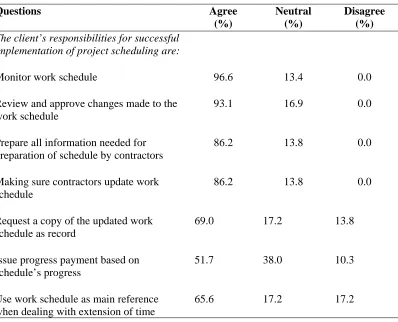
Table 5 shows the opinion of the respondents on the responsibilities of the client for successful implementation of project scheduling. It can be seen that majority of the respondents agreed that the client should keep a copy of an updated schedule and must ensure that the contractor update the schedule. The client needs to review and approve changes made to the schedule and monitor its implication. When there is request for extension of time, work schedule should be used as main source of information for evaluating the request. The client should also make progress payment based on schedule’s progress. It is also noted the client should provide all necessary information to the contractor for preparation of work schedule.
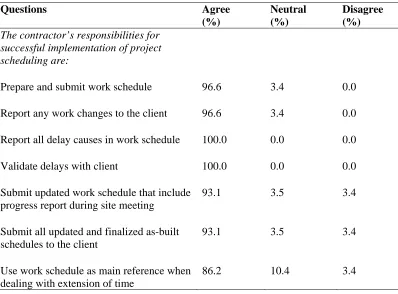
On the questions related to responsibilities of the contractor, the results of the survey are shown in Table 6. A high percentage of the respondents agreed that the contractor should prepare and submit work schedule prior to the start of project which is in line with the requirements under the CIDB or PAM contract. The contractor is also required to report to the client of any changes to work schedule, record and inform all delays, validate the delays, submit updated work schedule with progress report during site meeting, and submit all updated and finalised as-built schedules.
3.3 Application of Work Schedule
The results of the analysis on the application of work schedule are as shown in Table 7 to 10. Table 7 shows the application of work schedule in resource management. A high majority of the respondents agreed that work schedule must be used for resource planning. Slightly above half of respondents were in the view that the contractor must state clearly the resources used and updating of resources must be supported with proof of records.
show that the contractor should update the work schedule daily and submit to the client on a monthly basis.
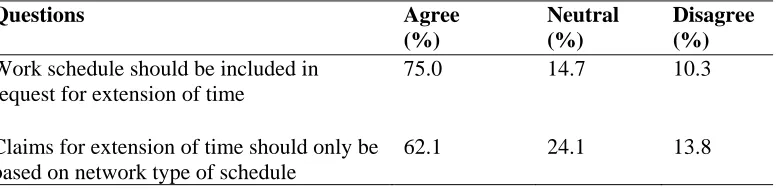
As for the application of work schedule in progress payment and claims for extension of time the results of the survey are shown in Table 9 and 10. The findings show that work schedule should be used as a reference for progress payment evaluation. Thus, progress payment claim made by the contractor should be based entirely on the work schedule. The work schedule should also be referred to when request for extension of time is made. The result of the study shows that more than 50% of the respondents agreed on this matter. It is also agreed that only as-built schedule based on network technique should be submitted when applying for extension of time.
Table 5: The client’s responsibilities
Questions Agree
(%)
Neutral (%)
Disagree (%) The client’s responsibilities for successful
implementation of project scheduling are:
Monitor work schedule 96.6 13.4 0.0
Review and approve changes made to the work schedule
93.1 16.9 0.0
Prepare all information needed for preparation of schedule by contractors
86.2 13.8 0.0
Making sure contractors update work schedule
86.2 13.8 0.0
Request a copy of the updated work schedule as record
69.0 17.2 13.8
Issue progress payment based on schedule’s progress
51.7 38.0 10.3
Use work schedule as main reference when dealing with extension of time
Table 6: The contractor’s responsibilities
Questions Agree
(%)
Neutral (%)
Disagree (%) The contractor’s responsibilities for
successful implementation of project scheduling are:
Prepare and submit work schedule 96.6 3.4 0.0
Report any work changes to the client 96.6 3.4 0.0
Report all delay causes in work schedule 100.0 0.0 0.0
Validate delays with client 100.0 0.0 0.0
Submit updated work schedule that include progress report during site meeting
93.1 3.5 3.4
Submit all updated and finalized as-built schedules to the client
93.1 3.5 3.4
Use work schedule as main reference when dealing with extension of time
86.2 10.4 3.4
Table 7: Application of work schedule in resource management
Questions Agree
(%)
Neutral (%)
Disagree (%) Work schedule must be used in resource
planning
82.6 17.4 0.0
The contractor must state resources used in the work schedule
56.5 39.2 4.3
Updating of work schedule must be made with proof of resource records
56.5 34.8 8.7
Resource based schedule should be submitted to the client
Table 8: Application of work schedule in progress monitoring
Questions Agree
(%)
Neutral (%)
Disagree (%) Monitoring must be based on project
schedule
86.8 13.2 0.0
Work schedule must include baseline to show progress
72.4 27.6 0.0
Work schedule should be updated by the contractor daily and submitted to the client monthly
62.1 27.6 10.3
Table 9: Application of work schedule in progress payment
Questions Agree
(%)
Neutral (%)
Disagree (%) Work schedule should be used as reference
for progress payment evaluation
62.1 24.9 13.0
Claims should be based on resource and progress schedules
58.6 20.7 20.7
Table 10: Application of work schedule in claims for extension of time
Questions Agree
(%)
Neutral (%)
Disagree (%) Work schedule should be included in
request for extension of time
75.0 14.7 10.3
Claims for extension of time should only be based on network type of schedule
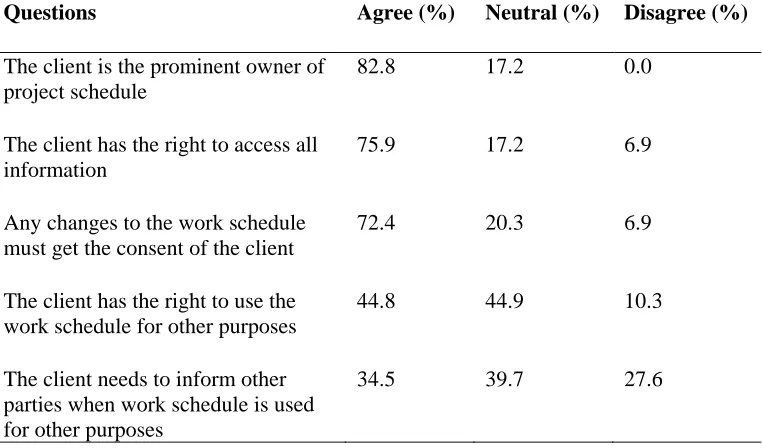
Table 11: Client’s rights
Questions Agree (%) Neutral (%) Disagree (%)
The client is the prominent owner of project schedule
82.8 17.2 0.0
The client has the right to access all information
75.9 17.2 6.9
Any changes to the work schedule must get the consent of the client
72.4 20.3 6.9
The client has the right to use the work schedule for other purposes
44.8 44.9 10.3
The client needs to inform other parties when work schedule is used for other purposes
34.5 39.7 27.6
Table 12: Consultant’s rights
Questions Agree (%) Neutral (%) Disagree (%)
The consultant only use work schedule for monitoring and evaluation
65.5 27.6 6.9
The consultant has full authority of work schedule with consent of the client
48.3 48.3 3.4
The consultant has to request for changes to the work schedule
65.5 24.2 10.3
The consultant has right to use the work schedule for other purposes with consent of the client
Table 13: Contractor’s rights
Questions Agree (%) Neutral (%) Disagree (%)
The contractor has full authority to use schedule for project purposes
76.0 20.6 3.4
The contractor has right to use the work schedule for other purposes with consent of the client
31.0 44.9 24.1
3.4 Implications of Work Schedule
Tables 11 to 13 highlight the results of the survey on the right of the client, consultant and contractor respectively. The respondents were in the opinion that the client should have the right to access all information in the work schedule, and give consent for any changes to the schedule. The consultant on the other hand should have the right to request for changes to the schedule when there is need to do so and may be given authority over the schedule when needed. Similarly the respondents also agreed that the contractor should have the right to request for changes to be made to the work schedule and be given authority over the schedule subject to approval of the client. Less than majority of respondents agreed that work schedule can be used for other purposes even with prior notice to the other parties in the project.
3.5
The Guidelines for the Preparation and Submission of Work Schedule
4.0 Conclusions
The study described in this paper focused on the development of standardised guidelines that can be used for the preparation and submission of work schedule. The development of the guidelines is based on the outcome of questionnaire survey to project participants. The guidelines consists of four main aspects of project scheduling which are process of acceptance of work schedule, responsibilities of the contracting parties, application of work schedule, and implications of work schedule. Altogether there are 43 items that have been included in the checklist where 9 items are under process of acceptance of work schedule, 12 items under the responsibilities of the contracting parties, 13 items under the application of work schedule, and 9 items under the implication of work schedule. These are the checklist items that need to be complied with in order to ensure standardisation of the preparation and submission of work schedule is achieved.
References
Construction Industry Development Board (CIDB) (2000) Standard Form of Contract for Building Work, 2000 edition.
Harban Singh, K.S. (2004) Work Programme – A Contractual Perspective, Buletin Ingenieur. Volume 21.
Institution of Engineers Malaysia (IEM) (1994) IEM.ME 1/94: IEM Conditions of Contract for Mechanical and Electrical Works.
Jabatan Kerja Raya (JKR) (1988) A Guide on the Administration of Public Works Contracts.
Appendix
Guidelines for the Preparation and Submission of Work Schedule
Introduction
The following guidelines highlight the steps for preparation and submission of work schedule.
Part 1 Process of Acceptance of Work Schedule Part 2 Responsibilities of Contracting Parties Part 3 Application of Work Schedule Part 4 Implications of Work Schedule
PART 1
Process of Acceptance of Work Schedule
Preparation of Work Schedule
• The main Contractor shall bear the responsibilities of preparing the work schedule.
• The work schedule must be prepared by the Contractor personnel that have undergone a proper training.
• Upon completing of preparing the work schedule, it must be reviewed and approved by the Client or his representatives.
Agreement
• An agreement must be signed by both the Client and Contractor when work schedule has been prepared and work awarded to the contractor
• Work Schedule must be considered as part of the contract document.
Forms of Work Schedule
• At least 2 types of schedule should be prepared, the as-planned as well as as-built schedules.
• Detailed work schedule should be prepared using the Network Modeling techniques i.e. Critical Path Method (CPM) and Program Evaluation Review Technique (PERT).
• All schedules must be computer generated. The uses of scheduling software like Primavera Project Planner and Microsoft Project should be given priority.
Cost of Preparation
• All costs of preparation should be included in the tender price and to be reviewed by the Client.
PART 2
Responsibilities of Contracting Parties
Responsibilities of Client
• The Client must monitor the usage of work schedule by the Contractor
• All major changes to the work schedule should be reviewed and approved by the Client before it is implemented.
• The Client must ensure that all necessary information needed by the Contractor is provided for.
• The Client must at all times make sure that the work schedule is updated by the Contractor.
• Whenever there is dispute in request for extension of time, the Client should make the work schedule as the primary source of information.
Responsibilities of Contractor
• The Contractor must prepare and submit the work schedule prior to the start of the project.
• The Contractor is responsible to report any changes in the schedule to the Client or his representatives.
• All causes of delays or changes to the schedule must be recorded properly by the Contractor and validated by the Client or his representatives.
• Updating of the work schedule should be done by the Contractor or his representative on a regular basis.
• The Contractor must submit a copy of the updated work schedule to the Client and the Consultant along with the progress reports during site meeting.
• At the completion of the project, the Contractor must submit the finalised as-built detailed work schedule to the Client.
PART 3
Application of Work Schedule
Planning of Project Resources
• The work schedule shall be utilised as a tool to plan the resources to be used in the project.
• Work schedule must include resource usage such as manpower, machineries, and materials.
• Updating of the resources is a must and must be accompanied by proof of records such as invoice, labour records and etc.
• Once the project is completed, the resource-based work schedule should be submitted to the Client.
Monitoring of Project Progress
• All monitoring work shall be based on the work schedule.
• Work schedule should have baseline schedule to clearly show the planned and actual work done.
• Work schedule should be updated daily by the Contractor and submitted every month to the Client together with other reports.
Evaluation of Progress Payment
• Evaluation of progress payment by the Quantity Surveyor should be done by referring to the work schedule.
• Progress claims must be submitted based on the work schedule.
• Contractor’s claims should be validated by the Quantity Surveyor prior to being approved by the Client.
Evaluation of Claims for Extension of Time
• In the case of project delay, the request for extension of time must be accompanied with the work schedule.
• The reasons of delays must be indicated clearly in the work schedule.
PART 4
Implications of Work Schedule
Client’s Rights
• The prominent owner of the work schedule is the Client.
• The Client reserves the right to access all the information in the work schedule.
• No changes shall be made without the approval of the Contractor and the Client.
• The Client reserves the right to use the work schedule for other purposes after informing the contactor about the use of the work schedule.
Consultant’s Rights
• The Consultant has the right to the work schedule for monitoring and evaluation purposes only.
• Full access to the project shall be granted when authorised by the Client.
• The Consultant can request for changes to the work schedule either from the Client or Contractor.
Contractor’s Rights
• The Contractor reserves the right to fully use and update the work schedule for the purpose of the project alone.