PARALLEL COMPUTATION OF FINITE DIFFERENCE METHOD FOR HEAT CONDUCTION IN DUCT PROBLEM
NOOR SYAZWANA BINTI ABD AZIZ
The thesis is submitted in partial fulfillment of the requirements for the award of
Master of Science (Mathematics)
Faculty of Science Universiti Teknologi Malaysia
iii
To my beloved family, thanks for your love and support
iv
ACKNOWLEDGEMENT
First of all, I thank Allah (SWT), the Lord Almighty, for giving me good health and strength ability to complete this thesis.
I would like to express my deepest gratitude to my supervisors, Dr Yeak Su Hoe, for his guidance and suggestion from the start until the end of this research. I also like to thank upon his thoughtful and constructive criticisms that lead me to achieve the objectives of my research.
I would like to convey my thanks to all my friends that help me a lot in finding information, checking my grammar and their support toward me throughout this research. Their help is valuable motivation for me to keep on doing this research. Thank you very much.
v
ABSTRACT
This dissertation is about to find a heat conduction in a curvature structure of duct. This problem will be solved using finite difference method and since the heat transfer in curvature is different from straight duct, heat equation must to be transformed into modified polar coordinate. OpenMP parallel was applied in this problem to speed up the calculation and the method used in parallel is Gaussian Elimination. Speedup for each processor will be calculated using formula 𝑠 𝑁 = 𝑇(1)
vi
ABSTRAK
Disertasi ini adalah bertujuan untuk mencari pengaliran haba di dalam saluran yang berbentuk melengkung. Kaedah beza terhingga digunakan untuk menyelesaikan masalah ini, namun persamaan haba haruslah diubah kepada ubah suai koordinat kutub memandangkan pengaliran haba di dalam saluran yang berbentuk melengkung adalah tidak sama dengan saluran yang berbentuk lurus. OpenMP selari telah diaplikasikan bagi menyelesaikan masalah ini dimana ianya bertujuan untuk mempercepatkan pengiraan suhu di dalam saluran dan kaedah dipilih untuk proses selari ini adalah penghapusan Gaussian. Kelajuan bagi setiap pemproses yang terlibat akan dikira dengan menggunakan formula 𝑠 𝑁 = 𝑇(1)
vii
CONTENTS
CONTENT
PAGE
TITLE
i
DECLARATION
ii
DEDICATION
iii
ACKNOWLEDMENT
iv
ABSRACT
v
CONTENTS
vi
LIST OF TABLE
x
LIST OF FIGURE
xi
NOMENCLATURE
xiii
CHAPTER 1
INTRODUCTION1
1.0 Background of the Study
1
1.1 Statement of the Problem
3
1.2 Objectives of the Study
4
1.3 Significant of the Study
4
viii
CHAPTER 2
LITERATURE REVIEW6
2.0 Introduction
6
2.1 Basic Law of Conduction
6
2.2 Application of Heat Conduction
10
2.3 Review of Heat Conduction
11
2.4 Review of Previous Researcher on Heat
Transfer in Duct
12
2.5 Review of Open MP
15
CHAPTER 3
MATHEMATICAL FORMULATION16
3.0 Introduction
16
3.1 Finite Difference Method
16
3.2 Geometrical Representation
20
3.3 Equilibrium State in Heat Equation
21
3.4 Heat Equation in Modified Polar CoordinateSystem
21
3.5 Chain Rule Method
23
3.6 Boundary Condition
27
ix
CHAPTER 4
MATHEMATICAL COMPUTATION32
4.0 Introduction
32
4.1 Flow Chart of Finite Difference Method
32
4.2 Numerical Formulation
34
4.2.1 Region of Duct Geometry
35
4.2.2 Define which nodes was BoundaryCondition
36
4.2.3 Creating Matrix A
36
4.2.4 Reduce Matrix and Vector B
38
4.2.5 Solve Problem by Parallel39
CHAPTER 5
PARALLEL COMPUTING41
5.0 Introduction
41
5.1 OpenMP
42
5.2 Basic in OpenMP
44
5.2.1 Execution Model
44
5.2.2 Work Sharing Construct
46
5.2.3 Runtime Library Function49
5.2.4 Timing Routine
50
5.3 Speedup
50
5.4 Gauss Elimination Method
52
5.5 OpenMP and Other Parallel Programming
x
CHAPTER 6
RESULT AND DISCUSSION56
6.0 Introduction
56
6.1 Result and Discussion
57
CHAPTER 7
CONCULSION AND RECOMMENDATION66
7.0 Introduction
66
7.1 Conclusion
66
7.2 Recommendation
68
xi
LIST OF TABLE
TABLE
TITLE
PAGE
5.2
Explanation of Function on Library Section49
5.3
Overview of OpenMP and MPI55
6.1
Coordinates of Grid Points on xy-plane and Temperature Every Node58
6.2
Timing Processing for Sequential and Parallel60
6.3
Calculation on Speedup for 1 Processor When Nodes is 4061
6.4
Calculation on Speedup for 2 ProcessorsWhen Nodes is 40
61
6.5
Speedup of Processor61
xii
LIST OF FIGURE
FIGURE
TITLE
PAGE
1.1
Grids in Duct for Heat Conduction3
2.1
Diagram of Conduction Through a PlaneWall
8
3.1
Finite Difference Scheme18
3.2
Computational Grid19
3.3
Region by Modified Polar Coordinate Equation (c > b)20
3.4
Graph liner 𝑟1223
3.5
Boundary Condition on Duct27
4.1
Flow Chart of Finite Difference in DuctProblem
33
4.2
Grid of Heat Conduction in Duct35
4.3
Flow Chart Gaussian Elimination in Parallel40
5.1
Memory Model OpenMP43
5.2
The Basic of OpenMP44
5.3
The OpenMP Execution Model45
xiii
5.5
Static Procedure46
5.6
Dynamic Function47
5.7
The Process for Every Kind of Schedule48
5.8
Function on Library Section49
5.9
Timing Routine50
6.1
Modified Polar Coordinate57
6.2
Difference Temperature in Duct59
6.3
Graph Timing Processing Sequential and Parallel60
6.4
Graph Speedup Followed by Number of Processor62
6.5
Comparison Errors between (4x8) and (2x4)63
6.6
Comparison Errors between (8x16) and (4x8)64
6.7
Comparison Errors between (16x32) and (8x16)64
6.8
Graph of Percentage Error65
xiv
NOMENCLATURE
𝜃 -Angle
℃ -Celsius
𝜋 -pi
𝑚 -Gradient
𝑅𝑖 -Radius form origin to any point at the region
Σ -Summation
Δ -The difference operator
𝑇 -Temperature
𝑎 -Radius from origin 𝑏 -Width of duct outlet 𝑐 -Width of duct inlet 𝑟12 -Width along the duct
𝑅 -Length 0 to any point region
𝑟 -Radius
𝑆(𝑁) -Speedup
xv
𝑇𝑖𝑠 - The average of serial time
𝑇𝑝 - The original single processor parallelizable time 𝑇𝑖𝑝 - The average of parallelizable time
1
CHAPTER 1
INTRODUCTION
1.0 Background of the Study
Heating is an important process especially in industry of raw material. Heat transfer (Heat conduction) is one of the processes that transfer heat from the low into high temperature. According to the First Law of Thermodynamics heat transfer changes the internal energy of both systems. The process of heat transfer is higher in solid because the network of the relatively fixed special relationship between atoms helps to transfer energy between them by vibration. However, this project we will more concentrate on heat transfer in duct geometry.
2
The problem of heat transfer can be solved by many ways from the finite difference method which is by estimating the differential term with algebraic expression. For example the problem can be transformed into Cartesian coordinates, cylindrical coordinates or spherical coordinates.
A Laplace equation is the simplest example of explicit the partial differential equation. Potential theory is a general theory for the Laplace equation. A Laplace equation is a steady state heat equation for the heat conduction problem and the Laplace equation as follows
𝑑2𝑢 𝑑𝑥2+
𝑑2𝑢 𝑑𝑦2 = 0
3
1.2 Statement of the Problem
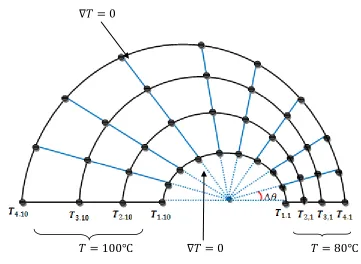
In this project we want to discuss the heat transfer in a curvature structure of duct. This problem will be solved by using finite difference method. The heat transfer in curvature structure is different from the straight duct. From this we need transform the heat equation into modified of polar coordinate system in order to solve the problem. The initial stage of approximating the temperature is the generation of a grid points using modified polar coordinate system. The language of C++ has been chosen to solve the problem. OpenMP has been used to speed up the calculations with parallel approaches.
∇𝑇 = 0
𝑇 = 100℃ ∇𝑇 = 0 𝑇 = 80℃
4
1.3 Objectives of the Study
The objectives of the study are:
1) To study the temperature in this geometry duct by using finite difference method
2) To represent the geometry of duct using modified polar coordinate system 3) To solve the problem of temperature in duct by using programs C++ 4) To speed up calculation by using parallel computation based on OpenMP.
1.4 Significant of Study
5
1.5 Scope of the Study
71
REFERENCES
Ayguade, E. , Gonzalez, M. , Martorel, X. and Jost, G. (2006). Employing Nested
OpenMP for the Parallelization of Multi-Zone Computational Fluid Dynamics
Applications. J. Parallel Distrib. Comput . 66: 686 – 697.
Azmi, A.Z. (2010). Finite Element Solution of Heat Conduction Problem, Thesis Master , UTM
Chen, C.K , Wu, L.W. and Yang, Y.T . (2005). Estimation of Unknown Outer-Wall Heat Flux in Turbulent Circular Pipe Flow with Conduction in the Pipe Wall. International Journal of Heat and Mass Transfer. 48: 3971–3981.
Croft, D.R and Lilley, D.G (1977) , Heat Transfer Calculations Using Finite Difference Equation, Applied Science Publishers.
Dong , F. and Ebadian , M. A. (1991). A Numerical Analysis of Thermally Developing Flow in Elliptic Duct with Internal Fins . Int . J.Heat Mass Transfer . 166-172.
Fan, Q.M. and Lu, W.Q. (2001) . A New Numerical Method to Simulate the Non-Fourier Heat Conduction in a Single-Phase Medium. International Journal of Heat and Mass Transfer . 2815–2821.
Fisher, L. and Martin, H.(1997). Friction Factor for Fully Developed Laminar Flow in Duct Confined by Corrugated Parallel Walls. Int . J.Heat Mass Transfer. 40: 635-639.
72
Haoqiang, J. , Jespersen, D. , Mehrotra, P. , Rupak, B. , Huang, L. and Chapman, B. (2011). High Performance Computing Using MPI and OpenMP on Multi-Core Parallel Systems. Parallel Computing .
Marusic-Paloka, E. and Paanin, I. (2010) . On The Effects of Curved Geometry on Heat Conduction Through a Distorted Pipe. Nonlinear Analysis: Real World Applications. 11(6) : 4554-4564.
Marios ,M. F. (2008). Heat Conduction in a Solid Slab Embedded with a Pipe of General Cross-Section: Shape Factor and Shape Optimization . International Journal of
Engineering Science. 46:907–916.
Makkawi, Y. Demirel, Y.A. and Al-Ali, H.H. (1998). Numerical Analysis of Convection Heat Transfer in a Rectangular Packed Duct with Asymmetric Heating.7 Elsevier Science Ltd. All rights. 455 - 463.
McGinn ,S.F. and Shaw, R.E. (2002). Parallel Gaussian Elimination Using OpenMP and MPI. Department of Applied Statistics and Computer Science.
Mokhtar, A. S. , Abbas, K. A. , Megat A, M. M. H. , Sapuan, S. M. , Ashraf, A. O., Wan, M. A. and Jamilah, B. (2004). Explicit Finite Difference Solution of Heat Transfer Problems of Fish Packages in Precooling, American Journal of Applied Sciences. 1(2): 115-120.
Mori, S. , Shinke, T. , Sakakibara, M. and Tanimoto, A. (1976). Steady Heat Transfer to Laminar Flow Between Parallel Plates with Conduction in Wall. Heat Transfer Jap. Res. 17-25.
73
Quinn, M. J (2004), Parallel Programming in C with MPI and OpenMP, McGraw-Hill, Higher Education.
Robin, Y. and Korin, E. (1996). Thermal Analysis of a Helical Heat Exchanger For Ground Thermal Energy Storage in Arid Zones, Journal of Heat and Mass Transfer.
Shah ,R.K. and London , A.L. (1978). Laminar Flow Forced Convection in Ducts . Academic Press, New York .
Sherony, D. F. and Solbrig, C. W. (1970).Analytical Investigation of Heat or Mass Transfer and Friction Factor in a Corrugated Duct Heat or Mass Exchanger. Int, J.Heat Mass Transfer. 40: 145-159.
Samsuddin, N.S. (2010), Finite Difference Solution for Heat Conduction in Duct-like Structure Problem Using Modified Polar Coordinate, Thesis Master, UTM.
Thom, A. and Apelt, C. J. (1961) . Field Computations in Engineering and Physics, London: Van Nostrand Company.
Yang, C.T. , Huang, C.L. and Lin, C.F. (2011). Hybrid CUDA, OpenMP, and MPI Parallel Programming on Multicore GPU Clusters . Computer Physics
Communications .182 : 266–269.
Zhang, S. , Zhang, H. W. , Yang, D. S . , Bi, J. Y. (2010). Multiple Spatial and Temporal Scales Method for Numerical Simulation of Non-Fourier Heat