A CHANGE EFFORT ESTIMATION MODEL
USING IMPACT ANALYSIS
FOR THE SOFTWARE DEVELOPMENT PHASE
MEHRAN HALIMI ASL
“We hereby declare that we have read this project report and in our opinion this thesis is sufficient in terms of scope and quality for the
award of the degree of Master of Software Engineering”
Signature : ... Name of Academic Mentor : ... Date : ...
Signature : ... Name of Industrial Mentor : ... Date : ... DR MOHD NAZ’RI MAHRIN
FOR THE SOFTWARE DEVELOPMENT PHASE
MEHRAN HALIMI ASL
A master project report submitted in partial fulfillment of the requirements for the award of the degree of
Master of Software Engineering
Advanced Informatics School Universiti Teknologi Malaysia
DECLARATION
I declare that this project report entitled “A CHANGE EFFORT ESTIMATION MODEL USING IMPACT ANALYSIS FOR THE SOFTWARE DEVELOPMENT PHASE” is the result of my own research except as cited in the references. The thesis has not been accepted for any degree and is not concurrently submitted in candidature of any other degree.
Signature : ...
Name : ...
DEDICATION
ACKNOWLEDGEMENT
In preparing this project report, both my academic and industrial mentors have helped me a lot. I wish to express my sincere appreciation to my academic mentor Dr Mohd Naz’ri Mahrin for his kind guidance, critics and encouragements; and my industrial mentor Dr Mohd Nazri Kama for his guidance, advices and motivation. Without their continued support and interest, this project would not have been the same as presented here.
ABSTRACT
ABSTRAK
Perubahan anggaran usaha dan perubahan analisis impak adalah dua kaedah
penting untuk mengenalpasti kesan perubahan yang diperlukan dan membuat
keputusan penerimaan perubahan yang berkesan. Menerima terlalu banyak
perubahan dalam fasa pembangunan perisian menyebabkan kos tambahan dan
kelewatan dalam penyiapan. Sebaliknya, penolakan perubahan boleh menyebabkan
rasa tidak puas hati pelanggan. Terdapat sangat sedikit kerja-kerja yang telah
dilakukan untuk menyokong keputusan perubahan yang berkesan dalam fasa
pembangunan perisian berbanding dengan fasa penyelenggaraan perisian. Cabaran
menganggarkan usaha perubahan dalam fasa pembangunan perisian adalah
kewujudan sebahagian artifak yang dibangunkan. Dalam laporan ini, kita mengkaji
dua teknik semasa; perubahan analisis impak bagi fasa pembangunan perisian; dan
terkenal dengan nama usaha anggaran model (COCOMO II). Selepas itu, kita
memperkenalkan model baru perubahan anggaran usaha bagi fasa pembangunan
perisian yang dinamakan sebagai COCHCOMO (Constructive Change Cost Model).
Ia dibangunkan untuk menganggarkan usaha perubahan menggunakan analisis impak
dan usaha anggaran awal Cocomo II. Selain itu, alat prototaip dibangunkan untuk
menyokong model baru kami. Pelaksanaan model ini telah digunakan untuk menilai
ketepatan model. Keputusan penilaian awal ke atas empat kajian kes menunjukkan
TABLE OF CONTENTS
CHAPTER
TITLE
PAGE
DECLARATION ii
DEDICATION iii
ACKNOWLEDGEMENT iv
ABSTRACT v
ABSTRAK vi
TABLE OF CONTENTS vii
LIST OF TABLES xi
LIST OF FIGURES xiii
LIST OF EQUATIONS xvi
LIST OF APPENDICES xviii
LIST OF ABBREVIATIONS xix
1 PROJECT OVERVIEW 1
1.1 Project Background 2
1.2 Problem Statement 3
1.3 Research Question 4
1.4 Project Objectives 4
1.5 Project Scopes 5
1.6 Project Plan 5
1.7 Significant Contribution 6
2.1 Introduction 8
2.2 Software Development Lifecycle 8
2.3 Requirement Engineering 13
2.4 Change Management 16
2.4.1 Change Request Specification 16
2.4.2 Change Management Process 19
2.5 Impact Analysis 21
2.5.1 Impact Analysis Process 22
2.5.2 Static Impact Analysis Technique 23 2.5.3 Dynamic Impact Analysis Technique 25
2.6 Effort Estimation 30
2.6.1 Source Lines of Code 33
2.6.2 Effort Estimation Accuracy 34
2.7 Literature Summary 36
3 RESEARCH METHODOLOGY 39
3.1 Introduction 39
3.2 Research Methods 40
3.2 Evaluation Method 42
3.3 Development Methodology 44
3.3.1 Prototype Tool Development Process 45
3.3.2 Software Tools 47
3.3 Chapter Summary 48
4 REVIEW ON AN EFFORT ESTIMATION MODEL AND A CHANGE IMPACT ANALYSIS TECHNIQUE FOR THE SOFTWARE DEVELOPMENT PHASE 49 4.1 Impact Analysis for Software Development Phase 49
4.2 Effort Estimation by COCOMO II 53
4.3 Discussion on Application of Effort Estimation Using
5.4 Step 3: Performing Static Change Impact Analysis 64 5.5 Step 4: Performing Dynamic Change Impact
Analysis 68
5.6 Step 5: Estimating Required Change Effort 72
5.7 Summary 76
6 DEVELOPMENT OF CHANGE EFFORT ESTIMATION
TOOL 79
6.1 Overview 79
6.2 COCHCOMO Tool Implementation 79
6.2.1 Importing Class Interactions Prediction 82
6.2.2 Acquiring Change Request 83
6.2.3 Performing Impact Analysis 84
6.2.4 Estimating Change Effort 91
6.2.5 Analyzing Results 93
6.3 Implementation Summary 95
7 EVALUATION OF CHANGE EFFORT ESTIMATION
MODEL 96
7.1 Case Study Definition 97
7.1.1 Scheduling Data 98
7.1.2 Software Artifacts Data 99
7.1.3 Change Requests Data 101
7.1.4 Initial Effort Estimation Data 104
7.2 Evaluation Metrics 106
7.3 Evaluation Procedure 108
7.4 Evaluation Results 111
7.4.1 CS1 Results 111
7.4.2 CS2 Results 113
7.5 Evaluation Analysis 118
8 DISCUSSION AND CONCLUSIONS 123
8.1 Research Summary 123
8.2 Constraints and Challenges 124
8.3 Contributions 125
8.4 Future Work 126
BIBLIOGRAPHY 127
LIST OF TABLES
TABLE NO.
TITLE
PAGE
1.1 Master project plan 6
2.1 Comparison between different software development
models 12
2.2 Requirements metrics 15
2.3 Change request specification attributes 17
2.4 Effort estimation techniques categories 30
2.5 SLOC categories (Hihn and Monson, 2011) 33
3.1 Tailored RUP workflows 45
3.2 Software tools 47
4.1 Summary of current impact analysis techniques features 53 4.2 COCOMO II cost drivers (Boehm et al., 1995) 54 4.3 COCOMO II scale factors (Boehm et al., 1995) 55
4.4 COCOMO II extensions 57
5.1 Change type factor values 67
5.4 Estimated values for the multipliers 75
6.1 Code inspection regular expressions 89
7.1 Case studies 97
7.2 OBA project phases 99
7.3 OBA use cases and requirements 99
7.4 OBA classes 100
7.5 Change requests distribution 102
7.6 Change requests effects 103
7.7 Change effort esstimation variables 104
7.8 COCOMO II factors 105
7.9 Contingency table 107
7.10 COCHCOMO results for CS1 112
7.11 Evaluation results for CS1 113
7.12 COCHCOMO results for CS2 113
7.13 Evaluation results for CS2 114
7.14 COCHCOMO results for CS3 115
7.15 Evaluation results for CS3 116
7.16 COCHCOMO results for CS4 116
7.17 Evaluation results for CS4 118
LIST OF FIGURES
FIGURE NO.
TITLE
PAGE
2.1 Rational unified process (Gornik, 2004) 11
2.2 Change request form (Sommerville, 2007) 18
2.3 Change management process (Small and Downey, 2001) 19 2.4 Sommerville change management process (Sommerville,
2007) 20
2.5 Structure of impact analysis process 22
2.6 Directed graph example 25
2.7 Example of string of letters format (Huang and Song, 2006) 26 2.8 Whole path dag example (Law and Rothermel, 2003) 27 2.9 Influences and influence graph example (Breech et al.,
2006) 28
2.10 Logical SLOC in C++ code sample 34
2.11 This project’s change request approval process overview 37
3.1 Engineering research method steps 41
5.1 Artifacts interactions sample 62
5.2 CDF flow chart 65
5.3 Cut-set for vertical traceability relations of classes 65 5.4 The partly developed classes detection algorithm 70 5.5 The algorithm for dynamic impact analysis 71 5.6 Summary of COCHCOMO, change effort estimation
process 77
6.1 COCHCOMO tool UML use case diagram 81
6.2 Main form user interface 82
6.3 Import CIP form 83
6.4 Change request form 84
6.5 Breadth-First search on a sample search tree 85
6.6 Sample of static impact analysis results 86
6.7 A Sample of dependent directed graph of class artifacts 87 6.8 Sample of class dependency filtration results 87
6.9 Sample of dynamic analysis results 91
6.10 Sample of change effort estimation results 92
6.11 Change impact analysis algorithm 93
6.12 Getting actual results implementation 94
6.13 Sample of change effort estimation results 95
LIST OF EQUATIONS
EQUATION NO.
TITLE
PAGE
2.1 Relative error and magnitude of relative error calculations 35
2.2 Mean magnitude of the relative error 35
2.3 Percentage of estimates falling within a specified relative
error 36
4.1 COCOMO II estimated effort 55
4.2 COCOMO II exponent B 56
4.3 COCOMO II time deviation 56
4.4 COCOMO II schedule equation 56
5.1 Impact size factor 66
5.2 Change effort calculation 72
5.3 Updated effort estimation value 73
5.4 Estimating software size after change 74
5.5 Development status factor 74
7.1 Correctness 107
LIST OF APPENDICES
APPENDIX
TITLE
PAGE
A Project’s Gantt Chart 134
B CIP XML Schema 136
C1 COCHCOMO Tool Generated Report Samples 137
C2 OBA CIP Model Report 141
LIST OF ABBREVIATIONS
AIS - Actual Impact Set
AT - Affect Type
BFS - Breadth-first Search
CDF - Class Dependency Filtration
CDG - Class Dependency Graph
CIAT - Change Impact Analysis Tool
CIP - Class Interactions Prediction
CIP-IPF - Class Interactions Prediction with Impact Prediction Filters
CIS - Candidate Impact Set
CM - Change Management
COCHCOMO - Constructive Change Cost Model
COCOMO - Constructive Cost Model
CR - Change Request
CTF - Change Type Factor
DAG - Directed Acyclic Graph
DBDD - Database Design Description
DFS - Depth-first Search
DIS - Discovered Impact Set
FP - Function Point
FPIS - False Positive Impact Set
IA - Industrial Attachment
IAM - Impact Analysis Module
IC - Impacted Class
LOC - Lines of Code
MDA - Method Dependency Addition
MDF - Method Dependency Filtration
MRE - Magnitude of Relative Error
NR - Number of relations
RE - Relative Error
RUP - Rational Unified Process
SCM - Software Change Management
SDD - Software Design Description
SDLC - Software Development Life Cycle
SDP-CIAF - Software Development Phase Change Impact Analysis Framework
SIS - Starting Impact Set
SLOC - Source Lines of code
SRS - Software Requirements Specification
PROJECT OVERVIEW
Software undergoes changes not only in the requirement phase, but also throughout the software development phase. Changes could happen at all stages of software development life cycle (SDLC). Accepting too many changes causes additional cost and delay in the competition. On the other hand, rejection of the changes may cause customer dissatisfaction. Consequently, it is essential for the software project managers to make effective decisions on change acceptance during software development to keep the evolving needs of the customer satisfied.
The main goal of impact analysis is to detect the consequences or the effects of proposed project changes. It identifies the potential consequences of a change and estimates what should be modified to implement that change (Arnold and Bohner, 1993). Basically there are two categories impact analysis techniques, which are static analysis and dynamic analysis techniques. The static analysis technique develops a set of potential impacted classes by analyzing program static information that is generated from software artifacts (i.e., requirement, design, and test artifacts). On the contrary, dynamic analysis technique develops a set of potential impacted class by analyzing program dynamic information or executing code.
To predict the cost of a change with respect to required effort; the required effort must be estimated for a typical project where the change is not introduced and for a typical project where the change is introduced. This means that the required effort must be estimated for a number of sub-processes where we do not have any experience.
Software effort estimation is the process of predicting the most accurate amount of effort required to develop or maintain software based on a large number of variables. Surveys indicate that the average effort overrun of software projects seems to be in the range 30 to 40 percent (Molokken and Jørgensen, 2003). Because of these inaccuracies, software project managers find it difficult to trust the effort estimation results. Further studies (Jørgensen and Molokken, 2004) show that, the most important reasons of inaccurate effort estimation result are change request in requirement specification, and not enough effort for the estimation process. Moreover, Jørgensen and Molokken-Ostvoldstudy (2004) study suggests that the most effective way of increasing the accuracy of effort estimation is to have flexibility on implementation of requirement specifications; and correspondingly having a better respond to change will increase the effort estimation accuracy.
techniques for the software development phase; integrate them into a unified technique; and at last, implement this technique in a change acceptance analysis tool.
The decision of accepting or rejecting change requests has always been a complex process. This decision would be more uncertain during the software development, because of the large number of variables under dynamically changing requirements. Many software project managers have failed to reach a reliable decision on change acceptance during the software development phase. Chua et al. (2008) study underscores the risks of not having an effective cost estimation model. Moreover, Chua (2010) stated that a tool supported change effort estimation model is a solution for current software change risks.
Effort estimation and impact analysis are two of the important processes to support the decisions of software project managers. The challenges with the current effort estimation techniques are that first their results have to be revised each time a change in the requirements happens; and second, change effort estimation should have a method to accurately estimate the software size after the change is implemented. One method to estimate the software size after change is to use change impact analysis results. However, current impact analysis techniques do not provide effort estimation with all the information it needs for estimating the software size. In other words, lack of association of impact analysis with effort estimation may decrease the usefulness and effectiveness of both effort estimation and impact analysis results for change acceptance decisions in the software development phase.
The main goal of this project is to find a solution to develop a new change effort estimation model which can predict the required change effort and impacts of software change requests in the software development phase; towards more useful and effective change acceptance decision.
Accordingly, this project deals with the main research question of “How to improve the change approval decisions for changes in the software development phase by predicting the required change effort and change impacts”. To provide an effective solution for the main research question, several sub-questions are constructed:
1) What are the current techniques for software change impact analysis and change effort estimation in the software development phase?
2) How to formulate new change effort estimation model using impact analysis in the software development phase?
3) How to implement the new change effort estimation model in an automated software tool?
This project has four objectives as below:
1) To identify and review an effort estimation model and a change impact analysis technique for the software development phase.
2) To formulate a new change effort estimation model for the software development phase.
3) To develop a tool to support the new change effort estimation model. 4) To evaluate the new change effort estimation model.
1.3
Research Question
The scopes of this project are as follow:
1) For reviewing, the concepts related to effort estimation and impact analysis shall be studied. Five impact analysis techniques shall be studies and compared; however, only the techniques which are specifically developed for the software development phase shall be examined with detail.
2) An impact analysis technique and a technique for effort estimation shall be identified, which are both applicable for development phase and are able to be combined into one change impact analysis technique. These two techniques shall be formulated into a new unified technique.
3) For developing the prototype tool, three-layer software architecture shall be used. The focus shall be on performing effort estimation as well as static & dynamic impact analysis on the developed class interaction prediction model (CIP); but not creating the CIP.
4) In this project, Software Requirements Specification, Software Design Document, and Database Design Description shall be developed as the software engineering documents. The documents shall use IEEE software standard documentations and formations.
5) For evaluation, an analysis method needs to be provided that can be used to measure the accuracy of the prototype tool.
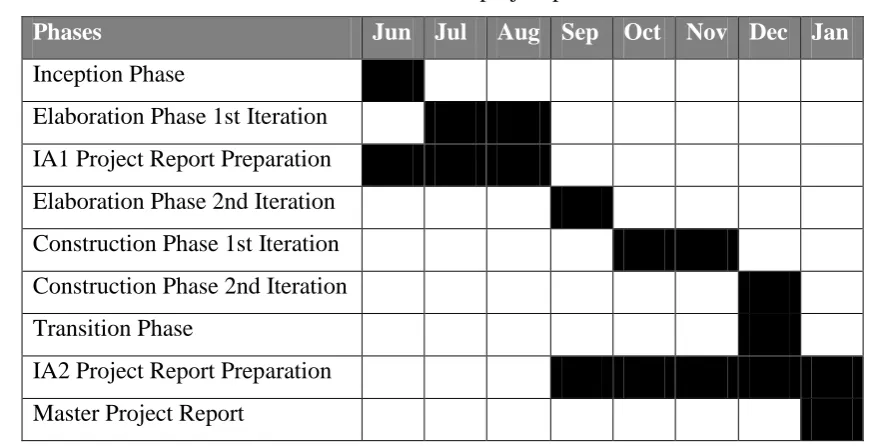
This project will be implemented in three stages sequentially and in totally eight months. The stages are: “IA1”, “IA2”, and “Master Project Report”, and all the research and software development activities will be completed in IA1 and IA2 stages. During IA1, the background research on the research objectives will be
and conclusions will be prepared. In IA2, the new model shall be developed, implemented and evaluated. At last in Master Project Report stage, the final project report will be prepared. Table 1.1 shows the schedule of phases in this project. For reviewing details of the project plan, please refer to the Appendix A.
Table 1.1 : Master project plan
Phases Jun Jul Aug Sep Oct Nov Dec Jan
Inception Phase
Elaboration Phase 1st Iteration IA1 Project Report Preparation Elaboration Phase 2nd Iteration Construction Phase 1st Iteration Construction Phase 2nd Iteration Transition Phase
IA2 Project Report Preparation Master Project Report
Our work in this research will contribute to the software change management and software change impact analysis by creating a new change effort estimation model. This model integrates change effort estimation with impact analysis for the software development phase. It is expected that this new technique will be able to develop accurate and effective effort estimation results; which will help the software project managers to make more reliable change approval decisions, and therefore reduce the cost of software development.
The deliverables for this project are as below: 1) Log Book
2) Master Project Report
3) Prototype Change Effort Estimation Tool
4) Prototype Change Effort Estimation Tool Source Code 1 5) Software Requirements Specification (SRS)
6) Software Design Document (SDD) 7) Database Design Description (DBDD) 2
1 The software and its source code of this tool are available in the CD attached to this document.