Investigating BSM Models with Large Scale Separation
AnnaHasenfratz1,ClaudioRebbi2,, andOliverWitzel3
1Department of Physics, University of Colorado, Boulder, CO 80309, USA
2Department of Physics and Center for Computational Science, Boston University, Boston, MA 02215, USA 3Higgs Centre for Theoretical Physics, University of Edinburgh, Edinburgh, EH9 3FD, UK
Abstract.Mass-split systems based on a conformal infrared fixed point provide a low-energy effective description of beyond the standard model systems with large scale
sep-aration. We report results of exploratory investigations with four light and eight heavy flavors using staggered fermions, and up to five different values for the light flavor mass,
five different heavy flavor masses, and two values of the bare gauge coupling.
1 Introduction
We focus on “beyond the standard model” (BSM) theories based on strong dynamics. These theories assume the existence of a strongly coupled system of gauge fields and fermions with a broken chiral symmetry: three Goldstone bosons provide the longitudinal components of theW’s andZ, while the Higgs emerges either as a pseudo-Goldstone boson or as a dilaton. Experiment demands that a viable theory accommodates a large separation between the scale of electroweak symmetry breaking and the scale of excitations in the new strongly coupled sector. This is achieved by formulating the strongly coupled theory in such a way that it lies within, or close to, the conformal window, i.e. the range of parameters for which a theory has an infrared fixed point (IRFP) but is still asymptotically free (see e.g. [1–5]). Now, while with some gauge groups a theory can be inside the conformal window with few fermions, in other cases, and most notably with the SU(3) gauge group, a large number of fermions is required to get a model with an IRFP. In this latter case only a small subset of the fermions can have vanishing mass: the other fermions must be given a mass to avoid the occurrence of way too many Goldstone bosons. Thus the theory becomes a “mass broken conformal theory”, that is a theory which would have an IRFP with all fermions massless, but which is kept away from the IRFP by giving mass to a subset of its fermions. Purpose of this paper is to study the properties of such “mass broken conformal theories”. We will proceed by presenting first some unproven, but plausible theoretical considerations based on non-perturbative Wilsonian renormalization group arguments, following them with the illustration of numerical results which appear to validate our assumptions. The conclusion will be that “mass broken conformal theories” have remarkable properties of universality, not unlike QCD where with massless quarks the theory is independent of any coupling constant.
Speaker, e-mail: [email protected]
2 Theoretical Considerations
In this section we will formulate some theoretical expectations. We consider an SU(3) lattice gauge theory withNf identical fermions. We take the lattice to be of infinite extent, we denote by β, in the standard manner, a parameter proportional to the inverse gauge coupling squared, denote byam the mass of the fermions in lattice units1, and assume that the fermions have been discretized in a manner which preserves chiral symmetry foram=0 and avoids unwanted fermionic copies. When we mention an observable, we take this to be the actual value taken by the observable, which is in principle theoretically well defined.
For our discussion, let us take first Nf = 4. The fermion massam can be taken to zero. The theory exhibits chiral symmetry breaking. Observables such as the pseudoscalar decay constantaFπ, massesaMetc. have well defined finite values in lattice units which depend only onβ. The continuum limit is recovered by lettingβ→ ∞: in this limit dimensionless ratios of observables approach their continuum values, any non-vanishing observable can be used to set the scale and all other observables are fully determined in a manner independent of any free parameter (dimensional transmutation.) We may take one or two masses,am1,am2,different from zero. Asβ → ∞to recover the continuum
limit we must also sendam1,am2 → 0 in a controlled manner. The spectrum of masses and other
observables will depend now on the wayam1,am2go to zero asβ→ ∞and the ratios of observables
toFπwill tend to finite limits. We recover QCD with massless up and down quarks and non-vanishing strange and charm masses. Nothing new here: we described a QCD-like theory with massless up and down quarks and non-vanishing strange and charm quark masses.
Let us consider then the SU(3) theory with 12 fermions of massam=0. We assume that the theory is conformal. The correlations functions will exhibit non-trivial power law behavior at large distances. If we rescale lengths appropriately, the long range behavior with any two values ofβwill be the same, because under renormalization group transformations the theory runs to to an IRFP, in the space of infinite couplings. (The location of the IRFP will depend on the specifics of the renormalization.) The continuum behavior of the correlation functions is recovered by going to very large lattice distances. If we are close enough to the IRFP, the lattice will approximate well the continuum also at moderate and small distances: then the short distance behavior of the correlation functions will be trivial because the theory is asymptotically free in the UV.
Assume now that we keep 4 fermions massless and give a massamto the other 8 fermions [6– 8]. The observables (in lattice units) will now depend onβandam. As in the case with Nf = 4, at large distances the correlation functions will exhibit exponential behavior and we can measure a non-vanishingaFπ as well as non-vanishing masses and other observables. In a renormalization transformation, in the space of infinite couplings, the system will move away from the IRFP with am=0 becauseamis a relevant parameter. To recover the continuum limit withaFπ → 0 we must letamapproach its fixed-point valueam=0, but, and here is the crucial point, contrary to the case of the theory withNf =4, now we do not need to letβ→ ∞, since, asam→0, the theory will flow closer and closer to the IRFP no matter what the originalβis. If we takeamsufficiently small, the ratios of observables, whether built out of the massless fermions, massive fermions or both, and in particular the ratios of observables toFπ, will be independent ofamandβ. If we give two different masses,am1,am2, to the massive fermions, or if we give a small massamto the massless fermions, hyperscaling arguments [8,9] show that the ratios of observables toFπ or among themselves only depend on the ratios of the bare Lagrangian masses.
1In this paper we follow the convention of using symbols such asm,M,Fπto denote dimensionful quantities.
2 Theoretical Considerations
In this section we will formulate some theoretical expectations. We consider an SU(3) lattice gauge theory withNf identical fermions. We take the lattice to be of infinite extent, we denote by β, in the standard manner, a parameter proportional to the inverse gauge coupling squared, denote byam the mass of the fermions in lattice units1, and assume that the fermions have been discretized in a manner which preserves chiral symmetry foram =0 and avoids unwanted fermionic copies. When we mention an observable, we take this to be the actual value taken by the observable, which is in principle theoretically well defined.
For our discussion, let us take first Nf = 4. The fermion mass amcan be taken to zero. The theory exhibits chiral symmetry breaking. Observables such as the pseudoscalar decay constantaFπ, massesaMetc. have well defined finite values in lattice units which depend only onβ. The continuum limit is recovered by lettingβ→ ∞: in this limit dimensionless ratios of observables approach their continuum values, any non-vanishing observable can be used to set the scale and all other observables are fully determined in a manner independent of any free parameter (dimensional transmutation.) We may take one or two masses, am1,am2,different from zero. Asβ → ∞to recover the continuum
limit we must also sendam1,am2 → 0 in a controlled manner. The spectrum of masses and other
observables will depend now on the wayam1,am2go to zero asβ→ ∞and the ratios of observables
toFπwill tend to finite limits. We recover QCD with massless up and down quarks and non-vanishing strange and charm masses. Nothing new here: we described a QCD-like theory with massless up and down quarks and non-vanishing strange and charm quark masses.
Let us consider then the SU(3) theory with 12 fermions of massam=0. We assume that the theory is conformal. The correlations functions will exhibit non-trivial power law behavior at large distances. If we rescale lengths appropriately, the long range behavior with any two values ofβwill be the same, because under renormalization group transformations the theory runs to to an IRFP, in the space of infinite couplings. (The location of the IRFP will depend on the specifics of the renormalization.) The continuum behavior of the correlation functions is recovered by going to very large lattice distances. If we are close enough to the IRFP, the lattice will approximate well the continuum also at moderate and small distances: then the short distance behavior of the correlation functions will be trivial because the theory is asymptotically free in the UV.
Assume now that we keep 4 fermions massless and give a massamto the other 8 fermions [6– 8]. The observables (in lattice units) will now depend onβandam. As in the case withNf = 4, at large distances the correlation functions will exhibit exponential behavior and we can measure a non-vanishingaFπ as well as non-vanishing masses and other observables. In a renormalization transformation, in the space of infinite couplings, the system will move away from the IRFP with am=0 becauseamis a relevant parameter. To recover the continuum limit withaFπ → 0 we must letamapproach its fixed-point valueam=0, but, and here is the crucial point, contrary to the case of the theory withNf =4, now we do not need to letβ→ ∞, since, asam→0, the theory will flow closer and closer to the IRFP no matter what the originalβis. If we takeamsufficiently small, the ratios of observables, whether built out of the massless fermions, massive fermions or both, and in particular the ratios of observables toFπ, will be independent ofamandβ. If we give two different masses,am1,am2, to the massive fermions, or if we give a small massamto the massless fermions, hyperscaling arguments [8,9] show that the ratios of observables toFπ or among themselves only depend on the ratios of the bare Lagrangian masses.
1In this paper we follow the convention of using symbols such asm,M,Fπto denote dimensionful quantities.
Correspond-ingly the mass of the fermions in lattice units must be denoted byam,abeing the lattice spacing, although in absence of scale setting, neitheranormare separately defined.
In conclusion, we can takeFπto set the scale, and then the continuum theory is fully defined by the ratio of Lagrangian masses. In particular, if we only have a common mass parameteramfor the 8 massive fermions, while the 4 light fermions are kept at zero mass, then the theory is fully defined without any free parameter. In this caseamplays a role similar toβfor massless QCD.
3 Numerical Results
In this section we illustrate numerical results which appear to validate the theoretical arguments pre-sented above. We simulated a theory [6–8] with:
• one staggered field (=4 flavors) with light massmplus two staggered fields (=8 flavors) with heavy massmh. The simulations have been done done witham=0.003,0.005,0.010,0.015,0.025,0.035, amh=0.050,0.060,0.080,0.100;
• a fundamental-adjoint gauge action withβ=4.0, βa =−β/4 [10,11], and nHYP smeared staggered fermions [12,13] ;
• lattice sizes mostly 243×48 and 323×64, but also 163×32 (exploratory), 363×64 and 483×96.
• We also simulated a system withβ=4.4,amh=0.070,am=0.009,0,013125,0.0175,0.0245, on a 323×64 lattice.
0 0.01 0.02 0.03 0.04 0
0.02 0.04 0.06 0.08 0.1
am
h=0.050
am
h=0.060
am
h=0.080
am
h=0.100
am
ℓaF
π
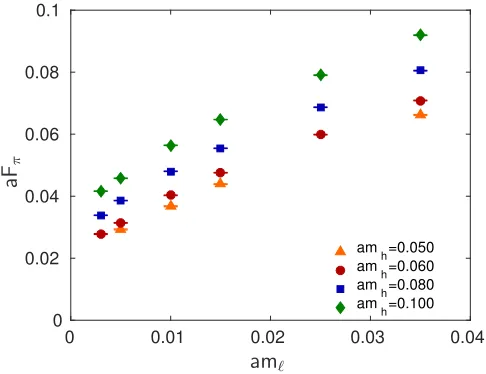
Figure 1.The pseudoscalar decay constant in lattice units.
In Figure1we present the value of the pseudoscalar decay constant, aFπ in lattice units. aFπ is seen to decrease asamh decreases, following the expectation that it should go to zero as amh approaches the fixed-point valueamh=0.
Our light spectrum results forβ=4.0 are summarized in the four panels of Fig2. (In this figure, as well as in the following figures, we use the symbolsπ, ρ, . . . as a short-hand for pseudoscalar, vector etc., referring to the particle state with the same quantum numbers as in QCD.) We plot ratios of hadron massesMHoverFπ, and as functions ofm/mh, in order to remove the scale dependence. We note that Mπ/Fπ decreases towards zero for m/mh → 0, giving evidence of chiral symmetry breaking. We also observe that the 0++is light, withM
QCD 0 2 4 6 8 10 12 14
MH
/
Fπ
mℓ
0 0.2 0.4 0.6 0.8
Mπ/Fπ
M̺/Fπ
Ma0/Fπ
Ma1/Fπ
M0++/Fπ
Mn/Fπ
mℓ/mh
amh=0.100
0 0.2 0.4 0.6 0.8
Mπ/Fπ
M̺/Fπ
Ma0/Fπ
Ma1/Fπ
M0++/Fπ
Mn/Fπ
mℓ/mh
amh=0.080
0 0.2 0.4 0.6 0.8
Mπ/Fπ
M̺/Fπ
Ma0/Fπ
Ma1/Fπ
M0++/Fπ
Mn/Fπ
mℓ/mh
amh=0.060
0 0.2 0.4 0.6 0.8
Mπ/Fπ
M̺/Fπ
Ma0/Fπ
Ma1/Fπ
M0++/Fπ
Mn/Fπ
mℓ/mh
amh=0.050
12f avg
Figure 2.Ratios of the masses ofπ, ρ,a0,a1,n, and of the 0++overFπ. The left panel shows results for QCD
taken from the PDG [14], the right panel averages for a (mass deformed) 12 flavor theory [11,15–17].
In Figure3we superimpose the data obtained with different values ofmh. Hyperscaling arguments [8,9] indicate that in the vicinity of the IRFP all scale independent quantities will be only a function ofm/mh, with no separate dependence onmh. The way in which the data appear to line-up in Fig.3 provides strong evidence for hyperscaling.
0 0.2 0.4 0.6 0.8 0
2 4 6 8 10 12 14
M
H
/
Fπ
Mπ/Fπ
M̺/Fπ
Ma1/Fπ
mℓ/mh
amh=0.050
amh=0.060
amh=0.080
amh=0.100
0 0.2 0.4 0.6 0.8 Ma0/Fπ
M0++/Fπ
Mn/Fπ
mℓ/mh
amh=0.050
amh=0.060
amh=0.080
amh=0.100
Figure 3.Hyperscaling: light hadron masses. Data for differentmhare superimposed.
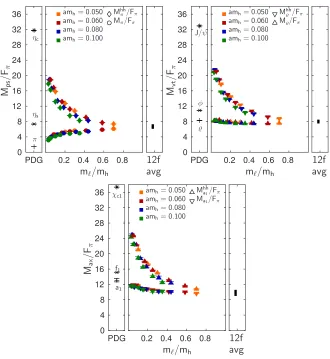
We also calculated the spectrum of masses for states made of heavy fermions. The spectra of light-light and heavy-heavy meson composites is illustrated in the the three panels of Fig.4. The heavy-heavy spectrum also gives clear evidence of hyperscaling.
QCD 0 2 4 6 8 10 12 14 MH / Fπ mℓ
0 0.2 0.4 0.6 0.8
Mπ/Fπ
M̺/Fπ
Ma0/Fπ
Ma1/Fπ
M0++/Fπ
Mn/Fπ
mℓ/mh
amh=0.100
0 0.2 0.4 0.6 0.8
Mπ/Fπ
M̺/Fπ
Ma0/Fπ
Ma1/Fπ
M0++/Fπ
Mn/Fπ
mℓ/mh
amh=0.080
0 0.2 0.4 0.6 0.8
Mπ/Fπ
M̺/Fπ
Ma0/Fπ
Ma1/Fπ
M0++/Fπ
Mn/Fπ
mℓ/mh
amh=0.060
0 0.2 0.4 0.6 0.8
Mπ/Fπ
M̺/Fπ
Ma0/Fπ
Ma1/Fπ
M0++/Fπ
Mn/Fπ
mℓ/mh
amh=0.050
12f avg
Figure 2.Ratios of the masses ofπ, ρ,a0,a1,n, and of the 0++overFπ. The left panel shows results for QCD
taken from the PDG [14], the right panel averages for a (mass deformed) 12 flavor theory [11,15–17].
In Figure3we superimpose the data obtained with different values ofmh. Hyperscaling arguments [8,9] indicate that in the vicinity of the IRFP all scale independent quantities will be only a function ofm/mh, with no separate dependence onmh. The way in which the data appear to line-up in Fig.3 provides strong evidence for hyperscaling.
0 0.2 0.4 0.6 0.8 0 2 4 6 8 10 12 14 M H / Fπ
Mπ/Fπ
M̺/Fπ
Ma1/Fπ
mℓ/mh
amh=0.050
amh=0.060
amh=0.080
amh=0.100
0 0.2 0.4 0.6 0.8 Ma0/Fπ
M0++/Fπ
Mn/Fπ
mℓ/mh
amh=0.050
amh=0.060
amh=0.080
amh=0.100
Figure 3.Hyperscaling: light hadron masses. Data for differentmhare superimposed.
We also calculated the spectrum of masses for states made of heavy fermions. The spectra of light-light and heavy-heavy meson composites is illustrated in the the three panels of Fig.4. The heavy-heavy spectrum also gives clear evidence of hyperscaling.
The upward bend in the heavy-heavy spectrum is in part due to the fact that light-lightFπshows a marked decrease form/mh→0.
PDG 0 4 8 12 16 20 24 28 32 36 Mps / Fπ π ηs ηc
mℓ/
0.2 0.4 0.6 0.8 Mπ/Fπ
Mhhπ/Fπ
mℓ/mh
amh=0.050 amh=0.060 amh=0.080 amh=0.100
12f avg PDG 0 4 8 12 16 20 24 28 32 36 Mvt / Fπ ̺ φ J/ψ
mℓ/
0.2 0.4 0.6 0.8 M̺/Fπ
Mhh̺/Fπ
mℓ/mh
amh=0.050 amh=0.060 amh=0.080 amh=0.100
12f avg PDG 0 4 8 12 16 20 24 28 32 36 Max / Fπ a1 f1 χc1
mℓ/
0.2 0.4 0.6 0.8 Ma1/Fπ
Mhh
a1/Fπ
mℓ/mh
amh=0.050
amh=0.060
amh=0.080
amh=0.100
12f avg
Figure 4.Ratios of the masses ofπ, ρ,a1overFπfor light-light and heavy-heavy composites. The left panels
shows result for QCD [14] with the (unphysical)ηstaken from [18], the right panels for a (mass deformed) 12
flavor theory [11,15–17].
In Figure5we show the ratio of the heavy-heavyπanda1masses over the mass of light-light and
heavy-heavyρ. Once again the upward bend in the left panel can be attributed to the decrease of the light-lightMρin the denominator. Ratios against heavy-heavyMρshow little variation.
0 0.2 0.4 0.6 0.8 1 0
0.3 0.6 0.9 1.2 1.5 1.8 2.1 2.4 2.7 3
Mhh π/M̺
Mhh
a1/M̺
M
hh H
/
M
̺
mℓ/mh
amh=0.050
amh=0.060
amh=0.080
amh=0.100
0 0.2 0.4 0.6 0.8 1 0
0.2 0.4 0.6 0.8 1 1.2 1.4
Mhh π/M
hh ̺
Mhh
a1/M
hh ̺
M
hh H
/
M
hh ̺
mℓ/mh
amh=0.050
amh=0.060
amh=0.080
amh=0.100
Figure 5. Ratios of the heavy-heavyπanda1masses over the mass of the light-lightρ(left panel) and of the
heavy-heavyρ.
0 0.2 0.4 0.6 0.8 1
0 0.01 0.02 0.03 0.04 0.05 0.06 0.07
a⋆ ml
a
nd
a⋆ Fπ
Fπ
a⋆mℓ
mℓ/mh
amh=0.050
amh=0.060
amh=0.080
amh=0.100
0 0.2 0.4 0.6 0.8 1
1 1.5 2 2.5 3
12 flavors
M
̺
/
M
π
mℓ/mh
amh=0.050
amh=0.060
amh=0.080
amh=0.100
Figure 6.Right panel:Fπand the light fermion massmas functions of the ratiom/mπ. For this graph the scale is based on the Wilson flow. Left panel: Ratio of theρmass over theπmass.
In Section2we stated that in the neighborhood of the IRFP the coupling constantβis an irrelevant parameter. In order to verify that this is indeed the case we performed additional simulations with β=4.4, amh =0.070. Ifβis an irrelevant parameter, then the ratios of physical quantities should be largely independent of its value. In Figure7we plot the results for Mπ, Mρ, Ma1, in units ofFπ, obtained from all our simulations. We already observed how the data corresponding to differentmhat
0 0.2 0.4 0.6 0.8 1 0 0.3 0.6 0.9 1.2 1.5 1.8 2.1 2.4 2.7 3 Mhh π/M̺
Mhh
a1/M̺
M
hh H
/
M
̺
mℓ/mh
amh=0.050
amh=0.060
amh=0.080
amh=0.100
0 0.2 0.4 0.6 0.8 1 0 0.2 0.4 0.6 0.8 1 1.2 1.4 Mhh π/M
hh ̺
Mhh
a1/M
hh ̺ M hh H / M hh ̺
mℓ/mh
amh=0.050
amh=0.060
amh=0.080
amh=0.100
Figure 5. Ratios of the heavy-heavyπanda1 masses over the mass of the light-lightρ(left panel) and of the
heavy-heavyρ.
0 0.2 0.4 0.6 0.8 1
0 0.01 0.02 0.03 0.04 0.05 0.06 0.07 a⋆ ml a nd a⋆ Fπ Fπ
a⋆mℓ
mℓ/mh
amh=0.050
amh=0.060
amh=0.080
amh=0.100
0 0.2 0.4 0.6 0.8 1
1 1.5 2 2.5 3 12 flavors M ̺ / M π
mℓ/mh
amh=0.050
amh=0.060
amh=0.080
amh=0.100
Figure 6.Right panel:Fπand the light fermion massmas functions of the ratiom/mπ. For this graph the scale is based on the Wilson flow. Left panel: Ratio of theρmass over theπmass.
In Section2we stated that in the neighborhood of the IRFP the coupling constantβis an irrelevant parameter. In order to verify that this is indeed the case we performed additional simulations with β=4.4, amh = 0.070. Ifβis an irrelevant parameter, then the ratios of physical quantities should be largely independent of its value. In Figure7we plot the results forMπ, Mρ, Ma1, in units ofFπ, obtained from all our simulations. We already observed how the data corresponding to differentmhat
β=4.0 fall on top of each other, confirming hyperscaling. From Figure7we see that also the data obtained withβ=4.4 follow the same pattern. While the small deviations from perfect alignment can be explained by scaling violations, finite size effects, and other systematic factors, the way in which all the data appear to line up, showing a common dependence onm/mh, is impressive and appear to validate the theoretical expectations expounded in Sect.2.
0.2 0.4 0.6 0.8 0 4 8 12 16 20 24 28 32 36
Mπ/Fπ
M
π
/
Fπ
Mhh π/Fπ
mℓ/mh
amh=0.05, β=4.0 amh=0.06, β=4.0 amh=0.08, β=4.0 amh=0.10, β=4.0 amh=0.07, β=4.4
0.2 0.4 0.6 0.8 0 4 8 12 16 20 24 28 32 36
M̺/Fπ
M
̺
/
Fπ
Mhh ̺/Fπ
mℓ/mh
amh=0.05, β=4.0 amh=0.06, β=4.0 amh=0.08, β=4.0 amh=0.10, β=4.0 amh=0.07, β=4.4
0.2 0.4 0.6 0.8 0 4 8 12 16 20 24 28 32 36
Ma1/Fπ
M
a1
/
Fπ
Mhh
a1/Fπ
mℓ/mh
amh=0.05, β=4.0
amh=0.06, β=4.0
amh=0.08, β=4.0
amh=0.10, β=4.0
amh=0.07, β=4.4
Figure 7.The coupling constantβis an irrelevant parameter: data obtained for the light-light and heavy-heavy masses ofπ,ρanda1 withβ=4.0,amh =0.100,0.080,0.060,0.050 andβ=4.4,amh =0.070 are
superim-posed.
4 Conclusions and Outlook
Our results give evidence for hyperscaling in the heavy fermion masses and for the irrelevance of the gauge coupling: for sufficiently smallmh, ratios of physical quantities will depend only onm/mhand will be independent ofβ. The continuum limit would be reached form,mh → 0 withm/mh kept fixed. In particular, in the chiral limitm=0,mhwould only serve to set the scale.
There is some analogy betweenmhin our model and the bare coupling constantgin QCD: near the fixed-point the physical values of masses and other observables do not depend on them. In principle, in the chiral limit, the theory built in the neighborhood of the IR fixed-point would be a self-consistent, parameter free theory, very much like QCD with massless quarks.
However, even if a theory built on the IR fixed-point were self-consistent, like QCD it would have to be embedded into a more general BSM framework. Then, on various phenomenological grounds (scaling dimensions of the condensate, of baryonic operators etc.), it can be argued that the theory should be strongly coupled: thus, still within the conformal window, but as close as possible to its beginning.
Acknowledgments
The authors thank their colleagues in the LSD Collaboration for fruitful and inspiring discussions. Computations for this work were carried out in part on facilities of the USQCD Collaboration, which are funded by the Office of Science of the U.S. Department of Energy, on computers at the MGHPCC, in part funded by the National Science Foundation (award OCI-1229059), and on computers allocated under the NSF Xsede program to the project TG-PHY120002. We thank Boston University, Fermilab, the NSF and the U.S. DOE for providing the facilities essential for the completion of this work. A.H. acknowledges support by DOE grant DE-SC0010005 and C.R. by DOE grant DE-SC0015845. This project has received funding from the European Union’s Horizon 2020 research and innovation programme under the Marie Skłodowska-Curie grant agreement No 659322.
References
[1] M.A. Luty, T. Okui, JHEP09, 070 (2006),hep-ph/0409274
[2] D.D. Dietrich, F. Sannino, Phys. Rev.D75, 085018 (2007),hep-ph/0611341 [3] L. Vecchi (2015),1506.00623
[4] G. Ferretti, D. Karateev, JHEP03, 077 (2014),1312.5330 [5] T. Ma, G. Cacciapaglia, JHEP03, 211 (2016),1508.07014
[6] R.C. Brower, A. Hasenfratz, C. Rebbi, E. Weinberg, O. Witzel, J. Exp. Theor. Phys.120, 423 (2015),1410.4091
[7] R.C. Brower, A. Hasenfratz, C. Rebbi, E. Weinberg, O. Witzel, Phys. Rev.D93, 075028 (2016), 1512.02576
[8] A. Hasenfratz, C. Rebbi, O. Witzel, Phys. Lett.B773, 86 (2017),1609.01401 [9] A. Hasenfratz, C. Rebbi, O. Witzel, PoSLATTICE2016, 226 (2016),1611.07427
[10] A. Cheng, A. Hasenfratz, G. Petropoulos, D. Schaich, PoS LATTICE2013, 088 (2013), 1311.1287
[11] A. Cheng, A. Hasenfratz, Y. Liu, G. Petropoulos, D. Schaich, Phys.Rev.D90, 014509 (2014), 1401.0195
[12] A. Hasenfratz, F. Knechtli, Phys. Rev.D64, 034504 (2001),hep-lat/0103029 [13] A. Hasenfratz, R. Hoffmann, S. Schaefer, JHEP0705, 029 (2007),hep-lat/0702028 [14] K.A. Olive et al. (Particle Data Group), Chin. Phys.C38, 090001 (2014)
[15] Y. Aoki, T. Aoyama, M. Kurachi, T. Maskawa, K.i. Nagai, H. Ohki, A. Shibata, K. Yamawaki, T. Yamazaki (LatKMI), Phys. Rev.D86, 054506 (2012),1207.3060
[16] Z. Fodor, K. Holland, J. Kuti, D. Nogradi, C. Schroeder, K. Holland, J. Kuti, D. Nogradi, C. Schroeder, Phys. Lett.B703, 348 (2011),1104.3124
[17] Y. Aoki, T. Aoyama, M. Kurachi, T. Maskawa, K.i. Nagai, H. Ohki, E. Rinaldi, A. Shibata, K. Yamawaki, T. Yamazaki (LatKMI), Phys. Rev. Lett.111, 162001 (2013),1305.6006 [18] R.J. Dowdall, C.T.H. Davies, G.P. Lepage, C. McNeile, Phys. Rev. D88, 074504 (2013),
1303.1670
[19] T.W. Chiu (2016),1603.08854
[20] T.W. Chiu, PoSLATTICE2016, 228 (2017)
![Figure 2. Ratios of the masses of π, ρ, a0, a1, n, and of the 0++ over Fπ. The left panel shows results for QCDtaken from the PDG [14], the right panel averages for a (mass deformed) 12 flavor theory [11, 15–17].](https://thumb-us.123doks.com/thumbv2/123dok_us/8055589.1342417/4.482.111.375.361.537/figure-ratios-masses-results-qcdtaken-averages-deformed-avor.webp)