31 | P a g e
REVIEW: A STUDY ON NEEDS OF ESSENTIALS
FACTORS FOR E-LEARNING
Dr. Tejinder Singh
Assistant Professor and Deputy Dean ERP, Baba Farid College, Bathinda.(India)
ABSTRACT
Any new and imaginative, thought prompts to new item, just if the pioneer believes that it's partner degree
advancement. Or maybe with regards to examination, a near review should be directed by the examiner to
continue extra, with great clarity. In this review the specialist administrated a near review on the use of
information innovation inside the parts of information sharing, viable learning, social change and innovation
usage in the zone of E-Learning and its reality, on the accompanying elements. E-Learning is the utilization of
innovation to empower individuals to learn whenever and anyplace. Semantic Web fuses endeavours to
assemble an effective web that upgrades content with formal semantics, which empowers better potential
outcomes for route and getting to its substance. This paper presents subtle elements of a client study to break
down learning styles and instruments inclinations of the end clients and to investigate huge connections among
them.
Keywords: E-Learning, Technology, Data Sharing, Effective Learning.
I INTRODUCTION
32 | P a g e II E-LEARNING SYSTEM DESIGN
This examination proposes the utilization of Associate in Nursing e-learning achievement model to
control the arranging, improvement, and conveyance of e-learning activities. Our e-learning
achievement display, as appeared in Figure 1, is adjusted from DeLone and McLean's information
frameworks achievement demonstrate (DeLone and McLean 2003). Gathered from past writing on
data frameworks achievement, six measurements of progress elements, in particular, framework
quality, data quality, benefit quality, utilize, client fulfilment, and net benefit, are known Associate in
Nursing consolidated into a general achievement display [6].
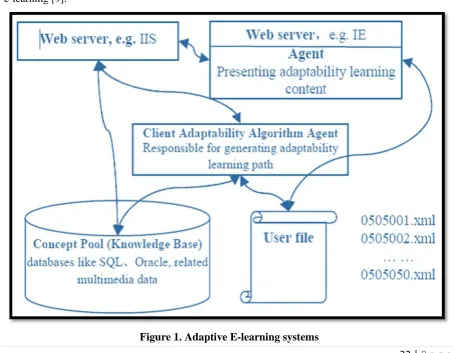
An adaptation e-learning system designed in this paper adopts B/A/S model, namely, Browser/ Agent/
Server model (shown in picture one.1). It is a ―thin client‖ model, and user uses the browser to surf
the internet, having no more want of putting in Setup on the shopper laptop. By adopting B/A/S
model, the system on the one hand provides a unified environment for e-learning, and simplifies the
development, maintenance of system and the cost of user training; on the opposite hand, the functions
of client and server will be strong by running some intelligent Agents. These agents are principally
developed through Flash Action Script two.0 to solve the issues just like the integration,
interexchange and demonstration of multimedia heterogeneous information and supply information in
e-learning [9].
33 | P a g e
E-Learning has attracted considerable analysis and development funding and business Interest. This has fuelled the creation of a significant body of books, refereed and Professional journal articles and reports, and commercial and other Web resources that Provide reports of follow, and guidance for the development of e-learning experiences.
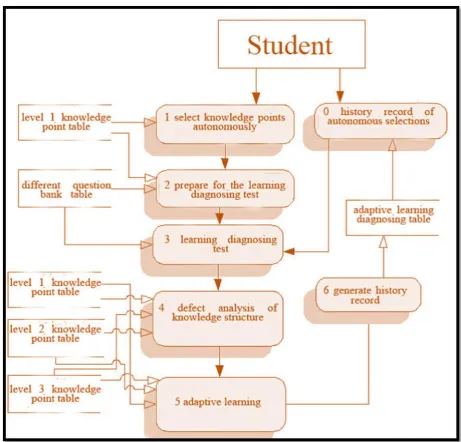
Figure 1.2 Data Flow of E-Learning System.
III E-LEARNING TOOLS PREFERENCE SURVEY RESULTS
A self-designed questionnaire was used to collect students’ current experience and preferences of
mistreatment emerging e-learning tools mentioned earlier, along with some other ancient e-learning
34 | P a g e
Over half (51.4%, N=105) of the class responded to the tools preference survey Including 90 (85.7%)
males and 15 (14.3%) females. The majority (84.8%) was aged between 21 and 29. Nearly 70%
reported their Internet usage as more than 15 hours per week while 82.2% described ‘study’ as their
major use of the Internet. These results suggest that our students are well aware of the Web usage in
education and are familiar with the Web-based e-learning tools to some extent. Students were asked to
rate their learning preferences on a scale of 1 (least preferred) to 5 (most preferred). Figure 1.2
presents their preferences against various academic activities. These results suggest that besides
relying on the traditional course management (Blackboard) and communication (email) tools, our
students also prefer to try emerging e-learning tools like vodcast and IM. These results also suggest
that our students prefer both synchronous (IM) and asynchronous (email, Blackboard, vodcast) modes
of communication, which is in contrast with Butler’s study reporting the preference of asynchronous
tools Only [8].
IV CONCLUSION AND FUTURE WORK
This paper presents our study on analysing students ‘learning styles and their preferences of using
emerging e-learning tools. This research moves us a step closer in harnessing the power of
Internet-based technologies to enhance learning. We demonstrated the applicability of an e-learning success
model to guide the design, development, and delivery of e-learning through four action research
cycles. A primary contribution of this research is in furthering our understanding of how to define,
assess, and promote e-learning success. Present economic situation will force different educational
institutions and organizations to consider adopting a cloud solution. Universities have begun to adhere
to this initiative and there are proofs that indicate significant decreasing of expenses due to the
implementation of cloud solutions. The aim of our work was to identify an architecture which will be
using Cloud Computing within higher education.
REFERENCES
[1] K. Watanabe, "A study on needs for e-learning - Through the analysis of national survey and case studies.," Progress in Informatics, vol. 2, pp. 77-86, 2005.
[2] M. Nichols, "A theory for eLearning," eLearning Consultant, pp. 1-10, 2003.
[3] D. A. M. .. M. Z. R. D. R. M. D. A.Senthil Karthick Kumar, "IS E-LEARNING A POSITIVE RAINDROP OF CLOUD: A LITERATURE REVIEW," International Journal of Advances in Science and Technology (IJAST), pp. 29-37, 2006.
35 | P a g e
Journal of Engineering Research and Development, vol. 4, no. 12, pp. 10-12, 2012.
[5] K. Ray, "Use of Effective Audio in E-learning Courseware," International Journal of Advanced Research in Computer Science and Software Engineering, vol. 4, no. 9, pp. 1-5, 2014.
[6] A. Lee-Post, "e-Learning Success Model: an Information Systems Perspective," Electronic Journal of e-Learning, vol. 7, no. 1, pp. 61-70, 2007.
[7] S. M. a. J. R. Jennifer Gilbert, "e-Learning: The student experience," British Journal of Educational Technology, vol. 38, no. 4, p. 560–573, 2007.
[8] Y. Y. Nauman Saeed, "Using Learning Styles and Preferences to Incorporate Emerging E-learning," in
Eighth IEEE International Conference on Advanced Learning Technologies, 2008.
[9] P. P. Prof.Vaishnavi.J.Deshmukh, "Cloud Computing System for E-Learning: A Design and Development Approach," International Journal of Advanced Research in Computer Science and Software Engineering,
vol. 3, no. 5, pp. 1-9, 2013.