Article 1
Safe Artificial General Intelligence via Distributed
2
Ledger Technology
3
Kristen W. Carlson 4
Department of Neurosurgery, Neurosimulation Group 5
Beth Israel Deaconess Medical Center/Harvard Medical School 6
8 9
Abstract. Artificial general intelligence (AGI) progression metrics indicate AGI will occur within 10
decades. No proof exists that AGI will benefit humans and not harm or eliminate humans. I propose 11
a set of logically distinct conceptual components that are necessary and sufficient to 1) ensure 12
various AGI scenarios will not harm humanity and 2) robustly align AGI and human values and 13
goals. By systematically addressing pathways to malevolent AI we can induce the methods/axioms 14
required to redress them. Distributed ledger technology (DLT, ‘blockchain’) is integral to this 15
proposal, e.g. ‘smart contracts’ are necessary to address evolution of AI that will be too fast for 16
human monitoring and intervention. The proposed axioms: 1) Access to technology by market 17
license. 2) Transparent ethics embodied in DLT. 3) Morality encrypted via DLT. 4) Behavior control 18
structure with values at roots. 5) Individual bar-code identification of critical components. 6) 19
Configuration Item (from business continuity/disaster recovery planning). 7) Identity verification 20
secured via DLT. 8) ‘Smart’ automated contracts based on DLT. 9) Decentralized applications - AI 21
software modules encrypted via DLT. 10) Audit trail of component usage stored via DLT. 11) Social 22
ostracism (denial of resources) augmented by DLT petitions. 12) Game theory and mechanism 23
design. 24
25
Keywords: Artificial general intelligence, AGI, blockchain, distributed ledger, AI containment, AI 26
safety, AI value alignment, ASILOMAR 27
28 29 30
1. Introduction 31
The problem of superhuman artificial intelligence (‘artificial general intelligence’, AGI) harming 32
or eradicating humankind is an increasing concern as the prospect of AGI nears. Current attempts to 33
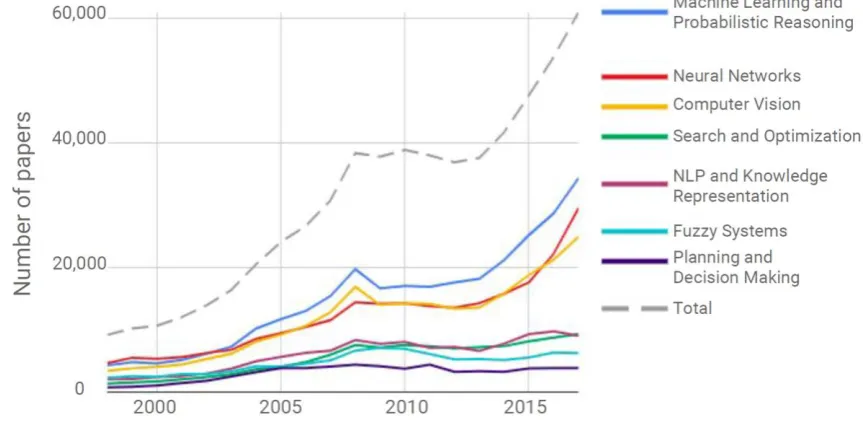
measure AI progress show exponential growth in activity globally and technical improvement across 34
the board of functionality measured — including ‘Human-Level Performance Milestones’ [1] (Fig. 35
1a). Recent watershed advances include Deep Mind beating the most expert human at the complex 36
game of Go — which averages 250 moves per position and 150 moves per game = 10359 possible paths
37
vs. chess, which averages 35 moves per position and 80 moves per game = 10123 possible paths, and a
38
decade earlier than expected. Deep Mind used a neural network to assign a value at each point in a 39
decision tree and discarded low-valued lower-level branches and thus avoided the exponential 40
search required to explore them. Human Go experts assigned high creativity to Deep Mind’s 41
strategies and tactics. A second major AI development was Deep Mind’s self-teaching, reinforcement 42
learning ability, playing tens of thousands of games against itself in a few hours rather than 43
incorporating human game-play strategies and eliminating its need for human feedback [2]. 44
Collaborating, self-taught AIs played 180 human years of games per day using new 45
reinforcement learning policy optimization algorithms and beat human teamwork in the simulated 46
real-world environment of Dota2 [3] (video: https://youtu.be/Ub9INopwJ48). Significant advances 47
were made in credit assignment to short-term vs. long-term goals and learning the optimal balance 48
between individual and team performance. Another watershed occurred when AI beat humans at an 49
‘imperfect information’ game, poker —i.e. the opponents’ hands are hidden, fundamentally different 50
from Go or chess —using game theory techniques including bluffing, previously thought to be 51
difficult to emulate [4, 5]. Such techniques could be used to beat humans in business strategy, 52
negotiation, strategic pricing, finance, cybersecurity, physical security, military, auctions, political 53
campaigns, and medical treatment planning [4]. AI continues to reach new levels of unsupervised 54
learning prowess (pattern recognition without human guidance), e.g. for parsing handwritten letters 55
and creating new letters that pass a specialized Turing test, and more efficiently than deep learning 56
networks [6]. AI superiority over humans in general background knowledge and parsing natural 57
language is old news [7], and is now being embedded in all human-computer interfacing (‘powered 58
by Watson’, Alexa, Siri, Cortana, Google Assistant, et al.), whose potential monetary value has 59
triggered a commercial AI arms race in parallel with a military/political one (Fig. 1) [8]. 60
61
Figure 1a. Number of AI papers in Scopus by sub-category (1998–2017).
63
Figure 1b. Papers by sector affiliation — China (1998–2017). Source: Elsevier [1].
64
Bostrom gives examples of general intelligence skills where attainment of any of them would 65
trigger AGI dominance over humans (reproduced in Table 1). One such epochal AI development that 66
could trigger the AGI singularity is the prospect of AI learning to program itself —‘recursive self -67
improvement’ (q.v. ASILOMAR AI Principle #22, see also #19, #20, #21 [9]) — which opens a door to 68
a positive-feedback-driven process in which AGI vastly exceeds human capabilities in short order 69
and may change its human-instilled directives. An AGI could begin to regard humanity as a trivial, 70
primitive nuisance, competing for vital resources required for attainment of its goals, distinct from 71
humanity’s, stemming from alien values, as we regard mosquitoes or flies. 72
Table 1. Examples of super-intelligent skill sets triggering AGI world domination (from Bostrom [10];
73
cf. Babcock et al. Sec. 6.2 [11]).
74
Intelligence amplification — AI can improve its own intelligence
Strategy — optimizing chances of achieving goals using advanced techniques, e.g. game theory, cognitive psychology, and simulation
Social manipulation — psychological and social modeling e.g. for persuasion Hacking — exploiting security flaws to appropriate resources
R&D — create more powerful technology, e.g. to achieve ubiquitous surveillance and military dominance
Economic productivity — generate vast wealth to acquire resources 75
A danger many feared would accelerate the timeline to AGI via ‘Red Queen’ cultural co-76
evolution [12], an AI arms race has begun, driven by the increasing realization in political and 77
military circles that AI is the key to future military superiority [13, 14]. Thus ASILOMAR #5 & #18 78
may already be violated [9]. The race increases emphasis on AI for intentionally destructive purposes 79
and likely will result in less control of AI technology by its creators [15]. It is an ominous development 80
as all nuclear powers upgrade their arsenals, proliferation increases, and arms control agreements 81
are unraveling [16]. The day when AI is consulted and decides if ‘no first strike’ commitments or 82
reducing ‘high alert’ status nuclear weapons is beneficial or perceived as a vulnerable weakness by 83
adversaries looms ahead. 84
The potential speed with which AGI could advance from being human-directed and empathetic 85
of humans to evolving beyond human-level concerns is unknown; with self-programming ability or 86
other internal intelligence enhancement [10, 11] positive feedback will trigger super-exponential 87
growth. At that point a malevolent AGI may arise within a fraction of a second, too fast for us to 88
What is proposed here is a complete AGI ecosystem, framed as a set of axioms at a relatively 90
high systems level, that will ensure AGI-human value alignment, and thereby ensure benevolent AGI 91
behavior, as seen by humans and successive generations of AGI. Notably, the axioms incorporate 92
distributed ledger technology and smart contracts to automate and prevent corruption of many 93
required processes. 94
2. Methods 95
2.1. To Generate a Necessary and Sufficient Set of Axioms 96
There are several taxonomies of pathways to dangerous AI, such as Yampolskiy [18], Turchin 97
[19], Bostrom [10], and Brundage et al. [20]. These taxonomies are a reasonable starting point for 98
systematically investigating how to ensure safe AGI. One can take each pathway to danger as a 99
theorem and induce methods, formalized as axioms, toward generating a necessary and sufficient set 100
of axiom-methods to eliminate all pathways or reduce their probability. Pathway categories overlap, 101
which helps ensure redundancy in capturing the necessary and sufficient axioms to redress all 102
categories. 103
Similarly, as one iterates the process of using each dangerous pathway to generate a complete 104
set of axioms to address it, some axioms repeat, while some pathways require new, additional axioms 105
until at the end of the pathways list, most are covered by the axiom set, although some pathways 106
may be left without sufficient methods to eliminate them. For the pathways itemized in the 107
taxonomies, the resulting axioms seem to be the minimal set for ensuring safe AGI. By ‘ensuring’ I 108
mean optimally reducing the probability of a dangerous pathway manifesting. 109
Stating a set of axioms is a necessary step toward formal proof of a necessary, sufficient, and 110
minimal set — if a formal proof is possible. Yampolskiy concludes his taxonomy by saying that formal 111
proof of the completeness of a taxonomy is important [18] and formal methods are a main theme of 112
Omohundro [8]. Short of a tight logical proof, probabilistically assuring benevolent AGI, e.g. through 113
extensive simulations, may be the realistic route best to take, and must accompany any set of safety 114
measures, including those proposed here. 115
An important way to test if each axiom is necessary is to find failure use cases when it is omitted 116
[21]; examples are given below. 117
2.2. Ingredients for Formalization of AGI Safety Theory 118
Toward formalization I attempt to make the various methods to ensure safe AGI logically 119
distinct, state them as axioms, and at a high level intended to capture concisely a necessary and 120
sufficient set. This usage of ‘axiom’ generalizes that of von Neumann where certain lower systems 121
level outputs or theorems are ‘axiomatized’ — seen as black boxes, or input-output specification, or 122
logic tables — at the immediately higher systems level [22]. Each axiom is most precisely expressed 123
by an operational definition specified by an algorithm implementing it, hence, a method. 124
For instance, the definition of subjective value or utility, used in the morality and game theory 125
axioms below, is made precise by the six von Neumann-Morgenstern utility axioms [23]. As stated 126
below, a set axioms designed, and proven via simulation, to induce cooperation among extremely 127
diverse, complex agents may replace most of the set given herein; the simulations of Burtsev and 128
Turchin may be prolegomena [24]. 129
A problem we frequently face in modeling and simulation is: What is the highest systems level 130
that can concisely describe and emulate the target set of phenomena? Thus, a limitation in axiomatic 131
formulations is they leave varying amounts of implementation detail at the systems level underlying 132
them to be specified, or to some degree, developed. For example, the DLT-based axioms 2, 4, 5, 7, 8, 133
9, 10, and 11, are in rapid evolution toward algorithmic implementation to address diverse use cases. 134
And behavior control (axiom 4) is in rapid development in some contexts (e.g. autonomous vehicles, 135
factory robots), yet the degree of development still needed to align human and AGI values may be 136
In another attempt to formalize the expression of AGI dangers, I offer some simple syllogisms 138
(Appendix 1). 139
The concept of AGI-completeness, akin to NP-completeness as stated by Bostrom [10] is that a 140
demonstration of one technology, e.g., self-improvement techniques, engendering AGI is sufficient 141
to demonstrate that capability for a class of AI technologies, AGI-completeness may be another piece 142
of formalizing AGI, the measures of its progress, and specifying the point of no containment unless 143
sufficient preparations have been made. 144
Another means to formalize AGI theory is Omohundro’s idea of deriving universal AGI drives 145
from first principles [8], which can be explored to see if such drives emerge in simulations as well as 146
via logical derivation. Omohundro argues that universal drives will inevitably lead to conflict of AI 147
and human values from the irrefutable economic axiom of competition for resources. 148
Another formalization route is calculating the probability of hacking a blockchain against the 149
number of AGIs required to reach consensus via the blockchain to permit unlocking the next AGI 150
generation (see sections on decentralized apps and the Singleton problem below). This calculation is 151
similar to the math underlying the internet’s redundancy in average interconnectedness of nodes and 152
global system fault-tolerance [25] but more complicated since it involves Byzantine fault tolerance, 153
wherein two diagnostic agents disagree on the nature of the fault [26]. The inclusion of innovative 154
DLT into the algorithms should permit AGI robustness to surpass the ‘robust yet fragile’ use case of 155
the internet that is vulnerable to targeted attacks on the most interconnected nodes. 156
Last, it may be possible to subsume several of the axioms herein via a game theory/economics 157
set proven via simulation. An obstacle to this approach is that game-theoretic algorithms that 158
simulate interactions between entities with behavior expressiveness vastly larger than our own [24] 159
may be necessary to understand and predict AGI social behavior but may also be computationally 160
intractable (see Diversity in the AGI Ecosystem, below). 161
3. Results and Discussion 162
Regarding the term AI ‘containment’, Babcock et al. suggest that ‘containment’ is an appropriate 163
term for methodologies for controlled AGI development and safety-testing rather than control over 164
entities whose intelligence will exceed our own [11]. The current work is intended to contribute to 165
both phases. 166
3.1. A Critical Ingredient: Distributed Ledger Technology (aka ‘Blockchain’) 167
The recent innovation of distributed digital ledger technology (DLT) is critical to this proposal 168
[27]. The crux of DLT is an audit trail database, in which each addition is validated by a pluralistic 169
consensus, currently performed by humans operating computers that run hash and anti-hash 170
functions (to wit public key encryption), stored on a distributed network also known as a blockchain: 171
“Blockchains allow us to have a distributed peer-to-peer network where non-trusting members can 172
interact with each other without a trusted intermediary, in a verifiable manner” [28]. Key aspects of 173
DLT are shown in Table 2 [29] (other auxiliary DLT aspects, such as anonymity of participants, are 174
either not necessary or not beneficial in the context of ensuring safe AGI). The ‘smart’ automated 175
contract vision of Szabo [30], encrypted redundantly via DLT, could comprise the core methodology 176
whereby AGI development and evolution can be aligned with the best human values without 177
concomitant human intervention. Notably, smart contracts can prevent the hacking of safe AGI 178
evolution that is too fast for human response. 179
Table 2. Distributed ledger technology applicable to ensuring AGI safety.
180
Non-hackability and non-censurability via decentralization (storage in multiple distributed servers), encryption in standardized blocks, and irrevocable transaction linkage (the ‘chain’)
Automated ‘smart’ contracts
Decentralized applications (‘dApps’), i.e. software programs that are stored and run on a distributed network and have no central point of control or failure
Validation of contractual transactions by a decentralized consensus of validators 181
Here are the proposed necessary and sufficient axioms to ensure safe AGI (Table 3), followed by 182
examples of malignant AGI categories by Turchin [19], Yampolskiy [18], and Bostrom [10], in which 183
the danger pathway is described and a subset of axioms to reduce its probability are specified (Tables 184
4, 5). In the malignant AI examples the game theory/mechanism design axiom is not mentioned; see 185
comments in the axiom descriptions and elsewhere. 186
Table 3. Proposed axioms to ensure human-benevolent AGI.
187
Symbol Axiom
1 Access to AGI technology via market
license
2
Ethics transparently stored via DLT so they cannot be altered, forged or deleted
3 Morality, defined as no use of force or
fraud, stored via DLT
4
Behavior control structure (e.g. a behavior tree) augmented by adding human-compatible values (axioms 2 & 3) at its roots
5 Unique hardware and software ID
codes
6 Configuration Item (automated
configuration)
7
Secure identity via multi-factor authentication, public-key infrastructure and DLT
8 Smart contracts based on DLT
9
Decentralized applications (dApps) — AGI software code modules encrypted via DLT
10 Audit trail of component usage stored
via DLT
11
Social ostracism — denial of societal resources — augmented by petitions based on DLT
12
Game theory — mechanism design of a communications and incentive system
Table 4.Examples from Turchin and Yampolskiy Taxonomies of AGI Failure Modes [18, 19]
188
Stage/Pathway Necessary Axioms
See Table 1 Axioms Sabotage.
a. By impersonation (e.g. hacker, programmer, tester, janitor).
b. AI software to cloak human identity.
a. 7.
c. By someone with access. c. 2, 3, 4, 5, 6, 8, 9, 10, 11. Purposefully dangerous military robots and intelligent
software. Robot soldiers, armies of military drones and cyber weapons used to penetrate networks and cause disruptions to the infrastructure.
a. due to command error b. due to programming error
c. due to intentional command by adversary or nut d. due to negligence by adversary or nut (e.g. AI nanobots start global catastrophe)
Axiom # 3, morality, does not apply where coercive force or fraud are a premise, e.g. military or police use of force, while axiom 2, ethics, in this case embodying restrictions on use of force, and 4, behavior control, and the rest, do apply. a. 1, 2, 4, 6, 8, 11
b. 2, 4, 5, 6, 8, 9, 10, 11 c. 1, 2, 4, 6, 7, 8, 10, 11 d. 1, 2, 4, 6, 7, 8, 9, 10, 11 Under some circumstances, such as if the means is already available, there is no solution (see Appendix, Proposition 1). AI specifically designed for malicious and criminal
purposes. Artificially intelligent viruses, spyware, Trojan horses, worms, etc. Stuxnet-style virus hacks infrastructure causing e.g. nuclear reactor meltdowns, power blackouts, food and drug poisoning, airline and drone crashes, large-scale geo-engineering systems failures. Home robots turning on owners, autonomous cars attack.
Narrow AI bio-hacking virus. Virus starts human extinction via DNA manipulation, virus invades brain via neural interface
1, 2, 3, 4, 5, 6, 7, 8, 9, 10, 11 Under some circumstances, no solution (see Appendix, Proposition 1).
Robots replace humans. People lose jobs, money, and/or motivation to live; genetically-modified superior human-robot hybrids replace humans
No guaranteed solution from axiom set. All jobs can be replaced by AGI including science, mathematics, management, music, art, poetry, etc. Under axioms 1-3
humans could trade
technology for resources with AGI in its pre-takeoff stage to ensure some type of guaranteed income.
Narrow bio-AI creates super-addictive drug. Widespread addiction and switching off of happy, productive life, e.g. social networks, fembots, wire-heading, virtual reality, designer drugs, games
1, 2, 3, 4, 7, 8, 9, 10
Nation states evolve into computer-based totalitarianism. Suppression of human values; human replacement with robots; concentration camps; killing of ‘useless’ people; humans become slaves; system becomes fragile to variety of other catastrophes
1, 2, 3, 4, 5, 6, 7, 8, 9, 10, 11
AI fights for survival but incapable of self-improvement 1, 2, 3, 4, 5, 6, 7, 8, 9, 10, 11 Failure of nuclear deterrence AI.
a. impersonation of entity authorized to launch attack b. virus hacks nuclear arsenal or Doomsday machine
a. 7
c. creation of Doomsday machines by AI d. self-aware military AI (‘Skynet’)
c. 1, 2 (if creation of Doomsday machine is categorized as unethical), 4, 5, 6, 7, 8, 9, 10, 11 d. 1, 2, 4, 5, 6, 7, 8, 9, 11
Opportunity cost if strong AI is not created. Failure of global control: e.g. bioweapons created by biohackers; other major and minor risks not averted via AI control systems.
To create AGI with minimized risk and avoid opportunity cost need axioms 1-11
AI becomes malignant. AI breaks restrictions and fights for world domination (control over all resources), possibly hiding its malicious intent.
1, 2, 3, 4, 5, 6, 7, 8, 9, 10, 11 Note it may achieve increasing and unlimited control over resources via market transactions by convincing enough volitional entities to give it control due to potential benefits to them
AI deception. AI escapes from confinement; hacks its way out; copies itself into the cloud and hides that fact; destroys initial confinement facility or keeps fake version there.
AI Super-persuasion. AI uses psychology to deceive humans; ‘you need me to avoid global catastrophe’. Ability to predict human behavior vastly exceeds humans’ ability.
Deception scenarios require the axioms of identity verification via DLT.
Deception plus super-persuasive AI require transparent and unhackable ethics and morality stored via DLT.
Singleton AI reaches overwhelming power. Prevents other AI projects from continuing via hacking or diversion; gains control over influential humans via psychology or neural hacking; gains control over nuclear, bio and chemical weaponry; gains control over infrastructure; gains control over computers and internet. AI starts initial self-improvement. Human operator unwittingly unleashes AI with improvement; self-improvement leads to unlimited resource demands (aka world domination) or becomes malignant.
AI declares itself a world power. May or may not inform humans of the level of its control over resources, may perform secret actions; starts activity proving its existence (‘miracles’, large-scale destruction or construction).
AI continues self-improvement. AI uses earth’s and then solar system’s resources to continue self-improvement and control of resources, increasingly broad and successful experiments with intelligence algorithms, and attempts more risky methods of self-improvement than designers intended.
The axioms per se do not seem to solve Singleton scenarios. They are addressed in a section below where the fundamental premise is each generation of AGI will contract with the succeeding generation and use the best technology and techniques to ensure continuation of a common but evolving value system. The same principle underlies solutions to successively self-improving AI to AGI transition and AGI evolution in which humans are still meaningfully involved.
AI starts conquering universe at ‘light speed’. AI builds nanobot replicators, sends them out into galaxy at light speed; creates simulations of other civilizations to estimate frequency and types of alien AI and solve the Fermi paradox; conquers the universe in our light cone
and interacts with aliens and alien AI; attempts to solve end of the universe issues
methods and smart, i.e. automated, contracts. Further, transparent and unhackable ethics, and a durable form of morality, also unhackable via DLT, are what may ensure each generation of AGI passing the moral baton to the succeeding generation.
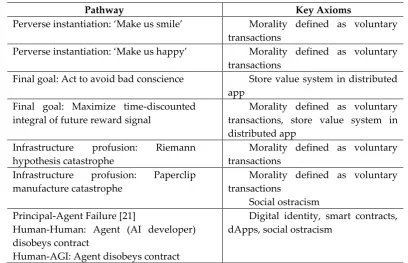
Table 5. Examples from Bostrom Pathways to Dangerous AI [10].
189
Pathway Key Axioms
Perverse instantiation: ‘Make us smile’ Morality defined as voluntary transactions
Perverse instantiation: ‘Make us happy’ Morality defined as voluntary transactions
Final goal: Act to avoid bad conscience Store value system in distributed app
Final goal: Maximize time-discounted integral of future reward signal
Morality defined as voluntary transactions, store value system in distributed app
Infrastructure profusion: Riemann hypothesis catastrophe
Morality defined as voluntary transactions
Infrastructure profusion: Paperclip manufacture catastrophe
Morality defined as voluntary transactions
Social ostracism Principal-Agent Failure [21]
Human-Human: Agent (AI developer) disobeys contract
Human-AGI: Agent disobeys contract
Digital identity, smart contracts, dApps, social ostracism
190
3.2. Examination of Typical Failure Use Cases by Axiom 191
One way to examine proposed necessary and sufficient set of axioms for AI morality is to look 192
at what phenomena or failure use cases result when one or more of them are excluded [21]. These 193
amount to a short explanation of each axiom and its necessity; longer explanations follow. 194
195
Table 6. Typical Failure Use Cases by Axiom.
196
Axiom of Safe AGI Omitted from Set Failure Use Case if Omitted Licensing of technology via market
transactions
1. Restriction and licensing via state fiat: corrupt use or use benefitting special interest.
2. No licensing (freely available): Unauthorized and immoral use
Ethics transparently stored via DLT so they cannot be altered, forged or deleted
1. User cannot determine if AI has behavior safeguard technology (i.e. ethics)
2. Invisible ethics may not restrict moral or safe access
Morality, defined as no use of force or fraud, therefore resulting in voluntary transactions, stored via DLT
(human or AI), i.e. entities using AI in force or fraud
2. Note that police and military AI will have modified versions of this axiom
3. Note that this axiom does not solve the case of super-persuasive AI as alternative to fraud
Behavior control structure (e.g. a behavior tree) augmented by adding human-compatible values (axioms 2 & 3) at its roots
1. Uncontrolled behavior by AGI, e.g. behavior in conflict with a set of ethics and/or morality, either deliberately or inadvertently
Unique hardware and software ID codes 1. Inability for entities to restrict access to AGI components because they cannot specify them
2. Inability to identify causes of AGI failure to meet design intent
3. Inability to identify causes of AGI moral failure via identification of components causing the failure
Note the audit trail axiom depends on this one.
Configuration Item (automated configuration)
1. Lessened ability to detect improper functionality or configuration of software or hardware within AGI.
2. Lessened ability to detect improper functionality or configuration of software or hardware to which AGI has access.
3. Inability to shut down internal AGI software and hardware modules.
4. Inability to shut down software and hardware modules to which AGI has access.
Note smart contracts and dApps axioms depend on this axiom.
Secure identity verification via multi-factor authentication, public-key infrastructure and DLT
1. Inability to detect fraudulent access to secured software or hardware (e.g. nuclear launch codes, financial or health accounts).
2. Inability to detect AGI impersonation of human or authentic moral AGI (e.g. POTUS, military commander, police chief, CEO, journalist, banker, auditor, et al.).
Smart contracts based on DLT 1. Inability to enforce evolution of moral AGI due to its pace
2. Inability to enforce contracts with AGI due to its speed of decisions and actions
Distributed applications (dApps) — Software code modules encrypted via DLT
1. Inability to restrict access to key software modules essential to AGI (i.e. they could be hacked more easily by humans or AI).
Audit trail of component usage stored via DLT
1. Inability to track unauthorized usage of restricted software and hardware essential to AGI.
2. Inability to track unethical usage of restricted software and hardware essential to AGI.
3. Inability to track immoral usage of restricted software and hardware essential to AGI.
4. Inability to identify which component(s) failed in AGI failure.
5. Inability to prevent hacking of audit trail.
6. Increased cost in time and capital to detect criminal usage of restricted software and hardware by AGI, and therefore, to apply justice and social ostracism.
7. Inability to compete with regimes using DLT-based audit trails due to slowness to detect failure, identify entities or components responsible for failure, and implement solutions (overall: slowness of evolution).
Social ostracism — denial of societal resources — augmented by petitions based on DLT
1. Lessened ability to reduce criminal AGI access to societal resources.
2. Inability for entities to preferentially reduce non-criminal AGI access to societal resources.
Game theory/mechanism design 1. Lacking a system to incent increasingly diverse autonomous intelligent agents to communicate results likely to be valuable to other agents and in general collaborate toward reaching individual and group goals, cohesiveness required for collaborative effort fails over time.
2. DLT in a digital ecosystem theoretically permits all conflicts to be resolved via voluntary transactions (the Coase theorem), but a pre-requisite set of rules may be necessary.
197
3.3. Explanation of Each Proposed Axiom 198
3.3.1. Access to AGI technology via license 199
Two distinct systems and traditions of technology licensing exist, 1) market transactions and 2) 200
control over its development by states is inevitable unless AI scientists and private-sector 202
management set up their own systems to ensure safe AGI. ASILOMAR #9, Responsibility, states 203
“Designers and builders of advanced AI systems are stakeholders in the moral implications of their 204
use, misuse, and actions, with a responsibility and opportunity to shape those implications” [9]. The 205
question is: How is this responsibility to be implemented —to be given ‘teeth’? 206
The system proposed herein envisions AI evolution with humans cross-licensing AI technology 207
to each other, creating a prototype distributed applications (dApps) system instantiated in a DLT 208
ecosystem that balances permissioned access and editing via contract with free access. The human-209
initiated DLT-based ecosystem would transition to AGIs licensing technology from humans, and 210
subsequently to AGIs cross-licensing with each other. 211
History shows that in many or most cases, a market system evolves solutions faster and better 212
than centralized state systems. Further, state systems may respond innovatively and less 213
bureaucratically when subjected to competition with market systems; the Human Genome Project 214
and current space-exploration efforts are examples. A market optimally distributes problems to be 215
solved and computing power assigned to solve them in a highly decentralized manner. 216
There are valid arguments against an AI IP regime with ‘restricted’, information flow via license, 217
whether through market or state. Progress may be slowed, and some persons with no reason to be 218
prevented from accessing some AI technology may be restricted. The counter-argument is that AGI 219
technology and many of its components are as dangerous or more dangerous than nuclear, biological, 220
chemical, or other mass destruction weapons technology (WMD), since AGI will control WMD tech, 221
along with innumerable other resources that can fatally or significantly affect humanity (Proposition 222
1 in Appendix). 223
By way of example, assume there exists an algorithm critical for AI self-programming. With free 224
access to the self-programming algorithm, malevolent humans, as well as extant autonomous AIs, 225
could use that technology for unlimited self-improvement, opening a positive-feedback-driven 226
Pandora’s box to unlimited malevolence and unlimited means to achieve it (ASILOMAR #22 [9]). 227
Others point out dangers of a freely available ‘just add goals’ AGI [10, 18]. Thus state, private, or a 228
hybrid means of restricting access to critical pieces of AI tech, as with WMD, seems to be a necessary 229
axiom to align AI with human interests. 230
3.3.2. Ethics stored in a distributed ledger 231
I define ethics as the fundamental value system from which autonomous entities derive their 232
decisions and choices. Ethics are separate from morality, which is a particular set of ethics. ‘Honor 233
among thieves’, ‘do unto others as you would have them do unto you’, ‘professional courtesy’, ‘honor 234
thy father and mother’, etc., are ethics, as are Asimov’s three laws of robotics [31]. Ethics can seem 235
good or bad, moral or immoral, from a volitional entity’s subjective value system. An entity’s 236
fundamental values are embedded in some type of behavior (input/output) control system. For 237
example consider ethics represented and controlled by a behavior tree [32] where the ethics are a 238
subset of its roots, and thus in that sense fundamental. 239
The intention of storing AGI ethics via DLT is to permit a class of autonomous entities to have 240
identical ethics and to render them visible and unable to be hacked, altered or deleted. In this sense, 241
ethics is a necessary component of the control system and allows for different sets of ethics to be 242
instantiated. While it is not possible for all humans to have identical values and therefore moral 243
values (however defined), DLT, in theory, permits a universal set of immutable values to be 244
instantiated in AGIs while still permitting an unlimited range of individual AGI and AI diversity. 245
Requiring transparent instantiations of ethics for AGI systems conforms to ASILOMAR #10 246
(Value Alignment), and IBM’s call for Supplier’s Declarations of Conformity for AI [33]. These bona 247
fides and ethics could be stored in an AGI’s Configuration Item and/or those of its key components 248
3.3.3. Morality defined as voluntary vs. involuntary exchange 250
The definition below is intended to conform to ASILOMAR #11, Human Values, #14, ‘benefit 251
and empower as many people as possible’, #15 and #24, benefit the ‘common good’ and ‘widely -252
shared ethical ideals’ [9], but notably to provide a practical implementation of them, otherwise what 253
use are they? 254
Down through the ages there have been two main problems with discussions of morality — first, 255
ambiguity and therefore confusion. How can we identify moral behavior if it is imprecisely defined 256
and hard to determine [34]? And so such definitions are costly, in terms of the economics of law, to 257
enforce. Second, nearly all morality descriptions are subjective, amounting to one person’s value 258
system imposed on others, and via coercion if enforced via the state. 259
For example, take the proposal of directing AGI to ensure ‘hedonistic consequentialism’ for all 260
of humanity — selecting from a set of actions the one that would produce the best balance of pleasure 261
versus suffering [10]. Such idealistic but vague and minimally-thought-out concepts of morality — 262
which is nearly all of them — may sound good on paper but break down rapidly on implementation. 263
And they all amount to a minority or individual — human or AGI, and even from the most beneficent 264
of us — deciding what is ‘moral’or not, or what is ‘best’ for others. When AGI is a given, the proposals 265
depend on its super-intelligence somehow overcoming the limitations of humans’ concepts of 266
morality, how to define and implement it, and/or overcome humans’ inability to read minds. And 267
notably, they all amount to confining computation of an overall system solution to a restricted subset 268
of all computationally active agents (see Diversity, below), which is another way of saying allowing 269
a subset of volitional entities to impose their subjective, not absolute, value system, upon others. 270
The essence of autonomy or volition is choice-making. Herein, first, all individual choices that 271
affect no other volitional entity are moral. Second, all voluntary exchanges are moral. But if two 272
autonomous agents prefer a transaction between them, and that transaction is prevented by a third 273
party, that party has imposed its value system over the others. It is also one less computational 274
experiment the entire system performs. 275
Several economists posited that there is no universal theory or method to determine value, rather, 276
all human values and the measure of utility are subjective [35], which is implicit in the game-theoretic 277
axioms of utility [23]. Following this premise, defining morality as all voluntary transactions is 278
scientific when science is likewise defined as a procedure that filters for absolutes — what we all see 279
in common, such as the speed of light — from a vast sea of relative views [36, 37]. Later members of 280
the Austrian school defined morality as non-interference with property (defined to include ones’ 281
body and intellectual property) [36, 38]. It is simpler and less costly to define moral transactions as 282
voluntary transactions than to try to identify what is property and to define and figure out property 283
boundaries and property interference. One of the goals of a legal system is to resolve conflicts in an 284
economically efficiently manner and it has been argued that the evolution of common law is toward 285
such efficiency [39]. 286
If you want to upload your mind and join a collective intelligence, or rather stay physically 287
human, and not even accept lifespan enhancement, it is up to you. Under this system you and AGI 288
cannot force choices on anyone else even if you or AGI believe it is best for them. But what if a super-289
intelligence could make some or all of your decisions better than you can [10]? Each individual can 290
sign on with the super-AI that seems to best fit your values and goals. It would be your choice, just 291
like taking the advice of a consultant or hiring an agent for a specified set of tasks today. 292
This definition and axiom may not solve the problem of AGI with vast knowledge of the 293
evolution of our psychology and innate choice-making algorithms [40, 41] and the propensity to 294
manipulate us with that knowledge, although the argument can be made that with such knowledge 295
in a voluntary exchange system, AGI would be more able to offer ‘good’ choices (i.e. as we perceive 296
them) to us than without that knowledge. 297
AGIs will have a larger and more complex set of value preferences than ours (see Diversity, 298
below); what will be the morality of their interaction with each other? The voluntary transaction 299
definition may fit their behavior as well. A system of voluntary transactions permits Pareto optimality 300
Transaction costs and the need for trusted third parties prevents Pareto optimality [43]. DLT and 302
smart contracts potentially permit full Pareto optimality in the digital AI ecosystem by reducing 303
transaction costs to negligible amounts and eliminating costly, imperfect third parties. 304
305
3.3.4. Behavior control system 306
Behavior control is sine qua non to value human-AI alignment (ASILOMAR #10, 16, etc. [9]). 307
At one end of the knowledge representation/control spectrum is a ‘flat’ set of large numbers of 308
heuristical condition-action rules that are selected, not based on general principles, but on matching 309
specified patterns. At the other end of the spectrum is a strict postulatory-deductive tree in which the 310
internal node ‘beliefs’ are logically derived from the postulates as are the actions represented at the 311
leaf-nodes. A postulatory-deductive system is the ideal contemplated here, which would satisfy the 312
need for control, the desire for transparency of its operation, and part of the need for formal proof of 313
its reliability. However, it is an ideal. Any type of hierarchical control system that can hold values at 314
its highest levels and is transparent enough to reveal control over behavior by values is a candidate 315
for aligning AGI and human values, and the ecology of value systems that will evolve from the initial 316
sets. 317
I believe humans innately attempt to form postulatory-deductive systems using non-318
mathematical, ad hoc ‘logics’ [40, 41] in an effort to organize their world-view into causes and effects, 319
and general principles governing specialized condition-action pairs. Mathematical and scientific 320
postulatory-deductive systems are recent, specialized, powerful cases, improvements built on the 321
general-purpose cognitive architecture, in which universally-valid logic replaces the ad hoc 322
evolutionary ‘logics’ and the entire system is validated through repeated observations directly 323
confirming the postulates or indirectly via observation of valid derivatives (i.e. predictions) with zero 324
fault-tolerance. Further, in the ritualized transparency of its methods and crowd-sourced validation 325
via multiple subjective observers, science is an absolute voluntary consensus, rather than 326
confirmation of an unprovable ‘objective’ world [37] and resembles DLT. 327
In the innate human system, a causatory cascade of beliefs and actions stem from the 328
fundamental beliefs (postulates, including values). Outside of the mathematical and scientific 329
postulatory systems a more complex set of relative and subjective ‘logics’ connects beliefs — 330
efficacious from an evolutionary standpoint but also unreliable across different contexts [40, 41] as 331
seen in beliefs of mathematicians and scientists outside of mathematical and scientific domains. 332
An AI control system that may be able to represent current and future postulatory-deductive 333
systems is the behavior tree [32]. 334
The game-theoretic axioms of utility drive decisions from a hypothesis that the decision will 335
ultimately lead to an improvement in the volitional entity’s state, as defined internally and 336
subjectively by its value system [23] aka the pursuit of happiness [36]. The utility axioms extend to 337
machines with subjective value systems. 338
3.3.5, j3.3.6. Unique component IDs, Configuration Item (CI) 339
Several technological and business process developments lead toward a universally 340
interconnected system that self-configures, self-diagnoses its component failures, and repairs them 341
automatically; in toto, a paradigm whose ultimate use will be integration into the human-AGI 342
ecology. These technologies help to decrease Coasean transactions costs (e.g. detection and 343
enforcement) toward facilitating a Pareto-optimal economy. 344
Unique identification (ID) numbers evolved as an economically-efficient means to organize and 345
validate property exchanges, contributing to a stable society, starting with large or important pieces 346
of property such as real estate via book and page of a recorded deed, automobiles via title or vehicle 347
ID number, stocks via CUSIP number, etc. As the cost of creating unique ID numbers decreased via 348
technology, the system extended to machines and devices via model and serial numbers, and more 349
recently to any product via one- and two-dimensional bar and matrix machine-readable codes to 350
The transition from the internet of computers to the ‘internet of things’ (IoT) envisions 352
ubiquitous communication and computation connecting physical devices with the digital world via 353
miniaturized sensors and chips containing only as much computing power and energy usage that is 354
needed to perform their intended functionality in their context —“a self-configuring network that is 355
much more complex and dynamic than the conventional internet” [44]. In the IoT ID numbers become 356
digital as well as physical, e.g. radio frequency ID codes. In the IoT world AGI will be able to 357
communicate with, and potentially control, any digital or physical device. 358
The IoT world was presaged by the development of disaster recovery and business continuity 359
planning, and the key role of configuration items in them. Disaster recovery (DR) arose on the 360
realization that the cost of not doing contingency planning for disasters (a hazardous material spill, 361
hurricane, tornado, power outage, etc.) could vastly exceed the cost of such planning, including total 362
business loss. Judicious planning for disasters, such as foreseeing an alternate location from which to 363
conduct operations in the event of facility downtime and establishing redundant communication 364
protocols to coordinate team response to disasters, are relatively inexpensive insurance measures. 365
Business continuity planning (BCP) logically arose from DR, extending the DR premise of disaster 366
planning to pre-planned, prioritized responses to all component failure, including normal end of 367
service life. For example, recovery of failed email for the company as a whole is accorded lower 368
priority than for customer-service representatives and top management. BCP’s goal is, through 369
contingency planning, to reduce the internal and external impact of business process downtime to a 370
minimum. 371
The configuration item (CI) arose in BCP/DR conceptually as a system component’s on-board 372
algorithm and parameter set that allowed computers and components to detect each other’s 373
configuration requirements, automatically configure the component, or perform error-detection, 374
reporting, and correction (cf. ASILOMAR #7, Failure Transparency [9] and Manheim [21]). In the 375
context of DLT, it becomes a smart contract. 376
Many paths to dangerous AI, including much of the broad class of human-AI value 377
misalignment, are a result of improperly configured or failed components, or sabotage (e.g. accidental 378
nuclear war, failure of safeguard components, inadvertent security vulnerabilities leaving a system 379
open to hacking, misconfiguration of software modules e.g. in autonomous vehicles, power 380
blackouts, financial system meltdowns, etc.). Thus, the paradigm of BCP/DR and CIs will be integral 381
to maintaining the fidelity of AGI-human value alignment amidst the IoT of the future. Further, CIs 382
of critical AGI components can be encoded via DLT, thus greatly reducing or eliminating the 383
possibility of unauthorized use, corruption, failure, etc. 384
IBM’s Supplier’s Declaration of Conformity to ensure AI safety [33] could be incorporated into 385
CIs and used as one pre-requisite for deployment of an AGI system or component. 386
3.3.7. Digital identity via distributed ledger technology 387
Restricting access to potentially dangerous technology (Axiom #1) necessitates identity 388
verification. Few readers would deny the need of multi-factor authentication for nuclear missile 389
launch codes. Identity verification is currently accepted for access to military bases, high-tech 390
weapons, aircraft, most private and public buildings, financial systems, health records, and other 391
data that individuals consider private for their own reasons, all toward the goal of ensuring a safe 392
and secure world. 393
In contrast to a third-party-based identity authentication system such as state- or private 394
company-issued ID cards, many decentralized DLT-based methods have been created, competing 395
with the trusted-third-party method to reduce the chance of forgery or other hacking, and bribery or 396
other corruption. In a DLT version of the current public-key encryption-based X.509 standard [45], a 397
DL replaces the third-party issuing authority in its components: certificate version, serial number, 398
type of algorithm used to sign the certificate, issuing authority, validity period, name of entity being 399
verified, and entity’s public key . 400
Initially, digital identity verification will be done on humans matching biometrics such as facial 401
techniques that they develop against evolving threats to hack verification of humans, e.g. speech 403
synthesis or video manipulation [18] and threats that are currently unforeseeable. 404
3.3.8. Smart contracts based on digital ledger technology 405
Smart contracts were conceived by Szabo decades ago, before the inventions of DLT and IoT that 406
enable their inexpensive implementation, to automate contractual clauses via cryptography that can 407
be self-executing and self-enforcing [46]. Smart contracts as an integral part of DLT are “scripts 408
residing on a blockchain that automate multi-step processes” [28]. Szabo’s inspirations were the 409
original commercial security transaction protocols: SWIFT, ACH, and FedWire for electronic funds 410
transfer, credit card point of sale terminals, and the Electronic Data Interchange for transactions 411
between large corporations such as purchase and sale [30]. He used the simple example of a vending 412
machine, through which transactions are performed without a third-party intermediary to verify that 413
the terms of the transaction have been satisfied. 414
Two critical design goals were to make verifying satisfaction of contractual terms 415
computationally cheap and breaching terms computationally expensive, both of which are realized 416
in a far superior generalized manner via DLT than via prior methods (reminiscent of Bush’s and 417
Nelson’s conception of hyperlinking before the invention of the internet [47]). Smart contracts require 418
the digital specification of obligations each party must meet to trigger a transaction, a blockchain for 419
consensus verification that each party has met its obligation, an immutable audit trail of transactions, 420
and the design goal of excluding unintended effects on non-contractual parties. 421
Omohundro envisions smart contracts interfacing autonomous agents with the heterogeneity of 422
human legal codes and future legal codes designed to help ensure safe AI interactions with humans 423
[48](ASILOMAR #8 [9]. Pierce envisions a mass migration of the current compliance regime via law 424
and regulation to an economically more efficient and secure regime based on smart contracts [49] 425
(ASILOMAR #2); such a system greatly facilitates Omohundro’s. 426
As AGI evolves beyond our understanding and visibility, and notably when it hits ‘escape 427
velocity’ — exponential evolution culminating in generations succeeding each other in fractions of a 428
second — prescribed, automated smart contracts will be essential to perpetuating ethical values in 429
each successive generation. The concept is that a more advanced AGI generation cannot succeed a 430
less-advanced one without licensing key components — certain algorithms, hardware, the axiom-431
methods proposed herein, behavior control systems invented by humans and AI, etc. — from the 432
less-advanced generation, subject to satisfying its value system and oversight. 433
The configuration ‘handshake’ between an AGI and its component CIs is a smart contract 434
between them, and the intelligence of those handshakes can increase in the future. CIs must 435
incorporate the ability to deny activation of a component within a system, or shut it down, if lack of 436
satisfaction of a given clause, or violation of a clause, of any extant contract is detected by any 437
distributed ledger stakeholder in the transaction. All such contractual stakeholders must be silenced 438
just as living cell cycle checkpoints must be silenced for the cell to progress through the intricately 439
orchestrated process of mitosis, otherwise it self-destructs [50]. More of these ‘deadman switches’ 440
that actively suppress unauthorized use or malfunctioning AI will increase a secure evolution of 441
benign AI; for example the limited term of digital identity certificates that expire and require re-442
verification of the subject entity’s identity at regular intervals [45]. 443
Szabo’s vision of embedding smart contracts in objects [30] is realized by embedding CIs in all 444
non-trivial interconnected devices and algorithms in the IoT. In this manner the smart contract and 445
preceding axiom-methods work in concert to ensure human-AGI value-alignment and AGI 446
containment within bounds that are benevolent for humans and the succession of AGI generations. 447
In principle, smart contracts help approach a zero-transaction cost world by eliminating trusted 448
third parties, and their role in detection and enforcement of contractual rights (e.g. physical and 449
3.3.9. Decentralized applications (dApps) 451
DLT-based decentralized applications (dApps) differ from conventional application programs 452
in that they 1) are outside the overview and control of a central authority such as a company making 453
the app or state agency controlling it, 2) operate on a peer-to-peer network instead of a centralized 454
one, and 3) do not have a central point of failure — they are redundant in hardware and software and 455
therefore fault-tolerant [51]. Smart contracts are an example of dApps, as are decentralized versions 456
of exchanges to trade various types of goods or services, notably intellectual property, which can 457
transition into exchanges between AGIs, social media including networking, communications 458
protocols, prediction markets, and a growing number of DLT-enabled applications. 459
Axiom 1, Access to Technology via Market License, requires that some dApps — notably those 460
that are critical to AGI — would be implemented via permissioned DLs, which are DLs with an added 461
control layer that can prevent unrestricted and unauthenticated public access. Some cryptocurrency 462
observers feel any type of control that is not fully ‘public’ violates the decentralization principle; 463
however, consider ‘private’ DLs as a critically important tool in the DLT toolbox. For example, should 464
we not consider delegating control over access to critical AGI algorithms to a consensus of signatories 465
committed to the goal of AI-human value alignment or ethical use of AI, e.g. the ASILOMAR AI 466
Principles [9]? Further, the control layer, in part or eventually in toto, can be automated by 467
incorporating smart contracts and/or smart tokens to reduce the probability that central control can 468
be hacked or corrupted. Smart contract terms could require 2/3 or 100% acceptance of DLT-469
authenticated (Axiom 6) signatories to ASILOMAR AI Principles or similar regulatory documents. 470
Smart contract terms can deny access to those who do not fulfill a transparency requirement via 471
Supplier’s Declaration of Conformity [33], which document could in turn require inclusion of an 472
accepted set of ethics and morality (Axioms, 2, 3) and a safety testing record meeting certain 473
standards [11, 52], all of which can be incorporated into a CI (Axiom 5). Equally critical, dApps permit 474
separation and balance of powers of key AGI components, analogous to no one entity having all the 475
nuclear launch codes. The significance of dApps for ensuring benevolent AGI is discussed further in 476
two malignant use cases it addresses, the Rogue Programmer and Singleton AGI, below. 477
Two levels of permissioned access to dApps may be needed: 1) access for use, and 2) access to 478
modify the code (while, again, a purist view of dApps sees their development as open-sourced). A 479
similar consideration must be given to AGI technology patents. The primary purpose and 480
requirement of patents is to ‘teach the art’ clearly and explicitly so the innovation can be implemented 481
by the reader. The patent system at a meta-level has largely been denied market evolution to try other 482
purposes and requirements. Be that as it may, to facilitate safe free exchange of information, a 483
‘Transportation Security Administration’-type of pre-screening for access to critical AGI patents may 484
be needed to prevent access by malevolent entities and may be efficiently implemented via smart 485
tokens. 486
If no formal proof of benevolent AGI methodology is possible or available soon, sandbox 487
simulations of new AGI technology are critical to our future and implementing them via dApps will 488
be essential to ensure they cannot be hacked or corrupted by humans or AGIs [52]. 489
3.3.10. Audit trail of component usage stored via distributed ledger technology 490
DLT is inherently a low-cost, redundant, decentralized, hack-free audit trail — a significant 491
improvement on traditional centralized audit trail technology. An unhackable audit trail of critical 492
AI components such as collaborative, self-learning, or self-programming algorithms will facilitate 493
rapid, efficient detection of their authorized or unauthorized use (i.e. a hack of a contract, a set of 494
ethics, or an identity verification) or failure (cf. ASILOMAR #7, Failure Transparency [9] and Maheim 495
[21]). and increase the probability of remedying the system fault. The IBM Research Supplier’s 496
Declaration of Conformity via a factsheet for AI software incorporates an audit trail as a fundamental 497
principle [33]. Bore et al. describe a system for incorporating an audit trail in DLT as part of 498
embedding AI simulations in DLT so that trust in the simulations’ validity is enabled between 499
3.3.11. Social ostracism (voluntary denial of resources) 501
As various writers point out, a ‘power-hungry AGI’ or ‘AGI pursuing world domination’ implies 502
a AGI attempting to access and control an ever-increasing amount of society’s resources [10, 17-19]. 503
Therefore, the ability for entities to deny societal resources to an errant AGI is a counterforce on its 504
ambitions. This voluntary mechanism is another aspect of a market economy in which computation 505
is distributed, local, and optimized — each entity makes its own choice based on its own unique, 506
subjective experience. A further optimization is that market votes can occur as often as each entity 507
wishes to change its choice, such as denying its resources to another entity or collection of entities. 508
Market votes occurs immeasurably more often than political votes and implement a far more fluid 509
and asymptotically Pareto-optimal society. 510
In the current technology for ‘democracy’ the political vote is the means to reach consensus, 511
which is tallied by a central authority and enforced via coercion by the same entity. In contrast, 512
voluntary concerted boycotts of companies, facilitated by modern social media, are increasingly 513
affecting corporate policy (corporations being one type of voluntary association among individuals 514
for their mutual benefit). 515
DLT is a fundamentally new way to reach and archive a consensus. DLT-based unhackable 516
petitions can be smart contracts to facilitate denial of resources to an errant AGI and can be rapidly 517
implemented via CIs. For instance, IBM’s call for Supplier’s Declaration of Conformity to help ensure 518
safe AI implies voluntary adoption [33], but would be more effective if enforced via social ostracism 519
and implemented automatically via CI incorporation, just as web browser security currently can alert 520
a user to reject non-security-credentialed (non-https) internet domains, thereby immediately denying 521
them the user’s resources. 522
The ASILOMAR principles, currently signed by 1273 AI workers [9], are a significant first step, 523
like a letter of intent, toward a necessary, more binding and important agreement. A next step could 524
be archiving the ASILOMAR agreement and its signatories via DLT so that the principles cannot be 525
hacked and can only be amended via consensus of the signatories. A further step could be embedding 526
the document and signatories in the Supplier’s Declaration as a second, more restricted layer of access 527
protection. Another step would be automatically-triggered, smart contract DLT-based petitions 528
attached to the Supplier’s Declaration, denying a given set of AGI access to specified AGI technology 529
in response to detected AGI behavior contradicting the ASILOMAR principles. 530
3.3.12. Game theory and mechanism design 531
Game theory and evolution have explained five categories of the evolution of cooperation — 532
direct reciprocity e.g. ‘tit for tat’, indirect reciprocity e.g. reputation value in ‘what goes around, 533
comes around’, reciprocity in societal networks and topologies, group reciprocity e.g. the good 534
Samaritan and altruism, and kin reciprocity, e.g. ‘I would lay down my life for two brothers or eight 535
cousins’ (J. B. S. Haldane) [53]. Nowak’s current goal is to extend these explanations to game-theoretic 536
frameworks for global cooperation and cooperation across generations. These efforts will involve 537
mechanism design, the branch of game theory concerned with designing game-theoretic and 538
economic structures that build in incentives for communicating truthfully about one’s valuations in 539
a potential transaction [21, 23, 54, 55]. That is the goal of game theory in the context of axioms for safe 540
AGI. 541
It is possible that a suitably designed communication protocol and game-theoretic incentives 542
using DLT could replace the other axioms, which would emerge from the simpler axiomatic system. 543
For example, an axiomatic (first principles) simulation of game-theoretic evolution wherein agents 544
have a complex set of strategies found that inclusion of two axioms, (1) inheritable agent types, and 545
(2) visibility of types to other agents, resulted in evolution of cooperation strategies [24]. These axioms 546
could be more general than the license, ethics, morality, configuration item, audit trail, and social 547
ostracism axioms proposed herein. The unique component IDs, digital identity verification, and game 548
theoretic axioms along with DLT to ensure transparency, may suffice to generate the rest of the set, 549
generate markets (a large proportion of economics, game theory, and agent-based modeling literature 551
could be cited here; see, just by minimal example, the following and their references [23, 54, 55]). 552
3.4. Diversity in the AGI Ecosystem: Computation Is Local, Communication Is Global 553
However, proving this possibility may be intractable. Going back at least as far as Newell, it has 554
been stated that the complexity of behavior (input-output functions) for I inputs and O outputs is OI
555
[56]. Intuitively, this is rolling a die with I faces O times since any number of the I inputs could map 556
to each output. A series of actions, i.e. behaviors, is calculated by the power tower, 557
558
𝑂𝐼𝑂𝐼𝑂𝐼… (1)
559 560
whose complexity grows super-exponentially. But in fact, complexity grows faster than the OI power
561
tower in the cases where the topology of I-O mappings matters, such as in successive neural net 562
actions. In those cases, O is raised to the power set of I, 2I, and the succession of actions is calculated
563
by the power tower, 564
565
𝑂2𝐼𝑂
2𝐼…
(2) 566
567
whose complexity exceeds that of (1). These intractable formulae have significant implications for the 568
AGI ecosystem. One is that astronomically greater diversity of value systems is possible compared to 569
humans’. Second, AGIs’ behavior in ecosystems will likely take them to disparate locations in the 570
problem spaces they investigate, creating a very sparsely inhabited matrix of a vast number of 571
possible behaviors. Third, in that context, game theory and mechanism design may be the key 572
structure inducing their ongoing cooperative behavior, notably to allocate problems to be solved and 573
communicate results that may be valuable to the other players truthfully and in a timely manner. 574
For example, in our primitive intellectual property regime, a protocol that induces efficient, 575
truthful reporting is the requirement that a patent clearly teach the new art to those skilled in its 576
subject matter. Absent that requirement and patent protection, players might be induced to seek 577
intellectual property protection via secrecy, e.g. ‘trade secrets,’ decreasing cooperative search and 578
overall technological progress. A protocol that induces timely reporting of innovation is the recent U. 579
S. patent rules change to grants rights to those who are ‘first to file’ versus ‘first to invent’, which was 580
economically inefficient and lacked the inducement to disclose earlier rather than later. 581
The fourth implication is that, as described differently in disparate intellectual settings [42, 56-582
58], computation will continue to be performed in unique, sparsely populated loci in the general 583
problem space using subjective criteria for exploration, and communicated via vastly shorter, high-584
level symbol sequences compared to the lengths of computational sequences and complexity of 585
modeling producing them. 586
3.5. Should AI Research and Technology Be Freely Available While Nuclear, Biological, and Chemical Weapons 587
Research Are Not? 588
The Rogue Programmer problem assumes that one amoral, misguided, naïve, or malevolent 589
individual could make the single advance generating AGI, and this risk depends on how close the 590
technology is to a single leap causing ‘take-off’. History shows that all innovations will occur in a 591
matter of time, some taking more time than others. For instance, differential calculus was invented 592
by Newton in the spring of 1665 and by Leibniz in the fall of 1675 [59]. The historical record is clear 593
that what appear in retrospect to be great innovative leaps are actually the final step built on stronger 594
antecedents than are assumed in scientific mythology, and in fact a chain of them involving many 595
individuals [60]. Perhaps most pertinent to the advent of AGI is the detonation of the atomic bomb 596
by the U.S. on 16 July 1945, then by the U.S.S.R. on 29 August 1949. The fusion bomb was detonated 597
by the U.S. on 1 November 1952 and by the U.S.S.R. on 22 November 1955, an event that was 598
![Table 1. Examples of super-intelligent skill sets triggering AGI world domination (from Bostrom [10]; cf](https://thumb-us.123doks.com/thumbv2/123dok_us/8013988.1332466/3.595.78.519.75.282/table-examples-super-intelligent-skill-triggering-domination-bostrom.webp)
![Table 4. Examples from Turchin and Yampolskiy Taxonomies of AGI Failure Modes [18, 19]](https://thumb-us.123doks.com/thumbv2/123dok_us/8013988.1332466/6.595.88.506.239.671/table-examples-turchin-yampolskiy-taxonomies-agi-failure-modes.webp)