GSZRP: Graphics-hardware based Optimized Secure
Zone Routing protocol
Sher Jung
1, Prof (Dr) Rajendra Kumar Sharma
21
Dept. of Computer Science
Al-Falah School of Engineering
Dhauj, Haryana , (India)
2
Dept. of Computer Science & Engineering
FET, Agra Collage, Agra UP, (India)
ABSTRACT
SZRP or Secure Zone Routing Protocol is an important step for securing communication in a MANET [1]. However, because of growing computational load on the mobile nodes, it has become difficult to meet the computational load. Many factors are responsible for this increased complexity, such as growing number of user-base, growing number of smart devices[2], growing number of user centric applications, and the advent of IoT. Applications based on IoT or Internet-of -Things has been applied in a number of areas including commercial business applications and also in consumer applications [3]. These applications often rely on forming an ad-hoc network for communication and we can envision how MANET routing is crucial. Not only that the communication should meet security goals, it has to meet very deadlines related to timing as well. This necessitates a strict requirement of having low complexity algorithms at very stages in communication in MANET. In this work we addressed these issues of optimization of SZRP. We termed our approach as GSZRP, where G stands for Graphics-hardware or it can be GPU (Graphics Processing Unit). We proposed and demonstrated our approach of using a GPU, (which is a massively parallel architecture having thousands of processing cores or computational units,) can be used for various processing using less computational load, making real time requirement of many applications in MANET, possible. We proposed two algorithms, one based on coarse grain parallelism and another based fine grained parallelism. We also investigated what are the conditions that should be met for exploiting the resources of a GPU for implementing various protocols on it and get a performance benefits. We also explained when a CPU based solutions is better option.
Keywords—GPU; SZRP; MANET; ZRP; Ad-hoc; Wireless
I.INTRODUCTION
In this section we give more explanation about a GPU, its applications and its advantages and limitations.
A. What is a GPU?
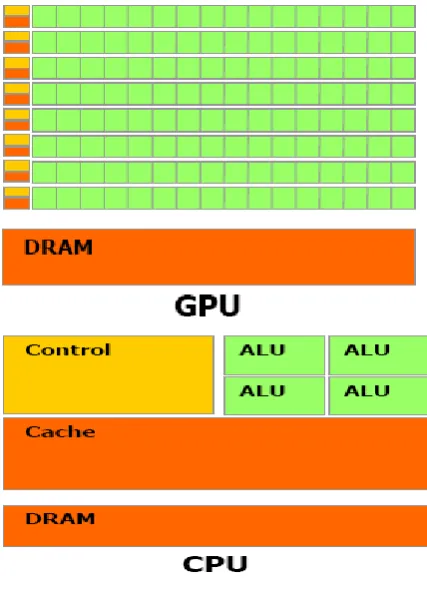
Fig. 1 below explains the main difference between a CPU and GPU. It can be seen that most of the silicon area in a GPU is devoted to computational units (shown in green) unlike a CPU where it has more units for controlling and cache (shown in orange and yellow color).
Fig. 1.CPU Vs. GPU
B. Why we use a GPU?
A GPU can be used for non-graphical computationally expensive applications because it has a large number of computational units called cores. These cores are utilized in parallel by a large number of threads to get results in parallel. All cores are clocked by a low frequency clock source therefore expected power dissipation is normally assumed low.
C. Advantages & Limitations
The inherent parallelism in a GPU makes it an excellent candidate for parallel applications. Especially embarrassingly parallel application best utilizes these computational resources. Not many applications are fully parallel and many a time only a small fraction is parallelizable [5]. In such case performance gain may not be very good.
Another issue with GPU is that we need to copy data to and from GPU. This copying operation is normally very costly as compared to calculations, which might degrade the over system performance. [6]
II.SECURING
ROUTING
IN
MANET
There are many protocols used for routing in MANET[7][8][9][10][11]12]. Because there is no central certification authority in a Mobile Wireless Adhoc Network or MANET, security becomes most important concern, especially for applications that share sensitive user data, including lifesaving critical applications. A malicious node for example pretend as an authorized node and send fake data to other nodes, giving rise to many attacks, including Denial-of-Service attacks[13].
Though MANET has several advantages, it lacks proper mechanism for security, we describe below those security related aspects and challenges in this section.
The communication in MANET relies completely on radio transmissions, which is susceptible to eavesdropping by an unauthorized node. This makes it mandatory to deploy an end-to end encryption to prevent eavesdropping. Because there is no central monitoring system, nodes participating in defining topology, may involve in Denial of Service attacks and might become black hole stalling all communications.
Further, many nodes are non-participating and any communication with such nodes results in wastage of CPU-time, bandwidth and battery power which are often limited in MANET nodes. MANETs behavior is highly dynamic, where non-participation and exits are highly unpredictable. In such dynamic environment, any static security mechanism is insufficient. A dynamic security approach, where security related parameters are adjusted on-demand is a must have in such situation. The Zone Routing Protocol [14] has no security enabling feature and thus it is its biggest limitations. That is why SZRP [2] is proposed which adds a security layer to make communication in a MANET secure.
III.OPTIMIZATION
AND
PERFORMANCE
ISSUES
IN
MANET
ROUTING
PROTOCOLS
In MANETs participating nodes are dynamically connected in an arbitrary manner which changes various network parameters. The rate of change of these parameters depends on how fast these participating nodes move. Routing protocols heavily rely on huge number of calculations at various stages during packet transmission and final delivery. MANET comprises of mobile devices which are often limited in power backups and computational capabilities. For a real-time application in MANET any delay in a transmission or reception of data packets could be disastrous especially for safety application.
In MANET the topology is highly dynamic because of exit or entry of new nodes in the network. These networks comprise of huge number of nodes, especially due to advent of recent advancement in IoT (Internet-of-Things) and similar technologies. Today we have huge number of mobile devices and a use of smart phones is very common these days. This further puts computational pressure on these small hand-held devices. Also the number of such devices is growing rapidly [3], Further Zones in MANET are also increasing in size, further increasing the complexity of the network as a whole. This demands more computation per second. Therefore, meeting the computational goal is crucial for successful use of the applications.
we intent to use the computational capability a GPU for doing a non-graphics problem of optimization of SZRP in a MANET.
IV.
GSZRP:
GRAPHICS-HARDWARE
BASED
OPTIMIZED
SECURE
ZONE
ROUTING
PROTOCOL
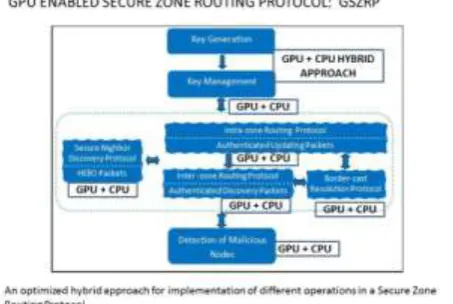
The proposed solution based on GPU can be seen in the following figure.
Fig. 2.CPU Vs. GPU
As can be seen here our proposal is based on a CPU-GPU hybrid approach where we try to exploit parallelism as much as possible. We propose that we should look for the opportunity to port parallel jobs on a GPU and serial controlling jobs on a CPU. In the previous section we have already described various conditions when a GPU can substantially outperform CPU performance.
D. Basic idea
Figure 3: Distance calculations in NDP on a CPU-GPU system will have higher parallelism opportunity
In this version we have assigned one thread to each distance calculation, that is, each thread is responsible for completing the D calculation,
D= sqrt( (x2-x1)2+ (y2-y1)2 (1)
All thread will work in parallel and will finish the job simultaneously. In contrast to this on a CPU everything will run serially so there will be considerable delay. Therefore, we see that a parallel approach using a GPU could help us latency issues in SZRP of MANET.
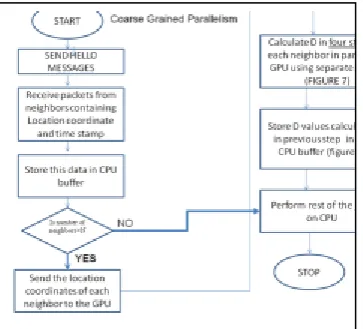
The following flow chart shows our proposed methodology
Figure 4: Distance calculations in NDP on a CPU-GPU system will have higher parallelism opportunity
V.RESULTS,
CONCLUSION
&
SCOPE
FOR
FUTURE
WORK
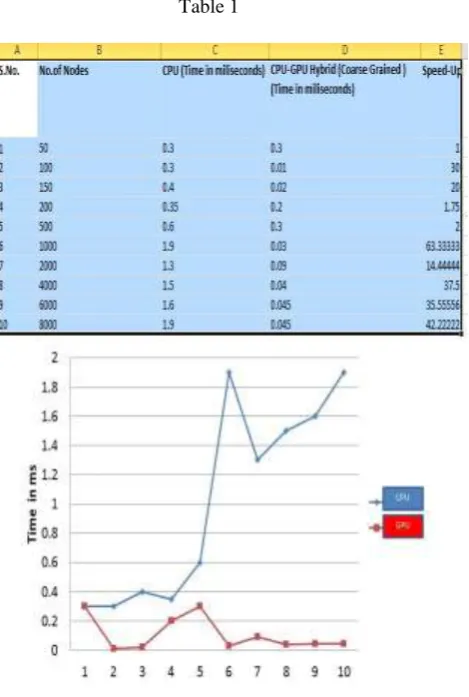
Table 1
Figure 5: Graph showing performance gain on CPU-GPU system as compared to a CPU only system.
CPU= Intel Core2Duo 2GHz, GPU=NVIDIA 410m Geforce
We observe from these graphs that a CPU-GPU system often outperforms a CPU by several folds, as high as 63 times for larger MANETS. Such large MANET is common now a day, especially due to advent of IoT devices and sensor networks. This establishes our hypothesis of using a GPU compatible algorithm for optimization of various stages in a MANET.
This work is based on using a GPU for getting performance gain in a typical MANET routing. We have demonstrated it using a real life scenario of NDP in MANET routing. Our propose method of using a CPU-GPU hybrid approach has given rise to several fold speed up as compared to a CPU only solution.
manufacturer [17]. We have not explored those avenues. Those features can greatly benefit various computationally intensive jobs in MANET protocol.
Also we suggest doing a more mathematically rigorous analysis for establishing advantages and limitations of our proposed methods.
REFERENCES
[1] Z.J. Haas, M. R. Pearlman, and P. Samer, “The Zone Routing Protocol (ZRP) for Ad Hoc Networks,” Internet Draft, 2003, available at:http://tools.ietf.org/id/draft-ietf-MANETs-zone-zrp-04.txt.
[2] J., & Indora, S. (2016). A Secure Improved Zone Routing Protocol (SIZRP) for Ad-hoc Networks. Proceedings of the 2016 Sixth International Conference on Advanced Computing & Communication Technologies. doi:10.3850/978-981-11-0783-2_399
[3] Linda Sui | Dec 21, 2016, 44% of World Population will Own Smartphones in 2017, on
https://www.strategyanalytics.com/strategy-analytics/blogs/smart-phones/2016/12/21/44-of-world-population-will-own-smartphones-in-2017#.WjNltlWWb3g
[4] Purohit, R., & Keswani, B. (2015). Node Mobility Impact on Zone Routing Protocol. International Journal of Computer Applications, 118(18), 29-32. doi:10.5120/20847-3534
[5] Gaudiot, J. (n.d.). Parallel computing; one opportunity, four challenges. [1989] Proceedings. Fifth International Conference on Data Engineering. doi:10.1109/icde.1989.47252
[6] Likun, Z., & Dingfang, C. (2008). Accelerate Your Graphic Program with GPU/CPU Cache. 2008 International Conference on Cyberworlds. doi:10.1109/cw.2008.58
[7] Mazinani, S. M., & Naderi, A. (2012). A differentiated reliable routing protocol along with re-routing policy in wireless sensor networks. 2012 IEEE Sensors Applications Symposium Proceedings. doi:10.1109/sas.2012.6166313
[8] Rahman, Z., Rahim, A., & Aslam, M. (2011). ZRIC (Zigzag routing inside cluster) energy efficient routing protocol for wireless sensor networks. 2011 IEEE Conference on Open Systems. doi:10.1109/icos.2011.6079247
[9] Rhee, B., Cho, S., Xianshu, J., & Han, S. (2009). QoS-Aware Router Combining Features of Conventional Routing and Flow-Aware Routing Based on Resource Management over NGN. 2009 International Conference on Advanced Information Networking and Applications Workshops. doi:10.1109/waina.2009.59
[10] C. Siva Ram Murthy and B. S Manoj, “Ad Hoc Wireless Networks, Architecture and Protocols”, Prentice
Hall PTR, 2004.
[11] Stefano Basagni, Macro Conti, Silvia Giordano and Ivan Stojmenovic, “Mobile Ad Hoc Networks” , IEEE press, A john Wily & Sons, INC. Publication, 2003
[13] Wireless Ad Hoc, Sensor and Mesh Networks. (2009). Security in Wireless Ad Hoc and Sensor Networks, 9-28. doi:10.1002/9780470516782.ch2
[14] Haas Z. J., Pearlman M. R., and Samar P., “The Zone Routing Protocol (ZRP)”, IETF Internet Draft,
draft-ietf-manet-zone-zrp-04.txt, July 2002.
[15] Nere, A., & Lipasti, M. (2010). Cortical architectures on a GPGPU. Proceedings of the 3rd Workshop on General-Purpose Computation on Graphics Processing Units - GPGPU 10. doi:10.1145/1735688.1735693
[16] Jan Schaumann, “Analysis of Zone Routing Protocol”, Course CS765, Stevens Institute of Technology
Hoboken, New Jersey, USA, 8th December 2002