Western University Western University
Scholarship@Western
Scholarship@Western
Electronic Thesis and Dissertation Repository
August 2010
Addressing Computational Complexity of Electromagnetic
Addressing Computational Complexity of Electromagnetic
Systems Using Parameterized Model Order Reduction
Systems Using Parameterized Model Order Reduction
Majid Ahmadloo
University of Western Ontario
Supervisor
Dr. Anestis Dounavis
The University of Western Ontario
Graduate Program in Electrical and Computer Engineering
A thesis submitted in partial fulfillment of the requirements for the degree in Doctor of Philosophy
© Majid Ahmadloo 2010
Follow this and additional works at: https://ir.lib.uwo.ca/etd
Part of the Electromagnetics and Photonics Commons, and the VLSI and Circuits, Embedded and Hardware Systems Commons
Recommended Citation Recommended Citation
Ahmadloo, Majid, "Addressing Computational Complexity of Electromagnetic Systems Using Parameterized Model Order Reduction" (2010). Electronic Thesis and Dissertation Repository. 12.
https://ir.lib.uwo.ca/etd/12
This Dissertation/Thesis is brought to you for free and open access by Scholarship@Western. It has been accepted for inclusion in Electronic Thesis and Dissertation Repository by an authorized administrator of
Addressing Computational Complexity of
Electromagnetic Systems Using Parameterized Model Order
Reduction
(Spine Title: Numerical Reduction Techniques for
Electromagnetic Systems)
(Thesis format: Monograph)
by
Majid Ahmadloo
Graduate Program in Engineering Science
Department of Electrical and Computer Engineering
A THESIS SUBMITTED TO THE FACULTY OF GRADUATE STUDIES AND RESEARCH IN PARTIAL FULLFILMENT OF THE REQUIREMENTS FOR THE
DEGREE OF DOCTOR OF PHILOSOPHY
THE SCHOOL OF GRDAUATE AND POSTDOCTORAL STUDIES THE UNIVERSITY OF WESTERN ONTARIO, LONDON, ONTARIO, CANADA
THE UNIVERSITY OF WESTERN ONTARIO
SCHOOL OF GRADUATE AND POSTDOCTORAL STUDIES
CERTIFICATE OF EXAMINATION
Supervisor
______________________________ Dr. Anestis Dounavis
Supervisory Committee
______________________________
Examiners
______________________________ Dr. Kazimierz Adamiak
______________________________ Dr. Jayshri Sabarinathan
______________________________ Dr. Anand V. Singh
______________________________ Dr. Mustapha C. E. Yagoub
The thesis by
Majid Ahmadloo
entitled:
Addressing Computational Complexity of Electromagnetic Systems
Using Parameterized Model Order Reduction
is accepted in partial fulfilment of the requirements for the degree of
Doctor of Philosophy
Abstract
As operating frequencies increase, full wave numerical techniques such as the finite
element method (FEM) become necessary for the analysis of high-frequency and
microwave circuit structures. However, the FEM formulation of microwave circuits often
results in very large systems of equations which are computationally expensive to solve.
The objective of this thesis is to develop new parameterized model order reduction
(MOR) techniques to minimize the computational complexity of microwave circuits.
MOR techniques provide a mechanism to generate reduced order models from the
detailed description of the original FEM formulation.
The following contributions are made in this thesis:
1. The first project deals with developing a parameterized model order reduction to
solve eigenvalue equations of electromagnetic structures that are discretized by using
FEM. The proposed algorithm uses a multidimensional subspace method based on
modified perturbation theory and singular-value decomposition to perform reduction
directly on the finite element eigenvalue equations. This procedure generates
parametric reduced order models that are valid over the desired parameter range
without the need to redo the reduction when design parameters are changed. This
provides significant computational savings when compared to previous eigenvalue
MOR techniques, since a new reduced order model is not required each time a design
parameter is changed.
2. Implicit moment match techniques such as the Arnoldi algorithm are often used to
improve the accuracy of the reduced order model. However, the traditional Arnoldi
arbitrary functions of frequency due to material and boundary conditions. In this
work, an efficient algorithm to create parametric reduced order models of distributed
electromagnetic systems that have arbitrary functions of frequency (due to material
properties, boundary conditions, and delay elements) and design parameters. The
proposed method is based on a multi-order Arnoldi algorithm used to implicitly
calculate the moments with respect to frequency and design parameters, as well as the
cross-moments. This procedure generates parametric reduced order models that are
valid over the desired parameter range without the need to redo the reduction when
design parameters are changed and provides more accurate reduced order systems
when compared with traditional approaches such as Modified Gram Schmidt.
3. This project develops an efficient technique to calculate sensitivities of microwave
structures with respect to network design parameters. The proposed algorithm uses a
parametric reduced order model to solve the original network and an adjoint variable
method to calculate sensitivities. Important features of the proposed method are 1)
that the solution of the original network as well as sensitivities with respect to any
parameter is obtained from the solution of the reduced order model, and 2) a new
Acknowledgement
This thesis could not be successful without the invaluable support of my supervisor
Dr. Anestis Dounavis of the Department of Electrical and Computer Engineering,
University of Western Ontario. I would like to express my gratitude towards him for
introducing me to the area of model order reduction and imbibing in me the enthusiasm
for research. His motivation, keen acumen in this field of research and friendly
disposition has always had a positive effect on my work.
I would also like to extend my thanks towards every faculty member, staff member
and friend of the Department of Electrical and Computer Engineering, University of
Western Ontario for their support and help at various stages of my thesis work. I would
like to specially mention my colleagues Amir Beygi and Ehsan Rasekh and Sourajeet
Roy for their invaluable advice.
My final thoughts are with my parents, Abolghasem and Fatemeh. Without their
encouragement and endless support, I would not have had the opportunity to complete
Contents
Certificate of Examination………...……... ii
Abstract………...…..…………. iii
Acknowledgements………...……….. v
Contents………. vi
List of Tables………...… viii
List of Figures ………...……..…….. ix
Abbreviations………...……….. xi
1. Introduction………..………. 1
1.1. Background and Motivation………….………1
1.2. Objectives………..……….. 4
1.3. Contributions……….……….………. 6
1.4. Organization of Thesis……….……… 7
2. Background and Literature Review……….... 9
2.1. Introduction………..……… 9
2.2. Simulation of Microwave Systems……….………..……. 10
2.2.1. FEM formulation of Microwave Systems………..………. 11
2.3. Simulation Techniques based on MOR……….……… 15
2.3.1. SVD Based MOR on Eigenproblems………….……….………... 16
2.3.2. Moment Matching Based MOR………..… 18
2.3.3. Sensitivity Analysis Using MOR Techniques………..….. 24
3. Parameterized Model Order Reduction on Eigenvalue Equations……… 27
3.1. Introduction………..…….. 27
3.2. Formulation of microwave system………..……... 27
3.3. Parameterized Reduced Order Model………..…….. 28
3.3.1. Parametric System Formulation………..…… 28
3.3.2. Computation of Parameterized Reduced Order Model………..……….29
3.3.3. Selecting the Order of the Reduced Order Model………..……… 34
3.4. Numerical Examples………..… 35
3.4.1. Example I: Partially-Filled Rectangular Waveguide………..……… 35
3.4.2. Example II: Microstrip Line………..…………. 40
4. Parameterized Model Order Reduction of Electromagnetic Systems using Multi-Order Arnoldi……….. 45
4.1. Introduction………..…….. 45
4.2. Parameterized Multi-Order Arnoldi for Systems with Arbitrary Functions…..…… 46
4.2.1. Computation of Reduced Order Model………..…. 46
4.2.2. Selecting the Order of the Reduced Order Model………..… 54
4.3. Problem Formulation and Numerical Examples………..…..55
4.3.1. Example I: RLC Network with Delay Elements………... 55
5. Sensitivity Analysis of Microwave Circuits using Parameterized Model Order
Reduction Techniques……… 66
5.1. Introduction………..……...66
5.2. Formulation of Microwave System………... 67
5.2.1. Adjoint Variable Method using MOR……… 67
5.2.2. Sensitivity Analysis of S-Parameters……….. 69
5.3. Numerical Example………..………. 71
6. Conclusion and Future Research……….. 85
6.1. Conclusion………..……... 85
6.2. Suggestions for Future Research………..……. 86
References……… 87
List of Tables
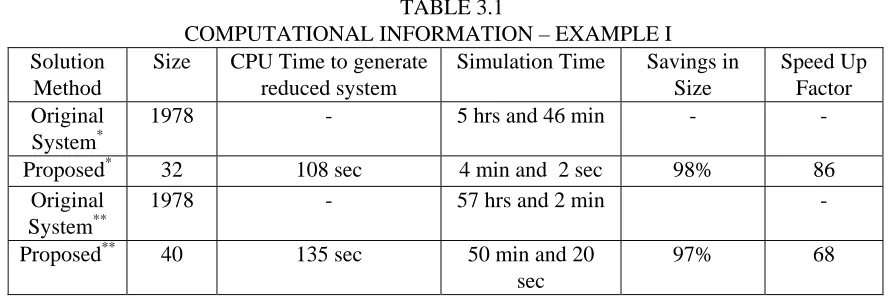
TABLE 3.1. ………..… 38
TABLE 3.2. ………..……… 44
TABLE 4.1. ……….……. 60
TABLE 4.2. ………..……… 65
List of Figures
Fig.2.1. Block Arnoldi Algorithm for expansion about a complex frequency point
0 s
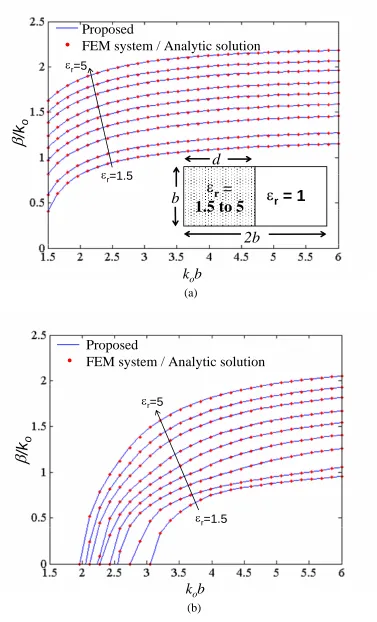
s= ………. 22 Fig. 3.1. Dielectric-loaded rectangular waveguide and the dispersion curves of the lowest four modes as εr ranges from 1.5 to 5 (a) mode 1 and physical geometry of waveguide (b)
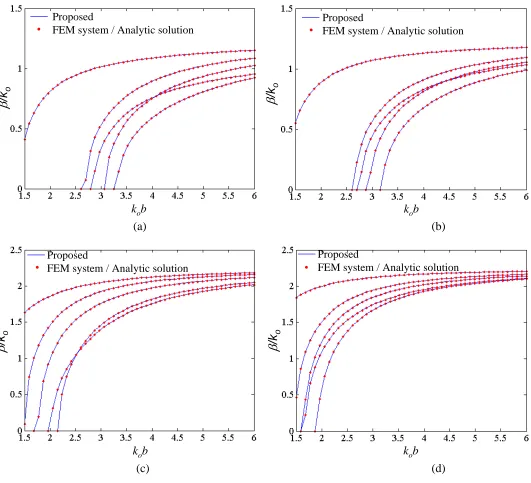
mode 4………... 34 Fig.3.2. Dispersion curves of the lowest five modes at the four extreme corners of parameter ranges for εr and d (a) At εr =1.5 and d=b (b) At εr =1.5 and d=1.3b (c) At εr
=5 and d=b (d) At εr =5 and d=1.3b………...………... 35
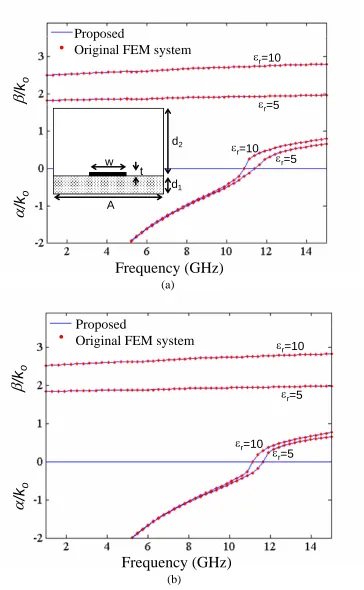
Fig. 3.3. Lossless microstrip line and the dispersion curves of the first two modes at the four extreme corners of parameter ranges for εr and w (a) At w=1.27 mm for εr =5 and εr
=10, (b) At w=1.65 mm for εr =5 and εr =10. In all cases A=12.7 mm, d1=1.27 mm,
d2=11.43 mm and t=0.127 mm………. 40
Fig. 3.4. Dispersion curves of the lowest twelve modes at the four extreme corners of parameter ranges for εr and w (a) At εr =5 and w=1.27 mm (b) At εr =5 and w=1.65 mm
(c) At εr =10 and w=1.27 mm (d) At εr =10 and w=1.65 mm………. 41
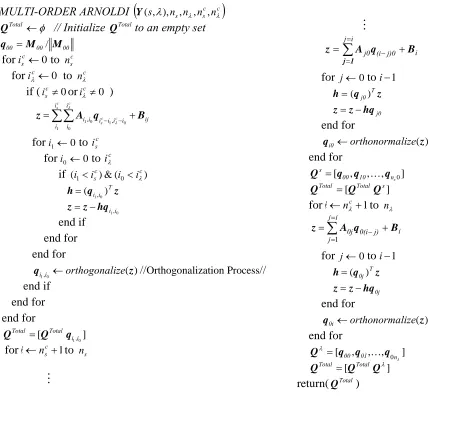
Fig. 4.1. Multi-Order Block Arnoldi Procedure including self-terms; with respect to frequency s, the design parameter λand the cross-terms………. 49 Fig.4.2. Multi-Order Block Arnoldi Procedure including self-terms; with respect to design parameters λN,K,λ0and the cross-terms……… 50
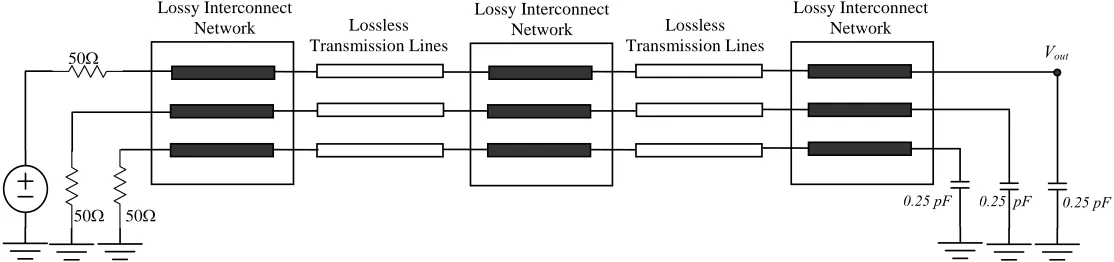
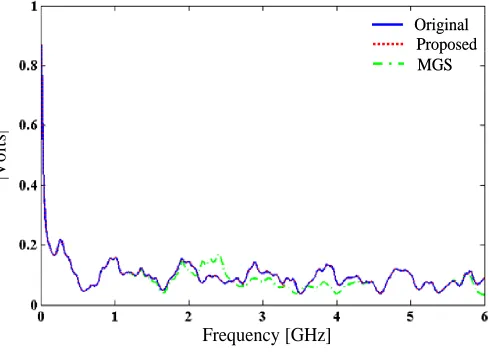
Fig. 4.3. RLC network including delay elements………. 55 Fig. 4.4. Frequency responses of the system of example 1 at the far end point at the expansion point at T = 5°C………... 56 Fig. 4.5. Time domain response of the system of example 1 at the far end point, at (a) T =
°
−40 C and (b) T = 50°C………... 57 Fig. 4.6. Geometry of the dual inductive iris filter………... 59 Fig. 4.7. The magnitude of S21 as a function of frequency at the expansion point at the
mid-range of design parametersεrandσ ……….. 60
Fig. 4.8. The magnitude of S21 as a function of frequency for different parameter values at
the corner of design parameters; (a) εr=1 and σ =3.78e7, (b)εr=5 and σ =3.78e7,
(c)εr=1 and σ =6.301e7 and (d) εr=5 and σ=6.301e7………... 61
Fig.5.1. WR90 waveguide with metallic iris at the input port. The rest of the waveguide is filled with dielectric material……… 70 Fig. 5.2a. S11 of the waveguiding structure at extreme corners of parameter ranges for εrand w (a)
r
ε =1 and w=0.00386, (b) εr=1 and w=0.00586………..………. 73
Fig. 5.2b. S11 of the waveguiding structure at extreme corners of parameter ranges for εrand w
(a) εr=5 and w=0.00386 and (b) εr=5 and w=0.00586……… 74
Fig. 5.3a. ∠S11 of the waveguiding structure at extreme corners of parameter ranges for εrand w
(a) εr=1 and w=0.00386, (b) εr=1 and w=0.00586……….. 75
Fig. 5.3b. ∠S11 of the waveguiding structure at extreme corners of parameter ranges for εrand w
Fig. 5.4a. Sensitivities of S11 of the waveguiding structure with respect to εrat (a) εr=3,
w=0.00386, (b) εr=3, w=0.00586………. 77
Fig. 5.4b. Sensitivities of ∠S11of the waveguiding structure with respect to εrat (a) εr=3,
w=0.00386, (b) εr=3, w=0.00586………. 78
Fig. 5.5a. Sensitivities of S11 of the waveguiding structure with respect to w at (a) εr=1,
w=0.00486, (b) εr=5, w=0.00486………. 79
Fig. 5.5b. Sensitivities of ∠S11of the waveguiding structure with respect to w at (a) εr=1,
Abbreviations
AWE Asymptotic Waveform Evaluation.
CFH Complex Frequency Hopping.
EM Electromagnetic.
FEM Finite Element Method.
LU Lower-upper matrix decomposition.
MGS Modified Gram Schmidt.
MOR Model Order Reduction.
ODE Ordinary Differential Equation.
PDE Partial Differential Equation.
PEC Perfect Electric Conductor.
PMC Perfect Magnetic Conductor.
p.u.l. Per-unit-length.
RF Radio Frequency.
SVD Singular Value Decomposition.
TEM Transverse electromagnetic.
Chapter 1
1. Introduction
1.1. Background and Motivation
The rapid advances of high frequency circuit technology have significantly affected the
construction of different types of microwave, millimeter-wave, optical and VLSI devices
commonly used in mobile communications, radio links, optical communications, and
various other automotive electronics systems. Modern wireless systems involve
electrically large electromagnetic (EM) structures such as the waveguides, antennas,
microwave circuits, and optical components, which are very complex in both geometry
and material properties [1]. Also technological advances in the circuit technology have
significantly reduced the feature sizes of high-speed electronic circuits and increased the
density of chips. This leads to the need for efficient analysis and design tools for
simulating and modeling the behavior of such structures and also performing
optimization on the parameters of such devices prior to costly prototype development.
Moreover, circuit designers also demand that the simulation techniques be fast and run on
relatively small computing platforms, such as standard desktop personal computers [1].
Hence at higher frequencies, integrated and microwave circuits require fast and accurate
modeling and simulation techniques for the optimization and design space exploration
problems.
The design of electromagnetic devices such as wave-guiding structures, microstrip
Differential Equations (PDE)s such as the vector wave equation derived by Maxwell’s
equations and hence full wave techniques are required to accurately characterize these
systems [2]-[6]. Numerical methods, such as the Finite Element Method (FEM), have
become extensively popular for accurate full wave analysis of microwave waveguide
devices [2]-[6]. The key advantages of the FEM are the accuracy, versatility and its
ability to handle complex materials (including anisotropic, lossy, non-linear etc) and
complicated geometries [2]-[4]. However it relies on the discretization of three
dimensional space and thus results in very large systems of equations which are
prohibitively expensive to solve. Furthermore, these equations are solved for a wide
frequency band and at different design parameters. One way to address computational
complexity of FEM is based on Model Order Reduction (MOR) techniques [7]-[19],
[28]-[30]. MOR techniques have been developed to efficiently calculate the scattering
parameters [11]–[12], [14]-[16], [19] and to perform fast wideband eigenmode analysis
of electromagnetic devices [28]–[31]. These algorithms are able to capture the frequency
response of large linear networks with low-order rational approximations. The underlying
concept of MOR is that distributed networks usually have large number of poles,
however, only a small percentage of these poles is dominant. Dominant poles are defined
as poles that have significant influence in the behavior of the network. By capturing only
the dominant poles, the CPU expense of the simulation can be significantly reduced
without compromising accuracy.
MOR techniques provide a mechanism to generate reduced order models from the
detailed description of the original FEM network. This is achieved by using moment
original system to approximate the response with a low-order transfer function [12],
[14]-[17], [19], [21]-[30]. However, these numerical techniques all conserve the original
system moments only with respect to frequency. While this provides a significant CPU
cost advantage when performing a single frequency sweep, a new reduced order model is
required each time a parameter is varied in the structure under study. This results in a
significant overhead and reduced efficiency when performing common design steps such
as optimization and design space exploration. Parameterized model order reduction
techniques have been proposed in the circuit area to address such concerns which
produce reduced order models that are functions of frequency or time as well as other
design parameters [20]-[26]. However, parameterized MOR techniques have not been
developed to solve microwave systems described by FEM equations.
Reduced order models are accurate at the frequency point of expansion and less
accurate away from the expansion point. To increase the accuracy of the reduced order
model additional moments are required or multiple expansion points can be used [43]. An
issue in developing efficient reduced order models is that as the number of moments
increases, the moments become ill-conditioned due to the fact that the higher order
moments converge to the largest eigenvalue of the system and are almost identical or
parallel to each other [43]-[44]. This minimizes the efficiency of the reduced order
model. One approach to improve the conditioning of the moment generating process is to
use implicit moment matching techniques such as the Arnoldi process [43]-[44]. The
traditional Arnoldi algorithm is applicable to first order linear systems that have a linear
dependency with respect to frequency. However, distributed microwave systems are
frequency due to material properties and boundary conditions. As a result, traditional
Arnoldi algorithms are not directly applicable in calculating the moments of the reduced
order system for microwave systems that exhibit arbitrary functions of frequency due to
high frequency phenomena such as skin effect.
MOR techniques have also been applied to perform sensitivity analysis of distributed
interconnects and microwave systems [80], [89]-[90]. However, these MOR-sensitivity
algorithms capture only the frequency moments of the original system. As a result, a new
reduced order model is required each time a design parameter is modified, which can
significantly increases the overhead of the optimization process.
The next sections describe the objectives and contributions of this thesis.
1.2. Objectives
The objective of this thesis is to develop efficient modeling techniques for the EM
structures and high frequency microwave circuit simulation. The proposed methodology
uses parameterized MOR techniques to reduce the computational complexity of
microwave systems described by the FEM formulation.
The FEM model used for microwave systems is obtained from the vector wave
equation for the electric field derived from Maxwell’s equation [27]. FEM discretization
of the vector wave equation results in a very large system of equations that are inherently
time consuming to solve. MOR techniques have been proposed in literature to
significantly reduce the CPU time required to simulate these large scale FEM problems
[11]–[12], [14]-[16], [19], [28]-[31]. However, the reduced order models do not capture
matched. As a result, a new reduced order model is required each time a design parameter
is modified which increases the overhead of the optimization process. In this thesis, a
methodology is proposed to form parametric reduced order models to perform fast
wideband eigenmode analysis of waveguide structures and to efficiently solve the
scattering parameters of microwave devices. The resulting reduced order models match
the characteristics of the original system in frequency domain as well as the other design
parameters within a range of interest.
For the scattering problems, the general form of the resulting FEM equations may
contain arbitrary functions of frequency due to material properties and boundary
conditions. However, these equations are not directly compatible with the traditional
Arnoldi algorithm, which relies on an implicit moment matching technique to obtain
numerically well conditioned subspace from the moments of the original system. In this
thesis the Arnoldi algorithm is extended to include arbitrary functions of frequency and
design parameters. This approach yields more accurate reduced order models for
complicated microwave systems that exhibit arbitrary functions of frequency and design
parameters due to material properties and boundary conditions.
Microwave designers must make proper trade-offs, often between conflicting design
requirements to obtain the best possible performance. Sensitivity analysis provides
designers with valuable information in terms of identifying critical components in the
design and provides gradient information needed for optimization. To combat the
computational burden of performing sensitivity analysis on large EM systems a
efficient in optimization since a new reduced model is not required each time a design
parameter is modified.
1.3. Contributions
The main contributions of this thesis are:
1. A parameterized model order reduction algorithm is developed to solve eigenvalue
equations of electromagnetic systems. The model uses perturbation technique to obtain
frequency moments as well as the moments with respect to other design parameters of
interest. Next Singular Value Decomposition (SVD) is used to obtain a parameterized
reduced order model which can be used to calculate the dispersion curves of the
microwave devices. This procedure generates parametric reduced order models that are
valid over the desired parameter range without the need to redo the reduction when
design parameters are changed.
2. An Arnoldi technique is developed for the reduction of finite element electromagnetic
systems to model structures with frequency dependant materials, delay elements and
boundary conditions, as traditional MOR techniques using the Arnoldi algorithm are only
applicable to first order linear systems and can not directly include arbitrary functions of
frequency. The algorithm uses multi-order Arnoldi method to implicitly calculate the
moments of the original system with respect to frequency, design parameters and well as
cross-moments. Numerical examples will illustrate that this approach yields more
accurate parameterized reduced order models when compared to explicit moment match
3. The parameterized MOR technique is developed to perform sensitivity analysis of
electromagnetic devices. The proposed algorithm uses a parametric reduced order model
to solve the original network and an adjoint variable method to calculate sensitivities.
Important features of the developed algorithm are: 1) a new reduced order model is not
required each time design parameters are varied, and 2) the solution of the original
network as well as sensitivities with respect to any parameter is obtained from the
solution of the reduced order model.
1.4. Organization of Thesis
The organization of the thesis is as follows. Chapter 2 begins by reviewing the FEM
based full wave analysis of microwave systems. From this discussion, MOR techniques
are examined to reduce the computational difficulties of large scale FEM systems. In
Chapter 3, a parameterized MOR technique for eigenvalue analysis of electromagnetic
structures is presented. The development of a perturbation method and the SVD
technique is described to create parametric reduced order models. Numerical examples
are presented to demonstrate the efficiency of the proposed eigenvalue analysis
algorithm. Chapter 4 describes the details of a multi-order Arnoldi technique for the
reduction of finite element electromagnetic systems to include the effect of frequency
dependant materials, delay elements and boundary conditions in the reduced order model.
This chapter is concluded by presenting some numerical examples to show the efficiency
of the algorithm. In Chapter 5, the parameterized MOR technique is developed to
using parameterized MOR is described. A numerical example is presented to illustrate the
Chapter 2
2. Background and Literature Review
2.1. Introduction
The finite-element method (FEM) is one of the most used numerical techniques for the
analysis and design of microwave and optical wave guiding structures. While the FEM
provides a high degree of versatility and accuracy, it relies on the discretization of 2-D or
3-D space and thus results in very large systems of equations which are computationally
expensive to solve. If the solution over a broad frequency spectrum is required, then the
analysis must be repeated at many frequency points. This problem is further exacerbated
when one considers the typical design process which includes optimization and design
space exploration and thus requires repeated simulation of the same problem for different
parameter values.
One approach to minimize the computational complexity of FEM is based on
model-order reduction (MOR) [20], [28]-[31], [47]-[48]. These techniques provide a mechanism
to generate reduced order models from the detailed description of the original FEM
network. MOR techniques are able to conserve the moments of the original network and
approximate the response with a low-order transfer functions. The goal of this chapter is
to review the FEM formulation and MOR techniques that are used to model high speed
VLSI interconnects and microwave circuits.
This organization of this chapter is as follows. The finite element formulation for the
a generalized eigenvalue problem or algebraic set of equations. Section 2.3 reviews MOR
techniques that are used to reduce the computational complexity of the FEM formulation.
2.2. Simulation of Microwave Systems
Microwave devices such as antennas, waveguides, filters, couplers, junctions and
microstrip devices are usually very complicated in geometrical structure and material
properties. These devices are governed by the Maxwell’s equations which can be
expressed in the form of PDEs. The mathematical difficulties inherent in analytical
solution of Maxwell’s equation, e.g. geometries with various cross-sections of
conventional microwave devices, and the use of anisotropic, nonlinear, and lossy
materials, make the analysis of such devices considerably complicated. As the operating
frequencies increase, full wave methods which directly solve Maxwell’s equation are
essential in order to accurately predict high frequency electromagnetic behaviour of
microwave devices. The FEM technique has now been a very popular approach for full
wave electromagnetic modeling of high frequency microwave devices due to its
accuracy, versatility and flexibility. However, the resulting system of equations after the
FEM discretization is typically very large and cumbersome to solve. This section briefly
reviews the FEM formulation for the microwave systems and MOR techniques to be used
2.2.1. FEM formulation of Microwave Systems
Considering a general waveguide whose conductors can be lossy and whose dielectrics
can be inhomogeneous and anisotropic, the FEM formulation begins with the
discretization of the electric field vector wave equation [27]
[ ]
(
1⋅∇×)
− 2[ ]
~ ⋅ =0 ×∇ −
E
E r
r k ε
µ (2.1)
where k2 =ω2ε0µ0. The variables
0
ε and µ0 are the permittivity and permeability of free
space;
[ ]
µr and[ ] [ ] [ ]
ε~r = εr − jσ /(ωε0) are the relative permittivity and permeabilitycoefficients, respectively;
[ ]
σ is the conductivity; ω is the angular frequency and E isthe electric field vector. For waveguide problems, on the conducting surfaces, the electric
field satisfies the Dirichlet boundary condition on perfect electric conductor (PEC) as
0 ˆ×E =
n (2.2)
If symmetry can be used to reduce the size of the original problem then Neumann
boundary condition on perfect magnetic conductor (PMC) is applied
[ ]
( )) 0 (ˆ× r −1⋅ ∇×E =
n µ (2.3)
By a variational formulation, the functional related to (2.1) and the boundary conditions
can be expressed as [27], [30]
where γ =α+ jβ is the complex propagation constant and Ω the cross section of the
waveguide. Considering the following transformations et =γEtand ez =γEz along with
combining the basis functions, the following formulation can be obtained
e e
F T T
M e K e
E) 2
( = −γ (2.5)
where
[ ]
}
{
∫∫Ω
− ∇× ⋅ ∇× ⋅ ⋅ Ω= µ ( ) ( )-k d
e 2 t rt t
0 t t 1 rz T e e e e K e ε
{
[ ]
}
∫∫
Ω − ⋅ +∇ − Ω ⋅ ∇ += µ k d
e 1 t t z rz t z
rt z t t T e e e e e e M
e ( ) ( ) 02ε
where e is a column vector containing nodal and edge variables related to field
distribution. Applying Ritz method to (2.5) result in a generalized eigenvalue problem
e
e M
K =γ2
(2.6)
Finally the frequency dependant eigen problem of (2.6) can rewritten as
0 )
(A(k)−λ(k)B(k) ⋅E(k)= (2.7)
where λ=γ2 and E are the eigenvalues and eigenvectors, respectively and k is the
wavenumber. The matrices A and B are functions of the wave number k which can be
To perform modal analysis of the EM structures the generalized eigenvalue problem
of (2.7) has to be solved. Such calculations are very time consuming, since the FEM
formulation of (2.7) often leads to a very large system of equations which needs to be
solved over a broad frequency spectrum.
For the case of scattering problems, the functional for boundary value problem
defined in (2.1) in accordance with the general variational principle can also be
represented in the presence of excitation Eincas [27]
[ ]
[ ]
[
]
∑ ∫∫
∫∫∫
= Γ − ⎭ ⎬ ⎫ ⎩ ⎨ ⎧ × ⋅ × ⋅ + ⋅ − × ∇ ⋅ × ∇ = p i V * r 2 1i 2 (n ) (n )-2j dS
j dV ε k ) ( ) ( µ 2 1 ) F( 1 ] ˆ ˆ [ ~ inc E E E E E E E E E β
β (2.9)
whereγ =α+ jβ is the complex propagation constant; V denotes the volume of the
structure; S denotes the surface enclosing V and nˆ is outward normal to S and p is the
total number of ports. The FEM discretization of (2.9) when there is finite conductivity
using vector basis functions results a matrix equation as
b e
A A
A
A + s+ s + jβ) s = jβ
( 0 1 2 2 3 (2.10)
where s= jω is the angular frequency, β is the propagation constant and is a function of
frequency, the matrices A0,A1,A2,A3and bare given by
∫∫∫
∇× ⋅∇× =V i j
ij N N dV
A
µ
1 ,
0 (2.11)
∫∫∫
⋅=
V i j
ij N N dV
∫∫∫
⋅ =V i j
ij N N dV
A2, ε (2.13)
∫∫∫
⋅ = V i jij S S dV
A3, (2.14)
dS n
inc
S i
i =−2
∫∫
S ⋅(E × ˆ)b (2.15)
where Si is the vector basis functions and Si =nˆ×Ni where Ni are the vector basis
functions that have unit tangential component at edge i, A0∈ℜN×N,
N N× ℜ ∈ 1
A ,A2∈ℜN×N and A3∈ℜN×Nare the sparse matrices obtained through the FEM
formulation. es∈CNis the vector of unknown variables in the approximation of E,
N
ℜ ∈
b in the vector of the incident field and N is the total number of variables in the
FEM formulation. In case of no finite conductivity (2.10) can be simplified as
b e A A
A + k+ k ) k =k
( 0 1 2 2 (2.16)
where ek∈CNin the vector of unknowns and k= jβ. The matricesA0,A1and A2are as
follows
2 0 0
2 0
0 A ( )A
A
µ ε t
k −
= (2.17)
3
1 A
A = (2.18)
2 0 0
0 )
1
( A
A
µ ε
= (2.19)
Y(s)⋅X(s)=b(s) (2.20)
where )Y(s ∈CN×N is the transfer function of the system; X(s)∈CN is the vector of
unknown variables; b(s)∈CN represents the excitation of the network; N is the number
of unknown variables in X(s) and s is the angular frequency. Complexity of such system
of equations often leads to large system matrices in (2.20) and as a result simulation of
which is computationally expensive.
One way to combat such computational complexity of FEM solutions is to use MOR
techniques. In the following sections, the MOR algorithms used to perform
eigen-analysis and calculate the scattering parameters of microwave systems are briefly
reviewed. In addition, MOR techniques to calculate sensitivities are also described.
2.3. Simulation Techniques based on MOR
To efficiently solve the eigenvalue problem of (2.7), MOR techniques based on
hyper-perturbation Taylor series expansion [28]-[30], asymptotic waveform evaluation [8]-[9]
and singular value decomposition [29]-[30] have been proposed. To obtain reduced order
models for (2.20), MOR techniques are either based on explicit moment matching based
on direct Padé approximants [32]-[34] or implicit moment matching based on projecting
large matrices on its dominant eigenspace [30], [36]-[39], [42]. The following sections
briefly reviews MOR techniques to efficiently solve the system equations in (2.7) and
2.3.1. SVD Based MOR for Eigenvalue Problems
Modal analysis of the EM structures corresponds to solving a generalized eigenvalue
problem of (2.7). One approach to derive a reduced order model for (2.7) is based on
using modified perturbation theory and singular value decomposition [28]-[30]. This
approach expands the eigenvectors E(k) and eigenvalues λ(k) of (2.7) into a Taylor
series at k=k0 as
∑
= − = M 0 i ii k k
(k) E ( 0)
E (2.21)
∑
= − = M 0 i ii k k
) h
(k, λ( 0)
λ (2.22)
Substituting (2.8), (2.21)-(2.22) into (2.7) and matching coefficients of corresponding
powers of (k−k0) yields the following recursive relationship
0 1 0 1 0 0 1 1 0 0
0 ) ( )
(A −λ B E =λB E − A −λ B E
) ( ) ( ) ( ) ( 0 1 1 0 1 0 2 0 2 1 1 0 1 0 0 2 2 0 0 0 E B E B E A E B A E B E B A + + − − − − = − λ λ λ λ λ B M
∑
∑
∑
− = −− − = = − − + ⋅ − = − ) , 2 min( 0 1 1 ) , 2 min( 1 0 0 0 0 0 0 ) ( ) ( i Mj j M i j
M
i i
M
i i i M i
M M E B E B A E B E B A λ λ λ λ (2.23)
To obtain the Taylor series coefficients of (2.21)-(2.22) from (2.23), equation (2.7) must
can be done by using the Lanczos algorithm as reported in [28], [30]. Since E0 is an
eigenvector of (2.7), then the following relationship holds true ( 0 0 0) 0 H
0 A − B =
E λ
[28]-[30], where the superscript H denotes the Hermitian of the matrix. Therefore, by
multiplying the first equation of (2.23) by H 0
E will make the left-hand side disappear and
1
λ can be found. With the knowledge of λ1 the first equation of (2.23) can be used to
find E1. This process is repeated recursively to find the higher order polynomial
coefficientsλi and Ei, where i=[0,1,...,M]. Once all the required Taylor series
coefficients with respect to k are evaluated, the subspace K is constructed as
[
E E EM]
K= 0, 1,..., . As the number of Taylor coefficients increase, the matrix K becomes
ill-conditioned. As a result, to obtain a more accurate reduced order system, the matrix K
is converted into orthonormal matrix Q using singular value decomposition [28]-[30].
The reduced order model is obtained by a change of variables as
(k) (k) QE
E = ˆ (2.24)
Substituting (2.24) into (2.7) and pre-multiplying by QH yields
0 ˆ ) ˆ ˆ
(A(k)−λ(k)B(k) ⋅E(k)= (2.25)
where
Q A Q Aˆ(k)= H (k)
Q B Q
The size of the reduced order model depends on the order M, which is very small
compared to the size of the original system. Once the reduced system of (2.25) is
obtained, it can be applied to perform fast frequency sweeps of electromagnetic
eigenvalue problems. However if one decides to change a parameter in the system, the
reduced order model of (2.25) is no longer valid and a new reduced order model needs to
be calculated. This is due to the fact that the moments are captured only with respect to
frequency.
2.3.2. Moment Matching Based MOR
For the solution of (2.20), MOR techniques can be broadly classified into two main
categories: approaches based on explicit moment matching based on direct Padé
approximants and implicit moment matching based on projecting large matrices on its
dominant eigenspace.
Explicit moment matching techniques calculate the actual moments of (2.10) and
(2.16) to obtain a reduced order system. However, these methods are limited to low order
approximations, due to the fact that the higher order moments converge to the largest
eigenvalue of the system and are almost identical or parallel to each other [15]-[16], [43].
As a result, the additional higher order moments add no new information to the reduced
order model. On the other hand, Krylov subspace methods based on congruent
transformations capture the system moments implicitly by using Arnoldi process [44] to
provide high order approximations. A general approach used to apply the Arnoldi process
for polynomial matrix equations in (2.16) is to convert it to a linear system by using extra
B X G
C+ ) =
(s (2.27)
where ; ; 0 1 0 1 ⎥ ⎦ ⎤ ⎢ ⎣ ⎡ − = ⎥ ⎦ ⎤ ⎢ ⎣ ⎡ − = 0 A I A C 0 A I A
G N N
⎥ ⎦ ⎤ ⎢ ⎣ ⎡ = ⎥ ⎦ ⎤ ⎢ ⎣ ⎡ ′ = 0 b B e e X ; k k (2.28)
where IN∈ℜN×Nis the identity matrix and e′x∈CNis the vector of extra unknown
variables. The system of equations (2.27) has linear dependency with respect to s, sothat
the Arnoldi algorithm is directly applicable.
To obtain a reduced order model the moments of the network need to be
evaluated. To illustrate this concept, for both explicit and implicit moment matching
techniques, consider a single-input single-output linear system and let H(s) be the transfer
function. Using a Maclaurin series expansion, H(s) can be expressed as
... s m s m m H(s) 2 2 1
o + + +
≈ (2.29)
where mi is referred to as the ith moment of H(s). To construct a reduced-order model
using explicit moment matching techniques such as Asymptotic Waveform Evaluation
(AWE), the series expansion of (2.29) is converted to a rational function using Padé
ap-proximation as N N 1 L L 1 0 1 L N 1 L N 2 2 1 o s b ... s b 1 s a ... s a a s ...m s m s m m H(s) + + + + + + ≈ + + + ≈ + − −
The coefficients ai and bi are obtained by cross multiplying the denominator of (2.28) and
equating similar powers of s. In general the system of equations can be represented as
⎥ ⎥ ⎥ ⎥ ⎦ ⎤ ⎢ ⎢ ⎢ ⎢ ⎣ ⎡ − = ⎥ ⎥ ⎥ ⎥ ⎦ ⎤ ⎢ ⎢ ⎢ ⎢ ⎣ ⎡ ⎥ ⎥ ⎥ ⎥ ⎦ ⎤ ⎢ ⎢ ⎢ ⎢ ⎣ ⎡ + + + − − + + + + − + − + − + − N L 2 L 1 L 1 1 N N 1 L N 2 L L 1 L 3 N L 2 N L L 2 N L 1 N L m m m b b b m m m m m m m m m M M K M M M L L ∑ = − + = + = = N) min(L, 1
i i L i
L L 0 1 1 1 0 0 m b m a m b m a m a
L (2.31)
The moments of (2.27) can be calculate by replacing X with a Maclaurin series
expansion, gives B M M M G
C + )( + + +....)=
(s 0 1s 2s2 (2.32)
Equating the coefficients of similar powers of s on both sides yields
0 GM CM 0 GM CM 0 GM CM B GM = + = + = + = − k k 1 2 1 1 0 0 L 1 1 2 0 1 0 − − = − = − = = k
k G CM
M CM G M CM G M B G M 1 -1 -1 --1 L (2.33)
SubstitutingA=−G-1Cand R=G-1Binto (2.33) yields
Equation (2.34) yields a closed form relationship for the computation of the moments Mk.
As shown in (2.33), only one matrix inversion is required to calculate the moments. As a
result the main computational cost to calculate the moments is one lower-upper
decomposition for each expansion point and one forward-backward substitution for each
moment. This significantly reduces the simulation time of linear circuits since the
original system requires many matrix inversions to solve the system at different
frequency points.
Explicit moment matching techniques based on AWE is limited to a low order
rational approximation, since (2.31) becomes an ill-conditioned matrix as the number of
moments increases. In addition, Padé approximants may produce unstable poles and
provide no estimates for error bounds. To address some of the difficulties with single
Padé expansition complex frequency hopping (CFH) has been developed which relies on
multiple expansion points to construct a unified rational function. However in both AWE
and CFH there is no guarantee that the reduced order model is passive [43].
Implicit moment matching techniques use Krylov subspace approaches to project
large matrices on its dominant eigenspace. The moments calculated using (2.33) are used
to form the moment matrix K as
[
]
[
q]
RA RA RA R M M M M
K = 0 1 2.... = 2.... (2.35)
The matrix K becomes an ill-conditioned matrix as the number of moments increase [43].
To obtain more accurate reduced order models, implicit moment matching techniques
such as the Arnoldi algorithm are used to convert the matrix K into an orthonormal
I Q Q K
Q =colsp T =
colsp( ) ( ) (2.36)
where both matrices K and Q span the same column space and I is the identity matrix. An
orthonormal matrix satisfies the following conditions:
[
q0 q1 q2 qq]
Q= L
n m≠ ∀ =
=
; 0 1
n m
i
q q
q
(2.37)
The reduced-order system is obtained by a change of variables in (2.27),
ˆ
X Q
X = (2.38)
where Xˆ contains the variables of the reduced order system. The reduced order system is
obtained by congruent transformation by substituting (2.38) into (2.27) and
pre-multiplying by QT yields
B X G
Cˆ ˆ) ˆ ˆ
(s + = (2.39)
where
B Q B CQ
Q C GQ
Q
Gˆ = T ˆ = T ˆ = T (2.40)
The orthonormal matrix Q is generated using the Arnoldi algorithm as described in
Fig. 2.1, where “orthonormalize” refers to the Modified Gram-Schmidt (MGS)
orthonormalization procedure. The basic idea of the Arnoldi algorithm is to exploit the
While the Arnoldi algorithm yields numerically more accurate results when compare to
explicitly calculating the moments, the Arnoldi algorithm is not directly applicable for
microwave systems that have arbitrary functions of frequency due to material properties
and boundary conditions. This is due to the fact the relationship between successive
moments does not satisfy the pattern of (2.35). Arnoldi algorithms have been extended to
second order polynomial systems as well as multi-order polynomial systems [56]-[57],
[60]-[61]. Approaches to model distributed systems with arbitrary functions of frequency
are either based on rational curve fitting and applying multiorder Arnoldi [57] or to treat
the arbitrary frequency functions as separate variables and apply multidimensional
subspace methods [24]-[25], [47].
[
]
) Return( end ]) [ ] [ ( ] [ end 1 j to 0 i for k to 1 j for ]) Im[ ] Re[ ( ] [ ) ( ) : output , , , : (inputs Arnoldi Block 1 Q Q Q Q Q Q z z Q h q z z z q h MCq z z z Q R z MB R C G M Q B C G 1 j j k 2 1 0 j j j i j j j T i 0 0 0 0 0 0 Im Re lize orthonorma lize orthonorma s s L = = − = = − ← − = ← = = = + = → − −2.3.3. Sensitivity Analysis Using MOR Techniques
Sensitivity analysis is important to determine which circuit parameters significantly
influence the response of the system. In addition, sensitivity analysis provides gradient
information needed for optimization. Among the techniques used to calculate
sensitivities, the adjoint method has been found to be the most efficient [86], [92]. The
following section briefly reviews the adjoint method using model order reduction
techniques.
Consider the linear network described by (2.20) in the frequency domain. Let λ
be a design parameter of the network. The adjoint or transpose method calculates
sensitivity of a specific output with respect to the circuit parameters. Let the output
variable be as following
X dT =
Φ (2.41)
where Φis the scaler variable of interest, d is a constant vector that selects the output of
interest and the superscript T denotes the transpose of matrix. Differentiating (2.20) and
(2.41) with respect to parameterλyields
λ
λ d
d d
d T X
d = Φ
(2.42)
⎟ ⎠ ⎞ ⎜
⎝
⎛ −
− =
λ λ
λ d
d d
d d
d b
X A Y
X -1
(2.43)
( )
⎟ ⎠ ⎞ ⎜⎝
⎛ −
= Φ
λ λ
λ d
d d
d d
d a T b
X A
X (2.44)
where Xa is the solution of the adjoint network defined as
d X
AT a =− (2.45)
Note, that the solution of the adjoint variable network does not require additional
lower-upper decompositions to invert AT since the lower-upper matrices are known from the
solution of (2.20). This leads to significant computational savings, since the sensitivities
with respect to all design parameters can be obtained with only one forward-backward
substitution to solve (2.44).
The find magnitude and phase values of the sensitivities Let the response of the
system be expressed in terms of the phase θ and magnitude |Φ|as
θ
j
e | |Φ =
Φ (2.46)
The sensitivity of the magnitude or absolute value of the function is defined as dΦ /dλ.
The value of dΦ /dλ is referred to the absolute sensitivity. To calculate dΦ/dλ and
λ θ d
d / , (2.46) is expressed as
θ
j ln
lnΦ= |Φ|+ (2.47)
Differentiating (2.47)Error! Reference source not found. with respect to a circuit
parameterλ,
λ θ λ
λ d
d j d d d
d Φ +
Φ = Φ Φ
| | | |
1 1
(2.48)
⎟ ⎠ ⎞ ⎜
⎝
⎛ Φ
Φ Φ
= Φ
λ
λ d
d d
d 1
Re | | | |
(2.49)
⎟ ⎠ ⎞ ⎜
⎝
⎛ Φ
Φ =
λ λ
θ
d d d
d 1
Im (2.50)
where “Re” and “Im” denote the real and imaginary parts. Equations (2.49) and (2.50)
calculate the absolute and phase sensitivities, respectively.
Recently MOR techniques have been used to perform sensitivity analysis of
distributed interconnects and microwave circuits [80], [89]-[90]. The methodologies of
[80] and [89] calculate moments for (2.20) and (2.45), to obtain reduced order models for
both the original and adjoint networks. In [90], the sensitivities are derived from the
reduced order model of the original network by finding the derivative of the orthogonal
basis. However, all these MOR-sensitivity algorithms conserve the original system
moments only with respect to frequency. As a result, a new reduced order system is
Chapter 3
3. Parameterized Model Order Reduction
on Eigenvalue Equations
3.1. Introduction
In this work, a parameterized model reduction technique is developed to perform
eigenanalysis of waveguiding structures. The proposed methodology uses modified
perturbation theory to calculate a multidimensional Taylor series and singular value
decomposition to perform reduction directly on the FEM eigenvalue equations. This
procedure results in a parameterized reduced order model that is valid over a user defined
range of design parameter values (such as material properties, geometrical parameters).
Such an approach is significantly more CPU efficient in optimization and design space
exploration problems since a new reduced model is not required when a design parameter
is modified. Numerical examples are presented to illustrate the validity of the proposed
technique.
This chapter is organized as follows. Section 3.2 describes the eigenvalue
problem derived from the FEM formulation of the vector wave equations. The proposed
parameterized model reduction technique is described in section 3.3. Numerical examples
are provided is section 3.4.
3.2. Formulation of microwave system
eigenvalue problem of (2.7). To derive a parametric reduced order model for (2.7), the
system is expressed as a function of the frequency variable k and other design parameters
as
0 )
(A(k,h)−λ(k,h)B(k,h) ⋅E(k,h)= (3.1)
where
) h ( k ) h ( k ) h ( ) (k,
) h ( k ) h ( k ) h ( ) h (k,
2 2 1
0
2 2 1
0
B B
B B
A A
A A
+ +
=
+ +
=
λ
(3.2)
and h =
[
h1,h2...hn]
are the design parameters of interest in the system.3.3. Parameterized Reduced Order Model
3.3.1. Parametric System Formulation
The design parameters of (3.1) can be material properties such as the permittivity,
permeability, and conductivity whose dependencies in the system are known directly.
However, in certain cases, the dependence on parameters (such as geometrical variations)
in the electromagnetic model is not known explicitly. In order to include geometrical
design parameters in the reduced order model, a polynomial fitting algorithm for
parametric model reduction is used [24], [46]-[47].
The polynomial fitting based approach samples the matrices at different points in the
parameter space, and fits the entries with polynomials. This technique requires that the
the same number of degrees of freedom and their corresponding locations in the system
matrices are same). For a given matrixA0(h1...hn), the polynomial fit A0′(h1...hn)is
j i j i i i i i
n h hh
h
h 0,
, j 0
00 1
0( ... ) A A A
A′ = ′ +
∑
′ +∑
′L
+ ′ +
∑
ijkk j i
k j ih h h 0, , ,
,
A i, j,k =1,K,n (3.3)
Once the system matrices are calculated as a function of design parameters using a
polynomial fit, they are substituted in (3.1) to derive a parameterized reduced order
model. In Section 3.4, a step by step approach of generating the reduced order model
using the polynomial fitting technique is illustrated.
3.3.2. Computation of Parameterized Reduced Order Model
The computation of the parameterized reduced order model expands the quantities of
(3.1) into a multidimensional Taylor series expansion with respect to the wave number k
and the design parametersh. For ease of presentation and without the loss of generality,
the method is described for the case when there is only one design parameterh =
[ ]
h . Theeigenvectors E(k,h) and eigenvalues λ(k,h) of (3.1) are expanded into a
multidimensional Taylor series at k =k0 and h=h0, expressed as
∑ ∑
∑
∑
= = = = − − + − + − = 1 0 0 0 0 ) ( ) ( ) ( ) (i j 1
∑ ∑
∑
∑
= = = = − − + − + − = 1 i j 1j i ij N 1 j j 0j M 0 i i i0 h h k k h h k k ) h (k, ) ( ) ( ) ( ) ( 0 0 0 0 λ λ λ λ (3.5)
where the first and second summation terms of (3.4) and (3.5) correspond to the
self-terms with respect to k and h, respectively, and the double summation self-terms of (3.4) and
(3.5) correspond to the cross terms. The matricesA(k,h) and B(k,h) of (3.1) are also
written as multidimensional series as
∑ ∑
∑
∑
= = = = − − + − + − = 1 i j 1j i ij 1 j j 0j 0 i i i0 h h k k h h k k ) h (k, ) ( ) ( ) ( ) ( 0 0 0 0 A A A A (3.6)
∑ ∑
∑
∑
= = = = − − + − + − = 1 i j 1j i ij 1 j j 0j 0 i i i0 h h k k h h k k ) h (k, ) ( ) ( ) ( ) ( 0 0 0 0 B B B B (3.7)
When the design parameter h represents a material property such as the permittivity,
permeability, or conductivity, the dependence on the design parameter in the system is
known and the matrices Aij and Bij are determined directly form the FEM formulation.
For the case when the dependency of the design parameter h is not known explicitly (i.e.
such as geometrical variations), the matrices of (3.6) and (3.7) are obtained using a
polynomial fitting algorithm for parametric model reduction as described in section 3.4.1.
similar to [28] and [30], except in the proposed work it is extended to include design
parameter variations. Substituting (3.4)-(3.7) into (3.1) and matching coefficients of
corresponding powers of (k−k0) yields the following recursive relationship
00 10 00 10 00 00 10 10 00 00
00 ) ( )
(A −λ B E =λ B E − A −λ B E
) ( ) ( ) ( ) ( 00 10 10 00 10 00 20 00 20 10 10 00 10 00 00 20 20 00 00 00 E B E B E A E B A E B E B A + + − − − − = − λ λ λ λ λ B M
∑
∑
∑
− = −− − = = − ⋅ + − − = − ) , 2 min( 0 0 ) ( 0 1 1 0 ) , 2 min( 1 0 ) ( 0 00 0 00 00 0 0 00 0000 ) ( )
( i M j j i M j M i i M i i M i i M M E B E B A E B E B A λ λ λ λ (3.8)
Similarly, matching coefficients of corresponding powers of (h−h0) yields
00 01 00 01 00 00 01 01 00 00
00 ) ( )
(A −λ B E =λ B E − A −λ B E
) ( ) ( ) ( ) ( 00 01 01 00 01 00 02 00 02 01 01 00 01 00 00 02 02 00 00 00 E B E B E A E B A E B E B A + + − − − − = − λ λ λ λ λ B M
∑
∑
∑
− = −− − = = − ⋅ + − − = − ) , 2 min( 0 ) ( 0 0 1 1 0 ) , 2 min( 1 ) ( 0 0 00 0 00 00 0 0 00 0000 ) ( )
( i N j j i N j N i i N i i N i i N N E B E B A E B E B A λ λ λ λ (3.9)