On Hardware Implementation of Tang-Maitra
Boolean Functions
Mustafa Khairallah1, Anupam Chattopadhyay1, Bimal Mandal2, and Subhamoy Maitra2
1
Nanyang Technological University, Singapore. [email protected], [email protected]
2
Indian Statistical Institute, Kolkata, India. [email protected], [email protected]
Abstract. In this paper, we investigate the hardware circuit complexity of the class of Boolean functions recently introduced by Tang and Maitra (IEEE-TIT 64(1): 393 402, 2018). While this class of functions has very good cryptographic properties, the exact hardware requirement is an immediate concern as noted in the paper itself. In this direction, we consider different circuit architectures based on finite field arithmetic and Boolean optimization. An estimation of the circuit complexity is provided for such functions given any input sizen. We study different candidate architectures for implementing these functions, all based on the finite field arithmetic. We also show different implementations for both ASIC and FPGA, providing further analysis on the practical aspects of the functions in question and the relation between these implementations and the theoretical bound. The practical results show that the Tang-Maitra functions are quite competitive in terms of area, while still maintaining an acceptable level of throughput performance for both ASIC and FPGA implementations.
Keywords:Boolean Functions, Bent Functions, Cryptology, Finite Fields, Hard-ware Implementation, Stream Cipher.
1
Introduction
functions, which is called the partial spread (PS) class of bent functions, and the bent functions in PSap is a subclass of PS. Another generic class of bent functions, called Maiorana–McFarland class (denoted by M), was introduced in [McF73] and further investigated in [Dil74]. Further, Dobbertin [Dob94] and Carlet [Car93] constructed different classes of bent functions. For more details of bent Boolean functions, we refer to [MM16,CS09]. Recently, Tang and Maitra [TM18, Construction 1] constructed a class of cryptographically significant bal-anced Boolean functions by modifying a special type of bent functions inPSap. Such functions have very good nonlinearity and autocorrelation at the same time. Further research in this direction has been reported in [KMT18].
Since the functions of [TM18] are derived from Dillon type bent functions (related to Maiorana-McFarland type functions), the actual hardware should fol-low from the finite field implementation ideas. This is the task that we take up here. Noting that such functions might be useful in lightweight stream ciphers, we try to see how efficiently one can actually implement such functions. In fact, we note that the 12-variable function requires area less than 500 GE (gate equiv-alent) which may be embedded in a lightweight stream cipher circuit of 1000 GE. Functions on 22-variables can be implemented with little more than 3000 GE. This underlines that such implementations might be of interest as primitives in stream cipher design.
Our Contributions In this paper, we study the circuit complexity of the Tang-Maitra class of Boolean functions. Since the construction is based on finite field arithmetic, we consider different representations for finite fields F2n. The first
two representations are the polynomial and normal bases representations. The third representation is the discrete-log representation of the finite field elements (though there are some additional complexities that we will discuss later). The results are summed up in the following three lemmas:
1. Lemma 1: The polynomial basis implementation of a Tang-Maitra function onnvariables, wherenis even, has the circuit complexity bounded byO(2k+
k2) and depth ofO(k), wheren= 2k.
2. Lemma 2: The normal basis implementation of a Tang-Maitra function onn
variables, wherenis even, has the circuit complexity bounded byO(2k+k3), wheren= 2k.
3. Lemma 4: The discrete-log implementation of a Tang-Maitra function on n
variables, where n is even, has the circuit complexity bounded by O(2k+
k2+ 2k/k2), wheren= 2k.
We also propose a general circuit construction for Rotation Symmetric Boolean Functions (RSBF), bounded by O(k2+ 2k/k2) (Lemma 3). Further, we briefly discuss the relationship between these different representations (Section 3.3) to clarify the well-known understanding of polynomial and normal bases repre-sentations related to certain cryptographic properties. Finally, we practically implement several instances of the Tang-Maitra functions for different values of
both ASIC and FPGA, providing a comparison with the hardware implementa-tion GMM class of Boolean funcimplementa-tions (Secimplementa-tion 4). The results are based on the polynomial representation, which has the lowest asymptotic circuit complexity.
2
Preliminaries
2.1 Finite field F2n arithmetic
The finite field F2n is an extension field ofF2 of degreen, whereF2 is a prime
field of two elements {0,1}. In other words, F2n is the field of polynomials of
degree at mostn−1 overF2. It consists of 2n elements and two basic operations are defined for it:
1. Addition (⊕): polynomial addition modulo 2.
2. Multiplication (): polynomial multiplication moduloF[x], whereF[x] is an irreducible polynomial of degreenoverF2.
There are three more operations of interest: Squaring, Inversion and the Trace Function, but they can be defined using the former two basic operations. Since there can be more than one irreducible polynomial of degree n, F2n according
to this definition is not unique. However, all the fields generated by different irreducible polynomial choice are isomorphic, i.e., a certain field can be changed to another one by a permutation of the elements.
The trace function is a frequently referred to, in finite field theory. It is defined as Trn1 :F2n→F2,
Trn1(α) =α⊕α2⊕α22⊕. . .⊕α2n−1, for allα∈F2n (1)
We list here certain properties of the trace function Trn1 that are important for our work. An interested reader may refer to [LN94] for a complete discussion related to finite fieldsF2n. These properties are:
1. Trn1(α⊕β) = Trn1(α)⊕Trn1(β), for allα, β∈F2n.
2. Trn1(α2) = Trn
1(α), for allα∈F2n.
2.2 Boolean functions
LetFn2 be the vector space of dimensionnoverF2 and any elementx∈Fn2 can be written asx= (xn−1, . . . , x1, x0), wherexi∈F2, 0≤i≤n−1. Any function
f from Fn2 (or F2n) to F2 is called Boolean function inn variables. The set of
n-variable Boolean functions is denoted by Bn. Any Boolean function f ∈ Bn can be represented in a unique way as
f(x) = M α∈Fn2
µαxα00x α1
1 . . . x αn−1
n−1 ,
for all x ∈ Fn2, where µα ∈ F2. This polynomial representation is called the algebraic normal form (ANF) of f ∈ Bn. The algebraic degree of a Boolean functionf ∈ Bn is defined as deg(f) = maxα∈Fn2{wt(α) : µα6= 0}, wherewt(α)
is the Hamming weight ofα∈Fn2, defined aswt(α) =
Pn−1
2.3 F2n practical representations
In order to perform operations on finite field elements in practice, we need to represent the elements and operations in terms of binary representations and cir-cuits/algorithms, respectively. In this section, we describe three possible repre-sentations, with the advantages and disadvantages of each. An inquisitive reader can find more details in [DIS09].
Polynomial basis Letα∈F2nbe a root of the irreducible polynomialF[x] used
to defineF2n. Hence,F2ncan be defined as{a(α)|a(α) =Lni=0−1aiαi}, whereai∈
F2. Therefore,x(α) can be represented by the binary string (xn−1, . . . , x1, x0). Operations are performed as follows:
1. Addition:Addition is performed using coefficient-wise XOR.
2. Multiplication: Multiplication is more complicated. Since multiplication is defined as polynomial multiplication, the circuit complexity is O(n1+), where > 0.5 for the available circuits, as opposed to O(n) in case of ad-dition. However, we explain the matrix-vector multiplication method, which has a complexity of O(n2), as it is useful in discussing the complexity of squaring and the trace function. In the first step, we compute the polyno-miald(x) =a(x)·b(x) of degree at most 2n−2. This is performed by the equation d0 d1 .. .
dn−1 .. .
d2n−2
=
a0 0 0 . . . 0 0
a1 a0 0 . . . 0 0 ..
. ... ... . .. ...
an−1an−2an−3. . . a1 a0 0 an−1an−2. . . a2 a1
..
. ... ... . .. ... 0 0 0 . . . 0 an−1
b0 b1 .. .
bn−1
(2)
This step requiresn2AND gates and (n−1)2XOR gates. The second step is to computec(x)≡d(x)mod F[x], which is performed by the equation
c0 c1 .. .
cn−1
= I R d0 d1 .. .
dn−1 .. .
d2n−2
(3)
3. Squaring:It can be implemented using only reduction (and wiring). This is due to the fact that a(x)·a(x) = an−1x2n−2⊕an−2x2n−4⊕. . .⊕a1x2⊕
a0. Hence, only the last step of the matrix-vector multiplication method is required, leading to a circuit withwt(R) XOR gates.
4. Inversion:Inversion is the most complex operation in polynomial basis. It requiresO(n2) gates. For example, a straightforward implementation of the Extended Euclidean Algorithm for Inversion requires around (24n2+ 24n) MUXes, (n2+n) AND gates and (5n2+ 5n) XOR gates. Complex Boolean optimization heuristics are usually used to design more efficient circuits. 5. Trace FunctionTrn1:Requiresn−1 squarings andn−1 XOR gates, as only
the constant coefficients ofα2i need to be added. The overall complexity is (wt(R) + 1)(n−1) XOR gates.
Normal basis The polynomial basis representation can be viewed as a vector space representation with the basis {1, α, α2, α3, . . . , αn−1}. Since it is known that the finite field representation is not unique, it is useful to look for other suitable bases that can be used. One special basis is the normal basis, which is defined as{β, β2, β22, . . . , β2n−1}, whereβ2n=β andβi 6=β for all 1< i <2n, withβis a primitive element ofF2n.F2nis defined as{a(β)|a(β) =Lni=0−1aiβ2
i
}, whereai ∈F2. Since the vectors of the normal basis are linearly independent, all the elements ofF2ncan be generated as linear combinations of the basis vectors.
Again,x(β) can be represented by the binary string (xn−1, . . . , x1, x0) and addition is the same as in the case of polynomial basis. While multiplication is even more complex than in the case of polynomial basis (O(n1+), where
> 0.6), two of the operations we are interested in are very simple using the normal basis representation; Squaring and Trn1. Equation (4) shows that squaring inF2nis a linear operation, while Equation (5) is an application of Fermat’s Little
Theorem toF2n. Using these two properties, it can be shown that in the normal
basis representation x2 is just a cyclic shift of the bit representation ofx and Trn1(x) =Ln−1
i=0 xi.
(β⊕γ)2=β2⊕γ2, for allβ, γ∈F2n (4)
β2n=β, for allβ∈F2n (5)
Inversion, however, is not efficient in the normal basis. Using Fermat’s little theorem, it requires circuit complexity of O(n2+), where > 0.6, since ex-ponentiation requires n−2 multiplication operations. On the other hand, for special choices of n, more efficient circuits can be implemented. For example, for n= 2r+ 1 only log(n−1) multiplications are required. Similar results are available for the cases whenn=m∗k, using Tower Fields [IT88].
Discrete-log representation Another interesting representation of finite field elements is the discrete logarithmic representation. Letαbe a primitive element ofF2n. Thenα2
n
=α,αi6=α, for all 0≤i≤2n−2 and any nonzero element
used forx= 0. Hence, only the exponentineeds to be stored. Sinceαhas order of 2n−1, each of the 2n−1 non-zero field elements have unique representation
∈ Z2n−1. Besides, i = 2n −1 is used to represent x = 0. This representation
is very useful for applications that include a lot of multiplication, squaring and inversion operations.
However, the transformation to/from discrete-log is a non-linear operation, and the relation between this representation and the polynomial basis represen-tation is non-linear. Hence, it cannot be used directly for the Tang-Maitra func-tions without implementing this non-linear transformation increasing the circuit complexity (details are given in Section 3.3). This representation is discussed in details in Appendices A and B as the cost of such non-linear transformations cannot be estimated immediately.
2.4 The Tang-Maitra Class of Functions
Tang and Maitra [TM18] constructed a class of Boolean functions with good cryptographic properties by modifying PSap, a subclass of partial spread, as follow:
Construction 1 [TM18, Construction 1] Let n = 2k and λ, µ ∈ F∗2n, where
k≥9 is an odd integer. An n-variable Boolean function over F2n is defined as
follows
f(x, y) =
h0(y) if x= 0
h1(y) if x=µ Trk1(λxy ) otherwise
(6)
Here we assume that Trk1(λx0 ) = 0, for allx∈F2k. The functionsh0andh1must satisfy some cryptographic properties, which can be found in [TM18,KMT18]. In Section 3, we provide circuits for Construction 1 using different finite field representations and derive an estimation of its circuit complexity.
3
Circuit Architectures of the Tang-Maitra Class of
Functions
In order to study the hardware complexity of the Tang-Maitra class of functions, we need to divide it into its smaller components, which are:
1. Three equality comparators (x= 0, x=µ, y= 0). 2. Finite field invertery−1.
3. Constant multiplier λx.
4. Finite field multiplier (λx)·y−1. 5. The trace function Trk1.
6. The circuits for h0 andh1. 7. A 4×1 multiplexer.
From the previous decomposition, we can already observe some of the properties of the hardware combinational circuit and also some simple optimizations. First, the cost of the multiplexer and encoder is small, constant and does not depend onk. Precisely, for anyk, 6 AND gates and 3 OR gates are needed for the 4×1 multiplexer and the required encoder can be implemented using 3 AND gates and 2 OR gates. Second, an obvious optimization is to choose λ ≡e where e
is the multiplicative identity element ofF2k. Hence, regardless of the finite field
representation use, the cost for the constant multiplication λx is zero. Third, while the comparator cost is linear in k, precisely k XNOR gates and k−1 AND gates, we can chooseµin a way that reduces the overall cost of the three comparators. We consider, µ such that considerwt(µ⊕0) = 1. The two k-bit comparators x= 0 and x=µ can be implemented using only one (k−1)-bit comparators, 2 single bit comparators and 2 extra AND gates. Overall, the three comparators will require 2k+ 1 XNOR gates and 2k−1 AND gates.
In the rest of this section, we discuss the overall circuit using different finite field representations, providing estimations for the cost using each of them. Since
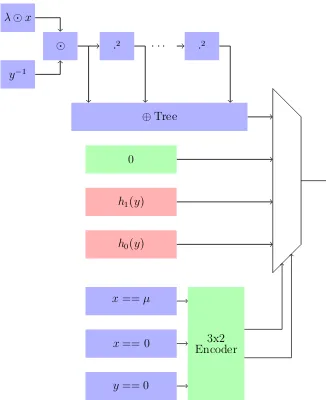
h0andh1 are constructed as Boolean functions and not as finite field functions, we consider their cost to be roughly the same for all representations. In the next section, we discuss their cost more precisely. For all figures, thick arrows representk-bit buses, blue blocks havepoly(k) cost, green blocks have constant cost and red boxes represent blocks of unknown cost.
3.1 Circuit based on polynomial basis
Lemma 1. The polynomial basis implementation of the Tang-Maitra function of nvariables, wherenis even, has a circuit complexity bounded by O(2k+k2) and depth of O(k), wheren= 2k.
Figure 1 shows the polynomial basis circuit. The first branch for the multiplexer is the default option, which computes Trk1(λxy ). Addition overF2k using polyno-mial basis is carry-free. Besides, 0 is represented as the binary string 0k and 1 is represented the binary string 0k−11. Hence, the addition part of Trk
1 can be performed by adding only the least significant bits, requires k−1 XOR gates, instead of k(k−1). Choosing λ ≡ e, the cost of this branch is the cost of 1 inversion, 1 multiplication,k−1 squaring andk−1 XOR gates. Multiplication costs O(k1+), where 0.5 ≤ ≤ 1. The cost for every squaring is O(k), and inversion has cost of O(k2). The overall complexity of this branch isO(k2) and depth ofO(k). However, as explained in Section 2.3, this complexity can be bad in practice due to large coefficients. Besides, the circuit complexity of theh0and
h1is bounded byO(2k).
3.2 Circuit based on normal basis
Lemma 2. The normal basis implementation of the Tang-Maitra function ofn
variables, wherenis even, has a circuit complexity bounded byO(2k+k3), where
y== 0
x== 0
x==µ
3x2 Encoder
h0(y)
h1(y) 0
⊕Tree
λx
y−1
·2 · · · ·2
Fig. 1: Polynomial basis circuit for a Tang-Maitra function
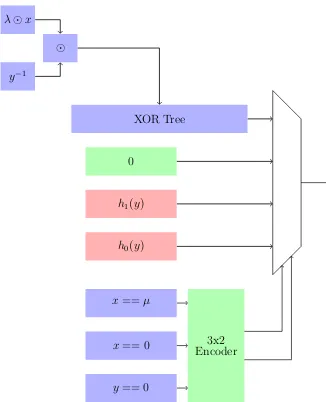
Figure 2 shows the normal basis circuit, it is similar to the polynomial basis circuit, from a high-level point of view. However, since the trace function is im-plemented as the XOR of all input bits, squaring is not required. The complexity of the first branch isO(k3), but it should be either smaller than or comparable to the polynomial basis circuit in practice. Besides, for certain choices ofk(e.g.
k= 2r+ 1 ork=m(2r+ 1)), the complexity can be in the order ofO(k2·log(k)).
λis chosen aseandµ=β.
3.3 Comments on Different Representations
The Tang-Maitra functions are defined as finite field functions. However, the cryptographic properties of interest were evaluated for the Boolean circuit gen-erated by implementing the polynomial representation of the underlying field. An important question is: are the cryptographic properties of the Tang-Maitra functions preserved under the change of basis/representation? The answer to that question is that if the change of representation operation is a linear (or affine) operation, they are preserved. Hence, both the polynomial and normal bases representations have the same cryptographic properties. However, since the transformation to/from discrete-log is a non-linear operation, it cannot be used directly without adjusting the input.
Letαbe a primitive element ofF2k, and Bpk andBnk be the polynomial and
normal bases ofF2k overF2, respectively. Then
Bpk={1, α, α2, . . . , αk−1}, Bnk ={α, α2, . . . , α2k−1}.
Thus, any element x ∈ F2k can be written as x = L
k−1
j=0ajαj and also x =
Lk−1
j=0bjα2
j
y== 0
x== 0
x==µ
3x2 Encoder
h0(y)
h1(y) 0
XOR Tree
λx
y−1
Fig. 2: Normal basis circuit for a Tang-Maitra function
and (bk−1, . . . , b1, b0) are called the binary representation of xwith respect to polynomial and normal bases, respectively. It is clear that two binary represen-tations of F2k using two bases, normal and polynomial bases, are related by a
linear nonsingular mapping.
For discrete-log representation ofF2k, let 0 = (1,1, . . . ,1), all one vector of
Fk2, andαi= (ck−1, . . . , c1, c0), wherei=Pj=0k−1cj2j andcj∈F2, 0≤j ≤k−1, for all 0≤i≤2k−2. In this representation, it is not possible to write all elements ofF2k in the linear combination ofklinearly independent elements and there is
no linear (or affine) mapping between discrete-log and normal (or polynomial) basis representations.
We know that cryptographic properties of a Boolean function such as alge-braic degree, balancedness, Walsh–Hadamard spectra, autocorrelation spectra, nonlinearity are invariant under the nonsingular affine transformations. But, if the transformations are not affine, then these properties may or may not be same.
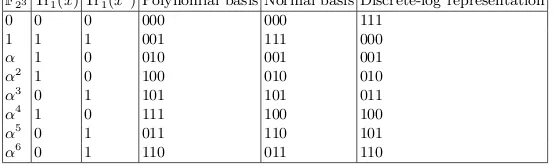
For example let k= 3 and αbe a primitive element ofF23 such thatα3⊕ α2⊕1 = 0. ThenB3
p ={1, α, α2}andBn3 ={α, α2, α4} are the polynomial and normal bases ofF3
2overF2, respectively. For discrete-log representation ofF23, let
0 = (1,1,1) andαi = (c
2, c1, c0), where i=P 2
j=0cj2j and cj ∈F2, 0≤j ≤2, for all 0≤i≤6. The binary representations ofF23 with respect toB3p,B3n and
discrete-log are given in Table 1.
One can check that using the nonsingular matrix
A=
1 1 1 1 0 0 0 1 0
Table 1: Binary representations ofF23 with respect different bases F23 Tr31(x) Tr31(x3) Polynomial basis Normal basis Discrete-log representation
0 0 0 000 000 111
1 1 1 001 111 000
α 1 0 010 001 001
α2 1 0 100 010 010
α3 0 1 101 101 011
α4 1 0 111 100 100
α5 0 1 011 110 101
α6 0 1 110 011 110
the binary representation of F23 with respect to normal and polynomial bases
are related. There is no such linear (or affine) transformation that maps between discrete-log and normal (or polynomial) basis. This we explain by an example here.
Supposef, g∈ B3 are defined as f(x) = Tr31(x) and g(x) = Tr 3
1(x3), for all
x ∈ F23 (defined as in Table 1). The algebraic degrees of f and g are 1 and
2 respectively. Then the algebraic normal form (ANF) of f(x1, x2, x3) over F32 with respect to normal and polynomial bases is x1⊕x2⊕x3, but with respect to discrete-log representation, it becomesx1x2⊕x2x3⊕x1x3⊕1. Moreover, the ANF of g(x1, x2, x3) over F32 with respect to normal an polynomial bases are
x1x2⊕x2x3⊕x1x3andx1⊕x2x3 respectively, but with respect to discrete-log representation, it isx1⊕x2⊕x3⊕1. Thus, while there are certain advantages in the discrete-log representation, unless the proper nonlinear transformation cannot be decided, the implementation is not complete. Still we explain the implementation in discrete-log domain in Appendices A, B.
3.4 Comparison
We assume the complexity of h0 and h1 is the same for the three representa-tions. Comparing the asymptotic complexity of Trk1(λxy ), polynomial basis has the smallest area complexity, while the normal basis has the smallest logical Depth. Moreover, in practice, sometimes the normal basis circuit can have a better area compared to the polynomial basis circuit, especially for good choices of k. The discrete-log circuit (Appendix B) has good parameters for small n, in practice, but due to its non-linearity with respect to the polynomial basis, it needs input adjustment, which can be costly.
4
Practical Implementations
In order to verify the theoretical bounds discussed in the paper, we have imple-mented the polynomial basis construction for the cases ofn∈ {12,14,16,18,20,22}
Table 2: Implementation Results on the Virtex-7 FPGA
n LUTs Critical Path (ns) Logic Levels
12 16 2.25 5
12 [PCZ17] 115 3.47 9
14 42 2.98 6
16 89 3.53 8
16 [PCZ17] 828 4.73 11
18 196 5.13 11
20 640 18.86 33
22 813 23.6 40
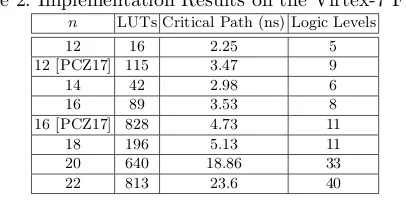
For FPGA, the design have been synthesized on Virtex-7 using Xilinx ISE 14.7 design flow, given in Table 2. The results show quadratic and linear in-crease in the number of LUTs and the critical path, respectively. This conforms with the theoretical estimations in the paper. The technology mapping tech-niques from [KCP17] have been used to reduce the area, specially for h0 and
h1 functions. In comparison with the implementations of the GMM functions in [PCZ17], the area and performance on FPGA are both better. Moreover, while the complexityh0 andh1 is theoretically exponential, the results show that the dominant factor of the circuit cost in practice is the cost of the trace function. The results also show that the circuit is relatively more costly forn >18.
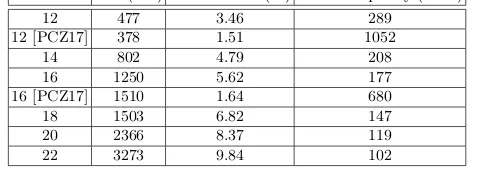
For ASIC, we have used Synopsys Design Compiler for both the Open Source Nangate 45nm and TSMC 65nm Standard Cell Libraries, given in Tables 3 and 4. The implementations from [PCZ17] have also been synthesized for the same technology. The ASIC results also follow the theoretical estimations. However, compared to [PCZ17], the cost of the Tang-Maitra functions is higher in terms of performance, due to the depth of linear order. With respect to area, the Tang-Maitra functions show a quadratic growth rate, compared to the sub-exponential rate in [PCZ17]. In addition, while the Tang-Maitra ASIC implementations are slower than the GMM ASIC implementations, the clock frequency for 22 vari-ables is still more than 100 MHz, which is faster than the speed required by many practical applications. The hardware results in this paper combined with the cryptographic properties of the Tang-Maitra functions show that they can be a building block for promising cryptographic primitives. Besides, we have not studied the effect of advanced circuit optimization techniques on the ASIC implementations, which can further improve both the area and performance.
5
Conclusion
Table 3: Implementation Results on the Nangate 45nm ASIC Technology Library
n Area(GE) Critical Path (ns) Clock Frequency (MHz)
12 580 2.9 344
12 [PCZ17] 381 0.95 1052
14 898 3.49 286
16 1328 4.56 219
16 [PCZ17] 1778 1.47 680
18 1657 5.66 176
20 2602 6.73 148
22 3501 7.95 126
Table 4: Implementation Results on the TSMC 65nm ASIC Technology Library
n Area(GE) Critical Path (ns) Clock Frequency (MHz)
12 477 3.46 289
12 [PCZ17] 378 1.51 1052
14 802 4.79 208
16 1250 5.62 177
16 [PCZ17] 1510 1.64 680
18 1503 6.82 147
20 2366 8.37 119
22 3273 9.84 102
be exploited for lightweight stream ciphers too. The implementation methods follow different ideas of finite field representation and the actual implementation results are explained. One may note that in truth table domain (considering the Boolean functions as a mapping from{0,1}n → {0,1}), the Maiorana-McFarland type bent functions can be seen as the concatenation of small affine functions. A theoretical view from this direction is being explored in an independent and parallel work [TKMM18] recently.
In a stream cipher, other than the Boolean function the main circuit com-ponent is LFSR or NFSR and the state size is decided by that. Thus, with a Boolean function with 500 GEs may be accommodated in a complete stream cipher circuit of 1000 GEs. Further, the Boolean function that we use have very good autocorrelation spectra, which may resist against proper signature gener-ation in Differential Fault Attack. The complete design of stream cipher using such functions and the resistance against different attacks will be presented in the journal version of this paper.
References
[Car93] Claude Carlet. Two new classes of bent functions. InWorkshop on the Theory and Application of of Cryptographic Techniques, pages 77–101. Springer, 1993. [CS09] Thomas W. Cusick and Pantelimon St˘anic˘a.Cryptographic Boolean Functions
and Applications. Academic Press, 2009.
[Dil74] John F Dillon. Elementary Hadamard difference sets. PhD thesis, 1974. [DIS09] Jean-Pierre Deschamps, Jose Luis Imana, and Gustavo D Sutter. Hardware
[Dob94] Hans Dobbertin. Construction of bent functions and balanced Boolean func-tions with high nonlinearity. InInternational Workshop on Fast Software Encryption, pages 61–74. Springer, 1994.
[FF98] Eric Filiol and Caroline Fontaine. Highly nonlinear balanced Boolean functions with a good correlation-immunity. In International Conference on the Theory and Applications of Cryptographic Techniques, pages 475–488. Springer, 1998.
[Fon99] Caroline Fontaine. On some cosets of the first-order reed-muller code with high minimum weight. IEEE Transactions on Information Theory, 45(4):1237–1243, 1999.
[IT88] Toshiya Itoh and Shigeo Tsujii. A fast algorithm for computing multiplicative inverses in gf (2m) using normal bases.Information and computation, 78(3):171–177, 1988.
[KCP17] Mustafa Khairallah, Anupam Chattopadhyay, and Thomas Peyrin. Looting the LUTs: FPGA Optimization of AES and AES-like Ciphers for Authenticated Encryption. In International Conference in Cryptology in India, pages 282–301. Springer, 2017.
[KMT18] Sel¸cuk Kavut, Subhamoy Maitra, and Deng Tang. Searching balanced Boolean functions on even number of variables with excellent autocorrelation pro-file. InTenth International Workshop on Coding and Cryptography, Saint-Petersburg, Russia, September 18-22, 2017.
[LN94] Rudolf Lidl and Harald Niederreiter. Introduction to finite fields and their applications. Cambridge university press, 1994.
[McF73] Robert L McFarland. A family of difference sets in non-cyclic groups.Journal of Combinatorial Theory, Series A, 15(1):1–10, 1973.
[MM16] Sihem Mesnager. Bent functions. Springer, 2016.
[PCZ17] Enes Pasalic, Anupam Chattopadhyay, and WeiGuo Zhang. Efficient im-plementation of generalized Maiorana–McFarland class of cryptographic functions.
Journal of Cryptographic Engineering, 7(4):287–295, 2017.
[Rot76] Oscar S Rothaus. On “bent” functions. Journal of Combinatorial Theory, Series A, 20(3):300–305, 1976.
[SM08] Pantelimon St˘anic˘a and Subhamoy Maitra. Rotation symmetric Boolean functionscount and cryptographic properties. Discrete Applied Mathematics, 156(10):1567–1580, 2008.
[Spi80] R J Spillman. The effect of DON’T CARES on the complexity of combinational circuits. Proceedings of the IEEE, 68(8):1021–1022, 1980.
[TM18] Deng Tang and Subhamoy Maitra. Construction ofn-variable (n≡2 mod 4) balanced Boolean functions with maximum absolute value in autocorrelation spectra
<2n/2. IEEE Transactions on Information Theory, 64(1):393–402, 2018.
[TKMM18] Dang Tang, Sel¸cuk Kavut, Bimal Mandal, Subhamoy Maitra. Modify-ing Maiorana-McFarland type bent functions for good cryptographic properties. Preprint, April 2018.
A
Discrete-Log Representation of
F
2nArithmetic
The Discrete-Log representation is described in Section 2.3. Multiplication can be defined as
x1x2=
(
2n−1 ifx
1= 2n−1 orx2= 2n−1
x1+x2 (mod 2n−1) otherwise
While inversion can be defined as
x−1= (
2n−1 ifx= 2n−1
−x (mod 2n−1) otherwise (9)
Both operations require circuit complexity of O(n), which is smaller than the corresponding circuits for both normal and polynomial bases. While the same can be said about squaring, we show now that it can be implemented as a cyclic shift operation (similar to the case of normal basis). Squaring can be written in terms of multiplication as follows, where×is used for integer multiplications as opposed to finite field multiplication,
x2= (
2n−1 ifx= 2n−1
2×x (mod 2n−1) otherwise (10)
and
2×x (mod 2n−1) = (
x1 if 2×x <2n−1
(x1)−(2n−1) otherwise (11)
Using the two’s complement representation of integer arithmetic, Equation (11) can be written as
2×x (mod 2n−1) = (
x1 if 2×x <2n−1
(x1) + 2n+ 1 (mod 2n) otherwise (12)
Equation (12) means that the squaring operation in the discrete-log representa-tion is a left shift operarepresenta-tion with the most significant bit ofxbecoming the least significant bit, i.e., a cyclic shift ofx.
In addition, however, in the discrete-log representation is complicated. It can be implemented by using look-up tables or by conversion to another represen-tation. Hence, studying the complexity of trace function is this representation without using addition is an interesting problem. Using property 2 of trace func-tion in Secfunc-tion 2.1 and and Equafunc-tion (12), we can conclude, as in the case of normal basis, that trace function is a Rotation Symmetric Boolean Function (RSBF). Now we define the rotation symmetric Boolean functions. Let xi ∈F2 for 0≤i≤n−1. We define
ρrn(xi) =x(i+r) modn=
xi+r, ifi+r≤n−1;
xi+r−n, ifi+r≥n.
LetPn ={ρ0n, ρ 1 n, . . . , ρ
n−1
n }be the permutation group which contains the rota-tions ofnsymbols, defined as
The problem of defining an RSBF is related to the problem of necklace equiv-alence in combinatorics. This helps to derive an upper bound on the circuit complexity of a trace function in the discrete-log representation.
Definition 2. A binary necklace of lengthnis an equivalence class ofn-character strings over the alphabet {0,1}, where two arrangements are equivalent if one can be obtained from the other by applying cyclic rotations.
Definition 3. The lexicographical representation of a binary necklace N is the member of [N] with the maximum number of leading 0’s.
B
Circuit for the Tang-Maitra functions based on
discrete-log representation
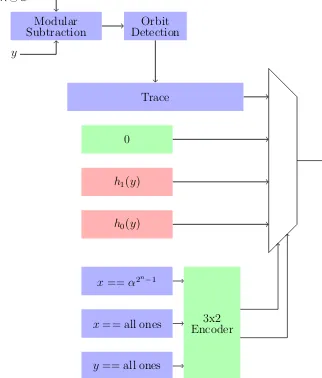
The circuit in Figure 3 can be used to compute the Tang-Maitra function when the inputs are in the discrete-log representation. The operation x
y is computed as x−y (mod 2k−1), with complexity O(k). After that, Trk
1 is computed as an RSBF. In this Section, we give a circuit for any RSBF, with sub-exponential complexityO(k2+ 2k/k2).
y== all ones
x== all ones
x==α2n−1
3x2 Encoder
h0(y)
h1(y) 0
Trace
λx
y
Modular
Subtraction DetectionOrbit
Fig. 3: Discrete-log circuit for a Tang-Maitra function
ρr
k(x), such thatρrk(x)≥ρik(x), for all 0≤i≤k−1. In other words, it is the rotation ofxthat has the maximum integer value. For more details of rotation symmetric Boolean function we refer to [FF98,Fon99]. This is the lexicographical representation of [x] based on the alphabet{0,1}.
Lemma 3. A rotation symmetric Boolean function (RSBF) of k variables has a circuit complexity bounded by O(k2+ 2k/k2).
Lemma 4. The discrete-log implementation of the Tang-Maitra function of n
variables, wherenis even, has a circuit complexity bounded byO(2k+k2+2k/k2), wheren= 2k.
Proof. In order to convert anyxto its lexicographical orbit representation, the orbit detection circuit generates all thekrotations ofx, then chooses the value of
xthat has the maximum integer value using a selection tree that consists ofk−1 two-input MAX circuits. Every two-input MAX circuit consists ofk+ 1 integer subtractor (6k+6 gates) andk2×1 MUXes, 3Kgates. Hence, the orbit detection circuit has a complexity of around 9k2−3k−6 gates. After the lexicographical orbit representation has been detected, a circuit decides whether the given orbit functional value is 0 or 1. This circuit expects only 1 of the lexicographical representations, which, according to Burnside’s Lemma and [SM08, Theorem 3], areNO= 1kPd|kφ(d)2
k
d, whereφis Euler’s phi-function. Hence,nx= 2k−NO
values in the Truth table of such circuit can be set as DON’T CARES ’X’. In [Spi80], the author gave an analysis of the circuit complexity of combinational circuits with a large number of DON’T CARES. The number of AND/OR/NOT gates was given by
L∞= (1−d)H(p)L∞(G),
whered=nx
2k,p=
n1
(1−d)2k,H(p) =−plog(p)−(1−p) log(1−p) andL∞(G) =
2k k . By substitution for the case of the trace circuit, the number of gates is NO
n H(p), where H(p)≤1. Hence, the circuit complexity is O(NO
n ), and from Burnside’s Lemma, it can be expressed as O(2kk). Hence, the overall complexity of this