Long Delay Attack
Puwen Wei1( ), Quan Yuan1( ), and Yuliang Zheng2
1
Key Laboratory of Cryptologic Technology and Information Security, Ministry of Education, Shandong University, Jinan, China
[email protected], yuanquan [email protected]
2
University of Alabama at Birmingham, Birmingham, USA [email protected]
Abstract. The consensus protocol underlying Bitcoin (the blockchain) works remarkably well in practice. However proving its security in a formal setting has been an elusive goal. A recent analytical result by Pass, Seeman and shelat indicates that an idealized blockchain is indeed secure against attacks in an asynchronous network where messages are maliciously delayed by at most ∆ 1/np, with n being the number of miners and p the mining hardness. This paper improves upon the result by showing that if appropriate inconsistency tolerance is allowed the blockchain can withstand even more powerful external attacks in the honest miner setting. Specifically we prove that the blockchain is secure against long delay attacks with∆≥1/npin an asynchronous network.
Keywords: Bitcoin·Blockchain ·Delay·Random oracle
1
Introduction
Bitcoin introduced by Nakamoto [19] is the first cryptocurrency that allows a ledger to be maintained by the public in a decentralized manner. It has a number of attractive properties including decentralization and pseudonymity. At the core of Bitcoin is a consensus protocol, called the blockchain. The blockchain is a chain-structured ledger maintained by all the participants (or miners), where records (or blocks) can only be added by the miners to the end of the chain.
POW is security, which has not been proven formally until Garay, Kiayias, and Leonardas [10] provide a rigorous analysis of the blockchain protocol. They mod-el the execution of the blockchain protocol by allowing the adversary to control a concrete percentage of computing power and also to interfere with commu-nication among miners, whereby proving that two basic properties, which are common prefix and chain quality, hold for a blockchain built on POW. Consid-ering the effect of delay, Pass, Seeman and shelat [22] prove the security of the blockchain protocol in an asynchronous network with a-priori bounded delay∆, where the adversary can delay any message with at most∆rounds. The security analysis in [22] holds for a relatively small delay only. Specifically the delay∆ should be significantly smaller than 1/np, that is ∆ 1/np, where n and p denote the number of miners and the mining hardness, respectively.
Networks delay is considered to be one of the most important threats to the security of a blockchain. As shown in [6], long delays lead to increased proba-bilities for forking, which may break the common prefix property. Pass, Seeman and shelat demonstrate a simple attack in a fully asynchronous setting where the adversary is allowed to schedule message delivery with a long delay relative to the mining hardness. What is worse, such attacks could be deployed even when all miners are honest, which means that the adversary does not need any hashing power [10].
In the real world, however, long delays, say∆≥1/np, could be caused not only by message propagation over a “bad” asynchronous network but also by malicious attacks. Instead of attempting to corrupt a sizable fraction of miners, it would be much easier for the adversary to disrupt communications among miners. Furthermore, it is also unpractical to require all the miners’ chains to be consistent with the “main chain” due to the long delay.
In practice the adversary cannot delay messages successfully all the time. Consider the eclipse attack [14] that allow an adversary to control 32 IP ad-dresses to monopolize all connections to and from a target bitcoin node with 85% probability. If the attack fails or the adversary loses the ability to intercept messages, blocks will be diffused to other miners at an exponentially fast rate. This naturally brings up a interesting question, that is
Is the blockchain protocol based on POW still secure in a real world asyn-chronous network, where long delay relative to the mining hardness, say ∆ ≥
1/np, is allowed?
our model, we present a concrete attack in which an adversary without any hash power may threaten the common prefix property of a blockchain protocol with certain parameters.
There are a number of subtle differences between our model and previous research in [10][22][11]. A detailed discussion follows.
– Long delay attack: In our model, the upper bound of delay can be large, say∆≥1/np, and the adversary can delay a message with probabilityα∈
(0,1], meaning that the adversary may not always disrupt communications successfully in practice. Previous works consider∆1/npor∆= 1 and the adversary can always delay any message. Hence, our model is more general in capturing the adversary’s ability to deliver messages maliciously.
– Common prefix for majority: We relax the requirements of common prefix and chain growth so that certain fractions of miners’ chains are allowed to be inconsistent with the common prefix of the main chain. Previous defini-tions of common prefix require all the miners’ chains be consistent with the common prefix of the main chain, which is a special case of our definition. We emphasize that such inconsistency tolerance is not only crucial to our proof but also necessary for the blockchain protocol to work in practice. – Honest miners: Since we only focus on the effect of delay, we assume all the
miners are honest. That is, all the miners follow the protocol honestly and the adversary neither corrupts any miners nor possesses any hash power. Hence, we only need to consider the common prefix property and the chain growth property. Previous works consider adversaries which can collect a fraction of the total hash power by means of corrupting miners and thus analyze chain quality. Additionally we impose restrictions on the miners’ behavior: two consecutive blocks cannot be mined by the same miner. This restriction is reasonable in our honest miner setting, as in practice is unlikely that two consecutive blocks are mined by the same miner3, especially when nis large whereaspis small.
In a large-scale blockchain protocol, it is hard for the adversary to collect enough computational power to mount an effective attack, where at least 1/3 computational power of all miners is usually required. Therefore, we ignore the influence of the hash power of an adversary and instead focus on attacks by disrupting communications.
Main techniques. Informally, the common prefix property states that, in ad-dition to the last T blocks, all the miners’ chains should have the same prefix. In order to prove the common prefix property, [22] shows that there are enough “convergence opportunities” for the miners to synchronize the same chain, where the “convergence opportunities” depend on consecutive ∆ rounds of “silence”. Here,∆rounds of “silence” means no honest miners mines a block during these ∆ rounds. If ∆ 1/np, it is likely that no block is mined during ∆ rounds. However, the challenge is that, if ∆ ≥1/np, at least one block is expected to
3
be mined during those rounds, which will ruin the “convergence opportunities”. So previous proof techniques cannot be applied when ∆ ≥1/np. To solve this problem, we introduce an inconsistency tolerance parameterλ, which is inspired by the fact that the common prefix property in the real world holds only for the majority miners. Therefore, we redefine the properties of chain growth rate and common prefix usingλ∈(12,1], which captures to what extent the common pre-fix property holds. Our definitions are more general and allow us to exclude the “bad” miners during∆rounds of silence. Furthermore, we introduce a powerful tool calledTreeMCto record the state of the main chains. Unlike theFtreeoracle
in [22] which stores all the chains during the execution of the blockchain protocol, ourTreeMConly records the state of the main chain at the current round, which can capture the evolution of main chains in a subtle manner. Then, we show the relation betweenTreeMCand the view of the real execution of blockchain proto-col. Due to the good properties ofTreeMC, we only need to focus on the analysis of TreeMC instead of the original block chain protocol, which greatly simplified the analysis and security proof.
Related Work. Since the introduction of Bitcoin, a number of cryptocurren-cy, e.g., Litecoin, Zerocash [2] and Ethereum, have appeared, most of which are based on the idea of Bitcoin. Meanwhile, a series of works [26][6][8][31][29][9][3][28] [27][30][21][12][15][23] analyze the security of Bitcoin under different attack s-cenarios and investigate the conditions under which Bitcoin achieves a game-theoretic equilibrium. Eyal and Sirer [8] propose an attack strategy called “selfish mining”, where the adversary only requires about 1/3 of the total mining power. Miller and LaViola [18] show the connection between bitcoin and probabilistic Byzantine agreement protocols. Heilman et al. [14] present eclipse attacks which allow an adversary controlling a sufficient number of IP addresses to “eclipse” a bitcoin node. As mentioned in [14], the attacker can eclipse a fraction of miners and launchN-confirmation double spending attacks without any mining power. In fact, such attacks can be extended to attacks on common prefix. For instance, the attacker can eclipse a fraction of miners in advance and launch the long delay attacks described in section 7. Notice that the target block which the attacker intends to delay may be not mined by the eclipsed miners. In other words, a block can be delayed with some probability, which is the scenario captured by our model. Sompolinsky and Zohar [29] show that the bitcoin protocol with high throughput is more susceptible to double-spend attacks. In order to solve the above problem, [29] presents an algorithm called GHOST, which chooses the main chain by the heaviest subtree instead of the longest branch. Then, Natoli and Gramoli [20] propose the balance attack against POW blockchain systems, where the common prefix property can be broken by disrupting communications between subgroups of similar mining power.
security of blockchain protocol with a bounded delay ∆ 1/np. Kiayias and Panagiotakos [16] investigate the tradeoff between provable security and trans-action processing speed. Then, Garay, Kiayias and Leonardas [11] analyze the security of blockchain protocol with variable difficulty. Pass and Shi [24] consider the sleepy model, where players can be either online or offline. Notice that it is difficult for the adversary to control large fractions of the total mining power in practice, and no such attacks has been observed to date. Hence, Badertscher et al. [1] investigates the reason why we can assume the majority of the mining power is honest or why the miners need to follow the protocol honestly. In order to overcome the problems induced by POW, such as large energy demands, an-other line of research focuses on the blockchain protocol based on proof of stake (POS), where the miner to issue the next block is decided by randomly selecting one of the miners proportionally to their stakes. For instance, Algorand [13], Snow White [4], Ouroboros/Ouroboros Praos [17][5], and Thunderella [25].
2
Preliminaries
In this section, we recall the blockchain protocol, following the notations of [10][22].
2.1 Notation
LetB denote a block. A blockchainC=−→B consists of a sequence of orderedBs and the length|C|means the number of blocks inC. Letmdenote the message contained in B. −→m denotes the messages in −→B correspondingly. We denote by Cir the chain of mineri at roundr. Cbk denotes the chain C that removes the lastkblocks, wherekis a nonnegative integer. Ifk≥ |C|,Cbk =ε. LetC1C2 denotes thatC1 is a prefix ofC2.B(n, k) denotes the binomial distribution with ntrials and success probabilityk.H :{0,1}∗→ {0,1}κ is a cryptographic hash function.
2.2 Blockchain protocol
the bitcoin protocol, m contains the transaction information and V is used to check the validity of transactions.
A blockB = (h−1, m, r, h) is valid with respect to a predecessor blockB−1= (h0−1, m0, r0, h0) only if following conditions hold:
– h−1=h0,
– h=H(h−1, m, r)< Dp, whereDp is the difficulty parameter.
If all blocks in C are valid and V(C(C)) = 1, we say C is valid, where the corresponding validity check algorithm is called “chain-check” algorithm.
Suppose there arenminers, wheren=n(κ) is a polynomial function withκ. At each round, a miner receives a messagemfrom the environmentZ and runs ΠV to maintain a chainC as follows:
– IfV(C(C)||m)6= 1, proceed to the next step. Otherwise, pick r ← {0,1}κ
randomly and compute h by querying H with (h−1, m, r), where h−1 is the pointer of the last block of C. If h < Dp, set C = CB, where B =
(h−1, m, r, h), and we say the miner succeeds in mining a new blockB. The miner can queryHat mostqtimes before he succeeds. Then, broadcast the new chainC. In order to capture the attack that the adversary can disturb the communication among miners,Cis considered as being delivered by the adversary.
– On receiving the chains delivered by the adversary, choose the longest and valid one, sayC0, where the validity of blocks is checked by queryingH.ver. If|C0|>|C|, replaceCbyC0. Otherwise, go to the next round.
Note that under the random oracle model H(·) is modeled by a random oracle H(·) and a miner is allowed to queryHfor at mostqtimes at each round, but can queryH.ver for arbitrary times.pdenotes the probability that a miner succeeds in mining a block at a round, where p = 1−(1−Dp
2κ)
q
≈ qDp
2κ . We use p to describe the difficulty of mining in the following parts.
2.3 Ftree model
In this section we recall the simplified blockchain protocol with access to Ftree
oracle introduced by [22]. TheFtreeoracle maintains a tree which contains
mes-sages of all valid chains and can answer two kinds of queries, Tree.extend and Tree.ver. When receiving queryTree.extend((B0, ..., Bl−1), B), it checks whether (B0, ..., Bl−1) is a path of the tree, where the root of the tree is the genesis block B0. If so, with probabilitypit extends this path withBand returns 1; Otherwise, return 0. When receivingTree.ver(B0, ..., Bl), it returns 1 if (B0, ..., Bl) is a path
of the tree; Otherwise, return 0. Here, a blockB only contains messagem, i.e., B= (m). Then the random oracle in blockchain protocol is replaced withFtree
and the resulting protocol is called (Πtree,Ctree). The main differences between
(Πtree,Ctree) and (Π,C) are described as follows.
The protocol (Πtree,Ctree) is also directed by an environment Z(1κ). The
– IfVtree(Ctree(C)||m)6= 1, proceed to the next step. Otherwise, query Ftree
with Tree.extend(C, m). If the oracle answers 1, a new block B = (m) is mined. SetC=CB and broadcastC.
– When receiving the chains delivered by the adversary, choose the longest and valid one, sayC0, where the validity ofC0 can be checked by querying Tree.ver(C0). If the oracle Tree.ver(C0) returns 1, we say the chain is valid. If|C0|>|C|, setC=C0. Otherwise, go to the next round.
Under the Ftree model, a miner is allowed to query Tree.extend only once
at each round, but can queryTree.verfor arbitrary times. Note that the miners described in section 2.3 can query Hat mostq times at a round and the prob-ability of successful mining at a round is p. Therefore those queries to Hat a round are considered as one query toTree.extend.
[22] shows that the security properties in (Πtree,Ctree) still hold in original
protocol, while the analysis is much simpler in the Ftree model. For simplicity,
we misuse (Π,C) to denote the basic blockchain protocol in the Ftree model.
Besides, the algorithm Vtree or V depends on the functionality of the concrete
protocol. To simplify the description, we consider V which outputs 1 for all inputs. Hence, V is omitted in following parts.
3
Blockchain Model with Long Delays
Nakamoto’s blockchain protocol is proved to be secure [22], where chains broad-casted by miners may suffer at most∆-bounded delays such that∆1/np. As discussed in Section 1, on one hand, it is much easier for the adversary to disturb the communications rather than collect large computational power. On the other hand, if the adversary fails to delay the target chain, the chain will be diffused to other miners immediately. To capture such scenario, our modifications for the behavior of the adversary are as below:
Execution of adversary at round r:
– Recieving. On receiving the chains from miners, the adversary chooses which valid chains he wants to delay. But only with probabilityαthe chosen one can be delayed. Those delayed chains are marked as “delayable” . The other undelayed chains are marked as “undelayable”. Then all the chains the adversary received together with their marks and the roundr are saved in a listT.
– Distribution.The adversary chooses which chains in T to be distributed and these chains will be received by all the miners at the next round. But the following two kinds of chains have to be distributed at the current round.
• The chains marked as undelayable;
• The chains having been marked as delayable for∆rounds.
broadcast chains C1 and C2 in a way that (C1, C2) to miner i but (C2, C1) to minerj, where|C1|=|C2|. IfC1andC2 are longer thaniandj’s chains, theni accepts C1 as his main chain whilej accepts C2. We emphasize that our model is in honest miner setting where the adversary does not corrupt any miners. Remark. In practice, it is possible that some miners receive a block earlier than others due to the propagation delay in the bitcoin network. As shown in [DW13], the broadcast of a block follows an exponential behavior. Hence, once a block has been broadcasted to its neighbors, most miners will receive the block immediately and it is difficult for the adversary to delay anymore. It takes about 10 seconds for a broadcasted block to be known by almost all the miners [D-W13][PSS17]. In our model, if the adversary broadcasts a block, all the miners will receive it in the next round, where the time span of a round can be 10 seconds. Such time span is enough for the adversary to influence the miners’ be-havior. To capture the possible attacks, e.g., attacks on mineriandj described above, we allow the adversary can adjust the order of these chains, which is equivalent to the case that miner ireceivedC1only.
Modification to blockchain protocol. We make additional restrictions on the miners’ behavior in the blockchain protocol. That is, the miner cannot mine in a chain, the last block of which was mined by himself. In other words, the miner who has already mined a block will not execute the mining step of Π until he receives a new chain mined by other miners. The reason why we prevent consecutive blocks mined by the same miner is that such consecutive blocks may cause possible forks even in the honest miner setting. In addition, it is not likely that a miner (not the mining pool) can mine two consecutive blocks in practice due to the large number of minersnand the small difficulty parameterp. Hence, such a restriction is reasonable in our honest miner setting.
We emphasize that our restriction only applies to a single miner which is an independent communication node of the network and has a unit computa-tional power. Hence, such a modification would lead to a slightly decline of the total mining power and we ignore such a mild change in the following proof for simplicity.
In our protocol, we say a miner is “being delayed” if his chain is being delayed by the adversary. Obviously, a miner being delayed will not mine a block untill he accepts a new chain mined by others.
4
Properties of Our Blockchain Model
In this section we redefine the chain growth property and the common prefix property in our blockchain model.
4.1 Chain growth
length increase of the majority of miners’ chains instead. Informally speaking, if the majority of chains, say, with fraction λ > 12, grows by t blocks during consecutive rounds, we say the blockchain view grows by t blocks during these rounds with majorityλ. In fact, the definition of chain growth in [22] is a special case of ours whenλ= 1. It is, however, difficult to haveλ= 1 in practice. Hence, our definition is more flexible in capturing the real scenario.
Letview(Π,C, A, Z, κ) and |view(Π,C, A, Z, κ)| denote the joint view of all miners and the number of rounds during the execution of (Π,C), respectively. Definition 1. Givenview(Π,C, A, Z, κ), we say the blockchain grows by at least
t blocks with majority λ∈(12,1]from roundr1 tor2, if Pr
i,j[|C r2
j | − |C r1
i | ≥t]≥λ, (1)
where the probability is taken over all the choice ofi, j∈[n].
Definechain-increase(A,Z,κΠ,C)(r1, r2, λ) as the maximum value oft satisfying (1). That is,
chain-increase(A,Z,κΠ,C)(r1, r2, λ) =max{t|Pr
i,j[|C r2
j | − |C r1
i | ≥t]≥λ}.
Definition 2. The blockchain protocol (Π,C) has the chain growth rate g ∈R
with majorityλ∈(12,1], if there exists some constantc and negligible functions
1, 2such that for everyκ∈N, T ≥clog(κ)and everyr≤ |view(Π, C, A, Z, κ)|−
T , the following holds:
Pr[chain-increase(A,Z,κΠ,C)(r, r+T, λ)≥gT]≥1−1(κ)−2(T), (2)
where the probability is taken over the randomness of the protocol.
4.2 Common prefix
Similarly, we can define common prefix as follows.
Definition 3. common-prefix(A,Z,κΠ,C)(r, k, λ) = 1 with majority λ ∈(12,1] if the following holds:
Pr
i,j[(C r i
bk
Cjr)∧(Cjrbk Cir)]≥λ, (3)
where the probability is taken over all the choice ofi, j∈[n].
Definition 4. A blockchain protocol (Π,C) satisfies the common prefix prop-erty with parameter λ ∈ (1
2,1], if there exists some constant c and
negligi-ble function 1 and 2 such that for every κ ∈ N, T ≥ clog(κ) and every
r≤ |view(Π, C, A, Z, κ)|, the following holds:
Pr[common-prefix(A,Z,κΠ,C)(r, T, λ) = 1]≥1−1(κ)−2(T), (4)
5
State of the Main Chain
In this section, we introduce a special tree to capture the evolution of the main chains.
5.1 Record the state of the main chain
During the execution ofΠ, miners will “reach agreement” on some chains at each round and those chains are called the main chains. Although the main chains may not be unique at each round, only one of those chains will be the prefix of the main chain after enough rounds. Since the evolution of the main chains is closely related to chain growth and common prefix, we introduce a special tree, denoted by TreeMC, to record the state of the main chains, where a node of the tree is a block of a chain. TreeMC is initialized to the root B0. Next, we show how to add and delete blocks at a round in TreeMC.
– AddBlock: When the adversary broadcasts a chain C = (B0, B1, ..., Bl),
and there exist a branch (or paths from root to leaves)C0 in TreeMC such thatC0 =Cbk with the smallestk, extendC0 with the lastkordered blocks
of C. Note that the adversary is allowed to send more than one chain at a round. That means the same leaf node ofTreeMC may be extended with different branches simultaneously.
– DeleteBlock: At the end of a round (after the adversary finishes Distribu-tion), supposeTreeMChas the depth, sayd. Delete “useless” blocks or forks so that only the branchesCs satisfying the following conditions remain.
• |C|=d,
• For any C0 with depth d, the last block of C was added to TreeMC no later than the last block ofC0.
Once the adversary broadcast the chains, each miner will update his chain with the longer one, and no one will withhold the shorter chains or attempt to extend them. Hence,TreeMC only records all the main chains of the undelayed miners at current round. But if a miner has a chain longer than the main chain but is delayed by the adversary, this delayed chain is not recorded inTreeMC.
5.2 Properties of TreeMC
Obviously, all of the branches onTreeMCat the end of a round are of equal depth and the depth ofTreeMC never decreases. Other interesting properties ofTreeMC are shown below.
Lemma 1. Properties of TreeMC.
1. If new blocks are successfully added to TreeMC at the end of a round, then
the depth ofTreeMC increases.
3. If only one block is added toTreeMC at the end of a round, thenTreeMC has
only one branch and the depth increases by 1.
Proof. 1. Suppose there are new blocks added to the TreeMC while the depth remains unchanged. So those added blocks are useless and will be deleted at once due toDeleteBlock.
2. Without loss of generality, suppose the depth ofTreeMC at roundr−1 and rare dand d+ 2, respectively. If the (d+ 2)th block is mined by miner i, then (d+ 1)th block must be mined by a different miner, say miner j, due to the restriction that the same miner cannot mine two consecutive blocks. Hence, minerireceived minerj’s chain of lengthd+ 1 from the adversary. That means there exists a roundr0such thatr0< rand the depth ofTreeMC isd+ 1 at round r0, which contradicts the fact that the depth of TreeMC is dat round r−1.
3. Suppose the depth of TreeMC is d at round r and only one block, say B, is successfully added at round r+ 1. Due to the first property, the depth increases to d+ 1. And the length of branches without B is still d. After DeleteBlock, the useless blocks of these branches will be deleted from the tree and only the branch with depthd+ 1 will remain.
5.3 Relation with the view of (Π,C)
TreeMC records the main chains known by all the miners at current round. But there are some chains at current round which are not recorded inTreeMC due to the adversarial delay. Hence, the actual view of the main chains of (Π,C) may be different from TreeMC. Fortunately, such difference in terms of chain growth and common prefix is negligible. Therefore, we can prove these properties of (Π,C) by analyzingTreeMC. The relations betweenTreeMCand the view of (Π,C) are proven by the following lemmas. (Note that the following lemmas are all discussed afterTreeMCfinishes the step of DeleteBlock.)
Lemma 2. Assume 1/2 < λ ≤ 1−8αp∆. Let mr
delay be the number of being delayed miners at round r. There exists a polynomial function poly such that
Pr[mrdelay >(1−λ)n 4 ]< e
−poly(κ). (5)
Proof. Consider the case thatr ≥∆. If a mineriis being delayed at round r, that meansisucceeded in mining a delayable block from roundr−∆+1 to round r. During these ∆ rounds, there are n∆ independent events of mining, each of which is delayable with probability αp. So mr
delay ∼ B(n∆, αp). According to
the Chernoff bound, for any≥1, we have
Pr[mrdelay >(1−λ)n 4 ]< e
−(1−λ)n 12(1+) ≤e
−(1−λ)n
24 , (7)
where the last inequality follows from 1+ ≥1
2. Since n=n(κ) is a polynomial function withκ, letpoly(κ) = (1−λ24)n(κ). That completes the proof of Lemma 2. We denote the event thatmrdelay > (1−4λ)n as Over-delay in the following parts.
Lemma 3. Assume 1/2 < λ≤1−8αp∆. Let dr
tree be the depth ofTreeMC at
round r. We have
Pr[chain-increase(A,Z,κΠ,C)(r1, r2, λ)≥dr2
tree−d r1
tree]≥1−2e
−poly(κ). (8)
Proof. If|Cr
i|< drtreewhich means there exists at least one chain of lengthdrtree
distributed by the adversary and known to all the miners, mineriat the end of round r should have updated his state with the chain of lengthdr
tree. That is,
|Cr
i|=drtree. So the event that|Cir|< drtreecannot happen.
If|Cr
i|> drtree, which meansCir is being delayed by the adversary. Assuming
that Over-delaydoesn’t happen at round r1 and r2 (with probability at least 1−2e−poly(κ)due to Lemma 2), we have
Pr
i [|C r i| 6=d
r tree] =
mr delay
n ≤
1−λ
4 . (9)
Therefore,
Pr
i,j[|C r2
j | − |C r1
i | ≥d r2
tree−d r1
tree]
≥ Pr
i,j[|C r2
j | − |C r1
i |=d r2
tree−d r1
tree]
≥ 1−Pr
i [|C r1
i | 6=d r1
tree]−Prj [|C r2
j | 6=d r2
tree]
≥ 1−1−λ
4 −
1−λ 4 > λ.
That meanschain-increase(A,Z,κΠ,C)(r1, r2, λ)≥drtree2 −d r1
tree, which completes the
proof of the Lemma 3.
Lemma 4. Assume 1/2 < λ≤1−8αp∆. Let d be the depth of TreeMC. If all
the branches of TreeMC at round r have a common prefix with length d−T, we
have
Pr[common-prefix(A,Z,κΠ,C)(r, T, λ) = 1]≥1−2e−poly(κ). (10)
Proof. Suppose all the branches of TreeMC at round r have a common prefix with length d−T. For any two branches of TreeMC at roundr, say Ctree.r 1 and Cr
tree.2, we have (Ctree.r 1
bT Cr
tree.2)∧(Ctree.r 2
bT Cr
tree.1). However, not every miner’s view match withTreeMC. SupposeCr
i is not a branch ofTreeMCat round
r, which is denoted byCr i 6⊂Tree
r
– Case 1:Ci
ris being delayed by the adversary at roundr. Assume that
Over-delaydoesn’t happen at round r. As is discussed in the proof of lemma 3, the probability of this case is at most 1−4λ.
– Case 2:Ciris not being delayed by adversary at roundr. Then|Cir|=drtree.
SupposeCr i 6⊂Tree
r
MC. That is, Cir has been distributed by the adversary,
which means the last block ofCr
i was added to TreeMC due to AddBlock but then deleted due toDeleteBlockat round r0 ≤r. Sincedr0
tree ≥ |Cir|
and dr0
tree ≤ drtree due to Lemma 1, we have dr
0
tree = |Cir| = drtree. Hence,
there exists another branchC∗ such that|Ctree∗ |=dr
treeandCtree∗ is added
toTreeMCearlier thanCir. Letr∗ denote the round at whichCtree∗ is added.
SinceCtree∗ is distributed by the adversary at roundr∗but the minerididn’t update his state withCtree∗ , Cr∗
i must be no shorter thanCtree∗ . Therefore,
|Cr∗
i |=|Cir|=drtree andCr
∗
i =Cir. We thus conclude thatCirwas created
no later thanr∗ but was distributed at roundr0> r∗. That means, mineri was being delayed at roundr∗.
Assuming thatOver-delaydoesn’t happen at roundr∗, the probability that miner i was being delayed at round r∗ is at most 1−4λ due to the proof of Lemma 3. So the probability ofCr
i 6⊂Tree r
MC in this case is at most 1−λ
4 . To sum up, on condition that Over-delay doesn’t happen at round r∗ and r (with probability at least 1−2epoly(κ)), the probability thatCir is not a branch ofTreeMC at roundr is
Pr
i [C r i 6⊂Tree
r
MC] = Pr
i [C r i 6⊂Tree
r
MC∧Case 1] + Pr
i [C r i 6⊂Tree
r
MC∧Case 2]
≤ m
r delay
n +
mr∗ delay
n
≤ 1−λ
4 +
1−λ
4 =
1−λ 2 Therefore,
Pr
i,j[(C r i
bT
Cjr)∧(C r j
bT
Cir)]
≥ Pr
i,j[C r i ⊂Tree
r
MC∧Cjr⊂Tree r
MC]
≥ 1−Pr
i [C r i 6⊂Tree
r
MC]−Prj [C
r j 6⊂Tree
r
MC]
≥ 1−1−λ
2 −
1−λ 2 =λ, which completes the proof of Lemma 4.
6
Proofs of Security
6.1 Chain Growth
Theorem 1. (Chain growth). Assume 1/2 < λ ≤ 1−8αp∆. The blockchain protocol(Π,C)has the chain growth rateg= 1+f E(1−[Rδ)if
delay]
with majorityλ, where
f = 1−(1−p)n,E[Ri delay] =
α−αω∆−1[ω+∆(1−ω2)]
1−ω andω= 1−(1−α)f. Proof. The aim of the adversary is to decrease the chain growth rate by delaying or scheduling the chain delivery. Due to Lemma 3, which shows the relation between the chain growth of (Π, C) and that ofTreeMC, we only need to focus on the chain growth ofTreeMC.
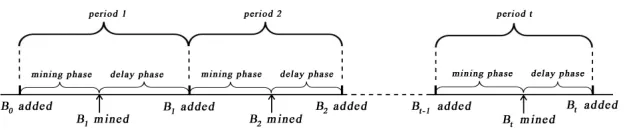
It seems that the adversary can use forks to distract the hashing power of miners in order to slow the chain growth rate. However, the forks does not help in breaking the chain growth property of TreeMC. More precisely, consider the rounds at which two consecutive blocks are added to TreeMC. Once a miner successfully mined a block B1, which corresponds to chain C1, the adversary can delay it with probability α for at most ∆ rounds, and waits for the next blockB10. IfB1is delayable and the next blockB10 corresponding toC10 is mined within∆rounds, the adversary can generate a fork by broadcasting both chain C1 andC10 simultaneously. ThenB1 andB10 can be added toTreeMC such that B1 is the neighbour of B10, and depth of TreeMC grows by 1. Specifically, the adversary can broadcastC1 to a set of miners, sayS1, andC10 to the remaining miners, sayS01. Then miners inS1 will accept chainC1, while miners inS10 will accept C10. Let r1 be the round at which B1 and B01 are added to TreeMC and r2 be the round at which the next block B2 is mined. Notice that r2−r1 is not influenced by the number of forks which the adversary generated at round r1, and only the number of the rounds of delays affect the chain growth rate of TreeMC.
Fig. 1.The rounds during whichtconsecutive blocks are added toTreeMC
Consider t consecutive blocks in TreeMC as shown in Figure 1. Block B0 is added to the tree at roundr0andBtis added at roundrt. We divide those rounds
fromr0tortintotperiods, and each period consists of the rounds during which
the depth ofTreeMCincreases by 1.
Each periodiconsists of mining phase and delay phase. For eachi, letBi be
the end of mining phase. LetRi
mineandRidelay denotes the number of rounds of
mining phase and delay phase of periodi, respectively. LetRmine=Σit=1Rimine
andRdelay=Σti=1Ridelay. SoRmine+Rdelay=rt−r0.
Next, we show how to computeRmineandRdelay. Letf = 1−(1−p)nbe the
probability that some miner succeeds in mining a block in a round. SinceRi mines
are independent geometrically distributed variables such that Pr[Ri
mine =k] =
(1−f)k−1f, the sum R
mine follows a negative binomial distribution NB(t, f).
Due to Lemma 5 in Appendix A, we have
Pr[Rmine≤
(1 +δ1)t
f ]≥1−e
−poly(δ21t), (11) where 0< δ1<1/2.
In delay phase, if Bi is undelayable, it has to be added to TreeMC at the
current round and Ri
delay = 0. Otherwise, the adversary can delay the chain
for at most ∆ rounds, Ri
delay ≤ ∆. It is obvious that Rdelay ≤ t∆. To get a
lower upper bound, we need to consider the event that a undelayable block is mined during each delay phase. Indeed, if an undelayable block is mined within ∆ rounds since the beginning of a delay phase, the adversary has to add such block toTreeMCand the delay phase is ended. Hence, the probability distribution ofRidelay is defined as follows:
Pr[Ridelay =k] =
1−α, ifk= 0,
α(1−(1−α)f)k−1(1−α)f, if 0< k < ∆, α(1−(1−α)f)k, ifk=∆,
0, otherwise.
(12)
So we have
E[Ridelay] =α(1−(1−α)f)∆∆+
∆−1
X
k=1
kα(1−(1−α)f)k−1(1−α)f
= α−αω
∆−1[ω+∆(1−ω2)]
1−ω ,
whereω= 1−(1−α)f. SinceRi
delays are independent random variables with the same distribution,
the expectation E[Rdelay] = P t i=1E[R
i
delay] = tE[R i
delay]. Using the Chernoff
bound, we get
Pr[Rdelay<(1 +δ2)tE[Rdelayi ]]>1−e
−δ
2
2tE[Ridelay]
3 , for 0≤δ2≤1. (13) So on the condition that (11) and (13) hold, the chain growth rate ofTreeMC is
g > t Rmine+Rdelay
= (1+δ t
1)t
f + (1 +δ2)tE[R i delay]
= (1−δ)f 1 +f E[Ri
delay]
whereδ is decided by picking sufficiently smallδ1 andδ2.
Due to Lemma 3, the view of (Π,C) has chain growth g with majority λ with probability at least 1−2e−poly(κ)conditioned on that (11) and (13) hold. Therefore, given the view of (Π,C), we have
Pr[chain-increase(A,Z,κΠ,C)(r, r+T, λ)≥gT]
≥1−2e−poly(κ)−e−poly(δ21T)−e−
δ22T E[Ridelay] 3 ,
which completes the proof of Theorem 1. Remark. If α = 1, then E[Ri
delay] = ∆ and the chain growth rate is
(1−δ)f
1+f ∆,
which is the same as that of [22].
6.2 Common prefix
Theorem 2. (Common prefix). Assume 0 < α <1−np and 1/2 < λ ≤ 1−
8αp∆. The blockchain protocol (Π,C)satisfies the common prefix property with parameterλ.
Proof. Due to Lemma 4, it remains to prove thatTreeMChave the common prefix property. Suppose the adversary’s goal is to break the common prefix ofTreeMC with depthd+T. That is, the adversary aims to make the length of the common prefix of all branches inTreeMCat mostd−1.
Note that the depth ofTreeMC can increase by 1 at most at each round due to Lemma 1. Therefore, in order to generate a fork inTreeMC, the adversary has to broadcast more than one blocks in a round. If only one block is broadcasted, there will be only one branch inTreeMCaccording to Lemma 1 and the adversary fails to generate a fork.
In order to capture the attack for common prefix, we introduce the following gameExperimentCOMMA,(Π,C), where the adversary generates a fork and tries to keep the branches of the fork as long as possible.
ExperimentCOMMA,(Π,C): Run (Π,C). Suppose that at current round r the depth of TreeMC is d−1 and there is no blocks being delayed and no forks in TreeMC. Then the adversaryAtries to generate a fork and extend the length of forks as follows.
1. Wait for new blocks to be mined. If the new block or blocks are mined at some roundr0 such thatr0> r.
– If more than one block are mined in the same roundr0,Abroadcasts the corresponding chains and goes to step 3. That means a fork is generated and recorded inTreeMC.
– If only one block, sayB, is mined,
• IfBis delayable,Adelays the corresponding chain, sayC1, and goes to step 2;
2. Atries to delayC1as long as possible. During these rounds of delays,Atries to generate a fork by “collecting” new blocks. If no block have been mined during these rounds,Afails to generate a fork and goes to step 1. Otherwise, go to step 3.
3. Atries to keep the fork ofTreeMCas long as possible. If at least two branch-es of the fork are extended with T blocks, we say the adversary wins the common prefix game.
Since the adversary can always keep waiting and trying until a fork is created (in step 1 and step 2), the common prefix property is measured by the success probability of Ain step 3.
Next, we consider a special event calledconvergewhich results in the failure ofA. Suppose the depth ofTreeMC increases tol at roundr. LetB∗be the first block mined after round r and let r∗ denote the round at whichB∗ is mined. The eventconverge satisfies the following conditions.
1. Only one miner succeeds in mining at roundr∗.
2. The chainC∗whichB∗lies in is undelayable, orC∗ is delayable while there is no new block mined in following∆rounds.
Note that if the event converge happens in step 3, then the depth of TreeMC increases by 1, e.g., froml tol+ 1.
When the depth of TreeMC increases to l at round r, the chains of all the miners are of length l. (Notice that the (l+ 1)th block can be mined only if a chain of length l is distributed). Then, if only one miner succeeds in r∗ and generates an undelayable chain C∗, C∗ will be the unique chain in TreeMC and Afails to extend the fork. IfC∗is undelayable and there is no new block mined in following∆rounds,A fails too.
Conditioned on that there exists some miner succeeding at round r∗, the probability of condition 1 is
np(1−p)n−1 1−(1−p)n >
np(1−p)n−1
np = (1−p)
n−1
>1−np (15) The probability of condition 2 is
1−α+α(1−p)n∆>1−α+α(1−np∆) = 1−αnp∆ (16) Therefore,
P r[converge]>(1−np)(1−αnp∆)>1−np(1 +α∆) (17) The adversary can keep the fork for consecutiveT blocks only if converge does not happen for consecutive T times, the probability of which is at most (np(1 +α∆))T. So the probability thatTree
MChas a common prefix with depth d−T is at least 1−(np(1 +α∆))T.
If∆≤1/np, considering the assumptionα <1−np, we have
np(1 +α∆)< np(1 + 1−np
If∆ >1/np, the equality (16) can be replaced with 1−α+α(1−p)n∆ >1−α, and the probability thatTreeMChas a common prefix with depthd−T is at least 1−(α+np)T, where α+np <1.
To sum up, the probability thatTreeMChas a common prefix path with depth d−T is at least 1−negl(T), whereneglis a negligible function. Due to Lemma 4, the view of (Π,C) satisfies common-prefix(A,Z,κΠ,C)(r, T, λ) = 1 with probability at least 1−2e−poly(κ). Therefore, given the view of (Π,C), we have
Pr[common-prefix(A,Z,κΠ,C)(r, T, λ) = 1]≥1−2e−poly(κ)−negl(T), which completes the proof of Theorem 2.
7
Long Delay Attack on Common Prefix
7.1 Long delay attack
Note that Theorem 2 is an asymptotic result, which means the common prefix property can hold whenT is large enough. To illustrate the threat of long delay attack comprehensively, we present a concrete attack on the common prefix of TreeMC when∆and αare “too” large relative to a fixedT.
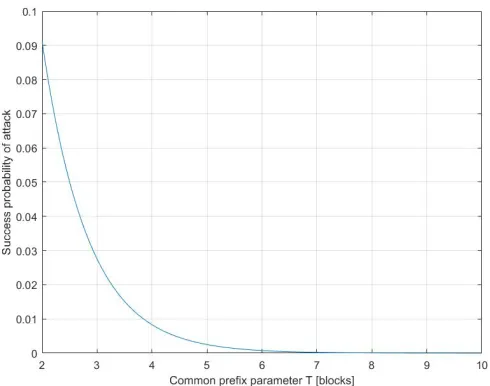
Fig. 2.Forα= 0.8 and T = 6, the success probability increases as ∆gets larger. In particular, the success probability grows much faster when∆ >60 (10 minutes). When
Fig. 3.For∆= 60 (10 minutes, the expected time of mining a block) andT = 6, the success probability increases as the probability of delayαget larger. As shown in the figure, the success probability increases much faster whenα >0.7.
Fig. 4. For ∆ = 60 (10 minutes) andα = 0.8, the success probability decreases as
Suppose that TreeMC has a fork with two branches4of depth 1, which lies in two chains, say chain A and chain B, respectively, and half of the miners accepted chain A and the other half accepted chain B. Then the adversary aims to increase the length of the two branches by T. Note that once the adversary need to broadcast two chains, he distributes in a way that the number of miners which accept one chain equals to that of miners which accepts the other chain. More details of the attack and related analysis are described in Appendix B. The success probability of such attack is
(f
4 + (α+
f(1−2α)
4 )
f(1−p∆ next)
2−2pnext
)
T
(19)
wherepnext≈
(2−f(1−α))(2−f)
4 .
For an experimental interpretation of the success probability of the attack, the parameters are set as follows: The time span of a round for full interaction is set to 10s. Since the expected time to mine a block is about 10 minutes, the probability of all the miners succeeding in mining per round is aboutf = 1/60. Consideringn= 105miners in the network, we havep≈f /n≈1.67×10−7. Let λ= 99.8%, which satisfies the assumption 1/2< λ≤1−8αp∆if∆ <1.5×10³ (about 4.2 hours). In this case, the common prefix ofTreeMCis the same as that of (Π,C) with probability at least 99.95% due to Lemma 4.
Given the above parameters, Figure 2,3 and 4 reflect the success probability of long delay attack when ∆, α and T varies. As shown in those figures, the adversary without any hash power may threaten the common prefix property of blockchain protocol especially when ∆and αare too large relative to the fixed T.
7.2 Balance attack
Our attack is reminiscent of the balance attacks introduced by [20], since both attacks can create or maintain forks by splitting honest miners into subgroups of similar mining power. Main differences between the original balance attack in [20] and ours are as follows.
– The goal of the original balance attack is to make the target branch selected as the main chain, while the goal of ours is to maintain the forks for as long as possible.
– The attacker in the original balance attack requires a fraction, say 20%, of mining power to launch attack, while our attack as well asN-confirmation double spending attack in [14] does not require any mining power.
– The original balance attack disrupts the communication between subgroups by delaying messages and those isolated subgroups mine their own blockchain-s independently. Our attack delayblockchain-s the new block (or blockchain) ablockchain-s blockchain-soon ablockchain-s it is successfully mined, e.g., the attacker “eclipses” the miner which mines
4
a new block. Then the attacker delivers different blockchains to different subgroups once he obtains enough blockchains.
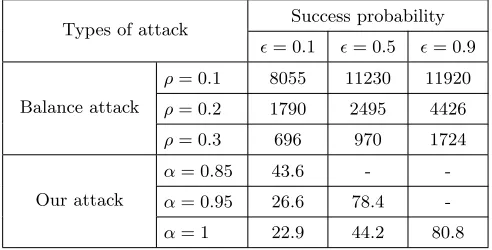
According to Theorem 5 of [20], we can evaluate the effectiveness of balance attack on bitcoin protocol. Table 1 shows the time of delays (in minutes) required by the original balance attack and ours, where we only consider the ideal case for the attacker of balance attack. More precisely, we assume that all the blocks mined in balance attack can be added to the main chain. For more details of balance attack, we refer to [20].
Table 1. Delays for balance attack and our long delay attack (minutes). f = 1/60 and T = 6.denotes the success probability of the attack.ρ denotes the fraction of mining power owned by the adversary in balance attack.αdenotes the probability of delay in our attack. “-” denotes that the corresponding success probability cannot be achieved. For example, the maximum success probability of our attack is about 0.55 whenα= 0.95 and hence cannot reach 0.9.
Types of attack Success probability
= 0.1 = 0.5 = 0.9
Balance attack
ρ= 0.1 8055 11230 11920
ρ= 0.2 1790 2495 4426
ρ= 0.3 696 970 1724
Our attack
α= 0.85 43.6 -
-α= 0.95 26.6 78.4
-α= 1 22.9 44.2 80.8
Although Table 1 shows that the balance attack requires longer delays than ours, we emphasize that it is not fair to say which attack is better. First, the goals are different. Second, the balance attack only considers the case that the attacker can always delay the message successfully, while our attack considers different probability of delay. Besides, the success probability estimation of bal-ance attack on bitcoin, which is obtained by applying the result on GHOST [20] directly, is not tight and can be further improved.
References
1. Badertscher, C., Garay, J., Maurer, U., Tschudi, D., Zikas, V.: But why does it work? a rational protocol design treatment of bitcoin. In: Nielsen, J., Rijmen, V. (eds.) EUROCRYPT 2018. LNCS, vol. 10821, pp. 34–65. Springer, Cham (2018) 2. Ben-Sasson, E., Chiesa, A., Garman, C., Green, M., Miers, I., Tromer, E., Virza,
M.: Zerocash: Decentralized anonymous payment from bitcoin. IEEE Symposium on Security and Privacy pp. 459–474 (2014)
3. Carlsten, M., Kalodner, H.A., Weinberg, S.M., Narayanan, A.: On the instability of bitcoin without the block reward. In: ACM CCS 2016. pp. 154–167. ACM Press, New York (2016)
4. Daian, P., Pass, R., Shi, E.: Snow white: Provably secure proofs of stake. IACR Cryptology ePrint Archive, Report 2016/919 (2016)
5. David, B., Gaˇzi, P., Kiayias, A., Russell, A.: Ouroboros Praos: An adaptively-secure, semi-synchronous proof-of-stake protocol. In: Nielsen, J., Rijmen, V. (eds.) EUROCRYPT 2018. LNCS, vol. 10821, pp. 66–98. Springer, Cham (2018) 6. Decker, C., Wattenhofer, R.: Information propagation in the bitcoin network. In:
13th IEEE International Conference on Peer-to-Peer Computing. pp. 1–10. IEEE Computer Society Press (2013)
7. Dubhashi, D.P., Panconesi, A.: Concentration of measure for the analysis of ran-domized algorithms. Cambridge University Press (2009)
8. Eyal, I., Sirer, E.G.: Majority is not enough: Bitcoin mining is vulnerable. In: Christin, N., Safavi-Naini, R. (eds.) FC 2014. LNCS, vol. 8437, pp. 436–454. Springer, Berlin, Heidelberg (2014)
9. Eyal, I., Sirer, E.G.: The miner’s dilemma. In: 2015 IEEE Symposium on Security and Privacy. vol. 2015-7, pp. 89–103. IEEE Computer Society Press (2015) 10. Garay, J., Kiayias, A., Leonardos, N.: The bitcoin backbone protocol: Analysis
and applications. In: Oswald, E., Fischlin, M. (eds.) EUROCRYPT 2015. LNCS, vol. 9057, pp. 281–310. Springer, Berlin, Heidelberg (2015)
11. Garay, J., Kiayias, A., Leonardos, N.: The bitcoin backbone protocol with chains of variable difficulty. In: Katz, J., Shacham, H. (eds.) CRYPTO 2017. LNCS, vol. 10401, pp. 291–323. Springer, Cham (2017)
12. Gervais, A., Karame, G.O., Wust, K., Glykantzis, V., Ritzdorf, H., Capkun, S.: On the security and performance of proof of work blockchains. In: ACM CCS 2016. pp. 3–16. ACM Press (2016)
13. Gilad, Y., Hemo, R., Micali, S., Vlachos, G., Zeldovich, N.: Algorand: Scaling byzantine agreements for cryptocurrencies. IACR Cryptology ePrint Archive, Re-port 2017/454 (2017)
14. Heilman, E., Kendler, A., Zohar, A., Goldberg, S.: Eclipse attacks on bitcoins peer-to-peer network. In: Jung, J. (ed.) 24th USENIX Security Symposium. pp. 129–144. USENIX Association (2015)
15. Kiayias, A., Koutsoupias, E., Kyropoulou, M., Tselekounis, Y.: Blockchain mining games. In: 2016 ACM Conference on Economics and Computation. pp. 365–382. ACM Press (2016)
16. Kiayias, A., Panagiotakos, G.: Speed-security tradeoffs in blockchain protocols. IACR Cryptology ePrint Archive: Report 2015/1019 (2016)
18. Miller, A., LaViola, J.J.: Anonymous byzantine consensus from moderately-hard puzzles: A model of bitcoin. University of Central Florida. Tech Report, CS-TR-14-01 (2014)
19. Nakamoto, S.: Bitcoin: A peer-to-peer electronic cash system (2008)
20. Natoli, C., Gramoli, V.: The balance attack against proof-of-work blockchains: The R3 testbed as an example. Computing Research Repository (2016), arX-iv:1612.09426
21. Nayak, K., Kumar, S., Miller, A., Shi, E.: Stubborn mining: Generalizing selfish mining and combining with an eclipse attack. In: 2016 IEEE European Symposium on Security and Privacy. vol. 142, pp. 305–320. IEEE Computer Society Press (2016)
22. Pass, R., Seeman, L., abhi shelat: Analysis of the blockchain protocol in asyn-chronous networks. In: Coron, J., Nielsen, J. (eds.) Advances in Cryptology - EU-ROCRYPT 2017. LNCS, vol. 10211, pp. 643–673. Springer-Verlag, Cham (2017) 23. Pass, R., Shi, E.: Fruitchains: A fair blockchain. In: ACM Symposium on Principles
of Distributed Computing. pp. 315–324. ACM Press (2017)
24. Pass, R., Shi, E.: The sleepy model of consensus. In: Takagi, T., Peyrin, T. (eds.) ASIACRYPT 2017. LNCS, vol. 10625, pp. 380–409. Springer, Cham (2017) 25. Pass, R., Shi, E.: Thunderella: Blockchains with optimistic instant confirmation. In:
Nielsen., J., Rijmen, V. (eds.) EUROCRYPT 2018. vol. 10821, pp. 3–33. Springer (2018)
26. Rosenfeld, M.: Analysis of bitcoin pooled mining reward systems. arXiv preprint:1112.4980 (2011), arXiv:1112.4980
27. Sapirshtein, A., Sompolinsky, Y., Zohar, A.: Optimal selfish mining strategies in bitcoin. In: Grossklags, J., Preneel, B. (eds.) FC 2016. LNCS, vol. 9603, pp. 515– 532. Springer, Berlin, Heidelberg (2016)
28. Schrijvers, O., Bonneau, J., Boneh, D., Roughgarden, T.: Incentive compatibility of bitcoin mining pool reward functions. In: Grossklags, J., Preneel, B. (eds.) FC 2016. LNCS, vol. 9603, pp. 477–498. Springer, Berlin, Heidelberg (2016)
29. Sompolinsky, Y., Zohar, A.: Secure high-rate transaction processing in bitcoin. IACR Cryptology ePrint Archive: Report 2013/881 (2017)
30. Teutsch, J., Jain, S., Saxena, P.: When cryptocurrencies mine their own business. In: Grossklags, J., Preneel, B. (eds.) FC 2016. LNCS, vol. 9603, pp. 499–514. Springer, Berlin, Heidelberg (2016)
31. Zohar, A.: Bitcoin: under the hood. In: Communications of the ACM. vol. 58, pp. 104–113. ACM Press (2015)
A
Chernoff bound for negative binomial distribution
Lemma 5. Let X1, X2, ..., Xk be independent random variables, such that for all i ∈ [k] and integer m ≥1, P r[Xi =m] = (1−p)
m−1
p. Let X =Σk i=1Xi, the variableX is said to have a negative binomial distributionNB(k, p), and for
δ∈(0,12)
Pr[X ≤(1−δ)k p]< e
−poly(δ2k)
(20)
Pr[X ≥(1 +δ)k p]< e
Proof. Let t = (1−pδ)k and = 1
1−δ −1 ∈ (0,1). Here, k = pt
1−δ = (1 +)pt.
Let Y1, Y2, ..., Ybtc be independent random boolean variables, such that for all
i∈ {1, . . . ,btc}, Pr[Yi= 1] =p.Y =Σb tc
i=1Yi. Due to the Chernoff bound [7], we
have
Pr[Y ≥k]≤Pr[Y ≥(1 +)pbtc]< e− 2pbtc
3 (22)
Since
pbtc=pt−p(t− btc)> pt−p= (1−δ)k−p (23) we have
Pr[Y ≥k]< e− 2
3((1−δ)k−p)< e− δ2k 3(1+δ)+
2p 3 < e−δ
2k 3 +
p
3 (24) Consider the eventY ≥k. If it happens, there are at leastksuccesses inbtc
Bernoulli trials. In other words, it takes us at most btcexperiments to achieve thekth successes.Xi is considered as the number of Bernoulli trials needed to
get one success. So the eventY ≥k is equivalent to the eventX ≤ btc. Hence, Pr[X ≤t] = Pr[X ≤ btc] = Pr[Y ≥k]< e−δ
2k 3 +
p
3 (25)
That completes the proof of inequality (20). Similarly, inequality (21) can be proved ift= (1+pδ)k and= 1− 1
1+δ.
B
Long Delay Attack on Common Prefix
Suppose chain A and chain B are inTreeMC, such that chain A is similar to chain B except that only the last blocks are different. For convenience, letGAandGB
denote the set of miners which accept chain A and chain B, respectively. The number of miners in group A equals to that of group B, i.e.,|GA|=|GB|=n/2.
Note that GA or GB is not fixed and will be changed due to the adversary
delivery. Then the adversary waits for a new block. We say roundris successful if there is a new block mined at roundr. Letγ(n, p) = 1−(1−p)n. Ifpis small, we have γ(n, p) ≈ np. Obviously, the probability that a round is successful is f =γ(n, p). When a successful round appears, consider the following cases:
1. There is at least one block mined in each of the two branches. That means, chain A and chain B are extended at the same round. The adversary dis-tributes the two chains in a way that the number of miners accepting chain A and the number of miners accepting chain B are equal. As a result, the adversary succeeds in extending the length of the fork by 1. Since the prob-ability of mining a block in one chain is γ(n2, p), the probability that this case happens is
γ(n2, p)·γ(n2, p) γ(n, p) ≈
1 4n
2p2 np =
np
4 (26)
while the length of chain B remains the same. So the useless blocks in chain B is deleted due toDeleteBlockand the adversary fails to extend the fork. The probability of this case is
2γ(n2,(1−α)p)(1−γ(n2, p)) γ(n, p) ≈
(1−α)np(1−np
2)
np =
(1−α)(2−np) 2
(27) 3. Otherwise, all the blocks mined at this round are delayable and in only one branch (without loss of generality, chain A). That means, the adversary neither succeeds nor fails at this round. The adversary can delay the new chain A and keep waiting for a new block in chain B in the following ∆ rounds. Due to equations (26)(27), the probability that the adversary needs to delay the chain is
1−np
4 −
(1−α)(2−np)
2 =α+
np(1−2α)
4 (28)
Then, the adversary keeps the chain A delayed and waits for a new block to be mined in chain B. At each of the following rounds, there are three cases to be discussed:
(a) If GB succeeds in mining a block, the chain B can be extended and
adversary distributes the delayed chain A and the new chain B in a way that|GA|=|GB|. As a result, the adversary succeeds in extending
the length of chain A and chain B by 1. The probability of this case is γ(n2, p)≈ np
2.
(b) IfGB does not succeed in mining a block whileGAmines anundelayable
block. Then, the new chain A should be distributed, which means only chain A inTreeMC is extended. So the adversary fails.
(c) If GA does not mine an undelayable block while GB does not succeed
in mining a block. The adversary checks whether the number of rounds for A being delayed exceeds ∆. If it exceeds ∆, the adversary has to broadcast chain A and fails. Otherwise, the adversary keeps chain A delayed and goes to the next round, where the probability of this event is
pnext= (1−γ(
n
2,(1−α)p))·(1−γ( n 2, p))≈
(2−np(1−α))(2−np)
4 .
(29) In a word, in case 3, the adversary can succeed with probabilitynp2 per round, or can go to the next round with probabilitypnext. Conditioned on case 3
happens at roundr, the probability for the adversary succeeding at round r+1 is np2 and the probability of success at roundr+2 ispnext·np2. Similarly,
conditioned on case 3 happens at roundr, the probability of success at round r+iis pnexti−1·np2 . Since the adversary only has∆rounds for trying, the
probability for adversary to succeed during those∆ rounds in case 3 is
∆
X
i=1
pnexti−1·
np 2 =
np(1−p∆next) 2−2pnext
Considering case 1, 2 and 3, the probability of the adversary succeeding in increasing the length of branches by 1 for a successful round is
np
4 + (α+
np(1−2α)
4 )
np(1−p∆ next)
2−2pnext
. (31)
Then the adversary waits for another successful round and executes as described above.
We say the adversary’s long delay attack is successful, if the adversary suc-ceeds in increasing the length of the fork by 1 for consecutiveT times. Therefore, the success probability of our long delay attack is
(f
4 + (α+
f(1−2α)
4 )
f(1−p∆ next)
2−2pnext
)
T
. (32)