Improving Performance between Proactive
and Reactive Routing Protocols in MANETs
K. Venkata Ramana
1, I. Sankar Babu
2, P.Nageswara Rao
3Research Scholar, Dept. of CSE, Dr.RR &Dr.SR Technological University, Chennai, Tamil Nadu, India1
Assistant Professor, Department of CSE, Sri Venkatesa Perumal College of Engineering & Technology, Andhra
Pradesh, India2
Principal, Swetha Institute of Technology and Science, Andhra Pradesh, India 3
ABSTRACT: Mobile Ad hoc Network (MANET), is a self-configuring infra structure less network of mobile devices Connected by wireless links. Each device in a MANET is free to move independently in any direction, and will therefore change its links to other devices frequently. In this paper we are presenting two mobile ad-hoc routing protocols DSDV and AODV. Here the DSDV is a proactive protocol depending on routing tables which are maintained at each node. The AODV is a reactive protocol, which find a route to a destination on demand, whenever communication is needed. Considering the bandwidth, throughput and packet loss, in both DSDV and AODV routing protocols, DSDV is best suited for only smaller networks and AODV is suited for general Ad-hoc networks.
KEYWORDS: Mobile Ad hoc Networks (MANETs), Quality of Service (QoS), AODV, DSDV, routing.
I. INTRODUCTION
A Network is defined as the group of people or systems or organizations who tend to share their information collectively for their business purpose. In Computer terminology the definition for networks is similar as a group of computers logically connected for the sharing of information or services (like print services, multi-tasking, etc.). Initially Computer networks were started as a necessity for sharing files and printers but later this has moved from that particular job of file and printer sharing to application sharing and business logic sharing. [1] defines computer networks as a system for communication between computers. These networks may be fixed (cabled, permanent) or temporary.A network can be characterized as wired or wireless.
II. WIRED VS WIRELESS NETWORKS
The different types of networks available today are Wired and Wireless networks. Wired are differentiated from wireless as being wired from point to point.
III. ROUTING
Routing is the act of moving information from a source to a destination in an internetwork. During this process, at least one intermediate node within the internetwork is encountered. The routing concept basically involves, two activities: firstly, determining optimal routing paths and secondly, transferring the information groups (called packets) through an internetwork. The later concept is called as packet switching which is straight forward, and the path determination could be very complex [2]. Routing is mainly classified into static routing and dynamic routing. Static routing refers to the routing strategy being stated manually or statically, in the router.
3.1 CLASSIFICATION OF ROUTING PROTOCOLS IN MANET’S
as Table-driven and source initiated, while depending on the network structure these are classified as flat routing, hierarchical routing and geographic position assisted routing[5] . B oth the Table-driven and source initiated protocols come under the Flat routing see [fig 3.1]
Figure 3.1: Classification of Routing Protocols In Mobile Ad-hoc Networks [5].
3.1.1 Table-Driven routing protocols
These protocols are also called as proactive protocols since they maintain the routing information even before it is needed [7]. Each and every node in the network maintains routing information to every other node in the network. Routes information is generally kept in the routing tables and is periodically updated as the network topology changes. Many of these routing protocols come from the link-state routing[5] . The proactive protocols are not suitable for larger networks, as they need to maintain node entries for each and every node in the routing table of every node. This causes more overhead in the routing table leading to consumption of more bandwidth.
3.1.2 Source Initiated routing protocols
These protocols are also called reactive protocols since they don’t maintain routing information or routing activity at the network nodes if there is no communication. If a node wants to send a packet to another node then this protocol searches for the route in an on-demand manner and establishes the connection in order to transmit and receive the packets.
IV. DESTINATION SEQUENCED DISTANCE VECTOR (DSDV) PROTOCOL
The destination sequenced distance vector routing protocol is a proactive routing protocol which is a modification of conventional Bellman-Ford routing algorithm. This protocol adds a new attribute, sequence number, to each route table entry at each node. Routing table is maintained at each node and with this table, node transmits the packets to other nodes in the network. This protocol was motivated for the use of data exchange along changing and arbitrary paths of interconnection which may not be close to any base station.
4.1 Protocol Overview and activities
Each node in the network maintains routing table for the transmission of the packets and also for the connectivity to different stations in the network. These stations list for all the available destinations, and the number of hops required to reach each destination in the routing table. The routing entry is tagged with a sequence number which is originated by the destination station. In order to maintain the consistency, each station transmits and updates its routing table periodically.The packets may be transmitted containing the layer 2 or layer 3 addresses [8].
– The destination address
– The new sequence number, originally stamped by the destination
4.2 Example for DSDV operation
Figure 4.2: Movement of Mobile host in Ad-hoc Networks [8].
Consider the above fig. 4.2 which has 8 hosts in the network. We will have a look at the changes to the MH4 routing table with reference to the movements of MH1. Initially, all the nodes advertise their routing information to all the nodes in the network and hence the routing table at MH4 initially looks like
Table 4.2: Routing table of MH4[8] Destination Next Hop Metric Sequence-Number Install
MH1 MH2 2 S406 MH1 T001_MH4 MH2 MH2 1 S128 MH2 T001 MH4
MH3 MH2 2 S564 MH3 T001 MH4 MH4 MH4 0 S710 MH4 T001 MH4 MH5 MH6 2 S392 MH5 T002 MH4 MH6 MH6 1 S076 MH6 T001 MH4 MH7 MH6 2 S128 MH7 T002 MH4 MH8 MH6 3 S050 MH8 T002 MH4
And the forwarding table at the MH4 would look like this
Table 4.3: Forwarding table at MH4 [8] Destination Metric Sequence Number
MH1 2 S406 MH1
MH2 1 S128 MH2
MH3 2 S564 MH3
MH4 0 S710 MH4
MH5 2 S392 MH5
MH6 1 S076 MH6
MH7 2 S128 MH7
MH8 3 S050 MH8
from different neighbors to reach MH1 with same sequence number, but different metric. The selection of the route will depend on less hop count when the sequence number is the same. Now the routing table will look like
V. AD-HOC ON-DEMAND DISTANCE VECTOR (AODV) PROTOCOL
AODV is a very simple, efficient, and effective routing protocol for Mobile Ad-hoc Networks which do not have fixed topology. This algorithm was motivated by the limited bandwidth that is available in the media that are used for wireless communications. It borrows most of the advantageous concept from DSDV algorithm. The on demand route discovery and hop-by-hop routing, usage of node sequence numbers from DSDV make the algorithm cope up with topology and routing information. Obtaining the routes purely on-demand makes AODV a very useful and desired algorithm for MANETs [11].
5.1 Working of AODV
Each mobile host in the network acts as a specialized router and routes are obtained as needed, thus making the network self-starting. Each node in the network maintains a routing table with the routing information entries to it’s neighbouring nodes, and two separate counters: a node sequence number and a broadcast-id. When a node (say, source node ‘S’) has to communicate with another (say, destination node ‘D’), it increments its broadcast-id and initiates path discovery by broadcasting a route request packet RREQ to its neighbors. The RREQ contains the following fields: – source-addr
– source-sequence# -to maintain freshness info about the route to the source. – dest-addr
– dest-sequence# - specifies how fresh a route to the destination must be before it is accepted by the source. – hop-cnt
The (source-addr, broadcase-id) pair is used to identify the RREQ uniquely. Then the dynamic route table entry establishment begins at all the nodes in the network that are on the path from S to D.
As RREQ travels from node to node, it automatically sets up the reverse path from all these nodes back to the source. Each node that receives this packet records the address of the node from which it was received. This is called Reverse Path Setup. The nodes maintain this info for enough time for the RREQ to traverse the network and produce a reply to the sender and time depends on network size. If an intermediate node has a route entry for the desired destination in its routing table, it compares the destination sequence number in its routing table with that in the RREQ. If the destination sequence number in its routing table is less than that in the RREQ, it rebroadcasts the RREQ to its neighbors. Otherwise, it unicasts a route reply packet to its neighbor from which it was received the RREQ if the same request was not processed previously (this is identified using the broad case -id and source-addr).
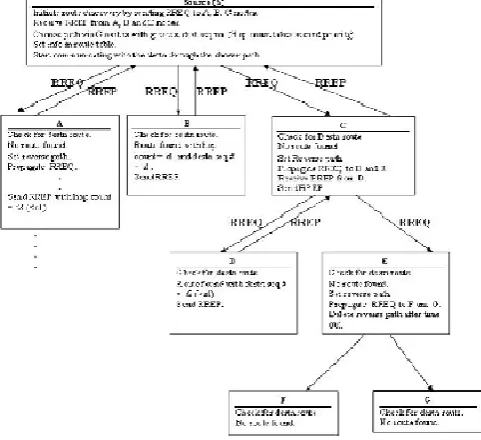
The below figure 5.1 is an example, which shows how the route to the destination is found by AODV routing protocol.
Step by step explaination of figure 5.1 is as follows: 1. Source ’S’ has to send data to destination.
2. S sends RREQ to its neighbors A, B, C.
3. B finds the path in its routing table (with destn seq-number s1 and hop count c1) and sends RREP toS.
4. C sets up reverse path.
5. C forwards RREQ to its neighbors D and E.
6. E sets up reverse path.
7. E forwards RREQ to its neighbors F and G.
9. D finds the path (with dest seq-number s2 which is greater than s1 and hop count c1) in its routing table and sends RREP to C.
10. C receives RREP from D and sets up forward path and forwards RREP to S.
11. A sets reverse path; forwards RREQ to its neighbors; receives RREP (with pathof hop count c2 which is greater than c1); sets forward path; and forwards this RREP to S.
12. S receives a path info from C (with destn seq-number s2 and hop count c1), another path info from B (with destn seq-number s1 and hop count c1), and another path info from A (with destn seq-number x which is less than s1 and s2 and hop count c2 which is less than c1).
13. S chooses path info from C (which was originated from D), giving first priority to the path with greatest destination sequence number and then second priority to the path with smallest hop count. Though path given by A is of smallest hop count, it is ignored because the destination sequence number is greater than the path from C.
Figure 5.1: Route finding process in AODV Routing Protocol.
VI. CONCLUSION
The study reveals that, DSDV routing protocol consumes more bandwidth, because of the frequent broadcasting of routing updates. While the AODV is better than DSDV as it doesn’t maintain any routing tables at nodes which results in less overhead and more bandwidth. It can be assumed that DSDV routing protocols works better for smaller networks but not for larger networks. So, my conclusion is that, AODV routing protocol is best suited for general mobile ad-hoc networks as it consumes less bandwidth and lower overhead when compared with DSDV routing protocol.
REFERENCES
[1]Andrew S. Tanenbaum. Computer Networks, 4th Edition. PRENTICE HALL,2002. [2] Cisco. Cisco Internetworking. Cisco Press, 2002.
[4] Scott M. Ballew. Managing IP Networks with Cisci Routers. Orilley 1st Edition,1997.
[5] Xiaoyan Hong, Kaixin Xu, and Mario Gerla. Scalable routing protocols for mobile ad hoc networks. 2002.
[6] Elizabeth M. Royer and Chai-Keong Toh. A review of current routing protocols for ad hoc mobile wireless networks. Technical report, University of California and Georgia Institute of Technology, USA, 1999.
[7] Charles E. Perkins. Ad Hoc Networking. Addision Wesley, 2001.
[8] Charles E. Perkins and Pravin Bhagwat. Dsdv routing over a multi hop wireless network of mobile computers. Technical report, IBM Research and University of Maryland, USA.
[9] Dr. Uwe Roth. Highly dynamic destination-sequenceddistancevectorrouting.http://wiki.uni.lu/secan-lab/Highly+Dynamic+Destination-Sequenced+DistanceVector+Routing.html(visited 2006-04-06).
[10] Guoyou He. Destination-sequenced distance vector (DSDV) protocol. Technical report, Helsinki University of Technology, Finland.
[11] Charles E. Perkins and Elizabeth M.Royer. Ad-hoc on-demand distance vector routing. Technical report, Sun Micro Systems Laboratories, Advacnced Developmenet Group, USA.
[12] Christian Schwingenschlogl and Timo Kosch. Geocast enhancements of aodv for vehicular networks. Technical report, Institute of Communication Networks, Munich University of Technology. and BMW Research,Munich, Germany.
![Figure 4.2: Movement of Mobile host in Ad-hoc Networks [8].](https://thumb-us.123doks.com/thumbv2/123dok_us/1525296.1186970/3.595.199.402.236.376/figure-movement-mobile-host-ad-hoc-networks.webp)