ISSN(Online): 2319-8753 ISSN (Print): 2347-6710
I
nternational
J
ournal of
I
nnovative
R
esearch in
S
cience,
E
ngineering and
T
echnology
(A High Impact Factor, Monthly, Peer Reviewed Journal) Visit: www.ijirset.com
Vol. 8, Issue 11, November 2019
An Efficient Region Based Image Retrieval Using
Fuzzy C Means Algorithm And User Interactive
Multi Threshold Robust Features Vector
S.Maheshwari, Mr.S.Prabakaran
M.E. Scholar, Idhaya Engineering College for Women, Chinnasalem, Tamil Nadu, India
Associate Professor, Dept. of CSE, Idhaya Engineering College for Women, Chinnasalem, Tamil Nadu, India
ABSTRACT: Remote Sensing Image processing is a technique to change an image into digital form and execute a number of operations on it, in order to obtain an improved image or to extract a number of useful information from it. It is a huge and demanding area with its applications in fields like aerial, medical and industrial applications, satellite images, and science and law enforcement. Frequently the image quality is more often linked to its brightness and contrast levels increasing these parameters will certainly provide the most excellent result. HE is an image enhancement technique that allocates the values of pixel consistently, therefore developing an improved picture. The major problem of color histogram equalization method of SVM is that it does not yield uniform histogram in gray scale transformation of 3D DWT. The scarcity of multi image supporting for satellite image is handled with the help of multispectral sensing image method. A satellite image is full of noisy information thus it faces many problems just to get a clear view of a location. Various image enhancement techniques are used to remove the unwanted data from the satellite image. Existing techniques fail to clear noise from the satellite image enough to be used for real time purposes. Therefore following methods are proposed to overcome above issues. SVM is proposed which has two significant parts. The first one is the interior point method and second one is boundary value selection. The majority of color histogram equalization methods do not yield uniform histogram in gray scale. Contrast of the converted image is worse in 1D and 2D, to overcome this we move on to 3D. The new satellite image contrast enhancement technique is based on the discrete wavelet transform (DWT) which decomposes the input image into the four frequency sub bands by using DWT and estimates the singular value matrix of the low- low sub band image, and, then, it reconstructs the enhanced image by applying inverse DWT.
I. INTRODUCTION
The motivation of thesis is to overcome the problem of scarcity of multi image supporting for satellite image and noise from the satellite image adequate to be utilized for real time application goals, and enhance the contrast and brightness of the satellite image during the night time. In the proposed approach, various methods and effective algorithms are used to get the goal of this research, the night time taken images are dark and so their details are hidden, therefore Contrast and brightness of image, and noiseless image is required in satellite image. These issues will be handled by the proposed methods.
II. BASICS OF IMAGE PROCESSING
ISSN(Online): 2319-8753 ISSN (Print): 2347-6710
I
nternational
J
ournal of
I
nnovative
R
esearch in
S
cience,
E
ngineering and
T
echnology
(A High Impact Factor, Monthly, Peer Reviewed Journal) Visit: www.ijirset.com
Vol. 8, Issue 11, November 2019
brightness – by increasing gamma Brightness can be modified. In brightness Gamma is anon-linear form of augment. Contrast- It is the partition between the bright and dark areas of an image. Hence, enhancing contrast increases darkness in dark areas and brightness in areas of bright. [3] Saturation- Saturation is enhancing the separation between highlights and the shadows. [16] Sharpness– It is connected to edges, the contrast along the photo edges. Utilizing histogram equalization contrast can be increased.
III. HISTOGRAM EQUALIZATION
Histogram equalization is a method for regulating image intensities to increase contrast. Histogram equalization is a easy and an efficient contrast enhancement method which distributes pixel values uniformly such that enhanced image have linear cumulative histogram and is a global operation [60].
There are many techniques by which image Histogram will be equalized. Depending upon the area of Application, various histogram equalization techniques are used. The following four types of Histogram Equalization techniques are explained in detail [64]:
Classical Histogram Equalization
CHE is the basic method for image processing, mainly when gray level images are considered. This method aim is to dispense the given number of gray levels over a range consistently, therefore increasing its contrast. By the below mentioned expression the cumulative density function (CDF) is formulated [60]:
The CHE tries to generate an output image with a compressed histogram, means a standardized distribution. By the dynamic range of values of gray levels an image is formed. Fundamentally, the whole gray levels are denoted as 0 to L −1.
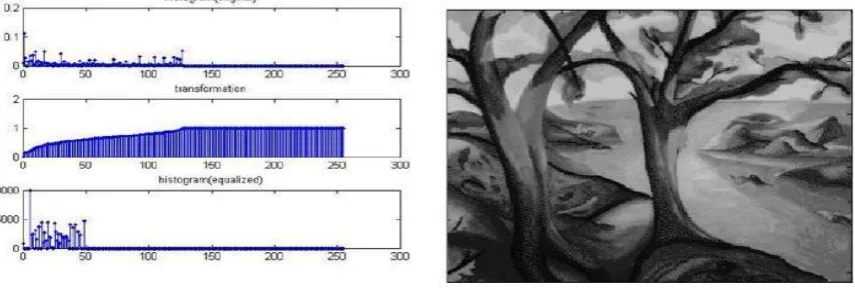
Figure 1.2: Histogram after CHE Figure 1.3: Image after CHE
Disadvantage
A disadvantage of this technique is that it is undifferentiating between the different pixels, that is, while
enhancing background contrast, the signal gets misrepresented.
ISSN(Online): 2319-8753 ISSN (Print): 2347-6710
I
nternational
J
ournal of
I
nnovative
R
esearch in
S
cience,
E
ngineering and
T
echnology
(A High Impact Factor, Monthly, Peer Reviewed Journal) Visit: www.ijirset.com
Vol. 8, Issue 11, November 2019
Adaptive Histogram Equalization
In images Adaptive Histogram Equalization (AHE) is utilized to progress contrast. It estimates numerous ordinary histograms, every one analogous with an image section. Therefore, the output results in each to redistributing the weightlessness values. It is suitable to regulate the local contrast and to obtain clear details [60].
AHE is accountable for over-expanding noise in a number of homogeneous regions of an image. An advanced AHE version, called Contrast Limited Adaptive Histogram Equalization (CLAHE) is presented to avoid this problem.
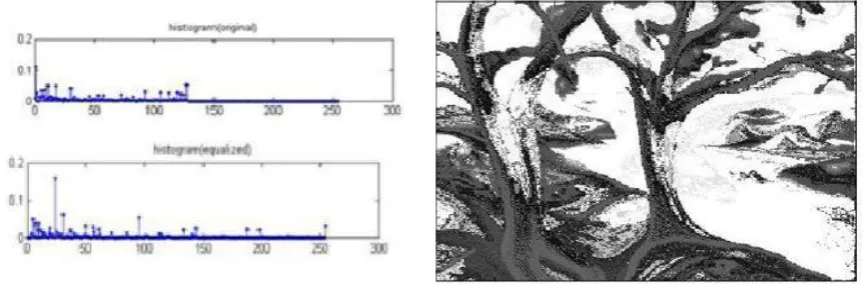
Figure 1.4: Histogram after AHE Figure 1.5: Image after AHE
Disadvantage
AHE has a behavior of increasing noise, therefore limiting its utilize for uniform figures.
CLAHE that removed the above difficulty.
With respect to the input image it also fails to maintain the brightness.
Bi-Histogram Equalization
The main basis of origination of this technique is to overcome the drawback by introduced CHE. Here, the original image is partitioned twice i.e. into two sub-sections. This is processed by separating the mean gray level and then applying method of CHE on everyone of the two sub-sectioned image. For real-time applications its objective is to make method suitable. But again this technique has the equivalent disadvantage as CHE by inputting unwanted signals.
ISSN(Online): 2319-8753 ISSN (Print): 2347-6710
I
nternational
J
ournal of
I
nnovative
R
esearch in
S
cience,
E
ngineering and
T
echnology
(A High Impact Factor, Monthly, Peer Reviewed Journal) Visit: www.ijirset.com
Vol. 8, Issue 11, November 2019
Recursive Mean Separate Histogram Decomposition
A comprehensive version of the BHE technique used before, and named as recursive mean-separate HE (RMSHE), presents the following. Instead of resolving the image only once, the method of RMSHE provides to execute image decomposition recursively, up to a scale r, creating 2r sub images. Subsequent to, every one of these sub-images is independently increased utilizing the CHE technique. Note that, computationally speaking, this technique proposes a problem: the number of resolved sub-histograms is a power of two.
Figure 1.8: Histogram of RMSHE Figure 1.9: Image of RMSHE
Multi-Decomposition Histogram Equalization
Every HE techniques that have enclosed earlier to this, increases the image contrast but are unable to conserve its brightness. As a result, in the processed image these techniques can produce unnatural and nonexisting objects. To remove these limitations, by decomposing the image into various small images MDHE comes up with a novel technique. After that the image contrast improvement provided by CHE in every sub-image is less concerted, directing the output image to have a more likely and suitable look.
Multi-Decomposition of the image
An image is assumed as input and separated into as numerous as 64 sub-images. This is executed utilizing the spatial domain methods. Functions are called and the image decomposition is done.
Applying histogram based techniques
At the present by applying Adaptive Histogram Equalization method dividing the image is into 64 sub-images on each one of the 64 sub-images to obtain enhanced sub-images. This is executed for loop by utilizing nested.
Interpolating the image
This is prepared is to disrupt all the sub-images in the correct sequence, guardedly at the right place to get Interpolated image. Though contrast development has been achieved, the image still lacks brightness preservation.
Brightness Preservation
ISSN(Online): 2319-8753 ISSN (Print): 2347-6710
I
nternational
J
ournal of
I
nnovative
R
esearch in
S
cience,
E
ngineering and
T
echnology
(A High Impact Factor, Monthly, Peer Reviewed Journal) Visit: www.ijirset.com
Vol. 8, Issue 11, November 2019
IV. SUPPORT VECTOR MACHINES (SVM)
Optimal Separating Hyperplane (OSH)
Let (xi , yi)1≤i≤N be a set of examples of training, xi ∈ R n and by yi ∈ {−1, 1} pertains to class labeled. The
intent is to carry out the hyperplane equation which divides the set of examples such that all the points with the similar label are on the same hyperplane side. This means discover w and b such that [49].
yi(w · xi + b) > 0, i = 1, . . . , N (1.1)
If there exist a hyperplane satisfying equation (1.1), the set is said to be linearly divisible. In this case, it is always probable to rescale w and b such that
min 1≤i≤N yi(w · xi + b) ≥ 1, i = 1, . . . , N
i.e. such that the neighboring point to the hyperplane has a distance of 1/||w||. Then, equation (1.1) becomes
yi(w · xi + b) ≥ 1 (1.2)
One for which the distance to the closest point is maximal is called optimal separating hyperplane (OSH) among the unraveling hyperplanes. As the distance to the closest point is 1/||w||, discovering the OSH amounts to resolve the following problem: decrease
1 /2 (w · w) (1.3)
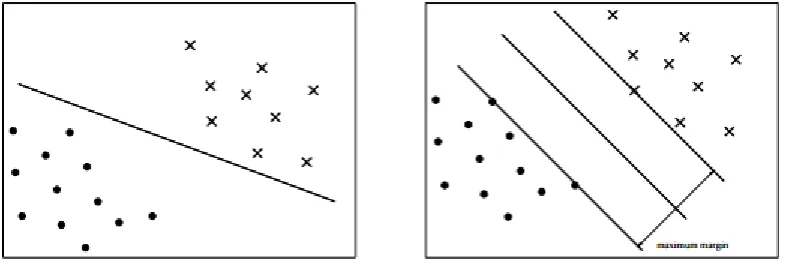
Under constraints (1.2) the quantity 2/||w|| is known as the margin and therefore, the OSH is the dividing hyperplane which increases the margin. The margin can be seen as a computation of complexity of the problem: the lesser the margin is, the further complicated the problem is. The larger the margin is, the improved the simplification is predictable to be (shown in Figure 1.2)
Figure 1.10: Both hyperplanes separate correctly the training examples
But on the right hand side the Optimal Separating Hyperplane has a superior margin and is predictable to provide improved generalization.
ISSN(Online): 2319-8753 ISSN (Print): 2347-6710
I
nternational
J
ournal of
I
nnovative
R
esearch in
S
cience,
E
ngineering and
T
echnology
(A High Impact Factor, Monthly, Peer Reviewed Journal) Visit: www.ijirset.com
Vol. 8, Issue 11, November 2019
L(w, b, α) = 1 2 w · w − X N i=1 αi [yi(w · xi + b) − 1] (1.4)
To locate this point, one has to reduce this function over w and b and to maximize it over the Lagrange multipliers αi ≥ 0. The saddle point must assure the following conditions:
∂L(w, b, α) b = X N i=1 yiαi = 0 (1.5)
∂L(w, b, α) w = w − X N i=1 αiyixi = 0 (1.6)
Substituting equations (1.5) and (1.6) into (1.4), this optimization problem amounts to make the most of W(α) = X N i=1 αi − 1 2 X N i,j=1 αiαjyiyjxi · xj (1.7) with αi ≥ 0 and under restraint (1.5). By the use of standard quadratic programming techniques [Bazaraa and Shetty, 1979] this can be attained. Once the vector α0 = (α 0 1 , . . . , α0 N) solution of the maximization problem (1.7) has been discoverd, taking (1.6) into account, the OSH (w0, b0) has the following expansion
(1.8)
While b0 can be determined from the Kuhn-Tucker conditions
(1.9)
Note that from equation (1.9), the points for which α 0 i > 0 satisfy in equation (1.2) with parity. Geometrically, it means that they are the closest points to the optimal hyperplane (shown in Figure 1.1). These points play a crucial role, since they are the only points needed in the expression of the OSH. They are called support vectors to point out the fact that they “support” the expansion of w0.
Given a support vector xi , the parameter b0 can be obtained from the corresponding KuhnTucker condition as
b0 = yi − w0 · xi
The problem of classifying a new point x is solved by by looking at the sign of w0 · x + b0
Considering the expansion (1.8) of w0, the hyperplane decision function can thus be written as
(1.10)
1.6.2 Linearly non-separable case
If the data are not linearly separable, the problem of finding the OSH becomes meaningless. To allow the possibility of examples violating (1.2), one can introduce slack variables (ξ1, . . . , ξN) with ξi ≥ 0 [Cortes and Vapnik, 1995] such that
yi(w · xi + b) ≥ 1 − ξi, i = 1, . . . ,N (1.11)
ISSN(Online): 2319-8753 ISSN (Print): 2347-6710
I
nternational
J
ournal of
I
nnovative
R
esearch in
S
cience,
E
ngineering and
T
echnology
(A High Impact Factor, Monthly, Peer Reviewed Journal) Visit: www.ijirset.com
Vol. 8, Issue 11, November 2019
(1.12)
Subject to constraints (1.11) and ξi ≥ 0. The first term is minimized to control the capacity learning as in the separable case; the purpose of the second term is to keep under control the number of misclassified points. The parameter C is chosen by the user, a larger C corresponding to assigning a higher penalty to errors. In analogy with what was done for the separable case, the use of the Lagrange multipliers leads do the following optimization problem : maximize
V. CONCLUSION
From the survey analysis, a histogram equalization method applied to a color image is more complicated than that of a gray image because the 3-D histogram needs three components of a color space such as R, G, and B. The scarcity of multi image supporting for satellite image is the major problem. In that file format compatibilities and maintain a size of the original image is an alternative problem of a sensor networks. The HE tends to produce intensity saturation problem due to the shifting of the original mean brightness. Moreover, the HE also leads to over-enhancement, which produces unnatural phenomena and noise amplifying to the enhanced images.
REFERENCES
[1]. Agaian S., Silver B., and Panetta K., “Transform Coefficient Histogram-Based Image Enhancement Algorithms using Contrast Entropy,” IEEE Transactions on Image Processing, vol. 16, no. 3, pp. 741-757, 2007.
[2]. Alia S. S., Dareb P., Jonesc S. D., Fusion of Remotely Sensed Multispectral Imagery and Lidar Data For Forest Structure Assessment at The Tree Level” Research gate, 2014.
[3]. Ammu Anna Mathew and Kamatchi S. , “Brightness and Resolution Enhancement of Satellite Images using SVD and DWT”, International Journal of Engineering Trends and Technology (IJETT), Vol.4, Issue.4, April 2013.
[4]. Angelos Tzotsos, “A Support Vector Machine Approach For Object Based Image Analysis”, Journal of Springer, 2008.
[5]. Ankit Aggarwal, R.S. Chauhan and Kamaljeet Kaur, “An Adaptive Image Enhancement Technique Preserving Brightness Level Using Gamma Correction”, Advance in Electronic and Electric Engineering”,Vol. 3, No9, pp. 1097-1108, 2013.
[6]. Arici T., Dikbas S., and Altunbasak Y., “A Histogram Modification Framework and Its Application for Image Contrast Enhancement,” IEEE Transactions on Image Processing, vol. 18, no. 9, pp. 1921-1935, 2009.
[7]. Bassiou N. and Kotropoulos C., “Color image histogram equalization by absolute discounting back-off,” Comput. Vis. Image Understand., vol. 107, no. 1–2, pp. 108–122, Jul.–Aug. 2007.
[8]. Buran Basha Mohammad and Mittal .M.L., “Improvement of Satellite Image Resolution Using Discrete Wavelet Transform”, International Journal of Engineering Research & Technology (IJERT), Vol. 2, No.10, Pp.880-883,October – 2013.
[9]. Carlos A. Torres, “Mineral Exploration Using GIS and Processed Aster Images”, journal of spring publications, 2007.
[10]. Celik T. and Tjahjadi T., “Contextual and Variational Contrast Enhancement,” IEEE Transactions on Image Processing, vol. 20, no. 12, pp. 3431-3441, 2011.
[11]. Celik T., and Tjahjadi T., “Automatic Image Equalization and Contrast Enhancement Using Gaussian Mixture Modeling,” IEEE Transactions on Image Processing, vol. 21, no. 1, pp.145-156, 2012.