DEEP LEARNING: A REVIEW
Rocio Vargas 1, Amir Mosavi 2, 3*, Ramon Ruiz 1
1 Obuda University, Faculty of Mechanical and Safety Engineering, 1081 Budapest, Hungary 2 Institute of Structural Mechanics, Bauhaus University Weimar, Weimar, Germany
3 Obuda University, Faculty of Electrical Engineering, 1034 Budapest, Hungary
Emails: amir.mosavi & Rocio.Vargas & [email protected]
Abstract. Deep learning is an emerging area of machine learning (ML) research.
It comprises multiple hidden layers of artificial neural networks. The deep learn- ing methodology applies nonlinear transformations and model abstractions of high level in large databases. The recent advancements in deep learning architec- tures within numerous fields have already provided significant contributions in artificial intelligence. This article presents a state of the art survey on the contri- butions and the novel applications of deep learning. The following review chron- ologically presents how and in what major applications deep learning algorithms have been utilized. Furthermore, the superior and beneficial of the deep learning methodology and its hierarchy in layers and nonlinear operations are presented and compared with the more conventional algorithms in the common applica- tions. The state of the art survey further provides a general overview on the novel concept and the ever-increasing advantages and popularity of deep learning.
Keywords: Deep learning, Machine Learning, Applied Deep Learning, Survey,
Literature Review
1
Introduction
Artificial intelligence (AI) as an intelligence exhibited by machines has been an effec- tive approach to human learning and reasoning [1]. In 1950, “The Turing Test” was proposed as a satisfactory explanation of how a computer could perform a human cog- nitive reasoning [2]. As a research field, AI is divided in more specific research sub- fields. For example: Natural Language Processing (NLP) [3] can enhance the writing experience in various applications [4,17]. The most classic subdivision within NLP is machine translation, which is understood as the translation between languages. Ma- chine translation algorithms have resulted in various applications that consider gram- mar structure as well as spelling mistakes. Moreover, a set of words and vocabulary related to the main topic is automatically used as the main source when the computer is suggesting changes to writer or editor [5]. Fig. 1 shows in detail how AI covers seven subfields of computer sciences.
Recently, machine learning and data mining have become the center of attention and the most popular topics among research community. These combined fields of study
analyze multiple possibilities of characterization of databases [9]. Through the years, databases have been collected with statistical purposes. Statistical curves can describe past, and present in order to predict future behaviors. Nevertheless, during the last dec- ades only classic techniques and algorithms have been used to process this data, whereas an optimization of those algorithms could lead on an effective self–learning [19]. A better decision making can be implemented based on existing values, multiple criteria and statistics advanced methods. Thus, one of the most important application of this optimization is medicine, where symptoms, causes and medical solutions gen- erate big databases that can be used to predict better treatments [11].
Fig. 1. Research in artificial intelligence (AI) Source: [1].
Since ML covers a wide range of research, many approaches have been established. Clustering, Bayesian Network, Deep Learning and Decision Tree Learning are only part of the approaches. The following review mainly focuses on deep learning, its basic concepts, past and nowadays applications in different fields. Additionally, it presents several figures portraying the rapid development of deep learning research through pub- lications over the recent years in scientific databases.
2
Background
The Deep Learning (DL) concept appeared for the first time in 2006 as a new field of research within machine learning. It was first known as hierarchical learning at the [2],
Natural Language Processing
1.- Machine Translation 2.- Computer Interface
Robotics
1.- Machine Vision 2.- Sensors 3.- Control Methods 4.- Robot software Cognitive modeling
Artificial
Intelligence Machine Learning
Expert Systems
Heuristic problem solving
Knowledge representation
and it usually involved many research fields related to pattern recognition. Deep learn- ing mainly considers two key factors: nonlinear processing in multiple layers or stages and supervised or unsupervised learning [4]. Nonlinear processing in multiple layers refers to an algorithm where the current layer takes the output of the previous layer as an input. Hierarchy is established among layers to organize the importance of the data to be considered as useful or not. On the other hand, supervised and unsupervised learn- ing is related with the class target label, its availability means a supervised system, whereas its absence means an unsupervised system.
3
Applications
Deep learning implies an abstract layer analysis and hierarchical methods. However, it can be utilized in numerous real life applications. As an example, within digital image processing; gray scale image coloring from a picture used to be done manually by users who had to choose each color based on their own judgment. Applying a deep learning algorithm, coloring can be performed automatically by a computer [10]. Similarly, sound can be added into a mute drumming video by using Recurrent Neural Networks (RNN) as part of the deep learning methods [18].
Deep learning can be understood as a method to improve results and optimize pro- cessing times in several computing processes. In the field of natural language pro- cessing, deep learning methods have been applied for image caption generation [20], and handwriting generation [6]. The following applications are categorized in pure dig- ital image processing, medicine and biometrics.
3.1 Image Processing
Before deep learning officially appeared as a new research approach, some applications had been carried out within the concept of pattern recognition through layer processing. In 2003, an interesting example was developed by applying particle filtering and Bayes- ian – belief propagation. The main concept of this application proposes that a human can recognize the face of a person by watching only a half – cropped face picture [14], therefore a computer could be able to reconstruct the image of a face from a cropped one.
Later in 2006, greed algorithm and hierarchy were combined into an application ca- pable to process handwritten digits [7]. Recent researches have applied deep learning as the main tool for digital image processing. For instance, applying a Convolutional Neural Networks (CNN) for Iris Recognition can be more effective than using conven- tional iris sensors. CNN effectiveness can reach up to 99.35 % of accuracy [16].
(VHB) and Space – Saliency Fingerprint Selection (SSFS). The accuracy of SSPDH is even 70% more efficient [15].
Finally, another remarkable application in digital image processing, using deep learning method, is facial recognition. Google, Facebook and Microsoft have unique deep learning face recognition models [8]. Lately, identification based on a facial pic- ture has changed to an automatic recognition by establishing age and gender as initial parameters. Sighthound Inc. for instance tested a deep convolutional neural network algorithm capable to recognize not only age and gender, but even emotions [3]. Fur- thermore, a robust system was developed to accurately determine the age and gender of a person from a single image by the application of a deep multi-task learning archi- tecture [21].
3.2 Medicine
Digital image processing is undeniably an important part of the research fields where a deep learning method can be applied. Thus, clinical applications have been recently tested. For instance, a comparison between shallow learning and deep learning in neural networks leaded to a better performance on disease prediction. An image taken from a Magnetic Resonance Imaging (MRI) [22] from a human brain was processed in order to predict a possible Alzheimer disease [3]. Although the early success of this proce- dure, some issues should be considered for future applications. Training and depend- ency on high quality are some of the limitations. Volume, quality and complexity of data are challenging aspects, however the integration of heterogeneous data types is a potential aspect of deep learning architecture [17, 23].
Optical Coherence Tomography (OCT) is another example where deep learning methods are showing valuable results. Conventionally, images are treated by a manual development of convolutional matrices [12]. Unfortunately, the lack of training sets, limits the deep learning method. Nevertheless within a few years, the introduction of better training sets will effectively predict retinal pathologies and decrease OCT tech- nology costs [24].
3.3 Biometrics
In terms of security, especially access control; deep learning is used in conjunction with biometric characteristics. DL was employed to speed up the developing and opti- mization of FaceSentinel face recognition devices. According to this manufacturer, their devices could expand their identification process from one–to–one to one–to– many in nine months [27]. This engine advancement could have taken 10 man years without DL introduction. It accelerated the production and launch of the equipment. These devices are used in Heathrow airport in London and have the potential to be used for time and attendance and in the banking sector [3, 29].
4
Overview
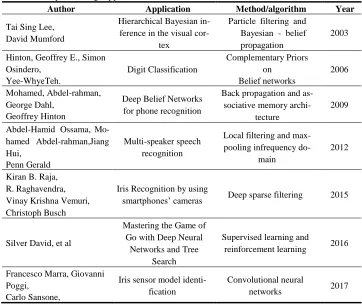
Table 1 summarizes several applications carried out throughout previous years regard- ing deep learning. Mostly, speech recognition and image processing are mentioned. This review only considers a few from the large list of applications.
Table 1. Deep Learning Applications, 2003 - 2017.
Author Application Method/algorithm Year
Tai Sing Lee, David Mumford
Hierarchical Bayesian in- ference in the visual cor-
tex
Particle filtering and Bayesian - belief propagation
2003
Hinton, Geoffrey E., Simon Osindero,
Yee-WhyeTeh.
Digit Classification
Complementary Priors on
Belief networks
2006
Mohamed, Abdel-rahman, George Dahl,
Geoffrey Hinton
Deep Belief Networks for phone recognition
Back propagation and as- sociative memory archi-
tecture
2009
Abdel-Hamid Ossama, Mo- hamed Abdel-rahman,Jiang Hui,
Penn Gerald
Multi-speaker speech recognition
Local filtering and max- pooling infrequency do-
main
2012
Kiran B. Raja, R. Raghavendra, Vinay Krishna Vemuri, Christoph Busch
Iris Recognition by using
smartphones’ cameras Deep sparse filtering 2015
Silver David, et al
Mastering the Game of Go with Deep Neural
Networks and Tree Search
Supervised learning and
reinforcement learning 2016
Francesco Marra, Giovanni Poggi,
Carlo Sansone,
Iris sensor model identi- fication
Convolutional neural
Luisa Verdoliva
4.1 Publication analysis per year
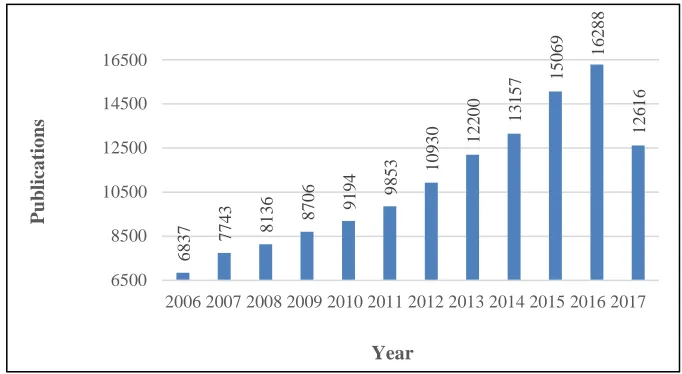
Fig. 1 details the number of deep learning publications from ScienceDirect database per year from 2006 till June 2017. Clearly, there is a progressive increment of publications that could describe an exponential growth.
Fig. 2 presents the total number of Springer’s deep learning publications per year from Jan 2006 till Jun 2017. In 2016, there is a sudden increment of publications, reach- ing up to 706 publications, which proves that deep learning is truly a contemporaneous area of interest for researchers.
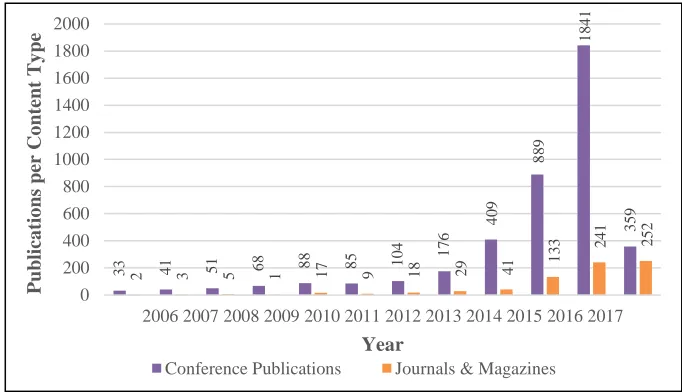
Fig. 3 shows the IEEE Digital Library’s number of conference publications and jour- nals & magazines from Jan 2006 till the Jun 2017. It is noticeable that since 2015 the number of publications has dramatically increased. The difference between 2016 and 2015 is even more than 200% of increment.
Fig. 1. Growth of the number of publications in Deep Learning, Sciencedirect database (Jan
2006-Jun 2017) 16500
14500
12500
10500
8500
6500
2006 2007 2008 2009 2010 2011 2012 2013 2014 2015 2016 2017
Year
P
ub
lica
tio
ns
6
8
3
7 774
3
8
1
3
6
8
7
0
6
9
1
9
4
9
8
5
3 109
3
0 122
0
0
1
3
1
5
7 15
0
6
9
1
6
2
8
8
1
2
6
1
2000 1800 1600 1400 1200 1000 800 600 400 200 0
2006 2007 2008 2009 2010 2011 2012 2013 2014 2015 2016 2017
Year
Conference Publications Journals & Magazines
Fig. 2. Growth of the number of publications in Deep Learning from Springer database. (Jan
2006-Jun 2017)
Fig. 3. Growth of publications in Deep Learning from IEEE database. (Jan 2006-Jun 2017)
5
Conclusions
Deep learning is indeed a fast growing application of machine learning. The numerous applications described above prove its rapid development in just few years. The usage of these algorithms in different fields shows its versatility. The publication analysis
900 800 700 600 500 400 300 200 100 0
2006 2007 2008 2009 2010 2011 2012 2013 2014 2015 2016 2017
Year P ub lica tio ns per Co nte nt T y pe P ub lica tio ns
33 2 41 3 51 5 68
1 88 17 85 9 1
0 4 18 1 7 6 29
39 49 54 73 62 77 116 129
4 0 9 149 41 8 8 9 266 1 3 3 1 8 4 1 706 2 4
1 35
9
2
5
2
performed in this study clearly demonstrates the relevance of this technology and gives a clearly illustrates the growth of deep learning and the tendency regarding for future research in this field.
Additionally, it is important to note that hierarchy of layers and the supervision in learning are key factors to develop a successful application regarding deep learning. Hierarchy is essential for appropriate data classification, whereas supervision considers the importance of the database itself to be part of the process. The main value of deep learning relies on the optimization of existing applications in machine learning, due to its innovativeness on hierarchical layer processing. Deep learning can deliver effective results on digital image processing and speech recognition. The reduction on error per- centage (10 to 20 %) clearly corroborates the improvement compared with existing and tested methods.
During the current era and in a future, deep learning can result into a useful security tool due to the facial recognition and speech recognition combined. Besides this, digital image processing is a research field that can be applied in multiple areas. For this reason and having proved a true optimization, deep learning is a contemporary and exciting subject of advancement in artificial intelligence.
References
1. Abdel, O.: Applying convolutional neural networks concepts to hybrid NN-HMM model for speech recognition. Acoustics, Speech and Signal Processing 7, 4277-4280 (2012). 2. Mosavi A., Varkonyi-Koczy A. R.: Integration of Machine Learning and Optimization for
Robot Learning. Advances in Intelligent Systems and Computing 519, 349-355 (2017). 3. Bannister, A.: Biometrics and AI: how FaceSentinel evolves 13 times faster thanks to deep
learning (2016).
4. Bengio, Y.: Learning deep architectures for AI. Foundations and trends in Machine Learning 2, 1-127 (2009).
5. Mosavi, A., Varkonyi-Koczy, A. R., Fullsack, M.: Combination of Machine Learning and Optimization for Automated Decision-Making. MCDM (2015).
6. Deng L, Yu D Deep learning: methods and applications. Foundations and Trends® in Signal Processing 7, 197-387 (2014)
7. Goel, B.: Developments in The Field of Natural Language Processing. International Journal of Advanced Research in Computer Science 8, (2017).
8. Vaezipour, A.: Mosavi, A. Seigerroth, U.: Machine learning integrated optimization for de- cision making, 26th Europian Conference on Operational Research, Rome (2013). 9. Hinton G E, Simon O, Yee-Whye T A fast learning algorithm for deep belief nets. Neural
computation 18, 1527-1554 (2006)
10. Hisham, A., Harin, S.: Deep Learning – the new kid in Artificial Intelligence. (2017) 11. Kim I W, Oh, M.: Deep learning: from chemoinformatics to precision medicine. Journal of
Pharmaceutical Investigation: 1-7 (2017)
13. Mosavi A., Y., Bathla, Varkonyi-Koczy A. R.: Predicting the Future Using Web
Knowledge: State of the Art Survey Advances in Intelligent Systems and Computing (2017). 14. Mosavi, A., Vaezipour, A.: Reactive Search Optimization; Application to Multiobjective
Optimization Problems. Applied Mathematics 3, 1572-1582 (2012)
15. Lee J-G (2017) Deep Learning in Medical Imaging: General Overview. Korean Journal of Radiology 18(4):570-584
16. Lee T.: David M Hierarchical Bayesian inference in the visual cortex. JOSA 20, 1434-1448 (2003).
17. Liu W Deep learning hashing for mobile visual search. EURASIP Journal on Image and Video Processing 17, (2017).
18. Marra F.: A Deep Learning Approach for Iris Sensor Model Identification. Pattern Recog- nition Letters (2017).
19. Miotto R et al (2017) Deep learning for healthcare: review, opportunities and challenges. Briefings in Bioinformatics
20. Mohamed A.: Deep belief networks for phone recognition. Nips workshop on deep learning for speech recognition and related applications: 1, 635-645 (2009).
21. Moor. J.: The Turing test: the elusive standard of artificial intelligence. Springer Science & Business Media (2003).
22. Vaezipour, A. Mosavi, U. Seigerroth, A.: Visual analytics and informed decisions in health and life sciences, International CAE Conference, Verona, Italy (2013)
23. Raja K B, Raghavendra R, Vemuri V K, Busch C (2015) Smartphone based visible iris recognition using deep sparse filtering. Pattern Recognition Letters 57:33-42.
24. Safdar S, Zafar S, Zafar N, Khan N F (2017) Machine learning based decision support sys- tems (DSS) for heart disease diagnosis: a review. Artificial Intelligence Review: 1-17 25. Mosavi, A. Varkonyi. A.: Learning in Robotics. Learning 157, (2017)
26. Xing J, Li K, Hu W, Yuan C, Ling H et al (2017) Diagnosing deep learning models for high accuracy age estimation from a single image. Pattern Recognition
27. Mosavi, A. Rabczuk, T.: Learning and Intelligent Optimization for Computational Materials Design Innovation, Learning and Intelligent Optimization, Springer-Verlag, (2017) 28. Vaezipour, A., et al., Visual analytics for informed-decisions, International CAE Confer-
ence, Verona, Italy, (2013).
29. Dehghan, A.: DAGER: Deep Age, Gender and Emotion Recognition Using Convolutional Neural Network3, 735-748 (2017)
30. Mosavi, A: predictive decision model, 2015, https://doi.org/10.13140/RG.2.2.21094.630472 31. Vaezipour, A., et al.: Visual analytics and informed decisions in health and life sciences."
Paper in Proceedings of International CAE Conference, Verona, Italy. (2013).
32. Vaezipour, A.: Visual analytics for informed-decisions, CAE Conference, Italy, (2013). 33. A.Vaezipour, A.:Machine learning integrated optimization for decision making. 26th Euro-
pean Conference on Operational Research, Rome (2013).
34. Vaezipour, A.: Visual Analytics for Multi-Criteria Decision Analysis, in Proceedings of In- ternational CAE Conference, Verona, Italy (2013).
35. Mosavi, A., Vaezipour, A.: Developing Effective Tools for Predictive Analytics and In- formed Decisions. Technical Report. (2013). https://doi.org/10.13140/RG.2.2.23902.84800 36. Mosavi A., Varkonyi-Koczy A. R.: Integration of Machine Learning and Optimization for
38. Mosavi, A.: Decision-making software architecture; the visualization and data mining as- sisted approach. International Journal of Information and Computer Science 3, 12-26 (2014). 39. Mosavi, A.: The large scale system of multiple criteria decision making; pre-processing,
Large Scale Complex Systems Theory and Applications 9, 354-359 (2010).
40. Esmaeili, M., Mosavi, A.: Variable reduction for multiobjective optimization using data mining techniques. Computer Engineering and Technology 5, 325-333 (2010)
41. Mosavi, A.: Data mining for decision making in engineering optimal design. Journal of AI and Data Mining 2, 7-14 (2014).
42. Mosavi, A., Vaezipour, A.: Visual Analytics, Obuda University, Budapest, (2015). 43. Mosavi, A., Vaezipour, A.: Reactive Search Optimization; Application to Multiobjective
Optimization Problems. Applied Mathematics 3, 1572-1582 (2012).
44. Mosavi, A., Varkonyi-Koczy, A. R., Fullsack, M.: Combination of Machine Learning and Optimization for Automated Decision-Making. MCDM (2015).
45. Mosavi, A., Delavar, A.: Business Modeling, Obuda University, Budapest, (2016). 46. Mosavi, A.: Application of data mining in multiobjective optimization problems. Interna-
tional Journal for Simulation and Multidisciplinary Design Optimization, 5, (2014) 47. Mosavi, A. Rabczuk, T.: Learning and Intelligent Optimization for Material Design Innova-
tion, Theoretical Computer Science and General Issues, LION11 (2017). 48. Mosavi, A., Visual Analytics, Obuda University, 2016.
49. Mosavi, A.: Predictive decision making, Tech Rep 2015. doi: 10.13140/RG.2.2.16061.46561 50. Mosavi. A.: Predictive Decision Making, Predictive Decision Model, Tech. Report. (2015).
https://doi.org/10.13140/RG.2.2.21094.63047
51. Mosavi, A., Lopez, A.: Varkonyi-Koczy, A.: Industrial Applications of Big Data: State of the Art Survey, Advances in Intelligent Systems and Computing, (2017).
52. Mosavi, A., Rabczuk, T., Varkonyi-Koczy, A.: Reviewing the Novel Machine Learning Tools for Materials Design, Advances in Intelligent Systems and Computing, (2017). 53. Mousavi, S., Mosavi, A., Varkonyi-Koczy, A. R.: A load balancing algorithm for resource
allocation in cloud computing, Advances in Intelligent Systems and Computing, (2017). 54. Baranyai, M., Mosavi, A., Vajda, I., Varkonyi-Koczy, A. R.: Optimal Design of Electrical
Machines: State of the Art Survey, Advances in Intelligent Systems and Computing, (2017). 55. Mosavi, A., Benkreif, R., Varkonyi-Koczy, A.: Comparison of Euler-Bernoulli and Timo- shenko Beam Equations for Railway System Dynamics, Advances in Intelligent Systems and Computing, (2017).
56. Mosavi, A., Rituraj, R., Varkonyi-Koczy, A. R.: Reviewing the Multiobjective Optimization Package of modeFrontier in Energy Sector, Advances in Intelligent Systems and Computing, (2017).
57. Mosavi, A., Bathla, Y., Varkonyi-Koczy A. R.: Predicting the Future Using Web Knowledge: State of the Art Survey, Advances in Intelligent Systems and Computing, (2017).
![Fig. 1. Research in artificial intelligence (AI) Source: [1].](https://thumb-us.123doks.com/thumbv2/123dok_us/7932011.1317063/2.596.168.455.301.499/fig-research-artificial-intelligence-ai-source.webp)