On the Security of Two-Round Multi-Signatures
Manu Drijvers1,2, Kasra Edalatnejad3, Bryan Ford3, Eike Kiltz4, Julian Loss4, Gregory Neven1, and Igors Stepanovs5
1
DFINITY
2 ETH Zurich 3
EPFL
4 Ruhr-University Bochum 5
UCSD
Abstract. A multi-signature scheme allows a group of signers to collaboratively sign a message, cre-ating a single signature that convinces a verifier that every individual signer approved the message. The increased interest in technologies to decentralize trust has triggered the proposal of highly efficient two-round Schnorr-based multi-signature schemes designed to scale up to thousands of signers, namely
BCJby Bagherzandi et al. (CCS 2008),MWLDby Ma et al. (DCC 2010),CoSi by Syta et al. (S&P 2016), andMuSigby Maxwell et al. (ePrint 2018). In this work, we point out serious security issues in all currently known two-round multi-signature schemes (without pairings). First, we prove that none of the schemes can be proved secure without radically departing from currently known techniques. Namely, we show that if the one-more discrete-logarithm problem is hard, then no algebraic reduction exists that proves any of these schemes secure under the discrete-logarithm or one-more discrete-logarithm problem. We point out subtle flaws in the published security proofs of the above schemes (exceptCoSi, which was not proved secure) to clarify the contradiction between our result and the existing proofs. Next, we describe practical sub-exponential attacks on all schemes, providing further evidence to their insecurity. Being left without two-round multi-signature schemes, we presentmBCJ, a variant of the
BCJscheme that we prove secure under the discrete-logarithm assumption in the random-oracle model. Our experiments show thatmBCJbarely affects scalability compared toCoSi, allowing 16384 signers to collaboratively sign a message in about 2 seconds, making it a highly practical and provably secure alternative for large-scale deployments.
1
Introduction
A multi-signature scheme allows a group of signers, each having their own key pair (pki,ski), to collabo-ratively sign a single message m. The result is a single signature σ that can be verified using the set of public keys{pk1, . . . ,pkn}, assuring a verifier that every signer approved messagem. While multi-signature schemes have been studied for decades [IN83,OO93,MOR01,Bol03,LOS+06,BN06,BCJ08,MWLD10], they have recently received renewed interest because of the rise of distributed applications that aim to decentral-ize trust such as Bitcoin [Nak08] and more generally blockchain. Such applications typically involve many users or nodes that need to approve particular actions, which naturally matches the multi-signature setting where many signers must collaborate in order to create a joint multi-signature.
Motivated by such applications, Syta et al. [STV+16] presented theCoSimulti-signature scheme, a highly scalable multi-signature scheme that allows a tree of 8192 signers to sign in less than two seconds. Since its recent introduction,CoSihas already led to a large body of follow-up work, including a distributed protocol to create secure randomness [SJKK+17], improving the scalability of Bitcoin [SJKK+17], and introducing a decentralized software update framework [NKJ+17].
Scheme KVf KAg Sign Vf Roundspk domain Signature domain
PK
domain Security
BCJ1 [BCJ08] 1G2 1G2+ 1G33G2 2 G×Z2q G2×Z3q G Insecure
BCJ2 [BCJ08] 1G+ 2G2 1Gn+1+ 2G22 G G3×Z3q G Insecure
MWLD [MWLD10] 1G2 1Gn+2 2 G Z3q Gn Insecure
CoSi[STV+16] 1
G2 1G 1G2 2 G×Z2q Z2q G Insecure
MuSig[MPSW18a] 1Gn 1G 1G2 2 G G×Zq G Insecure
mBCJ(this work) 1G2 1G2+ 1G33G2 2 G×Z2q G2×Z3q G DL, ROM
BN [BN06] 1G 1Gn+1 3 G G×Zq Gn DL, ROM BDN-MSDL[BDN18,MPSW18b] 1Gn 1G 1G2 3 G G×Zq G DL, ROM
B-Pop [Bol03,RY07] 2P 1G1 2P 1 G1×G2 G1 G2 co-CDH, ROM
WM-Pop [LOS+06,RY07] 2P 1
G1+ 1G22P 1 G1×G2×GTG1×G2 GT co-CDH
BDN-MSP[BDN18] 1Gn2 1G1 2P 1 G2 G1 G2 co-CDH, ROM
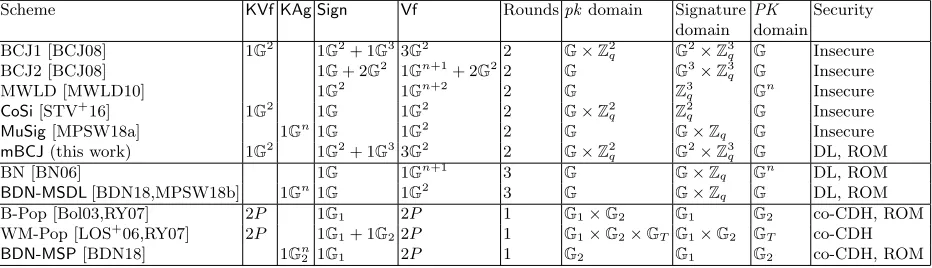
Table 1. Efficiency of multi-signatures in the key verification model. The first block of schemes depicts all known two-round multi-signature schemes without pairings. For completeness, we also include existing three-round schemes as well as non-interactive pairing-based schemes in the second and third blocks. Columns 2–5 show the computational efficiency of the individual algorithms by counting the number of (multi-)exponentiations and pairings, where “G”
denotes an exponentiation in group G, “Gk” denotes an k-multi-exponentiation in group
G, “P” denotes a pairing
operation, andndenotes the number of signers. Column 6 shows the number of communication rounds and columns 7– 9 show the size of the individual signer’s public key, the signature, and the aggregated public key, respectively, where any “proof-of-possession” of the secret key is considered to be part of the public key, andq denotes the order of the groups. Column 10 shows the assumptions under which the scheme is proved secure, if any, where “ROM” indicates a proof in the random-oracle model.
One of the main problems when designing provably secure Schnorr-based multi-signature schemes is that in order to simulate the honest signer, the reduction cannot simply use the zero-knowledge property and pro-gram the random oracle, because the random-oracle entry that must be propro-grammed depends on the output of the adversarial signers. Bellare and Neven [BN06] got around this issue by introducing a preliminary round in the signing protocol where signers exchange commitments to their first rounds. Bagherzandi et al.’sBCJ scheme [BCJ08] eliminated the need for this extra round by using homomorphic trapdoor commitments, while Ma et al.’sMWLDscheme [MWLD10] simulates signatures by exploiting the witness-indistinguishability of Okamoto signatures [Oka93].
Impossibility result.Our first result essentially shows that none of the existing two-round schemes can be proved secure under standard assumptions. More precisely, we prove that if the one-more discrete logarithm problem (OMDL) is hard, then there cannot exist an algebraic black-box reduction that proves the CoSi, MuSig,BCJ, orMWLD schemes secure under the discrete logarithm (DL) or OMDL assumption.
This is surprising, because all of these schemes, barringCoSi, were published with a security proof under the DL (BCJ,MWLD) or OMDL (MuSig) assumption. We explain the obvious contradiction by pointing out subtle flaws in their proofs. The problem is that simulating signing queries in combination with a rewinding argument (so-calledforking [PS00]) is especially delicate, because the forger may be forked at a point where it has an “open” signing query. If that is the case, the reduction has to come up with a second response for the same first round of the signing protocol, which leaks the signing key that it was hoping to extract from the forger. The actual impossibility proof is a bit more involved, but it exploits exactly this difficulty in simulating signing queries.
Sub-exponential attacks.If the above impossibility result still leaves a glimmer of hope that the existing schemes might be safe for practical use, our second result clearly indicates that this is not the case. Namely, we provide attacks that apply to all schemes based on Wagner’s algorithm for the generalized birthday problem [Wag02]. Because the attacks run in sub-exponential time, but not in polynomial time, they don’t supersede our impossibility result, but for reasonable parameter choices they are efficient enough to form a realistic threat. We show that an attacker performing`−1 concurrent signing queries can create a forgery in
O(`·2lgq/(1+lg`)) time and space, whereqis the order of the group. For practical values such as lgq= 256, this means that even for 15 concurrent signing queries, a forgery can be computed in 262 steps, which is feasible on modern clusters. For 127 concurrent queries, one can compute a forgery in less than 245 steps. We describe our attacks forCoSi, but they also extend toMuSig, BCJ, and MWLD, as well as to important applications ofCoSisuch as theRandHound scheme from [SJKK+17]. While asymptotically speaking these attacks can be thwarted by increasing the group order, doing so will render the schemes impractical, and even then provable security remains an elusive goal due to our impossibility result.
A secure two-round multi-signature scheme. Our negative results apply to all known two-round multi-signature schemes without pairings. There are pairing-based non-interactive multi-multi-signature schemes from BLS signatures [BLS01,Bol03,RY07,BDN18] and from Waters signatures [Wat05,LOS+06], but one may wonder whether secure two-round multi-signatures without pairings exist at all. We answer this question in the positive by presentingmBCJ, a variant of theBCJscheme that uses the same homomorphic commitment scheme to let signers commit to their first rounds as theBCJscheme, but lets the commitment parameters be determined by the output of a random oracle applied to the message being signed. We provide a rigorous security proof of themBCJscheme under the DL assumption in the random-oracle model.
Table 1 summarizes the efficiency and security of multi-signature schemes. Our mBCJ scheme is the only secure two-round multi-signature scheme. Even though it is less efficient in terms of signature size and verification time than some of its (insecure) precedents, it does have the advantage of supporting key aggregation. For applications that involve large numbers of signers, it is crucial that verification time can be kept constant (i.e., independent of the number of signers) by verifying against a constant-size aggregate public key. The verifier computes the aggregate public key once from the set of individual public keys to have (amortized) constant-time verification afterwards.
One may wonder what the cost is of provable security by comparing themBCJscheme against the highly efficientCoSischeme. To investigate the real-world effects of this difference, we performed large-scale exper-iments on prototype implementations of both schemes. For a network round-trip delay of 200 milliseconds, we found that a group as large as 16,384 signers can collaboratively sign a message using mBCJ in about 2 seconds, showing no significant difference withCoSi. ThemBCJscheme on average needs 73% more CPU time than CoSifor small amounts of signers. For large amounts of signers the difference becomes smaller, and the average CPU time per signer remains under 0.25 milliseconds when signing with 16,384 signers. Our results show thatmBCJis only marginally less efficient thanCoSi, so that any protocol based on the insecure CoSischeme should instead be built on the provably securemBCJscheme.
Restricted security of CoSi.Our impossibility proof and attacks on CoSicrucially rely on the adversary being able to engage in concurrent queries with the signing oracle. A natural question to ask is whether CoSicould still be secure when the adversary is limited to sequential signing queries. We show that this is indeed the case, but only in the weaker knowledge of secret key (KOSK) model. More specifically, we prove CoSisecure against sequential attacks (or even logarithmically many concurrent attacks) under the OMDL assumption in the KOSK setting in the random-oracle model. Hence, one could still consider usingCoSi in very specific scenarios where the KOSK setting can be considered reasonable and where one can naturally limit the number of parallel signing sessions to a small constant.
key, then the key computed from the outputs of the adversary must be independent from the simulator’s choice as well. This is not correct, because an adversary could base its output on signing oracle responses to cause the reduction to extract the key that it already knows. We are very grateful to an anonymous referee for catching this mistake.
This version adds sub-exponential attacks on all currently known two-round multi-signature schemes in Section 4, pointing out the danger of using these schemes in the real world. It also adds the new mBCJ scheme and the restricted security proof of CoSi in Section 6.
2
Preliminaries
2.1 Discrete Logarithm Problems
Definition 1 (Discrete Log Problem). For a group G = hgi of prime order q, we define AdvdlG of an adversaryAas
Prhy=gx:y←$
G, x←$ A(y) i
,
where the probability is taken over the random choices of A and the random selection of y. A (τ, )-breaks the discrete log problem if it runs in time at mostτ and has AdvdlG≥. Discrete log is(τ, )-hard if no such adversary exists.
Definition 2 (n-One-More Discrete Log Problem [BNPS03,BP02]). For a groupG=hgi of prime orderq, let Odlog(·)be a discrete logarithm oracle that can be called at mostntimes. We defineAdvn-omdl
G of an adversaryA as
Prh n ^
i=0
yi=gxi: (y0, . . . , yn)←$ Gn+1,(x0, . . . , xn)←$ AO dlog(·)
(y0, . . . , yn) i
,
where the probability is taken over the random choices ofAand the random selection of y0, . . . , yn.A(τ, )-breaks the n-one-more discrete log problem if it runs in time at most τ and hasAdvnG-omdl ≥.n-one-more discrete log is (τ, )-hard if no such adversary exists.
2.2 Algebraic Algorithms
Boneh and Venkatesan [BV98] definealgebraic algorithms to study the relation between breaking RSA and factoring. An algorithm working in some group is algebraic if it only uses the group operations to construct group elements. More precisely, it can test equality of two group elements, perform the group operation on two elements to obtain a new element, and invert a group element. This means that an algebraic algorithm that receives group elementsy1, . . . , yn as input can only construct new group elementsyfor which it knows
α1, . . . , αn such thaty=Qni=1yiαi.
We use the formalization by Paillier and Vergnaud [PV05]:
Definition 3. An algorithmAthat on input group elements(y1, . . . , yn)isalgebraicif it admits a polynomial time algorithm Extract that given the code of A and its random tape outputs (α1, . . . , αn) such that h = Qn
i=1y αi
i for any group elemenththat Aoutputs.
2.3 Generalized Forking Lemma
The original forking lemma was formulated by Pointcheval and Stern [PS00] to analyze the security of Schnorr signatures [Sch91]. The lemma rewinds a forgerAagainst the Schnorr signature scheme in the random-oracle model (ROM) to a “crucial” random-oracle query (typically, the query involved in a forgery) and runs A
non-negligible success probability in a single run, then the forking algorithm will generate two successful executions with non-negligible probability.
Bellare and Neven [BN06] generalized the forking lemma to apply to any algorithmAin the random-oracle model using a single rewinding, while Bagherzandi, Cheon, and Jarecki [BCJ08] generalized the lemma even further to multiple subsequent rewindings on multiple crucial queries. We recall here a slight modification of the latter version.
Let A be an algorithm that is given an input in as well as randomness f = (ρ, h1, . . . , hqH), where ρ is A’s random tape and h1, . . . , hqH are random values fromZq. Let Ω be the space of all such vectors f and letf|i= (ρ, h1, . . . , hi−1). We consider an execution of Aon inputin and randomnessf with access to oracle O, denoted AO(in, f), assuccessful if it outputs a tuple (J,{out
j}j∈J,aux), whereJ is a multi-set that is a non-empty subset of{1, . . . , qH},{outj}j∈J is a multi-set of side outputs, and aux is an additional set of auxiliary outputs. We say thatAfailed if it outputs J =∅. Let be the probability thatA(in, f) is successful for fresh randomnessf ←$ Ω and for an inputin←$ IGgenerated by an input generatorIG.
For a given input in, the generalized forking algorithmGFAis defined as follows:
GFA(in):
f = (ρ, h1, . . . , hqH)←
$ Ω
(J,{outj}j∈J,aux)← AO(in, f) IfJ =∅ then outputfail
Aux ←aux
LetJ ={j1, . . . , jn} such thatj1≤. . .≤jn Fori= 1, . . . , ndo
succi←0 ; ki←0 ; kmax←8nqH/·ln(8n/) Repeat untilsucci= 1 orki> kmax
f00←$ Ωsuch thatf00|
ji =f|ji
Letf00= (ρ, h1, . . . , hji−1, h
00
ji, . . . , h
00
qH) (J00,{out00j}j∈J00,aux)← AO(in, f00)
Aux←Aux∪aux Ifh00j
i 6=hji andJ
006=∅andj
i∈J00then out0ji←out00ji ; succi←1
Ifsucci= 1 for alli= 1, . . . , n
Then output (J,{outj}j∈J,{out0j}j∈J,Aux) Else outputfail
We say that GFA succeeds if it doesn’t output fail. The main difference to Bagherzandi et al.’s forking
lemma [BCJ08] isA’s access to the oracleO and the additional auxiliary outputaux that gets accumulated in Aux over all runs of A, including failed runs. If the oracle O is deterministic, meaning that it always answers the same query with the same response, it is easy to see that these extensions do not impact the bounds of their forking lemma, so the following statement continues to hold.
Lemma 1 (Generalized Forking Lemma [BCJ08]). Let IG be a randomized algorithm and A be a randomized algorithm running in timeτ with access to a deterministic oracleOthat succeeds with probability
. If q >8nqH/, then GFA(in)runs in time at most τ·8n2qH/·ln(8n/) and succeeds with probability at least/8, where the probability is over the choice of in ←$ IG and over the coins ofGF
A.
2.4 Security of Multi-Signatures
every cosigner is a direct child of the initiator. Moreover, we formalize the notion of an “aggregated key” of a group of signers, by adding an algorithm that computes a single aggregated public key from a set of public keys, and this aggregated key will be used by the verification algorithm. The idea of splitting key aggregation from verification is that if a group of signers will repeatedly sign together, a verifier will only once compute the aggregate public key and reuse that for later verifications. If the aggregated key is smaller than the set of public keys, or even constant size, this will allow for more efficient schemes. Note that this change does not exclude multi-signature schemes that do not have this feature: indeed, such schemes can simply use the identity function as key aggregation algorithm.
A multi-signature scheme consists of algorithmsPg,Kg,Sign,KAg,KVf, andVf. A trusted party generates the system parameters par ← Pg. Every signer generates a key pair (pk,sk)←$ Kg(par), and signers can
collectively sign a messagemby each calling the interactive algorithmSign(par,sk,T, m), whereT describes a tree between the signers that defines the intended communication between the signers. At the end of the protocol, the root of the treeT obtains a signatureσ. AlgorithmKAgon input parameterspar and a set of public keysPKoutputs a single aggregate public keyPK. A verifier can check the validity of a signatureσon messagemunder an aggregate public keyPK by runningVf(par,PK, m, σ) which outputs 0 or 1 indicating that the signatures is invalid or valid, respectively. Anybody can check the validity of a public key by using key verification algorithmKVf(par,pk).
First, a multi-signature scheme should satisfy completeness, meaning that 1) for any par ← Pg and any (pk,sk) ← Kg(par), we have KVf(par,pk) = 1, and 2) for any n, if we have (pki,ski) ← Kg(par) for i = 1, . . . , n, and any tree T containing exactly these n signers, and for any message m, if all sign-ers input Sign(par,ski,T, m), then the root of T will output a signature σ such that Vf(par,KAg(par,
{pki}n
i=1), m, σ) = 1.
Second, a multi-signature scheme should satisfy unforgeability. Unforgeability of a multi-signature scheme MS= (Pg,Kg,Sign,KAg,Vf,KVf) is defined by a three-stage game.
Setup. The challenger generates the parameterspar ←Pgand a challenge key pair (pk∗,sk∗)←$ Kg(par). It
runs the adversary on the public keyA(par,pk∗).
Signature queries. Ais allowed to make signature queries on a message m with a treeT, meaning that it has access to oracleOSign(par,sk∗,·,·)that will simulate the honest signer interacting in a signing protocol to sign messagem with intended communication tree T. Note thatAmay make any number of such queries concurrently.
Output. Finally, the adversary halts by outputting a multi-signature forgery σ, a message m and a set of public keysPK. In the key-verification setting, the adversary wins if pk∗∈ PK,KVf(par,pk) = 1 for every pk∈ PKwithpk 6=pk∗,PK ←KAg(par,PK),Vf(par,PK, σ, m) = 1, andAmade no signing queries onm. A special case of the key-verification model is the plain public key model, where there is no need to verify individual public keys, i.e., KVf always returns 1.6 In the weaker knowledge-of-secret-key (KOSK) setting, the adversary is required to additionally output corresponding secret keysskpk for allpk∈ PK,pk6=pk∗.
Definition 4. We sayAis a(τ, qS, qC, qH, )-forger for multi-signature schemeMS= (Pg,Kg,Sign,Vf)if it runs in timeτ, makes qS signing queries such that at mostqCsigning protocols are concurrently active (i.e., started but not yet finished) at any given time, makes qH random oracle queries, and wins the above game with probability at least.MS is(τ, qS, qC, qH, )-unforgeable if no(τ, qS, qC, qH, )-forger exists.
2.5 The CoSi Multi-Signature Scheme
CoSi is a multi-signature scheme introduced by Syta et al. [STV+16] that follows a long line of work on Schnorr-based multi-signatures [MOR01,BN06,RY07,BCJ08,MWLD10]. With a two-round signing protocol
6
ChildrenCi SignerSi ParentPi
m
m
{(PKj, tj)}j∈Ci -r←
$ Zq
ti←grQj∈Citj PKi←yiQj∈CiPKj
(ti,PKi)
-(¯t,PK)
c←H0(¯t, m) (¯t,PK)
{sj}j∈Ci
-si←r+cski
+P
j∈Cisj modq
si
-Fig. 1.TheCoSisigning protocol for signerSi with secret keyski and public keypk = (yi, πi). IfSi is the leader
then, instead of sending (ti,PKi) to its parent, it sends (¯t,PK) = (ti,PKi) to its children, and instead of sendingsi
to its parent, it outputs (c, s) = (c, si) as the signature.
and verification as efficient as verifying a single Schnorr signature,CoSiis more efficient than prior schemes, but it was proposed without a formal security proof. By organizing signers in a tree structure, thousands of signers can create a multi-signature in seconds, as demonstrated by the open source implementation.7 CoSi has already led to a large body of follow-up work [KJG+16,SJKK+17,BKJ+17,NKJ+17,KKJG+18] since its recent introduction.
Below, we describe a slight variant of the originalCoSischeme where we add a proof of possession to the public key, and where during signing the cosigners receive the final commitment value ¯t instead of just the hashc=H(¯t, m). The first change was already suggested in the original paper, the latter is necessary because the scheme is insecure without it, since signers are unable to ensure that they are signing the message that they intended to sign.
Parameters generation. ThePgalgorithm sets up a groupG=hgiof order q, whereqis aκ-bit prime. It also chooses two hash functionsH0,H1:{0,1}∗Zq. Outputpar ←(G, g, q,H0,H1).
Key generation.The key generation algorithmKg(par) samplessk ←$
Zq and computesy←gsk. It then generates a proof of possession π = (c, s) by choosing r ←$
Zq and computing s ← r+H1(gr, y). Output pk←(y, π) andsk.
Signing.Signing is a four-step protocol. A signerSi on inputSign(par,ski, m,T) behaves as follows. Announcement.IfSiis the leader (i.e., the root of treeT), it initiates the protocol by sending an announce-ment to its children, which consists of a unique identifier for this signing sessionssid. IfSiis not the leader, it waits to receive an announcement message and forwards it to its children inT. After doing so,Siproceeds with the commitment phase.
Commitment. Let Ci denote the set of children ofSi in tree T. Si waits to receive all values (tj,PKj) for
j ∈ Ci. Note that if Si has no children (i.e., it is a leaf in tree T), it will proceed immediately. Si chooses
ri←$ Zq and computesti←gri·Qj∈Citj andPKi←yi·Qj∈CiPKjforpki = (yi, πi). IfSi is not the leader, it sendsti to its parent. IfSi is the leader,Si proceeds with the challenge phase.
Challenge.If Si is the leader, it sets ¯t←ti andPK ←PKi, computes c←H0(¯t, m), and sends (¯t,PK) to its children. IfSi is not the leader, it waits to receive a message (¯t,PK), computesc←H0(¯t, m), and sends (¯t,PK) to its children.
Response.Si waits to receive all valuessj forj ∈ Ci (note that if Si is a leaf it will proceed immediately), and then computessi←ri+c·ski+Pj∈Cisj. It sendssi to its parent, unlessSi is the root, then Si sets
s←si and outputsσ←(c, s).
Key Aggregation. On input a set of public keys PK, KAg checks for all (y,(c, s)) ∈ PK that c = H1(gsy−c, y). If so, it outputs aggregate public keyPK ←Q(y,π)∈PKy.
Verification.Vfon input an aggregate public keyPK, a signatureσ= (c, s), and a messagem, checks that
c=? H0 gs·PK−c, m
.
7
2.6 The BCJ Multi-Signature Schemes
Whereas Bellare and Neven [BN06] solved the problem of signature simulation in the security proof by letting all signers commit to their contribution in a preliminary round of the signing protocol, theBCJscheme due to Bagherzandi et al. [BCJ08] avoids this extra round by using a multiplicatively homomorphic equivocable commitment scheme. Since the only known instantiation of such a commitment scheme is included in the same paper, we describe theBCJscheme for that instantiation here. We also adapt the scheme to support signers in a tree structure.
Parameters generation.Pgsets up a groupGof orderqwith generators g1,h1,g2, andh2, whereqis a
κ-bit prime. Choose hash functionsH0,H1:{0,1}∗→Zq and outputpar←(G, g1, h1, g2, h2, q,H0,H1). Key generation.The key generation algorithmKg(par) takes sk←$
Zq and setsy←gsk1 . Compute proof-of-posessionπ= (c, s) by takingr←$
Zq,c←H1(y, g1r),s←r+c·sk. Letpk←(y, π) and output (pk,sk).
Signing.Signing is the four-step protocol. A signerSi on inputSign(par,ski, m,T) behaves as follows. Announcement.IfSiis the leader (i.e., the root of treeT), it initiates the protocol by sending an announce-ment to its children, which consists of a unique identifier for this signing sessionssid. IfSiis not the leader, it waits to receive an announcement message and forwards it to its children inT. After doing so,Siproceeds with the commitment phase.
Commitment.LetCi denote the set of children of Si in treeT.Si waits to receive all values (tj,1, tj,2,PKj) forj∈ Ci. Note that ifSi has no children (i.e., it is a leaf in treeT), it will proceed immediately.Si chooses (ri, αi,1, αi,2) ←$ Z3q and computes ti,1 ← g
αi,1
1 h
αi,2
1 ·
Q
j∈Citj,1 and ti,2 ← g
αi,1
2 h
αi,2 2 ·g
ri
1 · Q
j∈Citj,2, and
PKi ←yi·Qj∈CiPKj. IfSi is not the leader, it sends (ti,1, ti,2,PKi) to its parent. IfSi is the leader, Si
proceeds with the challenge phase.
Challenge.IfSiis the leader, it sets ¯t1←ti,1, ¯t2←ti,2, andPK ←PKi. It computesc←H0(¯t1,¯t2,PK, m), and sends (¯t1,¯t2,PK) to its children. If Si is not the leader, it waits to receive a message (¯t1,t¯2,PK), computesc←H0(¯t1,¯t2,PK, m), and sends (¯t1,¯t2,PK) to its children.
Response. Si waits to receive all values (sj, γj,1, γj,2) for j ∈ Ci (note that if Si is a leaf it will proceed immediately), and then computes si ← ri+c·ski+Pj∈Cisj, γi,b ← αi,b+
P
j∈Ciγj,b for b ∈ {1,2}. It
sends (si, γi,1, γi,2) to its parent, unlessSi is the root, thenSi setss←si,γ1←γi,1,γ2←γi,2, and outputs
σ←(¯t1,¯t2, s, γ1, γ2).
Key Aggregation. KAg on input a set of public keys PK parses every pki ∈ PK as (yi,(ci, si)), and if this public key has not been validated before, check thatci =H1(yi, g1siy
−ci
i ). Output aggregate public key PK ←Q
(y,π)∈PKy.
Verification. Vf on input aggregate public key PK, a signature σ = (¯t1,¯t2, s, γ1, γ2), and a message m, computec←H0(¯t1,¯t2,PK, m) and check that ¯t1
? =gγ1
1 h γ2 1 and ¯t2
? =gγ1
2 h γ2 2 g1sPK
−c.
2.7 The MWLD Multi-Signature Scheme
The MWLD scheme due to Ma et al. [MWLD10] addresses the signature simulation problem by using a witness-indistinguishable proof based on Okamoto signatures [Oka93], yielding shorter signatures and more efficient signing than theBCJscheme. We present a slightly modified scheme here to support signers organized in a tree structure.
Parameters generation.Pgsets up a groupGof orderqwith generatorsgandh, whereqis aκ-bit prime. Choose two hash functionsH0,H1:{0,1}∗→Zq and outputpar ←(G, g, h, q).
it waits to receive an announcement message and forwards it to its children inT. After doing so,Siproceeds with the commitment phase.
Commitment. Let Ci denote the set of children of Si in tree T. Si waits to receive all values (tj, Lj) for
j ∈ Ci. Note that if Si has no children (i.e., it is a leaf in tree T), it will proceed immediately. Si chooses (ri,1, ri,2)←$ Z2q and computesti←gri,1hri,2·Qj∈Citj and Li← {pki} ∪(
S
j∈CiLj). IfSi is not the leader,
it sends (ti, Li) to its parent. IfSi is the leader,Si proceeds with the challenge phase.
Challenge.If Si is the leader, it sets ¯t←ti and L←Li, computesc ←H0(¯t, L, m), and sends (¯t, L) to its children. If Si is not the leader, it waits to receive a message (¯t, L), computes c ←H0(¯t, L, m), and sends (¯t, L) to its children. Response.Si waits to receive all values (sj,1, sj,2) for j ∈ Ci (note that if Si is a leaf it will proceed immediately), and then computesvi=H1(c,pki) andsi,b←ri,b+vi·ski,b+Pj∈Cisj,b for
b ∈ {1,2}. It sends (si,1, si,2) to its parent, unless Si is the root, then Si sets s1 ← si,1, s2 ← si,2, and outputsσ←(c, s1, s2).
Key Aggregation.This scheme does not support a compressed public key, i.e.,KAg(par,PK) =PK. Verification.Vfon input a set of public keysPK, a signatureσ= (c, s1, s2), and a messagem, checks that
c=? H0
g
s1hs2· Y pki∈PK
pk−H1(c,pki)
i ,PK, m
.
3
The Security of Two-Round Multi-Signatures using Rewinding
In this section, we analyze the security of existing two-round multi-signature schemes that use rewinding in their security proof. We first look at CoSi and present a metareduction, proving that if the OMDL assumption is hard, there cannot exist an algebraic black-box reduction that proves CoSi secure under the OMDL assumption, making it unlikely that CoSican be proven secure. Then, we show that the same metareduction with small modifications can be applied toMuSig, the MWLD scheme, and the BCJ scheme, showing that all those schemes cannot be proven secure with an algebraic black-box reduction to OMDL if OMDL is hard, and indicating that the presented security proofs for those schemes contain flaws.
3.1 Impossiblity of Proving CoSi Secure
We first provide an intuition behind the impossibility of provingCoSisecure by sketching why common proof techniques for Schnorr signatures fail in the case of CoSi. We then formalize this and use a metareduction toprove that there cannot be a security proof forCoSiin the ROM under the OMDL assumption.
In the classical security proof of Schnorr signatures under the DL assumption [PS00], the reduction feeds its discrete-logarithm challengeyas public keypk=y to the adversary. It uses the zero-knowledge property of the Schnorr protocol to simulate signatures without knowing the secret key. More precisely, the reduction first picks (c, s) at random, then choosestsuch that the verification equationgs=t·pkcholds, and programs the random oracleH(t, m) =c. The reduction then applies the forking lemma to extract two forgeries from the adversary, from which the discrete logarithm ofpk =y can be computed.
The crucial difference between standard Schnorr signatures and CoSi is that in CoSi, the final ¯t-value included in the hash is the product of individualti-values, rather than being determined by a single signer. Therefore, whenever the honest signer is not the leader in the signing query, the adversary learns the final ¯t
valuebefore the simulator does, and can prevent the simulator from programming the random-oracle entry H(¯t, m). One way around this is to prove security under the OMDL assumption [BP02,MPSW18a], so that the simulator can use its discrete-logarithm oracle to simulate signing queries. Namely, the simulator would use its first target point y0 as public key pk = y0 and use target points y1, . . . , yn as values t1, . . . , tn when simulating signing queries. Using the forking lemma, it can extract the discrete logarithm ofpk=y0, and, based on this value and the responses to its previous discrete-logarithm queries, compute the discrete logarithms of the other target points t1, . . . , tn. Overall, the reduction computes the discrete logarithms of
Unfortunately, this intuitive argument conveys a subtle flaw. Namely, the forking lemma may rewind the adversary to a point where it has an “open” signing query, meaning, a signing query where the simulator already output its ti value but did not yet receive the final ¯t value. The problem is that the adversary may choose a different ¯t value in its second execution than it did in its first execution, thereby forcing the simulator to make a second DL query for the same signing query and ruining the simulator’s chances to solve the OMDL problem. Indeed, Maxwell et al. [MPSW18a] overlooked this subtle issue that invalidates their security proof. Note that the same problem does not occur in the proof of Schnorr as an identification scheme [BP02] because the adversary does not have access to an identification oracle during the challenge phase.
So in order to correctly simulate signing queries in a rewinding argument, the reduction must be able to provide correct responses si and s0i for the same valueti but for different challenge valuesc =H(¯t, m) and
c0 =H(¯t0, m). This means, however, that the reduction must already have known the secret key corresponding topk, as it could have computed it itself assk = (si−s0i)/(c−c0) modq. Stronger even, the adversary can give the reduction a taste of its own medicine by forcing the reduction to provide two such responsessi and
s0i, and extract the value ofsk from the reduction!
This sudden turning of the tables, surprising as it may be at first, already hints that the reduction was doomed to fail. Indeed, our proof below exploits this exact technique to build a successful forger: in its first execution, the forger uses the DL oracle to compute a forgery, but in any subsequent rewinding, it will extract the secret key from the reduction and simply create a forgery using the secret key. The meta-reduction thereby ensures that it uses at most one DL oracle query for each of the k “truly different” executions of the forger. By additionally embedding a OMDL target point in its forgery, the meta-reduction reaches a break-even ofkDL oracle queries to invertktarget points. If the reduction succeeds in solving then-OMDL problem given access to this forger, then the meta-reduction can use its solution to solve the (n+k)-OMDL problem.
While this captures the basic idea of our proof, some extensions are needed to make it work for any reduction. For example, one could imagine a reduction using a modified forking technique that makes sure that the same challenge value c = H(¯t, m) is always used across timelines, e.g., by guessing the index of that random-oracle query. To corner such a reduction, our forger makes several signing queries in parallel and chooses one of two challenges at random for each query. When the reduction rewinds the forger, the reduction will with overwhelming probability be forced to respond to a different challenge on at least one of the signing queries, allowing the forger to extract.
Below, we formally prove that if the OMDL assumption holds, then there cannot exist a reduction (with some constraints, as discussed later) that proves the security of CoSi under the OMDL assumption. Our proof roughly follows the techniques of Baldimtsi and Lysyanskaya [BL13] for Schnorr-based blind signature schemes, in the sense that we also present a forger and a meta-reduction that, given a reduction that solves the OMDL problem when given black-box access to a forger, solves the OMDL problem by extracting a discrete logarithm from the reduction. Our proof is different, however, in the sense that we cover a different class of reductions (algebraic black-box reductions, as opposed to “naive random-oracle replay reductions”), and because the multi-signature scheme requires a more complicated forger because challenges used by the signing oracle must be random-oracle outputs, as opposed to arbitrary values in the case of [BL13]. The class of reductions that we exclude is large enough to encompass all currently known proof techniques for this type of schemes, making it extremely unlikely thatCoSiwill ever be proven secure under the DL or OMDL assumption.
Theorem 1. If the (n+k)-OMDL problem is (τ+τext+O(n+k`), −k2/2`)-hard, then there exists no algebraic black-box reductionB that provesCoSito be((2`+ 1)τexp+O(`), `, `,3,1−1/q)-unforgeable in the KOSK setting in the random-oracle model under the assumption that the n-OMDL problem is (τ, )-hard. Here, τext is the running time of Extractas per Definition 3,τexp is the time to perform an exponentiation inG, andk is the amount of times thatBruns Athrough rewinding, and` is a security parameter.
the DL or OMDL assumption, even in the KOSK setting and in the random-oracle model. It thereby also excludes,a fortiori, any security proofs in the key-verification and plain public-key settings or in the standard model.
For concreteness, let us set k = ` = 128, and let us say that we have a forger that breaks CoSi with overwhelming probability using just 257 exponentiations, 128 signature queries, and 3 random-oracle queries. That would indeed be a pretty serious security breach, certainly serious enough to rule out any further use ofCoSiin practice. Yet still, even for such a strong forger, Theorem 1 says that, if the 128-OMDL problem is hard, then there cannot exist a reductionBthat uses this forger to solve the DL problem. More generally, it says that if the (n+ 128)-OMDL problem is hard, then neither can there exist a reduction that solves then-OMDL problem. If such a reduction would exist, then that reduction would immediately give rise to a solution for the (n+ 128)-OMDL problemwithout needing access to any forger, meaning that the OMDL assumption was false to begin with.
The only room left by Theorem 1 are for a number of alternative proof approaches, but none of them look particularly hopeful. First, the theorem becomes moot when the OMDL problem turns out to be easy but the DL problem remains hard, or when the (n+k)-OMDL problem is easy but then-OMDL problem is still hard. At present, however, there is no evidence suggesting that any of these problems may be easier than the others. Second, it does not rule out the existence of non-algebraic or non-black-box reductions. The former type of reduction would imply strange properties of the underlying group. The latter would have to obtain a special advantage from inspecting the code of the forger, rather than just being able to execute it. While some cryptographic uses of non-black-box techniques exist [Bar04], to the best of our knowledge they have never been used in practical constructions such as CoSi. Finally, our theorem does not rule out security proofs under assumptions that are not implied byn-OMDL or proving security in the generic group model [Sho97]. However, this would mean that much stronger assumptions are required than one would expect from a Schnorr-based protocol.
Proof (Proof of Theorem 1). We prove the theorem by constructing a forger F and a meta-reduction M
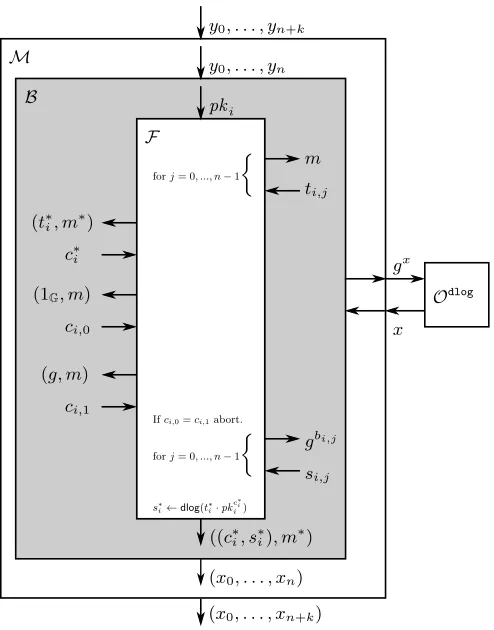
such that, if there exists a reduction Bthat uses F to break the n-OMDL problem, thenMcan use B to break the (n+k)-OMDL problem. Figure 2 depicts the execution setting of all three algorithms.
Lety0, . . . , yn+k denote then+k+ 1 OMDL challenge points thatMreceives as input. It will provideB with an environment that simulates then-OMDL game by handingy0, . . . , yn as input toBand responding to B’s Odlog queries using its own Odlog oracle. We have to provide reduction B with a successful forger
F againstCoSi, where Bis free to run and rewind F. To simplify the arguments about rewinding, we will describe a deterministic forgerF, so that the behavior ofFonly depends on the inputs and oracle responses provided byB, not on its random coins.
We describe a forgerFin terms of three subroutinestarget,rand, andforgethatFcan call out to but that will be implemented by the meta-reductionM. Subroutinetargettakes`+1 group elements (pk, t1, . . . , t`) as input and on thei-th invocation with a combination of inputs that it hasn’t been called with before, returns
M’s target point yn+i. Any invocations of target on previously used inputs consistently return the same output. The subroutinerandimplements a truly random functionG`+1×Z3q → {0,1}`, which is simulated byMthrough lazy sampling. The subroutineforge, finally, creates a forgery by returning ans-value, given a ¯t value, a public key, and ac-value; we will specify later howMimplements this routine.
Letpki be the public key thatBprovides toFin itsi-th execution ofF. The forgerF then proceeds as follows:
– On inputpki,Finitiates`signing queries on the same messagemand for the same treeT consisting of two signers: a leader with public keypk =g and a child that is the target signer with public keypki. – After receiving the results of the first roundti,1, . . . , ti,`,F sets ¯t∗i ←target(pki, ti,1, . . . , ti,`).
– F makes a random-oracle queryH(¯t∗i, m∗) for a fixed messagem∗6=m, yielding a responsec∗i.
– Fmakes two additional random-oracle queries onH(1G, m) andH(g, m), yielding responsesci,0andci,1, respectively.
B M
F
pki
y0, . . . , yn
y0, . . . , yn+k
m ti,j forj= 0, ..., n−1
(t∗i, m∗)
c∗i
(1G, m)
ci,0
(g, m)
ci,1
Ifci,0=ci,1abort.
forj= 0, ..., n−1
gbi,j
si,j
s∗
i←dlog(t∗i·pk c∗
i
i )
((c∗i, s
∗
i), m
∗
)
(x0, . . . , xn)
(x0, . . . , xn+k)
Odlog
gx
x
Fig. 2.Our metareduction Min the proof of Theorem 1, which simulates forger F towards any reduction B that would prove the security ofCoSiunder the OMDL assumption, and usesB to break the OMDL problem.
– When F receives the valuessi,1, . . . , si,` in the `signing protocols, it verifies that gsi,j =ti,j·pk ci,bi,j
i ,
aborting if an invalid signature is detected.
– F outputs a forgery (c∗i, s∗i) onm∗ with public keysPK={pki}by computings∗i ←forge(¯t∗i,pki, c∗i). Observe that F makes ` signing queries, three random-oracle queries, and performs at most (2`+ 1) exponentiations so thatFruns in time (2`+ 1)τexp+O(`). It outputs a successful forgery unlessci,0=ci,1, which happens with probability 1/q. Therefore, F is a ((2`+ 1)τexp +O(`), `,3,1−1/q)-forger for CoSi. Note thatFworks in the KOSK setting because the forgery doesn’t include any signer other than the target signer.
Suppose that there exists an algebraic reductionBthat, when given black-box access to the above forger
F, (τ, )-breaks then-OMDL problem. We now describe a meta-reductionMthat breaks the (n+k)-OMDL problem, where k is the number of times that Bruns F. As mentioned earlier, M, on input target points
y0, . . . , yn+k, runsBon inputy0, . . . , yn and forwardsB’sOdlogqueries to its ownOdlogoracle. It implements the subroutinestargetandrandas explained above, and implements theforgesubroutine as follows:
– If the i-th execution ofF invokes the subroutineforge(¯t∗i,pki, c∗i) and there exists a previous execution
i06=ithat already computed the secret keyski corresponding topki, then the subroutine computes and return the requested s-value ass∗i ←s∗i0+ (c∗i −c∗i0)·skimodq .
– If the i-th execution of F invokes the subroutine forge(¯t∗i,pki, c∗i) and there exists a previous execu-tion i0 6=i with (pki0, ti0,1, . . . , ti0,`) = (pki, ti,1, . . . , ti,`), then it checks whether (ci0,b
i0,1, . . . , ci0,bi0,`) =
(ci,bi,1, . . . , ci,bi,`). If so, then M halts and outputs failure. If not, then there exists at least one
in-dex j such that ci0,b
ski ←
si,j−si0,j
ci,bi,j−ci0,b i0,j
modq .It can then compute and return the requesteds-value ass∗i ←s∗i0+ (c∗i −
c∗i0)·skimodq .
– Else,MusesOdlog and returnss∗
i ← Odlog(¯t∗i ·pk c∗i i ).
IfB is successful, thenB will outputx0, . . . , xn such thatyi =gxi fori= 0, . . . , nafter having made at mostn queries to its Odlog oracle. Now Mproceeds to compute the discrete logarithms x
n+1, . . . , xn+k of
yn+1, . . . , yn+k as follows.
LetP be the partition of{1, . . . , k}whereiandi0are considered equivalent (and are therefore in the same component C ∈ P) if the i-th and i0-th executions are such that (pki, ti,1, . . . , ti,`) = (pki0, ti0,1, . . . , ti0,`).
Because of the wayMinstantiated thetargetsubroutine, we know thatMused the same target pointyjC
as the value ¯t∗i for all executions i that are in the same component C ∈ P, meaning that during the full simulation of B,M used target pointsyn+1, . . . , yn+|P|. Let P0 be the set of components C ∈P such that
Fnever invoked theforgesubroutine in any executioni∈C, letP1containC∈P such thatFinvoked the forgeexactly once over all executionsi∈C, and letP2+ contain the componentsC∈P such thatFinvoked forgeat least twice in total over all executionsi∈C. It is clear that |P|=|P0|+|P1|+|P2+|.
We will now show that M, using a total of |P| queries to its Odlog oracle, can derive a system of |P| independent linear equations in the |P|unknowns xn+1, . . . , xn+|P|. Namely, for every componentC ∈P0,
Msimply makes a discrete-logarithm queryαC← Odlog(yjC), which adds an equation of the form
xjC = αC . (1)
For every component C ∈ P1, there exists exactly one execution i ∈ C that caused M to make a query
s∗i ← Odlog(y jC ·pk
c∗i
i ). Since B is algebraic and only obtains group elements g, y0, . . . , yn+k as input, for all pki output by B, M can use Extract to obtain coefficients βi, βi,0, . . . , βi,n+k ∈ Zq such that ski = logg(pki) =βi+
Pn+k
j=0 βi,jxjmodq. For every C∈P1 it therefore has an equation of the form
s∗i = xjC +c
∗
i(βi+ n+k X
j=0
βi,jxj) modq . (2)
Note thatx0, . . . , xn are known values above, as they were output by B. For every componentC∈P2+,M made one discrete-logarithm querys∗i ← Odlog(y
jC·pk
c∗i
i ) during the first invocation offorge, and extracted the value ofski during the second invocation offorge. It can therefore add an equation of the form
s∗i = xjC +c
∗
iski modq . (3)
Finally, for the unused target points yj, j ∈ {n+|P|+ 1, . . . , n+k}, M can make an additional query
αj← Odlog(yj) to obtain an equation
xj = αj . (4)
The metareductionMcreated a system of|P0|equations of the form (1),|P1|equations of the form (2),|P2+| equations of the form (3), andk− |P|equations of the form (4), so that overall it has a system ofklinear equations in k unknowns. The equations of the form (1), (3), and (4) are clearly linearly independent, as each of these equations affects a single and different unknownxj. Equations of the form (2) are independent as well, because at the time thatBproducespki, its view is independent ofyji0 fori
0> i. One can therefore
order the equations of the form (2) such that each contains one unknownxjC that does not occur in any of
the preceding equations.
Solving this linearly independent system ofkequations inkunknowns yields all the values forxn+1, . . . , xk.
Mcan therefore output (x0, . . . , xn+k) after having made exactly oneOdlogquery for each of thekequations and at mostnOdlog queries to respond toB’s Odlog queries, meaning at mostn+kqueries in total.
The metareduction Mruns in timeτ+τext+O(n+k`) and wins the (n+k)-OMDL game wheneverB wins then-OMDL game, unlessMoutputs failure. The latter happens when in thei-th execution ofF, there exists a previous execution i0 < i with (pki0, ti0,1, . . . , ti0,`) = (pki, ti,1, . . . , ti,`) and (ci0,b
(ci,bi,1, . . . , ci,bi,`). We know that ci,06=ci,1, because otherwiseF would have aborted earlier, meaning that
at most one choice forbi,jwill causeci0,b
i0,j =ci,bi,j. Therefore, at the moment thatbi,1k. . .kbi,`is chosen at
random from{0,1}`in a call to therandsubroutine, for each executioni06=ithere is at most one bad choice
forbi,1k. . .kbi,`that causesMto output failure, meaning that there are at mostkbad choices overall. (Note that the output ofrand is fresh because it takes the full transcript of the protocol so far as an argument. If the arguments ofrandare equal in the i-th andi0-th execution, then the executions are simply identical. Also note thatBlearnsF’s choice forbi,1k. . .kbi,`beforeFcalls theforgesubroutine, so that it could keep many candidate executionsi0 open at the same time.) The probability that the choice of bi,1k. . .kbi,` hits any of these k bad choices causing Mto output failure in any of the k executions is at mostk2/2`. The success probability in solving the (n+k)-OMDL game is therefore−k2/2`.
3.2 Applicability to MuSig
While our metareduction is written forCoSi, the same technique can be applied to the similar multi-signature schemeMuSigas recently introduced by Maxwell et al. [MPSW18a]. The main difference betweenCoSiand MuSig is in how they avoid rogue-key attacks. While CoSi uses the key-verification model to avoid these attacks, MuSig works in the plain public key model by using a more involved key aggregation procedure. Rather than simply multiplying the individual keys together, they raise the individual keys to a hash function output, and present a security proof under the OMDL assumption. However, the problem in proving CoSi secure is not related to rogue-key attacks, as demonstracted by the fact that our metareduction holds in the KOSK setting, but due to the fact that many signing queries can be made in parallel, and rewinding may force the reduction to know the signer’s secret key. Indeed, the same metareduction (with some minor changes in bookkeeping and including the more involved key aggregation) is applicable to MuSig, proving that their security proof overlooked this case and that it is very unlikely thatMuSig can be proven secure under standard assumptions. In response to this work, the authors updatedMuSigto use a 3-round signing algorithm [MPSW18b].
3.3 Applicability to MWLD
Our metareduction can be applied to the MWLD scheme with small modifications. This means that the security proof under the DL assumption [MWLD10] is flawed.8While the metareduction is mostly unchanged, the forger and theforge-routine slightly change to account for the double generator and the double hashing. The modified forgerFworks as follows:
– On inputpki,Finitiates`signing queries on the same messagemand for the same treeT consisting of two signers: a leader with public keypk = 1G and a child that is the target signer with public keypki. – After receiving the results of the first roundti,1, . . . , ti,`,F sets ¯t∗i ←target(pki, ti,1, . . . , ti,`).
– F makes random-oracle queryH0(¯t∗i,{pki}, m∗) for a fixed messagem∗6=m, yielding a responsec∗i and random-oracle queryH1(c∗i,pki) yieldingvi∗.
– F makes four additional queries onH1(H0(1G,{pk,pki}, m),pki) andH1(H0(g,{pk,pki}, m),pki), yield-ing responses vi,0andvi,1, respectively.
– Ifvi,0=vi,1, thenFaborts. Otherwise, it continues the`open signing sessions by generating random bits
bi,1k. . .kbi,` ←rand((pki, ti,1, . . . , ti,`),(vi∗, vi,0, vi,1)) and sending the final ¯t-value for the j-th signing session as ¯ti,j ←gbi,j forj= 1, . . . , `.
– When F receives the values (si,1,1, si,1,2), . . . ,(si,`,1, si,`,2) in the ` signing protocols, it verifies that
gsi,j,1hsi,j,2 =t i,j·pk
vi,bi,j
i , aborting if an invalid signature is detected.
– F outputs a forgery (c∗i, s∗i,1, s∗i,2) on message m∗ with public keys PK={pki} by taking (s∗i,1, s∗i,1)← forge(¯t∗i,pki, v∗i).
8
Claim 4 of [MWLD10] is incorrect: while the view of the forger is independent of (sk1,sk2) in a single run of the
forger, the joint input of different rewindings of the forger are not independent of (sk1,sk2), and hence the keys
that the reduction extracts from these different rewindings are not independent of (sk1,sk2) either. Their event
The metareductionMimplementsforgeas follows:
– If the i-th execution ofF invokes the subroutineforge(¯t∗i,pki, vi∗) and there exists a previous execution
i0 6= i that already computed the secret key (ski,1,ski,2) corresponding to pki, then the subroutine computes and return the requesteds-values ass∗i,b←s∗i0,b+ (vi∗−vi∗0)·ski,bmodq . forb∈ {1,2}. – If the i-th execution of F invokes the subroutine forge(¯t∗i,pki, vi∗) and there exists a previous
execu-tion i0 6=i with (pki0, ti0,1, . . . , ti0,`) = (pki, ti,1, . . . , ti,`), then it checks whether (vi0,b
i0,1, . . . , vi0,bi0,`) =
(vi,bi,1, . . . , vi,bi,`). If so, then M halts and outputs failure. If not, then there exists at least one index
j such that vi0,b
i0,j 6=vi,bi,j, so that M can compute a secret key (ski,1,ski,2) corresponding to pki as
ski,b ←
si,j,b−si0,j,b
vi,bi,j−vi0,b i0,j
modq for b ∈ {0,1}. It can then compute and return the requested s-value as
s∗i,b←s∗i0,b+ (v∗i −vi∗0)·ski,bmodq forb∈ {0,1}. – Else,Mpicks s∗i,2←$
Zq usesOdlog to computesi,1∗ ← Odlog(¯t∗i ·pk vi∗ i ·h
−s∗
i,2) and outputs (s∗ i,1, s∗i,2).
3.4 Applicability to BCJ
Our metareduction can be applied to the BCJ key-verification model scheme with small modifications. This means that the security proof under the DL assumption [BCJ08] is flawed.9
The modified forgerFworks as follows:
– On input pki = (yi, πi), F initiates ` signing queries on the same message m and for the same tree
T consisting of two signers: a leader with public key pk = (1G, π) (where proof-of-possessionπ can be honestly constructed forsk = 0) and a child that is the target signer with public keypki.
– After receiving the results of the first round (ti,1,1, ti,1,2), . . . ,(ti,`,1, ti,`,2),F takes (αi,1, αi,2)←$ Z2q and sets ¯t∗i,1←gαi,1
1 h
αi,2
2 . It sets ¯t∗i,2←target(yi,(ti,1,1, ti,1,2), . . . ,(ti,`,1, ti,`,2)).
– F makes random-oracle queryH0(yi,(¯t∗i,1,¯t∗i,2), m∗) for a fixed messagem∗6=m, yielding a responsec∗i. – F makes two additional random-oracle queries on H0(y1,1G,1G, m) and H0(y1, g1, g1, m), yielding
re-sponsesci,0 andci,1, respectively.
– If ci,0 =ci,1, thenF aborts. Otherwise, it continues the` open signing sessions by generating random bits bi,1k. . .kbi,`←rand((yi, ti,1, . . . , ti,`),(c∗i, ci,0, ci,1)) and sending the (¯t1,¯t2,PK)-values for the j-th signing session as ¯ti,j,1←g
bi,j
1 and ¯ti,j,2←g bi,j
1 forj= 1, . . . , `.
– WhenF receives the values (si,1, γi,1,1, γi,1,2), . . . ,(si,`, γi,`,1, γi,`,2) in the `signing protocols, it verifies that ti,j,1 = g
γi,j,1
1 h
γi,j,2
1 and that ti,j,2 = g γi,j,1
2 h
γi,j,2
2 g
si,j
1 y
−ci,bi,j
1 , aborting if an invalid signature is detected.
– F outputs a forgery (¯t∗i,1,¯t∗i,2, s∗i, γi,1∗ , γ∗i,2) on message m∗ with public keys PK = {pki} by taking (γi,1∗ , γi,2∗ , s∗i)←forge(¯ti,1∗ ,¯t∗i,2, αi,1, αi,2, yi, c∗i).
The metareductionMimplementsforgeas follows:
– If thei-th execution ofFinvokes the subroutineforge(¯t∗i,1,t¯∗i,2, αi,1, αi,2, yi, c∗i) and there exists a previous executioni06=ithat already computed representation (δγ1, δγ2, δs) foryi, then the subroutine computes the requested forgery asγ∗i,1←γi∗0,1+ (c∗i−c∗i0)δγ1,γ
∗i,2←γ∗
i0,2+ (c∗i−c∗i0)δγ2,s
∗
i ←s∗i0+ (ci∗−c∗i0)δs.
9 The security proof distinguishes two forgery events: InE
1, the forger broke the binding property of the commitment
scheme, and inE2, the reduction can extract the secret key of the honest signer. It considers two different reductions, B0 which embeds the DL challenge in the commitment parameters and simulates signing queries by knowing the honest signer secret key, andB1which embeds the DL challenge as the honest signer public key and simulates signing queries by knowing the backdoor to the commitment scheme. The DL challenge is solved ifE1 occurs withB1or if
E2occurs withB0. The proof argues that, because the simulation strategies ofB0 andB1are indistinguishable, for
each event it holds that the difference between the probabilities that it occurs in reductionB0 andB1 is negligible. However, while it is true that the forger cannot distinguish between the oracle simulation strategies ofB0 andB1
in asingle execution, the eventsE1 and E2 are defined based on the joint outputs of multiple rewindings of the
– If thei-th execution of Finvokes the subroutineforge(¯t∗i,1,t¯∗i,2, αi,1, αi,2, yi, c∗i) and there exists a previ-ous execution i0 6=i with (yi,(ti,1,1, ti,1,2), . . . ,(ti,`,1, ti,`,2)) = (yi,(ti,1,1, ti,1,2), . . . ,(ti,`,1, ti,`,2)), then it checks whether (ci0,b
i0,1, . . . , ci0,bi0,`) = (ci,bi,1, . . . , ci,bi,`). If so, then Mhalts and outputs failure. If not,
then there exists at least one indexj such that ci0,b
i0,j 6=ci,bi,j, so thatM extracts a representation of
yi by setting
δγ1 ←
γi,j,1−γi0,j,2
ci,bi,j−ci0,bi0,j
modq
δγ2 ←
γi,j,2−γi0,j,2
ci,bi,j−ci0,bi0,j
modq
δs←
si,j−si0,j
ci,bi,j−ci0,bi0,j
modq
for which we have
yi=g δγ1 2 h
δγ2 2 g
δs
1 (5)
and
gδγ1 1 h
δγ2
1 = 1G. (6)
It can then compute and return the requested forgery asγi,1∗ ←γ∗i0,1+ (c∗i −c∗i0)δγ1,γ
∗
i,2←γi∗0,2+ (c∗i −
c∗i0)δγ2,s
∗
i ←s∗i0+ (ci∗−c∗i0)δs.
– Else, M sets γi,1 ← αi,1, γi,2 ← αi,2, and uses Odlog to compute s∗i ← Odlog(¯t∗i,2g
−αi,1
2 h
αi,2
2 y
c∗i i ) and returns (γi,1, γi,2, si).
4
Sub-Exponential Attacks on Multi-Signature Schemes
In this section we state thek-sum problem [Wag02], which is ak-dimensional generalization of the birthday problem. We show that the security ofCoSi,MuSig,MWLD, andBCJmulti-signature schemes can be reduced to this problem. Wagner [Wag02] proposed an algorithm that solves thek-sum problem in sub-exponential time. Together these results allow us to break the above multisignature schemes. Finally, we point out that the public-randomness generatorRandHound [SJKK+17] is insecure, which stems from its use of the CoSi scheme.
Our attacks are related to theROS-based attack on blind signatures [Sch01], which can also be reduced to thek-sum problem [Wag02]. However, for subtle reasons our attacks on multi-signatures need to use the
k-sum problem directly.
4.1 The k-Sum Problem
We now define thek-sum problem and provide the complexity estimates for solving it.
Definition 5 (k-Sum Problem). The k-sum problem in group (Zq,+) for an arbitraryq provides klists
L1, . . . , Lk of equal size, each containing elements sampled uniformly and independently fromZq, and requires to findx1∈L1, . . . , xk ∈Lk such thatx1+. . .+xk ≡0 modq. We say that adversaryA (τ, sL, )-breaks thek-sum problem if it runs in time at mostτ, uses listsL1, . . . , Lk each containingsL elements, and solves the k-sum problem with probability AdvkZ-sum
q (A)≥.
For any parameters k and n, Wagner [Wag02] defines the k-tree algorithm that (τ, sL, )-breaks the k -sum problem onn-bit long list elements forτ ∈O(k·2n/(1+lgk)),s
L= 2n/(1+lgk)andsome non-negligible function. The k-tree algorithm roughly requires to merge k−1 pairs of sL-element lists. This means that the 4-sum problem with lists of size 2n/3 can be solved with a non-negligible probability in time O(2n/3). Furthermore, ifk= 2
√
nthen thek-sum problem with lists of size 2√n can be solved in sub-exponential time
4.2 Attack on CoSi
We state the reduction from the unforgeability ofCoSi to thek-sum problem, and discuss the implications of our result to the choice ofCoSiparameters.
Reduction to the k-Sum Problem The attack uses a 2-node tree T where the challenger controls the leaf node with some secret key sk∗, and the adversary controls the root node with a secret key sk. The adversary chooses an arbitrary message mand initiates k−1 concurrent calls to the signing oracle, using
m,T as inputs to each of the oracle queries. At the beginning of the challenge phase of each concurrent oracle call i∈ {1, . . . , k−1} the adversary chooses a malicious ¯ti (we show how to choose it below). Note that there are no restrictions on the choice of ¯ti, because it fully depends on adversary’s commitment in the root node at the end of the commitment phase. During the response phase the adversary obtains fromT’s leaf nodesi =ri+ci·sk∗ for alli∈ {1, . . . , k−1}, one for each concurrent call to the signing oracle. Here
ri is uniformly random (and unknown to the adversary) andci =H0(¯ti, m). The adversary then constructs a signatureσ= (c∗, s∗) for some messagem∗ 6=m such thatc∗=Pki=1−1ci and s∗ =
Pk−1
i=1 si+c∗·sk. We now show how to choose the ¯ti’s such thatσis a valid signature for m∗.
By expanding the above, we get s∗ =Pki=1−1ri+ Pk−1
i=1 ci·(sk∗+sk) = Pk−1
i=1 ri+c∗·(sk∗+sk). Let
h=gPk−i=11ri, which is computable from the challenger’s commitment values. Note thatσis a valid signature if
c∗=H0(g Pk−1
i=1ri, m∗) =H
0(h, m∗). But from the above we only know thatc∗= Pk−1
i=1 ci= Pk−1
i=1 H0(¯ti, m). So in order to produce a forgery, the adversary needs to find valuesm, m∗ and ¯ti for alli∈ {1, . . . , k−1} such thatH0(h, m∗) =
Pk−1
i=1 H0(¯ti, m) modulo the group order.
We reduce this to the k-sum problem where list Li for each i ∈ {1, . . . , k−1} will containsL outputs of H0(¯ti, m), filled by evaluating the hash function on distinct values of ¯ti. List Lk will containsL outputs of H0(h, m∗), each for some distinct value of m∗. This requires that the message space is large enough to produce a sufficient number of list elements for listLk. In Section 4.2 we show how to extend this attack in case if the message space is limited.
Note that the unforgeability of CoSi can be broken in any tree T where the challenger controls a non-root node (recall that our security notion allows only a single non-adversarial tree node). Even though the values of PKj,tj andsj propagate and accumulate throughout the tree, the adversary can cancel out the contributed shares from all adversarial nodes regardless of the tree structure, obtaining the shares that belong specifically to the challenger’s node.
Furthermore, our attack can be extended to forge signatures in any treeT where the attacker controls only the root node (note that our security notion does not model this case). In order to do this, the attacker should treat all non-root nodes as a single challenger node, meaning it should multiply together all commitments and add together all responses acquired from its children. Running the above attack would then produce a forgery with respect to the sum of all secret keys that belong to the non-root nodes in the tree. The extended attack requires the same amount of resources as the basic attack against a single challenger node.
Theorem 2. LetG=hgibe a cyclic group of prime orderq. LetAbe an adversary that(τ, sL, )-breaks the
k-sum problem in group(Zq,+). Then there exists an adversaryB that is a(τ0, qS, qC, qH, )-forger forCoSi in groupG, whereτ0 =τ+O(k·sL·lgq),qS=qC=k−1 andqH=k·sL.
Proof (Proof of Theorem 2).We build aCoSiforgerB. Recall that adversaryBplaying against the unforge-ability ofCoSitakespar,pk∗as input, and is provided with an access to the random oracleH0:G×{0,1}∗→ Zq and to the signing oracleOSign(par,sk
∗,·,·)
. Herepar are parameters and (pk∗,sk∗) is a challenge key-pair generated by the security game. Upon halting, the adversary has to returnσ, m,PK, where σis a forgery for messagemwith respect to set of public keysPK. LetBperform the following steps:
– Choose an arbitrary message m∈ {0,1}∗. SetT equal to a 2-node tree of depth 1 where the leaf node
corresponds to the challenge key pairpk∗,sk∗, and the root node is controlled by the adversary. Sample an adversarial key pair (pk,sk)←$ Kg(par) that will be used for the root node. Parsepk∗ as (y∗, π∗) and
– Simultaneously initiatek−1 queries to the signing oracleOSign(par,sk∗,·,·)withmandT as input. For each
i ∈ {1, . . . , k−1}, pause thei-th concurrent interaction with the signing oracle after the commitment phase, having acquired the commitment value pair (ti,pk∗) where ti =gri forri∈Zq that was chosen uniformly at random and is not known to B. Seth=Qki=1−1ti.
– Create empty tables T:{1, . . . , k−1} ×Zq → GandTk: Zq →Zq. For eachi ∈ {1, . . . , k−1} create an empty list Li and fill it with xi,j = H0(¯tj, m) for all j ∈ {1, . . . , sL}, such that {¯t1, . . . ,¯tsL} are distinct elements from G. Set T[i, xi,j] = ¯tj accordingly. Create an empty listLk and fill it with xk,j =
q−H0(h, m∗j) modqforj∈ {1, . . . , sL}, such that{m∗1, . . . , m∗sL}are distinct elements from{0,1}
∗\{m}.
SetTk[xk,j] =m∗j accordingly.
– Run adversary Aon lists L1, . . . , Lk to get a solution to thek-list problem, meaning Areturns to B a list of elementsc1, . . . ck ∈Zq such that c1+. . .+ck ≡0 modq, and ci∈Li for alli∈ {1, . . . , k}. Set
m∗=Tk[ck] andc∗=H0(h, m∗). Note thatc1+. . .+ck−1≡c∗ modqif adversaryAreturned a correct solution to thek-sum problem.
– For each i ∈ {1, . . . , k−1} set ¯ti = T[i, ci] and pass (¯ti,PK) as the challenge value pair to the i-th concurrent interaction with the signing oracle to get back the response si=ri+ci·sk∗.
– Computes∗=Pki=1−1si+c∗·sk modq. Letσ= (c∗, s∗), and letPK={pk∗,pk}. Returnσ, m∗,PK. Assume that adversaryA returned a valid solution to thek-sum problem. Denoter∗ =Pkj=1−1ri. Then we haves∗=Pkj=1−1ri+
Pk−1
j=1cj·sk∗+c∗·sk=r∗+c∗·(sk∗+sk). It follows thatc∗=H0(h, m∗) =H0(gr
∗
, m∗) = H0(gs
∗
·PK−c∗, m∗), meaning σis a valid signature for message m∗ with respect to the aggregated public keyPK.
Parameter Choices When using thek-tree algorithm in the attack against CoSi, we haven= lgq. If the number of parallel signing queries is 3 then the adversary solves the 4-sum problem using 4·q1/3 random oracle queries in time O(q1/3). Furthermore, if k = 2√lgq and the adversary uses (k−1) parallel signing oracle queries, then it solves thek-sum problem using 22√lgq random oracle queries in timeO(22√lgq). More generally, if the adversary uses (k−1) parallel signing queries for any k, then it has to solve the k-sum problem using qH=k·2lgq/(1+lgk)random oracle queries (to generate klists of sizesL= 2lgq/(1+lgk)) and runtimeτ∈O(k·2lgq/(1+lgk)).
Producing a forgery for a fixed message In the attack onCoSi described above, the list Lk is filled using distinct values of m∗. This requires that the message space is large enough to produce a sufficient number of list elements for Lk. It also prohibits from producing a forgery for some a priori fixed message
m∗. We now extend the attack to remove these restrictions. We will show how to produce a forgery for an arbitrary messagem∗.
Compared to the initial attack, the adversary will now construct a signatureσ= (c∗, s∗) for some message
m∗ such thatc∗=a·Pki=1−1ciands∗=a· Pk−1
i=1 si+c∗·sk for an arbitrary group exponenta. The purpose of valueais to re-randomize possible values ofc∗, allowing to add a new element to listLk for each distinct
a. We now again show how to choose the ¯ti’s such thatσis a valid signature form∗. From the above, we gets∗=a·Pk−1
i=1 ri+c∗·(sk∗+sk). Leth=g Pk−1
i=1ri. Note thatσis a valid signature
ifc∗=H0(ga· Pk−1
i=1ri, m∗) =H
0(ha, m∗). But we only know thatc∗=a· Pk−1
i=1ci=a· Pk−1
i=1 H0(¯ti, m). So in order to produce a forgery, the adversary needs to find valuesa,m,m∗ and ¯ti for alli∈ {1, . . . , k−1}such thatH0(ha, m∗)·a−1=
Pk−1
i=1 H0(¯ti, m) modulo the group order.
We reduce this to the k-sum problem where listLi for eachi∈ {1, . . . , k−1}will containsL outputs of H0(¯ti, m), filled by evaluating the hash function on distinct values of ¯ti. ListLk will contain sL outputs of H0(ha, m∗)·a−1, each for some distinct valuea.
The following steps change in the reduction to the k-sum problem:
– In the first step of the attack, adversaryBnow chooses two arbitrary distinct messagesm, m∗∈ {0,1}∗.
– In the third step of the attack, the listLk is now populated withxk,j =q−H0(haj, m∗)·a−j1modqfor