Distributed Key Generation in the Wild
Aniket Kate1 Yizhou Huang2 Ian Goldberg2
1Max Planck Institute for Software Systems (MPI-SWS), Germany 2Cheriton School of Computer Science, University of Waterloo, Canada
[email protected],{y226huan,iang}@uwaterloo.ca
Abstract
Distributed key generation (DKG) has been studied extensively in the cryptographic litera-ture. However, it has never been examined outside of the synchronous setting, and the known DKG protocols cannot guarantee safety or liveness over the Internet.
In this work, we present the first realistic DKG protocol for use over the Internet. We propose a practical system model for the Internet and define an efficient verifiable secret sharing (VSS) scheme in it. We observe the necessity of Byzantine agreement for asynchronous DKG and analyze the difficulty of using a randomized protocol for it. Using our VSS scheme and a leader-based agreement protocol, we then design a provably secure DKG protocol. We also consider and achieve cryptographic properties such as uniform randomness of the shared secret and compare static versus adaptive adversary models. Finally, we implement our DKG protocol, and establish its efficiency and reliability by extensively testing it on the PlanetLab platform. Counter to a general non-scalability perception about asynchronous systems, our experiments demonstrate that our asynchronous DKG protocol scales well with the system size and it is suitable for realizing multiparty computation and threshold cryptography over the Internet.
Keywords: asynchronous communication model. computational setting. distributed key generation. uniform randomness. implementation
1
Introduction
Numerous online cryptographic applications require a trusted authority to hold a secret. How-ever, this requirement always leads to the problem of single point of failure and sometimes to the more undesirable problem of key escrow. Solving these problems is of paramount importance while designing systems over the Internet where denial-of-service attacks and malicious entities are widespread. A distributed key generation (DKG) [42] protocol overcomes these problems using a complete distribution of the trust among a set of servers. In essence, an (n, t)-DKG protocol allows a set ofnnodes to collectively generate a secret with itssharesspread over the nodes such that any subset of size greater than a thresholdtcan reveal or use the shared secret, while smaller subsets do not have any knowledge about it. Unlike the original secret sharing schemes [6, 46], where adealer
decryption scheme, a private key is distributed among a group such that, given a ciphertext, more than a threshold number of them have to combine their decrypted shares to find the plaintext message. On the other hand, in a threshold signature scheme, the signing key is distributed among a group such that more than a threshold number of them have to combine their partial signatures to sign a message. In distributed key distribution centres and threshold decryption and signature schemes, DKG tackles the problem ofsingle point of failure. In IBC, it also mitigates thekey escrow
issue, when it is impractical to trust and rely on a single entity, the private-key generator(PKG), to generate and distribute private keys to IBC clients. A distributed PKG becomes necessary when IBC is used in practical systems—outside the usual organizational settings—such as key distribution in ad-hoc networks [32] or pairing-based onion routing [30]. DKG is also an important primitive in distributed pseudo-random functions [38], which are useful in distributed coin tossing algorithms [11], random oracles [39] and multiparty computation (MPC) [26].
Although various theoretical aspects of DKG have been thoroughly researched for the last two decades, the systems aspects have been largely ignored. Existing DKG protocols rely on assumptions like synchronous communication (bounded communication delay, with known bounds) or ask for a reliable broadcast channel. As these prerequisites are not readily available over the Internet, the existing DKG protocols are not suitable for the Internet-based applications and there is no DKG available or used in practice yet. In this paper, we design and implement a practical DKG protocol for use over the Internet.
Contributions. In a preliminary version [28] of this paper, we defined the first practical DKG protocol for use over the Internet. Here, we formally prove its safety and liveness properties and present a practical mechanism to obtain cryptographically important property of uniform randomness of the shared secret. We also implement and verify the practicality of our DKG protocol over the PlanetLab platform.
• As our first contribution, we define a realistic system model over the Internet (Section 2). We combine the standard Byzantine adversary with crash recovery and network failures in an asynchronous setting. We also analyze the asynchronous versus partially synchronous dichotomy for the Internet and justify the choice of treating crashes and network failures separately.
• We present a VSS scheme (HybridVSS) that works in our system model (Section 4). Observing the necessity of a protocol for agreement on a set for asynchronous DKG, we define and prove a practical DKG protocol (HybridDKG) for use over the Internet (Section 5). We use a leader-based agreement scheme in our DKG, as we observe a few pragmatic issues with the usually suggested randomized agreement schemes.
• We also consider the uniform randomness of the shared secret in DKG and modify our Hy-bridDKGprotocol to achieve uniform randomness in the random oracle model (Section 5.3).
• Finally, we implement ourHybridDKG protocol and test its performance over the PlanetLab platform (Section 6). To the best of our knowledge, this is the first time that a distributed
2
Assumptions and System Model
In this section, we discuss the assumptions and the system model for our protocols, giving special attention to their practicality over the Internet. This generic system model will also be applicable to many other distributed protocols over the Internet.
2.1 Communication Model
Our DKG protocol should be deployable over the Internet. The expected message-transfer delay and the expected clock offset there (a few seconds, in general) is significantly smaller than a possible system utility period which may extend up to a few days. With such an enormous difference, a failure of the network to deliver a message within a fixed time bound can be treated as a failure of the sender; this may lead to a retransmission of the message after appropriate timeout signals. As this is possible without any significant loss in the synchrony of the system, the asynchronous communication assumption seems to be unnecessarily pessimistic here. It is tempting to treat the Internet as a synchronous network (bounded message delivery delays and processor speeds) and develop more efficient protocols using well-known message delivery time bounds and system run-time assumptions.
Deciding these time bounds correctly is a difficult problem to solve. Further, even if it is possible to determine tight bounds between the optimistic and pessimistic cases, there is a considerable difference between the selected time bounds and the usual computation and communication time. Protocols based on the synchronous assumption invariably use these time bounds in their definitions, while those based on the asynchronous assumption solely use numbers and types of messages.
A real-world adversary, with knowledge of any time bounds used, can always slow down the protocols by delaying its messages to the verge of the time bounds. In asynchronous protocols, although it is assumed that the adversary manages the communication channels and can delay messages as it wishes, a real-world adversary cannot control communication channels for all the honest nodes. It is practical to assume that network links between most of the honest nodes are perfect. Consequently, even if the adversary delays its messages, an asynchronous protocol completes without any delay when honest nodes communicate promptly. Thus, the asynchrony assumption may increase message complexity or the latency degree (number of communication rounds), but in practice does not increase the actual execution time. Observing this, we use the asynchronous communication assumption for our protocols.
Weak Synchrony Assumption (only for liveness). For liveness (the protocol eventually terminates), but not safety (the protocol does not fail or produce incorrect results), we need a (weak) synchrony assumption. Otherwise, we could implement consensus in the asynchronous model with adversary nodes, which is impossible [21]. We use a weak synchrony assumption by Castro and Liskov [14] to achieve liveness. Let delay(T) be the time between the moment T when a message is sent for the first time and the moment when it is received by its destination. The sender keeps retransmitting the message until it is received correctly. We assume that delay(T)
does not grow faster thanT indefinitely. Assuming that network faults are eventually repaired and DoS attacks eventually stop, this assumption seems to be valid in practice.
However, the weak synchrony assumption iso(T), and therefore, weaker than the partial synchrony assumptions.
2.2 Byzantine Adversary, Crash-Recoveries and Link Failures
Most of the distributed computing protocols in the literature assume at-limitedByzantine adversary
and a compromised node remains Byzantine and unused after recovery. We also aim at proactive security for our DKG, where the t-limited mobile Byzantine adversary can change its choice of t nodes as time progresses. There, a node compromised during a phase remains unused, after recovery, for the remainder of that phase as its share is already compromised. Any intra-phase share modification for a recovered node leads to intra-phase share modification to all the nodes, which is unacceptable in general.
This does not model failures over the Internet in the best way. Other than malicious attacks leading to compromise, some nodes (say f of them) may just crash silently without showing ar-bitrary behaviours or get disconnected from the rest of the network due to network failures or partitioning. Importantly, secrets at these f nodes are not available to the adversary and mod-elling them as Byzantine failures not only leads to sub-optimal resilience ofn≥3(t+f) + 1 instead ofn≥3t+ 2f+ 1, but it also increases the bit complexity with added security requirements (t+f instead oft). Keeping such nodes inactive, after their recovery, until the start of next phase is not ideal. This prompts us to use ahybrid model.
Our system adopts the hybrid model of Backes and Cachin [4], but with a modification to accommodatebroken links. From any honest node’s perspective, a crashed node behaves similarly to a node whose link with it is broken and we model link failures in the form of crashes. For every broken link between two nodes, we assume that at least one of two nodes is among the list of currently crashed nodes. A node that is crashed means that some of its links are down, not necessarily that they allare. Further, all non-Byzantine nodes may crash and recover repeatedly with a maximum of f crashed nodes at any instant and a recovering honest node recovers from a well-defined state using, for example, a read-only memory. In addition to these nodes that crash completely (losing any keys they may have) and subsequently recover from that state, other non-Byzantine nodes may remain up, but have someof their links down; those links remain down throughout the protocol (otherwise, they are simply normal asynchronous links), and the nodes may or may not realize that the links are down. These nodes will not need to recover their keys, since they have not lost them. As long as the size of the list of crashed nodes, including all completely crashed nodes, and one of the endpoints of every broken link, does not exceed f at any time, our protocols will succeed. We also assume that the adversary (eventually) delivers all the messages between two uncrashed nodes.
Formally, we consider an asynchronous network of n ≥3t+ 2f + 1 nodesP1, . . . , Pn of which the adversary may corrupt up to t nodes during its existence and may crash another f nodes at any time. Forf = 0, 3t+ 1 nodes are required as a differentiation between slow honest nodes and Byzantine nodes is not possible in an asynchronous network, while for t = 0, 2f + 1 nodes are mandatory to achieve consistency. At leastn−t−f nodes, which are not in the crashed state at the end of a protocol, are termed finally upnodes.
2.3 Cryptographic Assumptions and Setup
Definition 2.1. A function (·) :N→R+ is callednegligible if for allc >0 there exists a κ0 such
In the remainder of the paper, (·) denotes a negligible function. Our adversary is computa-tionally bounded with a security parameter κ and it has to solve the DLog problem [37, Sec. 3.6] (Definition 2.2) for the security parameter κ to break the security of the protocols. Further, as discussed in Section 3.3, our t-limited adversary is also static.
Definition 2.2. Let p be a prime whose size is linear in κ. Given a generator g of a multi-plicative group G of order p and a ∈ Z∗p, the discrete logarithm (DLog) assumption suggests that Pr[ADLog(g, ga) =a] =(κ) for every polynomial-time adversaryADLog.
We use a PKI infrastructure in the form of a PKI hierarchy with an external certifying authority or web-of-trust among nodes to achieve authenticated and confidential communication with TLS links, and message authentication with any digital signature scheme secure against adaptive chosen-message attacks [25]. Each node also has a unique identifying index. We assume that indices and public keys for all nodes are publicly available in the form of certificates. It is possible to achieve similar security guarantees in a symmetric-key setting with long-term keys.
2.4 Complexity Assumptions
In our hybrid model, nodes may crash and recover repeatedly with a maximum off crashed nodes at any instant. We still need to bound the crashes as an unbounded number of crashes can cause the protocol execution time to be unbounded. We restrict the adversary by a function d(·) that represents the maximum number of crashes that it is allowed to perform during its lifetime and parametrized(·) with the security parameterκ. Note that, based on the system requirements, it is possible to maked(·) constant or parametrize it withn,tor f.
Work done by honest parties can be measured by a protocol statistic X, which is a family of real-valued non-negative random variables {XA(κ)}, parametrized by adversary A and κ. Each XA(κ) is a random variable induced by running the system withA. A protocol statisticXis called
uniformly boundedif there exists a fixed polynomial T(κ) such that for all adversaries A, there is a negligible function A, such that for all κ ≥ 0, P r[XA(κ) > T(κ)] ≤ A(κ). As we consider a computationally bounded adversary, we aim at polynomially bounded system execution space and time and bounding protocol complexities by a polynomial in the adversary’s running time.
For crash-recovery situations, Backes and Cachin introduce the notion of d-uniformly bounded statistics[4, Def. 1]. Here, a bounded protocol statisticXis considered to bed-uniformly bounded (by T1 and T2) for a function d(κ) if there exist two fixed polynomials T1 and T2 such that for
all adversaries A, there exists a negligible function A(κ) such that for all κ ≥ 0, P r[XA(κ) > d(κ)T1(κ) +T2(κ)] ≤A(κ). In order words, the complexity of the protocol is uniformly bounded if no crash occurs (which is ensured byT2), and the computational overhead caused by each crash
is also uniformly bounded (ensured by T1). Similar to [4], we expect that the bit complexity of a
protocol is d-uniformly bounded for some polynomial d.
3
Background
In this section, we survey the concepts of VSS, homomorphic commitments and DKG.
3.1 Verifiable Secret Sharing
Definition 3.1. (n, t+δ, t)-Secret Sharing. For integersn, tand δ such thatn≥t+δ > t≥0, an(n, t+δ, t)-secret sharingscheme is a protocol used by a dealer to share a secret samong a set of
nnodes in such a way that any subset of t+δ or more nodes can compute the secrets, but subsets of size t or fewer have no information abouts.
A secret sharing scheme withδ= 1 is called athresholdsecret sharing scheme, and for δ >1, it is called arampsecret sharing scheme. In this work, we concentrate on threshold secret sharing and denote it as (n, t)-secret sharinginstead of (n, t+1, t)-secret sharing. Note that all polynomial-based threshold secret sharing schemes can easily be converted to ramp secret sharing schemes [47].
In some secret sharing applications, clients may need to verify a consistent dealing to prevent malicious behaviour by the dealer. A scheme with such a verifiability guarantee is known as
verifiable secret sharing (VSS) scheme [15]. Feldman [19] developed the first non-interactive and efficient VSS scheme and Pedersen [41] presented a modification to it.
Definition 3.2. An (n, t)-VSS scheme consists of two phases: the sharing (Sh) phase and the
reconstruction (Rec) phase.
Sh phase. A dealer Pd distributes a secret s∈ K among n nodes, where K is a sufficiently large
key space. At the end of theShphase, each honest node Pi holds a share si of the distributed
secret s.
Rec phase. In this phase, each nodePi broadcasts its secret shares0i and a reconstruction function
is applied in order to compute the secret s=Rec(s01, s02, . . . , s0n) or output ⊥ indicating that
Pd is malicious. For honest nodes s0i =si, while for malicious nodes s0i may be different from si or even absent.
It has two security requirements:
Secrecy (VSS-wS). At-limited adversary who can compromisetnodes cannot computesduring the Shphase.
Correctness (VSS-C). The reconstructed value should be equal to the shared secret s or every honest node concludes thatPd is malicious by outputting ⊥.
We consider VSS schemes in the computational complexity setting. Here, any malicious be-haviour byPdis caught by the honest nodes in theShphase itself and the VSS-C property simplifies to the following: the reconstructed value should be equal to the shared secret s. Further, many VSS applications avoid participation by all parties during theRecphase. It is required that shares from any t+ 1 honest nodes (or any 2t+ 1 nodes) is sufficient to reconstruct s. Therefore, we mandate the correctness property that we refer as strong correctnessrequirement.
Strong Correctness (VSS-SC). The same unique valuesis reconstructed regardless of the sub-set of nodes (of size greater than 2t) chosen by the adversary in the Recalgorithm.
Further, some VSS schemes achieve a stronger secrecy guarantee.
Strong Secrecy (VSS-S). The adversary who can compromise t nodes does not have any more information abouts except what is implied by the public parameters.
its successors [3,40], due to their Ω(n5) bit complexities, are prohibitively expensive for any realistic use.
Compromising the unconditional security assumption, Cachin et al. [9] (AVSS), Zhou et al. [50] (APSS), and more recently Schultz et al. [45] (MPSS) suggested more practical asynchronous VSS schemes. Of these, the APSS protocol is impractical for any reasonable system size, as it uses a combinatorial secret sharing scheme by Ito, Saito and Nishizeki [27], which leads to an exponential
n t
factor in its message complexity. MPSS, on the other hand, is developed for a more mobile setting where set of the system nodes has to change completely between two consecutive phases to maintain the secrecy and correctness properties.
AVSS is the most general and practical scheme in the asynchronous communication model against Byzantine adversaries, but it does not handle crash recoveries. It assimilates a bivariate polynomial into Bracha’s reliable broadcast [8] and can provide complete flexibility with the sets used without hampering the security. In asynchronous VSS, any two participants need to verify the dealer’s commitment with each other to achieve correctness; thus, a protocol with o(n2) message complexity does not seem to be possible. Therefore, AVSS, with its optimal message complexity, forms the basis for our HybridVSSand HybridDKGprotocols appearing in sections 4 and 5.
3.2 Homomorphic Commitments
A verification mechanism for a consistent dealing is fundamental to VSS. It is achieved using distributed computing techniques in the unconditional setting. In the computational setting, ho-momorphic commitments provide an efficient alternative. Let C(α,[r]) ∈ G be a homomorphic
commitment to α ∈Zp, where r is an optional randomness parameter andG is a (multiplicative)
group. For such a homomorphic commitment, givenC1 =C(α1,[r1]) andC2 =C(α2,[r2]), we have C1·C2 =C(α1+α2,[r]).
VSS protocols utilize two forms of commitments. Let g and h be two random generators ofG.
Feldman, for his VSS protocol [19], used theDLogcommitment scheme of the formChgi(α) =gαwith computational security under theDLogassumption and unconditional share integrity. Pedersen [42] presented another commitment of the form Chg,hi(α, r) = gαhr with unconditional security but computational integrity under theDLogassumption. In PKC based on computational assumptions, with adversarial access to the public key, unconditional security of the secret (private key or master key) is impossible. Further, in VSS schemes based on Pedersen commitments, in order to randomly select the generator h, an additional round of communication is required during bootstrapping. Consequently, in our scheme, we use simple and efficient DLog commitments, except during a special case described in Section 5.3.
It is also possible to prove equality of values committed using Pedersen commitments and
DLog commitments using non-interactive zero-knowledge (NIZK) proofs [20]. Here, given a DLog
commitmentChgi(s) = gs and a Pedersen commitment Chg,hi (s, r) =gshr to the same value sfor generators g, h ∈G and s, r ∈Zp, a prover proves that she knows s and r such that Chgi(s) =gs and Chg,hi(s, r) =gshr. We denote this by
NIZKPK≡Com(s, r,Chgi(s),Chg,hi(s, r)) =π≡Com (1)
The proof is equivalent to zero-knowledge proofs of knowledge used by Canetti et al. [12] in their adaptive secure DKG. It is generated as follows:
• Pick v1, v2∈RZp, and let t1=gv1 andt2 =hv2.
• Letu1=v1−c·s andu2=v2−c·r.
• Send the proof π≡Com = (c, u1, u2) along with Chgi (s) andChg,hi(s, r).
The verifier checks this proof (given π≡Com,g,h,Chgi (s),Chg,hi(s, r)) as follows:
• Lett01 =gu1C
hgi(s)c andt02 =hu2(
Chg,hi(s,r)
Chgi(s) )
c.
• Accept the proof as valid if c= H≡Com(g, h,Chgi(s),Chg,hi(s, r), t01, t02).
3.3 Distributed Key Generation
Pedersen [42] introduced the concept of distributed key generation (DKG) and developed a DKG scheme. Here, each node runs a VSS instance and distributed shares are added at the end to generate a combined shared secret without a dealer. Unlike VSS, DKG requires no trusted party.
Definition 3.3. An (n, t)-DKG scheme consists of two phases: the sharing (Sh) phase and the
reconstruction (Rec) phase.
Sh phase. Every nodePi distributes a secretzi ∈ Kamongnnodes, whereKis a sufficiently large
additive cyclic group. At the end of theShphase, each honest node Pi holds a share si of the distributed secret s, which is a pre-decided linear combination of the shared zi values.
Rec phase. Each node Pi broadcasts its secret share s0i and a reconstruction function is applied in order to compute the secret s = Rec(s01, s02, . . . , s0n). For honest nodes s0i = si, while for malicious nodes s0i may be different from si or even absent.
As discussed in the introduction, DKG has numerous application in cryptography. In the paper, we concentrate on threshold cryptosystems in the DLog setting. In this setting, having a cyclic groupGof prime orderp, a DKG protocol generates secret sharing of a secrets∈Zp, and publishes Y = (g, gs) for g∈RGas the corresponding public key. Gennaro et al. [24, Section 4.1] suggested the following secrecy and correctness requirements for an (n, t)-DKG protocol in the DLogsetting:
Correctness (DKG-C).
1. There is an efficient algorithm that on input shares from 2t+ 1 nodes and the public information produced by the DKG protocol outputs the same unique values, even if up totshares are submitted by malicious nodes.1
2. At the end of Shphase, all honest nodes have the same value of the public keyY =gs, wheresis the unique secret guaranteed above.
3. sand Y are uniformly distributed in Zn and G, respectively.
Secrecy (DKG-S). No information about the secretscan be learned by the adversary except for what is implied byY =gs.
Gennaro et al. [22] found that DKGs based on the Feldman VSS methodology do not guarantee uniform randomness of the shared secret key or DKG-S. Further, they observed that the use of digital signatures or other slight modifications do not provide any additional security to the Peder-sen DKG [42] and prePeder-sented a simplification using just the original Feldman VSS called the Joint
1
Feldman DKG (JF-DKG) as the representative scheme. They then defined a new DKG proto-col combining discrete logarithm and Pedersen commitments [42], which guarantees the uniform randomness property by increasing the latency (number of communication rounds) of the DKG protocol by one.
In [23], the same set of authors observed that the Pedersen DKG and JF-DKG produce hard instances of the DLog problem, which may be sufficient for the security of some threshold cryp-tographic schemes. Although a reduction in their JF-DKG security proof is not tight, as they discussed in [24], an elliptic-curve implementation of JF-DKG with appropriately increased key sizes is still faster than the modification they suggested in [22]. In this weaker version of DKG, the third correctness property is absent and the secrecy requirement weakens to the following:
Weak Correctness (DKG-wC).
1. There is an efficient algorithm that on input shares from 2t+ 1 nodes and the public information produced by the DKG protocol outputs the same unique values, even if up totshares are submitted by malicious nodes.
2. At the end of Sh phase, all honest nodes have the same value of public key Y = gs, wheresis the unique secret guaranteed above.
Weak Secrecy (DKG-wS). The adversary with t shares and the public key Y = gs cannot compute the secrets.
Knowing this efficiency and secrecy tradeoff, we define two versions of our DKG constructions: an efficient DKG with weak correctness and weak secrecy, and a DKG with uniform randomness of the shared secret and strong secrecy.
It is important to discuss the relationship between the various secrecy and correctness notions that we present in the above two sections. For secrecy, VSS-wS and VSS-S are equivalent to DKG-wS and DKG-S respectively. For correctness, VSS-SC is included in both DKG-DKG-wS and DKG-S; the weaker VSS-C is a property common only in the unconditional VSS protocols.
Our protocols and most of the distributed cryptographic protocols in the literature are not considered secure against an adaptive adversary that may choose its t compromisable nodes as a protocol is getting executed. As elaborated in [24, Section 4.4], this is only because their (simulation-based) security proofs do not go through when the adversary can corrupt nodes adaptively. In [19, Section 9.3], Feldman claimed that his VSS protocol is also secure against adaptive adversaries even though his simulation-based security proof did not work out. Canetti et al. [12] presented a distributed protocol methodology that is provably secure against adaptive adversaries using inter-active zero-knowledge proofs and a proof technique that may rewind the adversary a polynomial number of times. However, their methodology in general adds at least two more communication rounds to a protocol, which can severely deteriorate the system performance.
On the other hand, all of the protocols in the literature that are proven secure only against a static adversary have remained unattacked by an adaptive adversary for the last 25 years. Gaining some confidence from this fact and giving importance to efficiency, we stick to protocols provably secure only against a static adversary in our work.
4
VSS for the Hybrid Model—
HybridVSS
broad-cast protocol by Backes and Cachin [4]. We achieve a constant-factor reduction in the protocol complexities using symmetric bivariate polynomials.
4.1 Construction
As usual, our VSS protocol is composed of a sharing protocol (Sh) and a reconstruction protocol (Rec). In protocol Sh, a dealer Pd upon receiving an input message (Pd, τ,in,share, s), shares the secret s, where a counter τ and the dealer identity Pd forms a unique session identifier. NodePi finishes the Sh protocol by outputting a (Pd, τ,out,shared,C, si) message, whereC is the commit-ment and si is its secret share. Any time after that, upon receiving an input message (Pd, τ,in,
reconstruct), Pi starts the Rec protocol. TheRec protocol terminates for a node Pi by outputting a message (Pd, τ,out,reconstructed, zi), where zi isPi’s reconstructed value of the secrets.
Note that, for the simplicity of discussion, we use DLog commitments instead of the Peder-sen commitments used in the original AVSS protocol and achieve VSS-wS secrecy (as defined in Section 3.1). It is easily possible to use Pedersen commitments instead and achieve VSS-S secrecy.
Definition 4.1. In session (Pd, τ), protocol VSS in our hybrid model (HybridVSS) having an
asyn-chronous network of n ≥ 3t+ 2f + 1 nodes with a t-limited Byzantine adversary and f-limited crashes and network failures satisfies the following conditions:
Liveness. If the dealer Pd is honest and finally up in the sharing stage of session (Pd, τ), then all
honest finally up nodes complete protocolSh.
Agreement. If some honest node completes protocol Shof session (Pd, τ), then all honest finally
up nodes will eventually complete protocolShin session(Pd, τ). If all honest finally up nodes subsequently start protocol Rec for session (Pd, τ), then all honest finally up nodes will finish
protocol Rec in session (Pd, τ).
Correctness. Once t+ 1 honest nodes complete protocol Shof session (Pd, τ), then there exists a
fixed value z such that
• if the dealer is honest and has shared secret s in session (Pd, τ), then z=s, and
• if an honest node Pi reconstructs zi in session (Pd, τ), then zi =z.
This is equivalent to the strong correctness (VSS-SC) property defined in Section 3.1.
Secrecy. If an honest dealer has shared secret sin session (Pd, τ) and no honest node has started
the Rec protocol, then, except with negligible probability, the adversary cannot compute the shared secret s. This is equivalent to the VSS-wS secrecy property defined in Section 3.1.
Efficiency. The bit complexity for any instance ofHybridVSS is d-uniformly bounded.
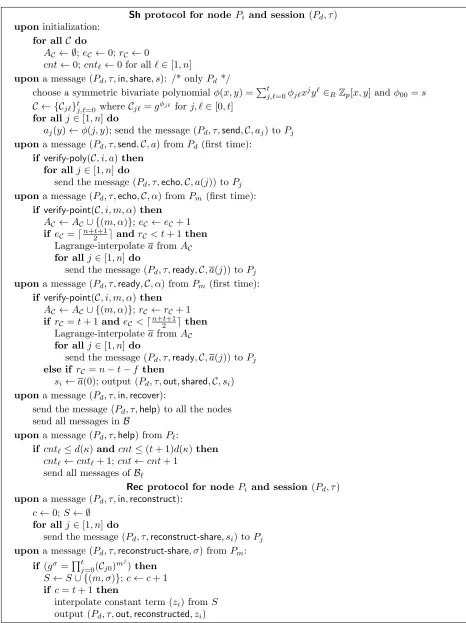
Shprotocol for node Pi and session (Pd, τ)
uponinitialization: for allC do
AC ← ∅;eC ←0;rC ←0
cnt←0;cnt`←0 for all`∈[1, n]
upona message (Pd, τ,in,share, s): /* onlyPd */
choose a symmetric bivariate polynomialφ(x, y) =Pt
j,`=0φj`xjy`∈RZp[x, y] andφ00=s C ← {Cj`}tj,`=0 whereCj`=gφj` forj, `∈[0, t]
for allj∈[1, n]do
aj(y)←φ(j, y); send the message (Pd, τ,send,C, aj) toPj
upona message (Pd, τ,send,C, a) fromPd (first time):
if verify-poly(C, i, a)then for allj∈[1, n]do
send the message (Pd, τ,echo,C, a(j)) toPj
upona message (Pd, τ,echo,C, α) fromPm(first time):
if verify-point(C, i, m, α)then
AC ←AC∪ {(m, α)}; eC ←eC + 1 if eC =dn+2t+1eandrC < t+ 1then
Lagrange-interpolateafromAC for allj∈[1, n]do
send the message (Pd, τ,ready,C, a(j)) toPj
upona message (Pd, τ,ready,C, α) fromPm(first time):
if verify-point(C, i, m, α)then
AC ←AC∪ {(m, α)}; rC ←rC+ 1 if rC =t+ 1 andeC <dn+2t+1ethen
Lagrange-interpolateafromAC for allj∈[1, n]do
send the message (Pd, τ,ready,C, a(j)) toPj
else if rC =n−t−f then
si←a(0); output (Pd, τ,out,shared,C, si)
upona message (Pd, τ,in,recover):
send the message (Pd, τ,help) to all the nodes
send all messages inB
upona message (Pd, τ,help) fromP`:
if cnt`≤d(κ)and cnt≤(t+ 1)d(κ)then
cnt`←cnt`+ 1;cnt←cnt+ 1
send all messages ofB`
Rec protocol for node Pi and session (Pd, τ)
upona message (Pd, τ,in,reconstruct):
c←0;S← ∅ for allj∈[1, n]do
send the message (Pd, τ,reconstruct-share, si) toPj
upona message (Pd, τ,reconstruct-share, σ) from Pm:
if (gσ =Qt
j=0(Cj0)m
j )then
S←S∪ {(m, σ)};c←c+ 1 if c=t+ 1 then
interpolate constant term (zi) from S
output (Pd, τ,out,reconstructed, zi)
verify-poly(C, i, a) verifies that the given polynomial a of Pi is consistent with the commitment
C. Here, a(y) = Pt
`=0a`y` is a degree-t polynomial. The predicate is true if and only if ga` =Qt
j=0(Cj`)i j
for all `∈[0, t].
verify-point(C, i, m, α) verifies that the given value α corresponds to the polynomial evaluation φ(m, i). It is true if and only if gα =Qt
j,`=0(Cj`)m ji`
.
Note that the AVSS and our HybridVSS schemes use bivariate polynomials, as they guarantee that the interpolated polynomials a are of degree t or less. If the univariate polynomials with the constant term equal to the secret s are instead used by dealers in the send messages and the univariate polynomials with the constant term equal to their sharessi are instead used by nodes in theecho andreadymessages, then degrees of the interpolated polynomials awill be greater thant with overwhelming probability.
4.2 Analysis
The main theorem forHybridVSS is as follows.
Theorem 4.1. With the DLog assumption, protocol HybridVSS implements asynchronous VSS in the hybrid model for n≥3t+ 2f+ 1.
Proof. We need to show liveness, agreement, correctness, secrecy, and efficiency. We combine proof strategies from AVSS [9, Sec. 3.3] and reliable broadcast [4, Sec. 3.3] to achieve this. We start by referring to two lemmas.
Lemma 4.1(Lemma 1 [4]). Let Pi be a finally up party during session(Pd, τ). Then every distinct
message sent to Pi by another finally up party Pj during session(Pd, τ) will be received by Pi in a non-crashed state, provided all associated messages are delivered.
Lemma 4.2 (Lemma 2 [9]). Suppose an honest node Pi sends a ready message containing
com-mitment Ci and a distinct honest node Pj sends a readymessage containing commitment Cj. Then
Ci=Cj.
Liveness. Here, we prove that if the dealerPdis honest and finally up during the sharing stage of session (Pd, τ), then all honest finally up nodes complete protocol Sh.
We assume that the dealerPdis honest and finally up. According to Lemma 4.1,sendmessages of the form (Pd, τ,send,C, ai) sent by Pd to each finally up nodePi will eventually be received and verified by each suchPi. Each of these honest and finally up nodes (at leastn−t−f) will send an
echo message of the form (Pd, τ,echo, C, ai(j)) to each system node Pj. Using Lemma 4.1, every finally up honest node will thus receive at least n−t−f valid echo messages. A validecho and
readymessage is one that satisfies verify-point. As n−t−f ≥ dn+t+1
2 e forn≥3t+ 2f+ 1, every
honest finally up node Pj will sendready message (Pd, τ,ready,C, aj(m)) to every system node Pm as either the received echo messages are greater than required bound (dn+t+1
2 e) or it has already
received t+ 1 ready messages. As all ready messages will be eventually received by the finally up nodes according to Lemma 4.1, each finally up honest node will receive at leastn−t−f verifiably correctreadymessages. Consequently, each honest finally up node will complete the protocolShby outputting (Pd, τ,shared) messages.
honest node sends only valid ready messages. Further, when sending, an honest node sends ready
messages to all system nodes. Thus, using Lemma 4.2, every honest finally up node receives at least t+f+ 1 validreadymessages with the same commitmentCand sends areadymessage containingC. Consequently, every honest finally up node receivesn−t−f validreadymessages with commitment
C and completes the Shprotocol.
For protocol Rec, we show that if all honest finally up nodes subsequently begin protocol Rec
for session (Pd, τ), then all honest finally up nodes will finish protocol Rec during session (Pd, τ) by reconstructing s0i. As discussed above, at the end of the sharing step, every honest finally up node Pi computes the same commitment C. Moreover, Pi has received enough valid echo or
readymessages with commitmentC and it computes validreadymessages and a valid sharesi with respect toC(si such that (gsi =Qtj=0(Cj0)m
j
) holds). Thus, if all honest servers subsequently start the reconstruction stage, then every server receives enough valid shares to reconstruct some value, provided the adversary delivers all associated messages.
Correctness (VSS-SC). Suppose an honest dealer has shared a degree-t symmetric bivariate polynomial φ(x, y) with constant term equal to the shared secret s. As the dealer is honest, an
echo message that an honest node Pi receives from another honest node Pj contains C, φ(j, i). As the required number of echo messages before interpolating the final univariate polynomial at a node is equal to dn+2t+1e, it is impossible for faulty nodes to make a node accept commitment C0
different from commitment Csuggested by the dealer. Subsequently, such an honest nodePi, after verification with verify-point, interpolates a polynomial a(y) such that a(y) =φ(i, y). Assume an honest node receives t+ 1readymessages before obtaining dn+2t+1e commitmentC echo messages. Using Lemma 4.2 all these readymessages have the same commitment and with at least of one of them from an honest node, it is equal to C. The honest node will interpolate the same a(y) as in the case of theecho messages. Using the agreement property, if a node completes the protocolSh, then all honest nodes will eventually finish it. LetS be any set oft+ 1 honest nodes (Pj) that have finished the sharing. Let sj,d represent the share for node Pj such that sj,d =a(0) = φ(j,0). Let λSj be Lagrange interpolation coefficients for the set S and position 0. We have
z= X Pj∈S
λS,j 0sj,d= X Pj∈S
λS,j 0φ(j,0) =s
and if the dealer is honest and has shared secretsduring session (Pd, τ), then z=s.
To prove the second part, assume that two distinct honest serversPi andPj reconstruct values zi and zj by interpolating two distinct sets Si = {`, s
(i)
` } and Sj ={`, s (j)
` } of t+ 1 shares each, which are valid with respect to the unique commitment C using Lemma 4.2. As the shares in Si and Sj are verified against commitmentC and they are valid, it is easy to see thatgzi =C
00=gzj.
Asg is a generator for a prime order group, zi =zj.
Secrecy (VSS-wS).To prove the secrecy property, we use theDLogassumption. The adversary’s view consists of polynomialsφ(i, y) for these Byzantine nodesi, and the commitment matrixC and the generator g provided by the dealer. Assume that there is an adversary algorithm A that can compute the shared secretsgiveng,C andtdegree-tunivariate polynomials consistent withC. We prove that a challenger B with an oracle access to such an adversary algorithm A can solve any
DLog instance (g, gα).
Given a DLog instance (g, gα), the challengerB generates tdegree-t polynomialsri(y)∈Zp[y] and associates them with non-zero indicesi. It then computesgri(0)for each indexi, setsgr0(0)=gα
this matrixC along with polynomialsri to the adversary algorithmAand return the outputs=α as the DLog value for tuple (g, gα). As this is not possible, except with negligible probability, we have proven that if an honest dealer has shared secretsduring session (Pd, τ) and no honest node has started theRecprotocol, then the adversary cannot compute the secretsexcept with negligible probability.
Note that, using Pedersen commitments instead of DLog commitments, we can easily achieve and prove the VSS-S property that the adversary has no information about the shared secrets.
Efficiency. We first discuss complexities when there are no crashes. An execution without any crashes hasO(n2) message complexity andO(κn4) bit complexity where the size of the message is dominated by the commitment matrixC having t(t+ 1)/2 =O(n2) entries.
Using a collision-resistant hash function, Cachinet al. [9, Sec. 3.4] suggest a way to reduce the bit complexity to O(κn3). In this approach, commitments are generated using the exponentiated form of polynomial evaluations (A(ji) =gφ(i,j)). Let A(j) =hA0(j), A1(j), . . . , A(nj)i. In this case, the bit complexity gets reduced by a linear factor using the A(0) vector and a vector h =hh
1, . . . , hni, whereH is collision-resistant hash function andhj =H(A(j)).
Now, assume there are crashes and there are subsequent recoveries. As defined earlier, d(κ) bounds the number of possible crashes in the system. In addition, each of the Byzantine nodes may produce unlimited false help messages, out of which first d(κ) will be answered by honest nodes. Therefore, each honest node will in total answer up to (t+ 1)d(κ) help messages. The recovery mechanism requiresO(n2) messages from the recovering node andO(n) messages from each helper node. Therefore, the total message and bit complexity of HybridVSS are O(tdn2) and O(κtdn3) respectively and we obtain a uniform polynomial bound on the bit complexity.
5
DKG for the Hybrid Model—
HybridDKG
HybridVSS requires a dealer (Pd) to select a secret and to initiate a sharing. DKG, going one step further, generates a secret in a completely distributed fashion, such that none of the system nodes knows the secret, while anyt+ 1 nodes can combine their shares to determine it. Although it seems that a DKG is just a system with n nodes running their VSSs in parallel and summing all the received shares together at the end, it is not that simple in an asynchronous setting. Agreeing on t+ 1 or more VSS instances such that all of them will finish for all the honest nodes (theagreement on a set problem [5]), and the difficulty of differentiating between a slow node and a faulty node in the asynchronous setting are the primary sources of the added complexity.
In our hybrid system model, with no timing assumption, the node cannot wait for more than n−t−f VSSs to finish. The adversary can certainly make agreeing on a subset of sizet+ 1 among those nodes impossible, by appropriately delaying its messages. Cachin et al. [9] solve a similar agreement problem in their proactive refresh protocol using a multi-valued validated Byzantine agreement (MVBA) protocol. Known (expected) constant-round MVBA protocols [10] require threshold signature and threshold coin-tossing primitives [11]. The algorithms suggested for both of these primitives in [11] require either a dealer or a DKG. As we aim to avoid the former (dealer) in this work and the latter (DKG) is our aim itself, we cannot use their MVBA protocol.
VSSs for each coin toss and is consequently inefficient. Therefore, we refrain from using randomized agreement.
We follow a much simpler approach with the same bit complexity as MVBA protocols. We use a leader-initiated reliable broadcast system with a faulty-leader change facility, inspired by Castro and Liskov’s view-change protocol [14]. We choose this (optimistic phase + pessimistic phase) approach, as we expect the Byzantine failures to be infrequent in practice. The probability that the current leader of the system is not behaving correctly is small and it is not worth spending more time and bandwidth by broadcasting proposals by all the nodes during every MVBA. With this background, we now define and analyze HybridDKG.
5.1 Construction
InHybridDKG, for sessionτ and leaderL, each nodePdselects a secret valuesdand shares it among the group using protocol Sh of HybridVSS for session (Pd, τ). Each node finishes the HybridDKG protocol by outputting a (L, τ,DKG-completed,C, si) message, wheresi andC are its share and the commitment respectively andL is the finally agreed upon leader.
Definition 5.1. In session τ, protocol HybridDKG in our hybrid model having an asynchronous network of n≥3t+ 2f+ 1 nodes with a t-limited Byzantine adversary and f-limited crashes and network failures satisfies the following conditions:
Liveness. All honest finally up nodes complete protocol HybridDKG in session τ, except with neg-ligible probability.
Agreement. If an honest node completes protocol HybridDKGin session τ, then, except with neg-ligible probability, all honest finally up nodes will eventually complete protocol HybridDKG in session τ.
Correctness. Once an honest node completes the HybridDKG protocol for session τ, then there exists a fixed values such that, if an honest node Pi reconstructs zi in sessionτ, then zi =s.
This is equivalent to the weak correctness (DKG-wC) property defined in Section 3.3.
Secrecy. If no honest node has started the Rec protocol, then, except with negligible probability, the adversary cannot compute the shared secret s. This is equivalent to the DKG-wS secrecy property defined in Section 3.3.
Efficiency. The bit complexity for any instance ofHybridDKG isd-uniformly bounded.
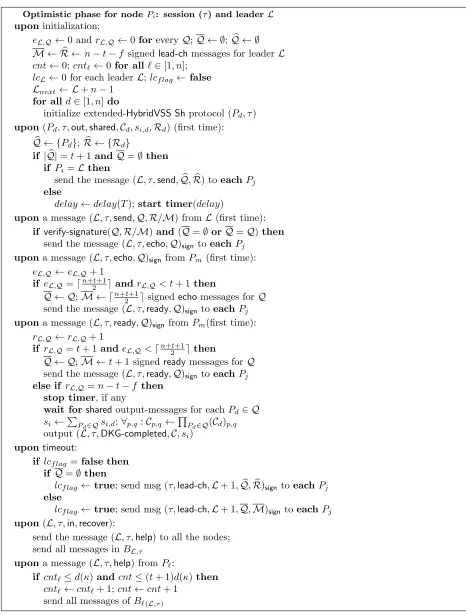
We first describe the optimistic phase of ourHybridDKGprotocol. For each sessionτ, one among n nodes works as a leader. The leader L, once it finishes the VSS proposal by t+ 1 nodes with (Pd, τ,out,shared,Cd, si,d), broadcasts the n−t−f ready messages (set Rb) it received for each of
thoset+ 1 finished VSSs (setQb). Nodes include signatures withreadymessages to enable the leader
to provide a validity proof for its proposal. In this extended HybridVSS protocol, shared messages look like (Pd, τ,out,shared,Cd, si,d,Rd), where a setRdincludes n−t−f signedreadymessages for session (Pd, τ). Once this broadcast completes, each node knows t+ 1 VSS instances to wait for. Once a nodePi finishes those, it sums the shares si,d to obtain its final share si.
Optimistic phase for nodePi: session (τ) and leader L uponinitialization:
eL,Q←0 andrL,Q←0forevery Q;Q ← ∅;Q ← ∅b
M ←R ←b n−t−f signedlead-chmessages for leader L
cnt←0;cnt`←0for all`∈[1, n];
lcL←0 for each leaderL;lcf lag ←false
Lnext← L+n−1
for alld∈[1, n]do
initialize extended-HybridVSS Shprotocol (Pd, τ)
upon(Pd, τ,out,shared,Cd, si,d,Rd) (first time):
b
Q ← {Pd};R ← {Rb d}
if |Q|b =t+ 1 andQ=∅ then
if Pi=Lthen
send the message (L, τ,send,Qb,Rb) toeachPj
else
delay←delay(T);start timer(delay)
upona message (L, τ,send,Q,R/M) fromL (first time): if verify-signature(Q,R/M)and(Q=∅orQ=Q)then
send the message (L, τ,echo,Q)sign toeachPj
upona message (L, τ,echo,Q)sign fromPm(first time):
eL,Q←eL,Q+ 1
if eL,Q=dn+2t+1eand rL,Q< t+ 1 then Q ← Q;M ← dn+t+1
2 esignedecho messages forQ send the message (L, τ,ready,Q)sign toeachPj
upona message (L, τ,ready,Q)sign fromPm(first time):
rL,Q←rL,Q+ 1
if rL,Q=t+ 1and eL,Q<dn+2t+1ethen
Q ← Q;M ←t+ 1 signed readymessages forQ send the message (L, τ,ready,Q)sign toeachPj
else if rL,Q=n−t−f then stop timer, if any
wait forsharedoutput-messages for eachPd∈ Q
si←PPd∈Qsi,d; ∀p,q:Cp,q ←QPd∈Q(Cd)p,q
output (L, τ,DKG-completed,C, si)
upontimeout:
if lcf lag =false then
if Q=∅ then
lcf lag ←true; send msg (τ,lead-ch,L+ 1,Qb,Rb)sign toeachPj
else
lcf lag ←true; send msg (τ,lead-ch,L+ 1,Q,M)sign toeachPj
upon(L, τ,in,recover):
send the message (L, τ,help) to all the nodes; send all messages inBL,τ
upona message (L, τ,help) fromP`:
if cnt`≤d(κ)and cnt≤(t+ 1)d(κ)then
cnt`←cnt`+ 1;cnt←cnt+ 1
send all messages ofB`(L,τ)
Leader-change for node Pi: session(τ) and leaderL
upona msg (τ,lead-ch,L,Q,R/M)sign fromPj(first time):
if L>Land verify-signature(Q,R/M)then
lcL←lcL+ 1
Lnext←min (Lnext,L)
if R/M=Rthen
b
Q ← Q;R ← Rb
else
Q ← Q;M ← M if (Plc
L=t+f+ 1 andlcf lag=false)then
if Q=∅then
send the msg (τ,lead-ch,Lnext,Qb,Rb) toeachPj
else
send the msg (τ,lead-ch,Lnext,Q,M) toeachPj
else if (lcL=n−t−f)then
M ←R ←b n−t−f signedlead-chmessages forL
L ← L;Lnext ← L −1
lcL←0;lcf lag =false
if Pi=Lthen
if Q=∅ then
send the message (L, τ,send,Qb,Rb) toeachPj
else
send the message (L, τ,send,Q,M) toeachPj
else
delay←delay(T) start timer(delay)
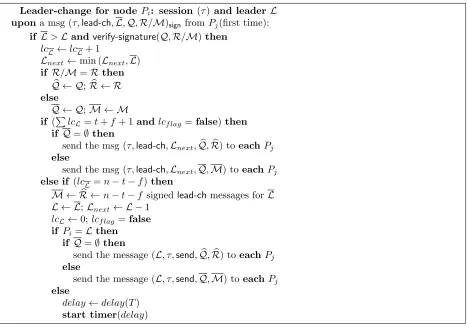
Figure 3: HybridDKG protocol (Pessimistic phase)
nodes for the next leader L+ 1 if it receives an invalid message from the existing leaderL or if its timer timed out. Timeouts are based on the function delay(T) described in Section 2.1. When a node collects t+ 1lead-ch messages for leadersL+δ for small positive integers δ, it is confirmed that at least one honest node is unsatisfied and it sends a lead-chmessage to all the nodes for the smallest leader among those requested, if it has not done that yet. Once a node receives n−t−f
lead-ch requests for a leader L >L, it accepts L as the new leader and enters into the optimistic phase.
The new leader enters into the optimistic phase by sending asendmessage for setQ if it is non-empty or else for setQb. SetQb contains the indices of nodes whose VSS instances have completed
at one more nodes, while set Q is a set of nodes broadcast by the current or a previous leader such that an honest node might have completed that broadcast. In case of leader change, set Q
avoids two honest nodes finishing with two different VSSs sets with two different leaders. Once a node receives dn+2t+1e echo messages or t+ 1 ready messages, Qb is assigned to Q as some or all
honest nodes might complete the broadcast even if others time out. Q ensures that the new leader broadcasts the same set Qb and all honest nodes delivers the same set in the agreement. Set M
attached to Q containsdn+2t+1e signedecho messages ort+ 1 signedreadymessages for Q. Along with condition (|Q|b = t+ 1 and Q = ∅), set M avoids wrong broadcast sets from the dishonest
numbers of overall help requests and help requests sent by each node P` respectively. Figures 2 and 3 present the optimistic and the pessimistic phases of the HybridDKGprotocol. Protocol Rec
forHybridDKGremains exactly the same as HybridVSS Recprotocol from Fig. 1.
5.2 Analysis
The main theorem for ourHybridDKG is as follows.
Theorem 5.1. With the DLog assumption, protocol HybridDKG provides an asynchronous dis-tributed key generation mechanism in the hybrid model for n≥3t+ 2f+ 1.
Proof. We need to show the liveness, agreement, correctness, secrecy, and efficiency of our Hybrid-DKGprotocol.
Liveness. In HybridVSS, if the dealer is honest and finally up, then all honest finally up nodes complete the sharing initiated by it. With n−t−f honest finally up nodes in the system, each honest finally up node will eventually complete t+ 1 HybridVSS sharings, as required. Each such node will start a timer upon completing theset+ 1HybridVSSinstances. If the leader is honest and uncrashed, it also completes t+ 1HybridVSS instances, and broadcasts its proposal; based on the liveness property of reliable broadcast [4], each honest finally up node delivers the same verifiable proposal. Honest finally up nodes stop their timers when they complete this reliable broadcast. To finish, according to the HybridVSS agreement properties, all honest finally up nodes complete protocolShfor nodes in this proposal.
If the leader is compromised, crashed or does not finish its broadcast before a timeout at an honest node, then a signed lead-ch request is broadcast by that honest node (pessimistic phase). After receivingn−t−f lead-chrequests, the new leader takes over, each honest node starts a timer for the proposal from the new leader, and the protocol reenters the optimistic phase. As the number of crashes is polynomially bounded and the network eventually gets repaired resulting in message delays becoming eventually bounded bydelay(T), an honest finally up leader will eventually reliably broadcast a proposal and protocolHybridDKG will complete.
The requirement of n−t−f lead-ch requests for a leader replacement makes sure that nodes do not complete the leader change too soon. An honest node sends a signed lead-ch message for the smallest leader (among the received set) if it receives t+f + 1lead-chmessages, even if it has not observed any fault, as this indicates that at least one honest node has observed some fault and the node does not want to start the leader change too late.
Agreement. An honest node completes a HybridDKG execution when it completes a reliable broadcast of the current leader’s sharing proposal, finishes HybridVSS sharing by t+ 1 nodes in that proposal, and computes its final share as a summation of the shares obtained from these t+ 1 sharings. According to the agreement property of the reliable broadcast, if one honest node completes the protocol, then all honest finally up nodes will eventually complete the protocol. Further, when only some (but not all) nodes complete the reliable broadcast before a leader change, setsQ and Mensure that all nodes complete a reliable broadcast for the sameQ after the leader change. According to the agreement property of the HybridVSS, once an honest node completes a set of t+ 1 sharings, then all honest finally up nodes will eventually complete all of these t+ 1 sharings. Consequently, once an honest node completesHybridDKG then all honest finally up nodes will eventually complete theHybridDKG protocol.
only some (but not all) nodes complete the reliable broadcast before a leader change, setsQandM
make sure that all nodes complete a reliable broadcast for the same Qafter the leader change. For each of the completed sharings, if run individually, each nodePi will reconstruct the same shared secretzi,d wherePdis the dealer for the sharing. Letzi=
P
Pd∈Qzi,d. As nodes add their shares for
the completedt+ 1 sharings as the HybridDKGexecution finishes and as Lagrange-interpolation is homomorphic over addition, on reconstruction after theHybridDKGprotocol each node will output the samezi=s.
Secrecy (DKG-wS). In HybridDKG sharings by t+ 1 nodes are used, where at least one of those shared secrets was proposed by an honest party. In a reliable broadcast, two honest nodes always finish the protocol with the same message; therefore, the samet+ 1 sharings are completed by all the honest nodes. For a HybridVSS execution, if the dealer Pd is honest then until the reconstruction protocol starts, the adversary cannot compute the shared secret sd. Therefore, at the end of HybridDKGprotocol, the adversary does not know at least one of thet+ 1 shared secrets. As the system’s secrets=P
Pd∈Qsd, the adversary cannot compute the shared secrets.
Efficiency. The message and bit complexities of HybridVSS are O(tdn2) and O(κtdn3) respec-tively. In the HybridDKG protocol with the asynchronous communication assumption, the system may complete allnVSS executions, even though the required execution count is justt+ 1; thus, the message and bit complexities of the possible nHybridVSS Sh protocols inHybridDKGare O(tdn3) and O(κtdn4) respectively. If the HybridDKG protocol completes without entering into the pes-simistic phase, then the system only needs one reliable broadcast of message of sizeO(κn), message complexity O(tdn2) and bit complexity O(κtdn3). As a result, the optimal message and bit com-plexities for theHybridDKG protocol areO(tdn3) andO(κtdn4) respectively.
In the pessimistic case, the total number of leader changes is bounded by O(d). Each leader change operation involves O(tdn2) messages and O(κtdn3) communication bits. For each faulty leader, O(tdn2) messages and O(κtdn3) bits are communicated during its administration. There-fore, in the worst case, O(td2n2) messages and O(κtd2n3) bits are communicated before the Hy-bridDKG completes and worst case message and bit complexities of the HybridDKG protocol are O(tdn2(n+d)) andO(κtdn3(n+d)) respectively. Note that considering just at-limited Byzantine adversary (and not also crashes and link failures), the above complexities becomeO(n3) andO(κn4) respectively. These are same as the complexities of the share refresh protocol for AVSS [9].
5.3 Uniform Randomness of the Shared Secret
The shared secret in the aboveHybridDKG may not beuniformlyrandom; this is a direct effect of using only the discrete logarithm commitments (see [24, Section 3] for details). In many cases, we do not need a uniformly random secret key; the security of these cases relies on the assumption that the adversary cannot compute the secret. However, a uniformly random shared secret may be required in some protocols. In that case, we use Pedersen commitments, but we do not employ the methodology defined by Gennaroet al.[24], which increases the latency in the system. We observe instead that with the random oracle assumption, the communicationally demanding technique by Gennaro et al. can be replaced with the much simpler NIZK proofs described in Equation 1 in Section 3.2.
We denoteHybridDKGschemes usingDLogcommitments and Pedersen commitments asHybridDKGDLog
schemes are defined as follows.
Chg,hi(s,s0),[Chgi(s),NIZKPK≡Com], si, s0i
= HybridDKG-ShPed(n, t, f, t0, g, h, αi, α0i)
Chgi(s), si
= HybridDKG-ShDLog(n, t, f,˜t, g, αi)
s = HybridDKG-RecPed(t,Chg,hi(s,s0), si, s0i)
s = HybridDKG-RecDLog(t,Chgi(s), si)
Here, t0 is the number of VSS instances to be chosen (t < t0 ≤ 2t+ 1), αi, α0i ∈ Zp are re-spectively a secret and randomness shared by Pi, and Chgi(s) = [gs, gφ(1),· · ·, gφ(n)] and Chg,hi(s,s0) = [gshs0, gφ(1)hφ0(1),· · · , gφ(n)hφ0(n)] are respectively the discrete logarithm and Pedersen commit-ment vectors forφ, φ0∈Zp[x] of degreetwithφ(0) =sandφ0(0) =s0. The optional NIZKPK≡Com is a vector of zero-knowledge proofs of knowledge that the corresponding entries ofChgi(s) andChg,hi(s,s0)
commit to the same values. This vector is useful in applications such as distributed PKG for IBC [29], where Pedersen commitments have to be replaced by DLogcommitments.
To achieve uniform randomness of the secret, each node adds a DLog commitment of its share and the corresponding NIZKPK≡Comin itsDKG-completedmessage at the end of theHybridDKGPed
protocol, and sends thisDKG-completedmessage without the share to every other node. HybridDKGPed
achieves the same liveness and agreement guarantees as those of HybridDKG, while for correctness and secrecy it respectively achieves the DKG-C and DKG-S properties instead of their weaker ver-sions inHybridDKGDLog. Maintaining the system-oriented flow of the article, we postpone the cryp-tographic analysis of HybridDKGPed with uniform randomness of the shared secret to Appendix A.
6
DKG Implementation over PlanetLab
We have implemented our HybridDKG protocol from Section 5 and analyzed its performance over the PlanetLab platform [43]. In this section, we discuss our implementation and experiments along with other system aspects of DKG. We observedHybridDKGto be practical for use over the Internet, which is also further illustrated by applications such as [29, 48].
We first briefly describe our design and implementation of HybridDKG. We then analyze the results from our experiments over PlanetLab and discuss resilience against denial-of-service (DoS) attacks and Sybil attacks. Finally, we propose some system-level optimizations for theHybridDKG
protocol based on our analysis. These optimizations improve the performance of the protocols, without hampering its liveness or safety, when a leader behaves honestly and delays in the system remain within reasonable limits.
6.1 Software Design and Implementation
We design our DKG nodes as state machines (using the state machine replication approach [33,44]), where nodes move from one state to another based on the messages received. These messages are categorized into three types: operator messages, network messages and timer messages. The operator messages define interactions between nodes and their operators and are of two types: in
described in Section 2.1 in the form ofstart timer,stop timerand timeout. Our node will be in one of the following seven states:
leader unconfirmed, under recovery, functional, agreement started, agreement completed,
leader change started, anddkg completed.
leader unconfirmedis a starting phase, which indicates that a node does not have a sufficient number of lead-ch signatures to confirm a new leader. We also differentiate between agreement completed
and dkg completed as a node may complete the broadcast by the leader before it completes the associated VSS instances. The rest of the states (under recovery, functional, agreement started,
dkg completed,leader change started) have their apparent meanings.
A primary application for our protocols is to construct distributed PKGs [29, 48]. Therefore, we consider a HybridDKG implementation over pairing-friendly elliptic curves. We develop our object-oriented C++ implementation over the PBC library [35] for the underlying elliptic-curve and finite-field operations, and a PKI infrastructure with the DSA signatures based on GnuTLS [36] for confidentiality and message authentication. However, our DKG code is generic and can easily be modified to work with any other C/C++ number theoretic library. When using a different library, a C++ interface layer will have to be developed over that library, which will provide a cyclic group interface in the form of a C++ class as required for our polynomials, commitments and shares.
Our implementation [2] replicates ourHybridVSSandHybridDKGpseudocode and therefore has an event- (or message-) driven architecture. The similarity between the code and the pseudocode is intentional; it helped identify several errors in the code and omissions in the pseudocode. DKG nodes are multithreaded and the code is structured as a set of event handlers. This set contains a handler for each operator and network message, and a handler for each timer. Each handler corresponds to an input action and there are also methods that correspond to the internal actions in the system. The event handling loop works as follows: nodes wait in aselect call for a network message to arrive, for an operator instruction or for a timer deadline to be reached and then they call the appropriate handler. The handler performs computations similar to the corresponding action in the pseudocode and then it invokes any methods corresponding to internal actions whose preconditions have become true. In most of the cases, it results in sending a message to an operator or over the network. Each message has a 3-byte generic header, which contains a tag that identifies the message type (1 byte) and the total size of the rest of the message (2 bytes). The structure of the message bodies varies from message type to message type.
6.2 Performance Analysis
Experimental Setup and Testing. In order to examine its realistic performance, we test our DKG implementation on the PlanetLab platform.
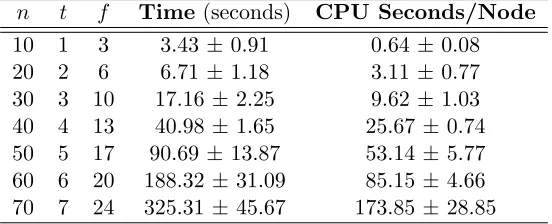
Table 1: Median values of DKG completion time and CPU time per node for various system sizes.
n t f Time(seconds) CPU Seconds/Node
10 1 3 3.43±0.91 0.64±0.08 20 2 6 6.71±1.18 3.11±0.77 30 3 10 17.16± 2.25 9.62±1.03 40 4 13 40.98± 1.65 25.67± 0.74 50 5 17 90.69±13.87 53.14± 5.77 60 6 20 188.32 ± 31.09 85.15± 4.66 70 7 24 325.31 ± 45.67 173.85 ± 28.85
determine an average performance, we ran the experiments at least ten times for each parameter set.
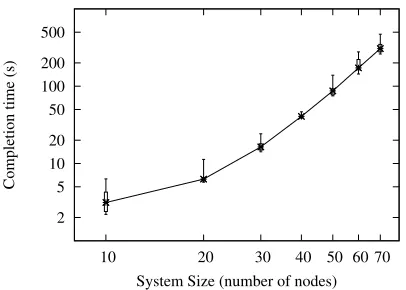
We test the DKG implementation for systems of up to 70 nodes and present median comple-tion times and median CPU usage in Table 1 along with 95% two-sided confidence intervals. Our experiments are terminating and conducted via the method of independent replications. A single replication consists of n−t−f or more individual observations each corresponding to the time required for a participating peer in the quorum to complete the DKG protocol; there are 10 repli-cations for each n value. Using independent replications, an unbiased sample point estimator for variance is calculated and used to obtain our two-sided confidence intervals using thet-distribution. Our DKG experiments are set up so that correctness is guaranteed so long as at most 30% of the peers may crash and 10% of the peers may be Byzantine. While we can tolerate any fraction of Byzantine peers less than 1/3, we use these numbers since in many practical scenarios we expect the fraction of Byzantine faults to be less than 10% and modest compared to the fraction of crash failures.
During our tests, we studied the following aspects: possible sizes of the system, the average completion time of the protocol and the applicability of the weak synchrony assumption from Section 2.1 that we make for HybridDKG. Our HybridDKGprotocol handles Byzantine attacks and the performance of the implementation against these malicious attacks should have been verified during the testing. However, in ourHybridDKGanalyses in Section 5.2, we observe that at-limited Byzantine adversary cannot launch any attack other than delaying the network messages; this is a direct effect of working in the computational security setting. The verification mechanism in our HybridDKG and HybridVSS protocols can easily catch any modification to network messages, commitments or shares and messages that fail verification are dropped by the honest nodes without any further processing. As a result, we do not include any special Byzantine adversary code in our tests. Note that we still need to follow the security threshold t for the shared polynomials as otherwise the adversary can break the secrecy of the protocol.
Evaluation. We make the following observations based on our experiments over the PlanetLab platform:
2 5 10 20 50 100 200 500
10 20 30 40 50 60 70
Completion time (s)
System Size (number of nodes)
Figure 4: Quartile plot of DKG Completion Times for system sizes ranging from 10 to 70 nodes. Note the log-log scale.
• In Fig. 4, we compare minimum and maximum completion times for a set of experiments. The large gaps between those values demonstrate the robustness of the DKG system against the Internet’s asynchronous nature and varied resource levels of the PlanetLab nodes that we chose.
• To check the applicability of the weak synchrony assumption [14] that we use in Hybrid-DKG, we also tested the system with multiple crashed leaders. In such scenarios, the DKG protocol successfully completed after a few leader changes. However, we observe that the av-erage completion time of a system critically varies with the choice of delay(T) function. For delay(T) =T, the leader change takes significantly more time than that required to reliably broadcast the chosen instances. As a result, when a leader is crashed, most of the other nodes end up waiting for long periods even though the next possible leader is available. Further, this waiting period grows significantly in the case of multiple crashes.
We observed thatdelay(T) =T /δ forδ = 2 or 3 is a better choice in terms of a compromise between allowing an honest leader enough time to complete its broadcast and reducing the waiting period between leader changes. However, an appropriate delay(T) function may change as the system parameters vary and we suggest thatdelay(T) should only be finalized for a system after some rigorous testing.
• Further, we compared the (CPU) execution time for nodes against the time they spend on network transmission or waiting for other nodes. We observe that the the protocol execution time per node is significantly smaller than their completion periods (Table 1). This proves that the completion time periods are larger not because of the required computation; they are high rather due to network delays and will drop significantly if a more reliable network with better bandwidth (e.g., an internal network in an organization or a cloud computing environment) is provided.
2 5 10 20 50 100 200 500 1000 2000
10 20 30 40 50 60
Completion time (s)
System Size (number of nodes) commitment vectors commitment matrices
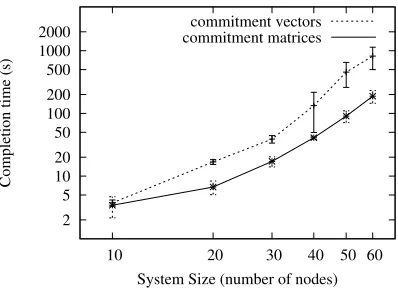
Figure 5: Completion time vs system size (log-log plot) for commitment matrices and commitment vectors
the group modification agreement protocol [28, Sec. 6], which involves administrative interaction at each node.
6.3 System-Level Optimizations
The completion time values of ourHybridDKGimplementation that we observe in Fig. 4 are practical for applications such as PB-OR [30, 31], where DKG phase sizes are in days. However, these values may not be ideal for many other practical systems such as our robust communication protocols for DHTs [48, 49]. During our experiments we observed that some system-level optimizations can significantly reduce the completion time values and make HybridDKG practical enough for these applications. We next discuss these optimizations. Note that these optimizations make
HybridDKGmore practical in the normal course of operation, when a leader behaves honestly and its messages flow without any significant delay. They may not be the best options in the worst-case scenarios having multiple leader-change operations. However, they never hamper the safety or liveness properties of the protocol.
shared Messages. With the PKI infrastructure in place, digital signatures are readily available in our system. OurHybridVSSscheme does not make use of these signatures. In theHybridDKG
protocol, it is important for the leader to be one of first nodes to complete any HybridVSS
instance. That helps the leader to send its DKG send message before the timer timeoutsat fast nodes.
To help the leader, we add a new shared network message that a node having 2t+f + 1 signed VSSreadymessages for a completedHybridVSSinstance sends to a leader. The leader can then include this HybridVSS instance in its DKG send without completion of the VSS instance at its own machine. Note that 2t+f + 1 signed ready messages confirms that the correspondingHybridVSS instance will complete at all honest finally up nodes.
Commitment Matrices versus Commitment Vectors.