A Novel Architecture of Cloud Computing By User Revocation
T.HARIPRASAD1& N.ASHOK2
1
M-Tech Dept. of CSE Swathi Institute of Technology & Science
2
Assistant Professor Dept. of CSE Swathi Institute of Technology & Science
ABSTRACT
The advent of the cloud computing makes storage outsourcing becomes a rising trend, which
promotes the secure remote data auditing a hot topic that appeared in the research literature.
Recently some research considers the problem of secure and efficient public data integrity
auditing for shared dynamic data. However, these schemes are still not secure against the
collusion of cloud storage server and revoked group users during user revocation in practical
cloud storage system. Here I figure out the collusion attack in the exiting scheme and provide an
efficient public integrity auditing scheme with secure group user revocation based on vector
commitment and verifier-local revocation group signature. In existing system, Kallahalla et al
presented a cryptographic storage system that enables secure data sharing on untrustworthy
servers based on the techniques that dividing files into file groups and encrypting each file group
with a file-block key. ECC is a really amazing public key cipher that uses only basic number in
its description. However, whenever a new cipher appears there will be many people that test its
security and whenever possible will try to break it. So far ECC has not been broken but certain
bad things can happen with it if we are not careful. As well as key size is also too length.
Proposed system can achieve fine-grained access control. Registered users can use the source in
the cloud and revoked users cannot access the cloud. The revoked users cannot get the original
data even if they conspire with the cloud, so the system can be protected from collusion attack.
Proposed system is able to support dynamic groups efficiently, when a new user joins in the
group or a user is revoked from the group, the private keys of the other users do not need to be
recomputed and updated. The primary benefit promised by Paillier cryptosystem is a similar key
size, reducing storage and transmission requirements, and it provides the same level of security
afforded by an ECC-based system with a large modulus and correspondingly larger key.
Key words: - Cloud Server, Group manager, Group Members, Key Distribution, Access
Control, Data Confidentiality.
1. INTRODUCTION Cloud computing, with the characteristics of
provides a better utilisation of resources. In
cloud computing, cloud accommodation
providers offer an abstraction of illimitable
storage space for clients to host data. It can
avail clients reduce their financial overhead
of data managements by migrating the local
managements system into cloud servers.
However, security concerns become the
main constraint when outsourcing the
storage of data, which is possibly sensitive,
to cloud providers. To preserve data privacy,
a prevalent approach is to encrypt data files
afore the clients upload the encrypted data
into the cloud. Infelicitously, it is arduous to
design a secure and efficient data sharing
scheme, especially for dynamic groups in
the cloud. Kallahalla et al presented a
cryptographic storage system that enables
secure data sharing on untrustworthy servers
predicated on the techniques that dividing
files into file groups and encrypting each file
group with a file-block key. However, the
file-block keys need to be updated and
distributed for a utilised revocation; ergo,
the system had a heftily ponderous key
distribution overhead. Other schemes for
data sharing on untrusted servers have been
proposed in. However, the intricacies of
utilised participation and revocation in these
schemes are linearly incrementing with the
number of data owners and the revoked
users. Yu et al exploited and cumulated
techniques of key policy attribute-predicated
encryption, proxy re-encryption and indolent
re-encryption to achieve fine-grained data
access control without disclosing data
contents. However, the single-owner manner
may obstruct the implementation of
applications, where any member of the
group can utilise the cloud accommodation
to store and apportion data files with others.
Lu et al proposed a secure provenance
scheme by leveraging group signatures and
ciphertext-policy attribute-predicated
encryption techniques. Each utilised obtains
two keys after the registration while the
attribute key is utilised to decrypt the data
which is encrypted by the attribute
predicated encryption and the group
signature key is utilised for
privacy-preserving and traceability. However, the
revocation is not fortified in this scheme.
2. RELEGATED WORK
2.1Existing System
The file-block keys need to be updated and
distributed for a utilised revocation; ergo,
the system had a cumbersomely hefty key
distribution overhead. The involutions of
utilised participation and revocation in these
schemes are linearly incrementing with the
number of data owners and the revoked
obstruct the implementation of applications,
where any member of the group can utilise
the cloud accommodation to store and
apportion data files with others.
2.2Proposed System
In this system, a secure data sharing scheme
is proposed, which can achieve secure key
distribution and data sharing for a dynamic
group. A secure way for key distribution
without any secure communication channels
is provided. The users can securely obtain
their private keys from group manager
without any Certificate Ascendant entities
due to the verification for the public key of
the utilizer. Proposed scheme can achieve
fine-grained access control, with the avail of
the group utilizer list, any utilizer in the
group can utilise the source in the cloud and
revoked users cannot access the cloud again
after they are revoked. A secure data sharing
scheme which can be bulwarked from
collusion assailant is proposed. The revoked
users can not be able to get the pristine data
files once they are revoked even if they
conspire with the un trusted cloud. Proposed
scheme can achieve secure utilizer
revocation with the avail of the polynomial
function. Proposed scheme is able to fortify
dynamic groups efficiently when an
incipient utilizer joins in the group or a
utilizer is revoked from the group, the
private keys of the other users do not require
to be recomputed and updated. Security
analysis to prove the security of our scheme
is provided by me.
3. IMPLEMENTATION
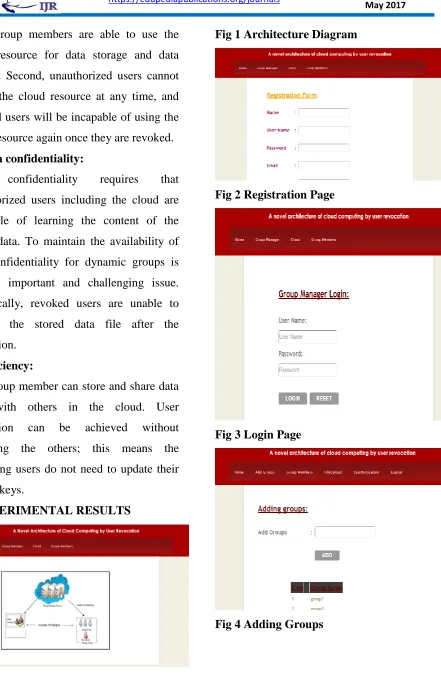
3.1Cloud:
The cloud, maintained by the cloud service
providers, provides storage space for hosting
data files in a pay-as-you-go manner.
3.2 Group manager:
Group manager takes charge of system
parameters generation, user registration, and
user revocation. In the practical applications,
the group manager usually is the leader of
the group.
3.3 Group members:
Group members(users) are a set of registered
users that will store their own data into the
cloud and share them with others.
3.4Key Distribution:
The requirement of key distribution is that
users can securely obtain their private keys
from the group manager without any
Certificate Authorities. In other existing
schemes, this goal is achieved by assuming
that the communication channel is secure,
however, in proposed scheme, it is achieved
without this strong assumption.
First, group members are able to use the
cloud resource for data storage and data
sharing. Second, unauthorized users cannot
access the cloud resource at any time, and
revoked users will be incapable of using the
cloud resource again once they are revoked.
3.6Data confidentiality:
Data confidentiality requires that
unauthorized users including the cloud are
incapable of learning the content of the
stored data. To maintain the availability of
data confidentiality for dynamic groups is
still an important and challenging issue.
Specifically, revoked users are unable to
decrypt the stored data file after the
revocation.
3.7Efficiency:
Any group member can store and share data
files with others in the cloud. User
revocation can be achieved without
involving the others; this means the
remaining users do not need to update their
private keys.
4. EXPERIMENTAL RESULTS
Fig 1 Architecture Diagram
Fig 2 Registration Page
Fig 3 Login Page
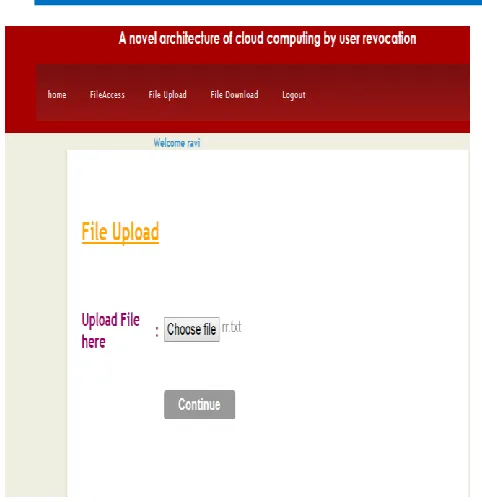
Fig 5 File Uploading Page
5. CONCLUSION
In proposed system, a secure anti-collusion
data sharing scheme is designed for dynamic
groups in the cloud. In proposed scheme, the
users can securely obtain their private keys
from group manager Certificate Authorities
and secure communication channels. Also,
proposed scheme is able to support dynamic
groups efficiently, when a new user joins in
the group or a user is revoked from the
group, the private keys of the other users do
not need to be recomputed and updated.
Moreover, proposed scheme can achieve
secure user revocation; the revoked users
can not be able to get the original data files
once they are revoked even if they conspire
with the entrusted cloud. This project is very
efficient in its execution. Although, there
still exists scope for the improvement of this
project in future. This project has been
developed mainly by taking the example of
the environment of the company. This
project can be extended to the fields such as
education, entertainment, various social
networks and other wider areas. For
example, this project can be employed in the
universities to maintain the database of the
students which can be used by the groups of
lecturers. Here lecturer becomes the group
member and the head of the department
becomes the group manager. Further
enhancement in the security of the data
uploaded by the members can be done. This
project can be enhanced by concentrating on
creating subgroups in the groups and also
concentrating on preserving identity privacy.
Interaction between the group manager and
the group member should be improved.
6. REFERENCE
[1] “A secure anti collusion data sharing scheme for dynamic groups in the cloud” by
Zhongma Zhu , Rui Jiang, 2013.
[2] S. Kamara and K. Lauter,
“Cryptographic Cloud Storage,” Proc. Int’l
Conf. Financial Cryptography and Data
Security (FC), pp.136- 149, Jan. 2010.
[3] M. Kallahalla, E. Riedel, R.
Swaminathan, Q. Wang, and K. Fu, “Plutus:
Storage,” Proc. USENIX Conf. File and
Storage Technologies, pp. 29-42, 2003.
[4] E. Goh, H. Shacham, N. Modadugu, and
D. Boneh, “Sirius: Securing Remote Untrusted Storage,” Proc. Network and
Distributed Systems Security Symp.
(NDSS), pp. 131-145, 2003.
[5] G. Ateniese, K. Fu, M. Green, and S.
Hohenberger, “Improved Proxy
Re-Encryption Schemes with Applications to
Secure Distributed Storage,” Proc. Network
and Distributed Systems Security Symp.
(NDSS), pp. 29-43, 2005.
[6] Shucheng Yu, Cong Wang, Kui Ren, and
Weijing Lou, “Achieving Secure, Scalable,
and Fine-grained Data Access Control in
Cloud Computing,” Proc. ACM Symp.
Information, Computer and Comm.
Security, pp. 282-292, 2010.
[7] V. Goyal, O. Pandey, A. Sahai, and B.
Waters, “Attribute-Based Encryption for
Fine-Grained Access Control of Encrypted
Data,” Proc. ACM Conf. Computer and
Comm. Security (CCS), pp. 89-98, 2006
[8] R. Lu, X. Lin, X. Liang, and X. Shen,
“Secure Provenance: The Essential of Bread
and Butter of Data Forensics in Cloud
Computing,” Proc. ACM Symp.
Information, Computer and Comm.
Security, pp. 282-292, 2010.
[9] M. Armbrust, A. Fox, R. Griffith, A. D.
Joseph, R. Katz, A. Konwinski, G. Lee, D.
Patterson, A. Rabkin, I. Stoica, and M.
Zaharia. “A View of Cloud Computing,”
Comm. ACM, vol. 53, no. 4, pp. 50-58,