PREDICTORS OF NONWORD READING AND DYSLEXIA
Predictors of Exception Word and Nonword Reading in Dyslexic Children: The Severity Hypothesis
Yvonne M Griffiths University of York
Margaret J Snowling University of York
Abstract
The classification of dyslexic children into discrete subtypes yields a poor description of the dyslexic population at large. Multiple regression methods were used to examine continuous variation in component reading subskills (nonword and exception word reading) and their underlying cognitive skills within a group of 59 9-15 year-old dyslexic children. Two measures of phonological skills contributed unique
variance to nonword reading: phonological processing and verbal short-term memory skills. In contrast, the only unique predictor of exception word reading was reading experience. The results are discussed within a connectionist framework that views the decoding deficit in dyslexia as stemming from poorly specified phonological representations. The extent of the nonword reading deficit is determined by the severity of the underlying phonological impairment. In contrast,
Predictors of Nonword Reading in Dyslexic Children.
The strong developmental association between phonological skills and learning to read (Fowler, 1991; Goswami & Bryant, 1990; Share, 1995) provides a back-drop to the theory that the proximal cause of developmental dyslexia is a phonological processing deficit (Brady & Shankweiler, 1991; Morton & Frith, 1995; Snowling, 2000; Stanovich & Siegel, 1994). Within this view, literacy development is affected in dyslexic children who come to the task of reading with poorly specified
phonological representations (Elbro, Borstrom & Petersen, 1998; Hulme & Snowling, 1992).
However, cases of children with dyslexia who do not have a phonological processing impairment(Castles & Coltheart, 1996; Goulandris & Snowling, 1991; Hanley, Hastie & Kay, 1992) pose a problem for the phonological deficit hypothesis. In contrast to dyslexic children with poor nonword reading
(phonological dyslexia; Campbell & Butterworth, 1985; Hulme & Snowling, 1992; Temple & Marshall, 1983), developmental
surface dyslexic children place extensive reliance on
phonological strategies for reading and spelling (Coltheart, Masterson, Byng, Prior & Riddoch, 1983).
Individual differences in dyslexia have been
accomplished either by a direct reading system involving mappings between printed words and their meanings, or by a phonological system incorporating grapheme-phoneme
correspondences. The direct route is used for reading
exception words and familiar regular words, whereas nonwords have to be read using the phonological reading system. In contrast, within connectionist models, exception word and nonword reading is accomplished using a single mechanism
operating over distributed representations of orthographic and phonological units. Such models gradually abstract the
statistical relationships between orthographic inputs and phonological outputs, allowing novel words to be read through generalisation of this knowledge (Seidenberg & McClelland, 1989). Generalisation within connectionist models depends upon the structure of orthographic and phonological
representations (Plaut, McClelland, Seidenberg & Patterson, 1996).
performance on tests of exception word and nonword reading. Initial analyses used a regression procedure to determine the proportion of their dyslexic sample for whom a single
component reading skill (either nonword or exception word reading) was outside the normal range. Eight (15%) children from their sample could be classified as having a specific deficit in nonword reading (phonological dyslexia) and 10 (20%) as having a specific deficit in exception word reading (surface dyslexia). Thus, a large proportion of individuals could not be classified using this method, since they were outside the normal range on both types of reading tasks.
Therefore, Castles and Coltheart employed a less conservative method than the original, by classifying
individuals into subtypes (using the same regression method)if they showed greater discrepancies for their age in their
ability to read one set of items (words or nonwords) relative to the other. Using this criterion, they were able to classify 55% of their sample as showing a phonological dyslexic
profile, and 30% as showing surface dyslexia1.
A limitation of Castles and Coltheart‟s regression
McBride-Chang and Peterson (1996) identified relatively few children who demonstrated dissociations between nonword and exception word reading once reading age was taken into account;
specifically, 24% of their sample could be classified as showing a phonological dyslexic profile and only 2% were classified as showing surface dyslexia. Similarly, when Stanovich, Siegel and Gottardo (1997) used a reading-age matched design to identify subtypes using the same regression method, only 17 phonological dyslexic children (25%) and 1 (1.5%) child with surface dyslexia subtype could be classified from the 68 children in their sample. Thus, in contrast to Castles and Coltheart (1993), the results from both these studies indicated a much lower incidence of developmental phonological dyslexia and very few children with the profile of developmental surface dyslexia.
Aside from the issue of how best to classify dyslexic children, it is important to understand the variation in cognitive skills that underlies the individual differences observed in their reading abilities (Snowling, 1987). Manis et al.,(1996) and Stanovich et al.,(1997) compared the
cognitive skills of the subgroups that they were able to classify in their samples (in relation to normal readers of the same age) as either phonological or surface dyslexic
readers, while those with a surface dyslexic profile were indistinguishable from the younger controls, even on tasks measuring orthographic skill.
Rather than look for discrete patterns of impairments in reading and reading-related cognitive skills, an alternative way of conceptualising these individual differences is in terms of continuous variation among the cognitive skills that underpin reading (Castles, Datta, Gayan & Olson, 1999; Olson, Kliegel, Davidson & Foltz, 1985; Snowling, Goulandris & Defty, 1997). An assumption of the dual route model is that
component reading skills can be selectively impaired. However, such models do not simulate learning (Coltheart, Rastle,
Perry, Langdon & Ziegler, 2001) and are therefore silent as to how deficits in reading-related cognitive skills that differ in severity affect reading performance.
Within the connectionist framework, both the nature of underlying representations and the efficiency of learning resources can lead to differential impairments of exception word and nonword reading (Seidenberg & McClelland, 1989; Harm & Seidenberg, 1999). Although subsequent models were able to achieve more accurate levels of nonword reading in their simulations by using improved phonological representations, the SM 89 model inadvertently demonstrated that impairments in the representations of phonological knowledge
word reading. Seidenberg and McClelland (1989) also discussed the results of a simulation in which they reduced the number of hidden units, which resulted in both poor nonword and exception word reading.
When considering different profiles of reading
impairment, Manis et al, (1996) proposed that a basic resource limitation could cause a pattern of surface or delay dyslexia by slowing mastery of all print-pronunciation associations (cf. Windfuhr & Snowling, in press). Furthermore, this
limitation may be moderated by other factors such as amount of exposure to text or emphasis on phonics instruction in the curriculum. As an alternative, Stanovich et al.,(1997) proposed that the delayed reading profile observed among surface dyslexics might be due to mildly depressed
phonological skill combined with exceptionally inadequate reading experiences.
Taking these observations together with the findings of Manis et al. (1996) as a starting point, Harm & Seidenberg (1999) simulated “sub-types” of dyslexia in a connectionist model of reading. In this model, a phonological network was pre-trained to allow it to encode information about the
phonological structure that is represented by the weights. To simulate phonological dyslexia the network‟s capacity to represent phonological information was reduced in two ways, the least disruptive being to impose a degree of weight decay within the phonological network. In addition to imposing weight decay, the second, more severe impairment of
phonological representation was created by removing a set of phonological clean-up units, continuing to impose a degree of weight decay and severing connections within the phonological layer. Finally, the third, most severe impairment involved making the computations in the phonological attractor more noisy2.
Harm and Seidenberg‟s simulations showed that the more severe the impairment to the phonological network, the greater the nonword reading deficit. Moreover, with more severe
phonological deficits, the network had to draw more upon general processing resources. Only in the case of the most severe impairments was exception word reading also affected. In contrast, altering the learning parameter to a non-optimal level affected the model‟s capacity to read exception words, with a lesser effect on nonword reading.
profiles have less severe phonological impairments (in line with the findings of Manis et al.,1996 and Stanovich et
al.1997). Since these children‟s reading behaviour is similar to that of younger reading-age matched controls, a possible explanation for their difficulties is that they lack
sufficient reading experience to ensure familiarity with the range of exception words typically known by a child of their age (Stanovich et al. 1997). Indeed a number of studies have reported empirical evidence in support of an association between reading experience (indexed by measures of print exposure) and reading accuracy (Cunningham and Stanovich, 1991; McBride-Chang, Manis, Seidenberg, Custodio & Doi, 1993; c.f., Barker, Torgeson & Wagner, 1992).
reading depends upon having segmentally structured
phonological representations (Brown, 1997), we predicted that phonological skills would be stronger predictors of nonword than exception word reading. In contrast, we predicted that variation in exception word reading would be more closely associated with overall levels of reading ability (Metsala et al., 1998) and print exposure (Barker, Torgeson & Wagner, 1992; Cunningham & Stanovich, 1991; McBride-Chang et al, 1993; Stanovich & West, 1989).
The rationale for the choice of tasks followed from the well-accepted view that phonological deficits are at the core of dyslexia (Stanovich & Siegel, 1994). Two sets of
phonological tasks were included in the assessment battery. Following Gombert (1992), tasks tapping metalinguistic
awareness of the phonological structure of speech, namely, phoneme deletion and rhyme production, and those tapping implicit phonological processes, namely nonword repetition, verbal short-term memory and speech rate, were included. In addition, to assess the influence of reading experience on individual differences in reading skill, the dyslexic children completed tests of title and author recognition as measures of print exposure.
Dyslexic readers The dyslexic children who took part in the study were recruited from schools, education authorities and dyslexia centres in the North of England. Colleagues in these various centres were asked to suggest volunteers for the research who were of at least average IQ (WISC-III IQ of at least 85) and reading at least two years behind their
chronological age. Initial contacts were followed up with a letter outlining the aims and methods of the study. Sixty two dyslexic children agreed to participate and all fulfilled the following selection criteria: either a standard score for reading achievement of less than 85 or, in the case of any referred child with a documented reading problem, a standard score below 90 with a standard score for spelling below 85. This procedure resulted in the exclusion of 3 children; two obtained reading scores that were too high (standard scores of 90 and 94) and one child's reading age was much higher than that of the rest of the group.
The dyslexic sample comprised 59 children aged between 9 years and 15 years 6 months, with a mean age of 12 years 2 months (SD =18 months). To confirm that the sample was of average intelligence, they were administered two subtests from the Wechsler Intelligence Scale for Children (III-UK)
Wechsler Objective Reading Dimensions (WORD; Wechsler, 1993) Basic Reading Scale ranged from 6 years 3 months to 9 years 9 months, with a mean reading age of 8 years 2 months (SD = 11 months). Standard scores on this test ranged from 59 to 87 with a mean of 75.8 (SD = 7.22). On the WORD Spelling test scores ranged from 6 years 3 months to 9 years 9 months, with a mean spelling-age of 7 years 10 months (SD = 10 months). Standard scores ranged from 58 - 94, with a mean of 73.2 (SD = 8.07).
Control sample Each dyslexic child was matched
individually with a younger normal reader whose reading age was within 4 months of the dyslexic child‟s reading age on the WORD test. The normal readers all attended state primary schools in the City of York. The control sample comprised 59 children aged between 6 years 6 months and 9 years 10 months, with a mean age of 8 years 2 months (SD = 10 months). Their reading ages (WORD) ranged from 6 years 3 months to 9 years 9 months, with a mean reading age of 8 years 2 months (SD = 10 months). Standard scores ranged from 90 to 109, with a mean of 100 (SD = 4.77) and percentile scores were between 25 and 73 (mean = 49, SD = 12.3). All control children had reading ages within 6 months of their chronological age.
Tests and Materials3
The test battery was divided into two parts. First, a series of tests were administered to all children in order to determine their relative proficiency in reading exception words and nonwords. Second, a series of tasks tapping
related language and cognitive skills were administered to investigate the concurrent predictors of component reading skills. Owing to constraints on the amount of time children could be released from class, a reduced set of these tests was given to controls.
Component Reading Skills
Both groups of children were administered tests of component reading skills.
Nonword reading 1. Each child read 32 nonwords, printed on individual cards in lower case letters (Geneva font, 24-point). Twenty four monosyllabic nonwords taken from the set used by Manis et al., (1996) and 8 two-syllable nonwords, e.g., polmex, torlep from Castles and Coltheart (1993). The 24 one-syllable nonwords varied in the frequency of their orthographic rime unit; 8 items contained high frequency rimes (e.g., lum, veed) 8 items contained low frequency rimes
(e.g., choub, vep) and 8 nonwords had no close orthographic neighbours (e.g., phuve, glaje) (after Treiman, Goswami & Bruck, 1990; see Appendix 1). Coefficient alpha was computed to be 0.87 (Cronbach, 1951).
Nonword reading 2 . The Graded Nonword Reading Test (GNWRT; Snowling, Stothard & McLean, 1996) was used as an additional measure of nonword decoding skill. This
standardised test contains 20 nonwords , 10 monosyllabic (e.g., sted, gromp) and 10 two-syllable nonwords (e.g.,
Exception word reading. Children read 44 exception words used in the Manis et al., (1996) study (after Adams & Huggins, 1985). These items consisted of exception words graded in their word frequency, including high- (e.g., island, busy) and low-frequency (e.g., colonel, sovereign) items. Due to time constraints, it was necessary to discontinue this task after 10 consecutive errors but pilot testing showed this gave a reasonably accurate measure of exception word reading skill. Alpha was 0.89(Cronbach, 1951).
Phonological awareness
Rhyme fluency. In this task, children had to provide as many words orally to rhyme with a target item, as they could in 60 seconds (cf. Muter et al., 1998). The task comprised 6 items (day, plate, fright, chair, mitten, feather) and a score was obtained by adding together the totals across all items. Nonword responses were counted as correct. Alpha was 0.91 (Cronbach, 1951).
Phoneme deletion (after McDougall, Hulme, Ellis & Monk, 1994). In this task, children were required to „take-away‟ a phoneme from a set of 24 nonwords, and to say what would be left. The items included 3 subsets of 8 nonwords which varied in difficulty according to whether the phoneme to be removed was in an initial (e.g., “bice” without the /b/ would be “ice”), medial (e.g., “hift” without the /f/ would be “hit”) or final position (e.g., “teap” without the /p/ would be
in 16/24 cases. One repetition of the item was allowed for each item. Cronbach alpha was 0.83 (Cronbach, 1951). Phonological Processing
Nonword Repetition (dyslexic children only). The
Children‟s Nonword Repetition Test (CNRep; Gathercole, Willis, Baddeley, & Emslie, 1994) was administered to assess the
child‟s ability to repeat unfamiliar nonwords. The test comprises 40 nonwords, 10 two, three, four and five syllables items (e.g., ballop, blonterstaping). The split-half
reliability was reported as 0.66 for children with a mean age of 4 years 9 months.
Verbal memory span (after McDougall, Hulme, Ellis & Monk, 1994) (dyslexic children only). Children were asked for
immediate serial recall of items from sets containing 8 one, two and three syllable nouns, to determine memory span. Children listened to strings of words spoken aloud by the experimenter, and tried to repeat them back in the correct order. Two trials were given at each list length, starting with a list of two for each set of words. Testing was
discontinued for each set once errors were made on both trials at a particular length. Memory span was calculated as the longest list length on which the child was completely correct plus an additional score of 0.5 for list lengths on which only one trial was correct. Memory span was calculated by
Speech Rate (dyslexic children only). This task required children to articulate 10 pairs of 1, 2, and 3
syllable words taken from the memory span task, as quickly as possible (McDougall, Hulme, Ellis & Monk, 1994). Two trials were completed at each length, using different pairs of words. Speech rate (i.e., the number of words articulated per second) was calculated at each length and a final raw score was
obtained by averaging across the 3 lengths. Cronbach alpha was 0.86 (Cronbach, 1951).
Print Exposure
Print exposure has been shown to be a strong predictor of reading skill in normal populations, even when phonological awareness is controlled (Cunningham & Stanovich, 1991). Two measures of print exposure were administered to the dyslexic group, a Title Recognition Test (TRT; adapted from Cunningham & Stanovich, 1990) and an Author Recognition Test (ART;
adapted from Stanovich & West, 1989). Both measures require participants to simply scan the list and check those names known to be authors on the ART and check titles known to be names of books.
Author Recognition The version used in the present study consisted of a total of 40 items (see Appendix 2 for full item list): 25 actual target items (real authors) embedded among 15
foils (names that were not authors). Cronbach alpha was computed to be .75.
titles and 15 foils for book names (see Appendix 2 for full item list). Cronbach alpha was computed to be .49.
Procedure
The dyslexic children were tested individually in one two hour session that included breaks as required. Children came into the laboratory or were tested either at home or school in a quiet room. The control children were tested on a shorter battery lasting about one hour, in two sessions within the same week. Testing took place in a quiet room at school.
Both the TRT and the ART were mailed to all of the dyslexic participants. The return rate was 40 out of the 59 individuals in the dyslexic sample (68%). Hence, a separate set of analyses is reported with the Print Exposure variables as predictors of reading.
Results and Discussion Reader-group differences
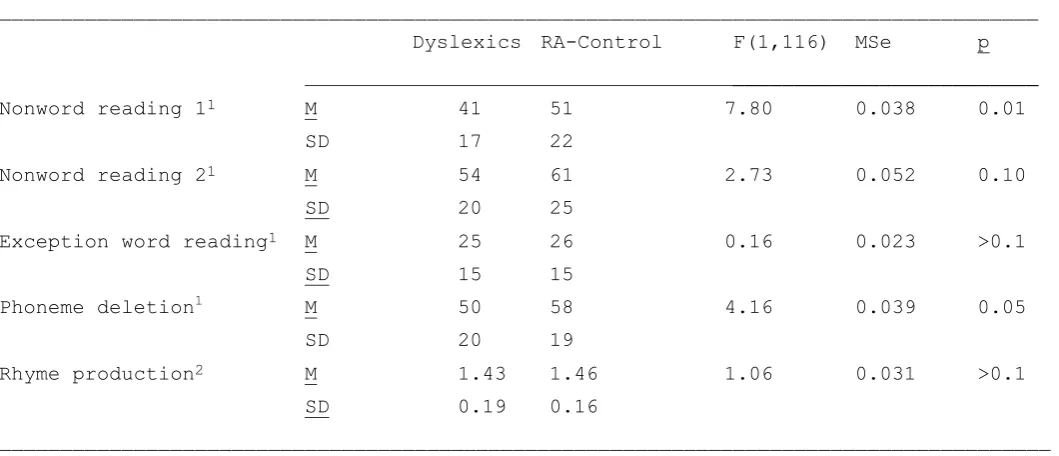
The performance of the dyslexic readers and the RA-controls on the core assessment battery is shown in Table 1. Scrutiny of the data describing the performance of the
Univariate analyses indicated significant group
differences on the nonword reading test 1 (Manis et al., 1996) requiring reading of nonwords containing vowel digraphs. Group differences on the nonword reading test 2 (Snowling et al., 1996) were in the same direction - the dyslexics read 54% of these items correctly compared to 61% in the control group, but the differences were not significant. The dyslexic group also performed significantly less well on the phoneme deletion task. The groups did not differ in exception word reading or in rhyme production.
Taken together, these findings confirm that the present sample of dyslexic readers is representative of others studied in the literature (Bruck, 1990; Rack, Snowling & Olson, 1992; Swan & Goswami, 1997). By contrast, the exception word
reading skills of this group of dyslexics were at the level expected for their reading age (Metsala et al., 1998). Concurrent predictors of reading skills among dyslexic and normal readers
As an initial step in investigating the concurrent predictors of nonword and exception word reading, a correlational analysis was conducted on measures of age, reading skills and phonological awareness, separately for dyslexics and RA-controls (Table 2). Strong correlations between the two nonword reading tests (r=.75, p<.001)
As expected, for reading-age controls, there were strong correlations of age with nonword reading (r =.61), exception word reading (r =.78) and phoneme deletion (r =.53). For the dyslexic readers, whose reading is out of line with
development, none of these correlations were significant (r =.08, .24 and -.09 respectively). Rhyme fluency correlated with phoneme deletion in dyslexics but not with any of the other measures for either group.
Consistent with the above findings, reading age was strongly correlated with both nonword reading and exception word reading for dyslexic readers and both reading sub-skills were correlated with phoneme deletion. In contrast, the correlations between phonemic awareness and reading were only moderate in dyslexic children and the inter-correlation of nonword and exception word reading, though significant, was relatively low (r = .29).
These findings highlight the fact that the development of orthographic knowledge in dyslexic readers must proceed to an extent independently of the normal foundation in phonological skills (cf.Olson et al, 1985; Snowling, 1980). This might be because word identification can benefit from additional
sources of activation, semantic representations being a likely candidate, whereas nonword reading cannot (Frith & Snowling, 1983; Nation & Snowling, 1998; Stanovich, 1980). Among
between phonemic skills and exception word reading (r =.41) is consistent with this view.
To assess this possibility, we went on to carry outconducted hierarchical regressions assessing the
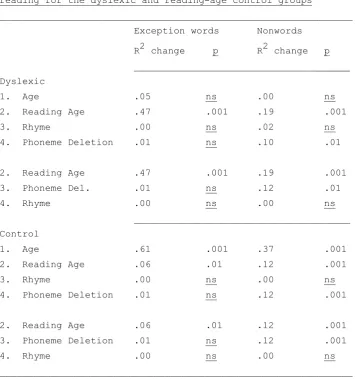
contribution of phonological skills to exception word and nonword reading. Because we were interested in the extent to which phonological skills were uniquely associated with the ability to read different types of word, it was important to control first for overall reading level because this measure can be considered to tap a range of different reading-related processes, including print exposure. We did this by entering age and reading level (WORD raw score) on the first two steps (Table 3). For normal readers, age and reading age accounted for 67% of the variance in exception word reading. After these variables were controlled, phonological skills accounted for no further variance in the model. For dyslexics, age and reading age accounted for a similarly high 52% of the
variance, the majority being attributable to reading age. Once again, phonological skills accounted for no further variance. Taken together, these results suggest that
both groups, even when its contribution to reading age was controlled.
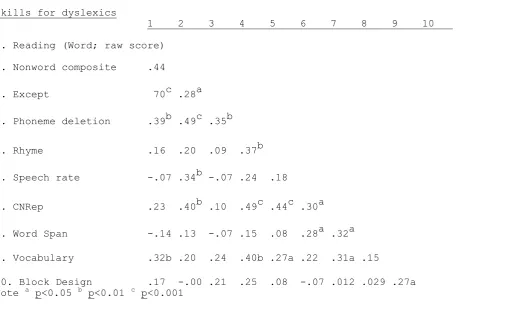
Predictors of individual differences in dyslexic reading. The data available from the dyslexic readers was more extensive than for the controls. Further exploration of the predictors of reading skills was therefore possible for this group. A correlational analysis, controlling for
chronological age (Table 4), produced moderate correlations between the nonword reading composite, phoneme deletion (r =.49, p<.001), speech rate (r =.34, p<.01) and nonword
repetition (r =.40, p<.01) and relatively low but significant correlations between nonword and exception word reading (r =.28, p<.05). Exception word reading correlated with phoneme deletion (r =.35, p<.01) but not with any other phonological variable, though the correlation with vocabulary was marginal (r =.24, p<.07).
Gombert‟s hypothesis, tests of implicit and explicit
phonological processing loaded together on the first factor, with tasks considered to tap short-term memory processes (Hulme et al. 1984) forming a separate factor.
Factor scores were derived on the basis of the principal components analysis and used to explore the concurrent
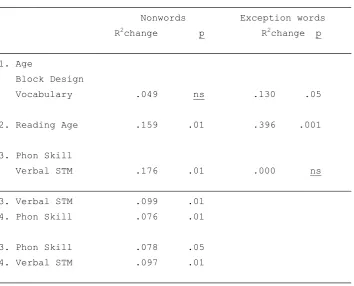
predictors of reading sub-skills once variations in age, overall level of reading and IQ were taken into account. The results of these analyses are shown in Table 6. Age and IQ accounted for a significant 13% of the variance in the
prediction of exception word but only 5% of the variance in nonword reading skill which was not significant. After age and IQ were controlled, a substantial amount of variance in both exception word and nonword reading skill was accounted for by reading level (for exception word reading 40% and for nonword reading 16%). Neither phonological variable accounted for unique variance in exception word reading after these other factors. However, both were significant predictors of nonword reading, together accounting for a total of 18% of the variance.
Print Exposure as a concurrent predictor of reading
A further set of analyses was conducted to investigate the role of print exposure as a concurrent predictor of nonword and exception word reading. These analyses were conducted separately since data was available for only 40 dyslexic children.
Print exposure was calculated by subtracting the
proportion of distracters identified from the proportion of correct titles or authors recognised and then forming a
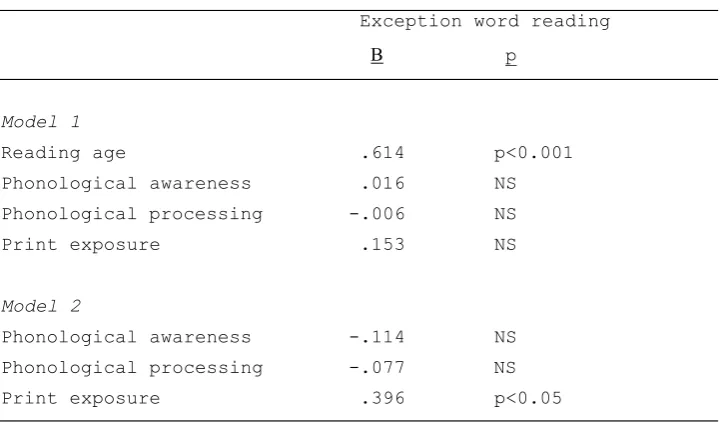
composite measure using the summed z scores for each variable. Print exposure correlated strongly with age (r=.33, p <0.05) and also with both reading age (r=.45, p<0.01) and exception word reading (r=.42, p<0.01), but not with nonword reading (r=0.07). Two simultaneous regressions were conducted to examine the relative strength of print exposure as compared to phonological skill as a concurrent predictor of exception word reading (Table 7).
have also reported measures of print exposure as significant predictors of accuracy in single word reading after
controlling for the effects of age, IQ and phonological skill (Cunningham & Stanovich, 1991; McBride-Chang et al., 1993).
General Discussion
Although there have been a number of attempts to classify dyslexic children according to the patterns of reading
impairment they show, (e.g., Castles et al., 1999; Seymour, 1986), the classification of dyslexic children into sub-types yields a poor description of the dyslexic population at large. Accordingly, in this study a correlational design was used to investigate how individual differences in reading skill among dyslexic and normal readers were related to variations in their phonological skills and reading experience.
As a group, the dyslexic readers in the present study were no worse at exception word reading than RA-controls
(Metsala et al., 1998); and once reading age and IQ were taken into account, the only unique predictor of exception word reading was reading experience as indexed by reading age or print exposure. In contrast, the dyslexic readers were impaired in nonword reading and the nonword reading deficit was associated with the severity of the phonological
impairment.
The present analyses revealed two sorts of evidence for the association between nonword reading and phonological skills. In both normal reader and dyslexic samples, phonemic
awareness accounted for independent variance in nonword
reading after age and reading skill were taken into account. In further analyses focusing on the dyslexic readers only, phonological processing ability and verbal STM both accounted for independent variance in nonword reading.
Although these results might be taken to imply that phonological skills are important for nonword but not exception word reading, the moderate correlations between phoneme awareness and exception word reading suggest that even the ability to read words which do not conform to regular grapheme-phoneme correspondences, depends on having access to segmental phonological representations. The relatively
smaller contribution of phoneme awareness to exception word reading among the nondyslexic readers suggests that phonemic skills are necessary but not sufficient to read exception words.
Another factor that contributes to the acquisition of exception word reading, over and above having a foundation of print-to-sound-mappings in place, is individual variation in semantic skills (Nation & Snowling, 1998a; Plaut et al., 1996). Indeed, semantic activation is particularly important to avoid regularising English exception words. In addition, exception word reading depends upon experience reading irregular forms, consistent with our finding that print
The interpretation offered here is in line with both connectionist (Plaut, McClelland, Seidenberg & Patterson, 1996) and developmental models of reading (Ehri, 19970). Unlike dual-route formulations, these models propose a single mechanism for the processing of regular and exception words. Within Seidenberg and McClelland‟s (1989) model and subsequent generations of it, a system of mappings between orthographic inputs and phonological outputs computes pronunciations not only for regular and exception words on which the model has been trained, but also for novel letter strings. Similarly within Ehri‟s framework, the orthographic system of the fluent reader is built on a foundation of mappings between print and phonology (see also Seymour, 1994).
The results reported here are also compatible with Share‟s self-teaching hypothesis (Jorm & Share, 1983; Share, 1995) according to which „phonological recoding (print-to-sound translation) performs a self-teaching function enabling the learner to acquire the detailed orthographic
Cunningham & Stanovich, 1990; 1993; Olson, Datta, Gayan, &De Fries, 1999; Olson, Frosberg, Wise & Rack, 1994;).
Although the group reading deficit in dyslexia has been characterised as a nonword reading deficit (van Izjendoorn & Bus, 1994; Rack, Snowling & Olson, 1992), the present results highlight individual differences between dyslexic children in their ability to decode nonwords as well as in their exception word reading skill. Importantly, while the dyslexic
children‟s exception word reading ability was closely tied to their reading experience, their nonword reading was related to two measures of phonological skill, namely phonological
processing and verbal short-term memory (STM). The
independent contribution of phonological processing and verbal STM to this model suggests that the two measures are tapping different resources (cf. McDougall et al. 1994).
We speculate that the phonological processing measure assesses the nature and integrity of underlying phonological representations by assessing performance on tasks that require access to these representations. The verbal STM measure
comprised memory span and speech rate for the same set of words and therefore tapped lexical knowledge as well as
phonological processing (Hulme et al., 1991). It follows that it may be a measure of more general verbal resources than the factor score representing phonological processing.
predict nonword reading, Harm and Seidenberg (1999) showed that reducing the network‟s capacity to represent phonological information in different ways affected nonword reading to differing extents. Mild to moderate degrees of phonological impairment created by imposing a level of weight decay within the phonological network primarily affected nonword reading. When more severe impairments were simulated by also severing connections within the phonological network, the network had to draw more heavily upon general processing resources. Within this view, differences in general processing capacity can moderate the extent to which poor phonology disrupts the ability to read nonwords. It is possible that children with better memory span for words in the face of phonological difficulties are those who can draw more easily upon such general resources. These same children might be expected to show relatively better nonword reading.
One of the attractions of connectionist models of reading is that they can explain how patterns of reading impairment, which at the behavioural level seem discontinuous, may
represent continuities in performance at a more fundamental cognitive level (e.g. Castles et al., 1999; Morton & Frith, 1995). The hypothesis forwarded in the present paper is that the pattern of reading impairment observed in individual cases of dyslexia depends upon the severity of a child's
of dyslexia, reported results consistent with the severity hypothesis. Although they reported different etiologies for the phonological and surface dyslexic patterns, supporting a view of partial independence of phonological and orthographic skill, the surface dyslexics were also impaired to a degree on measures of phonological processing.
References [Try to shorten by at least 1 page)
Adams, M. J., & Huggins, A. W. F. (1985). The growth of children‟s sight vocabulary: A quick test with educational and theoretical implications. Reading Research Quarterly, 20, 262-281.
Barker, T.A., Torgeson, J.K., & Wagner, R.K. (1992) The role of orthographic processing skills on five different reading tasks. Reading Research Quarterly, 27 (4), 335-345.
Brady, S., & Shankweiler, D. (Eds.). (1991). Phonological Processes in Literacy. Hillsdale, NJ: Erlbaum.
Broom, Y. M., & Doctor, E. A. (1995). Developmental surface dyslexia: A case study of the efficacy of a
remediation programme. Cognitive Neuropsychology, 12(1), 69-110.
Brown, G. D. A. (1997). Connectionism, phonology, reading and regularity in developmental dyslexia. Brain and Language, 59, 207-235.
Bruck, M. (1990). Word recognition skills of adults with childhood diagnoses of dyslexia. Developmental Psychology, 26, 439-454.
Castles, A., & Coltheart, M. (1993). Varieties of developmental dyslexia. Cognition, 47, 149-180.
Castles, A., & Coltheart, M. (1996). Cognitive correlates of developmental surface dyslexia: a single case study.
Cognitive Neuropsychology, 13(1), 25-50.
Castles, A., Datta, H., Gayan, J., & Olson, R. K. (1999). Varieties of reading disorder: genetic and environmental
influences. Journal of Experimental Child Psychology 72, 73-94.
Coltheart, M., Masterson, J., Byng, S., Prior, M., & Riddoch, J. (1983). Surface dyslexia. Quarterly Journal of Experimental Psychology, 35, 469-495.
Coltheart, M., Rastle, K., Perry C., Langdon R., Ziegler J. (2001) DRC: A dual route cascaded model of visual word recognition and reading aloud. Psychological Review, 108 (1): 204-256.
Cronbach, L.J. (1951).Coefficient alpha and the internal structure of tests. Psychometrika, 16, 297-334.
Cunningham, A.E., & Stanovich, K.E. (1990). Tracking the unique effects of print exposure and orthographic skills in children - a quick measure of reading experience. Journal of Educational Psychology, 82,4, 733-740.
Ehri, L. C. (1997). Sight word learning in normal readers and dyslexics. In B. A. Blachman (Ed.), Foundations of Reading Acquisition and Dyslexia: Implications for Early Intervention. Hillsdale, NJ: Lawrence Erlbaum Associates.
Elbro, C., Borstrom, I., & Peterson, D. K. (1998). Predicting dyslexia from kindergarten: The importance of distinctiveness of phonological representations of lexical items. Reading Research Quarterly, 33(1), 36-60.
Fowler, A. (1991). How early phonological development might set the stage for phoneme awareness. In S. A. Brady & D. P. Shankweiler (Eds.), Phonological processes in literacy: A tribute to Isabelle Liberman, (pp. 97-117). New Jersey: Erlbaum.
Frith, U., & Snowling, M.J. (1983) Reading for meaning and reading for sound in autistic and dyslexic children. British Journal of Developmental Psychology,1, 329-342.
Gathercole, S. E., Willis, C., Baddeley, A. D., & Emslie, H. (1994). The Children‟s Test of Nonword Repetition: A test of phonological working memory. Memory, 2, 103-127.
Gombert, J. E. (1992). Metalinguistic Development. London: Harvester-Wheatsheaf.
Goswami, U., & Bryant, P. E. (1990). Phonological skills and learning to read. London: Erlbaum.
Goulandris, N., & Snowling, M. J. (1991). Visual memory deficits: A plausible cause of developmental dyslexia?
Hanley, J. R., Hastie, K., & Kay, J. (1992).
Developmental surface dyslexia and dysgraphia: an orthographic processing impairment. Quarterly Journal of Experimental
Psychology, 44A, 285-320.
Harm, M. W., & Seidenberg, M. S. (1999). Phonology, reading and dyslexia: Insights from connectionist models. Psychological Review, 106(3), 491-528.
Hulme, C., Thomson,N., Muir, C., & Lawrence, A.(1984) Speech rate and the development of short-term memory. Journal of Experimental Child Psychology, 38, 241-253.
Hulme, C., Maughan, S., & Brown, G. D. A. (1991). Memory for familiar and unfamiliar words: Evidence for a long-term memory contribution to short-term memory span. Journal of Memory and Language, 30, 685-701.
Hulme, C., & Snowling, M. J. (1992). Deficits in output phonology: an explanation of reading failure? Cognitive Neuropsychology, 9, 47-72.
Jorm, A.F. & Share, D.L. (1983) Phonological reading and reading acquisition. Applied Psycholinguistics, 4, 103-147.
Manis, F. R., Seidenberg, M. S., Doi, L. M., McBride-Chang, C., & Petersen, A. (1996). On the bases of two subtypes of developmental dyslexia. Cognition, 58(2), 157-195.
McBride-Chang, C., Manis, F.R., Seidenberg, M.S.,
Custodio, & Doi, L.M. (1993) Print Exposure as a predictor of word reading and reading comprehension in disabled and
McDougall, S., Hulme, C., Ellis, A. W., & Monk, A. (1994). Learning to read: the role of short-term memory and phonological skills. Journal of Experimental Child Psychology, 58, 112-23.
Metsala, J. L., Stanovich, K. E., & Brown, G. D. A. (1998). Regularity effects and the phonological deficit model of reading disabilities: A meta-analytic review. Journal of Educational Psychology, 90(2), 279-293.
Morton, J., & Frith, U. (1995). Causal modelling: a structural approach to developmental psychopathology. In D. Cicchetti & D. J. Cohen (Eds.), Manual of developmental psychopathology, . New York: Wiley.
Muter, V., Hulme, C., Snowling, M., & Taylor, S. (1998). Segmentation, not rhyming, predicts early progress in learning to read. Journal of Experimental Child Psychology, 71, 3-27.
Nation, K., & Snowling, M. J. (1998a). Semantic
processing and the development of word recognition skills: evidence from children with reading comprehension
difficulties. Journal of Memory and Language, 39, 85-101. Nation, K., & Snowling, M. J. (1998b). Individual
differences in contextual facilitation: Evidence from dyslexia and poor reading comprehension. Child Development, 69(4), 996-1001.
Olson, R.K., Datta, H., Gayan, J., & De Fries, J.C.
Converging methods for understanding reading and dyslexia. Cambridge, MA: MIT Press.
Olson, R.K., Forsberg, H Wise, B., & Rack, J. (1994). Measurement of word recognition, orthographic and phonological skills. In G.R. Lyon (Eds.), Frames of references for the assessment of learning disabilities: New views of measurement issues, Baltimore MD: Paul H. Brookes Publishing Co., 243-77
Olson, R. K., Kliegel, R., Davidson, B. J., & Foltz, G. (1985). Individual and developmental differences in reading disability. In G. E. Mackinnon & T. G. Waller (Eds.), Reading Research: Advances in Theory and Practice, (Vol. 4, pp. 1-64). New York: Academic Press.
Plaut, D. C. (1997). Structure and function in the lexical system: insights from distributed models of word reading and lexical decision. Language and Cognitive Processes, 12, 765-805.
Plaut, D. C., McClelland, J. L., Seidenberg, M. S., & Patterson, K. (1996). Understanding normal and impaired word reading: Computational principles in quasi-regular domains. Psychological Review, 103, 56-115.
Rack, J. P., Snowling, M. J., & Olson, R. K. (1992). The nonword reading deficit in developmental dyslexia: a review. Reading Research Quarterly, 27, 29-53.
Seymour, P. H. K. (1986). A cognitive analysis of dyslexia. London: Routledge and Kegan Paul.
Seymour, P. H. K. (1994). Variability in dyslexia. In C. Hulme & M. J. Snowling (Eds.), Reading Development and
Dyslexia, . London: Whurr Publishers.
Share, D. L. (1995). Phonological recoding and self-teaching: sine qua non of reading acquisition. Cognition, 55, 151-218.
Share, D.L. (1999). Phonological recoding and
orthographic learning: A direct test of the self-teaching
hypothesis. Journal of Experimental Child Psychology, 72, 2,
95-129.
Snowling, M. J. (1987). Dyslexia: A cognitive developmental perspective. Oxford: Blackwell.
Snowling, M.J. (2000). Dyslexia. 2nd Edn. Oxford:
Blackwell.
Snowling, M. J., Bryant, P. E., & Hulme, C. (1996). Theoretical and methodological pitfalls in making comparisons between developmental and acquired dyslexia: Some comments on A. Castles and M Coltheart (1993). Reading and Writing, 8, 443-451.
Snowling, M. J., Goulandris, N., & Defty, N. (1998). Development and variation in developmental dyslexia. In C. Hulme & M. Joshi (Eds.), Cognitive and Linguistic Bases of Reading, Writing and Spelling, (pp. 201-217). Mahwah, New Jersey: Erlbaum.
Snowling, M. J., & Hulme, C. (1994). The development of phonological skills. Philosophical transactions of the Royal Society B, 346, 21-28.
Snowling, M. J., Stothard, S. E., & McLean, J. (1996). The Graded Nonword Reading Test. Reading: Thames Valley Test Company.
Stanovich, K., Siegel, L. S., & Gottardo, A. (1997). Converging evidence for phonological and surface subtypes of reading disability. Journal of Educational Psychology, 89, 114-127.
Stanovich, K.E., & Siegel, L. S. (1994). The phenotypic performance profile of reading-disabled children: a
regression-based test of the phonological-core variable-difference model. Journal of Educational Psychology, 86, 24-53.
Stanovich, K.E., & West, R.F. (1989). Exposure to print and orthographic processing. Reading Research Quarterly, 24, 402-433.
Swan, D., & Goswami, U. (1997). Phonological awareness deficits in developmental dyslexia and the phonological representations hypothesis. Journal of Experimental Child Psychology, 60, 334-353.
Treiman, R., Goswami, U., & Bruck, M. (1990). Not all nonwords are alike: Implications for reading development and theory. Memory and Cognition, 18(6), 559-567.
Van-Ijzendoorn, M. H., & Bus, A. G. (1994). Meta-analytic confirmation of the nonword reading deficit in developmental dyslexia. Reading Research Quarterly, 29(3), 267-275.
Wechsler, D. (1992). Wechsler Intelligence Scale for Children - Third Edition UK. New York: Psychological Corporation.
Appendix 1
Materials Used in the Nonword Reading Test 1
1 syllable 2 syllables
HF LF NCWN
fip vep sprenk tashet
chob leck phuve polmex
vag chud wreeb gurdet
lum yol gheab tadlen
cheed loash smaip dethix
yoal soag glouze latsar
veed foop glaje torlep
Appendix 2
Materials Used in the Title Recognition Test
Target book titles Distracter book titles
B.F.G Space Brownies
Animal Farm Without Wishes
Pride and Prejudice Squashed Bananas
1984 The Phantom Fool
Superfudge The Adventures of Mary Higgins
The Adventures of Tom Trading Vanities
Sawyer
IT Feverish
Goodnight Mister Tom Try, Try, Try Again
Jane Eyre Reasons for Trying
Bury Me Deep Dreams of New York
The Teacher Irrelevant Fantasies
Treasure Island Arthur and Orangutan
Forever Voyage to the Underworld
Great Expectations Green Treason
Lord of the Rings Dawn Days
Macbeth
The Babysitters Club
Mort
Flowers in the Attic
The Pigman‟s Legacy
To Kill a Mocking Bird
Blitzcat
The Accident
The Chronicles of Narnia
Life, the Universe and Everything
Materials Used in the Author Recognition Test
Target authors Distracter authors
Dean Koontz A.C.Leach
Dick King-Smith Paul Dobson
Betsy Byars Anthony Lynch
Judy Blume Martin Downing
Danielle Steel Richard Westfield
Virginia Andrews Jennifer Platt
Jackie Collins John O‟Sullivan
James Herbert Tommy McCabe
Robert Westall Michael Hartshone
Sue Townsend Carolyn Young
William Shakespeare Rosie Gunning
Victoria Tonner John Ainsley
Stephen King L.J. Storey
John Steinbeck Judith Pearson
Enid Blyton Joanna Austin
Charles Dickens
Terry Pratchet
J.R.R Tolkein
Agatha Christie
George Orwell
H.G. Wells
Catherine Cookson
Barry Hines
Author notes
1. Yvonne Griffiths, Department of Psychology, University of York, Heslington, York Y010 5DD; Margaret Snowling, University of York.
2. This study was funded by a University of York / Dyslexia Institute studentship to the first author.
3. We wish to acknowledge all the children who took part in the study, the schools in York and in particular their Special Educational Needs Co-ordinators (Lord Deramore‟s Primary, St Lawrence‟s Primary, St Oswald‟s Primary, Fishergate Primary, Robert Wilkinson Primary, Huntington Secondary School,
Lowfield Secondary School), Netherside Hall School, Darlington Education Authority, and the Dyslexia Institute. We thank John Rack for his support and advice throughout the project, Charles Hulme and Kate Nation for helpful discussion.
Footnote
1 These patterns were later described as „soft‟ subtypes by
Stanovich, Siegel and Gottardo, 1997).
2Harm and Seidenberg described a number of ways in which the
surface dyslexia or „reading delay‟ profile of reading behaviour could arise in their model, including reduced training of the model (i.e., reduced reading experience), a non-optimal learning rate, and a reduction in the capacity of the model to encode information regarding mappings from
orthography to phonology (Seidenberg & McClelland, 1989).
3The full item lists for unpublished tests can be obtained from
the first author.
Table 1
Performance of dyslexic readers and RA- controls on reading and phonological awareness tasks
_____________________________________________________________________________________
Dyslexics RA-Control F(1,116) MSe p
_________________________
Nonword reading 11 M 41 51 7.80 0.038 0.01
SD 17 22
Nonword reading 21 M 54 61 2.73 0.052 0.10
SD 20 25
Exception word reading1 M 25 26 0.16 0.023 >0.1
SD 15 15
Phoneme deletion1 M 50 58 4.16 0.039 0.05
SD 20 19
Rhyme production2 M 1.43 1.46 1.06 0.031 >0.1
SD 0.19 0.16
______________________________________________________________________________________
Notes
1 % correct
Table 2
Correlations among reading and phonological awareness skills for dyslexics and reading-age controls
______________________________________________________________
1 2 3 4 5____
1. Age
2. Reading Dyslexic .20 Control .88 c
3. Nonword composite Dyslexic .08 .44 c Control .61 c .70 c
4. Exception words Dyslexic .24 .71c .29 a Control .78c .80 c .55 c 5. Phoneme deletion Dyslexic -.09 .37b .48c .32b
Control .53c .64c .71c .41b
6. Rhyme Dyslexic -.06 .15 .20 .08 .37 b Control .01 .07 .04 .03 .03 ______________________________________________________________ Notes
Table 3
Hierarchical Regressions predicting nonword and exception word reading for the dyslexic and reading-age control groups
______________________________________________________________ Exception words Nonwords
R2 change p R2 change p ______________________________________ Dyslexic
1. Age .05 ns .00 ns
2. Reading Age .47 .001 .19 .001
3. Rhyme .00 ns .02 ns
4. Phoneme Deletion .01 ns .10 .01
2. Reading Age .47 .001 .19 .001
3. Phoneme Del. .01 ns .12 .01
4. Rhyme .00 ns .00 ns
______________________________________ Control
1. Age .61 .001 .37 .001
2. Reading Age .06 .01 .12 .001
3. Rhyme .00 ns .00 ns
4. Phoneme Deletion .01 ns .12 .001
2. Reading Age .06 .01 .12 .001
3. Phoneme Deletion .01 ns .12 .001
4. Rhyme .00 ns .00 ns
Table 4
Partial correlations (controlling for age) among cognitive abilities and reading
skills for dyslexics
1 2 3 4 5 6 7 8 9 10
1. Reading (Word; raw score)
2. Nonword composite .44
3. Except 70c .28a
4. Phoneme deletion .39b .49c .35b
5. Rhyme .16 .20 .09 .37b
6. Speech rate -.07 .34b -.07 .24 .18
7. CNRep .23 .40b .10 .49c .44c .30a
8. Word Span -.14 .13 -.07 .15 .08 .28a .32a
9. Vocabulary .32b .20 .24 .40b .27a .22 .31a .15
10. Block Design .17 -.00 .21 .25 .08 -.07 .012 .029 .27a
Table 5
Principal component analysis showing factor loadings
describing the performance of the dyslexic readers on the 5 phonological tasks.
Factor 1 Phonological Skill
Factor 2 Verbal STM
Nonword Repetition .71 .42
Word Span .03 .84
Speech Rate .18 .73
Phoneme Deletion .78 .12
Rhyme Fluency .81 -.03
Table 6
Results of hierarchical regressions predicting nonword and exception word reading skills among dyslexic readers
______________________________________________________________ Nonwords Exception words R2change p R2change p
______________________________________________________________
1. Age
Block Design
Vocabulary .049 ns .130 .05
2. Reading Age .159 .01 .396 .001
3. Phon Skill
Verbal STM .176 .01 .000 ns
______________________________________________________________ 3. Verbal STM .099 .01
4. Phon Skill .076 .01
3. Phon Skill .078 .05 4. Verbal STM .097 .01
Table 7
Contribution of Print Exposure to variance in exception word reading in the dyslexic group (n=40)
Exception word reading
p
Model 1
Reading age .614 p<0.001
Phonological awareness .016 NS Phonological processing -.006 NS
Print exposure .153 NS
Model 2