Round-E
ffi
cient Black-Box Construction of Composable
Multi-Party Computation
Susumu Kiyoshima
NTT Secure Platform Laboratories, Japan.
August 21, 2018
Abstract
We present a round-efficient black-box construction of a general multi-party computation (MPC) protocol that satisfies composability in the plain model. The security of our protocol is proven in the angel-based UC framework [Prabhakaran and Sahai, STOC’04] under the minimal assumption of the existence of semi-honest oblivious transfer protocols. The round complexity of our protocol is max(Oe(log2n),O(ROT)) when the round complexity of the underlying oblivious transfer protocol isROT. Since constant-round semi-honest oblivious transfer protocols can be constructed under standard assumptions (such as the existence of enhanced trapdoor permuta-tions), our result gives aOe(log2n)-round protocol under these assumptions. Previously, only an O(max(nϵ,ROT))-round protocol was shown, whereϵ >0 is an arbitrary constant.
We obtain our MPC protocol by constructing aOe(log2n)-round CCA-secure commitment scheme in a black-box way under the assumption of the existence of one-way functions.
Keywords. multi-party computation, composability, angel-based UC security, black-box con-struction, CCA-secure commitment
1
Introduction
Secure multi-party computation (MPC) protocols enable mutually distrustful parties to compute a functionality without compromising the correctness of the outputs and the privacy of their inputs. In the seminal work of Goldreich et al. [GMW87], it was shown thatgeneral MPC protocols—MPC protocols that can be used to securely compute any functionality—can be constructed even in the model with malicious adversaries and a dishonest majority.1
In this paper, we consider a black-box constructionof a general MPC protocol that guarantees composable security. Before stating our result, we explain black-box constructions and composable security.
Black-Box Constructions.
A construction of a cryptographic protocol isblack-boxif it uses the underlying cryptographic prim-itives only in a black-box way (i.e., only through their input/output interfaces). If a construction uses the codes of the underlying primitives, it isnon-black-box.
The original publication appears in Journal of Cryptology and is available atwww.springerlink.com(DOI:https: //doi.org/10.1007/s00145-018-9276-1). This article is based on an earlier article that was presented at CRYPTO 2014 (DOI:https://doi.org/10.1007/978-3-662-44381-1_20).
As argued by Ishai et al. [IKLP06], constructing black-box constructions is important for both theoretical and practical reasons. Theoretically, it is important because understanding whether non-black-box use of cryptographic primitives is necessary for a cryptographic task is of great inter-est. Practically, it is important because black-box constructions are typically more efficient than non-black-box ones in terms of both communication and computational complexity. (In fact, most non-black-box constructions of general MPC protocols are highly inefficient and hard to implement because they use general NP reductions when executing zero-knowledge proofs.)
Recently, a number of works have studied black-box constructions of general MPC protocols. Ishai et al. [IKLP06] showed the first construction of a general MPC protocol that uses the underlying low-level primitives (such as enhanced trapdoor permutations or homomorphic public-key encryption schemes) in a black-box way. Combined with the subsequent work by Haitner [Hai08], who showed a black-box construction of a (maliciously secure) oblivious transfer protocol based on a semi-honest oblivious transfer protocol, their work gave a black-box construction of a general MPC protocol based on a semi-honest oblivious transfer protocol [HIK+11]. Subsequently, Wee [Wee10] reduced the round complexity toO(log∗n), and Goyal [Goy11] further reduced the round complexity toO(1). The security of these black-box protocols are proven in the stand-alone setting. Hence, these protocols are secure when a single instance of the protocol is executed at a time.
Composable Security.
A setting that is more general and realistic than the stand-alone setting is theconcurrent setting, in which many instances of many different protocols are concurrently executed in an arbitrary schedule. A notable difference from the stand-alone setting is that adversaries can now perform a coordinated attack by choosing their messages in an instance based on the executions of the other instances.
As a strong and realistic security notion in the concurrent setting, Canetti [Can01] proposed uni-versally composable (UC) security. The main advantage of UC security is composability, which guarantees that UC-secure protocols can be composed in such a way that the security of the resultant protocol can be deduced from the security of its components (in other words, UC security enables modular constructions of secure protocols). Composability also guarantees that a protocol remains secure even when it is concurrently executed with any other protocols in any schedule (that is, UC security implies security in the concurrent setting). A UC-secure general MPC protocol was con-structed by Canetti et al. [CLOS02] in thecommon reference string (CRS) model(i.e., in a model in which all parties are given a common public string that is chosen by a trusted third party). A black-box construction of a UC-secure general MPC protocol was constructed by Ishai et al. [IPS08] in the FOT-hybrid model (i.e., in model with the ideal oblivious transfer functionality) and by Choi et al.
[CDMW09] in theFCOM-hybrid model (i.e., in the model with the ideal commitment functionality).
UC security, however, turned out to be too strong to achieve in theplain model. That is, it was shown that even with non-black-box use of cryptographic primitives, we cannot construct UC-secure general MPC protocols in the model with no trusted setup [CF01, CKL06].
composability.) Prabhakaran and Sahai [PS04] presented a general MPC protocol that satisfies angel-based UC security in the plain model under new assumptions. Subsequently, Malkin et al. [MMY06] constructed another general MPC protocol that satisfies angel-based UC security in the plain model under a new number-theoretic assumption.
Several works have constructed general MPC protocols with angel-based UC security under stan-dard assumptions. Canetti et al. [CLP10, CLP16] constructed a polynomial-round general MPC pro-tocol in angel-based UC security assuming the existence of enhanced trapdoor permutations. Sub-sequently, Goyal et al. [GLP+15] reduced the round complexity toO(loge n) under the same assump-tion. They also showed that by using enhanced trapdoor permutations that are secure against quasi-polynomial-time adversaries, the round complexity of their protocols can be reduced toO(1).
The constructions of these MPC protocols are non-black-box, so they use underlying primitives in a non-black-box way.
Black-Box Constructions of Composable Protocols.
Recently, Lin and Pass [LP12] showed the first black-box construction of a general MPC protocol that guarantees composable security in the plain model. The security of their protocol is proven under angel-based UC security and based on the minimal assumption of the existence of semi-honest oblivious transfer (OT) protocols. The round complexity of their protocol isO(max(nϵ,ROT)), where
ϵ > 0 is an arbitrary constant andROT is the round complexity of the underlying semi-honest OT
protocols. Thus, with enhanced trapdoor permutations (from which we can construct constant-round semi-honest OT protocols), their result gives an O(nϵ)-round protocol. Subsequently, a constant-round protocol was constructed by Kiyoshima et al. [KMO14] from constant-constant-round semi-honest OT protocols that are secure against quasi-polynomial-time adversaries and one-way functions that are secure against subexponential-time adversaries.
Summarizing the state-of-the-art, for composable protocols in the plain model, we have
• O(loge n)-round non-black-box constructions under a standard polynomial-time hardness as-sumption [GLP+15],
• a O(nϵ)-round black-box construction under a standard polynomial-time hardness assumption [LP12], and
• O(1)-round black-box or non-black-box constructions under standard super-polynomial-time hardness assumptions [GLP+15, KMO14].
Thus, for composable protocols based on standard polynomial-time hardness assumptions, there ex-ists a gap between the round complexity of the non-black-box protocols (O(loge n) rounds [GLP+15]) and that of the black-box protocols (O(nϵ) rounds [LP12]). The following is therefore an interesting open question.
Does there exist a round-efficientblack-box construction of a general MPC protocol that guarantees composability in the plain model under polynomial-time hardness as-sumptions?
1.1 Our Result
Main Theorem. Assume the existence of ROT-round semi-honest oblivious transfer protocols. Then,
there exists amax(O(loge 2n),O(ROT))-round black-box construction of a general MPC protocol that
satisfies angel-based UC security in the plain model.
Recall that, assuming the existence of enhanced trapdoor permutations, we have a constant-round semi-honest OT protocol. Thus, under this assumption, our main theorem gives aO(loge 2n)-round protocol.
CCA-secure commitment scheme. To prove our main theorem, we construct a O(loge 2n)-round
black-box construction of aCCA-secure commitment scheme[CLP10, CLP16, LP12, KMO14, GLP+15] from one-way functions.
Theorem. Assume the existence of one-way functions. Then, there exists aO(loge 2n)-round black-box construction of a CCA-secure commitment scheme.
Roughly speaking, a CCA-secure commitment scheme is a tag-based commitment scheme (i.e., a commitment scheme that takes ann-bit string, atag, as an additional input) such that the hiding prop-erty holds even against adversaries that interact with thecommitted-value oracleduring the interaction with the challenger. The committed-value oracle interacts with the adversary as an honest receiver in many concurrent sessions of the commit phase. At the end of each session, if the commitment of this session is invalid or has multiple committed values, the oracle returns⊥to the adversary. Otherwise, the oracle returns the unique committed value to the adversary.
Lin and Pass [LP12] showed that in angel-based UC security, anO(max(RCCA,ROT))-round
gen-eral MPC protocol can be obtained in a black-box way from aRCCA-round CCA-secure commitment
scheme and aROT-round semi-honest OT protocol. Thus, we can prove our main theorem by
combin-ing the above theorem with the result of Lin and Pass [LP12].
1.2 Outline
In Section 2, we give an overview of our CCA-secure commitment scheme. In Section 3, we give definitions that are used throughout the paper. In Section 4, we show the building blocks that are used in our CCA-secure commitment scheme. In Section 5, we show our CCA-secure commitment scheme and prove its security. In Section 6, we show our main theorem.
2
Overview of Our CCA-Secure Commitment Scheme
In the previous work on CCA-secure commitment schemes [CLP10, CLP16, LP12, KMO14, GLP+15], extractabilityandnon-malleability play fundamental roles in the proof of CCA security. Roughly speaking, the CCA security of the existing CCA-secure commitment schemes is proven by reducing it to the hiding property [CLP10, CLP16, LP12] or by showing that the proof of the hiding prop-erty goes though even in the presence of the committed-value oracle [KMO14, GLP+15]. During the security proofs, extractability is used to show that the committed-value oracle can be emulated in polynomial time by extracting the committed values from the adversary, and non-malleability is used to show that the emulation of the oracle can be performed without “disturbing” the hiding property [CLP10, CLP16, LP12] or each step of the proof of the hiding property [KMO14, GLP+15].
2.1 Building Block 1: Strongly Extractable Commitment Scheme
A commitment scheme is strongly extractable if a rewinding extractor can extract the committed value of a commitment in such a way that the extractor outputs⊥when the commitment is invalid.2 Strong extractability differs from basic extractability in that it requires the extractor to output⊥when the commitment is invalid; basic extractability, in contrast, allows the extractor to output an arbitrary value when the commitment is invalid (this is calledover-extraction). A constant-round extractable commitment schemeExtComcan be constructed in a black-box way from one-way functions [PW09]; however, no black-box construction of a strong extractable commitment scheme has been constructed. To construct a strongly extractable commitment scheme, we start from the following scheme, in which the cut-and-choose technique is used in the same way as in the previous work on black-box protocols [CDMW08, CDMW17, CDMW09, Wee10, LP12, KMO14].
1. Let v be the value to be committed. Then, the committer computes an (n + 1)-out-of-10n Shamir’s secret sharings=(s1, . . . ,s10n) of valuevand commits to eachsjin parallel by using
ExtCom.
2. The receiver sends a random subsetΓ⊂[10n] of sizen.
3. For every j∈Γ, the committer decommits the j-thExtComcommitment tosj.
4. The receiver accepts the commitment if and only if the decommitments ofExtComare valid for every j∈Γ.
For j∈[10n], let us call the j-thExtComcommitmentthe j-th column. In this scheme, theExtCom commitments are valid in most columns when the receiver accepts the commitment in Step 4; this is because when theExtComcommitments are invalid in, say,ncolumns, at least one of them is chosen byΓand the receiver rejects the commitment in Step 4 except with exponentially small probability. Since the committed value of aExtComcommitment can be extracted when it is valid, this implies that the committed shares can be extracted in most columns when the receiver accepts the commitment in Step 4; therefore, when the commitment is valid, the committed value v can be recovered by extracting the committed shares from theExtComcommitments and then using the error-correcting property of Shamir’s secret sharing scheme.3 Furthermore, by carefully designing the decommit phase as in [CDMW08, CDMW17, CDMW09, Wee10, LP12, KMO14], we can make sure that the extractor outputs⊥when the commitment is invalid.
The problem of this scheme is that we do not know how to prove its hiding property. In particular, since the receiver requests the committer to open adaptively chosen ExtCom commitments, it can performselective opening attacks[DNRS03], and therefore the hiding property of this scheme cannot be reduced to the hiding property ofExtComeasily.
We therefore modify the scheme and let the receiver commit toΓ at the beginning by using a statistically binding commitment schemeCom. Now, since the receiver no longer chooses the subset
Γadaptively, we can prove the hiding property by using a standard technique. Furthermore, at first sight, the hiding property ofComseems to guarantee that the scheme remains strongly extractable.
In the modified scheme, however, we cannot prove the strong extractability. This is because we can no longer show that most of theExtCom commitments are valid in an accepting commitment. Consider, for example, that there exists a cheating committerC∗ such that after receiving a Com commitment toΓat the beginning,C∗somehow generates an invalidExtComcommitment in the j-th column for every j <Γ and commits to 0n in the j-th column for every j ∈ Γ. Intuitively, it seems
thatC∗breaks the hiding property of Com. However, we do not know how to useC∗to break the hiding property ofCom. To see this, observe the following. Recall that sinceExtComis extractable withover-extraction, the extractor ofExtCommay output an arbitrary value when theExtCom com-mitment is invalid. Hence, when we extract the committed values of theExtComcommitments from C∗, the extracted value may be 0n in every column. Therefore, althoughC∗ behaves differently in ExtCombased on the value ofΓ, we do not know how to detect it.
To overcome this problem, we use the commitment scheme wExtComthat was introduced by Goyal et al. [GLOV12]. Roughly speaking,wExtComis a scheme that is extractable only in a weak sense—extractions may fail with probability at most 1/2—but is extractable without over-extraction. That is, the extractor may output⊥with probability 1/2, but when the extractor outputsv , ⊥, the commitment is valid and its committed value isv. Concretely, the commit phase ofwExtComconsists of three stages.
1. commit stage. The committer commits to randoma0,a1∈ {0,1}nsuch thata0⊕a1=v.
2. challenge stage. The receiver sends a random bitch∈ {0,1}.
3. reply stage. The committer revealsachand decommits the corresponding commitment.
It is easy to see thatwExtComsatisfies the following property: For a fixed transcript of thecommit stage, if a cheating committer returns a valid reply with probability 1/poly(n) for bothch = 0 and ch=1, then the committed value can be extracted with probability 1 in expected polynomial time by rewinding the cheating committer.
UsingwExtCom, we modify our scheme as follows. After committing tos=(s1, . . . ,s10n) with
ExtCom, the committer commits to (sj,dj) for each j∈[10n] in parallel by usingwExtCom, where
(sj,dj) is a decommitment of theExtComcommitment in the j-th column. We then show that most
columns areconsistentin an accepted commitment except with negligible probability, meaning that in most columns on an accepted commitment, thewExtComcommitment is valid and its committed value is a valid decommitment of the correspondingExtCom commitment except with negligible probability. Toward this end, we observe the following.
• If a cheating committer generates an accepting commitment with non-negligible probability, inwExtComof more than 9ncolumns the cheating committer returns a valid reply with non-negligible probability for both ch = 0 andch = 1. This is because if the cheating committer returns a valid reply with non-negligible probability for bothch = 0 andch = 1 inwExtCom of at most 9ncolumns, there aren columns in which thewExtComcommitment is accepted with probability at most 1/2+negl(n), so the probability that allwExtComcommitments are accepted is negligible.4
• Then, from the property of wExtCom, we can extract the committed values of thewExtCom commitments without over-extraction in more than 9ncolumns.
• Then, from the property of the cut-and-choose technique, we can show that in most columns of an accepting commitment, thewExtComcommitment is valid and its committed value is a valid decommitment of the correspondingExtComcommitment. Note that since the committed values ofwExtComcommitments can be extracted without over-extraction, we can show that the cheating committer cannot give invalidwExtComcommitments in many columns.
4The formal proof is more complicated because thewExtCom commitments are executed in parallel and thus the
Then, since theExtComcommitments are valid in consistent rows, we have that most of theExtCom commitments are valid whenever the commitment is accepted. We can thus extract the committed value of the scheme without over-extraction as before, i.e., by extracting the committed values of ExtComcommitments and then using the error-correcting property of Shamir’s secret sharing scheme.
2.2 Building Block 2: One-One CCA-Secure Commitment Scheme
Aone-one CCA-secure commitment scheme, which is closely related to anon-malleable commitment scheme, is one that is CCA secure w.r.t. a restricted class of adversaries that execute only a single session with the committed-value oracle and obtain its committed value from the oracle at the end of the session.5
We construct a black-boxO(logn)-round one-one CCA-secure commitment scheme by simpli-fying the CCA-secure commitment scheme of Lin and Pass [LP12] and then applying the “DDN logntrick” [DDN00, LPV08] on it, where the DDN logntrick is a transformation by Dolev, Dwork, and Naor (DDN) [DDN00] and has been used to transform a concurrent non-malleable commit-ment scheme for tags of lengthO(logn) to a non-malleable commitment scheme for tags of length O(n) without increasing the round complexity. Roughly speaking, the scheme of [LP12] consists of polynomially-manyrows—each row is a parallel execution of (a part of) the trapdoor commitment scheme of [PW09]—and a cut-and-choose phase, which forces the committer to give valid and con-sistent trapdoor commitments in every row. Our idea is to reduce the number of rows frompoly(n) to ℓ(n) in the scheme of [LP12], whereℓ(n) is the length of the tags. The resultant scheme is no longer CCA secure, but can be shown to beparallel CCA secure, i.e., CCA secure w.r.t. a restricted class of adversaries that give only a single parallel queries to the oracle. Then, we setℓ(n) := O(logn) and apply the DDN logn trick to the above parallel CCA-secure commitment scheme. It is not hard to show that the resultant scheme is one-one CCA secure.
2.3 CCA-Secure Commitment Scheme from the Building Blocks
Now, we explain how we obtain our CCA-secure commitment scheme,CCACom, using a constant-round strongly extractable commitment schemesExtComand aO(logn)-round one-one CCA-secure commitment schemeCCACom1:1as building blocks.
In addition tosExtComandCCACom1:1, we use theconcurrently extractable commitment scheme of Micciancio et al. [MOSV06] in our CCA-secure commitment scheme. Roughly speaking, con-current extractability guarantees that a rewinding extractor can extract committed values even from polynomially many commitments that are concurrently generated by an adversarial committer. The concurrently extractable commitment scheme of Micciancio et al. [MOSV06], which we denote by CECom, is an abstraction of the preamble stage of the concurrent zero-knowledge protocol of Prab-hakaran et al. [PRS02] and is constructed in a black-box way from one-way functions. CECom satisfies even a stronger notion of concurrent extractability called robust concurrent extractabil-ity[GLP+15], which roughly guarantees that the extractor works even against adversarial commit-ters that additionally participate in an arbitrary external protocol, and furthermore, even though the extractor rewinds the adversarial committers, the external protocol is not rewound during the extrac-tion.CEComsatisfies robust concurrent extractability for ak-round external protocol if a parameter ℓ ofCECom (often called “the number of slots” in CECom) satisfies ℓ = ω(klogn). The round complexity ofCEComisO(ℓ).
5In contrast, a non-malleable commitment scheme is one that is CCA secure w.r.t. a restricted class of adversaries that
UsingsExtCom,CCACom1:1, andCEComas building blocks, we construct CCAComroughly as follows. Letvbe the value to be committed to andtagbe the tag.
1. The receiver commits to a random subsetΓ⊂ [10n] of sizenby usingCCACom1:1, where the tag ofCCACom1:1 istag.
2. The committer computes an (n+1)-out-of-10n Shamir’s secret sharing s = (s1, . . . ,s10n) of
valuevand commits to each sj in parallel by using a two-round statistically binding
commit-ment schemeCom. Letϕ1, . . . , ϕ10n be the commitments andd1, . . . ,d10n be their
decommit-ments.
3. The committer commits tosjby usingCEComfor every j∈[10n] in parallel. Letψ1, . . . , ψ10n
be the commitments ande1, . . . ,e10n be their decommitments. The parameterℓofCECom is
set asℓ:=O(log2nlog logn) so that we haveℓ=ω(log2n).
4. The committer commits touj
def
= (sj,dj,ej) by usingsExtComfor every j∈[10n] in parallel.
5. The receiver decommits theCCACom1:1commitment in the first step toΓ.
6. For every j∈Γ, the committer decommits the j-thsExtComcommitment touj = (sj,dj,ej).
The receiver verifies whether (sj,dj) and (sj,ej) are valid decommitments ofϕj andψη,j for
every j∈Γ.
The committed value of aCCAComcommitment is defined by the shares that are committed to in theComcommitments (i.e., the committed value is the value that can be reconstructed from these shares).
We prove the CCA security using a hybrid argument. Recall that CCA security requires that the hiding property holds even against adversaries that interact with the committed-value oracle. To-ward proving the CCA security of CCACom, we design a series of hybrid experiments in which theCCACom commitment that the adversary receives in the left session (the session between the adversary and the challenger) is gradually changed as follows.
• In HybridH0, the CCA-security experiment is executed honestly.
• In Hybrid H1, the values that are committed to bysExtComare switched fromuj to 0|uj| for
every j<Γ, whereΓis the subset that is committed to by the adversary in the first step.
• In Hybrid H2, the values that are committed to by CECom are switched from sj to 0|sj| for
every j<Γ.
• In HybridH3, the values that are committed to byComare switched from sj to 0|sj| for every
j<Γ.
From the security of Shamir’s secret sharing, the adversary receives no information aboutv inH3.
Hence, from a hybrid argument, we can prove CCA security by showing indistinguishability between neighboring hybrid experiments.
problem by showing that the committed-value oracle can be emulated in polynomial time. Specif-ically, we show that the oracle can be emulated by extracting the committed shares from the rows ofCEComusing its concurrent extractability and then computing the committed value of each right session from the extracted shares. Roughly speaking, this emulation works because in an accepting right session, the shares committed to in the row ofCECom must be “close” to the shares that are committed to in the row ofCom(recall that the committed value of aCCAComcommitment is de-fined based on the shares that are committed to in the row ofCom); in fact, if they disagree in many locations, the session will be rejected in the last step of the scheme.
In more detail, we prove the indistinguishability between, say, the first and second hybrids in two steps.
Step 1. Prove the indistinguishability assuming that the adversary does not “cheat” in each right session, where, roughly speaking, we say that the adversary cheats in a right session if the adversary commits touj = (sj,dj,ej) in the row ofsExtComas specified by the scheme in at
most 9nlocations in an accepting session.
Step 2. Prove that the adversary does not cheat in the right sessions except with negligible probability.
Each step is explained in more detail below.
Step 1. Proving the indistinguishability assuming that the adversary does not cheat. Recall that H0andH1differ only in the values that are committed to in the row ofsExtComin the left session.
For proving indistinguishability between them, we consider new hybrid experiments,G0andG1, such
thatGh(h∈ {0,1}) is the same asHhexcept that the committed-value oracle computes the committed
value of each right session from the shares that are extracted from the row ofCECom (rather than from the row ofCom), and those shares are extracted using the robust concurrent extractability of CEComso that the row ofsExtComin the left session is not rewound during the extraction. We then prove the indistinguishability betweenH0andH1in two steps.
1. First, we show the indistinguishability betweenHhandGh. Since we assume that the adversary
does not cheat in the right sessions, the shares that are committed to in the row ofComand those that are committed to in the row ofCEComare 0.9-close. Combined with an error-correcting property of Shamir’s secret sharing, their closeness guarantees that the correct committed val-ues of the right seasons are computable even from the shares that are committed to in the row ofCECom; hence, the committed-value oracle computes the same value inHhandGh, so these
two hybrids are indistinguishable.
2. Second, we show the indistinguishability betweenG0 andG1 by using the hiding property of
sExtCom. Since these two hybrids run in polynomial time while the adversary is receiving the row ofsExtComin the left session, and the row ofsExtComin the left session is not rewound thanks to the robust concurrent extractability ofCECom, we can easily design a (non-uniform) reduction from the indistinguishability betweenG0andG1to the hiding property ofsExtCom.
Combining these two, we obtain the indistinguishability betweenH0 andH1 under the assumption
that the adversary does not cheat in the right sessions.
Obstacle 1. The adversary interacts with the committed-value oracle, which runs in super-polynomial time. We overcome this obstacle by, again, considering a hybrid in which the oracle is emulated in polynomial time.
Obstacle 2. The challenger cheats in the left session inH1,H2, H3 (recall that in these hybrids, the
challenger commits to 0|uj| rather thanu
j for every j < Γin the row ofsExtCom), and thus,
the adversary may be able to cheat in a right session by using the messages in the left session. We overcome this obstacle by using the simulation-soundnessof the cut-and-choose phase. Specifically, since the cheating challenger can be emulated in polynomial time by making a single query to the committed-value oracle of CCACom1:1 (that is, the left session can be emulated in polynomial time if the subset that is committed in toCCACom1:1 is given), the one-one CCA security ofCCACom1:1guarantees that the subset in each right session is hidden even though the challenger cheats in the left session.
More formally, the proof proceeds as follows. Assume for contradiction that the adversary cheats in a right session with non-negligible probability in, say,H1. Then, there exists a right session such that
the adversary cheats with non-negligible probability in this right session but does not cheat except with negligible probability in any right session that completed before this right session; we call this right session thetarget right session. Then, we consider a hybrid experiment that is the same asH1
except for the following.
• The execution ofH1is terminated just before the committed-value oracle returns the committed
value in the target right session.
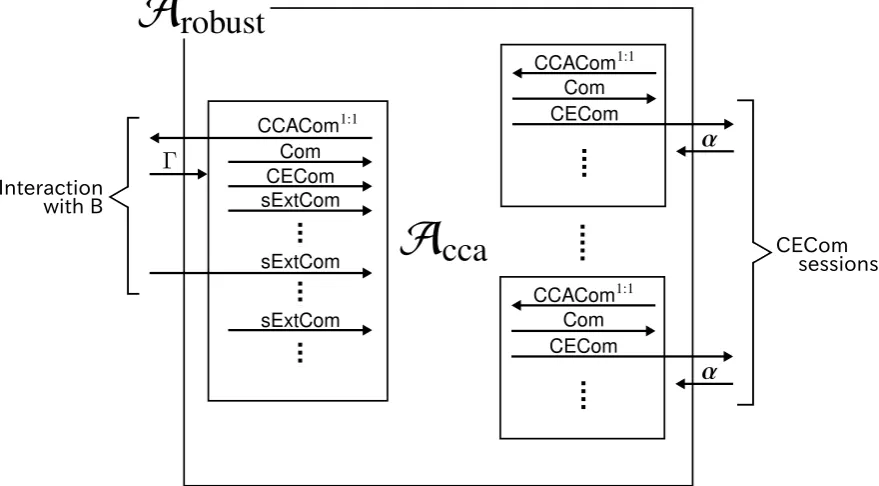
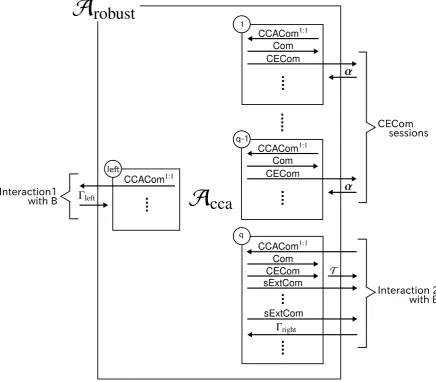
• The oracle computes the committed value of each right session from the shares that are ex-tracted from the row ofCECom, and those shares are extracted using the robust concurrent ex-tractability ofCEComso that the row ofCCACom1:1in the left session, the row ofCCACom1:1 in the target right session, and the row ofsExtComin the target right session are not rewound during the extraction. (Such robust concurrent extraction is possible since the total round com-plexity of these rows isO(logn) and the parameterℓofCEComsatisfiesℓ=ω(log2n).)
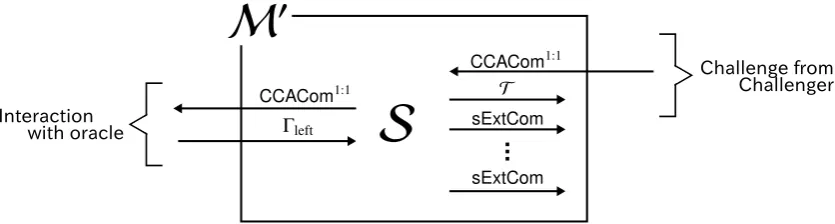
Since the oracle returns the committed values only in the right session that terminates before the target right session, and it is assumed that the adversary does not cheat in such right sessions, we can show, as before, that the oracle is correctly emulated in this hybrid. Thus, the adversary cheats in the target right session with non-negligible probability even in this hybrid. Now, since this hybrid runs in polynomial time except when extracting the subset from theCCACom1:1commitment in the left session, we can break the one-one CCA security ofCCACom1:1 in the target right session by extracting the shares committed to in the row ofsExtComin the target right session and checking the locations where the adversary does not commit touj=(sj,dj,ej) in the row ofsExtComas specified
by the scheme, while simulating the left session using the committed-value oracle ofCCACom1:1. Hence, we conclude that the adversary does not cheat in the right sessions except with negligible probability.
Remark1. In the above explanation, we assume that sExtComhas a robust extractability property such that the extraction from the row ofsExtComis possible even while theCCACom1:1commitment in the left session is forwarded to the committed-value oracle ofCCACom1:1. In the actual proof, we remove the necessity of robust extractability by increasing the number of rows ofsExtCom to RCCA1:1+1, whereRCCA1:1 is the round complexity ofCCACom1:1. WithRCCA1:1+1 rows ofsExtCom,
we can argue that one of the rows ofsExtComin the target right session does not “interleave” with theCCACom1:1commitment of the left session, so we extract the values that are committed to in this
Remark2. We note that in the above argument,CCACom1:1 need to be one-one CCA secure (rather than just non-malleable) since we need to obtain the committed subset from the oracle immediately after completing the query to the oracle (and possibly before completing the challenge commitment). We also note that sExtCom must be strongly extractable since otherwise the adversary may give invalid commitments in more thann locations without being detected in the cut-and-choose phase. (As explained in Section 2.1, the existence of such an adversary does not contradict the one-one CCA
security ofCCACom1:1if over-extraction can occur.) ^
Combining Steps 1 and 2, we conclude thatH0andH1are indistinguishable. The
indistinguisha-bility between other neighboring hybrids can be shown similarly.
3
Preliminaries
Throughout the paper, we usento denote the security parameter,Nto denote the set of all natural numbers, andpptas an abbreviation of “probabilistic polynomial time.” For any k ∈ N, we use [k] to denote the set{1,2, . . . ,k}. For any two ensembles of random variables,{Xn}n∈N and{Yn}n∈N, we
use{Xn}n∈N c
≈ {Yn}n∈Nto denote that{Xn}n∈Nand{Yn}n∈Nare computationally indistinguishable and
{Xn}n∈N s
≈ {Yn}n∈Nto denote that{Xn}n∈Nand{Yn}n∈N are statistically indistinguishable. We assume
familiarity with the notion of cryptographic protocols, which are formalized as interactions between interactive Turing machines (ITMs). We remind the reader that theviewof a party in the execution of a cryptographic protocol consists of the input of the party, randomness of the party, and all the messages received by the party.
3.1 Shamir’s Secret Sharing
We first recall Shamir’s secret sharing scheme. (In this paper, we use only the (n+ 1)-out-of-10n version of it.) To compute a (n+1)-out-of-10nsecret sharings=(s1, . . . ,s10n) of a valuev∈GF(2n),
we choose randoma1, . . . ,an ∈GF(2n), let p(z)
def
= v+a1z+· · ·+anzn, and setsi := p(i) for each
i∈ [10n]. Givens, we can recovervby obtaining polynomial p(·) thorough interpolation and then computingp(0). We useDecode(·) to denote a function that recoversvfromsas above.
For any positive real number x ≤ 1 and anys = (s1, . . . ,s10n) and s′ = (s′1, . . . ,s′10n), we say
thatsands′ are x-close if|{i ∈ [10n] s.t. si = s′i}| ≥ x·10n. Ifsands′ are not x-close, we say
that they are (1− x)-far. Since the shares generated by (n+1)-out-of-10nShamir’s secret sharing scheme are actually a codeword of the Reed-Solomon code with minimum relative distance 0.9, if a (possibly incorrectly generated) sharingsis 0.55-close to a valid codewordw, we can recoverw fromsefficiently by using, for example, the Berlekamp-Welch algorithm.
The following technical lemma will be used in the analyses of our commitment schemes in Sec-tions 4.1 and 5.
Lemma 1. Let x = (x1, . . . ,x10n) andy = (y1, . . . ,y10n) be any (possibly incorrectly generated)
shares of(n+ 1)-out-of-10n Shamir’s secret sharing scheme, where some of these shares may be equal to a special error symbol⊥. For any setΓ⊂[10n]of size n, letValueΓ(·)be the function that is defined in Figure 1. Then, we haveValueΓ(x)=ValueΓ(y)if the following three conditions hold.
1. For every i∈[10n], if xi ,⊥, it holds xi =yi.
2. |{i∈[10n]s.t. xi =⊥}|<n∧{i∈[10n]s.t. xi=⊥} ∩Γ =∅.
3. x is either0.9-close to a valid codewordw = (w1, . . . ,w10n) that satisfies wi = xi for every
Reconstruction procedureValueΓ(s). Fors=(s1, . . . ,s10n), the output ofValueΓ(s) is
com-puted as follows. Ifsis 0.9-close to a valid codewordw =(w1, . . . ,w10n) that satisfieswi = si
for everyi∈Γ, thenValue(s) is the value that is decoded fromw, i.e.,ValueΓ(s)def= Decode(w). Otherwise,ValueΓ(s)def= ⊥.
Figure 1: FunctionValueΓ(·).
Proof . We consider two cases.
Case 1.xis0.9-close to a valid codewordw=(w1, . . . ,w10n)that satisfieswi = xifor everyi∈Γ:
First, we observe thatyis also 0.9-close tow. Sincewis a valid codeword, we havewi , ⊥
for every i ∈ [10n]; thus, we have xi , ⊥for everyisuch that xi = wi. Also, from the first
assumed condition, we have xi=yifor everyisuch that xi,⊥. Therefore, we haveyi =wifor
everyisuch thatxi =wi. Then, sincexis 0.9-close towfrom the assumption of this case, we
have thatyis 0.9-close tow.
Next, we observe thatwsatisfieswi =yifor everyi∈Γ. From the second assumed condition,
we have xi , ⊥for everyi∈ Γ. Also, from the first assumed condition, we have xi = yi for
everyisuch thatxi ,⊥. Thus, we have xi =yifor everyi∈Γ. Then, since we havewi= xi for
everyi∈Γfrom the assumption of this case, we havewi=yifor everyi∈Γ.
Now, sinceyis 0.9-close tow, andwsatisfieswi = yifor everyi ∈Γ, we haveValueΓ(x) =
ValueΓ(y)=Decode(w) from the definition ofValueΓ(·).
Case 2.xis0.2-far from any valid codewordw=(w1, . . . ,w10n)that satisfieswi= xifor everyi∈Γ:
For any valid codewordw′ = (w′1, . . . ,w′10n) that satisfiesw′i = yi for everyi∈Γ, we observe
thatyis 0.1-far fromw′. Since we havexi ,⊥for everyi∈Γ(the second assumed condition)
andxi =yifor everyisuch thatxi ,⊥(the first assumed condition), we havexi =yi for every
i ∈Γ. Then, since we havew′i = yi for everyi∈ Γ, we havew′i = xi for everyi∈Γ. Thus,x
is 0.2-far fromw′from the assumption of this case. Now, sincexandyare 0.9-close from the first and second assumed conditions, it follows thatyis 0.1-far fromw′.
Now, from the definition ofValueΓ(·), we conclude thatValueΓ(x)=ValueΓ(y)=⊥.
Notice that from the third assumed condition, either Case 1 or 2 is true. This concludes the proof of
Lemma 1. □
3.2 Commitment Schemes
Definition 1(Statistical binding property). For a commitment scheme⟨C,R⟩and any (not necessarily
ppt) adversarial committer C∗, consider the following probabilistic experimentExpbind(⟨C,R⟩,C∗,n,z) for any n∈Nand z∈ {0,1}∗.
On input1n and auxiliary input z, the adversary C∗interacts with an honest receiver in the commit phase of ⟨C,R⟩and then outputs two decommitments, (v0,d0) and(v1,d1).
Then, C∗is said to win the experiment if v0 , v1 but the receiver accepts both(v0,d0)
and(v1,d1)in the decommit phase.
Then,⟨C,R⟩isstatistically bindingif for any sequence of auxiliary inputs{zn}n∈N, the probability that
C∗wins the experimentExpbind(⟨C,R⟩,C∗,n,zn)is negligible. ^
Definition 2(Computational hiding property). For a commitment scheme ⟨C,R⟩ and any ppt ad-versarial receiver R∗, consider the following probabilistic experimentExphideb (⟨C,R⟩,R∗,n,z)for any b∈ {0,1}, n∈N, and z∈ {0,1}∗.
On input1n and auxiliary input z, the adversary R∗chooses a pair of challenge values v0,v1∈ {0,1}nand then interacts with an honest committer in the commit phase of⟨C,R⟩,
where the committer commits to vb. The output of the experiment is the view of R∗
LetExphideb (⟨C,R⟩,R∗,n,z) denote the output of experiment Exphideb (⟨C,R⟩,R∗,n,z). Then, ⟨C,R⟩ is computationally hidingif the following are computationally indistinguishable.
• {Exphide0 (⟨C,R⟩,R∗,n,z)}
n∈N,z∈{0,1}∗
• {Exphide1 (⟨C,R⟩,R∗,n,z)}
n∈N,z∈{0,1}∗
^
Unless stated otherwise, all the commitment schemes in this paper are statistically binding and com-putationally hiding. We say that a commitment is acceptingif the receiver does not abort in the commit phase, andvalidif there exists a value to which the commitment can be decommitted (i.e., if there exists a decommitment that the verifier accepts in the decommit phase). Thecommitted valueof a commitment is the value to which the commitment can be decommitted; we define the committed value of an invalid commitment as⊥.
There exists a two-round statistically binding commitment schemeCombased on one-way func-tions [Nao91, HILL99], and it uses the underlying one-way function in a black-box way.
Strong Computational Binding Property. We say that a commitment scheme ⟨C,R⟩ satisfies
strong computational binding propertyif anypptcommitterC∗can generate a commitment that has more than one committed value with at most negligible probability.6 A formal definition of the strong computational binding property is given below.
Definition 3(Strong computational binding property). For a commitment scheme⟨C,R⟩and anyppt adversarial committer C∗, consider the following probabilistic experiment Expbind2(⟨C,R⟩,C∗,n,z) for any n∈Nand z∈ {0,1}∗.
On input1n and auxiliary input z, the adversary C∗interacts with an honest receiver in the commit phase of⟨C,R⟩. Then, C∗ is said to win the experiment if there exists two decommitments, (v0,d0) and(v1,d1), such that v0 , v1 but the receiver accepts both
(v0,d0)and(v1,d1)in the decommit phase.
6The standard computational binding property guarantees that for any
LetCombe the two-round statistically binding commitment scheme that is mentioned in Sec-tion 3.2.
Commit Phase
The committerCand the receiverRtake common input 1n, andCadditionally takes private input v∈ {0,1}n. To commit tov, the committerCdoes the following with the receiverR.
commit stage. Cchoosesnindependent random pairs{(ai0,ai1)}i∈[n] such thatai0⊕ai1 =vfor
everyi ∈ [n]. Then, Ccommits to ai0 andai1for everyi ∈ [n] by using Com. For each i∈[n] andb∈ {0,1}, letcibbe the commitment toaib.
challenge stage. Rsends uniformly random bits{ei}i∈[n]toC.
reply stage. Cdecommitsciei toaiei for everyi∈[n].
Decommit Phase
CsendsvtoRand decommitsci0andci1toai0andai1for everyi∈[n]. Then,Rchecks whether a00⊕a01=· · ·=an0⊕an1=v.
Figure 2: Extractable commitment schemeExtCom[PW09].
Then,⟨C,R⟩isstrongly computationally bindingif for any sequence of auxiliary inputs{zn}n∈N, the
probability that C∗wins the experimentExpbind2(⟨C,R⟩,C∗,n,zn)is negligible. ^
3.3 Extractable Commitment Schemes
We next recall the definition ofextractable commitment schemesfrom [PW09]. Roughly speaking, a commitment scheme isextractableif there exists an expected polynomial-time oracle machine, called extractor E, such that for any adversarial committerC∗that gives a commitment to honest receiver, EC∗ extracts the committed value of the commitment from C∗ as long as the commitment is valid. We note that when the commitment is invalid,Ecan output an arbitrary garbage value; this is called over-extraction.
Formally, extractable commitment schemes are defined as follows. A commitment scheme⟨C,R⟩ isextractableif there exists an expected polynomial-time extractorEsuch that for anypptcommitter C∗, the extractorEC∗ outputs a pair (τ, σ) that satisfies the following properties.
• τis identically distributed with the view of C∗ that interacts with an honest receiverRin the commit phase of⟨C,R⟩. Letcτbe the commitment thatC∗gives inτ.
• Ifcτis accepting, thenσ,⊥except with negligible probability.
• Ifσ,⊥, then it is statistically impossible to decommitcτto any value other thanσ.
There exists a four-round extractable commitment schemeExtCombased on one-way functions [PW09], and it uses the underlying one-way function in a black-box way. Furthermore, ExtCom satisfies extractability in a stronger sense: It is extractable even against adversarial committers that give polynomially manyExtComcommitmentsin parallel. (The extractor outputs (τ, σ1, σ2, . . .) for
LetCombe the two-round statistically binding commitment scheme that is mentioned in Sec-tion 3.2.
Commit Phase
The committerCand the receiverRtake common input 1n, andCadditionally takes private input v∈ {0,1}n. To commit tov, the committerCdoes the following with the receiverR.
commit stage. Cchooses a pair of randomn-bit strings (a0,a1) such thata0⊕a1=v. Then,C
commits toa0anda1by usingCom. For eachb∈ {0,1}, letcbbe the commitment toab.
challenge stage. The receiverRsends a random bite∈ {0,1}toC.
reply stage. Cdecommitscetoae.
Decommit Phase
CsendsvtoRand decommitsc0andc1toa0anda1. Then,Rchecks whethera0⊕a1 =v.
Figure 3: Weakly extractable commitment schemewExtCom[GLOV12].
Strongly Extractable Commitment Schemes. We also use a stronger notion of extractability called strong extractability. Roughly speaking, an extractable commitment scheme is strongly extractable if no over-extraction occurs during the extraction. Formally, a statistically binding commitment scheme ⟨C,R⟩isstrongly extractableif there exists an expected polynomial-time extractorEsuch that for any pptcommitterC∗, the extractorEC∗ outputs a pair (τ, σ) that satisfies the following properties.
• τis identically distributed with the view of C∗ that interacts with an honest receiverRin the commit phase of⟨C,R⟩. Letcτbe the commitment thatC∗gives inτ.
• Ifcτis invalid, thenσ=⊥except with negligible probability.
• Ifcτis valid, then it is statistically impossible to decommitcτto any value other thatσ.
Weakly Extractable Commitment Schemes. We also use a weaker notion of extractability called
weak extractability. A commitment scheme⟨C,R⟩isweakly extractableif there exists an expected polynomial-time extractorEsuch that for anypptcommitterC∗, the extractorEC∗outputs a pair (τ, σ) that satisfies the following properties.
• τis identically distributed with the view of C∗ that interacts with an honest receiverRin the commit phase of⟨C,R⟩. Letcτbe the commitment thatC∗gives inτ.
• The probability thatcτis accepting andσ=⊥is at most 1/2.
• Ifσ , ⊥, thencτ is valid and it is statistically impossible to decommitcτ to any value other thanσ.
CEComis based on the extractable commitment schemeExtComin Figure 2, which consists of three stages—commit,challenge, andreply.
Commit Phase
The committerC and the receiverR take common input 1n and parameter ℓ. (In [MOSV06], ℓ =ω(logn).) To commit tov ∈ {0,1}n, the committerC commits tovconcurrentlyℓtimes by usingExtComas follows.
1. CandRexecutecommitstage ofExtComℓtimes in parallel.
2. CandRdo the following for each j∈[ℓ] in sequence.
(a) Rsends thechallengemessage ofExtComfor the j-th session.
(b) Csends thereplymessage ofExtComfor the j-th session.
Decommit Phase
CsendsvtoRand decommits all theExtComcommitments.
Figure 4: Concurrently extractable commitmentCECom[MOSV06].
3.4 Concurrently Extractable Commitment Schemes
We next recall the notion of concurrently extractable commitment schemes. Roughly speaking, a commitment scheme isconcurrently extractableif there exists a polynomial-time extractor such that for any adversarial committer that commits to polynomially many values concurrently, the extractor can extract the committed values of all the valid commitments from the committer.
There exists aO(loge n)-round concurrently extractable commitmentCECombased on one-way functions [MOSV06], and it uses the underlying one-way function in a black-box way. CECom is an abstraction of the preamble stage of the concurrent zero-knowledge protocol of Prabhakaran et al. [PRS02], and the extractor ofCEComperforms the extraction by rewinding the adversarial committer according to the carefully designed rewinding strategy of [PRS02, PTV14]. CEComis described in Figure 4. We remark thatCEComhas a parameterℓ, which is the number ofExtComcommitments that are generated in aCEComcommitment. (In [MOSV06],ℓ=ω(logn).)
3.4.1 Robust Concurrent Extraction Lemma [GLP+15]
only with negligible probability if we setℓ:=ω(klogn).
A formal description of the robust concurrent extraction lemma is given below. (Large parts of the text below are taken from [GLP+15].)
The external protocolΠ. LetΠ:= ⟨B,A⟩be an arbitrary two-party protocol. Let domB(n) denote
the domain of the input forBandk:=k(n) denote the round complexity ofΠ.
The robust-concurrent attack. Letx∈domB(n). In therobust-concurrent attack, the adversaryA
interacts with a special (possibly super-polynomial-time) partyEcalled theonline extractor. The on-line extractorEsimultaneously participates in one execution ofΠand several executions ofCECom, whereEinteracts withAas an honestB(1n,x) in the execution ofΠand interacts withAas an honest receiver in each execution ofCECom. The scheduling of all messages in all sessions—Πas well as CECom—is controlled byA. WhenAsuccessfully completes aCEComcommitments, the online extractorEsends a valueαstoA.
Forn ∈N,x ∈ domB(n),z ∈ {0,1}∗, let RealAE,Π(n,x,z) denote the following probabilistic exper-iment: On inputs 1n, x,z, the experiment starts an execution ofA(1n,z), which launches the robust-concurrent attack by interacting withE(1n,x,z); the output of the experiment is the view ofAand the output ofB(who was emulated byE). LetRealAE,Π(n,x,z) denote the output of RealAE,Π(n,x,z).
The robust concurrent extraction lemma. Roughly speaking, the lemma states that there exists
an interactive Turing machine, called therobust simulator, that statistically simulatesRealAE,Π(n,x,z) even if the value that the online extractor E returns to A at the end of each successful CECom commitment is the committed value of this commitment. Furthermore, the robust simulator does not “rewind” Band runs in time polynomial in the number of the sessions opened byA. A formal statement of the lemma is given below.
Lemma 2(Robust Concurrent Extraction Lemma [GLP+15]). There exists an interactive Turing ma-chine S called a robust simulator such that for every adversary A and every two-party protocol
Π:=⟨B,A⟩, there exists a partyEcalled anonline extractorsuch that for every n∈N, x∈domB(n),
and z∈ {0,1}∗, the following conditions hold:
1. Validity constraint. For every viewρofAinRealAE,Π(n,x,z)and for everyCEComcommitment s appearing in ρ, if there exists a unique value v ∈ {0,1}n to which the commitment s can be decommitted, then
αs=v,
whereαsis the value thatEsends toAat the end of s.
2. Statistical simulation.Let k =k(n)be the round complexity ofΠ. Then the statistical distance betweenRealAE,Π(n,x,z)andoutputB,S[B(1n,x)↔ SA(1n,z)]is given by
∆(n)≤2−Ω(ℓ−k·logT(n)),
Commit Phase
To commit to σ ∈ {0,1} on common input 1n, the committerC does the following with the receiverR:
Step 1. Rchooses a randomn-bit stringe=(e1, . . . ,en) and commits toeby usingCom.
Step 2. For eachi∈[n], the committerCchooses a randomηi ∈ {0,1}and then sets
vi := (
v00i v01i v10i v11i
)
=
(
ηi ηi
σ⊕ηi σ⊕ηi )
.
Then, for eachi ∈ [n],α ∈ {0,1}, and β ∈ {0,1} in parallel,C commits tovαβi by using ExtCom; let (vαβi ,dαβi ) be the corresponding decommitment.
Step 3. Rdecommits the commitment in Step 1 toe.
Step 4. For eachi∈[n],Csends (vei0
i ,d ei0
i ) and (v ei1
i ,d ei1
i ) toR. Then,Rchecks whether these
are valid decommitments and whethervei0
i =v ei1
i .
Decommit Phase
C sends σand random γ ∈ {0,1} to R. In addition, for everyi ∈ [n],C sends (v0iγ,d0iγ) and (v1iγ,d1iγ) to R. Then, Rchecks whether (vi0γ,di0γ) and (vi1γ,d1iγ) are valid decommitments and whetherv00γ⊕v10γ =· · ·=v0nγ⊕v1nγ =σ.
Figure 5: Black-box trapdoor bit commitment schemeTrapCom.
3.5 Trapdoor Commitment Schemes
We next recall trapdoor commitment schemes [PW09]. Roughly speaking, trapdoor commitment schemes are commitment schemes such that there exists a simulator that can generate a simulated commitment and can later decommit it to any value. Pass and Wee [PW09] showed that the black-box schemeTrapComin Figure 5 is a trapdoor bit commitment.TrapComis not statistically binding, but it satisfies the strong computational binding property. (The strong computational binding property holds since if an adversarial committerC∗generates aTrapComcommitment that can be decommitted to both 0 and 1, we can break the hiding property ofComusingC∗by extracting the committed values of theExtComcommitments fromC∗and then computing the committed valueeofComfrom them.) Pass and Wee also showed that by runningTrapComin parallel, we can obtain a black-box trapdoor commitment schemePTrapComfor multiple bits.PTrapComalso satisfies the strong computational binding property.
3.6 CCA-Secure Commitment Schemes
CCA Security (w.r.t. the Committed-Value Oracle)
Roughly speaking, a tag-based commitment scheme (i.e., a commitment scheme that takes ann-bit string, atag, as an additional input)⟨C,R⟩isCCA-secureif its hiding property holds even against any adversaryAthat interacts with thecommitted-value oracleduring the interaction with the committer. The committed-value oracleOinteracts withA as an honest receiver in many concurrent sessions of the commit phase of⟨C,R⟩using tags chosen adaptively byA. At the end of each session, if the commitment of this session is invalid or has multiple committed values,Oreturns⊥toA. Otherwise, Oreturns the unique committed value toA.
More precisely, let us consider the following probabilistic experiment INDb(⟨C,R⟩,A,n,z) for
eachb ∈ {0,1}. On input 1n and auxiliary inputz, the adversary AO adaptively chooses a pair of challenge valuesv0,v1∈ {0,1}nand ann-bit tagtag∈ {0,1}n. Then,AOreceives a commitment tovb
with tagtagfrom the challenger. Letybe the output ofA. The output of the experiment is⊥if during the experiment,AsendsOany commitment using tag tag. Otherwise, the output of the experiment isy. LetINDb(⟨C,R⟩,A,n,z) denote the output of experiment INDb(⟨C,R⟩,A,n,z).
Definition 4. Let⟨C,R⟩be a tag-based commitment scheme andObe the committed-value oracle of ⟨C,R⟩. Then,⟨C,R⟩isCCA-secure (w.r.t the committed-value oracle)if for anypptadversaryA, the following are computationally indistinguishable:
• {IND0(⟨C,R⟩,A,n,z)}n∈N,z∈{0,1}∗
• {IND1(⟨C,R⟩,A,n,z)}n∈N,z∈{0,1}∗
Theleft session is the session between the challenger andA, and right sessions are the sessions
betweenAandO. ^
We say a commitment scheme isone-one CCA-secureif it is CCA secure w.r.t. a restricted class of adversaries that start only a single right session.
κ-Robustness (w.r.t. the Committed-Value Oracle)
Roughly speaking, a tag-based commitment scheme isκ-robustif for any adversaryAand any ITM B, apptsimulator can simulate the joint output of aκ-round interaction betweenAOandB. Thus, the κ-robustness guarantees that the committed-value oracle is useless for attacking anyκ-round protocol.
Definition 5. Let⟨C,R⟩be a tag-based commitment scheme andObe the committed-value oracle of ⟨C,R⟩. For any constantκ ∈N, we say that⟨C,R⟩isκ-robust (w.r.t. the committed value oracle)if for anypptadversaryA, there exists apptmachineScalled asimulatorsuch that for anyκ-round pptITM B, the following are computationally indistinguishable:
• {outputB,AO [
B(1n,y)↔ AO(1n,z)]}
n∈N,y,z∈{0,1}n
• {outputB,S[B(1n,y)↔ S(1n,z)]}
n∈N,y,z∈{0,1}n
Here, for any ITMs A and B, we useoutputA,B[A(1n,y)↔B(1n,z)] to denote the joint output of A and B in an interaction between them on inputs(1n,y)to A and(1n,z)to B, respectively. If⟨C,R⟩is κ-robust for any constantκ, we say that⟨C,R⟩isrobust. ^
4
Building Blocks
4.1 Strongly Extractable Commitment Scheme
Using one-way functions in a black-box way, we construct a constant-round strongly extractable com-mitment schemesExtCom. Recall that a commitment scheme is strongly extractable if a rewinding extractor outputs a correct committed value when the commitment is valid and outputs⊥when the commitment is invalid.
Lemma 3. Assume the existence of one-way functions. Then, there exists a constant-round strongly extractable commitment schemesExtComthat uses the underlying one-way function only in a black-box way.
Proof . The schemesExtComis shown in Figure 6, in which we use the following tools (all of which can be constructed from one-way functions in a black-box way).
• A two-round statistically binding commitment schemeCom. (See Section 3.2.) • A constant-round extractable commitment schemeExtCom. (See Section 3.3.)
• The constant-round weakly extractable commitment schemewExtComof Goyal et al. [GLOV12]. (See Section 3.3.)
We prove the binding property and the hiding property in Section 4.1.1 and the strong extractability in Section 4.1.2.
4.1.1 Proofs of Binding and Hiding
First, we show thatsExtComis statistically binding and computationally hiding. The binding prop-erty follows directly from that ofExtCom. To show the hiding property, we consider the following hybrid experiments for anypptcheating receiverR∗and eachb∈ {0,1}.
HybridH0b(n,z) is an experiment in which R∗ takes input 1n and auxiliary input z and receives a sExtComcommitment toσbfrom an honest committer, where (σ0, σ1) is the challenge values
thatR∗chooses at the beginning. The output ofH0b(n,z) is that ofR∗.
HybridH1b(n,z) is the same asH0b(n,z) except that thesExtComcommitment from the committer is modified as follows.
• In Step 1, the committed valueΓis extracted by brute force. • In Step 2, the committer commits to 0|sj|instead ofs
jfor every j<Γ.
• In Step 3, the committer commits to (0|sj|,0|dj|) instead of (s
j,dj) for every j<Γ.
LetHbi(n,z) be the random variable representing the output of Hib(n,z) fori ∈ {0,1}andb ∈ {0,1}. From the construction, R∗ receives no information about b in Hb
1(n,z) for eachb ∈ {0,1}, so the
Commit Phase
The committerCand the receiverRtake common input 1n, andCadditionally takes private input σ∈ {0,1}n. To commit toσ, the committerCdoes the following with the receiverR.
Step 1. Rcommits to a random subsetΓ⊂[10n] of sizenby usingCom.
Step 2. Ccomputes an (n+1)-out-of-10nShamir’s secret sharings=(s1, . . . ,s10n) of valueσ.
Then, for each j∈[10n] in parallel,Ccommits tosjby usingExtCom. Letϕ1, . . . , ϕ10n
be the commitments andd1, . . . ,d10nbe the decommitments.
Step 3. For eachj∈[10n] in parallel,Ccommits to (sj,dj) by usingwExtCom. Letψ0, . . . , ψ10n
be the commitments.
Step 4. Rdecommits the commitment in Step 1 toΓ.
Step 5. Cdecommits the j-thwExtComcommitmentψj in Step 3 to (sj,dj) for each j∈Γ. R
checks whether (sj,dj) is a valid decommitment of the j-thExtComcommitmentϕjin
Step 2 for every j∈Γ.
Decommit Phase
• Csendsσand decommits theExtComcommitmentsϕ1, . . . ϕ10nin Step 2 tos1, . . . ,s10n.
• Raccepts if and only if the following holds w.r.t.s=(s1, . . . ,s10n), wheresjis defined to
be⊥if the decommitment ofϕjis invalid.
– sis 0.9-close to a valid codewordw=(w1, . . . ,w10n) that satisfieswj= sjfor every
j∈Γ, andwis a codeword ofσ.
4.1.2 Proof of Strong Extractability.
Next, we show thatsExtCom is strongly extractable. That is, we show that an extractor extracts a correct committed value from a validsExtCom commitment and extracts ⊥from an invalid one except with negligible probability.
We first remark that from the construction of the decommit phase ofsExtCom, the committed value ofsExtComis defined as follows.
Definition 6(Committed value ofsExtCom). If the sharess = (s1, . . . ,s10n) that are committed to
in Step 2 are0.9-close to a valid codewordw=(w1, . . . ,w10n)that satisfies wj = sj for every j∈Γ,
the committed value of asExtComcommitment isDecode(w). Otherwise, the committed value is⊥
(i.e., the commitment is invalid). ^
We notice that the functionValueΓ(·) in Figure 1 (Section 3.1) computes the committed value of a sExtComcommitment as above on input the sharessthat are committed to in Step 2.
Our extractorEextracts the committed value of asExtComcommitment by extracting the com-mitted values of theExtComcommitments in Step 2. Formally, for any pptcheating committerC∗, the extractorEdoes the following.
• Einternally invokesC∗and interacts withC∗as a receiver honestly except thatEextracts the committed values of the theExtComcommitments in Step 2 by using their extractability. Let τbe the view of internalC∗. If thesExtComcommitment inτis rejecting orEfails to extract the committed values of theExtComcommitments in Step 2,Esetseσ:=⊥. Otherwise,Esets
e
σ:=ValueΓ(es), whereesis the shares that are extracted from theExtComcommitments andΓ is the subset that is committed to in Step 1. Ethen outputs (τ,σe).
From the extractability ofExtCom, the simulated viewτis identically distributed with the real view. Hence, it remains to show thateσis a committed value ofτexcept with negligible probability.
Fix anypptcheating committerC∗. Without loss of generality, we assume thatC∗is deterministic. First, we show that the extracted valueeσis indeed equal to a committed value of the simulated viewτas long as theExtComcommitments in Step 2 inτare “good.”
Definition 7(GoodExtCom commitments in Step 2). In a sExtComcommitment, we say that the
ExtComcommitments in Step 2 aregoodif all of the following conditions hold. • Their committed valuess=(s1, . . . ,s10n)are uniquely determined.
(That is, none of them has more than one committed value.)
• {j∈[10n]s.t. sj =⊥}<0.5n.
(That is, less than0.5n of them are invalid.)
• sis either 0.9-close to a valid codeword w = (w1, . . . ,w10n)that satisfies wj = sj for every
j∈Γor0.2-far from any such valid codeword.
^
![Figure 8: Description of the schedules used in Stage 2 of the protocol of [LP12]. (α(1, β1, γ1) andα2, β2, γ2) are the transcripts of a pair of rows in Stage 2.](https://thumb-us.123doks.com/thumbv2/123dok_us/7911951.1313681/30.595.231.377.567.656/figure-description-schedules-stage-protocol-anda-transcripts-stage.webp)