On the quaternion
`
-isogeny path problem
David Kohel, Kristin Lauter, Christophe Petit?, Jean-Pierre Tignol
Institut de Math´ematiques de Marseille,Microsoft Research,
Universit´e catholique de Louvain,Universit´e catholique de Louvain
To appear in the LMS Journal of Computation and Mathematics, as a special issue for ANTS (Algorithmic Number Theory Symposium) conference.
Abstract. Let O be a maximal order in a definite quaternion algebra
over Q of prime discriminant p, and ` a small prime. We describe a
probabilistic algorithm, which for a given leftO-ideal, computes a
repre-sentative in its left ideal class of`-power norm. In practice the algorithm
is efficient, and subject to heuristics on expected distributions of primes, runs in expected polynomial time. This breaks the underlying problem for a quaternion analog of the Charles-Goren-Lauter hash function, and has security implications for the original CGL construction in terms of supersingular elliptic curves.
1
Introduction
In this paper, we provide a probabilistic algorithm to solve a quaternion ideal analog of the path problem in supersingular`-isogeny graphs. The main result is an algorithm for the following. Let Bp,∞ be a quaternion algebra over Q ramified at p and ∞. Let ` be a “small” prime, typically 2 or 3, or any small constant prime. Given a maximal quaternion orderOinBp,∞and a leftO-ideal
I, compute an equivalent left O-ideal J = Iβ with norm `k for some k. This algorithm runs in practice in probabilistic polynomial time, and this effective runtime follows from heuristic assumptions on expected distributions of primes. With minimal adaptation, the algorithm also applies to output an ideal with smooth (or power-smooth) norm. The algorithm is described in terms of a special maximal order, but extends to any maximal order by passing through such a special order.
The motivation for this problem is an explicit equivalence of categories be-tween leftO-ideals and supersingular elliptic curves (over ¯Fp). The Deuring cor-respondence gives a bijection between such curves, up to Galois conjugacy, and isomorphism classes of maximal orders in Bp,∞. This bijection can be turned
into an equivalence of categories by the following construction. Let E0/K be
a fixed elliptic curve with endomorphism ring O = End(E0) a quaternion
or-der in Bp,∞ =O ⊗Q(we may take the base field K =Fp2 andE0 such that
?
The third author is supported by an F.R.S.-FNRS postdoctoral research fellowship
|E0(K)| = (p+ 1)2). Associated to any pair (E1, ϕ) whereϕ : E0 → E1 is an
isogeny, we obtain a left O-ideal I = Hom(E1, E0)ϕ of norm n = deg(ϕ) and
conversely every leftO-ideal arises in this way (see Kohel [9, Section 5.3]). In par-ticular, given any isogenyψ:E0→E1of degreem, the leftO-idealJ =Iϕψ/nˆ
is an equivalent ideal of normm, where ˆψis the dual ofψ.
The problem we address in this work is to solve the quaternion version of the supersingular`-isogeny path problem: givenE0,E1and a small prime`, find an
`-power isogeny from E0 toE1. Under this equivalence of categories, the
anal-ogous problem is the determination of a `-power norm leftO-ideal in the class of a given leftO-idealI. After introducing the necessary background on quater-nion orders and ideals in Section 2 and addressing some preliminary algorithmic problems in Sections 3, we solve the`-power norm problem in Section 4. Subject to reasonable heuristics on the probability of finding suitable primes, we obtain a probabilistic algorithm which solves this problem in expected polynomial time. The experimental runtime agrees with the most optimistic predictions for the distribution of primes.
The algorithm gives a clear distinction between the efficiency of the`-isogeny problem in the equivalent category of quaternion ideals, whereas the analogous problem in the category of supersingular elliptic curves, on which the security of the Charles, Goren and Lauter hash function [4] is based, has to date resisted attack. This dichotomy poses several questions on the extent to which the infor-mation from the algebraic category can be transported to the geometric one. In particular, one expects an algorithm for computing the endomorphism ring of a given elliptic curve to provide an effective reduction to the algebraic setting, making the hardness of this problem critical to the underlying security.
2
The quaternion
`
-isogeny path problem
In this section, we first motivate and define the quaternion`-isogeny path prob-lem. We then recall basic facts on quaternion algebras. We introducep-extremal maximal orders, which will play an important role in our solution of the quater-nion`-isogeny problem. We finally discuss properties of reduced norms and ideal morphisms.
2.1 “Hard” isogeny problems
The motivation for studying the quaternion `-isogeny problem is based on the analogous (indeed categorically equivalent) problem for supersingular elliptic curves. The difficulty of this problem for elliptic curves underlies the security of the Charles, Goren and Lauter hash function [4].
As an example, finding a preimage (inverting the function) amounts to solving the following path problem in the supersingular`-isogeny graph:
Problem 1 Let p and ` be prime numbers, p=6 `. Let E0 and E1 be two
su-persingular elliptic curves over Fp2 with |E0(Fp2)|=|E1(Fp2)|= (p+ 1)2. Find
Similarly, finding collisions requires a solution to the following multiple path problem in the supersingular`-isogeny graph:
Problem 2 Let p and ` be prime numbers, p 6= `. Let E0 be a supersingular
elliptic curve over Fp2. Find k1, k2 ∈ N, a supersingular elliptic curve E1 and
two distinct isogenies (i.e. with distinct kernels) of degrees respectively `k1 and
`k2 fromE
0 toE1.
Setting O= End(E0), we have a category of leftO-ideals, with morphisms
I → Iα ⊆ J, for α in B = O ⊗Q, which is equivalent to the category of supersingular elliptic curves and isogenies. The analog of the path problem in supersingular`-isogeny graphs is that of finding a representative idealJfor given
I of norm`k. We call this problem thequaternion`-isogeny path problem, and focus on its effective solution in this article.
2.2 Quaternion algebras
In this work we consider the structure of left ideals of a maximal order in the quaternion algebraBp,∞ ramified only atpand∞. Such an algebra is
isomor-phic to End(E)⊗Qfor any supersingular elliptic curveE/Fp2. Here we denote End(E) = End¯Fp(E) and if we assume #E(Fp2) = (p+ 1)2, then the full endo-morphism ring End(E) is defined overFp2. Any definite quaternion algebra over Qhas a presentation of the formQhi, ji, where i2=a, j2=b,k=ij=−jifor negative integersa, b. The canonical involution on Bp,∞is given by
α=x0+x1i+x2j+x3k7−→α¯=x0−x1i−x2j−x3k.
from which the reduced trace and norm take the form Trd(α) =α+ ¯α= 2x0 and Nrd(α) =αα¯=x20−ax
2 1−bx
2 2+abx
2 3.
The integral basis{1, i, j, k}has the nice property of being an orthogonal basis with respect to the bilinear formhx, yi= Nrd(x+y)−Nrd(x)−Nrd(y) associated to the reduced norm. Nevertheless, the orderO=Zhi, jiis never maximal.
2.3 Extremal orders
In this work we first place the focus on the p-extremal maximal orders O con-tainingπsuch thatπ2=−p. For a general order there exists a unique maximal 2-sided idealPoverp, and this ideal is principal if and only if there exists such an element π. The maximal ideal P is a generator of the 2-sided class group, andp-extremal orders are precisely those of trivial 2-sided class number. In the context of supersingular elliptic curves, these are the maximal orders which are endomorphism rings of elliptic curves defined overFp with Frobenius endomor-phismπ.
p-extremal maximal quaternion orders, we define a specialp-extremal maximal orderO to be ap-extremal maximal order such thatd(O) is minimal.
The following lemma establishes the main properties we need for such an order, after which Lemmas 2, 3, and 4 provide for their existence by explicit construction.
Lemma 1 Let Obe a maximal order inBp,∞ containing a subringZhi, jiwith
i2 =−q, j2=−p, and ij =−ji, forq coprime to p. Set R=O ∩
Q[i] and let
D be its discriminant. If R is the ring of integers of Q[i], then R⊥ = Rj and
R+Rj is a suborder of index|D|inO. Ifω is a generator ofR, then Nrd(x1+y1ω+ (x2+y2ω)j) =f(x1, y1) +pf(x2, y2),
wheref(x, y)is a principal quadratic form of discriminant D.
Proof. The triviality of the trace ofj and the anti-commuting relationij=−ji
imply thatQ(i) has orthogonal complementQ(i)j inBp,∞. ConsequentlyR⊥⊂
Ois a lattice inQ(i)j containingRj, hence of the formaj for a fractional ideal
a ofR which containsR. The primepis inert inR, sincepis ramified inBp,∞
but not inR. Since the norm is integral onaj, and Nrd(j) =p, it follows thata
is integral, hence equalsR. The orthogonality ofRandRjimplies thatjβ = ¯βj
for all β in R, so jR = Rj and R+Rj is closed under multiplication. The form of the norm follows from orthogonality and multiplicativity of the norm: Nrd(β1+β2j) = Nrd(β1)+pNrd(β2). Consequently the discriminant of the norm
form isD2p2, from which we conclude thatR+Rjhas index|D|in any maximal
order.
By convention, for our special p-extremal order O, we fix Z[i] ⊆ R with
i2 =−q andD = disc(R) =−d(O), andj2 =−p(i.e.j =π above). Being of
smallest discriminant, R is necessarily a maximal order whose discriminant is the first of the sequence
−3,−4,−7,−8,−q for primeq≡3 mod 4,
such thatpis ramified or inert inR. The next three lemmas establish existence forq= 1,q= 2, andq≡3 mod 4 prime. These lemmas incorporate and expand on Propositions 5.1 and 5.2 of Pizer [12]. We recall that an order in a quaternion algebra is Eichlerif it is the intersection of two maximal orders.
Lemma 2 Let p≡3 mod 4 be a prime, and let B =Qhi, ji be the quaternion algebra given by the presentation i2 = −1, j2 = −p, and k = ij = −ji, and set R =Z[i]. Then B is ramified only at pand ∞, and Zhi, ji is contained in exactly two maximal orders with index 4, described by the inclusion chains:
Zhi, ji( Zhi,
1 +i+j+k
2 i(
Zhi, 1 +j
2 i, Zhi,1 +k
2 i·
Lemma 3 Let p≡5 mod 8 be a prime, and let B =Qhi, ji be the quaternion algebra given by the presentation i2 = −2, j2 = −p, and k = ij = −ji, and
set R =Z[i]. Then B is ramified only at pand ∞, and Zhi, ji is contained in exactly two maximal orders with index 8, described by the inclusion chains:
Zhi, ji( Zhi, j,
i+k
2 i( Zhi,
i+k
2 ,
1 +j+k
2 i(
Zhi,1 +j+k
2 ,
i+ 2j+k
4 i, Zhi,
1 +j+k
2 ,
i+ 2j−k
4 i·
In particularZhi, jiis not an Eichler order.
Lemma 4 Let pandqbe primes, with p≡1 mod 4,q≡3 mod 4, and
−p
q
= 1.
Let B =Qhi, jibe the quaternion algebra given by the relations i2=−q,j2 = −p, and k=ij =−ji, and setR =Z[(1 +i)/2]. Then B is ramified only atp and∞, andZh(1 +i)/2, ji=R+Rj is contained in exactly two maximal orders with indexq, described by the inclusion chains:
Zh(1 +i)/2, ji(
Zh 1 +i
2 ,j,
ci+k q i,
Zh1 +i 2 ,j,
ci−k q i,
wherec is any root of x2+pmodq. In particular R+Rj is an Eichler order.
Under the generalized Riemann hypothesis, forp≡1 mod 4, the smallest q
satisfying the conditions of the last lemma isO(log(p)2) by a result of Ankeny [1] (or explicitlyq <2 log(p)2 by Bach [2]). In the remainder of this paper, we will assume thatBp,∞,O, andR are suitably constructed from these lemmas with
disc(R) the minimal discriminant in which pis inert in the sequence −3, −4, −7,−8, or−qforq≡3 mod 4 prime.
2.4 Reduced norms and ideal morphisms
Now suppose that O is any maximal order. We recall that the reduced norm onBp,∞ induces a reduced norm on left ideals defined by any of the equivalent
conditions
Nrd(I) :=p|O/I|= gcd ({Nrd(α) : α∈I}),
modules (with respect to the reduced norm). In particular, an isomorphism sends a reduced basis to a reduced basis. In fact the normalized norm map
qI = Nrd
Nrd(I):I−→Z
remains invariant under this isomorphism, in the sense that qI(α) =qJ(β) for
αin I andβ =αγ in J. The normalized norm qI is a positive-definite integral quadratic map, whose bilinear module given byhx, yi=qI(x+y)−qI(x)−qI(y) has determinantp2. This follows from the same property for any maximal order
(see Pizer [12, Proposition 1.1]), since|O/I| = Nrd(I)2, and the fact that any
submodule of indexmin a quadratic moduleLhas determinantm2det(L).
The following lemma serves to replace an idealI with an isomorphic one of different reduced norm.
Lemma 5 Let I be a left O-ideal of reduced norm N and α an element of I. ThenIγ, where γ= ¯α/N, is a leftO-ideal of normqI(α).
Proof. By the multiplicativity of the reduced norm, and Nrd(α) = Nrd( ¯α), we have
Nrd(Iγ) = Nrd(I)Nrd(γ) =NNrd(α) N2 =
Nrd(α)
N =qI(α).
Clearly I is a fractional leftO-ideal, so it remains to show that Iγ ⊆ O. Since Oα⊆I, we have ¯α⊆I¯, and henceIα¯⊆II¯=NO, from whichIγ ⊆ Ofollows.
3
Preliminary algorithmic results
In this section, we provide two algorithmic tools that will be used to solve the quaternion `-isogeny path problem in Section 4. The first algorithm computes prime norm representatives in ideal classes. The second one computes represen-tations of integers by the norm form of ap-extremal order.
3.1 Computing prime norm representatives in ideal classes
Given a maximal orderOand a leftO-idealI, we give a probabilistic algorithm that computes another left O-idealJ = Iγ in the same class, but with prime norm. Using Lemma 5, this problem reduces to the problem of finding a prime represented byqI.
Prime norm algorithm.Given a leftO-idealIof normN, with a Minkowski-reduced basis {α1, α2, α3, α4}. Generate random elements α = Pixiαi with (x1, x2, x3, x4) in a box [−m, m]4 until finding an element α of I with qI(α) prime, and returnI( ¯α/N).
high probability of finding one. If{α1, α2, α3, α4}is a Minkowski-reduced basis,
theqI(αi) attain the successive minima, and we have the bounds
p2≤16qI(α1)qI(α2)qI(α3)qI(α4)≤4p2,
whereqI(αi)≤qI(αi+1). For a generic idealIwe expectqI(α4) to be in ˜O(
√
p). In the worst case, qI(α4) is in ˜O(p) when I equals an order O containing a
subringRwith|disc(R)|inO(log(p)n). AssumingIis generic, we expect to find
α with qI(α) in ˜O(m2 √
p). In practice, we find sufficiently many primes qI(α) formwhich grows polynomially in log(p). However to provably terminate, even under the GRH, it may be necessary to allowmto exceed a function inO(√4p), in which case the output may exceedO(p).
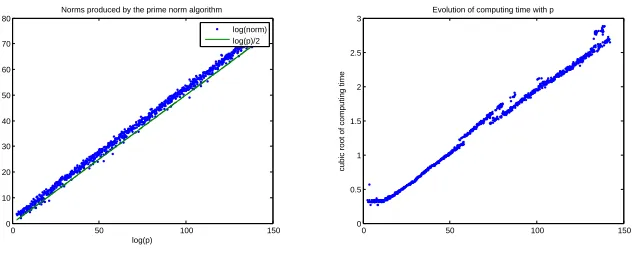
We implemented a prime norm algorithm in Magma [7]. We tested it on ideals of`-power norms generated via a random walk from a given maximal order. All our computations with primes of up to 200 bits and random ideals took seconds on an Intel Xeon CPU X5500 processor with 24 GB RAM running at 2.67GHz. The norms of the output idealsJ were experimentally only slightly larger than √
p. The experimental results are given in Appendix A.1.
3.2 Representing integers by special orders
We also consider the problem of representing a sufficiently large positive integer
M by the norm form ofO. Suppose thatOis ap-extremal order, with suborder
R+Rj, and letD = disc(R). We letΦ(x) be a monotone function such that a suitable interval [x, x+Φ(x)] contains sufficiently many primes, and we assume that M ≥p Φ(M). Ifωis a reduced generator ofR (of trace 0 or±1), then the norm form onR+Rjis of the form
Nrd(α+βj) =f(x1, y1) +pf(x2, y2),
whereα=x1+y1ωandβ=x2+y2ω, andf(x, y) is a principal form. For (x, y)
in [−m, m]2 withm=bp
Φ(M)/|D|c, we havef(x, y)< Φ(M) and Nrd(βj)< p Φ(M)< M. This gives the following algorithm on which we build our strong approximation algorithm.
Integer representation.Given an integerM ≥p Φ(M). Setm=bp
Φ(M)/|D|c, and choose (x2, y2) at random in [−m, m]2 until finding a prime r = M −
pf(x2, y2) which is split in R and for which a prime r over r is principal. Let
α=x1+y1ω be a generator forr, setβ =x2+y2ω, and returnα+βj.
Clearly the output has normM. We assume that primes have density 1/log(M) in the arithmetic progression M −p[0, Φ(M)]. Moreover we assume that such primes are equidistributed among primes which are non-split and split inRand, in the latter case, among each of theh(R) ideal classes of R. Finally, we must assume that elementsβ=x2+y2ω give rise to integersr=M−pNrd(β) with
is 2h(R) log(M). Detecting a primer, solving for a representative primeroverr, and determination of a principal generator can be done in expected polynomial time by Cornaccia’s algorithm [5].
Under the heuristic assumptions made above, we can appeal to average dis-tributions among all arithmetic progressionsa−p[0, Φ(M)], for representatives
aof (Z/pZ)∗. In the application that follows,M will be of the form`e orN `e, and we can adapt to failure to find primes in a particular arithmetic progression sparsely populated with primes by changinge.
4
Main algorithm
In this section, we provide an algorithm to solve the quaternion`-isogeny path problem. We also sketch a generalization of our approach to build ideal class representatives with powersmooth norms.
4.1 Overview of the algorithm
We reduce the quaternion`-isogeny problem to a restricted version of the same problem, where we assume that O is a special p-extremal maximal order with suborderR+Rjas defined in Section 2.2. We also assume thatIis a leftO-ideal with reduced normN, whereN is a (large) prime coprime to`,|disc(R)|andp. A reduction from generic leftO-ideals to leftO-ideals with the required norms can be effectively performed with the algorithm of Section 3.1. A reduction from general maximal orders to special p-extremal orders will be provided in Section 4.6.
Using Lemma 5, the quaternion`-isogeny path problem is also reduced to an effective strong approximation theorem in Section 4.2. In particular if the ideal is given by a pair of generatorsI=O(N, α), the quaternion`-isogeny path problem is reduced to findingλ∈Zcoprime toN and
β ≡λαmodNO with Nrd(β) =N `e for some positive integere.
Sections 4.3, 4.4, and 4.5 describe the core of our approach to solve this problem. Since the index ofR+RjinOis coprime toN, we have an isomorphism
R+Rj N(R+Rj)
∼
= O
NO·
We can therefore choose representative elements in R+Rj as convenient to simplify the algorithm. Since the index [O:R+Rj] =|disc(R)| is assumed to be small (inO(log(p)2) under the GRH), the size of the output might be slightly
larger, but the distinction is asymptotically insignificant. A direct approach to the strong approximation problem to solve forβ seems daunting, so instead we reduce to the following steps:
2. Solve for [µ] in (O/NO)∗ such that (Oγ/NO)[µ] =I/NO.
3. Solve for the strong approximation of [µ] (moduloN) byµin Oof reduced norm`e1.
Here we denote the elementµ+NOofO/NOby [µ] to distinguish it from the conjugate ¯µofµ. The outputβ =γµis then an element ofIwith reduced norm
N `e where e =e0+e1. The elementγ can be constructed with the algorithm
of Section 3.2. We solve for [µ] by linear algebra in Section 4.3, showing that we can take [µ] in (R/N R)∗[j] ⊆ (O/NO)∗. The core of the algorithm is the
final specialized strong approximation algorithm of Section 4.4, taking [µ] in (R/N R)∗[j] and constructing the liftingµof norm`e. The whole algorithm for
p-extremal orders is analyzed in Section 4.5.
As mentioned above, we finally remove thep-extremal condition in Section 4.6 by providing a reduction from the general case to the case ofp-extremal orders, and we generalize our approach to compute ideal representatives of smooth or powersmooth norms in Section 4.7.
4.2 Effective strong approximation
LetB :=Bp,∞ be the quaternion algebra ramified atpand∞. Let AQ be the
rational ad`ele ring, defined as the restricted product of Qv with respect to Zv, let ` 6= p be a “small” prime, and let AQ,` be the restricted product over all
v6=`. LetAB =B⊗QAQ be the ad`ele ring ofB, andAB,`=B⊗AQ,`. ThenB
embeds diagonally inAB and is discrete in AB (see [3, Section 14]). The strong approximation theorem (see [3, Section 15]) asserts thatB is dense inAB,` (see also Th´eor`eme Fondamental 1.4, p. 61 of Vign´eras [14]).
The strong approximation theorem can be viewed as a strong version of the Chinese remainder theorem. We apply this to find an element of a leftO-idealI
which generatesI almost everywhere. Each such ideal is known to be generated by two elementsNandα, where we may takeN = Nrd(I) for the first generator. This follows since locallyOv =O ⊗Zv is a left principal ideal ring, hence so is the quotientO/NO.
If I =O(N, α) := ON+Oα, the approximation theorem implies that we can findβ inI such that
β≡αmodNO
and Nrd(β) = N `e for some positive integer e, from which I = O(N, α) = O(N, β). By Lemma 5, an effective version of this strong approximation theorem is sufficient to solve the quaternion`-isogeny path problem. In particular, since
β is in I, the idealIβ/N¯ is an isomorphic ideal of norm `e. Similarly, solving for
β ≡λαmodNO
4.3 Isomorphism of O/NO-ideals
In this section, let I be a left O-ideal of prime norm N 6= p, and let γ be an arbitrary element of O of normN M, where gcd(N, M) = 1. Since N is large, we can assume that it does not divide the index [O :R+Rj], hence we have equalities of rings
O/NO= (R+Rj)/N(R+Rj)∼=M2(Z/NZ).
We denote by [α] the class of an element α in O/NO (as distinct from its conjugate ¯α).
We note thatOγ/NOandI/NOare proper nonzero leftO/NO-ideals. The following explicit classification of such ideals, inM2(Z/NZ), will let us construct an explicit isomorphism between these ideals.
Lemma 6 Let N be a prime andA=M2(Z/NZ). There exists a bijection
S:P1(Z/NZ)×P1(Z/NZ)−→ {γ∈A\{0} : det(γ) = 0} (Z/NZ)∗
,
given by
S (u:v),(x:y)
=
ux uy vx vy
·
Under this correspondence, the set of proper nontrivial leftA-ideals is in bijection with the set
{P1(Z/NZ)×(x:y) : (x:y)∈P1(Z/NZ)},
and the right action ofA∗/(Z/NZ)∗= PGL2(Z/NZ)on leftA-ideals is transitive and induced by the natural (transpose) action onP1(Z/NZ).
Proof. The nonzero matrices of determinant zero, modulo (Z/NZ)∗, determine a hypersurfacead=bc, which is the image ofP1×
P1by the Segre embedding in P3 (= (A\{0})/(Z/NZ)∗). It is easily verified that left and right multiplication induce the standard and transpose multiplication on the first and second factors ofP1×
P1, respectively, under this isomorphism, from which the result follows. Using an explicit isomorphismO/NO ∼=M2(Z/NZ), by this lemma we can find [µ] in (O/NO)∗ such that (Oγ/NO)[µ] =I/NO,using linear algebra over Z/NZ.
In Section 4.4 we require an input [µ] which is a unit inRj/NO. Observing that [j] is a unit, we see that such units form a coset of (R/N R)∗:
(O/NO)∗∩Rj/NO= (R/N R)∗[j].
We note that (R/N R)∗ acts on theN+ 1 proper nontrivial leftO-ideals, with
kernel (Z/NZ)∗. By hypothesis, R is a subring of small discriminant in which
N is not ramified. If N is inert in R, then the N + 1 ideals form one orbit. Otherwise, if N is split, there is one orbit of size N −1 and two fixed points Op1/NOandOp2/NO, wherep1andp2are the prime ideals ofRoverN. With
4.4 Approximating elements of (R/N R)∗[j] by `-power norm representatives
In this section, we assume that ` is a quadratic non-residue modulo N. Let also ω be a generator of R of minimal norm, either 1, 2, or (1 +q)/4, for q a prime congruent to 3 modulo 4. We now motivate the restriction to elements of (R/N R)∗[j] in the previous section.
We suppose that we are given as input a liftµ0=x0+y0ω+ (z0+w0ω)j of
an arbitrary element ofO/NOto R+Rj. The relaxed approximation problem is to search forλinZandµ1=x1+y1ω+ (z1+w1ω)jsuch thatµ=λµ0+N µ1
satisfies the norm equation
Nrd(µ) =f(λx0+N x1, λy0+N y1) +p f(λz0+N z1, λw0+N w1) =`e,
for somee∈N, wheref(x, y) = Nrd(x+yω) is a principal binary quadratic form of discriminantD as in Lemma 1. The key idea to solve this norm equation, as used in [11] to cryptanalyze the other hash function of Charles-Goren-Lauter, is that it simplifies considerably whenx0=y0= 0:
Nrd(µ) =N2f(x1, y1) +p f(λz0+N z1, λw0+N w1) =`e. (1)
The simple algorithm we now describe to solve this equation justifies the choice of [µ]∈(R/N R)∗[j] in Section 4.3.
To construct µ, given [µ] ∈(R/N R)∗[j], we consider a first lift µ0 = (z0+
w0ω)j to Rj as above, and find λ in Zand µ1 = (x1+y1ω) + (z1+w1ω)j in
R+Rj satisfying the simplified equation (1). This equation modulo N, gives
λ2p f(z0, w0) =`emodN, and since`is a quadratic nonresidue modulo N, we
choose the parity ofe depending on whether p f(z0, w0) is a quadratic residue
moduloN or not, and solve for a square root moduloN to findλ, in 0< λ < N. Now for fixedz0,w0, andλ, Equation (1) implies a linear equation inz1and
w1:
2λpL((z0, w0),(z1, w1)) =
`e−λ2pf(z 0, w0)
N modN, (2)
whereL is the bilinear polynomial
L((z0, w0),(z1, w1)) =hz0+w0ω, z1+w1ωi= 2z0z1+Trd(ω)(z0w1+w0z1)+2Nrd(ω)w0w1.
Since N is a large prime, such that gcd(x0w0|D|p, N) = 1, there are exactly
N solutions (z1, w1) to the linear equation (2). We choose a random solution
satisfying
|λz0+N z1|< N2 and|λw0+N w1|< N2,
and equation (1) now leads to a problem of representation of an integer by a binary quadratic form:
f(x1, y1) =r:=
`e−pf(λz
0+N z1, λw0+N w1)
We assume that e was chosen sufficiently large so that r is positive. If r (or
rq), modulo a smooth square integer factor, is prime, splits and is a norm inR, Cornaccia’s algorithm [5] can efficiently solve this equation, or determine that no solution exists. In the latter case, we repeat with a new value of (z1, w1).
Assuming the values of r behave as random values around N4|D|p, we expect
to choose log(N4|D|p)h(D) values before finding a solution.
In practice, we begin with e the minimal possible value having the correct parity, then we progressively increase it if no solution has been found. ForN in the range ˜O(√p), we expect the size ofeto satisfye∼log`(N4|D|p)∼3 log
`(p).
4.5 Algorithm analysis and experimental results
We summarize our algorithm to compute an `-power norm representative of a leftO-ideal, whereOis a specialp-extremal maximal order.
Theorem 7 Let O be a maximal order in a quaternion algebra Bp,∞ and let `
be a small prime. There exists a probabilistic algorithm, which takes as input a left O-ideal and outputs an isomorphic left O-ideal of`-power reduced norm.
Under the most optimistic heuristic assumptions on randomness of represen-tations of integers by quadratic forms and uniform distributions of primes, this algorithm is expected to run in polynomial time and to produce ideals of norm
`e, where
e∼log`(N p Φ(p)|D|) + log`(N4|D|p)−log`N2,
where the three terms respectively account for the norms of γ, µ and N−1. Assuming that log`(N)∼1
2log`(p) and that in practiceΦ(p)∼log(p)n suffices, this leads to
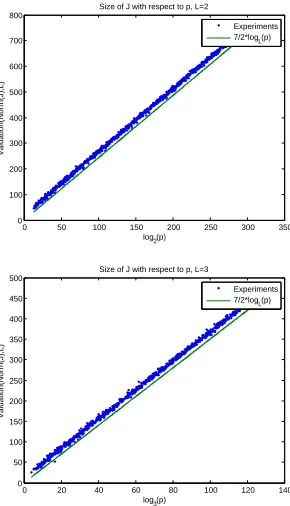
e∼ 7
2log`(p).
We implemented the algorithms of this article in Magma [7]. We first tested the algorithm of Section 3.2 to compute N times`-power norm elements in O with ` ∈ {2,3}, for random primes pof sizes up to 200 bits and for N values obtained after applying the algorithm of Section 3.1 on an ideal generated via a random walk from O. The norm of the outputs were close to the expected values.
We then tested the algorithm of Section 4.4 for ` ∈ {2,3}, for random p
values of sizes up to 200 bits, forN values obtained after applying the algorithm of Section 3.1 on an ideal generated via a random walk from O, and forµ0 =
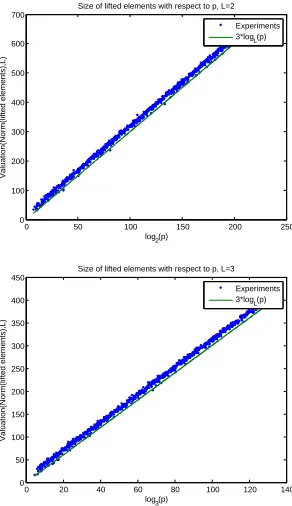
(z0+w0ω)j with randomly chosenz0, w0 ∈Z/NZnot both equal to zero. The exponents of the norms of the quaternions computed were close to the expected value 3 log`p.
We finally tested the overall algorithm of Section 4 for`∈ {2,3}, for random
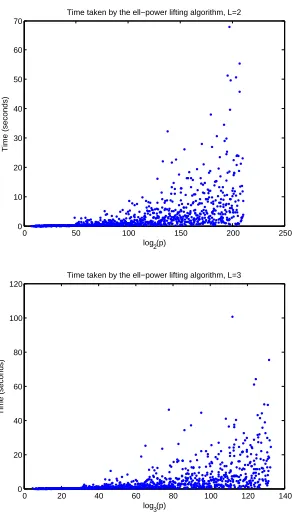
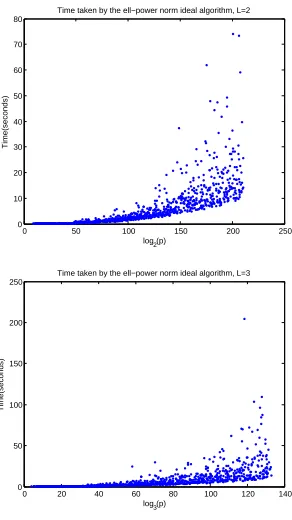
All computations were carried out on an Intel Xeon CPU X5500 processor with 24 GB RAM running at 2.67GHz. The algorithm of Section 4.4 succeeded in less than 100 seconds for all 200 bit primes, and the overall algorithm of Section 4 terminated in less than 250 seconds for primes in this range. Additional experimental results are provided in Appendix A.
4.6 Generalization to arbitrary orders
We now describe how to remove the condition thatOis one of the special orders defined in Section 2.2. First we encode the relation between two maximal orders embedded inBp,∞ in terms of an associated ideal.
Lemma 8 Suppose that O1 and O2 are given maximal orders in Bp,∞. Then
the Eichler order O1∩ O2 has the same index in each ofO1 andO2, which we
denote M, and the set:
I(O1,O2) ={α∈Bp,∞|αO2α¯⊆MO1}
is a left O1-ideal and right O2-ideal of reduced norm M. Conversely, if I is
a left O1-ideal with right order O2, such that I 6⊆ nO1 for any n > 1, then
I=I(O1,O2).
Proof. The determinant of the norm form of any maximal orderOisp2, and for any sub-latticeL⊂ Oof indexM, the reduced norm form onLhas determinant
M2det(O). This establishes the well-known result that the index of an Eichler order in any maximal order is an invariant, called its level.
It is clear by construction thatI(O1,O2) is a leftO1-module and a rightO2
-module. Locally at any primeq, we may assumeO1 andO2are Zq-orders such that O2=α−1O1α, for someαin O1 hence also inO2. It follows that we have
an inclusionαO2=O1α⊆I(O1,O2). However, removing any integer factors (in
the center), the reduced norm of a minimalαmust equal the levelMZq, which implies equality. The global result follows from the local-global principle.
Conversely, since any leftO1-idealI is locally principal at each primeq, one
can find locallyαsuch thatI=O1α; the right order of I is thenO2=α−1O1α.
By hypothesisαis not divisible by any integer and we conclude that the Eichler order has level Nrd(α) = Nrd(I) =MZq. From the above construction in terms of a local generator, we concludeI=I(O1,O2).
Theorem 9 Let O1 and O2 be maximal orders in a quaternion algebra Bp,∞
and let ` be a small prime. Given an algorithm which takes as input a left O1
-ideal and outputs an equivalent leftO1-ideal of`-power reduced norm, there exists
an algorithm with the same complexity, up to a constant of size polynomial in the input size ofO1andO2, which takes as input a leftO2-ideal and outputs an
equivalent leftO2-ideal of`-power reduced norm.
Proof. Assume we are given two orders O1, O2 and a left O2-ideal J, and set
is bounded by something polynomial in the specification ofO1 andO2 in terms
of a basis forBp,∞.
Supposing that we have an algorithm for O1, we find representative left
O1-ideals for I and IJ such that I1 = I¯γ1/Nrd(I) with γ1 in I, and I2 =
IJ¯γ2/Nrd(IJ) withγ2in IJ, where
Nrd(γ1) = Nrd(I)`e1 and Nrd(γ2) = Nrd(IJ)`e2.
It follows thatγ= ¯γ1γ2/Nrd(I) is an element ofJ with reduced norm Nrd(γ) =
Nrd(J)`e1+e2, and henceJγ/¯ Nrd(J) is of reduced norm`e1+e2.
This provides a reduction of the general case to the case of specialp-extremal orders, at the cost of two applications of the algorithm of Section 4, and a larger power of`.
4.7 Generalization to powersmooth norms
We recall that a numbers=Q`ei
i isS-powersmooth if` ei
i < S. Our algorithms can be easily modified to construct ideal representatives of powersmooth norms. Using the approximations as before, the norm should be of size close to p7/2.
Since the product of all maximal powers of a prime lower thanScan be approx-imated by SS/logS, an adaptation of our algorithms will allow us to compute
S-powersmooth representatives of left ideal classes ofO, withS ≈7 2logp.
5
Conclusion and future work
In this paper, we provided a probabilistic algorithm to solve a quaternion ideal analog of the path problem in supersingular `-isogeny graphs. The algorithm runs in expected polynomial time subject to heuristics on expected distributions of primes, and it is efficient in practice.
Following Deuring [6], there is a one-to-one correspondence between supersin-gular elliptic curves modulop, up to Galois conjugacy, and isomorphism classes of maximal orders in the quaternion algebraBp,∞. By identifying isogeny
ker-nels with powersmooth ideals in the quaternion algebra graphs, we expect our techniques to lead to both partial attacks on Charles-Goren-Lauter’s isogeny based hash function (when the initial curve has extremal endomorphism ring), and to security reductions to the problem of computing the endomorphism ring of a supersingular elliptic curve. Similarly, we expect our results to lead to a constructive version of Deuring’s correspondence from maximal orders inBp,∞
References
1. N. C. Ankeny. The least quadratic non residue,Annals of Mathematics, 55(1):65–
72, 1952.
2. E. Bach. Explicit bounds for primality testing and related problems,Math. Comp.,
55(191):355–380, 1990.
3. J. W. S. Cassels. Global fields. In J. W. S. Cassels and A. Frohlich, editors,
Alge-braic Number Theory, chapter Global Fields, pages 42–84. Academic Press, 1967. 4. D. X. Charles, K. E. Lauter, and E. Z. Goren. Cryptographic hash functions from
expander graphs. J. Cryptology, 22(1):93–113, 2009.
5. G. Cornacchia. Su di un metodo per la risoluzione in numeri interi dell’ equazione Pn
h=0chxn−hyh=p,Giornale di Matematiche di Battaglini, 46:33–90, 1903.
6. M. Deuring. Die Typen der Multiplikatorenringe elliptischer Funktionenk¨orper.
Ab-handlungen aus dem Mathematischen Seminar der Universit¨at Hamburg, 14:197– 272, 1941.
7. W. Bosma, J. J. Cannon, C. Fieker, A. Steel (eds.), Handbook of Magma functions,
Edition 2.20 (2013),http://http://magma.maths.usyd.edu.au/magma/.
8. D. R. Heath-Brown. The number of primes in a short interval. J. Reine
Angew. Math., 397:162–193, 1989.
9. D. Kohel. Endomorphism rings of elliptic curves over finite fields, PhD thesis,
University of California, Berkeley, 1996.
10. H. Maier. Primes in short intervals,Michigan Math. J., 32:221–225, 1985.
11. C. Petit, K. Lauter, and J.-J. Quisquater. Full cryptanalysis of LPS and
Morgen-stern hash functions. In R. Ostrovsky, R. De Prisco, and I. Visconti, eds., SCN,
volume 5229 ofLecture Notes in Computer Science, pages 263–277. Springer, 2008.
12. A. Pizer. An algorithm for computing modular forms onΓ0(N)∗.Journal of
Alge-bra, 64:340–390, 1980.
13. A. Selberg. On the normal density of primes in small intervals and the difference
between consecutive primes,Arch. Math. Naturvid., 47:87–105, 1943.
14. M.-F. Vign´eras.Arithm´etique des alg`ebres de quaternions. Springer-Verlag, 1980.
A
Experimental results
In our experiments, the value ofmand the functionΦappearing in the specifica-tion of our algorithms were fixed to a priori minimal values based on probabilistic arguments on the distribution of primes, then increased when needed.
A.1 Prime norm ideals
We show experimental results on the prime norm algorithm of Section 3.1 in Figure 1. The norms of the ideals constructed seem to be slightly larger than
p1/2and the computation time cubic in log(p).
A.2 Quaternion elements with particular norms
0 50 100 150 0
10 20 30 40 50 60 70 80
log(p)
Norms produced by the prime norm algorithm log(norm) log(p)/2
Student Version of MATLAB
0 50 100 150 0
0.5 1 1.5 2 2.5 3
cubic root of computing time
Evolution of computing time with p
Student Version of MATLAB
Fig. 1.Experimental results for the algorithm of Section 3.1 (withmof the expected
size): logarithm of the output normqI(α) and cubic root of running time with respect
to logp.
0 50 100 150 0
0.5 1 1.5 2 2.5 3 3.5 4 4.5 5
Increase of e with respect to p, L=2
log(p)
Increase of e
Student Version of MATLAB
0 50 100 150 0
1 2 3 4 5 6
Increase of e with respect to p, L=3
log(p)
Increase of e
Student Version of MATLAB
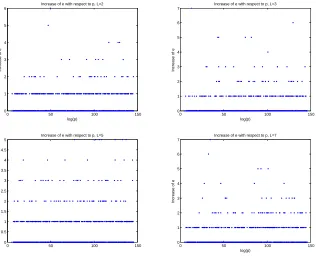
Fig. 2.Experimental results for computing elements of normsN `e with the algorithm
of Section 3.2, for variouspvalues with`= 2 (left) and`= 3 (right): Difference between
0 50 100 150 0
1 2 3 4 5
6 Increase of e with respect to p, L=2
log(p)
Increase of e
Student Version of MATLAB
0 50 100 150 0
1 2 3 4 5 6
7 Increase of e with respect to p, L=3
log(p)
Increase of e
Student Version of MATLAB
0 50 100 150 0
0.5 1 1.5 2 2.5 3 3.5 4 4.5
5 Increase of e with respect to p, L=5
Student Version of MATLAB
0 50 100 150 0
1 2 3 4 5 6
7 Increase of e with respect to p, L=7
log(p)
Increase of e
Student Version of MATLAB
Fig. 3.Experimental results for computing elements of norms`e with the algorithm
of Section 3.2, for`∈ {2,3,5,7}and variouspvalue: Difference between the minimal
A.3 Ideals with`-power norms
Experimental results on the algorithms of Section 4 are shown in Figures 4, 5, 6, 7.
0 50 100 150 200 250 0
100 200 300 400 500 600 700
Size of lifted elements with respect to p, L=2
log2(p)
Valuation(Norm(lifted elements),L)
Experiments 3*logL(p)
Student Version of MATLAB
0 20 40 60 80 100 120 140 0
50 100 150 200 250 300 350 400 450
Size of lifted elements with respect to p, L=3
log3(p)
Valuation(Norm(lifted elements),L)
Experiments 3*logL(p)
Student Version of MATLAB
Fig. 4.Size of `-power norm quaternions obtained with the algorithm of Section 4.4
for variouspvalues with`= 2 (left) and`= 3 (right). The green line corresponds to
0 50 100 150 200 250 0
10 20 30 40 50 60 70
Time (seconds)
Time taken by the ell−power lifting algorithm, L=2
log2(p)
Student Version of MATLAB
0 20 40 60 80 100 120 140 0
20 40 60 80 100 120
log3(p)
Time (seconds)
Time taken by the ell−power lifting algorithm, L=3
Student Version of MATLAB
Fig. 5.Time taken by the algorithm of Section 4.4 for variouspvalues, with`= 2 (left)
0 50 100 150 200 250 300 350 0
100 200 300 400 500 600 700
800 Size of J with respect to p, L=2
log2(p)
Valuation(Norm(J),L)
Experiments 7/2*logL(p)
Student Version of MATLAB
0 20 40 60 80 100 120 140 0
50 100 150 200 250 300 350 400 450 500
log3(p)
Valuation(Norm(J),L)
Size of J with respect to p, L=3
Experiments 7/2*logL(p)
Student Version of MATLAB
Fig. 6.Size of`-power norm ideals returned by the algorithm of Section 4 for variousp
values with`= 2 (left) and`= 3 (right). The green line shows a priori approximative
values 7
0 50 100 150 200 250 0
10 20 30 40 50 60 70 80
Time taken by the ell−power norm ideal algorithm, L=2
log2(p)
Time(seconds)
Student Version of MATLAB
0 20 40 60 80 100 120 140 0
50 100 150 200
250 Time taken by the ell−power norm ideal algorithm, L=3
log3(p)
Time(seconds)
Student Version of MATLAB
Fig. 7.Time taken by the algorithm of Section 4 for variouspvalues with`= 2 (left)