ISSN 2286-4822
www.euacademic.org DRJI Value: 5.9 (B+)
A Comparative Study of the Difficulties faced by the
teachers in Communicative Language Teaching &
Grammatical Translation Method in the Primary
Schools of the Rural Areas of Allahabad
HAMID GITTAN JEWAD Department of English &Foreign languages Chitamber Schools of Humanities and Social sciences
Faculty of Humanities social and Education Sam Higginbottom Institute
India Dept. of Scholarships & Cultural Relations University of Kerbala Iraq DR. SHIVANI S.VERMA Dept. of English & Foreign Languages Chitamber School of Humanities and Social Sciences Sam Higginbottom Institute India
Abstract:
Communicative Approach emphasizes fluency and the Grammar Translation Method is concerned with accuracy. Fluency and accuracy are the target for English learning. So the best way to improve the situation is to combine both methods in teaching English Grammar.
Key words: Grammar translation method, Communicative approach, Difficulties
I. Introduction
comparison to be made between the foreign language and the native language.
the Researcher wanted to know the teachers' perception of Communicative Language Teaching (CLT) and Grammatical Translation Method.
Low1, High and Middle. Old Frisian (Modern Frisian is
descended from the Old Frisian) was akin to Anglo-Saxon. a special group ‘Anglo-Frisian’—a sub-group of Teutonic .To conclude , "English is an offshoot of the Anglo-Frisian group Anglo-Saxon had several dialects. Venerable Bede informs us that the Teutonic invaders of England were from Jutland, Anglilus and Old Saxony, They were racially and linguistically amalgamated on the continent (Europe) but were differentiated in England. (R.K.Jain, 2007:20).
1.2 Development of English “Anglo-Saxon passes over into Middle English (from 1150 to 1400) “ending with such authors as Chaucer and Gower”. It had three divisions—Northern, Midland and Southern, broadly characterised by their forms of the third plural present indicative (e.g., es, en and hop-eth), representing the older North-umbrain, Mercian and west-Saxon respectively. Kentish in Kent continued. Thus, Middle) English, like the modern, had a large number of dialects. This is, important especially for those who desire to specialise in phonetics. , Thus, it is clear that the period of Old English (dating from 5th century A. D.) comes to an end somewhere in the beginning of the 12th century. Up to fifteenth it was the period of Middle English. With Chaucer "the uneclipsed sun of modern English" began to rise and shine on our Globe. With the growth of trade and commerce and through Colonisation, English has spread far outside England. It was once said that the sun never set in the British Empire. Now, though the sun of the Bloomfield informs us informs us of the Native speakers. Of English to be about 170 million in 1920. V. K. Gokak gives a figure of 250 million and according to Dennis Bloodworth some 300 million people of the world speak English. This figure has swelled to 4100 million. Today one out of 10 persons in the
world speaks English. Chinese tops the list, While English comes next to it. It has become the language of a universal culture "which embraces so many departments of knowledge." It was possible because of its flexible, and liberal nature to adapt to new changes. (R.K.Jain, 2007:21).The aim of my research was to know the answer of the following question: What are the difficulties that are faced by teachers’ of Indian Primary Rural Schools of Allahabad city by using Grammatical Translation method (GTM) and Communicative language teaching (CLT)? .To know the difficulties and which method is better for teaching English language at primary level, researcher asked them some theoretical questions which helped him to know their difficulties. The theoretical questions have been included in the methodology chapter. In order to reach an answer to my question Researcher conducted a quantitative research. Researcher formed a questionnaire for sixty teachers
1.3 Justification
The study will help to find out the difficulties faced by teachers while teaching English language with Communicative Approach and Grammar Translation Method by the Indians teachers of Primary level schools.
This will help the teachers to communicate well while teaching, writing and in speaking more effectively.
The study will also provide the learners of English to become masters and apply it in using second language in a sensible way.
1.4 Objectives
1) To make comparative study between Communicative Language Teaching and Grammar Translation Method in teaching second language.
Translation Method in the Rural Primary School at Allahabad.
3) To provide the teachers with some applications for teaching and learning communicative language teaching.
1.5 Hypotheses
1) There is no statistically significance seen regarding gender, in performing their Roles in the light of the Communicative Approach and Grammatical Translation method in Teaching English language.
2) There is a lack of educational Language that enables to provide necessary skills to the learners
3) Both the approaches have to be applied for the positive maximum results.
II. Literature review
Previous Related Researches into Grammar Translation Method and Communicative Language Teaching .The related researches are as follows:
(1) Stern, H. H., (1992). In his book “Issues and Options in Language Teaching” indicates “a contrastive analysis, just as the comparative linguistics studies, is indeed very important for the second language learner. Therefore translation in one form or another can play a certain part in language learning”.
(2) Brown H.D., (1994). In his Principles of Language Learning and Teaching, states “It does virtually nothing to enhance a student’s communicative ability in the language.”
learning environment for translation. Translation can contribute to the students’ acquisition of the target language, at all levels”.
(4) Austin J Damiani, (2003). In his paper “The Grammar Translation Method of Language Teaching” states “As a teacher, I liked using the grammar translation method because I could assume the intelligence of my students; I could talk to them like the intelligent people that they are, and we could talk about the grammar and vocabulary that I was teaching. In another method, I would have had to use simple language and familiar phrases to communicate in the target language, and even then, I could not be sure that my students knew and understood what it was that they were saying.”
III. Materials and Methods
3: Methodology
This section of the paper deals with the research methodology adopted in order to conduct the research. This research details the analytical and statistical study used for finding answers. Researcher collected data through a ‘questionnaire’ designed by him under the guidance of supervisor and staff of DOEFL3 from
Communicative Language Teaching and Grammatical Translation Method in teaching English language in rural primary school and to know which is better to teach. This again ensured that all questions related to the instruments used for data collection were explained by the researcher himself and also to save time and minimize expenses which otherwise would have been incurred. According to Welman et al., (2005) research has shown that questionnaires posted to respondents either do not come back, are not filled in correctly or they delay in coming back. According to Welman et al. (2005), the researcher has the least control over the conditions under which postal questionnaires are completed. The chances are great that some questionnaires may be omitted or not to be responded to in the order presented, or even that someone else may complete or censor some of the questions. They go on to say that when a respondent leaves a single question unanswered, it may mean that the remainder of his or her responses cannot be used for purposes of analysis. The researcher’s lack of control over the completion of the questionnaires may result not only in poorly completed questionnaires, but also a poor response rate (the percentage of questionnaires handed back, returned or posted back.) Postal Surveys accordingly tend to have the lowest response rate of all survey methods.
3.1 Research design
and objective in its ways of using numerical data from only a selected subgroup of a universe (or population) to generalise the findings to the universe that is being studied.
3.2: Setting of the study
12 Rural Primary Schools in Allahabad district of India.
3.3: Subjects
From 60 English teachers who were teaching in the rural primary schools. The data was collected randomly.
3.4: Questionnaire The prospective respondents were provided with questionnaires which comprised both fixed-choice and Open-Ended questions. The questionnaire comprised of two sections, the first section included 5 questions related to general information of the teachers, and the second part comprised of 25 questions having information related to classroom environment.
3.5: Instruments The following questions guided to understand the perception and attitude of the teachers toward CLT2 and GTM3 and the difficulties they faced in using them
for teaching English language in the Primary Rural Schools.
3.6: Method and Procedure As the research was conducted with the English teachers from different schools, researcher selected a renowned district in Allahabad where Researcher found more than twelve primary schools. Researcher visited five times. In the first visit, Researcher had to select the schools and got permission from the Principals of each school and told them about the purpose of visit .It was informed to them that the Researcher from Iraq is a student in the Department of
English and foreign languages, Chitamber Schools of Humanities and Social Science ,Faculty of Humanities Social Science and Education, Sam Higginbottom Institute of Agriculture Technology and Science .Teachers including the Principal cooperated maximum. Most of the English teachers agreed to answer the questions in the questionnaire. To collect data it took three weeks.
3.7: Data Processing The analyzing of the data is based on the calculation percentage /style frequency. Percentages are used to express how large /small are quantity is relative to another quantity .Below is the calculation formula used to find the number.
GN/TN×100= (%) GN= Given number. TN=Total number.
If here are answers of the first question 50 ‘yes’ and 10 ‘no’, the calculation will be like following:
50/60×100= (83, 3%) the percentage of the teachers who answered ‘yes’.
10/60×100= (17, 6%) the percentage of the teachers who answered ‘no’.
IV. Theoretical Background
4.1.1. English was the official language of this country: Science British India and occupies this place even now. It dominates the administrative fields in the Centre as well as the States and will continue to do so in the future. It is the language of the law and will remain so in the future. English is also the language of inter-state commerce, trade and industry. It is noticed, Indian language do not seem to replace English in these fields in the near future.
4.1.2 English being link language within India: It is link language with the other countries of the world. As English is the important international language of international politics, trade, industry and commerce. Though English came to India with the English. It came to stay here as an international language. The study of English can be stopped only at the risk of isolation from the rest of the world. That can have a great loss.
4.2 The History of Teaching Methods
In this section, a description of the teaching approaches which were dominant in recent centuries and the role of vocabulary in each one of them will be discussed. The first predominant teaching methodology from the beginning of the nineteenth Century was the Grammar- Translation Method. Grammar- Translation Method was developed and was based on a procedure for teaching Latin and evolved out of the need to standardize foreign language teaching for children (Howatt, 1984, as cited in Schmitt, 2000). Students were givenextensive grammatical explanation in theirL1 (first language), lists of bilingual vocabulary, and some practice exercises to translate from L11 into L22 (second language) or vice versa. In this
correction. Terrell and Krashen claim that there is no need for direct instruction and practice for grammar and vocabulary because students acquire them naturally (Wright, 2010). Although that grammar and vocabulary are treated separately in most teaching method, recent evidence from large corpora (language database) shows that grammar and vocabulary are fundamentally linked. Thus, it is difficult to think of them as separate entities. On the other hand, one should think of them as one entity without discrete boundaries, which is referred to as lexicogrammar2 (Schmitt, 2000).This section represented the
4history of teaching methods and the role of vocabulary in each
one of them. Then, it discussed the importance of grammar and vocabulary in language learning and teaching. In the present study, the Researcher evaluates the effects of two teaching/learning approach and method by investigating the difficulties those faced by the teachers of primary schools in Allahabad city. The present study may help clarify which method is better for teaching/learning English language in rural primary schools at Allahabad as a second language.
4.3 The Grammar-Translation Method
The Grammar-Translation Methods called old method of teaching.IT was one of the earliest methods used to teach classical languages such as Greek and Latin. In the early 19th century, it was used to teach some modern languages like English and French, and it is still used in many Countries (Richards et al. 1992:161). The Grammar-Translation Method was developed mainly to improve learners’ ability to read and understand L2 literature. It was believed that learners would benefit from learning L2 literature consolidate native language learning through an understanding of L2 literature (Larsen-Freeman2000:11). The Grammar-Translation Method analyses the language rather than uses it. In other words, it isolates the
methods, as it makes fewer demands on the teacher than other methods. It requires little involvement and skills from teachers who concentrate on teaching grammatical forms The Grammar-Translation Method also has its shortcomings. Its emphasis on deduction of rules and studying lists of vocabulary and translation exercises, results in failure to develop learners’ abilities to communicate in the L2 (Celce-Murcia 1991:6). It neglects learners’ cognitive ability to hypothesize and formulate their own rules of the L2, and discounts the suitability and appropriateness of the language used and learnt to contexts and situations in society. It also discounts socio-cultural factors, such as different cultures and attitudes of learners. These shortcomings have led language teachers to seek other methods of teaching to develop learners’ speaking abilities.
4.4 The Communicative Approach
language with the other code of communicative conduct” (Hymes 1972:277-78). Hymans’s view requires developing the components of communicative competence into a teaching approach and method. Communicative competence enables learners to convey and interpret meaningful messages within specific contexts. Hymes makes a distinction between the use of ‘linguistic competence’, that is, knowledge of the language forms and rules to form grammatically correct sentences, and ‘communicative competence’, that is, knowledge that enables learners to form grammatically correct sentences and to use the rules of speaking in different situations appropriately (Brown 2000:246 and Richards et al. 1992:65). Hymes rejects structuralism based on behaviorism, which measures learners’ competence by testing their knowledge of underlying grammatical rules. The Communicative Approach is also a rejection of Chomsky's generativism based on mentalism which measures learners’ competence in the TL by their cognitive abilities to generate utterances which are governed by grammatical rules of the TL (Brown 2000:10). Hymes’s notion of competence is more extensive than Chomsky’s linguistic competence (grammatical knowledge). Chomsky (1965 In Hymes1972:283) admits, “Grammaticalness is only one of the many factors that interact to determine acceptability”. Canale and Swain (1980) and Canale (1983 in Brown 2000:247) developed a model that further refined communicative competence into other components:
1. Grammatical competence, which comprises the lexicon, morphology, syntax, sentence-structure, semantics, and phonology.
2. Discourse competence, which is needed to connect sentences in order to establish and maintain logical coherence in expository prose (written or spoken). This competence focuses on the use of interested relationships to produce coherent conversations and written texts (Brown 2000:247).
observing sociocultural rules in Conversation, requiring clear awareness and correct interpretation of social situations
1991:686) also maintains that what he has called ‘strategic competence’ accounts for the metacognitive strategies of the assessment of goal setting and planning of utterances. “Such strategies work with all areas of language knowledge and function interactively”. (Bachman, 1991 in Brown 2000:248) also separates strategies from the other language competencies. He maintains that strategic competence “almost serves as an ‘executive’ function of making the final ‘decision’, among many possible options, on wording, phrasing, and other productive and receptive means for negotiating meaning”. The above-mentioned contributions suggest that language proficiency is not just a collection of its parts (phonology, morphology, syntax and lexicon), but a mastery of linguistic forms for use in real situations. What is important is to provide learners with meaningful (comprehensible) input and opportunities to interact with each other in a language they understand so that they can use the TL in various situations (Krashen 1983in Brown, 2000:277-80).
V. Results and Discussion
5.1 Introduction
teaching approaches along with the problems they faced while teaching English language.
The quantitative data for this study included teachers’ responses of the closed ended questions of survey questionnaire .The responses obtained from the survey questionnaire were recorded in the form of a raw data table. The question wise responses given by the teachers were recorded in the form of a table and analyzed statistically as well as descriptively. The teachers’ responses were recorded in the form of a table and analyzed statistically as well as descriptively.
5.2 Quantitative Data
All the closed ended questions presented in the survey questionnaire were quantitative (see appendix A). Tables of descriptive statistics for teachers’ responses on their teaching difficulties and comparative between CLT and GTM. And figures bearing percentages of each question were developed on Microsoft excel.
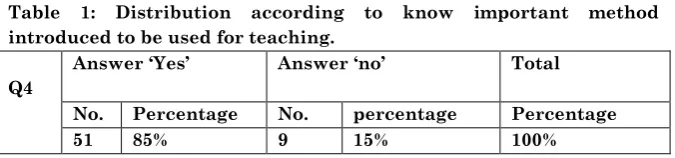
Table 1: Distribution according to know important method introduced to be used for teaching.
Q4
Answer ‘Yes’ Answer ‘no’ Total
No. Percentage No. percentage Percentage
51 85% 9 15% 100%
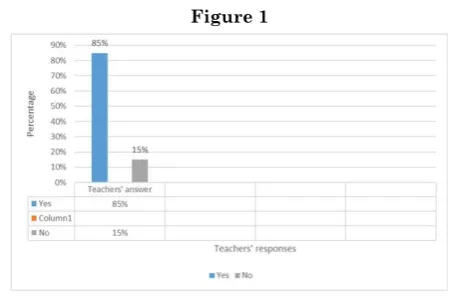
Figure 1
Table 2: Distribution according to ‘which methods do you use to teach English’?
Q5
Answer ‘Yes’ Answer ‘no’ Total
No. Percentage No. percentage percentage
GTM5 23 53.3% 28 46.6% 100%
CLT6 48 80% 12 20% 100%
BLM7 7 11.6% 53 88.3% 100%
SA8 16 26.6% 44 73.3% 100%
DM9 22 36.6% 38 63.3% 100%
others 8 13.3% 52 86.6% 100%
In the table above every teacher can choose many methods that he used in teaching English language in his class .this table reveals that the CLT takes the high majority ,it is percentage 80% and the ‘others’ takes the lowest status. It is percentage 1%.from this table we know that CLT come first and GTM second,DMis third.
5 GTM: Grammatical Translation Method 6 CLT: Communicative Language Teaching 7 BLM: Bilingual Method
Figure 2
Table 3:Distribution according to ‘use the communicative Approach and Grammatical Translation Method to teach English language’?
Q.6&7
Answer ‘yes’ Answer ‘no’ total
No. Percentage No. Percentage No. percentage
CLT 23 62% 32 38% 06 100%
GTM 51 25% 41 75% 06 100%
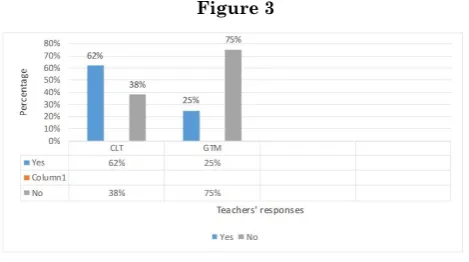
This table reveals that 62% are using Communicative Approach to teach English language opposite 23% do not use. Also this table explain that 25% are using Grammatical Translation method opposite 75% not use.
Figure 3
Q.8
Answer by choosing the adequate activities
total
No. Percentage No. percentage
Pair work 17 28.3% 43 71.6%
Group work 26 43.3% 34 56.6%
Dialogue 9 15%% 51 85%
Discussion 35 58.3% 25 41.6%
Role play 24 40%% 36 60%
Dramatization 13 21.6% 37 61.6%
reading 31 51,6% 29 48,3%
translation 16 26,6% 44 73,3%
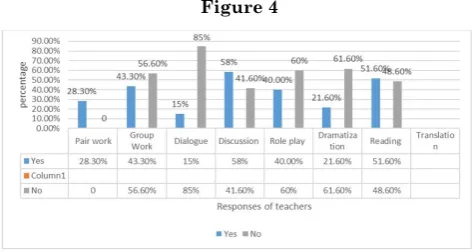
In this table the teachers choose many points and this table reveals that (58.3 %) choose the discussion and 15% choose the dialogue. The statistical results proved that the majority of the 35 teachers (58.3%) chose the discussion activity to teach English language by using Communicative Approach.
Figure 4
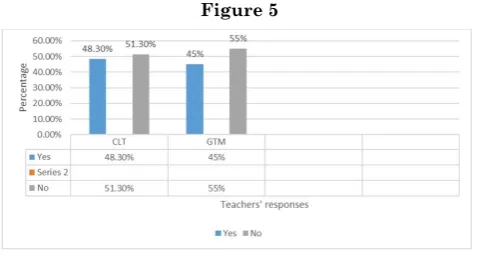
Table 5: Distribution according to ‘do you get pre-service training to use Communicative Approach and Grammatical Translation Method?’
Q.53
Answer ‘Yes’ Answer ‘No’ Total
No. Percentage No. Percentage No. percentage CLT 29 48.3% 31 51.6% 60 100%
GTM 27 45% 33 55% 60 100%
to use Communicative Approach and 51.6% not get. Also this table explains that 45% get pre-service training to use Grammatical Translation Method, and 55% do not get.
Figure 5
Table 6: Distribution according to ‘do your schools have sufficient instructional materials to use Communicative Approach?’
This table reveals that 10% answered their schools had tape recorders.
38.3 % answered their schools had charts. 45% answered their schools had pictures. 5% answered their schools had V.C.P.
1.6% answered their schools had other instructional materials. I feel ‘others, V.C.P, and Tape recorder’ have the minority while the ‘pictures and charts’ have the majority.
Q.17 Choices
Answer ‘yes’
No. Percentage
Tape recorder 6 10%
charts 23 38.3%
pictures 27 45%
V.C.P. 3 5%
others 1 1.6%
Q.18.a) What are the difficulties faced by you while teaching English Communicative Approach?
The main points of difficulties that faced the teachers when used Communicative Language Teaching that is suggested by teachers are:
1. The large number of students in the class
2. Students want to learn English through translation. 3. Students are small so they are difficulty understanding. 4. Influence of mother tongue.
5. Lack of English environment.
6. Lack of efficient assessment instruments 7. Students’ environment.
8. Students background play major role because students come from different villages
9. Time is also problem. Time isn’t enough.
b) What are the remedies to overcome these difficulties? (Write your suggestions)
Response:
1. Most of the teachers feel that the most important remedial measure is to reduce the class roll so that individual attention is given and the teachers feel that the time allotted to language classes is not sufficient and that it should extended.
2. Decrease the number of students. 3. Teaching with current news.
4. The teachers and administration should create an English environment in the school to increase to provide good atmosphere to students.
Q.19.a) What are the difficulties faced by you while teaching English by Grammatical Translation Method?
1. It is difficult for students to understand and memorize the grammatical rules.
2. More students in the class.
3. Small children are not able to learn by this method.
5. The noise of students 6. The fault of pronunciation.
7. The lack of basic knowledge of the English grammar.
Responses: 100% of teachers feel that the most grave faced is unmanageable class roll.
80% feel that the fault lies with method. 20% feel that the fault lies with the learner
And 50% approximately feel that the problems are faulty syllabus, irregular attendance, inappropriate objectives, and poor attention in class, poor motivated students and learner attitude not positive.
b) What are the remedies to overcome these difficulties? (Write your suggestions)
1. Make many examples
2. Make real examples for each rule. 3. Reading short stories
VI. Conclusion
the title “Results and Discussion” is comprised of types of data collected from the teachers, presentation of data collected through the questionnaires, statistical analysis and interpretation of data collected through questionnaire .The sixth and the last chapter entitled as “Conclusions & Recommendations” contains the results of this research as follows.
CLT was introduced to India when the traditional grammar based approach was considered as responsible for student’s inability in the communicative use of English. However as a Western-oriented methodology, the application of Communicative Language Teaching ‘CLT’ and the Grammatical Translation Method ‘GTM’ encounters many difficulties and constraints. More and more educators started to doubt if CLT and GTM are really applicable in EFL context, such as in India. In this paper the researcher mainly discussed the major problems and difficulties in adopting CLT and GTM facing the teachers of primary rural schools in Allahabad city, the inability of the teachers, the sociocultural factors and the present situation in India. Finally, the researcher talked about which is better CLT or GTM in teaching English language in Rural Primary Schools.
examinations, and the lack of appropriate materials. However, the teachers in this study were found to be enthusiastic to apply the Communicative Approach in the classroom. They appeared hopeful that the problems associated with the implementation of the CLT approach in India can be overcome.
REFERENCES
Arora, Navita. 2012. English language Teaching approach and methodologies. Tata McGraw hill education private limited.
Bachman, L. F. 1991. “What does language testing have to offer?” TESOL Quarterly 25(4).
Brown, H. D. 2000. Principles of language learning and teaching. 4th edition. Englewood Cliffs NJ: Prentice Hall Regents.
Brown, H.D. 1994. Principles of language learning and teaching. Englewood Cliffs, NJ: Printice-Hall.
Brumfit, C.J. & Johnson, K. (Eds.). 1979. The Communicative approach to language teaching. Oxford: Oxford University Press.
Celce-Murcia, M. (Ed.) 1991. Teaching English as second or foreign language. Boston: Newbury House.
Defeng, L. 1998. ““It is always more difficult than you plan and imagine”: Teacher’s perceived difficulties in introducing the communicative approach in South Korea.” TESOL Quarterly, 32 (4).
Fazili, Mubeena. 2007, 2013. Communicative Method in ELT an Indian perspective. Atlantic publishers and distributors (p) ltd.
Hymes, D. 1972. “On Communicative competence.” In
Vocabulary in language teaching, edited by N. Schmitt. Cambridge: Cambridge University Press.
Teaching. Vinod Pustak Mandir, Agra-2.
Larsen-Freeman, D. 2000. Techniques and principles in language teaching. (2nd Ed.).Oxford: Oxford University Press.
Larsen-Freeman, D. 1986. Techniques and Principles in Language Teaching. Oxford: Oxford University Press. Lyster, R. & Ranta, L. 1997. “Corrective feedback and learner
uptake: Negotiation of form in communicative classrooms.” Studies in Second Language Acquisition
19: 37-66.
Littlewood, W. 1981. Communicative Language Teaching.
Cambridge: Cambridge University Press.
Mukalel, Joseph C. 2013. Approaches to English Language Teaching. New Delhi: Discovery publishing house.
Mahanand, Anand. 2013. English teaching perspectives from the Periphery. Jaipur, India: Aavishkar publishers, Distributors.
Nunan, David. 1989. Designing Tasks for the Communicative Classroom. New York: Cambridge University Press. Patel & Praveen M. Jain. 2008. English Language Teaching:
Methods, Tools and techniques. Jaipur, India: Sun rise publishers and Distributors.
Pica, T. 2000. Tradition and transition in English language teaching methodology. System.
Rao, Z. 2008. “Reconciling Communicative approach to the teaching of English with traditional Chinese method (Online).” Available: www.elechina.super-red.esl/rao. [2008, August 31].
Richards, J. & Rodgers, T. 2001. Approach and methods in language teaching. New York: Cambridge University Press.
Richards, J. C. & Rodgers, T. S. 2001. Approaches and methods in language teaching. New York: Cambridge University Press.
methods in language teaching. Cambridge: Cambridge University Press.
Savignon, S. J. 1972. Competence: on experiment in foreign language teaching. Paris: Marcel Didier.
Savignon, S.J. Communicative Language Teaching-Linguistic Theory and Classroom Practice. Yale Press.
Van der Walt, J. L. 1990. “The role of the teacher in communicative language teaching.” Journal for Language Teaching 24 (1).
Widdowson, H.G. 1978. Teaching Language as Communication.
Oxford: Oxford University Press.
_______. 1993. English Language teaching methodology