A Novel Approach for Solving Economic
Dispatch Problems
Using Particle Swarm
Optimization Technique
1Alaa Siddig Ali, 2Murtada Khalafallah Elbashir
1Faculty of Graduate Studies, Faculty of Computer Science and Information Technology, Sudan University of Science and Technology
2
College of Computer and Information System Jouf University KSA, Faculty of Mathematical and Computer Sciences, University of Gezira, Wad Madani, Sudan
ABSTRACT
The Economic Dispatch (ED) play a vital role in the energy industry in such a way that it aims to reduce the cost of generation utility. Many researches have been conducted to optimize energy resources and minimize overall cost of fuel. One of these researches invented method based on Swarm Intelligence (SI) algorithm called PSO. PSO is benchmarked in various test cases including generating units with high non-linearity. Two factors that are considered for comparing the results of PSO with other intelligence optimization algorithm 1) power generation and 2) operating cost of generators. PSO results were proven to consume minimum operating cost and have a minimum standard deviation among three types of solutions: 1) best 2) mean and 3) worst. It further shows good solution quality because the proposed technique can be easily exported and that it can converge with relevant forms in a rapid manner. In this paper we propose a new approach based on PSO for solving ED Problem. In our new approach we adjusted the values of the particles in the range of p min (minim generated power) and P max (maximum generated power). The simulation show that our proposed approach gives the best practical results compared to other methods that uses PSO.
Index Terms : Economic dispatch (ED); Particle Swarm Intelligence (PSO).
1. INTRODUCTION
Power system operation and planning is a vast framework that covers tools, practices, methodologies and multiple problems as well. These problems may include load flows, Economic Dispatch (ED), Unit Commitment (UC), Reactive Power Control, Power System Stability and Relay Coordination. Two of these problems (ED and UC) are considered as optimization problems and are on top of the priority list of tasks in power system operation and planning. These problems have been approached by several researchers previously in a conventional way using generic optimization techniques such as Lambda iteration, Gradient method, Newton and Heuristic methods. ED, in particular, involves reduction of generation cost while meeting system loads and constraints like transmission systems and operating limitation of the equipment. From an economic perspective, it is of huge importance to be able to optimize operation costs of the generation units. ED techniques come into play when it determines an allocation of electrical energy in the lowest possible generation cost. The factors to take into account in this ED technique must include common constraints like electrical load demand in the power system, losses transmission power and generation cost coefficients. Since the modern generation units possess non-linear behaviors, the EDP formulation is expected to be non-linear and multi-model. The electricity industry has been working on producing cheap electricity by achieving high operating efficiency of power
utilities. If the operating efficiency is relatively high, it reduces the kilowatt per hour costs for both the consumer and the company rendering the electricity service. This reduction occurs despite constant raise in fuel, supplies, and maintenance and labor prices.
Wood et al (1996) the technique based on PSO method to minimize the selected criterion of cost while satisfying the operational and load constraints. ED works on determining the power output of every plant and its generating units and the procedure reduces the overall fuel cost necessary to fulfill the system load.
Park et al. (2006) solved the traditional ED problem by using lambda iteration method, gradient-based method and other optimization techniques based on mathematical programming. In this case, a single quadratic function represents the cost function for each generator.
Liang et al (1992) Used Dynamic programming (DP) method, it is one of the approaches to solve the non-linear and discontinuous ED problem. However, DP confront Problems as “curse of dimensionality” or local optimality.
Gailing (2003) used PSO method, it is considered to be one of the most powerful and effective technique in finding solutions for global optimization problems. PSO belongs to a vast category of other swarm intelligence methods and it was inspired by examples of social behavior of organisms like bird flocking or fish schooling. It was believed that this behavior has possibilities of being utilized to optimize a solution.
A number of researchers have pointed out that although PSO meets the global optimum quite fast, it has its own challenges such as premature convergence and loss in diversity and performance during the optimization process. One specific researcher named Clerc have specified the need for using a constriction factor to assure convergence of the particle swarm algorithm. (Clerc 1999). His research mentioned that the rate of convergence can be significantly increased by including properly defined constriction coefficients. If the constriction factors are defined properly, it can avoid explosion and stimulate convergence among particles on local optima.
In this paper, we propose a new approach based on PSO which is considered to be one of the most powerful and effective techniques in finding solutions for global optimization problems, to solve the
EDP.
METHODS
2.1. PROBLEM FORMULATION
The ED is a nonlinear programming problem which is considered as a sub-problem of the Unit Commitment (UC) problem. In a specific power system with a determined load schedule, ED planning performs the optimal power generation dispatch among the existing generation units. The solution of ED problem must satisfy the constraints of the generation units, while it optimizes the generation based on the cost factor of the generation units. Equation (1) represents the total fuel cost for a power system which is the equal summation of all generation units fuel costs, in a power system.
Where
ng is the number of generation units and Pj is the output power of jth generation unit. The cost
function in (1) can be approximated to a quadratic function of the power generation, therefore, the
total cost function will be changed to (2).
Where
Pj generated power by jth generation unit;
Two set of constraints are considered in the present study, including equality constraints and inequality constraints.
Equality constraints
Normally, in a power system the amount of generated power has to be enough to feed the load demand
plus transmission lines loss (3). Since the transmission lines are located between the generating units and
loads, Ploss can occur anywhere before the power reaches load (Pd). Any shortage in the generated power
will cause shortage in feeding the load demand which may cause many problems for the system and
loads.
Where
Pd is the load demand and Ploss is the transmission lines loss, while ng and Pj have the same definition as (2).
Here, The loss coefficient method which is developed by Kron and Kirchmayer, is used to include the
effect of transmission losses. B matrix which is known as the transmission loss coefficients
matrix is a square matrix with a dimension of ng×ng while ng is the number of generation units in the
system. Applying B-matrix gives a solution with generated powers of different units as the variables.
Equation (4) shows the function of calculating Ploss as the transmission loss through B-matrix.
Where:
Ploss total transmission loss in the system;
Pi, Pj generated power by ith and jth generating units respectively;
Bij element of the B-matrix between ith and jth generating units.
Inequality constraints
All generation units have some limitations in output power regardless of their type. In existing power
systems, thermal units play a very important role. Thermal units can pose both maximum and minimum
constraints on the generating power, so there is always a range of operating work for the generating units.
Generating less power than minimum may cause the rotor to over speed where as at maximum power, it
may cause instability issues for synchronous generators .
So (5) has to be considered in all steps of solving the ED problem.
For j=1,2, …., ng.
Where
Pj min and Pj max are the constraints of generation for jth generating unit.
The PSO, first introduced by Kennedy and Eberhart is one of modern heuristic algorithms.
Developed through simulation of a simplified social system, it has been found to be robust in solving
continuous nonlinear optimization problems. Since it is considered as a heuristic and stochastic
algorithm, it does not need any mathematical information of the fitness function such as gradient
derived or any statistic error function.
The PSO uses a vectorized search space where each particle in search space proposes a solution to
the problem. It is a swarm intelligence based algorithm which uses location and velocity of the
particles to evaluate them using a fitness function or so called objective function. For each particle,
the best position visited during its flight in the problem search space referred to as "personal best
particle" (Pbest). Personal best position means the one that yields the best fitness value for that
particle. For a minimization task such as in this case, the position having the smallest function value is
regarded as having the highest fitness. Also, the best position among all Pbest positions, is
referred to as global best (Gbest). At each iteration, the velocity of each particle is modified using the
current velocity and its distance from Pbest and Gbest which is represented by (6). as updated
velocity of particle i leads the particle to a new position called (7). X and V are
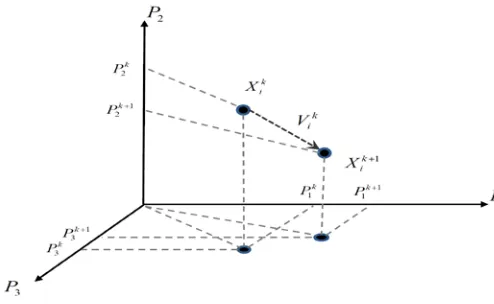
demonstrations of vectors which iteration result gives a new position for the particle. Figure 1 is a
simple diagram which shows the movement typical particle
i= 1, 2,…, nop (number of particles);
k=1, 2, …, kmax (maximum iteration number)
Where:
K :iteration number;
i :particle number;
W : inertia weight factor;
c1 and c2 acceleration constants;
r1 and r2 random values between 0 and 1;
velocity of particle i at iteration k;
position of particle i at iteration k.
Figure 1: Simple Diagram For Movement Of A Sample Particle In PSO.
Inertia weight in PSO plays an important role because of its control on particle speed. Hence, a suitable selection of it is important. Equation (8) is the general selection of inertia weight. In current study the value of inertia weight decreases from 1.2 to 0.5 during a run time.
W= Wmax- (Wmax-Wmin / iteration max) * iteration K ………. (8)
In (8), iteration max is the maximum number of iterations while iteration K is the kth iteration which is
considered as current iteration in this paper.
The Proposed Method
The current proposed PSO-based algorithm is developed to obtain an efficient solution for (ED) problem.
The optimized solution will give the best amount of power generation for each generation unit in terms
of costs. Some definitions are made in the proposed algorithm as follows.
Representation of Swarm
Swarm is the particles which are moving and giving solutions for solving the problem. The particles
move in the domain of the problem space and each of them represents a solution for the problem.
Figure 2 illustrates a simple three dimensional ED problem. If P1, P2 and P3 are the generation units
in a system, then particle i flies in the problem area to find the best possible solution. Vector Vi is the
resultant vector which is obtained from (6).
Figure 2: A Simple Three Dimensional ED Problem Space.
For a system with more than three generation units, we cannot demonstrate them in a 2-D paper
because there is no Cartesian space available.
However, we can consider systems with more than three dimensions theoretically to solve problems. In
the current study, arrays and matrixes are the problem search space. For example, P[i][j] is a matrix of
power generation in the proposed algorithm while i indicates the particle and j is the number of
generation unit. For Figure 2, the dimension of problem will be 150×3, if we consider the number of
particles to be equal to 150.
Fitness Function
To evaluate the proposed solutions by particles, we need to define a fitness function. The fitness function
has to be able to determine which solution is better and more efficient after considering all the solutions
obtained by the particles at each iteration. Normally the fitness function is being set to have the lowest
possible value at an optimum point. In the current study, we also need to have the lowest possible value
for the cost and transmission lost, hence the fitness function is proposed as follow:
Where
L the value of fitness function;
Cj the cost function of generation unit j;
Pd the power demand by the loads; coefficient of error;
Pi and Pj the generated power by ith and jth unit respectively.
Based on (9), the fitness function is generated by two parts: summation of costs and error in generation,
which is the difference between the desired generation and real generation. The desired generation is the
amount that can feed load demand (Pd) and power transmission loss (4), but the real generation is the
summation of the generated power of all generation units. If those two numbers are not the same, the
system will not work in an ideal situation and there will be a lack of feeding loads. In the best case, the
absolute part in (9) will be zero, therefore we set _ to a high value to magnify any error. In this paper, the
value of _ is equal to 100 and any small error will be mirrored in the value of the fitness function.
Here, an algorithm based on PSO is proposed to give a quick solution to solve EDP. Unlike other PSO
algorithms, in this method each single particle gives a solution to solve the main problem. In each
generation of movement the best given solution by the particles is collected and that point in the problem
space is called the global best. Personal best is the point that any particle by itself has experienced so far.
Although these particles have the opportunity to search the full area of the problem space, missing some
points in the problem space is inevitable because the vectors determine the direction of movement of
each particle. Hence getting close to global best point might hold the particle around that point. However,
the detected global best point is not necessarily the optimum solution to the problem. To overcome this,
the acceleration factors of global best and personal best which are known as C1 and C2 have been
adapted in a manner that let the particles search the problem Space easier and with more efficient. The Steps of the Proposed Algorithm are as Shown Below:
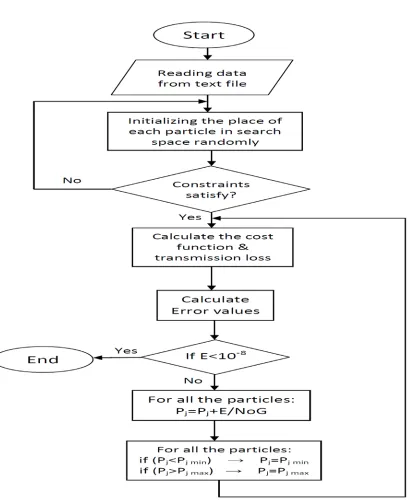
Step 1: receive the data of generation units’ characteristics, loss coefficients matrix B, and load demand from a text file. Initialize the positions for all the particles in the problem space randomly while the constraints of generation units are satisfied. X[i][j] holds the positions of particles in problem space while i indicates the particle and j is the generation unit.
Step 2: calculate the cost function (1) and transmission loss matrix (4) based on loss coefficients matrix B for each particle that gives a solution for the problem. Then an Error function is defined as a matrix to calculate the difference between the estimated power generation and summation of demand load and as below:
E[i]=PG[i]-(Pd+Ploss[i]); (10) Then the value of Error for each particle is divided among the number of generators to be shared between them. Step 2 is placed in an infinite for loop while the value of Error is less than a small
number _ which has been considered equal to 0.00000001 in the current algorithm.
Step 3: calculate the fitness function (9) based on the obtained values for generation units from Step 2. Note that for each particle one fitness value exists, hence we have a matrix with dimensions
equal to the number of particles called L[i] where i indicates the particle.
Step 4: compare all values of L[i] matrix to find the lowest value as the global best solution. This solution is saved in a matrix called Gbest[j] while its dimension is 1×j and j is equal to the number of the generation units. Since the movement part is not started yet, the personal best value of each particle is set to its current location and saved in a matrix called Pbest[i][j].
Step 5: Movement part: Modify the initial velocity of each particle based on (11) Vi[i][j]=Vmin+(((Vmax-Vmin)*Rand(0,1))); (11)
i=1,2,…,nop(number of particles) and
j=1,2,…,nod(number of dimensions)
While the number of dimensions demonstrates the number of generation units.
Step 6: A for loop which determines the number of iteration starts from this step. Movement of particles starts by renewing the velocity of each particle based on (12).
Vk+1[i][j]=W×Vk[i][j]+(r1*c1*(Gbest[j]-Xk[i][j]))+(r2*c2*((Pbest[i][j])-(Xk[i][j]))) (12)
Xk+1[i][j]= Xk[i][j]+ Vk+1[i][j] (13)
i=1,2,…,nop(number of particles) and
j=1,2,…,nod(number of dimensions)
Where
i and j have same definition as in Step 5, r1 and r2 are random numbers between 0 and 1, W is the inertia weight of velocity which is obtained by (8),
Xk[i][j] and Vk[i][j] are specifications of particle i at iteration k, c1 and c2 are the global best
acceleration factor and personal best acceleration factor respectively. Unlike existing PSO methods
which took c1=c2=2, in current study they have different values as c1=0.2 and c2=2. In fact acceleration
factors are tools to drag a sample particle to the place of global best point and personal best point. By
decreasing the c1 as global best acceleration factor, particle has more degree of freedom in searching the
problem space.
Calculating the new location of each particle of movement at iteration k+1 is the next aim of this
step which is obtained trough (13).
Step 7: check the values of Xk+1[i][j] matrix to make sure no generation unit violates its constraints. If Xk+1[i][j] is not in range the value will be set to either minimum when X<Pmin or maximum when
X>Pmax.
Step 8: calculate the cost function (1), is based on B-coefficient matrix (4) and value of fitness function matrix (9). Compare all values of Lk+1[i] as the fitness matrix at iteration k+1 to find the global best and
then save the solution in Gbest[j]. The number of particle which generates Gbest[j] is saved as a number
called OP means Optimum Particle. Compare the current fitness value of each particle at iteration k+1
with its value at iteration k through matrix L[i]. If the fitness value of any particle has decreased, the
better solution would be replaced with former solution in matrix Pbest[i][j] which holds the best solution
for each single particle.
Step 9: if the number of iteration reaches its maximum, then go to Step 10. Otherwise, go to Step 6. Step 10: here Gbest[j] is the best solution of the problem while j indicates the number of generation units. Also the particle which made the best solution has been saved in OP and can be obtained.
Then by referring to the cost function which values are registered in cost[i][j] matrix, cost[OP][j] holds
the cost of all generation units which are the optimum generation values.
Figure 3: Flowchart For The Proposed PSO-Based Algorithm: Initializing Part. NUMERICAL RESULTS AND DISCUSSION
Here, the results of case studies have been brought to verify the feasibility of the proposed PSO
algorithm. In these cases, the obtained results are compared to existing PSO based and GA based results.
At each case, under the same function of operation and algorithm, we performed 10 trials to make sure
that the solution is not stammered in any local optimum point.
Considering the transmission lines power losses and the transmission capacity constraints, a
reasonable B loss coefficients matrix has been utilized for each case. The programming was in C
language and executed on an AMD Phenom II×6 core processor, personal computer with 4.00 GB RAM.
PSO method seems to be sensitive to the variation of weights and factors; hence in the present study
different values for parameters have been set to find out how different factors and parameters can affect
the swarm performance. However, the results presented only belong to the best set of parameters which
lead the swarm to the optimum place.
Case Study
Example: Three-Unit System: this case study has been adapted from [27] which is considered as a
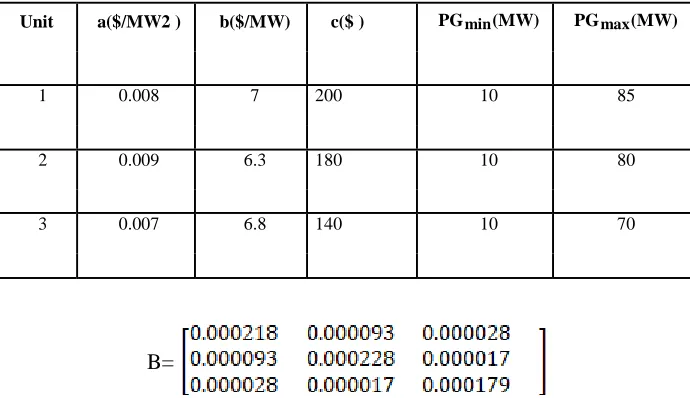
small system containing three thermal units. The system has the load demand of 150 MW. Table 1
shows the cost characteristics of three generators while matrix B is the loss coefficient matrix for the
considered system.
Table 1: Cost Coefficients of Three Units For the case.
Unit a($/MW2 ) b($/MW) c($ ) PGmin(MW) PGmax(MW)
1 0.008 7 200 10 85
2 0.009 6.3 180 10 80
3 0.007 6.8 140 10 70
B=
The matrix Pg in this case has 3 columns based on three units and 150 rows based on the number of
particles which is constant for all four cases. As it has been described the generation of P1, P2, and P3
are random and the dimension of the swarm is 150×3. The number of particles is normally
assumed to be 100, but in the current study, the number has been increased to 150 to give the
swarm more opportunity to search the problem space easier. However, for small cases we do not
need many particles to find the optimum but in large scales, having a larger number of particles
makes the swarm more capable to search the problem space faster and more reliable. The best
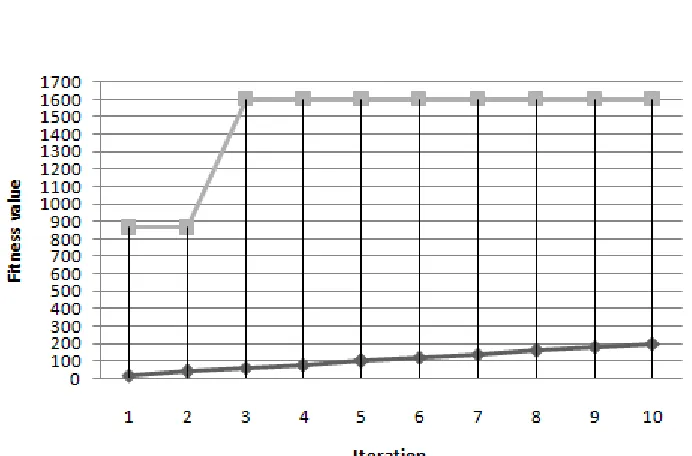
results based on the proposed algorithm and existing results have been listed in Table 2. Figure
4 illustrates the convergence property of the proposed algorithm for the case.
Table 2: The Best Obtained Results of Three-Units
Generator output (MW) Proposed PSO algorithm Conventional Algebraic
PG1(MW) 304.538 33.490
PG2(MW) 301.289 64.116
PG3(MW) 261.144 55.126
Total Cost($/hr) 866.97 1600.46
Transmission loss 0.71535 2.3419
Load demand 150 150
Figure4: Convergence Property of Proposed Algorithm For the case.
Results of Table 2 show an acceptable improvement in the total cost of the system which demonstrates
the ability of the proposed algorithm even in a small problem search space.
CONCLUSION
In this paper we apply particle swarm optimization (PSO) to provide a rapid solution to solve ED problems. Our proposed different from other, PSO algorithms have single particle gives a solution to solve the main problem. In each generation of movement the best given solution by the particles is collected and that point in the problem space is called the global best. Personal best is the point that any particle by itself has experienced so far. Although these particles have the opportunity to search the full area of the problem space, missing some points in the problem space is inevitable because the vectors determine the direction of movement of each particle. Hence getting close to global best point might hold the particle around that point. However, the detected global best point is not necessarily the optimum solution to the problem. The efficiency and effectiveness of the proposed technique is benchmarked for test case consisting of three generating units with high non-linearity. The results of the PSO compared with that of other intelligence optimization algorithms in terms of operating cost of generators and power generation. Wide contrasting simulation results are observed with the other methods. PSO results in minimum operating cost, minimum standard deviation among best, mean and worst solution showing good exportability, fast convergence with iteration leads to robustness and good solution quality.
REFERENCES
[1]B. CHOWDHURY and S. RAHMAN, "A review of recent advances in economic dispatch," IEEE Transactions on Power Systems, vol. 5, pp. 1248-1259, 1990.
[2] B. Vanaja, et al., "Artificial Immune based Economic Load Dispatch with valve-point
effect," 2009, pp. 1-5.
[3] S. H. Ling, et al., "Economic load dispatch: A new hybrid particle swarm optimization
approach," 2008, pp. 1-8.
[4] A. Wood and B. Wollenberg, "Power generation, operation, and control. 1996," ed:
John Wiley and Sons, New York.
[5] N. SINHA, et al., "Evolutionary programming techniques for economic load dispatch," IEEE
transactions on evolutionary computation, vol. 7, pp. 83-94, 2003.
[6] A. P. Engelbrecht, Computational intelligence: an introduction: Wiley, 2007.
[7] Y. Shi and R. C. Eberhart, "Empirical study of particle swarm optimization," 2002.
[8] J. Kennedy and R. C. Eberhart, "Particle swarm optimization," 1995, pp. 1942-1948.
[9] A. BAKIRTZIS, et al., "Genetic algorithm solution to the economic dispatch problem,"
IEE proceedings. Generation, transmission and distribution, vol. 141, pp. 377-382, 1994.
[10] P. Chen and H. Chang, "Large-scale economic dispatch by genetic algorithm," IEEE
Transactions on Power Systems, vol. 10, 1995.
[11] T. Yalcinoz, et al., "Economic dispatch solution using a genetic algorithm based on arithmetic crossover," 2001.
[12] Y. Fukuyama and Y. Ueki, "An application of artificial neural network to dynamic economic
load dispatching," 2002, pp. 261-265.
[13] T. YALCINOZ and M. SHORT, "Neural networks approach for solving economic
dispatch problem with transmission capacity constraints," IEEE Transactions on Power
Systems, vol. 13, pp. 307-313, 1998.
[14] T. Niknam, et al., "A new fuzzy adaptive particle swarm optimization for non-smooth
economic dispatch," Energy, vol. 35, pp. 1764- 1778, 2010.
[15] W. Lin, et al., "An improved tabu search for economic dispatch with multiple minima,"
IEEE Transactions on Power Systems, vol. 17, pp. 108-112, 2002.
[16] K. T. Chaturvedi, et al., "Particle swarm optimization with crazy particles for nonconvex
economic dispatch," Applied Soft Computing, vol. 9, pp. 962-969, 2009.
[17] Z. Zhisheng, "Quantum-behaved particle swarm optimization algorithm for economic load
dispatch of power system," Expert Systems with Applications, vol. 37, pp. 1800-1803, 2010.
[18] Z. L. Gaing, "Particle swarm optimization to solving the economic dispatch considering the
generator constraints," Power Systems, IEEE Transactions on, vol. 18, pp. 1187-1195, 2003.
[19] C. C. Kuo, "A novel coding scheme for practical economic dispatch by modified
particle swarm approach," Power Systems, IEEE Transactions on, vol. 23, pp. 1825-1835,
2008.
[20] L. d. S. Coelho, et al., "Improved differential evolution approach based on cultural algorithm
and diversity measure applied to solve economic load dispatch problems,"
Mathematics and Computers in Simulation, vol. 79, pp. 3136-3147, 2009.
[21] T. Niknam, et al., "A new honey bee mating optimization algorithm for non-smooth
economic dispatch," Energy, vol. 36, pp. 896- 908, 2011.
[22] L. d. S. Coelho and V. C. Mariani, "An efficient cultural self-organizing migrating strategy for
economic dispatch optimization with valvepoint effect," Energy Conversion and
Management, vol. 51, pp. 2580-2587, 2010.
[23] M. Fesanghary and M. M. Ardehali, "A novel meta-heuristic optimization methodology for
solving various types of economic dispatch problem," Energy, vol. 34, pp. 757-766, 2009.
[24] J. X. V. Neto, et al., "Improved quantuminspired evolutionary algorithm with diversity
information applied to economic dispatch problem with prohibited operating zones,"
Energy Conversion and Management, vol. 52, pp. 8-14, 2011.
[25] C. T. SU and G. J. CHIOU, "A fastcomputation hopfield method to economic
dispatch of power systems," IEEE Transactions on Power Systems, vol. 12, pp. 1759-1764,
1997.
[26] K. Swarup and S. Yamashiro, "Unit commitment solution methodology using
genetic algorithm," Power Systems, IEEE Transactions on, vol. 17, pp. 87-91, 2002.
[27] H. Saadat, Power System Analysis: McGrawhill companies, 1999.
[28] H. Yoshida, et al., "A PARTICLE SWARM OPTIMIZATION FOR REACTIVE POWER
AND VOLTAGE CONTROL CONSIDERING VOLTAGE SECURITY ASSESSMENT,"
IEEE Trans. on Power Systems, vol. 15, pp. 1232-1239, 2001.