
Cryptanalysis of GGH15 Multilinear Maps
?Jean-S´ebastien Coron1, Moon Sung Lee1, Tancr`ede Lepoint2, and Mehdi Tibouchi3
1
University of Luxembourg 2
CryptoExperts 3
NTT Secure Platform Laboratories
June 2, 2016
Abstract. We describe a cryptanalysis of the GGH15 multilinear maps. Our attack breaks the multi-partite key-agreement protocol in polynomial time by generating an equivalent user private key; it also applies to GGH15 with safeguards. We also describe attacks against variants of the GGH13 multilinear maps proposed by Halevi (ePrint 2015/866) aiming at supporting graph-induced constraints, as in GGH15.
1 Introduction
Multilinear maps. For the past couple of years, cryptographic multilinear maps have found numerous applications in the design of cryptographic protocols, the most salient example of which is probably the construction of indistinguishability obfuscation (iO) [GGH+13b]. The first multilinear maps candidate (GGH13) was described by Garg, Gentry and Halevi [GGH13a] from ideal lattices. It was then followed by another candidate (aka, CLT13) due to Coron, Lepoint and Tibouchi [CLT13] using the same techniques but over the integers, and later by a third candidate (GGH15) by Gentry, Gorbunov and Halevi [GGH15], related to the homomorphic encryption scheme from [GSW13].
Unfortunately, these candidates do not rely on well-established hardness assumptions, and recent
months have witnessed a number of attacks (including [CHL+15], [CGH+15], [HJ16], [BGH+15],
[PS15], [CFL+16]) showing that they fail to meet a number of desirable security requirements,
and that they cannot be used to securely instantiate such and such protocols. Some attempts to protect against these attacks have also known a similar fate [CLT15, BGH+15]. The security of the constructions based on these multilinear maps is currently unclear to the community [Hal15a]. While
two recent works [CGH+15, MSZ16] have shown polynomial-time attacks against some obfuscation
candidates, many iO candidates remain unaffected by the attacks proposed so far. The same cannot be said for the more immediate application of multilinear maps that is one-round multipartite key agreement.
One-round multipartite key-agreement protocol. Since its discovery in 1976, the Diffie– Hellman protocol [DH76] is one of the most widely used cryptographic protocol to create a common secret between two parties. A generalization of this one-round protocol to three parties was proposed
in 2000 by Joux [Jou00] using cryptographic bilinear maps; it was later extended to k≥4 parties
assuming the existence of a cryptographic (k−1)-linear map by Boneh and Silverberg [BS02]. In
a nutshell, the protocol works as follows: assuming some public parameters are shared by all the parties, each party broadcasts some data and keeps some data secret, and then by combining their
?
secret data with the other parties’ published values using the multilinear map, they can derive a shared common secret key.
The first candidates for a k-partite Diffie–Hellman key-agreement protocol for arbitrary k
were described in [GGH13a, CLT13] using respectively the GGH13 and CLT13 multilinear maps candidates. Unfortunately, the protocols were later shown to be insecure in [HJ16, CHL+15]: using the public parameters and the broadcast data, an eavesdropper can recover the shared common secret key in polynomial time.
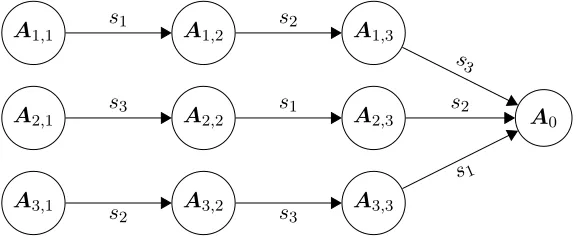
The GGH15 key-agreement protocol. Since the third proposed multilinear maps scheme, GGH15, does not fit the same graded encoding framework as the earlier candidates, one needs new constructions to use it to instantiate cryptographic protocols. And the first such application was again a Diffie–Hellman key-agreement protocol [GGH15, Section 5.1]. To avoid similar attacks as the one that targeted GGH13 and CLT13, based on encodings of zero, the protocol was designed in such a way that the adversary is never given encodings of the same element that could be subtracted
without doing the full key-agreement computation. Namely, each party i has a directed path of
matricesAi,1, . . . ,Ai,k+1 all sharing the same end-pointAi,k+1=A0, and has a secret valuesi. She
can then publish encodings ofsi on the chains of the other parties in a “round robin” fashion, i.e.si
is encoded on thej-th edge of the chain of the partyi0 =j−i+ 1, with index arithmetic modulo k. The graph for 3 parties is illustrated in Figure 1.
A0
A1,3
A1,2
A1,1
A2,3
A2,2
A2,1
A3,3
A3,2
A3,1
s1 s2
s3
s3 s1 s2
s2 s3
s1
Fig. 1.Graph for a 3-partite key-agreement protocol with GGH15 multilinear maps.
On thei-th chain, Partyiwill then be able to multiply these encodings (the one he kept secret
and the ones published by the other parties) to get an encoding of Q
jsj relative to the path
Ai,1 A0. Now, since the encodings of si cannot be mixed before the end-point A0, it seems
difficult to obtain an encoding of 0 on an edge in the middle of the graph to mount “zeroizing attacks” [GGH15].
Halevi’s candidate key-agreement protocols. As no attack was known on GGH15 multilinear maps and in an attempt to reinstate a key-agreement protocol for GGH13, Halevi recently proposed, on the Cryptology ePrint Archive, two variants of GGH13 supporting a similar key-agreement
protocol [Hal15a].1 The first variant uses the “asymmetric” GGH13 scheme to handle the graph
structure [Hal15a, Section 7]. Namely, in basic GGH13 each encoding is multiplicatively masked
by a powerzi of a secret mask z; in asymmetric GGH13, the encodings can be masked by powers
of multiple zj’s. Therefore, in this new key-agreement protocol candidate, the public encodings
are now associated with independent maskszi,j’s such that their product yields the same valueZ,
i.e. Q
jzi,j =Z for alli(so that the final encoding shall extract to the same shared key). The graph
for 3 parties is illustrated in Figure 2.
Z z1,1
·z1,2
z1,1
z3,1 ·z3,2
z3,1
z2,1 ·z2,2
z2,1 1
s1
s2
s3
s1
s2
s3
s1 s2 s3
Fig. 2.Multipartite key agreement from asymmetric GGH13, with 3 parties, from [Hal15a, Section 7].
Once again, the fact that the encodings of the same value si are multiplied with different masks
gives hope that no encoding of 0 multiplied by a value other than Z can be obtained, and therefore
that zeroizing attacks are impossible [GGH13a, CGH+15].
A second variant of GGH13, which we refer to as Graph-GGH13, mimics the structure of GGH15 encodings more closely and is described in [Hal15a, Section 6]. An encodingc∈α+gR relative to a
pathu vis now a matrix ˜C =P−1
u ·C·Pv, whereC ∈Zn×nq is the multiply-by-cmatrix, and the
Pw’s are secret random matrices. In the key-agreement protocol, each partyihas a directed path
of matricesPi,1, . . . ,Pi,k+1 all sharing the same end-pointPi,k+1 =P0 and the same start-point
Pi,1 =P1, and has a secret valuesi. She can then publish encodings ofsi on the chains of the other
parties in a “round robin” fashion. The graph for 3 parties is illustrated in Figure 3.
P0
P1,3
P1,2
P2,3
P2,2
P1
P3,3
P3,2
s1
s2
s3
s3 s1 s2
s2
s3
s1
And here again, the fact that the encodings corresponding to the same si are multiplied on the
left and on the right by completely random matricesPi,j makes it difficult to cancel them out and
obtain an encoding of 0 without evaluating the full “chains” (that is, the operations of the key agreement itself).
Finally, in order to capture the intuition of what it means for an attacker to break the scheme, Halevi defined, for both schemes, the “core computational task” of an adversary as recovering any basis of the (hidden) plaintext space [Hal15a, Section 2.2].
Our contributions. Our main contribution is to describe a cryptanalysis of the Diffie–Hellman key-agreement protocol when instantiated with GGH15 multilinear maps. Our attack makes it possible to generate an equivalent user private key in polynomial time, which in turn allows to recover the shared session key. Our attack proceeds in two steps: in the first step, we express the secret exponent of one user as a linear combination of some other secret exponents corresponding to public encodings, using a variant of the Cheon et al. attack [CHL+15]. This does not immediately break the protocol because the coefficients of the linear combination can be large. In the second step, we use the previous linear combination to derive an encoding equivalent to the user private encoding, by correcting the error resulting from the large coefficients of the linear combination. Our attack also applies to GGH15 with safeguards; we extend the basic attack by using another linear relation to estimate the error incurred from the large coefficients, thus enabling to recover the shared session key.
In Appendix B, we also describe attacks that break both variants of GGH13 proposed by Halevi in [Hal15a]. Our attacks apply some variant of the Cheonet al.attack [CHL+15] to recover a basis of the secret plaintext spaceR/gRin polynomial time. This was considered as the “core computational task of an attacker” in [Hal15a].
Source code. A proof-of-concept implementation of our cryptanalysis of GGH15, using the Sage [Dev16] mathematics software system, is available at:
http://pastebin.com/7kZHnTXY
2 The GGH15 Multilinear Map Scheme
We briefly recall the GGH15 multilinear map scheme; we refer to [GGH15] for a full description. In the following we only consider the commutative variant from [GGH15, Section 3.2], as only that commutative variant can be used in the multipartite key-agreement protocol from [GGH15, Section 5.1].
2.1 GGH15 Multilinear Maps
The construction works over polynomial ringsR =Z[x]/(f(x)) andRq=R/qR for some degreen
irreducible integer polynomial f(x)∈Z[x] and an integer q. The construction is parametrized by a
directed acyclic graph G= (V, E). To each nodeu∈V a random row vector Au ∈Rmq is assigned,
where mis a parameter. An encoding of a small plaintext element s∈R relative to pathu v is a
matrix with small coefficientsD ∈Rm×m such that:
where E is a small error vector of dimension mwith components inR; we refer to [GGH15] for how
such encoding D can be generated, based on a trapdoor sampling procedure from [MP12]. Only
small plaintext elementss∈R are encoded. As in [Hal15a] we use the row vector notation forAu,
rather than the column vector notation used in [GGH15].2 It is easy to see that two encodingsD1
and D2 relative to the same path u v can be added; namely from:
Au·D1 =s1·Av+E1 (mod q)
Au·D2 =s2·Av+E2 (mod q) we obtain:
Au·(D1+D2) = (s1+s2)·Av+E1+E2 (modq).
Moreover two encodings D1 and D2 relative to pathu v andv w can be multiplied to get
an encoding relative to path u w. Namely given:
Au·D1=s1·Av+E1 (modq)
Av·D2=s2·Aw+E2 (modq)
we obtain by multiplying the matrix encodings D1 and D2:
Au·D1·D2 = (s1·Av+E1)·D2 (modq)
=s1·s2·Aw+s1·E2+E1·D2 (modq) =s1·s2·Aw+E0 (modq)
for some new error vector E0. Sinces1,E1, E2 and D2 have small coefficients,E0 still has small coefficients (compared toq), and therefore the product D1·D2 is an encoding ofs1·s2 for the path
u w.
Finally, given an encoding D relative to path u w and the vectorAu, extraction works by
computing the high-order bits of Au·D. Namely we have:
Au·D =s·Aw+E (mod q)
for some small E, and therefore the high-order bits ofAu·D only depend on the secret exponents.
Remark 1. As emphasized in [GGH15], only the plaintext space of the si’s is commutative, not the
space of the encoding matrices Di. The ability to multiply the plaintext elementssi in arbitrary
order will be used in the multipartite key-agreement protocol below.
2.2 The GGH15 Multipartite Key-Agreement Protocol
We briefly recall the multipartite key-agreement protocol from [GGH15, Section 5.1]. We consider the protocol withk users. As illustrated in Figure 4 fork= 3 users, each userifor 1≤i≤khas a directed path of vectorsAi,1, . . . ,Ai,k+1, all sharing the same end-pointA0 =Ai,k+1. Thei-th user will use the resulting chain to extract the session key. Each user ihas a secret exponentsi. Each
secret exponent si will be encoded in each of thek chains; the encoding ofsi on the j-th chain for
j 6=iwill be published, while the encoding of si on thei-th chain will be kept private by user i.
2
Therefore on the i-th chain only user iwill be able to compute the session key. The exponentssi
are encoded in a “round robin” fashion; namely the i-th secret si is encoded on the chain of userj
at edge`=i+j−1, with index arithmetic modulok. Only the vectorsAi,1 for 1≤i≤kare made public to enable extraction of the session-key; the others are kept private. We recall the formal description of the protocol in Appendix A.
A0 A1,3
A1,2 A1,1
A2,3 A2,2
A2,1
A3,3 A3,2
A3,1
s1,(D1,1) s2,D1,2
s3,
D 1,3
s3,D2,1 s1,D2,2 s2,(D2,3)
s2,D3,1 s3,(D3,2)
s1,D 3,3
Fig. 4. Graph of a key agreement between 3 parties for GGH15. The vertices contain random vectors Aij, and
encodings are represented on the edges. Each party is represented by a different color, keeps the encoding in parenthesis secret and publishes the two other encodings.
We illustrate the protocol for k= 3 users. For the chain corresponding to User 1, we have the following encodings:
A1,1·D1,1=s1·A1,2+F1,1 (modq)
A1,2·D1,2=s2·A1,3+F1,2 (modq)
A1,3·D1,3=s3·A0+F1,3 (modq)
where D1,2 andD1,3 are public while D1,1 is kept private by User 1. Therefore User 1 can compute modulo q:
A1,1·D1,1·D1,2·D1,3= (s1·A1,2+F1,1)·D1,2·D1,3 (modq)
= (s1·s2·A1,3+s1·F1,2+F1,1·D1,2)·D1,3 (modq). LettingFˆ1,2 :=s1·F1,2+F1,1·D1,2, we obtain:
A1,1·D1,1·D1,2·D1,3=
s1·s2·A1,3+Fˆ1,2
·D1,3 (modq)
=s1·s2·s3·A0+s1·s2·F1,3+Fˆ1,2·D1,3 (modq).
Sinces1,s2 ands3 are small andF1,3,Fˆ1,2 andD1,3 have small components, User 1 can extract the most significant bits corresponding tos1·s2·s3·A0. Similarly User 2 will compute the session key using the following chain, where D2,1 and D2,2 are public whileD2,3 is private to User 2:
A2,1·D2,1=s3·A2,2+F2,1 (modq)
A2,2·D2,2=s1·A2,3+F2,2 (modq)
Namely User 2 can compute:
A2,1·D2,1·D2,2·D2,3 = (s3·s1·A2,3+s3·F2,2+F2,1·D2,2)·D2,3 (mod q) =s3·s1·s2·A0+F (modq)
for some small vector F, and extract the same most significant bits corresponding to s1·s2·s3·A0; the same holds for User 3.
The previous encodings are generated by random linear combination of public encodings, corresponding to secret exponentsti,` for 1≤`≤N, for large enoughN. More precisely, for each
1≤i≤k one generates random small plaintext elementsti,` for 1≤`≤N, which are then encoded
on all chainsj at edge i0=i+j−1 (with index modulo k), by Cj,i0,`. This means that for k= 3 users, we have the following encodings corresponding to User 1:
A1,1·C1,1,`=t1,`·A1,2+E1,1,` (modq)
A2,2·C2,2,`=t1,`·A2,3+E2,2,` (modq)
A3,3·C3,3,`=t1,`·A0+E3,3,` (mod q)
and the tuple (D1,1,D2,2,D3,3) is generated by linear combination of the tuple (C1,1,`,C2,2,`,C3,3,`),
so that the matrices D1,1, D2,2 andD3,3 encode the same secret exponent s1; the same holds for users 2 and 3. We refer to Appendix A for the formal description of the protocol.
3 Cryptanalysis of GGH15 Without Safeguards
In the following we describe a cryptanalysis of the multipartite key-agreement protocol based on GGH15 multilinear maps recalled in the previous section. Heuristically our attack recovers the session-key from public element in polynomial-time. Our attack proceeds in two steps.
1. In the first step, we are able to express one secret exponent s1 as a linear combination of the other secret exponents t1,`, using a variant of the Cheon et al.attack [CHL+15]. However this
does not immediately break the protocol, because the coefficients are not small.
2. In the second step, we compute an equivalent of the private encoding of User 1 from the previous linear combination, by correcting the error due to the large coefficients. This breaks the key-exchange protocol.
3.1 Description With 3 Users
For simplicity we first consider the protocol with only 3 users; the extension to k ≥ 3 users is
A1,1·D1,1=s1·A1,2+F1,1 (modq) A1,1·C1,1,`=t1,`·A1,2+E1,1,` (modq)
A1,2·D1,2=s2·A1,3+F1,2 (modq) A1,2·C1,2,`=t2,`·A1,3+E1,2,` (modq)
A1,3·D1,3=s3·A0+F1,3 (modq) A1,3·C1,3,`=t3,`·A0+E1,3,` (mod q)
A2,1·D2,1=s3·A2,2+F2,1 (modq) A2,1·C2,1,`=t3,`·A2,2+E2,1,` (modq)
A2,2·D2,2=s1·A2,3+F2,2 (modq) A2,2·C2,2,`=t1,`·A2,3+E2,2,` (modq)
A2,3·D2,3=s2·A0+F2,3 (modq) A2,3·C2,3,`=t2,`·A0+E2,3,` (mod q)
A3,1·D3,1=s2·A3,2+F3,1 (modq) A3,1·C3,1,`=t2,`·A3,2+E3,1,` (modq)
A3,2·D3,2=s3·A3,3+F3,2 (modq) A3,2·C3,2,`=t3,`·A3,3+E3,2,` (modq)
A3,3·D3,3=s1·A0+F3,3 (modq) A3,3·C3,3,`=t1,`·A0+E3,3,` (mod q)
where all encodingsCi,j,`andDi,j are public, exceptD1,1 which is private on Row 1,D2,3 is private on Row 2, andD3,2 is private on Row 3. The corresponding graph is illustrated in Figure 4. Note that on each row we have used the same index `fort1,`,t2,` andt3,`, but on a given row one can
obviously compute product of encodings for different indices.
First step: linear relations. In the first step of the attack, we show that we can express s1 as a linear combinations of the t1,`’s. For this we consider the rows 2 and 3, for which the encodings
D2,2 andD3,3 corresponding tos1 are public. In the remaining of the attack, we always consider a fixed index `= 1 for the encodings corresponding to t3,`, and for simplicity we writet3 :=t3,1,
C1,3 :=C1,3,1,C2,1:=C2,1,1 and C3,2 :=C3,2,1.
Since we always work with the same t3, on Row 2 we define the product encodings Cˆ2,2,`:=
C2,1·C2,2,`, and on Row 3 we define the product encodingsCˆ3,2,`:=C3,1,`·C3,2; recall that we
use a fixed index for t3. Therefore we can write:
A2,1·Cˆ2,2,`=t1,`·t3·A2,3+Eˆ2,2,` (modq) (1)
A2,3·C2,3,`=t2,`·A0+E2,3,` (modq)
A3,1·Cˆ3,2,`=t2,`·t3·A3,3+Eˆ3,2,` (modq)
A3,3·C3,3,`=t1,`·A0+E3,3,` (modq)
for some small error vectors Eˆ2,2,` and Eˆ3,2,`.
For simplicity of notations, we first consider a fixed index ifor the encodings corresponding to
t1,i, and we writet1 :=t1,i,Cˆ2,2 :=Cˆ2,2,i and C3,3 :=C3,3,i. Similarly we consider a fixed indexj
for the encodings corresponding to t2,j and we writet2 :=t2,j, C2,3 :=C2,3,j andCˆ3,2 :=Cˆ3,2,j.
We use similar notations for the corresponding error vectors.
All previous equations hold modulo q only. To get a result overR instead of only moduloq, we compute the difference between two rows, for the same product of secret exponents. More precisely, we compute:
ω=A2,1·Cˆ2,2·C2,3−A3,1·Cˆ3,2·C3,3 (2) =t1·t3·t2·A0+t1·t3·E2,3+Eˆ2,2·C2,3
−t2·t3·t1·A0−t2·t3·E3,3−Eˆ3,2·C3,3
Namely the latter equation holds overR (and not only modulo q) because all the terms in (3) have small coefficients; namely the only termt1·t2·t3·A0 with large coefficients modulo q is canceled when doing the subtraction.
We have that ωis a vector of dimensionm. Now an important step is to restrict ourselves to the
first component ofω. Namely in order to apply the same technique as in the Cheonet al. attack,
we would like to express ω as the product of two vectors, where the left vector corresponds to
User 1 and the right vector corresponds to User 2. However due to the “round-robin” fashion of exponent encodings, for this we would need to swap the productEˆ3,2·C3,3 appearing in (3), since
ˆ
E3,2 corresponds to User 2 while C3,3 corresponds to User 1; this cannot be done if we consider the full vector ω. By restricting ourselves to the first component ofω, the productEˆ3,2·C3,3 becomes a simple scalar product that can be swapped; namely the scalar product of Eˆ3,2 by the first column vectorC03,3 of the matrixC3,3. We obtain the scalar:
ω=t1·t3·E2,3+Eˆ2,2·C02,3−t2·t3·E3,3−C03,3·Eˆ3,2
where C02,3 and C03,3 are the first column vectors ofC2,3 and C3,3 respectively, both of dimension
m; similarly E2,3 and E3,3 are the first components ofE2,3 and E3,3 respectively.
We can now write ω as the scalar product of 2 vectors, the left one corresponding only to User 1, and the right one corresponding only to User 2:
ω = h
t1 Eˆ2,2 E3,3 C03,3 i ·
t3·E2,3
C02,3
−t2·t3 −Eˆ3,2
.
Note that the two vectors in the product have dimension 2m+ 2.
As in the Cheon et al.attack [CHL+15], we can now extendω to a matrix by considering many
left row vectors and many right column vectors. However instead of a square matrix as in the Cheon
et al.attack, we consider a rectangular matrix with 2m+ 3 rows and 2m+ 2 columns. In Equation (2), this is done by considering 2m+ 3 public encodingsCˆ2,2,i and C3,3,i corresponding to User 1,
and similarly 2m+ 2 encodings C2,3,j and Cˆ3,2,j corresponding to User 2, for 1≤i≤2m+ 3 and
1 ≤j ≤2m+ 2. More precisely we compute as previously overR the following matrix elements,
restricting ourselves to the first component:
(W)ij =A2,1·Cˆ2,2,i·C02,3,j−A3,1·Cˆ3,2,j·C03,3,i (4)
and as previously we can write:
(W)ij =
h
t1,i Eˆ2,2,i E3,3,i C03,3,i
i ·
t3·E2,3,j
C02,3,j
−t2,j·t3 −Eˆ3,2,j
.
We obtain a (2m+ 3)×(2m+ 2) matrixW with:
W = . . .
t1,i Eˆ2,2,i E3,3,i C03,3,i
. . .
| {z }
A ·
t3·E2,3,j
..
. C
0
2,3,j ..
. −t2,j·t3
−Eˆ3,2,j
| {z }
where the matrix A has 2m+ 3 rows vectors, each of dimension 2m+ 2, and the matrix B has
2m+ 2 column vectors, each of dimension 2m+ 2; henceB is a square matrix.
By doing linear algebra, we can find a vectoruover Rof dimension 2m+ 3 such thatu·W = 0, which gives:
(u·A)·B= 0.
Heuristically with good probability the matrixB is invertible, which implies:
u·A= 0.
Since the first column of the matrixA is the column vector given by thet1,i’s, such vector ugives a
linear relation among the secret exponents t1,i.
Moreover, since the encodings D2,2 and D3,3 corresponding to s1 are public, we can express
s1 as a linear combination of the t1,i’s, over R. Namely we can define as previously the product
encoding Dˆ2,2 :=C2,1·D2,2, with:
A2,1·Dˆ2,2 =s1·t3·A2,3+Fˆ2,2 (modq)
for some small error vector Fˆ2,2, and we can now compute the same (W)ij as in (4) but withDˆ2,2 and D03,3 instead of Cˆ2,2,i and C30,3,i, where D03,3 is the first column of D3,3. More precisely, we compute for all 1≤j≤2m+ 2:
ωj =A2,1·Dˆ2,2·C02,3,j−A3,1·Cˆ3,2,j·D03,3 which gives as previously:
ωj =
h
s1 Fˆ2,2 F3,3 D03,3 i
·
t3·E2,3,j
C02,3,j
−t2,j·t3 −Eˆ3,2,j
.
This implies that we can replace any row vector [t1,i Eˆ2,2,i E3,3,i C03,3,i] in the matrix Aby the row
vector:
[s1 Fˆ2,2 F3,3 D03,3] (5)
where D03,3 is the first column ofD3,3, and F3,3 is the first component ofF3,3. Using the previous technique, we can therefore obtain a linear relation betweens1 and thet1,i’s over R. More precisely,
with overwhelming probability, such a relation can be put in the form:
µ·s1 = 2m+2
X
i=1
λi·t1,i (6)
with µ∈Zandλ1, . . . , λ2m+2 ∈R. Indeed, we obtain such a relation by computing the kernel of the matrix analogous toW above in echelon form over the fraction field of R, which gives the kernel of the corresponding matrixA(assuming thatB is invertible). Unless a minor of that matrix vanishes, which happens with only negligible probability, this gives a relation where the coefficient of s1 is 1 and the other coefficients are in the fraction fieldR⊗ZQofR. By clearing denominators, we get an
Then, by considering exactly one additional t1,i (sayt1,2m+3) and carrying out the same compu-tations with indices i= 2, . . . ,2m+ 3 instead ofi= 1, . . . ,2m+ 2, we get a second relation:
ν·s1 = 2m+3
X
i=2
λ0i·t1,i.
If the integers µand ν are relatively prime, which happens with significant probability3, we can apply B´ezout’s identity to obtain a linear relation inR where the coefficient ofs1 is 1:
s1 = 2m+3
X
i=1
αi·t1,i. (7)
Note that we have the same linear relations for the other components of the vector (5) corresponding tos1, namely:
ˆ
F2,2= 2m+3
X
i=1
αi·Eˆ2,2,i, F3,3= 2m+3
X
i=1
αi·E3,3,i, D03,3= 2m+3
X
i=1
αi·C03,3,i. (8)
Second step: equivalent private-key. In this second step, we show how to publicly compute an encoding equivalent to D1,1, which is private to User 1; this will break the key-agreement protocol.
In the first step, we had considered rows 2 and 3 to derive the linear relations (7) and (8); we now consider Row 1. On Row 1, the encodings D1,2 and D1,3 are public, so we can define as previously the product encodingDˆ1,3 =D1,2·D1,3, which gives:
A1,2·Dˆ1,3 =s2·s3·A0+Fˆ1,3 (modq)
for some small error vectorFˆ1,3. Recall that the encoding D1,1 is private to User 1, with:
A1,1·D1,1 =s1·A1,2+F1,1 (modq). (9) Therefore only User 1 can privately compute:
A1,1·D1,1·Dˆ1,3 =s1·s2·s3·A0+s1·Fˆ1,3+F1,1·Dˆ1,3 (modq) (10) and extract the high order bits of s1·s2·s3·A0modq to generate the session key.
We cannot compute the previous equation since D1,1 is private. However since we know a linear relation (7) betweens1 and thet1,i’s, and the encodingsC1,1,i corresponding tot1,i are public, with:
A1,1·C1,1,i=t1,i·A1,2+E1,1,i (modq)
it is then natural to compute:
˜
D1,1 = 2m+3
X
i=1
αi·C1,1,i,
3
Heuristically, it is the probability that two random elements ofRhave coprime norms, since the rational integer denominator of an element of the fraction field has the same prime factors as its norm. ForR=Z[x]/(x2
n
which gives:
A1,1·D˜1,1 =s1·A1,2+ 2m+3
X
i=1
αi·E1,1,i (modq). (11)
The difference with (9) is that the error term P2m+3
i=1 αi·E1,1,i is not necessarily small since the coefficients αi can be large. Therefore if we compute:
A1,1·D˜1,1·Dˆ1,3=s1·s2·s3·A0+s1·Fˆ1,3+ 2m+3
X
i=1
αi·E1,1,i
!
·Dˆ1,3 (modq) (12)
then as opposed to (10) this does not reveal the high-order bits of s1 ·s2·s3·A0 modq. In the
following, we show how to derive an approximation ofP2m+3
i=1 αi·E1,1,i over R, in order to correct the error in (11) and break the protocol. This is the second part of our attack.
As in the first step of the attack, to get equations over R and not only moduloq, we consider the difference between two rows, this time the difference between rows 1 and 3 (instead of rows 2 and 3). We have the public encodings:
A1,1·C1,1,`=t1,`·A1,2+E1,1,` (modq)
A1,2·Cˆ1,3,`=t2,`·t3·A0+Eˆ1,3,` (modq)
A3,1·Cˆ3,2,`=t2,`·t3·A3,3+Eˆ3,2,` (modq)
A3,3·C3,3,`=t1,`·A0+E3,3,` (modq)
where we letCˆ1,3,`:=C1,2,`·C1,3, for some small error vectorEˆ1,3,`. As previously we can compute
overR, restricting ourselves to the first component, whereCˆ01,3,j and C03,3,i are the first columns of ˆ
C1,3,j and C3,3,i respectively:
ωij =A1,1·C1,1,i·Cˆ01,3,j−A3,1·Cˆ3,2,j·C03,3,i
=t1,i·Eˆ1,3,j+E1,1,i·Cˆ01,3,j−t2,j·t3·E3,3,i−Eˆ3,2,j·C03,3,i.
We can therefore compute overR, using the coefficients αi from the linear relation (7):
Ωj =
2m+3 X
i=1
αi·
A1,1·C1,1,i·Cˆ01,3,j−A3,1·Cˆ3,2,j·C03,3,i
(13)
= 2m+3
X
i=1
αi·
t1,i·Eˆ1,3,j+E1,1,i·Cˆ01,3,j−t2,j·t3·E3,3,i−Eˆ3,2,j·C03,3,i
.
Using the linear relations (7) and (8), we obtain:
Ωj =s1·Eˆ1,3,j−t2,j·t3·F3,3−Eˆ3,2,j·D03,3+ 2m+3
X
i=1
αi·E1,1,i
!
·Cˆ01,3,j
which gives:
Ωj =uj+
2m+3 X
i=1
αi·E1,1,i
!
for some smalluj inR. In summary we obtain a large scalarΩj because the coefficientsαi in (13) are
large, but eventually what makes Ωj large is only the contribution from (P2i=1m+3αi·E1,1,i)·Cˆ01,3,j;
namely because of the linear relations (7) and (8) the other terms remain small.
We can now write (14) in vectorial form, where we let Cˆ001,3 be the square matrix whose columns are the column vectorsCˆ01,3,j for 1≤j ≤m; recall that the Cˆ01,3,j are the first column vectors of the matrix encodingsCˆ1,3,j. We obtain a row vector Ω of dimensionm, where:
Ω =u+ 2m+3
X
i=1
αi·E1,1,i
!
·Cˆ001,3 (15)
where Cˆ001,3 is a public square matrix of dimension m.
Now the crucial observation is that because the vector u has small components, we can get an
approximation of the vector P2m+3
i=1 αi·E1,1,i by reducing the vector Ω modulo the matrixCˆ
00
1,3, assuming thatCˆ001,3 is an invertible matrix, which heuristically holds with good probability. This can be done by solving over the fraction field ofRthe linear system Ω =y·Cˆ001,3 and then rounding
to R the coefficients of y. Heuristically the vector E =bye should be a good approximation of
P2m+3
i=1 αi·E1,1,i; namely letting:
E0= 2m+3
X
i=1
αi·E1,1,i−E (16)
we get using y=Ω·Cˆ00−1,31:
E0 = (Ω−u)·Cˆ00−1,31−E
=y−E−u·Cˆ00−1,31
and therefore since y−E andu are small, the difference vectorE0 should be small if the norm of the transpose of the matrix Cˆ00−1,31 remains small. We know that such a bound holds with probability close to 1 if we model Cˆ001,3 as a random matrix (e.g. Rudelson [Rud08] provides a bound of the formO(m3/2)), and so we expect E0 to be small (compared toq) for randomly generated encodings, since in the GGH15 parameter selection one takes m=Θ(logq).
Combining (11) and (16), we get:
A1,1·D˜1,1−E =s1·A1,2+E0 (mod q)
for a small vectorE0. Note that the previous equation is very similar to the original equation for the private encoding D1,1:
A1,1·D1,1=s1·A1,2+F1,1 (modq)
the only difference being the publicly computed correction vector E. Therefore the pair (D˜1,1,E) gives us an equivalent of the private encodingD1,1, which breaks the protocol. More precisely we
can eventually compute from public parameters:
A1,1·D˜1,1−E
·D1,2·D1,3= s1·A1,2+E0
·Dˆ1,3 (modq)
=s1·s2·s3·A0+s1·Fˆ1,3+E0·Dˆ1,3 (modq)
3.2 Extension to k ≥3 Users
The extension of our attack tok≥3 users is relatively straightforward and described in Appendix D.
4 Cryptanalysis of GGH15 With Safeguards
In [GGH15, Section 5.1] two safeguards for multipartite key agreement based on GGH15 multilinear maps are described:
1. Kilian-style randomization of the encodings, where C is replaced by C¯ :=R−1·C·R0 using
the randomizer matrices R,R0 belonging to two adjacent nodes.
2. Choosing the first encoding matrix in each chain to have large entries.
In the following, we show how to extend our previous attack when those two safeguards are used.
4.1 First Safeguard: Kilian-Style Randomization of the Encodings.
The following safeguard for GGH15 multilinear maps is described in [GGH15], using Kilian-type
randomization [Kil88]. For each internal node v in the graph one can choose a random invertible
m×m matrix Rv moduloq, and for the sinks and sources we set Rv =I. Then each encodingC
relative to path u v is replaced by a masked encoding C¯ :=Ru−1·C ·Rv. Concretely, in the
GGH15 key-agreement protocol, instead of publishing encodingsCi,j with:
Ai,j·Ci,j,`=t1+(j−imodk),`·Ai,j+1+Ei,j,` (modq)
one would only publish the masked encodings moduloq:
¯
Ci,j,`:=R−i,j1·Ci,j,`·Ri,j+1 (17)
with Ri,1 = Ri,k+1 = I for all i; the same masking is applied to the encodings Di,j. Since the
product of encoding on any source-to-sink path remains the same, the same value is eventually extracted. Namely for all iwe have:
k
Y
j=1 ¯
Ci,j = k
Y
j=1
Ci,j
and therefore exactly the same session-key as before is computed by all users.
4.2 Second Safeguard: First Encodings With Large Entries
4.3 Cryptanalysis of GGH15 With Both Safeguards
In this section we show how to extend our attack from Section 3 when both safeguards are used. Note the first step of our attack still applies, since in the first step we are only using product of
encodings from source to sink. Namely in Equation (4) exactly the same value (W)ij is obtained
when using masked encodings. Therefore we can still derive the same linear relation between secret exponents as in (7) and (8).
However the second step of our attack does not apply directly, since our second step requires the knowledge of the matrix Cˆ001,3 in (15), which is obtained from the first columns of the encodings
ˆ
C1,3,j=C1,2,j·C1,3. Since these are partial products only, such partial products would be masked by the unknown randomization matrixR−1,12 modulo q, hence the matrix Cˆ001,3 is unknown.
We can however adapt our second step as follows. For simplicity we keep the same notations as previously, that is we describe our extended attack in term of the original encodingsCi,j,`, instead of
the masked encodingsC¯i,j,`from (17); in that case we are only allowed to use products of encodings
from source to sink. We first start with a slightly different equation from (15):
Ω =u+ 2m+3
X
i=1
αi·E1,1,i
!
·Gˆ001,3 (18)
whereGˆ001,3is a matrix whose columns are the first column vectors of D1,2·C1,3,j for 1≤j≤2m+ 2.
Note that in (12) the error term that we must estimate to recover the session key is:
E =
2m+3 X
i=1
αi·E1,1,i
!
·Dˆ1,3 (19)
Using a similar approach as in the attack first step, our approach consists in finding a vectorxwith coefficients in the fraction fieldR⊗ZQof R such that:
ˆ
D01,3 =Gˆ001,3·x
where Dˆ01,3 is the first column vector ofDˆ1,3. Applying the vectorx on (18) and rounding inR, we obtain:
bΩ·xe=bu·xe+ 2m+3
X
i=1
αi·E1,1,i
! ·Dˆ01,3
Since the components ofu (overR) are small, and moreover the coefficients ofx (overR⊗ZQ) are
heuristically also small, the scalar bu·xein R is small compared toq, and therefore we obtain a good estimate of the first component of the error vectorE from (19), which enables to recover the first component of the session key and breaks the scheme.4
4.4 Detailed Description
First step: linear relations in R. The first step of our attack is exactly the same as previously. Namely as mentioned previously the first step of our previous attack still applies, since in the first step we are only using product of encodings from source to sink. More precisely in Equation (4)
4
exactly the same value (W)ij is obtained when using masked encodings, and therefore we can still
derive the same linear relations as in (7) and (8):
s1 = 2m+3
X
i=1
αi·t1,i, Fˆ2,2 = 2m+3
X
i=1
αi·Eˆ2,2,i, F3,3 = 2m+3
X
i=1
αi·E3,3,i, D03,3 = 2m+3
X
i=1
αi·C03,3,i.(20)
Note that as opposed to Section 3 we don’t know the value of the encodingsD03,3 andC03,3,i, since they are masked by theRij matrices; we only recover the coefficientsαi inR.
Second step: another linear relation. In the second step, our goal is to find a vector x with coefficients in the fraction fieldR⊗ZQof R such that:
D01,3 = 2m+2
X
i=1
xi·C01,3,i
where D01,3 and C01,3,i are the first column vectors of D1,3 and C1,3,i respectively. We show that
this can be done using the same approach as in the attack first step.
Namely lettingCˆ1,2,`:=C1,1,`·C1,2 where we letC1,2:=C1,2,1 corresponding tot2:=t2,1, we
obtain:
A1,1·Cˆ1,2,`=t1,`·t2·A1,3+Eˆ1,2,` (modq)
A1,3·C1,3,`=t3,`·A0+E1,3,` (modq)
Similarly lettingCˆ2,3,`:=C2,2,`·C2,3 whereC2,3:=C2,3,1, we get:
A2,1·C2,1,`=t3,`·A2,2+E2,1,` (modq)
A2,2·Cˆ2,3,`=t1·t2,`·A0+Eˆ2,3,` (modq)
We can therefore compute the following matrix elements in R, restricting ourselves as previously to the first component of the vectors:
(W)ij =A1,1·Cˆ1,2,i·C01,3,j−A2,1·C2,1,j·Cˆ02,3,i
=t1,i·t2·E1,3,j+Eˆ1,2,i·C01,3,j−t3,j·Eˆ2,3,i−E2,1,j·Cˆ02,3,i
for all 1≤i≤2m+ 2 and 1≤j≤2m+ 2, whereC01,3,j andCˆ02,3,i are the first column vectors of
C1,3,j and Cˆ2,3,i respectively. This gives:
(W)ij =
h
t1,it2 Eˆ1,2,i Eˆ2,3,i Cˆ02,3,i
i ·
E1,3,j
C01,3,j
−t3,j
−E2,1,j
.
Moreover, since the encodingsD1,3 andD2,1 corresponding tos3 on rows 1 and 2 are public, we can additionally compute the corresponding vector:
(V)i=A1,1·Cˆ1,2,i·D01,3−A2,1·D2,1·Cˆ02,3,i
= h
t1,it2 Eˆ1,2,i Eˆ2,3,i Cˆ02,3,i
i ·
F1,3
D01,3
−s3 −F2,1
whereD01,3 is the first column vector ofD1,3. Therefore assuming that the matrix W is invertible,
we can find xin R⊗ZQsuch that:
W ·x=V
which gives as required:
D01,3 = 2m+2
X
i=1
xi·C01,3,i (21)
Note that the only difference with the linear relations from Step 1 is that we don’t require the xi’s
to be inR, only in the fraction fieldR⊗ZQof R; this implies that heuristically such coefficients should remain small in absolute value.
Third step: estimating the error term. In the third step our goal is to estimate the error term when computing the session-key, as in the second step of the basic attack. We first start with a slightly different equation from (15):
Ω =u+ 2m+3
X
i=1
αi·E1,1,i
!
·Gˆ001,3 (22)
whereGˆ001,3is a matrix whose columns are the first column vectors of D1,2·C1,3,j for 1≤j≤2m+ 2.
Therefore the only difference with (15) is that we use the matrixGˆ001,3 instead ofCˆ001,3.
To obtain (22) we proceed as follows. Instead of letting Cˆ1,3,` = C1,2,`·C1,3 as in the basic attack, we let Cˆ1,3,`=D1,2·C1,3,`. Similarly we letCˆ3,2,`:=D3,1·C3,2,`. This is possible because
on rows 1 and 3 the encodingsD1,2 and D3,1 corresponding to s2 are public. We obtain:
A1,1·C1,1,`=t1,`·A1,2+E1,1,` (modq)
A1,2·Cˆ1,3,`=s2·t3,`·A0+Eˆ1,3,` (modq)
A3,1·Cˆ3,2,`=s2·t3,`·A3,3+Eˆ3,2,` (modq)
A3,3·C3,3,`=t1,`·A0+E3,3,` (modq)
As previously we can compute overR, restricting ourselves to the first component, whereCˆ01,3,j
and C03,3,i are the first columns ofCˆ1,3,j andC3,3,i respectively:
ωij =A1,1·C1,1,i·Cˆ01,3,j−A3,1·Cˆ3,2,j·C03,3,i
=t1,i·Eˆ1,3,j+E1,1,i·Cˆ01,3,j−s2·t3,j·E3,3,i−Eˆ3,2,j·C03,3,i.
We can therefore compute overR, using the coefficients αi from the linear relations (20):
Ωj=
2m+3 X
i=1
αi·ωij
= 2m+3
X
i=1
αi·
t1,i·Eˆ1,3,j+E1,1,i·Cˆ01,3,j−s2·t3,j·E3,3,i−Eˆ3,2,j·C03,3,i
Using the linear relations in (20), we obtain:
Ωj =s1·Eˆ1,3,j−s2·t3,j·F3,3−Eˆ3,2,j·D03,3+ 2m+3
X
i=1
αi·E1,1,i
!
·Cˆ01,3,j
where D03,3 is the first column vector ofD3,3. This gives:
Ωj =uj+
2m+3 X
i=1
αi·E1,1,i
!
·Cˆ01,3,j
for some smalluj in R. Since we have letCˆ1,3,j =D1,2·C1,3,j for 1≤j≤2m+ 2, in vectorial form
we obtain (22) as required, where Gˆ001,3 is the matrix whose columns are the first column vectors of
D1,2·C1,3,j for 1≤j≤2m+ 2.
Recall that in (12) the error term that we must estimate to recover the session key is:
E =
2m+3 X
i=1
αi·E1,1,i
!
·Dˆ1,3 (23)
where Dˆ1,3 = D1,2 ·D1,3. In the following we will only estimate the first component, so we let
ˆ
D01,3=D1,2·D01,3, whereDˆ10,3 andD01,3 are the first column vectors ofDˆ1,3 andD1,3 respectively.
We now use the vector x computed in the second step. In matrix notation, Equation (21) gives:
D01,3 =C001,3·x
whereC001,3 is the matrix whose columns are the first column vectors of C1,3,i for 1≤i≤2m+ 2.
UsingGˆ001,3 =D1,2·C001,3, this gives: ˆ
D01,3 =D1,2·D01,3=D1,2·C001,3·x=G
00
1,3·x
where Dˆ01,3 is the first column vector ofDˆ1,3. Applying the vector xon (22), we therefore get:
Ω·x=u·x+ 2m+3
X
i=1
αi·E1,1,i
! ·Dˆ01,3
We claim that this provides a good estimate of the first component of the error vectorE from (23).
Recall that the components ofx are in R⊗ZQ, so by rounding to the nearest integer we can get
the following value in R:
E0=bΩ·xe=bu·xe+ 2m+3
X
i=1
αi·E1,1,i
!
·Dˆ01,3 (24)
Since the components ofu (overR) are small, and moreover the coefficients ofx (overR⊗ZQ) are
also small (heuristically), the scalarbu·xe inR is small. Finally, letting as previously:
˜
D1,1 = 2m+3
X
i=1
we obtain:
A1,1·D˜1,1 =s1·A1,2+ 2m+3
X
i=1
αi·E1,1,i (modq).
which gives as previously:
A1,1·D˜1,1·Dˆ01,3 =s1·s2·s3·A0+s1·Fˆ1,3+ 2m+3
X
i=1
αi·E1,1,i
!
·Dˆ01,3 (modq)
Therefore combining with (24) we can compute from public parameters:
A1,1·D˜1,1·Dˆ01,3−E0 =s1·s2·s3·A0+s1·Fˆ10,3− bu·xe (modq)
Since the termss1·Fˆ10,3 andbu·xe are small, this reveals the first component of the secret vector
s1·s2·s3·A0, which breaks the scheme.
Acknowledgments. This work has been supported in part by the European Union’s H2020 Programme under grant agreement number ICT-644209.
References
[BF14] Jean-Fran¸cois Biasse and Claus Fieker. Subexponential class group and unit group computation in large degree number fields. LMS Journal of Computation and Mathematics, 17(suppl. A):385–403, 2014. [BGH+15] Zvika Brakerski, Craig Gentry, Shai Halevi, Tancr`ede Lepoint, Amit Sahai, and Mehdi Tibouchi.
Crypt-analysis of the quadratic zero-testing of GGH. Cryptology ePrint Archive, Report 2015/845, 2015. Available athttps://eprint.iacr.org/2015/845.
[Bia14] Jean-Fran¸cois Biasse. Subexponential time ideal decomposition in orders of number fields of large degree. Advances in Mathematics of Communications, 8(4):407–425, 2014.
[BS02] Dan Boneh and Alice Silverberg. Applications of multilinear forms to cryptography. Contemporary Mathematics, 324:71–90, 2002.
[BS16] Jean-Fran¸cois Biasse and Fang Song. Efficient quantum algorithms for computing class groups and solving the principal ideal problem in arbitrary degree number fields. In Robert Krauthgamer, editor,SODA 2016, pages 893–902. ACM, 2016.
[CDPR16] Ronald Cramer, L´eo Ducas, Chris Peikert, and Oded Regev. Recovering short generators of principal ideals in cyclotomic rings. In Marc Fischlin and Jean-S´ebastien Coron, editors,EUROCRYPT 2016, Part II, volume 9666 ofLNCS, pages 559–585. Springer, 2016.
[CFL+16] Jung Hee Cheon, Pierre-Alain Fouque, Changmin Lee, Brice Minaud, and Hansol Ryu. Cryptanalysis of the new CLT multilinear map over the integers. In Marc Fischlin and Jean-S´ebastien Coron, editors, EUROCRYPT 2016, Part I, volume 9665 ofLNCS, pages 509–536. Springer, 2016.
[CGH+15] Jean-S´ebastien Coron, Craig Gentry, Shai Halevi, Tancr`ede Lepoint, Hemanta K. Maji, Eric Miles, Mariana Raykova, Amit Sahai, and Mehdi Tibouchi. Zeroizing without low-level zeroes: New MMAP attacks and their limitations. In Rosario Gennaro and Matthew Robshaw, editors,CRYPTO 2015, Part I, volume 9215 ofLNCS, pages 247–266. Springer, 2015.
[CGS14] Peter Campbell, Michael Groves, and Dan Shepherd. Soliloquy: A cautionary tale. ETSI 2nd Quantum-Safe Crypto Workshop, 2014. Available athttps://docbox.etsi.org/Workshop/2014/201410_CRYPTO/ S07_Systems_and_Attacks/S07_Groves_Annex.pdf.
[CHL+15] Jung Hee Cheon, Kyoohyung Han, Changmin Lee, Hansol Ryu, and Damien Stehl´e. Cryptanalysis of the multilinear map over the integers. In Elisabeth Oswald and Marc Fischlin, editors,EUROCRYPT 2015, Part I, volume 9056 ofLNCS, pages 3–12. Springer, 2015.
[CLT15] Jean-S´ebastien Coron, Tancr`ede Lepoint, and Mehdi Tibouchi. New multilinear maps over the integers. In Rosario Gennaro and Matthew Robshaw, editors,CRYPTO 2015, Part I, volume 9215 ofLNCS, pages 267–286. Springer, 2015.
[Dev16] The Sage Developers. Sage Mathematics Software (Version 7.0), 2016. http://www.sagemath.org. [DH76] Whitfield Diffie and Martin E. Hellman. New directions in cryptography. IEEE Transactions on
Information Theory, 22(6):644–654, 1976.
[GGH13a] Sanjam Garg, Craig Gentry, and Shai Halevi. Candidate multilinear maps from ideal lattices. In Thomas Johansson and Phong Q. Nguyen, editors, EUROCRYPT 2013, volume 7881 of LNCS, pages 1–17. Springer, 2013.
[GGH+13b] Sanjam Garg, Craig Gentry, Shai Halevi, Mariana Raykova, Amit Sahai, and Brent Waters. Candidate indistinguishability obfuscation and functional encryption for all circuits. In Omer Reingold, editor,FOCS 2013, pages 40–49. IEEE Computer Society, 2013.
[GGH15] Craig Gentry, Sergey Gorbunov, and Shai Halevi. Graph-induced multilinear maps from lattices. In Yevgeniy Dodis and Jesper Buus Nielsen, editors, TCC 2015, Part II, volume 9015 of LNCS, pages 498–527. Springer, 2015.
[GPV08] Craig Gentry, Chris Peikert, and Vinod Vaikuntanathan. Trapdoors for hard lattices and new cryptographic constructions. In Cynthia Dwork, editor,STOC 2008, pages 197–206. ACM, 2008.
[GSW13] Craig Gentry, Amit Sahai, and Brent Waters. Homomorphic encryption from learning with errors: Conceptually-simpler, asymptotically-faster, attribute-based. In Ran Canetti and Juan A. Garay, editors, CRYPTO 2013, Part I, volume 8042 ofLNCS, pages 75–92. Springer, 2013.
[Hal15a] Shai Halevi. Graded encoding, variations on a scheme. Cryptology ePrint Archive, Report 2015/866, 2015. Available athttps://eprint.iacr.org/2015/866.
[Hal15b] Shai Halevi. Private communication, 2015.
[HJ16] Yupu Hu and Huiwen Jia. Cryptanalysis of GGH map. In Marc Fischlin and Jean-S´ebastien Coron, editors,EUROCRYPT 2016, Part I, volume 9665 ofLNCS, pages 537–565. Springer, 2016.
[Jou00] Antoine Joux. A one round protocol for tripartite Diffie-Hellman. In Wieb Bosma, editor,ANTS-IV, volume 1838 ofLNCS, pages 385–394. Springer, 2000.
[Kil88] Joe Kilian. Founding cryptography on oblivious transfer. In Janos Simon, editor,STOC 1988, pages 20–31. ACM, 1988.
[LSS14] Adeline Langlois, Damien Stehl´e, and Ron Steinfeld. GGHLite: More efficient multilinear maps from ideal lattices. In Phong Q. Nguyen and Elisabeth Oswald, editors,EUROCRYPT 2014, volume 8441 ofLNCS, pages 239–256. Springer, 2014.
[MP12] Daniele Micciancio and Chris Peikert. Trapdoors for lattices: Simpler, tighter, faster, smaller. In David Pointcheval and Thomas Johansson, editors,EUROCRYPT 2012, volume 7237 ofLNCS, pages 700–718. Springer, 2012.
[MSZ16] Eric Miles, Amit Sahai, and Mark Zhandry. Annihilation attacks for multilinear maps: Cryptanalysis of indistinguishability obfuscation over GGH13. Cryptology ePrint Archive, Report 2016/147, 2016. Available athttps://eprint.iacr.org/2016/147.
[PS15] Alice Pellet-Mary and Damien Stehl´e. Cryptanalysis of Gu’s ideal multilinear map. Cryptology ePrint Archive, Report 2015/759, 2015. Available athttps://eprint.iacr.org/2015/759.
[Rud08] Mark Rudelson. Invertibility of random matrices: Norm of the inverse.Annals of Mathematics, 168(2):575– 600, 2008.
A Multipartite Key Agreement Based on GGH15 Multilinear Maps
We recall the description of the GGH15-based multipartite key-agreement protocol from [GGH15, Section 5.1]:
• Setup(1λ, k): the setup algorithm takes as input the security parameter 1λ and the total number of users k.
1. Run the parameter-generation and instance-generation of the graph-based encoding scheme
for the graph withk chains with a common end-point, each of lengthk edges. Let denote
2. Using the secret parameters, run the sampling procedure of the encoding scheme to choose random plaintext elementsti,` for 1≤i≤k and 1≤`≤N, and for eachti,` compute an
encoding of it relative to all the edgesei0,j forj= (i+i0−2 modk) + 1, denoted byCi0,j,`.5 The public parametersppinclude the public parameters of the encoding scheme,i.e.the matrices for all the source nodes Ai,1, and also the encoding matrices Ci,j,` for all 1 ≤ i, j ≤ k and
1≤`≤N.
• Publish(pp, i): the i-th party chooses random small plaintext elements ri,` ←χ for all 1≤`≤N
and sets Di0,j ← P
`Ci0,j,` for all 1 ≤ i0 ≤ k, with j = (i+i0 −2 modk) + 1. It keeps
Di,(2i−2 modk)+1 private and broadcast all the otherDi0,j.
• Keygen(PP, i,ski,{pubj}j6=i): Party i collects all the matrices Di,j (encoding the secrets si0 relative to its chain i). The session-key is then computed from the high-order bits of:
Ai,1·
k
Y
j=1
Di,j modq
B Breaking Some Variants of GGH13
Before this paper, the multipartite Diffie–Hellman key agreement—first application of the candidates multilinear maps—has been shown to be insecure for two out of three candidates (namely GGH13 and CLT13). In an attempt to reinstate the protocol for GGH13, Halevi attempted to reinstate the key-agreement protocol for GGH13 by borrowing ideas from the key-agreement protocol of GGH15 [Hal15a]. In this section, we describe attacks against the variants proposed for GGH13. The attacks differ from the main attack described in Section 3.
B.1 The GGH13 Scheme
We briefly recall the (symmetric) GGH13 graded encoding scheme; we refer to [GGH13a] for a full description. The operations of that scheme work over the polynomial ringsR =Z[x]/(f(x)) and
Rq =R/qR for some degreen irreducible integer polynomial f(x) ∈ Z[x] and an integer q. The
plaintext space isRg=R/I whereI =hgi=gR forg∈R a small (secret) element. The zero-test
parameter ispzt =h·zk/g∈Rq, whereh is somewhat small (of size ≈q1/2),zis a random (secret)
multiplicative mask andk is the multi-linearity parameter.
Encoding. A level-iencoding uofm∈Rg and size boundν isu=c/zi ∈Rq wherec∈m+gRis
of size kck ≤ν. For ν > nlogn, such a ccan be found using the GPV sampler (Theorem 1 below) and using a basis ofI.
Theorem 1 ( [GPV08], Theorem 4.1). There is a probabilistic polynomial time algorithm that, given a basisB of an n-dimensional latticeL, a parameter s≥ |B˜| ·ω(√logn) and a centerc∈Rn,
outputs a sample from a distribution that is statistically close to the discrete Gaussian distribution over L of centerc and parameter s.
Encodings at the same level can be added (and the underlying plaintext values get added modulo I), and a level-iencoding can be multiplied with a level-j encoding wheni+j ≤kand the result is a level-(i+j) encoding of the multiplication of the plaintext values moduloI.
5
Extraction/zero-testing. Given a level-k encodingv= (m+ξ·g)/zk∈Rq for someξ ∈R, we
can compute
ω =pzt·vmodq=h·(m/g+ξ) modq .
Since ξ is small and h is somewhat small, the high-order bits ofω only depends onm; we say that the extraction of v are the high-order bits of the coefficients of ω. Also, one can test whetherv
encodes m= 0: the high order bits of ω would all be equal to 0,i.e. ω would be small.
Public encodings. In order to perform a multipartite key-agreement protocol using GGH13 multilinear maps, it was suggested in [GGH13a, LSS14] to add to the public parameters the following encodings:
– y =e/z ∈Rq wheree∈1 +gRis small;
– x0=b0·g/z∈Rq and x1 =b1·g/z ∈Rq whereb0, b1 are small inR.
Therefore a randomized level-1 encoding corresponding to a level-0 encoding u(sampled directly
from a small Gaussian distribution) can be generated as
ˆ
u=u·y+ρ0·x0+ρ1·x1∈Rq
for small ρ0, ρ1 ∈R.
Classical and quantum security. The parameters of GGH13 were chosen heuristically so that computing (classically and quantumly) the discrete-log of an encoding should be hard. In particular it is easy to see that ghas to remain secret. Now, finding a short generator of a principal ideal (here
recovering g fromI =hgi) is called the Short Generator of a Principal Ideal Problem (SG-PIP).
Recent research [BF14, Bia14, CGS14, BS16, CDPR16] suggests that there exists a quantum attack that solves this problem in polynomial time. Therefore, finding any basis of the plaintext space
Rg = R/I (or of I) seems intuitively at the heart of the security of GGH13 and is therefore
considered as thecore computational task of the adversary [Hal15a, Section 2.2].
B.2 Breaking the Key Agreement of GGH13
In [GGH13a], Garg et al. described a N-partite Diffie–Hellman key agreement using GGH13
with multi-linearity level k = N −1. Each party i ∈ [1, N] samples a random level-0 encoding
ci =ai+g·αi ∈R, and publishes a randomized level-1 encoding
ˆ
ci =ci·y+ρ0·x0+ρ1·x1,
with small ρ0, ρ1. Each party can then compute the product of all the public encodings except its own, and multiply it by its secret level-0 encoding;i.e. partyi computes:
si=
Y
j6=i
ˆ
cj
·ci.
All the si’s are then level-kencodings of the plaintext QNj=1aj, and therefore extract to the same
derived keysshould be pseudo-random given the public parameters and all the broadcast information. We call theN-partite Diffie–Hellman assumption the assumption that it is hard to distinguish the high-order bits of the (si·pztmodq), i.e.s, from random bits.
Unfortunately, this protocol was shown to be insecure (and thus theN-partite Diffie–Hellman
assumption to be easy for GGH13). The first attack is a weak discrete-log attack and further enables,
from the public parameters, to recover the ideal I = hgi [GGH13a, CGH+15]. As discussed in
the previous section, it likely follows that there exists a polynomial time quantum attack (and a subexponential classical attack) that recovers the secret elementg fromI. The second attack [HJ16] builds upon the first attack and classically breaks the key agreement. We recall the two attacks below.
Attack 1: classical weak discrete-log and quantum discrete-log. We start with a level-1 encoding u= (e+ξ·g)/z∈Rq corresponding to a short secrete∈R. We compute
ωu = (u·x0·yk−2·pzt) modq=e·b0·h+ξu·g .
The right hand side has no reduction modulo q. Similarly, we also compute
ω0 = (x0·yk−1·pzt) modq=b0·h+ξ0·g .
We can now compute
E=ωu/ω0 modhgi=emodhgi,
which gives
E =e+β·g .
This is a weak discrete-log attack: we recover a (large) element of the cosete+I rather thaneitself (which is small).
Recovering I=hgi. This attacks enables to recover I from the public parameters. Indeed, when
u is a level-0 encoding of 0, the previous attack yieldsωu =g·ξu ∈ I. Therefore, by running the
attack on x0, x1 and rerandomizations thereof, one obtains a lot of ωu’s, all in I. By computing
GCDs, with high probability one can recover a basis ofI.
Quantum discrete-log attack. If there indeed exists a quantum polynomial time attack that recovers
g from I =hgi, it then suffices to compute (E modg) to recover edirectly, the discrete-log of u. This obviously would break the full key agreement, as one could recover the plaintext values of all the public encodings.
Attack 2: breaking GGH13 key agreement classically. Now, on a classical computer,
recov-eringg fromI takes at least subexponential time. We describe below a classical polynomial-time
attack of Hu and Jia against the key-agreement protocol [HJ16]. First assume that we recovered I
as in the previous attack. Recall that we wish to compute the high-order bits of (say)
ω =c1· Y
j6=1 ˆ
cj
!
as this would break theN-Diffie–Hellman assumption. Note that this is similar to recovering the high-order bits of
ω0 =a1· Y
j6=1 ˆ
cj
!
·pztmodq .
To do so, we first compute
Y =x0· Y
j6=1,2 ˆ
cj
!
·pzt modq ,
which gives
Y =h·b0· Y
j6=1,2
aj+ξy·g
!
≡h·b0· Y
j6=1,2
aj
!
(modhb0·gi).
The previous attack allows to recover C1 =a1+ξ1·gfor a largeξ1 from ˆc1. We computeW =Y·C1 overR, which gives
W ≡a1·h·b0·
k
Y
j6=1,2
ai≡a1·Y (mod hb0·gi)
We also compute
X=x20·yk−2·pzt modq=ξX·b0·g .
We can now compute
W0 =W modhXi.
Since X is a multiple of b0·g, this also gives
W0 ≡a1·Y (mod hb0·gi).
The crucial point is that now W0 is small; therefore we have
W0 =a1·Y +ξ·b0·g
for a somewhat small ξ. Eventually we can compute
W00=W0·cˆ2/x0 modq ,
which gives using ˆc2 = (c2+ξ2·g)/zfor some small ξ2 ∈R:
W00=a1·Y ·ˆc2/x0+ξ·b0·g·cˆ2/x0 modq
=a1· Y
j6=1 ˆ
cj
!
·pzt+ξ·(c2+ξ2g) modq
=ω0+ξ·(c2+ξ2g) modq .
B.3 Another Key-Agreement Protocol With GGH13 and Its Cryptanalysis
In [Hal15a, Section 7], Halevi proposed a key-agreement protocol for GGH13 inspired from the GGH15-based protocol, and put forward a simple hardness assumption as target for cryptanalysis. Below, we describe this protocol and describe a polynomial-time attack against the hardness assumption.
Asymmetric GGH13. We begin by describing how the asymmetric variant of GGH13 works. Instead of one single secret multiplicative mask z, we have (say)k different masksz1, . . . , zk. The
zero-test parameter then becomes pzt =h· Qkj=1zj
/g ∈ Rq, i.e. only encodings relative to all
these masks can be extracted/zero-tested. In particular, when someone haskencodings, respectively relative to a single zj for all j, the only-way to create an encoding that can be zero-tested is to
multiply them altogether with multiplicity one. This asymmetric GGH13 is at the heart of the indistinguishability obfuscation (iO) candidates [GGH+13b].
A new key-agreement protocol. We recall theN-party key-agreement protocol from [Hal15a,
Section 7]. We choose k = N2 secret random masks zi,j under the constraint that for all i, the
QN
j=1zi,j’s are equal to some random Z ∈Rq. The zero-test parameter that will be used for the
extraction is then pzt=h·Z/g∈Rq.
Public encodings. For every j ∈ [N], sample co-prime aj, bj ∈ R with coefficients drawn from a
discrete Gaussian distribution over Zn. Then for all j, sample N level-0 encodings a1,j, . . . aN,j of
aj, andN level-0 encodingsb1,j, . . . bN,j ofbj. Finally, for all (i, j), mask both ai,j andbi,j with zi,j:
Ai,j = (ai,j/zi,j)∈Rq, Bi,j = (bi,j/zi,j)∈Rq.
The public encodings are the Ai,j’s and Bi,j’s.
Protocol. In the protocol, the party j chooses two random scalars αj, βj ∈ R from a Gaussian
distribution, and set
Ci,j =αj ·Ai,j+βj·Bi,j ∈Rq, i∈[N].
Partyj publishes all the Ci,j but keepsCj,j secret. Then using the broadcast values of the other
parties and its own secretCj,j, party j can compute
sj = N
Y
j0=1
Cj,j0 ∈Rq.
All the sj’s are encodings ofQNj0=1(αj0·aj0+βj0·bj0) relative to the mask Q
j0zj,j0 =Z. Partyj can then use the extraction procedure with pzt.
Simple hardness assumption. The hardness assumption proposed by Halevi in [Hal15a, Section 7.1] is, given the Ai,j’s, Bi,j’s and pzt generated as above, it should be difficult to find any basis of
I =hgi.
The key idea behind this key-agreement protocol was to avoid giving any encoding of 0, or the creation thereof, below the top-level. Therefore each party can, from two public encodings, generate a random-looking encoding for each zi,j and while keeping its index-(j, j) encoding secret, reveal
Z z1,1·z1,2
z1,1
z2,1·z2,2
z2,1
z3,1·z3,2
z3,1 1
s1,( C1,1)
s2, C1,2
s3 , C
1,3
s1 , C
2,1
s2,(C2,2)
s3, C 2,3
s1, C3,1 s2, C3,2 s3,(C3,3)
Fig. 5.Graph of a key agreement between 3 parties for GGH13 from [Hal15a, Section 7]. The vertices contain the secret masks, and encodings are represented on the edges (their mask is on the destination node). Each party is represented by a different color, keeps the encoding in parenthesis secret and publishes the two other encodings.
Attacking the simple hardness assumption. For ease of presentation, we describe the attack for three parties; the attack extends easily to more parties. For simplicity, we do not write the masks nor the reduction modulo q; of course the attack only do operations permitted by the masks, which
basically means manipulating product of elements as long as they are masked by Z.
From the public encodings, one can compute
E1=A1,1·A1,2=a1·a2+ε1·g F1=A1,3=a3+φ1·g
E2=A2,1·A2,2=a1·a2+ε2·g F2=A2,3=a3+φ2·g
E3=A3,1·A3,2=a1·a2+ε3·g F3=A3,3=a3+φ3·g
Now, the above encodings can be multiplied on a row by row basis, and the resulting encoding encodes a1·a2·a3 respective to the maskZ. One can therefore compute
ω=pzt·(E1·F1+E2·F2−2·E3·F3)
and since we zero-test an element that encodes 0, we getωoverR and not moduloq. Now, note that
ω =
E1E2−2E3
·
F1
F2
F3
·pzt. (25)
Assume for now that, for all (i, j) we have not two encodingsAi,j, Bi,j, but also a third encoding
Ci,j corresponding to plaintexts cj. We can therefore compute the same ω as in (25) but with 3
different row vectors corresponding to aj, bj and cj respectively, and 3 different column vectors
corresponding to aj,bj and cj. As in the zeroizing attacks [CHL+15, CGH+15], we can therefore
extend ω into a matrix W by using these three different row vectors and three different column
vectors, and the matrixW is full rank with high probability. Also, modulo I=hgi, we get
ω= (ε1+ε2−2ε3)·(h·a3) + (h·a1·a2)·(φ1+φ2−2φ3) modhgi,
which can be written as
ω=ε1+ε2−2ε3 h·a1·a2
·
h·a3
φ1+φ2−2φ3
The crucial observation is that since we now have vectors of dimension 2 instead of 3, the matrixW
cannot be invertible moduloI =hgi.6 Therefore we can compute the determinant of W overR and
get a non-zero multiple ofg. By collecting many such multiples and taking GCDs, we can recover a basis forI =hgi.
Note that we assumed that three encodings are available for all (i, j). We can simulate this by working with 6 parties and multiplying the encodings quadratically to get 2·2 = 4 encodings. Also, it was pointed out to us that the attack works even when the number of parties is three. Indeed, if only two encodings are available for each (i, j), the set of values that each party broadcast gives the attacker a set ofN−1 linear equations overRq in two variables (therefore the protocol is definitively
insecure if one has less thanN encodings to choose from) [Hal15b].
B.4 Graph-GGH13: a GGH13 Variant With Graph Constraints, a New Candidate Key Agreement and Its Cryptanalysis.
Still in [Hal15a, Section 6], Halevi proposed a variant of GGH13 with the same graph constraints as in GGH15. This Graph-GGH13 scheme can then be used to instantiate the GGH15 key-agreement protocol. In the rest of this section, we describe Graph-GGH13 and the corresponding third candidate key-agreement protocol, and finally an attack thereon.
Graph-GGH13. In the following, we assume that all the graphs we consider are DAG, with a single source and a single sink [Hal15a].
Parameters generation. The parameters generation takes as inputs the security parameterλand a
graph G= (V, E) with sourcesand sink t. As for GGH13, the operations of Graph-GGH13 work
over some polynomial ringsR=Z[x]/(f(x)) and Rq=R/qRfor some degree nirreducible integer
polynomialf(x)∈Z[x] and an integer q (note that n, q also depends on the diameter of the graph).
As in GGH13, the plaintext space is Rg =R/I where I=hgi forg∈R a small (secret) element.
Each vertexv ∈V is associated a (secret) random invertible matrixPv ∈Zn×nq . Finally, the (public)
zero-test parameter is a tuple (˜v,w˜) such that ˜v=vT ·Psmodq and ˜w=P−t1·G−1·wmodq
where v,ware small random vectors and G−1 ∈Zn×nq is the divide-by-g matrix.
Encoding. In Graph-GGH13, encodings are relative to the paths of G. An encoding of m ∈ Rg
relative to the path u v of G is a matrix
˜
C =P−u1·C·Pv modq ,
where C ∈Zn×n
q is a multiply-by-c matrix for a small c=m+α·g (namely, a level-0 encoding of
GGH13).
Operations. Addition and multiplication are just matrix addition and multiplication overZq. Note
that we can only add encodings relative to the same path u v. Two encodings relative to paths
u1 v1 and u2 v2 can only be multiplied whenv1 =u2.
6
Extracting/zero-testing. To extract/zero-test an encoding, it has to be relative to the source-to-sink
paths t. Such an encoding is of the form
˜
C =P−s1·C·Ptmodq
where the multiply-by-c matrixC is such thatc=m+g·ξ for a smallξ. Similarly to GGH13, one can compute
ω= ˜v·C˜ ·w˜ =vT ·C·G−1·wmodq.
Now,C·G−1·wis the vector representation of the ring elementc·g−1·w= (m/g+ξ)·w∈Rq (a
classical GGH13 extraction) and as for GGH13, its high-order bits only depends onm. This remains true for ω when the coefficients ofv are small.
GGH15-like key agreement for Graph-GGH13. Graph-GGH13 can be used to implement the graph-based key agreement protocol of [GGH15], which we briefly describe in the following. We only describe the setup procedure of the protocol, as it is the only step relevant to our attack. For simplicity, we describe the protocol for 3 users; the protocol and the attack can easily be extended to 4 users and more.
P0 P1,3
P1,2
P2,3 P2,2
P1
P3,3 P3,2
s1,(
˜ C1,1)
s3,C˜1,2
s2,
˜ C 1,3
s2,C2˜ ,1 s1,C˜2,2 s3,( ˜C2,3)
s3,
˜ C
3,1
s2,( ˜C3,2)
s1,
˜ C3,3
Fig. 6.Graph of a key agreement between 3 parties for Graph-GGH13 from [Hal15a, Section 6]. The vertices contain the secret random matrices, and encodings are represented on the edges. Each party is represented by a different color, keeps the encoding in parenthesis secret and publishes the two other encodings.
Let us consider the DAG of Figure 6. As explained before, we associate to each vertex a (secret) random invertible matrices: P0 for the sink, P1 for the source, and matricesPi,j’s overZn×nq for
the inner vertices. At each edge, a large enough number N of small secret elements si,` ∈R are
encoded in matrices in Zn×nq in a “round robin” fashion. More precisely, for 1≤i, j≤3, 1≤`≤N,
define
ci,j,`=s(j−i) mod 3+1,`+αi,j,`·g,
where αi,j,` is a small random element in R. Then
˜
Ci,j,`=P−i,j1·Ci,j,`·Pi,j+1 modq, 1≤i, j≤3, 1≤`≤N ,
with Pi,4 :=P0 and P1,j :=P1, whereCi,j,`’s are multiply-by-ci,j,`matrices. These matrices ˜Ci,j,`
![Fig. 2. Multipartite key agreement from asymmetric GGH13, with 3 parties, from [Hal15a, Section 7].](https://thumb-us.123doks.com/thumbv2/123dok_us/7922224.1315413/3.612.162.452.539.664/fig-multipartite-agreement-asymmetric-ggh-parties-hal-section.webp)

![Fig. 5. Graph of a key agreement between 3 parties for GGH13 from [Hal15a, Section 7]](https://thumb-us.123doks.com/thumbv2/123dok_us/7922224.1315413/26.612.156.453.69.232/fig-graph-key-agreement-parties-ggh-hal-section.webp)
![Fig. 6. Graph of a key agreement between 3 parties for Graph-GGH13 from [Hal15a, Section 6]](https://thumb-us.123doks.com/thumbv2/123dok_us/7922224.1315413/28.612.163.451.334.454/fig-graph-agreement-parties-graph-ggh-hal-section.webp)
