Efficient Pairings and ECC for
Embedded Systems
Thomas Unterluggauer and Erich Wenger Graz University of Technology
Institute for Applied Information Processing and Communications Inffeldgasse 16a, 8010 Graz, Austria
{Thomas.Unterluggauer,Erich.Wenger}@iaik.tugraz.at
Abstract. The research on pairing-based cryptography brought forth a wide range of protocols interesting for future embedded applications. One significant obstacle for the widespread deployment of pairing-based cryptography are its tremendous hardware and software requirements. In this paper we present three side-channel protected hardware/software designs for pairing-based cryptography yet small and practically fast: our plain ARM Cortex-M0+-based design computes a pairing in less than one second. The utilization of a multiply-accumulate instruction-set extension or a light-weight drop-in hardware accelerator that is placed between CPU and data memory improves runtime up to six times. With a 10.1 kGE large drop-in module and a 49 kGE large platform, our design is one of the smallest pairing designs available. Its very practical runtime of 162 ms for one pairing on a 254-bit BN curve and its reusability for other elliptic-curve based crypto systems offer a great solution for every microprocessor-based embedded application.
Keywords:optimal-ate pairing, elliptic-curve cryptography, embedded computing, hardware/software co-design.
1
Introduction
The field of pairing-based cryptography has become the key enabler for novel pro-tocols and algorithms: privacy-aware group-signature schemes [9, 22], identity-based encryption schemes [7, 23], and since recently even provable leakage-resilient protocols [25] rely on pairing operations. The practical advantages of those protocols motivate their use in the very competitive markets of embedded microprocessors and smart cards.
Cost-sensitive embedded applications however simply do not have the budget for such powerful application processors or 130-180 kGE of dedicated hardware. For these embedded scenarios, implementations on light-weight RISC pro-cessors have been done. For example, Szczechowiaket al.[33] need 17.9 seconds for a pairing on an ATmega microprocessor, Gouvˆea et al. [18] need 1.9 sec-onds on an MSP430X microprocessor, and Devegiliet al.[15] need 2.5 seconds on a Philips HiPerSmart™ MIPS microprocessor. Unfortunately, such runtimes are not very promising for real-world, interactive applications as pairing-based protocols like group-signature schemes often happen to rely on several pairing and group operations. The resulting overall runtimes of several seconds would be considerably too slow. Additionally, it is unclear to which degree timing-analysis, power-timing-analysis, or fault-analysis attacks have been considered in all those implementations.
These limitations motivated us to be the first to implement constant-runtime, side-channel protected optimal-Ate pairings using Barreto-Naehrig (BN) curves [4] on an ARM Cortex-M0+ [2, 3] microprocessor1. The respective pairing run-time of 993 ms seems very promising as it is several run-times faster than related work2, but might be insufficient for interactive protocols as well. Therefore, it was a necessity to improve performance by adding dedicated hardware.
In this paper, we present three reusable pairing platforms which offer run-times of down to 162 ms requiring 10.1 kGE of dedicated hardware at most – significantly less than similarly fast hardware implementations by related work. Our rigorous hardware/software co-design approach equipped one platform with a multiply-accumulate instruction-set extension and another platform with a drop-in accelerator3[35]. By building a flexible, specially crafted drop-in module with several novel design ideas, we were able to improve the runtime of pairing and group operations up to ten times. This concept platform consisting of CPU, RAM, ROM, and drop-in module consumes merely 49 kGE of hardware in total with 10.1 kGE of those being spent for the drop-in accelerator. The practicability of this platform is evaluated for several high-level pairing protocols [7, 8, 22] – each operating in significantly less than one second. Its reusability for Elliptic-Curve Cryptography (ECC) is further verified for secp160r1, secp256r1 [11, 29], and Curve25519 [5], requiring 11.9-36.8 ms for a side-channel protected point multiplication. Those results make the drop-in based platform highly suitable for embedded computing, smart cards, wireless sensor nodes, near-field communi-cation, and the Internet of Things.
The paper is structured as follows: Section 2 gives an overview on pairings and Section 3 covers the implementation aspects of the high-level pairing arithmetic. In Section 4, the architectural options to build suitable pairing platforms are presented. The respective platforms are evaluated in Section 5 and compared
1
The source code is available athttps://github.com/IAIK/pairings_in_c.
2Not considering the different underlying microprocessor architectures. 3
with related work in Section 6. The (re-)usability of our drop-in platform is content of Section 7. A conclusion is finally done in Section 8.
2
Background on Pairings
The wide range of cryptographic protocols in pairing-based cryptography is based on three cyclic order-n groups G1, G2, GT and a bilinear pairing op-eration. A bilinear pairing e: G1×G2 → GT accepts an element of the two additive groupsG1andG2, respectively, maps these to the multiplicative group GT, and hereby fulfills several properties:
1. Bilinearity:e(aP, bQ) =e(P, Q)ab
∀P ∈G, Q∈G, a, b∈Z. 2. Non-degeneracy: ∀P ∈G1\ {O} ∃Q∈G2:e(P, Q)6= 1 . 3. Computability:e(P, Q) can be computed efficiently.
The groups G1, G2 are typically groups over elliptic curves and GT is the sub-group of a large extension field. However, only certain elliptic curves allow the definition ofG1,G2,GT with an admissible bilinear pairing, e.g., [4, 27]. In this paper, we focus on the pairing-friendly elliptic curves by Barreto and Naehrig [4] of the form E : y2 =x3+b with b
6
= 0 (BN curves). Ate pairings a(Q, P) based on these curves can be described as follows:
a: G2×G1→GT : E(Fp12)×E(Fp)→F∗p12. (1) Note that forG1,G2andGT to have the same prime ordern,G2andGT need to be subgroups ofE(Fp12) andF∗p12, respectively. The BN curves use a parameter usuch that a desired security level is achieved. This allows the computation of the primepand the prime group ordernin dependence ofu:
p(u) = 36u4+ 36u3+ 24u2+ 6u+ 1 n(u) = 36u4+ 36u3+ 18u2+ 6u+ 1.
As another benefit, BN curves possess an efficiently computable group homomor-phism that exploits the curve’s sextic twistE0. Utilization of this homomorphism allows the compression of the elements inG2, which leads to a more efficient def-inition of the Ate pairing, namely
a: G2×G1→GT : E0(Fp2)×E(Fp)→F∗p12. (2) The pairinga itself consists of the evaluation of a rational functionfλ,Q and a final exponentiation that maps all cosets to the same unique representative:
a=fλ,Q(P)(p 12−1)/n
.
Owing to the Frobenius homomorphism, the final exponentiation by (p12 −1)/n can be split into an easy part (p6
−1)(p2+ 1) and a hard part (p4
Pairing
Integer Arith. Hash, PRNG, Symmetric Algorithm, ...
E′(Fp2)
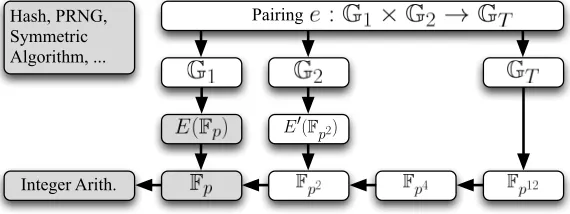
Fig. 1: Arithmetic required for pairings over Barreto-Naehrig curves
The functionfλ,Q can in general not be evaluated directly. However, Miller [26] described an important property of rational functions, namely
fi+j,P =fi,Pfj,P
`[i]P,[j]P ν[i+j]P
.
The property allows the computation of fλ,Q in polynomial time by merely evaluating vertical (ν) and straight (`) lines in elliptic curve points using a double-and-add approach. Values of λ with low Hamming weight result in a particularly fast computation offλ,Q, the pairing becomes optimal. In this work, we used the efficient optimal-Ate pairing by Vercauteren [34].
3
High-Level Arithmetic
The computation of bilinear pairings over BN curves requires several layers of arithmetic. As illustrated in Figure 1, all arithmetic is based on a multi-precision integer arithmetic layer. On top of that, prime-field arithmetic and a tower of extension fields are built upon. The elliptic curve groups used as G1 and G2 utilize the prime field and its quadratic extension field, respectively. The largest extension field Fp12 is used by GT. The pairing computation itself is based on the groupsG1, G2,GT, and their underlying field arithmetic.
Parameters.As this work aims to offer a certain degree of flexibility, both the 80-bit and the 128-bit security level are supported. The two elliptic curves BN158 [18] (u=40 00800023h) and BN254 [30] (u=−40800000 00000001h) of the formy2=x3+ 2 were chosen. Those lead to particularly fast execution times as the respective constantsλoffλ,Qhave low Hamming weights. The extension field Fp2 is represented asFp[i]/(i2−β) withβ =−1. The extension fieldFp12 is built asFp2[z]/(z6−ζ), withζ= (1 +i) for BN254 andζ= 1+1i for BN158.
Implementation Attacks.An important aspect in the implementation of pairings and group arithmetic for embedded applications is the consideration of side-channel attacks. While scalar factors or exponents are typically the secret operands for operations in G1,G2 and GT, an elliptic curve point may have to be protected in the case of pairing operations.
As a countermeasure to timing attacks, all implemented algorithms have constant, data-independent runtime. Therefore, e.g., some fast but vulnerable point multiplication algorithms are not used. Both the point multiplications in G1,G2 and the exponentiations in GT hence use Montgomery ladders. The implementation’s countermeasures against first-order Differential Power Analysis (DPA) attacks comprise Randomized Projective Coordinates (RPC) [12] in both the pairing computation and the point multiplications inG1and G2. To detect fault attacks on data, point multiplications in G1 and G2 include several point verifications. DPA and fault attacks on exponentiations in GT as well as fault attacks on pairings were also taken into consideration, but can better be handled on the protocol layer using randomization.
4
Hardware Architectures
To meet the high requirements of pairing-based cryptography in embedded de-vices, our goal was to equip a stand-alone microprocessor, designated for em-bedded applications, with a dedicated hardware unit such that: (i) Pairing com-putations are usable within interactive (e.g., authentication) protocols. (ii) A pre-existing microprocessor platform is modified only minimally. (iii) The over-all hardware requirements, i.e., the costs, are kept smover-all and considerably below 100 kGE needed in related work [16, 24]. (iv) Embedded applications such as wireless sensor nodes and NFC should be practically feasible.
(d) (b)
(c) (a)
CPU
Program Memory
Dedicated Hardware Module Data Memory
CPU
Program Memory Data
Memory
CPU
Program Memory Data
Memory
CPU
Program Memory Data
Memory MAC
Drop-in Module
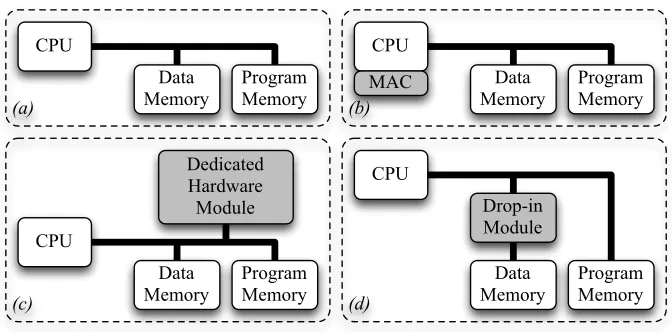
Fig. 2: Architectural options for fast and flexible pairing designs
Following up the potential architectures, we consecutively evaluate the prac-ticability of a plain microprocessor design(a), a multiply-accumulate instruction-set extension (b), and a dedicated drop-in module(d).
4.1 The Used Microprocessor
The accomplishment of the initially set goals highly depends on the used mi-croprocessor. As the runtime figures by Szczechowiaket al. [32] and Gouvˆeaet al.[18] discourage the use of an 8-bit or 16-bit microprocessor, a 32-bit micro-processor is preferred as a basis. Moreover, the bottleneck between computation unit and RAM is less of an issue if 32-bit interfaces are used. We hence decided to utilize a self-built processor functionally equivalent to the ARM Cortex-M0+ [2], because the Cortex-M0+ was especially designed for embedded applications and currently is one of the smallest 32-bit processors in production. The Cortex-M0+ has 16 32-bit general-purpose registers of which 8 are efficiently usable. It comes with a mixed 16/32-bit Thumb/Thumb-2 instruction set and optionally either a 32-cycle or single-cycle 32-bit multiplier. In its minimum configuration, ARM specifies its Cortex-M0+ to require only 12 kGE in a 90 nm process technology.
4.2 The Software Framework
each function, stack allocation facilitates the reduction of required memory by separating code into different functions. Second, allocated memory is reutilized where possible. Third, memory-optimized algorithms are used, e.g., for the final exponentiation as in Appendix A.1. Last, compiler optimizations are used to de-crease the program size. Therefore, the compiler options-ffunction-sections, -fdata-sectionsand the linker options -gc-sections, --specs=nano.specs are passed to the bare-metal ARM GNU toolchain (version 4.7.4).
The high-level pairing framework is common to all three evaluated platforms. The main difference between these platforms is the implemented finite-field arith-metic. While(a)and(b)control the whole finite field arithmetic in software,(d) relies on finite-state machines to perform additions, subtractions and multipli-cations inFp andFp2. Nevertheless, all implementation options ensure constant runtime and consider side-channel attacks.
4.3 Assembly-Optimized Software Implementation (a)
The plain microprocessor platform(a)is based on a Cortex-M0+ with a single-cycle multiplier. Its hand-crafted assembly routines for optimized prime-field arithmetic always perform a reduction step to ensure constant runtime. This is accomplished by storing the reduction result either to the target or a dummy memory location via masking of the operand addresses. The crucial prime-field multiplication utilizes an unrolled Separated Product Scanning (SPS) method of the Montgomery multiplication [28] that is derived from [10]. The SPS variant is chosen because of the particular Fp2-multiplication technique [6, 31] we use, which performs the required three multiplications and two reductions separately. Product scanning can further be efficiently implemented on the processor if three registers are used as an accumulator, as presented in [36]. The reduction step for the curve BN254 is further optimized as several multiply-accumulates can be skipped due to the sparse prime [18].
4.4 Multiply-Accumulate Hardware Extensions (b)
Drop-In
Datapath Cortex-M0+
Controlpath
Datapath NVIC
Decoder Instruction
Pipeline
Registers
ALU
Memory Access
Unit
RA
M
OpAReg OpBReg
ACC WRITE 32x16-bit
Multiply-Accumulate
ADD/ SUB Controlpath
160-bit Fp
Fp2
256-bit Fp
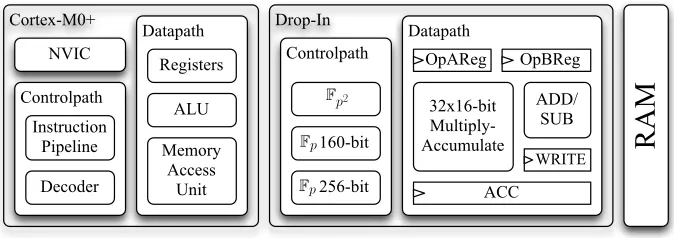
Fig. 3: High-level representation of architecture (d)(without program memory). Note that the sizes of the blocks are not proportional to their respective hardware footprints
4.5 The Drop-in Module (d)
As a consequence of the high-level runtime and area goals, it is of utmost impor-tance to maximize the utilization of the invested chip hardware. To achieve this, a lightweight hardware drop-in accelerator is placed between processor and data memory. The respective design, which is shown in Figure 3, uses a Cortex-M0+, but any other processor is equally suitable.
The drop-in module provides unrolled state machines and an appropriate arithmetic unit for 160-bit and 256-bit Fp multiplication, Fp addition and Fp subtraction. It further encompasses state machines to controlFp2 addition,Fp2 subtraction,Fp2 multiplication and Fp2 squaring. Several memory-mapped reg-isters are used to control the drop-in module. A lightweight arbiter is built in which always gives preference to the CPU when the CPU wants to access the data memory. In such case, the drop-in module is prepared to stall its operation. The core element of our drop-in module is a multiply-accumulate unit that is used to perform a Finely Integrated Product Scanning (FIPS) [10] Montgomery multiplication. Within this algorithm approximately 2N2+N, withN =
dld(p)
W e,
W-bit integer multiplications are performed that require approximately 4N2load operations. Instead of using a dual-port memory, we attain a perfectly utilized bus and a perfectly utilized multiplier by using a two-cycle multiply-accumulate unit that is based on aW ×W/2-bit multiplier. This saves 3 kGE forW = 32 in an 130 nm process compared to a traditionalW×W-bit multiplier.
Table 1: Propagation of data within the pipelined drop-in module
Bus OpBReg OpARegMult. Accum.
LD OpB+0
LD OpA+0 WR
LD OpB+0 SH WR
LD OpA+1 WRSH MUL1
LD OpB+1 SH WR MUL2 SHIFT
LD OpA+0 WRSH MUL1
LD OpB+2 SH WR MUL2
ST RES+0 WRSH MUL1
LD OpB+1 SH MUL2 SHIFT
LD OpA+1 WRSH MUL1
LD OpB+0 SH WR MUL2
A[0]B[0] A[4]B[4]
A[0]B[4]
C[0] C[4]
C[8]
A[4]B[0]
Fig. 4: 5×5-word zig-zag product scanning multi-precision multiplication method
sequence of shift/rotate operations is necessary to actually multiply the loaded operands. Table 1 visualizes the dataflow within the drop-in module. For a single multiply-accumulate operation five clock cycles are necessary. As the drop-in module heavily relies on pipelining, practically only two cycles are needed. The following steps are performed: (i)OpB+iis applied to the bus. (ii)OpB+iisWRitten to OpBReg andOpA+j is applied to the bus. (iii) OpAReg isWRitten and OpBReg is SHifted by 16 bits. (iv) The first multiplication cycle (MUL1) multiplies the lower 16 bits of OpB+i withOpA+j andOpBReg is shifted again. (v) During the second multiplication cycle (MUL2) the accumulator is optionallySHIFTed. When shifted, the lowest 32-bit of the accumulator are stored in the WRITE register. This data is later written to the addressRES+i+j, when the bus is not utilized. As the fully utilized bus needs some free cycles to write the result, we use a zig-zag product scanning technique (cf. Figure 4) [37]. In this technique, consec-utive columns are traversed in different order, which allows caching of a single operand from one column to the next. This frees the bus for 2N cycles, which are exactly the 2N cycles required to store the computed results.
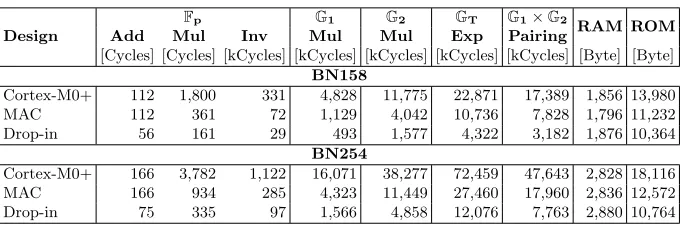
Table 2: Performance of various operations on architectures(a),(b), and(d)
Design
Fp G1 G2 GT G1×G2
RAM ROM
Add Mul Inv Mul Mul Exp Pairing
[Cycles] [Cycles] [kCycles] [kCycles] [kCycles] [kCycles] [kCycles] [Byte] [Byte]
BN158
Cortex-M0+ 112 1,800 331 4,828 11,775 22,871 17,389 1,856 13,980 MAC 112 361 72 1,129 4,042 10,736 7,828 1,796 11,232 Drop-in 56 161 29 493 1,577 4,322 3,182 1,876 10,364
BN254
Cortex-M0+ 166 3,782 1,122 16,071 38,277 72,459 47,643 2,828 18,116 MAC 166 934 285 4,323 11,449 27,460 17,960 2,836 12,572 Drop-in 75 335 97 1,566 4,858 12,076 7,763 2,880 10,764
on the stack are freed once a function finishes, which requires adding additional wait statements within the extension-field arithmetic to prevent the drop-in from accessing reallocated memory locations. Nevertheless, the utilization of the drop-in is drop-increased from 77.6% to 85.1% when the function first waits for previous operations to finish. Similarly, the utilization of the RAM is raised from 75.7% to 80.1% (cf. 34.6% in(b), 17.0% in(a)).
5
Implementation Results
To verify the achievement of the area and performance goals initially set, the three microprocessor-based platforms (a), (b) and (d) were evaluated with re-spect to hard- and software. Regarding the overall hardware platforms, runtime, area, power, and energy consumption are distinctive. Regarding the software part, the evaluation focuses on the runtimes of the underlying finite-field arith-metic and the most expensive operations used within protocols: the point mul-tiplications inG1 andG2, the exponentiation inGT, and the pairing operation. The results in Table 2 show that the multiply-accumulate extension speeds up the prime-field multiplications by factors of 4.0-5.04, but leaves the prime-field additions unaffected. The same speed-ups are observed for prime-field inversions and point multiplications inG1. However, the impact of the multiply-accumulate extension on the performance of both pairings and operations inG2,GT is lower and lies between a factor of 2.1 and 3.3. Considering the performance of the drop-in module, an even greater speed-up is observed compared to the pladrop-in software implementation. In this case, prime-field multiplications, inversions and point multiplications in G1 are up to 11.3 times faster, which eventually results in an up to 6.1 times faster computation of pairings. On average, operations using BN158 are 3.0 times faster than operations using BN254.
Throughout all implementations, the demand for data memory is kept rela-tively low, with a maximum of 1,876 bytes and 2,880 bytes for BN158 and BN254, respectively. Similarly, the program sizes are kept small, e.g., 18 KB for BN254.
4
Cortex-M0+ MAC Drop-in 0
200 400 600
101
24 10
245
83
33
476
224
90
362
163
66
[ms] BN158
G1 Mul. G2 Mul. GT Exp.
Pairing
Cortex-M0+ MAC Drop-in 0
500 1,000 1,500 2,000
335
90 33
797
239
101
1
,
510
572
252
993
374
164
[ms] BN254
G1Mul. G2Mul. GT Exp.
Pairing
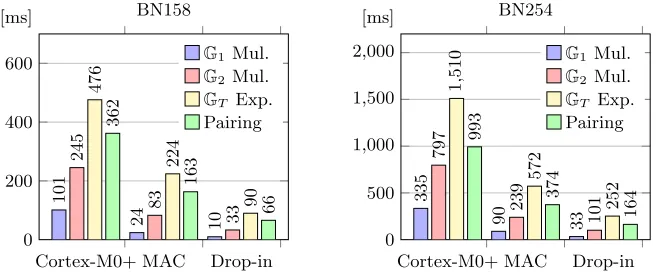
Fig. 5: Group operations at 48 MHz
Given a typical clock frequency of 48 Mhz, the performance results of the point multiplications in G1, G2, the exponentiation in GT, and the pairing opera-tion are illustrated in Figure 5. The respective runtimes support our choice of a 32-bit architecture: providing 128-bit security, the drop-in based platform does pairing computations in highly practical 164 ms. The pure embedded software implementation performs the same computation in 993 ms.
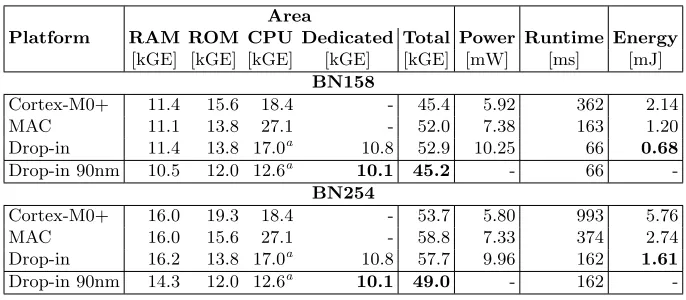
While Table 2 focuses on the software part, the most important hardware characteristics are visualized in Table 3. The runtime is given for a single pairing computation. Both area and power measurements were determined for an 130 nm low-leakage UMC technology. The area results in a 90 nm UMC technology are explicitly marked. The designs were synthesized and their power and runtime evaluated for a clock frequency of 48 MHz. Both data and program memory were realized using RAM and ROM macros of appropriate sizes. The program memory encompasses all routines required to implement pairing-based protocols, i.e., pairings, operations in G1, G2, and GT. These platforms are hence ready-to-use for future applications based on pairings over BN curves.
Table 3: Implementation characteristics for 130 nm and 90 nm process technologies
Platform
Area
RAM ROM CPU Dedicated Total Power Runtime Energy [kGE] [kGE] [kGE] [kGE] [kGE] [mW] [ms] [mJ]
BN158
Cortex-M0+ 11.4 15.6 18.4 - 45.4 5.92 362 2.14
MAC 11.1 13.8 27.1 - 52.0 7.38 163 1.20
Drop-in 11.4 13.8 17.0a 10.8 52.9 10.25 66 0.68 Drop-in 90nm 10.5 12.0 12.6a 10.1 45.2 - 66
-BN254
Cortex-M0+ 16.0 19.3 18.4 - 53.7 5.80 993 5.76
MAC 16.0 15.6 27.1 - 58.8 7.33 374 2.74
Drop-in 16.2 13.8 17.0a 10.8 57.7 9.96 162 1.61 Drop-in 90nm 14.3 12.0 12.6a 10.1 49.0 - 162
-a
Bit-serial multiplier.
6
Comparison with Related Work
As a consequence of our hardware/software co-design approach, comparison with related work focuses on two aspects. On the one hand, the pure software mentation on the Cortex-M0+ is brought into relation to other software imple-mentations on low-resource hardware. On the other hand, the resulting hardware design is compared with other dedicated pairing hardware implementations.
The comparison of our software implementation with related implementa-tions of Ate pairings over BN curves providing approximately 128-bit security is summarized in Table 4. Gouvˆea et al.[18] provide highly optimized software implementations for the 16-bit microcontroller MSP430 and a variant of its suc-cessor MSP430X, which is equipped with a 32-bit multiplier (MPY32). The implementation by Devegili et al.[15] is evaluated on a 32-bit Philips HiPerS-mart™smart card, which has a SmartMIPS architecture and clearly is a direct competitor of Cortex-M0+-based smart cards. However, it is unclear to which extent side-channel resistance is considered by either of them.
As both the MSP430 and the Cortex-M0+ use a 16-bit instruction-set, it is important to highlight the exceptionally low program and data memory foot-print of our implementations. It is however hard to compare the quality of an
Table 4: Related software implementations of Ate pairings over BN curves
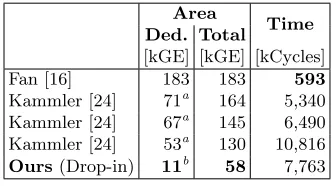
Table 5: Related hardware platforms (130 nm)
Area
Time Ded. Total
[kGE] [kGE] [kCycles] Fan [16] 183 183 593 Kammler [24] 71a 164 5,340 Kammler [24] 67a 145 6,490 Kammler [24] 53a 130 10,816 Ours(Drop-in) 11b 58 7,763
a
Core excl. 26 kGE of original RISC b
Drop-in module.
0 10 20 30 40 50 0
50 100 150 200 ·10
3
Cortex-M0+ MAC
Drop-In Kammler 1
Kammler 2 Kammler 3 Fan
Runtime [MCycles]
Area
[G
E]
Faster
Efficient
Smaller
Fig. 6: Characteristics of related hardware
implementation when different frameworks and different microprocessors are in-volved.
Other pairing implementations for 32-bit ARM processors are limited to the Cortex-A series, such as in [20]. However, their pairing’s runtime of 9.9 ms on a 1.2 GHz Cortex-A9 is as well hardly comparable with our pairing’s runtime on the Cortex-M0+ since the multi-core Cortex-A processors provide massively higher clock frequencies along with a more powerful instruction set.
Regarding related hardware platforms, Table 5 covers hardware implemen-tations of pairings providing roughly 128-bit security. Fanet al.[16] proposed a dedicated pairing cryptoprocessor with parallelized, full-precisionFparithmetic. Its centerpiece is a hardware implementation of a hybrid modular multiplication algorithm that performs both polynomial and coefficient reduction. Their area figures, however, exclude the required RAM. Kammler et al. [24] extended a 5-stage 32-bit RISC core with instructions forFp arithmetic. Their Application-Specific Instruction-set Processor (ASIP) uses a Montgomery multiplier struc-ture that can be synthesized in different configurations and sizes. Unfortunately, their area figures do not contain the program memory.
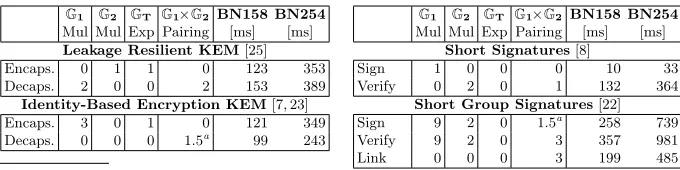
Table 6: Performance of pairing-based protocols on the drop-in platform
G1 G2 GT G1×G2 BN158 BN254
Mul Mul Exp Pairing [ms] [ms]
Leakage Resilient KEM[25] Encaps. 0 1 1 0 123 353 Decaps. 2 0 0 2 153 389
Identity-Based Encryption KEM[7, 23] Encaps. 3 0 1 0 121 349 Decaps. 0 0 0 1.5a
99 243
a
Ratios and products of pairings are counted as 1.5 pairing computations.
G1 G2 GT G1×G2 BN158 BN254
Mul Mul Exp Pairing [ms] [ms]
Short Signatures[8]
Sign 1 0 0 0 10 33 Verify 0 2 0 1 132 364
Short Group Signatures[22] Sign 9 2 0 1.5a
258 739 Verify 9 2 0 3 357 981 Link 0 0 0 3 199 485
7
Re-usability of our Drop-in Architecture
To emphasize the practicability of our low-area platforms for deploying cryp-tography to embedded environments, several protocols that are relevant in such context have been assessed in terms of the performance to expect.
Using the Drop-in Module for Pairing-based Protocols. The short signature scheme by Boneh et al. [8] is interesting for constrained signature devices as it aids to reduce communication. As a representative of group signa-tures, which help to provide anonymous authentication, the scheme by Hwang
et al. [22] was chosen. To be able to establish a random session key without the necessity of verifying public keys, the identity-based encryption scheme by Bonehet al.[7] in its Key Encapsulation Mechanism (KEM) variant was evalu-ated as it combines good performance with small parameters. Additionally, the leakage resilient bilinear ElGamal KEM by Kiltz and Pietrzak [25] is taken into consideration because it is proven to have bounded side-channel leakage.
The number of computationally expensive operations and the expected over-all runtime of each of the aforementioned protocols are presented in Table 6. The runtimes are given for the drop-in module based platform. As the figures sug-gest, all of the protocols may be performed on the device with user interaction as response times lie noticeably below one second.
11.9-36.8 ms (at 48 MHz) the drop-in concept is clearly an enabler of elliptic-curve based interactive protocols.
8
Conclusion
According to our evaluations of three microprocessor-based hardware designs, the utilization of a compact 32-bit microprocessor results in notably small pairing implementations. Requiring merely 45.2-49.0 kGE of chip area, we provided one of the smallest available hardware designs capable of bilinear pairings. The most prominent platform was however obtained by the construction of a dedicated drop-in hardware module for prime-field arithmetic. Its low area requirements and highly practical runtime facilitate pairing-based cryptography in interactive embedded applications.
Acknowledgments
This work has been supported in part by the Austrian Government through the research program FIT-IT under the project number 835917 (project NewP@ss) and by the European Commission through the FP7 program under project num-ber 610436 (project MATTHEW).
References
1. Aranha, D.F., Karabina, K., Longa, P., Gebotys, C., L´opez, J.: Faster Explicit Formulas for Computing Pairings over Ordinary Curves. In: Paterson, K. (ed.) EUROCRYPT 2011, LNCS, vol. 6632, pp. 48–68. Springer Berlin Heidelberg (2011) 2. ARM Ltd.: Cortex-M0+ Processor (Sep 2013), http://www.arm.com/products/
processors/cortex-m/cortex-m0plus.php
3. Atmel Corporation: Atmel SAM D20 ARM-based Microcontroller Datasheet (Dec 2013),http://www.atmel.com/Images/Atmel-42129-SAM-D20_Summary.pdf
4. Barreto, P.S., Naehrig, M.: Pairing-Friendly Elliptic Curves of Prime Order. In: Preneel, B., Tavares, S. (eds.) SAC 2005. LNCS, vol. 3897, pp. 319–331. Springer Berlin Heidelberg (2006)
5. Bernstein, D.: Curve25519: New Diffe-Hellman Speed Records. In: Yung, M., Dodis, Y., Kiayias, A., Malkin, T. (eds.) PKC 2006. vol. 3958, pp. 207–228 (2006) 6. Beuchat, J.L., Gonz´alez-D´ıaz, J., Mitsunari, S., Okamoto, E.,
Rodr´ıguez-Henr´ıquez, F., Teruya, T.: High-Speed Software Implementation of the Optimal Ate Pairing over Barreto-Naehrig Curves. In: Joye, M., Miyaji, A., Otsuka, A. (eds.) Pairing 2010, LNCS, vol. 6487, pp. 21–39. Springer Berlin Heidelberg (2010) 7. Boneh, D., Boyen, X.: Secure Identity Based Encryption Without Random Oracles. In: Franklin, M. (ed.) CRYPTO 2004, LNCS, vol. 3152, pp. 443–459. Springer Berlin Heidelberg (2004)
8. Boneh, D., Boyen, X.: Short Signatures Without Random Oracles and the SDH Assumption in Bilinear Groups. Journal of Cryptology 21(2), 149–177 (2008) 9. Boneh, D., Boyen, X., Shacham, H.: Short Group Signatures. In: Franklin, M. (ed.)
10. C¸ .K. Ko¸c, T. Acar and B.S. Kaliski, Jr.: Analyzing and Comparing Montgomery Multiplication Algorithms. IEEE Micro 16(3), 26–33 (June 1996)
11. Certicom Research: Standards for Efficient Cryptography, SEC 2: Recommended Elliptic Curve Domain Parameters, Version 1.0 (September 2000), http://www. secg.org/
12. Coron, J.S.: Resistance against Differential Power Analysis for Elliptic Curve Cryp-tosystems. In: Ko¸c, C¸ .K., Paar, C. (eds.) CHES’99. LNCS, vol. 1717, pp. 292–302. Springer (1999)
13. Costello, C., Lange, T., Naehrig, M.: Faster Pairing Computations on Curves with High-Degree Twists. In: Nguyen, P., Pointcheval, D. (eds.) PKC 2010, LNCS, vol. 6056, pp. 224–242. Springer Berlin Heidelberg (2010)
14. Devegili, A.J., h ´Eigeartaigh, C.O., Scott, M., Dahab, R.: Multiplication and Squar-ing on PairSquar-ing-Friendly Fields. Cryptology ePrint Archive, Report 2006/471 (2006) 15. Devegili, A., Scott, M., Dahab, R.: Implementing Cryptographic Pairings over Barreto-Naehrig Curves. In: Takagi, T., Okamoto, T., Okamoto, E., Okamoto, T. (eds.) Pairing 2007, LNCS, vol. 4575, pp. 197–207. Springer Berlin Heidelberg (2007)
16. Fan, J., Vercauteren, F., Verbauwhede, I.: FasterFp-Arithmetic for Cryptographic
Pairings on Barreto-Naehrig Curves. In: Clavier, C., Gaj, K. (eds.) CHES 2009, LNCS, vol. 5747, pp. 240–253. Springer Berlin Heidelberg (2009)
17. Fuentes-Casta˜neda, L., Knapp, E., Rodr´ıguez-Henr´ıquez, F.: Faster hashing to G2. In: SAC 2011. pp. 412–430. SAC’11, Springer-Verlag, Berlin, Heidelberg (2012) 18. Gouvˆea, C., Oliveira, L., L´opez, J.: Efficient Software Implementation of
Public-Key Cryptography on Sensor Networks Using the MSP430X Microcontroller. Jour-nal of Cryptographic Engineering 2(1), 19–29 (2012)
19. Granger, R., Scott, M.: Faster Squaring in the Cyclotomic Subgroup of Sixth De-gree Extensions. In: Nguyen, P., Pointcheval, D. (eds.) PKC 2010, LNCS, vol. 6056, pp. 209–223. Springer Berlin Heidelberg (2010)
20. Grewal, G., Azarderakhsh, R., Longa, P., Hu, S., Jao, D.: Efficient Implementation of Bilinear Pairings on ARM Processors. In: SAC 2012. LNCS, Springer Berlin Heidelberg (2013)
21. Hutter, M., Joye, M., Sierra, Y.: Memory-Constrained Implementations of El-liptic Curve Cryptography in Co-Z Coordinate Representation. In: Nitaj, A., Pointcheval, D. (eds.) AFRICACRYPT 2011. LNCS, vol. 6737, pp. 170–187. Springer (2011)
22. Hwang, J.Y., Lee, S., Chung, B.H., Cho, H.S., Nyang, D.: Short Group Signatures with Controllable Linkability. In: LIGHTSEC 2011. pp. 44–52. IEEE Computer Society, Washington, DC, USA (2011)
23. IEEE: P1363.3TM/D1 Draft Standard for Identity-based Public-key Cryptography Using Pairings. (2008)
24. Kammler, D., Zhang, D., Schwabe, P., Scharwaechter, H., Langenberg, M., Auras, D., Ascheid, G., Mathar, R.: Designing an ASIP for Cryptographic Pairings over Barreto-Naehrig Curves. In: CHES 2009. pp. 254–271. Springer-Verlag, Berlin, Heidelberg (2009)
25. Kiltz, E., Pietrzak, K.: Leakage Resilient ElGamal Encryption. In: Abe, M. (ed.) ASIACRYPT 2010, LNCS, vol. 6477, pp. 595–612. Springer Berlin Heidelberg (2010)
26. Miller, V.S.: The Weil Pairing, and Its Efficient Calculation. Journal of Cryptology 17(4), 235–261 (2004)
28. Montgomery, P.L.: Modular Multiplication without Trial Division. Mathematics of Computation 44, 519–521 (1985)
29. National Institute of Standards and Technology (NIST): FIPS-186-3: Digital Signature Standard (DSS) (2009), http://csrc.nist.gov/publications/fips/ fips186-3/fips_186-3.pdf
30. Nogami, Y., Akane, M., Sakemi, Y., Kato, H., Morikawa, Y.: Integer Variable χ -Based Ate Pairing. In: Galbraith, S., Paterson, K. (eds.) Pairing 2008, LNCS, vol. 5209, pp. 178–191. Springer Berlin Heidelberg (2008)
31. S´anchez, A.H., Rodr´ıguez-Henr´ıquez, F.: NEON Implementation of an Attribute-Based Encryption Scheme. In: Jacobson, M., Locasto, M., Mohassel, P., Safavi-Naini, R. (eds.) ACNS 2013, LNCS, vol. 7954, pp. 322–338. Springer Berlin Hei-delberg (2013)
32. Szczechowiak, P., Kargl, A., Scott, M., Collier, M.: On the Application of Pairing Based Cryptography to Wireless Sensor Networks. In: Basin, D.A., Capkun, S., Lee, W. (eds.) WISEC 2009. pp. 1–12. ACM (2009)
33. Szczechowiak, P., Oliveira, L.B., Scott, M., Collier, M., Dahab, R.: NanoECC: Testing the Limits of Elliptic Curve Cryptography in Sensor Networks. In: Verdone, R. (ed.) EWSN 2008. LNCS, vol. 4913, pp. 305–320. Springer (2008)
34. Vercauteren, F.: Optimal Pairings. Information Theory, IEEE Transactions on 56(1), 455–461 (2010)
35. Wenger, E.: Hardware Architectures for MSP430-Based Wireless Sensor Nodes Performing Elliptic Curve Cryptography. In: Jacobson, M., Locasto, M., Mohassel, P., Safavi-Naini, R. (eds.) ACNS 2013, LNCS, vol. 7954, pp. 290–306. Springer Berlin Heidelberg (2013)
36. Wenger, E., Unterluggauer, T., Werner, M.: 8/16/32 Shades of Elliptic Curve Cryp-tography on Embedded Processors. In: Paul, G., Vaudenay, S. (eds.) INDOCRYPT 2013. LNCS, vol. 8250, pp. 244–261. Springer International Publishing (2013) 37. Wenger, E., Werner, M.: Evaluating 16-Bit Processors for Elliptic Curve
Cryptog-raphy. In: Prouff, E. (ed.) CARDIS 2011, LNCS, vol. 7079, pp. 166–181. Springer Berlin Heidelberg (2011)
A
Optimizations
A.1 Final Exponentiation
The hard part of the final exponentiation by Fuentes-Casta˜nedaet al.[17] yields fast execution by reducing the number of multiplications and exponentiations in
Fp12. As a drawback, it requires four large temporary variables inFp12. In order to attain a low-memory implementation, we decreased the number of temporary variables by adapting their formulas without noticeably degrading performance. Therefore, we initially set t0=fpand compute the chain
fu→f2u→f4u→f6u→f6u2 →f12u2 →f12u3. Following, aandb are set to a=f6u
·f6u2
·f12u3
andb=a·(f2u
·f)−1. The computation of the result, namely
Algorithm 1Memory-optimized hard part of the final exponentiation for pair-ings over BN curves.
Input: f ∈Fp12
Output: fφ12(p)/n∈F p12 1: t0←fp
2: b←fu
3: if u <0thenb←b .Conjugate 4: b←b2
5: a←b2 6: a←a·b 7: b←b·f 8: b←b 9: f ←f·t0 10: t0←au
11: if u <0thent0←t0
12: f ←f·t0 13: a←a·t0 14: t0←t20
15: if u <0thent0←t0 16: a←a·tu
0 .Interleaved 17: b←b·a
18: t0←bp 19: t0←t0·a 20: t0←tp0 21: t0←t0·b 22: t0←tp0 23: t0←t0·f 24: f ←t0·a 25: returnf
requires one more multiplication and one more Frobenius action than originally. However, the respective implementation in Algorithm 1 requires three temporary variables instead of four when the exponentiation and the multiplication on Line 16 are done simultaneously using a dedicated function. Since variables in
Fp12 are large and RAM is more expensive than ROM, this approach aids to keep chip area low.
A.2 Prime-Field Inversion
The parameterized prime p(u) facilitates an optimized exponentiation-based prime-field inversion for positiveuthat have low Hamming weight. In such cases, the inversea−1
∈Fp can be expressed as
a−1modp=ap−2modp=a36u4+36u3+24u2+6u−1modp =a6u(4u+6u2(1+u))·a6u−1modp . Precomputation of the constant 6u−1 and the chain of computations
a6u−1→a6u→a12u2 →a24u2→a36u2 →a36u3 →a36u4 enables the computation of the inverse as
a−1modp=a6u−1·a24u2·a36u3·a36u4 modp .