THEORETICAL CONCEPTIONS OF HUMAN MOVEMENT AND THEIR IMPLICATIONS FOR DANCE INSTRUCTION IN SELECTED PRIMARY
SCHOOLS IN KENYA BEATRICE OBONYO DIGOLO
DEPARTMENT OF MUSIC, KENYATTA UNIVERSITY, P.O. BOX 43944, NAIROBI, KENYA
ABSTRACT
Thepurpose of this study was to analyse the implication of selected theoretical conceptions on the content of dance programmes and the methods of dance instructions in Kenya Primary Schools. Specifically, the study sought to: (1) Discuss theories of humanistic approach, and child development, as they relate to human movement and the implications of the theories for dance syllabus content and instructional methods for Kenyan primary schools. (2) Determine to what extent selected theoretical conceptions are related tocurrent practices in the implementation of dance programmes in the primary schools. (3)Discuss the findings and give suggestions for improvement, where necessary. The study was conducted in 40primary schools selected from Nairobi and Nyanza Provinces. Simple random sampling technique was used to select the schools, which participated in the study. Empirical methods of investigation were used for data collection. These included questionnaire, interview and observation. The data were analysed using frequencies, percentages and tabulation. The study revealed that in the primary schools learners are not given adequate opportunities to express themselves through movement, particularly in dance activities. The other major findings were that there is a big discrepancy between the specified theoretical conceptions and what is actually practised in reaction to the implementation of dance programmes in Kenyan primary schools. The implications of the findings were discussed and recommended for possible implementation.
INTRODUCTION AND CONTEXT OF THE STUDY
Dance activities form a vital part of a child's development of body control, expressiveness and creativity. Children have an innate sense ofrhythm and a natural love for rhythmic movement. How extensively these qualities are developed depends upon the opportunities a child is given to express them. The development ofcreativity is one of the major objectives of dance education. In dance lessons, as much as possible, the learners should be given the opportunity to express themselves through exploration, improvisation and
•
In the light of the above background, this study reviewed some of the theoretical conceptions, which spell out effective movement foundations, and placed them in the context of Kenyan primary school dance instruction. An analysis was then carried out on their implications for the dance syllabus content and the actual practice in the implementation of dance programmes in the schools.
THE CONCEPTS OF HUMANISTIC APPROACH AND HUMAN DEVELOPMENT THEORIES.
The humanistic theory emphasises the anchoring involvement of the individual in his movement education. In other words, the theory advocated for the type of learning that caters for depth, meaning and continuity to the day-to day movement experience planned for the children (Schurr, 1975).The humanistic approach further assets that any type of movement activities should not be learned in isolation but given an allowance for working with or studying fellow humans.
The human development theory, as used in the context of human movement, asserts that instruction on all forms of human movement should be geared towards enhancing all aspects of child growth and development. The human development theory particularly stresses the use of movement education to promote in the learner the sense of self-actualisation, self-identity and creativity. The theory further asserts that movement education should be seen as contributing to a much larger goal. It should cater for the total development of the individual child, not just in school, but also as he interacts with people in his environment
According to Chirp (1991), movement education must cater particularly for the social development of a child. Thescholar points out that any instruction that falls short of this requirement exposes the child to the danger of facing psychological obstacles in the adult life.
Chirp (1991) considers the stage of human development to be what he refers to as the leadership stages. He asserts that his stage is the sum total of the long journey that a person goes through to reach the responsibility level in which he will be capable of taking on the reins of leadership. The educator states that any sound movement education should instil into a person the responsibility of leadership. According to him, the degree to, which an individual acquires such goals through movement education is determined by the level of exposure to the activities.
dance programmes in primary schools is that the programmes should represent a continuity of experiences. In other words, the dance activities should beprovided at all levels of primary education. The syllabi must spellout the dance activities that befit learners during their formative years, as well as the activities that will meet the needs of more mature learners.
Creativity is given paramount consideration in the humanistic approach. The theory advocates that movement education should be planned for,and with the learner. The demand for involvement of learner in day-to day planning fortheir activities implies the development of creative thinking on part ofthe learners, through various dance activities.
The humanistic theory calls for an interdisciplinary approach to dance instruction. The proponents of the theory, like Schurr (1975), assert that it would be logical toteach a dance ofa particular people, when the people's area oforigin and their customs are being studied bythe same class, in the other subject areas. In the human development theory, Rarick (1993) seems to support the interdisciplinary approach to dance instruction, when he asserts that all subjects should be seen a contributing to the total development ofan individual as he interacts with people in his broad environment.
In demanding that the day-to-day planning of movement activities be carried out forand with the learners, the human development theorists imply that the ultimate goal forthe dance programmes should cater for self-direction and wise decision-making both on part of the learner as well as the teachers. It also implies that the teachers should make use of syllabus guidelines in developing experiences, which best meet the spelt out development needs of the learners.
DATA ANALYSIS AND DISCUSSION OF FINDINGS ON ACTUAL DANCE INSTRUCTION PRACTICES IN THE PRIMARY SCHOOLS
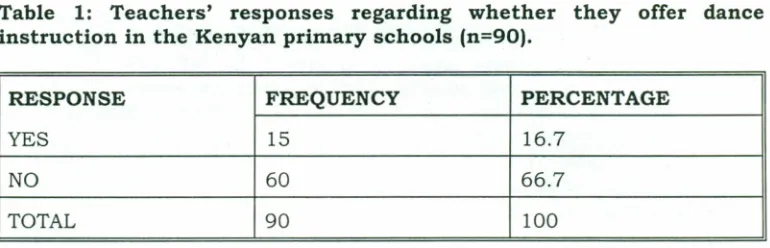
The results presented in this paper were generated from the survey design study of randomly selected primary schools from Langata division in Nairobi and Boro division in Siaya, Nyanza Province. The study used questionnaire, interview and observation techniques. The data were gathered from a total of number of 90 primary school teachers. The data was analyses using frequency counts, percentages and tabulation. Analysis of the data is presented on the tables below. The results presented in table 1 indicate that dance instruction is non-existent in majority of Kenyan primary schools. As is evident in the table, 60 (66.7%) of the teachers indicated that they never offered any dance instruction to pupils intheir schools. Those whoresponded positively were only
Table 1: Teachers' responses regarding whether they offer dance instruction in the Kenyan primary schools (n=90).
RESPONSE FREQUENCY PERCENTAGE
YES 15 16.7
NO 60 66.7
TOTAL 90 100
The dangers of neglecting dance instruction are reflected in the theory of
human development (Chirp, 1991). According to Chirp, the degree to which an individual has to meet the physiological needs for movement directly influences
the development of his self-concept. Dance instruction is among the best
activities through, which learners can meet the physiological needs for
movement because children have innate sense of rhythm and a natural love for
rhythmic movement. However, the extent to which the learners meet their
physiological needs through dance would depend upon their level of exposure to dance activities.
Analysed in table 2 are the teachers' responses regarding whether they planned
for the dance lessons or not. Majority of the teachers, 78 (86.7 %) indicated
that they never made any lesson plans for dance. Only 12 (13.3%) responded
that they planned for the lessons. The finding reveals that dance instruction
in many schools may be lacking in sequence and purpose.
Table 2: Teachers" responses on whether they plan for dance instruction in Kenyan primary schools (n=90).
RESPONSE FREQUENCY PERCENTAGE
YES 12 13.3
NO 78 86.7
TOTAL 90 100
The results of the data analysed in table 2 reveal a trend that contradicts the
dictums of the humanistic theory. The theory maintains that learners should
be guided through a carefully planned sequence of tasks to enable them to
discover by themselves the movement responses. However, as the finding
Analysis presented in table 3 shows that a number of the primary school
teachers felt that contents of syllabi are incomprehensible. The teachers
pointed out that they were unable to interpret the syllabus contents into
experiences with which they could guide their pupils into acquiring the needed
values. Asindicated in table 3, 49 (54.4 %)of the teachers responded that the
syllabus contents were incomprehensible. Only 17 (18.9 %)responded that
they could understand the syllabus. The other 24 (26.7%) of the teachers were
undecided. An investigation through interview revealed that those who were
undecided were unaccustomed with the syllabus contents.
Table 3: Teachers' responses on the comprehensibility of dance syllabus contents (n=90).
RESPONSE FREQUENCY PERCENTAGE
COMPREHENSIBLE 17 18.9
INCOMPREHENSIBLE 49 54.4
UNDECIDED 24 26.7
"'
}TOTAL 90 100
Itis unfortunate that the teachers who should give guidance to the learning
process are incapable of comprehending the contents of dance syllabus. Such
teachers may not be able to guide learners towards the attainment of
proficiency in a wide variety of movement skills as is advocated by Schurr
(1975) in the humanistic approach.
Analysis in table 4 shows that lack of clear syllabus guidelines and inadequacy
of teaching time are some of the major hindrance to dance instruction in
primary schools. The teachers that reported the hindrances were 62 (68.9%)
and 57 (63.3%), respectively. The other mentioned hindrances were lack of
qualified personnel, that was reported by28 (31.1%) and scarcity of teachers
supervision that was reported by 13 (14.1%) of the music teachers.
The teachers' responses, whose analysis are presented in table 4, may help to
explain the reason why there is a big discrepancy between the specified
theoretical conceptions and the actual practice in the implementation of dance
Table 4:Teachers' responses on constraints to effective dance instruction (n=90).
RESPONSE FREQUENCY PERCENTAGE
LACK OF CLEAR SYLLABUS 62 68.9
GUIDELINES
LACK OF QUALIFIED 28 31.1
PERSONNEL
SCARCITY OF TEACHERS 13 14.1
SUPERVISION
INADEQUACY OF 57 63.3
TEACHING TIME
POSSIBLE STRATEGIES FOR IMPROVEMENT ')
(1) Comprehensive teachers' guidelines should be developed with practical suggestions for techniques of planning for and directing dance activities in order to give teachers a clearer picture on what is expected in the dance instruction at each level ofprimary learning.
(2) During the training period, the teachers should be instructed on the movement theories, child growth and development factors, as these will lead them to understand the importance of involving learners in movement activities likedance.
(3) There should be regular supervision of the teachers, as this will ensure that no aspect of school curriculum is neglected as has been revealed about dance instruction in this study.
(4) More learning times should be devoted to the areas of the school curriculum dealing with human movements as these form a crucial part of child development.
(5) Dance activities should be taught in connection with their historical and cultural backgrounds. This may require an inter-disciplinary approach to dance instruction.
Chirp, G.B. (1991). Basic Movement Education for Children: Rationale and
Teaching Units. Addison-Wesley: Reading, Mass., USA.
Ministry of Education (1986). Syllabus for Kenyan Primary Schools Vols. 1
and 2. Nairobi, Kenya.
Rarick, R.L. (1993). Physical Activities for Human Growth and
Development. New York: Academic Press.
Schurr, E.L.(1975). Movement Experiences for Children: A Humanistic
Approach to School Physical Education. Englewood Cliffs, N.J.: