Verifiable Set Operations over Outsourced Databases
Ran Canetti∗ Omer Paneth† Dimitrios Papadopoulos‡ Nikos Triandopoulos§
Abstract
We study the problem of verifiable delegation of computation over outsourced data, whereby a pow-erful worker maintains a large data structure for a weak client in a verifiable way. Compared to the well-studied problem of verifiable computation, this setting imposes additional difficulties since the ver-ifier needs to verify consistency of updates succinctly and without maintaining large state. In particular, existing general solutions are far from practical in this setting.
We present a scheme for verifiable evaluation of hierarchical set operations (unions, intersections and set-differences) applied to a collection of dynamically changing sets of elements from a given domain. That is, we consider two types of queries issued by the client: updates (insertions and deletions) and data queries, which consist of “circuits” of unions, intersections, and set-differences on the current collection of sets.
This type of queries comes up in database queries, keyword search and numerous other applications, and indeed our scheme can be effectively used in such scenarios. The computational cost incurred is proportional only to the size of the final outcome set and to the size of the query, and is independent of the cardinalities of the involved sets. The cost of updates is optimal (O(1)modular operations per update).
Our construction extends that of [Papamanthou et al., Crypto 2011] and relies on a modified version of theextractable collision-resistant hash function(ECRH) construction, introduced in [Bitansky et al., ITCS 2012] that can be used to succinctly hash univariate polynomials.
Keywords: secure data outsourcing; verifiable computation; knowledge accumulators; extractable collision-resistant hash functions; secure set operations; authenticated query processing; authenticated data structures
∗
Boston University and Tel Aviv University. Email:[email protected]. Supported by the Check Point Institute for Informa-tion Security, an NSF EAGER grant, and an NSF Algorithmic foundaInforma-tions grant 1218461.
†
Boston University. Email: [email protected]. Supported by the Simons award for graduate students in theoretical computer science and an NSF Algorithmic foundations grant 1218461.
‡
Boston University. Email:[email protected]. Supported by NSF grants CNS-1012798 and CNS-1012910.
§
1
Introduction
Outsourcing of storage and computation to the cloud has become a common practice for both enterprises and individuals. In this setting, typically, a client with bounded computational and storage capabilities wishes to outsource its database and, over time, issue queries that are answered by powerful servers.
We consider aclientthat outsources a datasetDto aserver. The client can then issue the server informa-tionalqueries that are answered according toD, or it can issueupdatequeries that changeD, for example by inserting or removing elements. This model captures a variety of real-world applications such as out-sourced SQL queries, streaming datasets and outout-sourced file systems. We also consider the more general setting where multiple clients issue informational queries toD, but only onesourceclient can issue update queries. For an example, consider a small company that wishes to store its dataset on a cloud server while accommodating queries from the company’s multiple clients.
In the above settings clients may want to verify the integrity of the server’s answers to protect themselves against servers that behave maliciously, are compromised by an external attacker, or simply provide false data due to bugs. Specifically, when answering a client query, the server will also compute aproofof the integrity of the data used to compute the answer as well as the integrity of the computation itself. For this purpose, we allow the client to perform some polynomial time preprocessing onDbefore outsourcing it to the server, and to save a smallverification statethat allows it to verify the server’s proofs. When issuing an update query, the client will also update its verification state. If the verification state can be made public we say that the server’s proofs are publicly verifiable. Public verifiability is particularly important in the multi-client setting.
In this work we study efficient mechanisms for securely outsourcing databases. Several different measures of efficiency have been considered. First, we would like that the time it takes for the client to verify a proof is short, ideally, some fixed polynomial in the security parameter that is independent of the size of server’s computation cost and the size of D. Second, we would like the server’s computational overhead in computing proofs to be minimal. Additional efficiency considerations include the proof size, and the efficiency of update queries. The number of communication rounds should also be minimized. In this work we concentrate on non-interactive solutions where the client sends a query and receives back an answer and a proof in one round of interaction.
Set operations over outsourced databases. The focus of this work is on the problem of general set operationsin an outsourced setting. That is, we consider a dataset Dthat consists of m setsS1, ..., Sm,
where the clients’ queries are arbitrary set-operation overDrepresented as formulas of union, intersection, and set-difference gates over some of the inputs S1, ..., Sm. The motivation for set operations comes
from their great expressiveness and the range of computations that can be mapped by them. Real-world applications of general set operations include a wide class of SQL database queries, authenticated keyword search with elaborate queries, access control management and similarity measurement, hence a practical protocol would be of great importance.
1.1 Verifiable Computation - The Generic Approach
Our settings are closely related to the setting of verifiable computation that was extensively studied in recent years. In verifiable computation the client outsources a computation to the server and receives an answer that can be quickly verified. The main difference is that in verifiable computation we usually assume that the input to the computation is short and known to both parties, while in our settings the server’s answers are computed over the outsourced dataset that must also be authenticated.
ran-dom oracles. One possible approach for designing a practical protocol is based on the memory delega-tion soludelega-tion where Micali’s CS proofs are replaced with asuccinct non-interactive argument-of-knowledge
(SNARK) construction. Good candidates for such a SNARK include recent works of [4,6,29] that provide more practical constructions.1
One major obstacle for implementing the generic approach described above (discussed already in [29]) is that it only considers computations represented as boolean or arithmetic circuits. For example, in the context of set operations, the transformation from formulas of set-operations to circuits can be extremely wasteful as the number of sets participating in every query and the set sizes (including the size of the answer) may vary dramatically between queries. Another source of inefficiency is that the generic approach considers a universal circuit that gets the query, in the form of the set-operation formula, as input. Such universal circuit introduces additional overhead. Overall, while asymptotically, the computational overhead of the server can be made poly-logarithmic, identifying the constants involved is the main obstacle for using the generic solution to implement secure outsourcing of set operations.
1.2 Our Result
In this work we propose a scheme for publicly verifiable secure delegation of set-operations. The main advantage of our scheme over the generic approach is that is does not involve translating the problem to an arithmetic or boolean circuit. In particular, the server will need to perform only4N exponentiations in a group with a symmetric bilinear pairing, whereN is the sum of the sizes of all the intermediate sets in the evaluation of the set formula (when the pairing is asymmetric,8N exponentiations are required).
In our scheme, the verification state is of constant size, and proof verification time isO(δ+t)wheret is the size of the query formula andδis the answer set size. The dependence on the answer size is inherent since the client must receive the answer set from the server. We stress that the verification time (and proof length) do not grow with the sizes of all other sets involved in the computation.
Our scheme also supports two types of updates: source updates and server-assisted updates. In a source update, the source client maintains an update state of lengthO(m)(mis the number of sets in the dataset) and it can add or remove a single element for every set in constant time. The source then updates the server and all other clients with a new verification state. A source update does not require any party to compute any proofs. Server-assisted updates are used to perform updates that change a large number of elements in the dataset. The idea is for the client to delegate the update to the server (as in [15]). The client can set the value of every set by applying a set-operation formula to the current state of the dataset. The answer to a server-assisted update query includes a new verification state for the client and a proof that the update was performed correctly. Verifying this proof with the old verification state requires the same time as verifying informational queries and no update state. In the current version of the paper, the definition of the model and the construction only consider source updates. In the full version of this paper we plan to extend the definitions and the construction to support also server-assisted updates.
1.3 Overview of Techniques
The starting point for our construction is the scheme of Papamanthou, Tamassia and Triandopoulos [28] that supports a single set operation (one union or one intersection). For a query consisting of a single union or intersection overtsets, where the answer set is of sizeδ, the proof verification time in the scheme of [28] isO(t+δ). The “naive” way to extend the scheme of [28] to support general set-operation formulas is to have the server provide a separate proof for each intermediate set produced in the evaluation of the formula. However, proving the security of this construction is problematic. The problem is that in the scheme of [28] the proofs do not necessarily compose. In particular, it might be easy for a malicious server to come up with a false proof corresponding to an incorrect answer set without “knowing” what this incorrect answer is
1
(if the malicious server would be able to also find the answer set, the scheme of [28] would not have been secure). Therefore, to make the security proof of the naive scheme go though, the server would also have to prove to the client that it “knows” all the intermediate sets produced in the evaluation of the query formula. One way for the server to prove knowledge of these sets is to send them to the client, however, this will result in a proof that is as long as the entire server computation.
Knowledge accumulators. To solve this problem we need to farther understand the structure of the proofs in [28]. The construction of [28] is based on the notion of a bilinear accumulator [26]. We can think of a bilinear accumulator as a succinct hash of a large set that makes use of a representation of a set by its
characteristic polynomial(i.e., a polynomial that has as roots the set elements). . The accumulators have homomorphic properties that allow verifying relations between sets via arithmetic relations between the accumulators of the sets. The main idea in this work is to use a different type of accumulator that has “knowledge” properties. That is, the only way for an algorithm to produce a valid accumulation value is to “know” the set that corresponds to that value. The knowledge property of our accumulator together with the soundness of the proof for every single operation (one union or one intersection) allows us to prove the soundness of the composed scheme. Our construction of knowledge accumulators is very similar to previous construction of knowledge commitments in [6, 21]. The construction is based on theq-PKEassumption which is a variant of knowledge-of-exponent assumption [16]. We capture the knowledge properties of our accumulator by using the notion of anextractable collision-resistant hash function(ECRH), originally introduced in [6] (we follow the weaker definition of ECRH with respect to auxiliary input, for which the recent negative evidence presented in [8] do not apply and the distributions we consider here are not captured by the negative result of [12] either).
We also need to change the way a single set operation is proven. Specifically, in [28], a proof for a single union of sets requires one accumulation value for every element in the union. This will again result in a proof that is as long as the entire server computation. Instead we change the proof for union so it only involves a constant number of accumulation values. Additionally, we change the way single operations are proven to support efficient generation of proofs for formulas that have gates with large fan-in.
The verification state and accumulation trees. In order to verify a proof in our scheme, the client only needs to know the accumulation values for the sets that participate in the computation. Instead of saving the accumulation values of all sets in the dataset, the client will only save a constant size verification state that contains a special hash of these accumulation values. We hash the accumulation values of the sets in the dataset using anaccumulation tree, introduced in [27]. This primitive can be thought of as a special “tree hash” that makes use of the algebraic structure of the accumulators to gain in efficiency (authentication paths are of constant length).
Finally we note that the formal definition of our model, and consequently also the security analysis, use the popular framework ofauthenticated data structuresintroduced in [32].
1.4 Combining our Approach with the Generic Approach
One disadvantage of our solution compared to the generic solution of [15] is that our proofs are not constant in size and depend on the size of the query formula. One way to fix this is to compose our proofs with generic SNARK’s. That is, we can consider a hybrid scheme where the server proves using a SNARK that it knows a proof (following our scheme) for the validity of its answer. The security of the hybrid scheme can be shown by a reduction to the security of our scheme based on the knowledge property of the SNARK (via a standard composition argument [7]).
the SNARK only to certify a small computation (involving only the small verification circuit of our scheme). Moreover, most of the server’s work, when answering the query, is certified using our scheme that is tailored for set operations, resulting in less overhead for the server compared to the generic solution alone.
1.5 Related Work
The very recent work of [3] also considers a practical secure database delegation scheme supporting a restricted class of queries. They consider functions expressed by arithmetic circuits of degree up to 2. Their construction is based on homomorphic MAC’s and their protocol appears practical, however their solution is only privately verifiable and it does not support deletions from the dataset. Additionally we note that the security proof in [3] is not based on non-falsifiable assumptions. In a sense, that work is complementary to ours, as arithmetic and set operations are two desirable classes of computations for a database outsourcing scheme.
With respect to set operations, previous works focused mostly on the aspect of privacy and less on the aspect of integrity [2,11,19,22]. There exists a number of works from the database community that address this problem [23,34], but to the best of our knowledge, this is the first work that directly addresses the case of nested operations.
Characteristic polynomials for set representation have been used before in the cryptography literature (see for example [26, 28]) and this directly relates this work with a line of publications coming from the
cryptographic accumulatorsliterature [13,26]. Indeed our ECRH construction, viewed as a mathematical object, is identical to a pair of bilinear accumulators (introduced in [26]) with related secret key values. Our ECRH can be viewed as an extractable extension to the bilinear accumulator that allows an adversarial party to prove knowledge of a subset to an accumulated set (without explicitly providing said subset). Indeed, this idea is central to all of our proofs for validity of set-operation computations. It also allows us to use the notion ofaccumulation treeswhich was originally defined for bilinear accumulators.
The authenticated data structure (ADS) paradigm, originally introduced in [32], appears exten-sively both in the cryptography and databases literature (see for example [1, 20, 23, 25, 28, 35, 36]). A wide range of functionalities has been addressed in this context including range queries and basic SQL joins.
2
Tools and Definitions
In the following, we denote withlthe security parameter and withν(l)a negligible function.2 We say that an event can occur with negligible probability if its occurrence probability is upper bounded by a negligible function. Respectively, an event takes place with overwhelming probability if its complement takes place with negligible probability. In our technical exposition we adopt theaccess complexitymodel: Used mainly in the memory checking literature [9, 18], this model allows us to measure complexity expressed in the number of primitive cryptographic operations made by an algorithm without considering the related security parameter. For example, an algorithm makingkmodular multiplications over a group of sizeO(n)where nisO(exp(l))for a security parameterl, runs in timeO(klogn). In the access complexity model, this is O(k)ignoring the “representation” cost for each group element (that is specified byl).
Bilinear pairings. LetGbe a cyclic multiplicative group of prime orderp, generated byg. Let alsoGT
be a cyclic multiplicative group with the same order pande : G×G → GT be a bilinear pairing with
the following properties: (1) Bilinearity: e(Pa, Qb) = e(P, Q)ab for all P, Q ∈ G anda, b ∈ Zp; (2)
Non-degeneracy:e(g, g)6= 1; (3) Computability: There is an efficient algorithm to computee(P, Q)for all P, Q∈G. We denote withpub:= (p,G,GT, e, g)the bilinear pairings parameters, output by a randomized
polynomial-time algorithmGenBilinearon input1l.
2
For cleaner presentation, in what follows we assume a symmetric (Type 1) pairinge. In Section4we discuss the modifications needed to implement our construction in the (more efficient) asymmetric pairing case (see [14] for a general discussion of types of pairings).
Our security analysis makes use of the following two assumptions over groups with bilinear pairings:
Assumption 1 (q-Strong Bilinear Diffie-Hellman [10]) For any poly-size adversaryAand forq being a parameter of sizepoly(l), the following holds:
Pr
pub←GenBilinear(1l);s←RZ∗ p;
(z, γ)∈Z∗
p×GT ← A(pub,(g, gs, ..., gs
q
))s.t.γ =e(g, g)1/(z+s))
≤ν(l)].
Assumption 2 (q-Power Knowledge of Exponent [21]) For any poly-size adversary A, there exists a poly-size extractorEsuch that:
P r
pub←GenBilinear(1l);a, s←RZ∗p;σ= (g, gs, ..., gsq, ga, gas, ..., gasq) (c,˜c)← A(pub, σ); (a0, ..., an)← E(pub, σ)
s.t. e(˜c, g) =e(c, ga) ∧ c6=
n Y
i=0
gaisiforn≤q
≤ν(l).
Extractable collision-resistant hash functions. These functions (or ECRH for short) were introduced in [6] as a strengthening of the notion of collision-resistant hash functions. The key property implied by an ECRH is the hardness of oblivious sampling from the image space. Informally, for a functionf, sampled from an ECRH function ensemble, any adversary producing a hash valuehmust have knowledge of a value x∈Dom(f)s.t.f(x) =h. Formally, an ECRH function is defined as follows:
Definition 1 (ECRH [6]) A function ensembleH={Hl}lfrom{0,1}t(l)to{0,1}lis an ECRH if:
Collision-resistance For any poly-size adversaryA:
Pr
h←Hl
x, x0 ← A(1l, h)s.t.h(x) =h(x0)∧x6=x0≤ν(l).
Extractability For any poly-size adversaryA, there exists poly-size extractorEsuch that:
Pr
h←Hl
"
y← A(1l, h);x0 ← E(1l, h)
s.t.∃x:h(x) =y∧h(x0)6=y
#
≤ν(l).
An ECRH construction fromq-PKE. We next provide an ECRH construction from theq-PKEassumption defined above. In [6] the authors provide an ECRH construction from an assumption that is conceptually similar and can be viewed as a simplified version ofq-PKEand acknowledge that an ECRH can be con-structed directly fromq-PKE(without explicitly providing the construction). Here we present the detailed construction and a proof of the required properties with respect toq-PKEfor extractability andq-SBDHfor collision-resistance.3
• To sample fromHl, chooseq ∈O(poly(l)), run algorithmGenBilinear(1l)to generate bilinear pairing
parameters pub = (p,G,GT, e, g) and sample a, s ←R Z∗p ×Z∗p s.t. a 6= s. Output public key
pk= (pub, gs, ..., gsq, ga, gas, ..., gasq)and trapdoor informationsk= (s, a). It should be noted that thepkfully describes the chosen functionh. Trapdoorskcan be used for a more efficient computation of hash values, by the party initializing the ECRH .
• To compute a hash value onx= (x1, ..., xq), outputh(x) =
Q
i∈[q]gxis
i
,Q
i∈[q]gaxis
i
.
Lemma 1 If theq-SBDHandq-PKEassumptions hold, the above is a(q·l,2l)-compressing ECRH.
Proof: Extractability follows directly from theq-PKEassumption. To argue about collision-resistance, as-sume there exists adversaryAoutputting with probability,(x,y)such that there existsi∈[q]withxi 6=yi
andh(x) =h(y). We denote withP(r)theq-degree polynomial fromZp[r],Pi∈[q](xi−yi)ri. From the
above, it follows thatP
i∈[q]xisi =Pi∈[q]yisi. Hence, whileP(r)is not the 0-polynomial, the evaluation
ofP(r)at pointsisP(s) = 0andsis a root ofP(r). By applying a randomized polynomial factorization algorithm as in [5], one can extract the (up toq) roots ofP(r)with overwhelming probability, thus comput-ings. By randomly selectingc∈Z∗
p and computingβ =g1/(c+s)one can output(c, e(g, β)), breaking the
q-SBDHwith probability(1−0)where0is the negligible probability of error in the polynomial factoring algorithm. Therefore any poly-sizeAcan find a collision only with negligible probability. 2 One natural application for the above ECRH construction would be the compact computational repre-sentation of polynomials fromZp[r]of degree≤q. A polynomialP(r)with coefficientsp1, ..., pq can be
succinctly represented by the hash valueh(P) = (f, f0) =
Q
i∈[q]gpis
i
,Q
i∈[q]gapis
i
.
Authenticated data structure scheme. Such schemes, originally defined in [28], model verifiable compu-tations over outsourced data structures. Let Dbe any data structure supporting queries and updates. We denote with auth(D) some authenticated information on D and with dthe digest of D, i.e., a succinct secure computational description ofD. An authenticated data structure scheme ADS is a collection of the following six polynomial-time algorithms:
1. {sk, pk} ←genkey(1k). Outputs secret and public keysskandpk, given the security parameterl. 2. {auth(D0), d0} ←setup(D0, sk, pk): Computes the authenticated data structureauth(D0)and its
respective digest,d0, given data structureD0, the secret keyskand the public keypk.
3. {auth(Dh+1), dh+1, upd} ←update(u, auth(Dh), dh, sk, pk): On input updateuon data structure
Dh, the authenticated data structureauth(Dh)and the digestdh, it outputs the updated data structure
Dh+1along withauth(Dh+1), the updated digestdh+1and some relative informationupd. It requires the secret key for execution.
4. {Dh+1, auth(Dh+1)dh+1} ← refresh(u, Dh, auth(Dh), dh, upd, pk): On input update u on data
structureDh, the authenticated data structureauth(Dh), the digestdh and relative informationupd
output byupdate, it outputs the updated data structureDh+1along withauth(Dh+1)and the updated digestdh+1, without access to the secret key.
5. {a(q),Π(q)} ←query(q, Dh, auth(Dh), pk): On input queryqon data structureDhandauth(Dh)
it returns the answer to the querya(q), along with a proofΠ(q).
6. {accept, reject} ←verify(q, a(q),Π(q), dh, pk): On input queryq, an answera(q), a proofΠ(q), a
digestdhandpk, it outputs either “accept” or “reject”.
Let{accept, reject}=check(q, a(q), Dh)be a method that decides whethera(q)is a correct answer for
queryqon data structureDh(this method is not part of the scheme but only introduced for ease of notation.)
Then an authenticated data structure scheme ADS should satisfy the following:
Correctness. We say that ADS iscorrectif, for alll∈N, for all(sk, pk)output by algorithmgenkey, for all(Dh, auth(Dh), dh) output by one invocation ofsetup followed by polynomially-many invocations of
refresh, whereh ≥0, for all queriesqand for alla(q),Π(q)output byquery(q, Dh, auth(Dh), pk), with
all but negligible probability, whenevercheck(q, a(q), Dh)accepts, so doesverify(q, a(q),Π(q), dh, pk).
and di+1 through oracle access to algorithm update. At any point during these update queries, he can make polynomially many oracle calls to algorithmsproveandverify. Finally the adversary picks an index 0 ≤t ≤h+ 1, a queryq, an answera(q)and a proofΠ(q). We say that an ADS issecureif for all large enoughk∈N, for all poly-size adversariesAit holds that:
Pr
"
(q, a(q),Π(q), t)← As.t
accept ←verify(q, a(q),Π(q), dt, pk)∧reject ←check(q, a(q), Dt)] #
≤ν(l)
where the probability is taken over the randomness ofgenkeyand the coins ofA.
2.1 Set Representation with Polynomials
Sets can be represented with polynomials, using the notion of characteristic polynomial, e.g., as introduced in [19,26,28]. Given a setX={x1, .., xm}, the polynomialCX(r) =Qmi=1(xi+r)fromZp[r], whereris a
formal variable, is called thecharacteristic polynomialofX(when possible we will denote this polynomial simply byCX). Characteristic polynomials constitute representations of sets by polynomials that have the
additive inverses of their set elements as roots. What is of particular importance to us is that characteristic polynomials enjoy a number of homomorphic properties w.r.t. set operations. For example, given setsA, B withA⊆B, it must hold thatCB|CAand given setsX, Y withI =X∩Y,CI=gcd(CX,CY).
The following lemma characterizes the efficiency of computing the characteristic polynomial of a set.
Lemma 2 ([30]) Given set X = x1, ..., xn with elements from Zp, characteristic polynomialCX(r) := Pn
i=0ciri ∈Zp[r]can be computed withO(nlogn)operations with FFT interpolation.
Note that, while the notion of a unique characteristic polynomial for a given set is well-defined, from ele-mentary algebra it is known that there exist many distinct polynomials having as roots the additive inverses of the elements in this set. For instance, recall that multiplication of a polynomial inZp[r]with an invertible
unit inZ∗p leaves the roots of the resulting polynomial unaltered. We define the following:
Definition 2 Given polynomialsP(r), Q(r)∈Zp[r]with degreen, we say that they areassociate(denoted asP(r)≈aQ(r)) iffP(r)|Q(r)andQ(r)|P(r).
Thus, associativity can be equivalently expressed by requesting thatP(r) =λQ(r)for someλ∈Z∗p.
Note that although polynomial-based set representation provides a way to verify the correctness of set operations by employing corresponding properties of the characteristic polynomials, it does not provide any computational speedup for this verification process. Intuitively, verifying operations over sets of car-dinalityn, involves dealing with polynomials of degreenwith associated cost that is proportional to per-forming operations directly over the sets themselves. We overcome this obstacle, by applying our ECRH construction (which can be naturally defined over univariate polynomials with coefficients in Zp, as
al-ready discussed) to the characteristic polynomialCX: Set X will be succinctly represented by hash value
h(CX) = gCX(s), gaCX(s)(parameterqis an upper bound on the cardinality of sets that can hashed), and a
operation of setsXandY will be optimally verified by computing only on hash valuesh(CX)andh(CY). A note on extractability. In the above, we are essentially using a pre-processing step representing sets as polynomials, before applying the extractable hash function on the polynomial representations. We cannot define the ECRH directly for sets since, while every set has a uniquely defined characteristic polynomial, not every polynomial is a characteristic polynomial of some set. Hence extractability of sets (using only public key information) is not guaranteed. For example, an adversary can compute an irreducible polyno-mialY ∈ Zp[r], of degree> 1, and outputh(Y). SinceY has no roots, no extractor (without access to
function ensemble{Hl}l with an internal computation of the characteristic polynomial, can be shown to be extractable collision-resistant under theECRH2definition recently introduced in [17]. In the context of a cryptographic protocol for sets, additional mechanisms need to be deployed in order to guarantee that a given hash value corresponds to the characteristic polynomial of some set. For our ADS construction, we will combine the use of the ECRH construction for sets, with an authentication mechanism deployed by the source in a pre-processing phase. This will allow any client to verify the authenticity and freshness of the hash values corresponding to sets that are input to its query.
3
An
ADS
scheme for hierarchical set operations
Anauthenticated data structure(ADS) is a protocol for secure data outsourcing involving the owner of a dataset (referred to assource), an untrusted server and multiple clients that issue computational queries over the dataset. The protocol consists of a pre-processing phase where the source uses a secret key to compute some authentication information over the datasetD, outsourcesDalong with this information to the server and publishes some public digest drelated to the current state ofD. Subsequently, the source can issue update queries for D(which depend on the data type ofD), in which case, the source updates the digest and both the source and the server update the authentication information to correspond consistently with the updated dataset state. Moreover, multiple clients (including the source itself), issue computational queriesq addressed to the server, which responds with appropriate answerαand proof of correctnessΠ. Responses can be verified both forintegrity of computationofqandintegrity of dataused (i.e., that the correct query was run on the correct dataset D) with access only to public key information and digestd. The service offered to clients in this setting is that the received answers are “as-good-as” being directly computed by the trusted source. A restricted version of this setting, is a two-party model where the owner ofDoutsources it to a server and issues updates and computational queries, benefiting in both storage and computation cost.
Here we present an ADS supporting hierarchical set operations. We assume a data structureDconsisting ofmsorted setsS1, ..., Sm, consisting of elements fromZp,4where sets can change under element insertions
and deletions; here,p is a l-bit prime number and lis a security parameter. IfM = Pmi=1|Si|, then the
total space complexity needed to storeDisO(m+M). The supported class of queries is any set-operation formula over a subset of the setsSi, consisting of unions and intersections.
The basic idea is to use the ECRH construction from Section2to represent setsSi by the hash values
h(CSi)of their characteristic polynomials. For the rest of the paper, we will refer to valueh(CSi) ashi,
implying the hash value of the characteristic polynomial of thei-th set ofDor thei-th set involved in a query, when it is obvious in the context. Recall that a hash valuehconsists of two group elements,h= (f, f0). We will refer to the first element ofhiasfi, i.e., for a setSi = (x1, ..., xn),fi =g
Qn
j=1(xj+s)and likewise for
fi0. For the authenticity of these values, an authentication mechanism similar to Merkle trees (but allowing more efficient updates) will be deployed by the source.
Each answer provided by the server is accompanied by a proof that includes a number of hash values for all sets computed during answer computation, the exact structure of which depends on the type of operations. The verification process is essentially split in two parts. First, the client verifies the validity of the hash values of the sets used as input by the answer computation process (i.e., the validity of sets specified inq) and subsequently that the hash values included in the proof respect the relations corresponding to the operations inq, all the way from the input hash values to the hash value of the returned answerα. The key technique is that by using our ECRH construction we can map relations between input and output sets in a set operation, to similar relations in their hash values. This allows the verification process to run in time independent of the cardinality of involved sets and only linear to the length ofqandαmaking it asymptotically as fast as simply reading the input and output. In the following sections, we present the algorithms of our construction.
4
Actually elements must come fromZ\ {s,1, ..., m}, becausesis the secret key in our construction and themsmallest integers
3.1 Setup and Updates
During the setup phase, the source computes the m hash values h(CSi) of sets Si and then deploys an
authentication mechanism over them, that will provide proofs of integrity for these values under some public digest that corresponds to the current state of D. This mechanism should be able to provide proofs for statements of the form “hiis hash of thei-th set of the current version ofD.”
There is a wide variety of such mechanisms that can be deployed by the owner of D and the choice must be made with optimization of a number of parameters in mind, including digest size, proof size and verification time, setup and update cost and storage size. For example, using a standard collision resistant hash function, the owner can compute the hash of the stringh1||...||hm as a single hash value. However,
a single update inDwill requireO(m)work in order to compute the updated digest from scratch. On the other hand, the owner can use a digital signature scheme to sign a hash representation of each set. This yields an update cost ofO(1)(a single signature computation) but the digest consists ofmsignatures.
Another popular authentication mechanism for proofs of membership are Merkle hash trees [24] that provide logarithmic size proofs, updates and a single value digest. Such a mechanism, allows the server to provide proofs that a valuehi belongs in the set of hash values of the sets inD. An alternative to Merkle
trees, introduced in [27] (and specifically in the bilinear group setting in [28]) areaccumulation trees. The difference between them is that their security is based on different cryptographic assumptions (secure hash-ing versus bilinear group assumptions) and, arguably more importantly, accumulation trees yield constant size proofs (independently of the number of elements in the tree) and constant time updates. Another useful property of the accumulation tree is that it can be computed using the same ECRH construction we will be using for the rest of the algorithms of our scheme. Thus, we can avoid the cost for additional public/secret key generation and maintenance. In our construction, we use the accumulation tree to verify the correctness of hash values for the sets involved in a particular query. On a high level, the public tree digest guarantees the integrity of the hash values and in turn the hash values validate the elements of the sets.
An accumulation treeAT is a tree withd1/elevels, where0< <1is a parameter chosen upon setup, andmleaves. Each internal node ofT has degreeO(m)andT has constant height for a fixed. Intuitively, it can be seen as a “flat” version of Merkle trees. Each leaf node contains the (first half of the) hash value of a setSiand each internal node contains the (first half of the) hash of the values of its children. Since, under
our ECRH construction, hash values are elements inGwe will need to map these bilinear group elements to values inZ∗pat each level of the tree before they can be used as inputs for the computation of hash values
of higher level nodes. This can be achieved by a function φthat outputs a bit level description of hash values under some canonical representation ofG(see below). The accumulation tree primitive we are using here was introduced in [28] where the corresponding “hashing” function used was the bilinear accumulator construction from [26]. We are implicitly making use of the fact that the outputs of our ECRH construction can be interpreted as pairs of accumulation values of sets.
Now we present the setup and update algorithms or our ADS construction:
Algorithm{sk, pk} ←genkey(1l). The owner ofDruns the sampling algorithm for our ECRH construc-tion, chooses an injective5functionφ:
G\ {1G} →Z
∗
p, and outputs{φ, pk, sk}.
Algorithm{auth(D0), d0} ←setup(D0, sk, pk). The owner ofDcomputes valuesfi =g
Q
x∈Si(xi+s)
for setsSi. Following that, he constructs an accumulation treeAT over values fi. A parameter0 < < 1
is chosen. For each nodevof the tree, its valued(v) is computed as follows. Ifvis a leaf corresponding tofithend(v) = fi(i+s) where the numberiis used to denote that this is thei-th set inD(recall that, by
definition, setsSi contain elements in[m+ 1, ..., p−1]). Otherwise, ifN(v)is the set of children ofv,
thend(v) =g Q
u∈N(v)(φ(d(u)+s)(note that the exponent is the characteristic polynomial of the set containing
the elementsφ(d(u)) for allu ∈ N(v)). Finally, the owner outputs{auth(D0) = f1, ..., ft, d(v) ∀v ∈
AT , d0 =d(r)}whereris the root ofAT.
Algorithm{auth(Dh+1), dh+1, upd} ←update(u, auth(Dh), dh, sk, pk). For the case of insertion of
el-ementxin thei-th set, the owner computesx+sandη = fix+s. For deletion of elementxfromSi, the
owner computes(x+s)−1andη=f(x+s) −1
i . Letv0be the leaf ofAT that corresponds to thei-th set and
v1, ..., vd1/ethe node path fromv0 tor. Then, the owner setsd0(v0) =η and forj = 1, ...,d1/ehe sets
d0(vj) =d(vj)(φ(d
0(v
j−1))+s)(φ(d(vj−1))+s)−1. He replaces node values inauth(D
h)with the corresponding
computed ones to produceauth(Dh+1). He then setsupd=d(v0), ..., d(r), x, i, bwherebis a bit denoting the type of operation and sendsupdto server. Finally, he publishes updated digestdh+1 =d0(r).
Algorithm {Dh+1, auth(Dh+1), dh+1} ← refresh(u, Dh, auth(Dh), dh, upd, pk). The server replaces
values inauth(Dh)with the corresponding ones inupd,dhwithdh+1and updates setSiaccordingly.
The runtime of setup isO(m+M)as computation of the hash values using the secret key takesO(M) and the tree construction has access complexityO(m)for post-order traversal of the tree as it has constant height and it hasmleaves. Similarly, update and refresh have access complexity ofO(1).
Remark 1 Observe that the only algorithms that make explicit use of the trapdoorsareupdateandsetup
when updating hash value efficiently. Both algorithm can be executed withouts(given only the public key) in time that is proportional the size ofD.
3.2 Query Responding and Verification
As mentioned before, we wish to achieve two verification properties: integrity-of-data and integrity-of-computation. We begin with our algorithms for achieving the first property, and then present two protocols for achieving the second one, i.e., for validating the correctness of a single set operation (union or intersec-tion). These algorithms will be used as subroutines by our final query responding and verification processes.
3.2.1 Authenticity of hash values
We present two algorithms that make use of the accumulation tree deployed over the hash values ofSi in
order to prove and verify that the sets used for answering are the ones specified by the query description.
Algorithmπ ← QueryTree(pk, d, i, auth(D))The algorithm computes proof of membership for valuexi
validating that it is thei-th leaf of the accumulation tree. Letv0be thei-th node of the tree anv1, ..., vd1/e
be the node path fromv0 to the rootr. Forj = 1, ...,d1/eletγj =g
Q
u∈N(vj)\{vj−1}(φ(d(u))+s)
(note that the exponent is the characteristic polynomial of the set containing the elementsφ(d(u))for allu ∈ N(v) except for nodevj−1). The algorithm outputsπ:= (d(v0), γ1), ...,(d(vd1/e−1), γd1/e).
Algorithm{0,1} ←VerifyTree(pk, d, i, x, π). The algorithm verifies membership ofx as thei-th leaf of the tree by checking the equalities: (i)e(d(v1), g) =e(x, gigs); (ii) forj = 1, ...,d1/e −1,e(d(vj), g) =
e(γj, gφ(d(vj−1))gs); (iii)e(d, g) =e(γd1/e, gφ(d(vd1/e−1))gs). If none of them fails, it output accept.
The above algorithms make use of the property that for any two polynomialsA(r), B(r)withC(r) := A(r) ·B(r), for our ECRH construction it must be thate(f(C), g) = e(f(A), f(B)). In particular for sets, this allows the construction of a single-element proof for set membership (or subset more generally). For example, for elementx1 ∈ X = {x1, ..., xn)this witness is the valueg
Qn
i=2(xi+s). Intuitively, for the
Lemma 3 ([28]) Under the q-SBDHassumption, for any adversarially chosen proofπ s.t. {j, x∗, π) s.t. VerifyTree(pk, d, j, x∗, π)→1, it must be thatx∗is thej-th element of the tree except for negligible proba-bility. Algorithm QueryTree has access complexityO(mlogm)and outputs a proof ofO(1)group elements and algorithm VerifyTree has access complexityO(1).
3.2.2 Algorithms for the single operation case
The algorithms presented here are used to verify that a set operation was performed correctly, by checking a number of relations between the hash values of the input and output hash values, that are related to the type of set operation. The authenticity of these hash values is not necessarily established. Since these algorithms will be called as sub-routines by the general proof construction and verification algorithms, this property should be handled at that level.
Algorithm for Intersection. LetI =S1∩...∩Stbe the wanted operation. SetIis uniquely identified by
the following two properties:(Subset)I ⊆Sifor allSiand(Complement Disjointness)∩ti=1(Si\I) =∅.
The first captures that all elements ofIappear in all ofSiand the second that no elements are left out.
Regarding the subset property, we argue as follows. LetX, S be sets s.t.S ⊆Xand|X|=n. Observe thatCS|CX, i.e. CX can be written asCX = CS(r)Q(r)whereQ(r) ∈ Zp[r]isCX\S. The above can be
verified by checking the equality:
e(fS, W) =e(fX, g),
whereW =gQ(s). If we denote withWithe valuesgCSi\I(s), the subset property can be verified by checking
the above relation forI w.r.t each ofSi.
For the second property, we make use of the property thatCSi\I(r)are disjoint fori= 1, ..., tif and only
if there exist polynomialsqi(r)s.t. Pti=1CSi\I(r)qi(r) = 1, i.e. thegcdof the characteristic polynomials
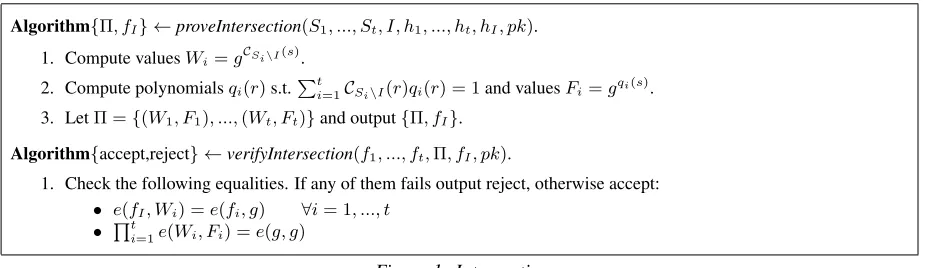
of the the complements ofIw.r.tSishould be 1. Based on the above, we propose the algorithms in Figure1
for the case of a single intersection:
Algorithm{Π, fI} ←proveIntersection(S1, ..., St, I, h1, ..., ht, hI, pk).
1. Compute valuesWi=gCSi\I(s).
2. Compute polynomialsqi(r)s.t.Pti=1CSi\I(r)qi(r) = 1and valuesFi=g qi(s).
3. LetΠ ={(W1, F1), ...,(Wt, Ft)}and output{Π, fI}.
Algorithm{accept,reject} ←verifyIntersection(f1, ..., ft,Π, fI, pk).
1. Check the following equalities. If any of them fails output reject, otherwise accept: • e(fI, Wi) =e(fi, g) ∀i= 1, ..., t
• Qt
i=1e(Wi, Fi) =e(g, g)
Figure 1: Intersection
Algorithm for Union. Now we want to provide a similar method for proving the validity of a union operation of some sets. Again we denote setU =S1∪...∪Stand lethi be the corresponding hash values
as above. The union setU is uniquely characterized by the following two properties:(Superset)Si ⊆U for
allSiand(Membership)For each elementxi ∈U,∃j∈[t]s.t. xi ∈Sj. These properties can be verified,
with values Wi, wj for i = 1, ...t andj = 1, ...,|U|defined as above checking the following equalities
(assuminghUis the hash value ofU):
e(fi, Wi) =e(fU, g) ∀i= 1, ..., t
e(gxjgs, w
j) =e(fU, g) ∀j= 1, ...,|U|.
general operations (each intermediate union operation the verification procedure would be at least as costly as computing that intermediate result). Therefore, we are interested in restricting the number of necessary checks. In the following we provide a union argument that achieves this.
Our approach stems from the fundamental inclusion-exclusion principle of set theory. Namely for set U = A∪B it holds thatU = (A+B)\(A∩B) whereA+B is a simple concatenation of elements from setsA, B (allowing for multisets), or equivalently, A+B = U ∪(A∩B). Given the hash values hA, hB the above can be checked by the bilinear equalitye(fA, fB) = e(fU, fA∩B). Thus one can verify
the correctness of hU by checking a number of equalities independent of the size ofU by checking that
the above equality holds. In practice, our protocol for the union of two sets, consists of a proof for their intersection, followed by a check for this relation. Due to the extractability property of our ECRH, the fact thathIis included in the proof acts as a proof-of-knowledge by the prover for the setI, hence we can remove
the necessity to explicitly includeIin the answer.
There is another issue to be dealt with. namely that this approach does not scale well with the number of input sets for the union operation. To this end we will recursively apply our construction for two sets in pairs of sets until finally we have a single union output. Let us describe the semantics of a set union operation overtsets. For the rest of the section, without loss of generality, we assume∃k ∈ Ns.t. 2k = t, i.e.,t is a power of 2. Let us define asU1(1), ..., Ut/(1)2 the sets(S1 ∪S2), ...,(St−1 ∪St). For setU is holds that
U =U1∪...∪Ut/2due to the commutativity of the union operation.
All intermediate resultsUi(j)will be represented by their hash valuesh
Ui(j)yielding a proof that is of size
independent of their cardinality. One can use the intuition explained above, based on the inclusion-exclusion principle, in order to prove the correctness of (candidate) hash valueshU(1)
i
corresponding to setsUi and,
following that, apply repeatedly pairwise union operations and provide corresponding arguments, until set U is reached. Semantically this corresponds to a binary treeT of heightkwith the original setsSiat thet
leafs (level0), setsUi(1)as defined above at level 1, and so on, with setU at the root at levelk. Each internal node of the tree corresponds to a set resulting from the union operation over the sets of its two children nodes. In general we denote byU1(j), ..., Ut/(j2)jthe sets appearing at levelj.
We propose the algorithms in Figure2for proof construction and verification for a single union:
For ease of notation we denote byA, Bthe two sets corresponding to the children nodes of each non-leaf node ofT, byU, I their union and intersection respectively and byFthe final union output.
Algorithm{Π, fF} ←proveUnion(S1, ..., St, U, h1, ..., ht, hU, pk).
1. InitializeΠ =∅.
2. For eachUi(j)of levelj = 1, ..., k, corresponding to setsU, Ias defined above, computeU, Iand valueshU, hI.
Append valueshU, hItoΠ.
3. For eachUi(j)of levelj= 1, ..., k, run algorithmproveIntersection(A, B, hA, hB, pk)to receive(ΠI, fI)and append
ΠItoΠ. Observe that setsA, Band their hash values have been computed in the previous step.
4. Output{Π, fF}. (hF has already been computed at step (2) but is provided explicitly for ease of notation).
Algorithm{accept,reject} ←verifyUnion(f1, ..., ft,Π, fF, pk).
1. For each intersection argument{ΠI, fI} ∈ΠrunverifyIntersection(fA, fB,ΠI, fI, pk). If for any of them it outputs
reject, output reject.
2. For each node ofT check the equalitye(fA, fB) =e(fU, fI). If any check fails, output reject.
3. For each hash valuehU∈Πchecke(fU, ga) =e(fU0, g)and likewise for valueshI. If any check fails output reject,
otherwise accept.
Figure 2: Union
Analysis of the algorithms. LetN = Pti=1|Si|andδ = |I|or|F|respectively, depending on the type
construction andO(t+δ)for verification and the proofs containO(t)bilinear group elements. A proof of the complexity analysis for these algorithms can be found in Section3.4.
It can be shown that these algorithms, along with appropriately selected proofs-of-validity for their input hash values can be used to form a complete ADS scheme for the case of a single set operation. Here however, these algorithms will be executed as subroutines of the general proof construction and verification process for our ADS construction for more general queries, presented in the next section. In the full version of the paper, we present similar algorithms for the set difference operation
3.2.3 Hierarchical Set-Operation queries
We now use the algorithms we presented in the previous subsection to define appropriate algorithmsquery, verifyfor our ADS scheme. A hierarchical set-operations computation can be abstracted as a tree, the nodes of which contain sets of elements. For a queryqovertsetsS1, ..., St, corresponding to such a computation,
each leaf of the treeT contains an input set forqand each internal node is related to a set operation (union or intersection) and contains the set that results to applying this set operation on its children nodes. Finally the root of the tree contains the output set ofq. In order to maintain the semantics of a tree, we assume that each input is treated as a distinct set, i.e.,tis not the number of different sets that appear inq, but the total number of involved sets counting multiples. Another way to see the above, would be to interprettas the length of the set-operations formula corresponding toq.6
Without loss of generality, assume qis defined over thetfirst sets ofD. For reasons of simplicity we describe the mode of operation of our algorithms for the case where all setsSi are at the same level of the
computation, i.e., all leafs ofT are at the same level. The necessary modifications in order to explicitly cover the case where original sets occur higher in T, are implied in a straight-forward manner from the following analysis, since any setSi encountered at an advanced stage of the process can be treated in the
exact same manner as the sets residing at the tree leafs. The algorithms for query processing and verification of our ADS scheme are described in Figure3.
Intuitively, with the algorithms from the previous section a verifier can, by checking a small number of bilinear equations, gain trust on the hash value of a set computed by a single set operation. Observe that, each prover’s algorithm “binds” some bilinear group elements (the first parts of the input hash values) to a single bilinear group element (the first part of the hash value of the output set). We made explicit use of that, in order to create a proof of union for more than two sets in the previous section. Here we generalize it, to be able to obtain similar proofs for hierarchical queries containing intersections and unions. The proof forq is constructed by putting together smaller proofs for all the internal nodes inT. LetΠbe a concatenation of single union and single intersection proofs that respectq, i.e., each node inT corresponds to an appropriate type of proof inΠ. The hash value of each intermediate result will also be included in the proof and these values at leveliwill serve as inputs for the verification process at leveli+ 1. The reason the above strategy will yield a secure scheme is that the presence of the hash values, serves a proof by a cheating adversary that he has “knowledge” of the sets corresponding to these partial results. If one of these sets is not honestly computed, the extractability property allows an adversary to either attack the collision-resistance of the ECRH or break theq-SBDHassumption directly, depending on the format of the polynomial used to cheat. Observe that the size of the proofΠisO(t+δ). This follows from the fact that thetproofsπi consist
of a constant number of group elements and Π is of size O(t) since each of the O(|T|) = O(t) nodes participates in a single operation. Also, there areδcoefficientsbitherefore the total size ofΠisO(t+δ).
6
More generallyqcan be seen as a DAG. Here, for simplicity of presentation we assume that all setsSiparticipate only once
Dis the most recent version of the data structure andauth(D), dbe the corresponding authenticated values and public digest. Letqbe a set operation formula with nested unions and intersections andT be the corresponding semantics tree. For each internal nodev∈ T letR1, ..., Rtv denote the sets corresponding to its children nodes andObe the set that is produced by
executing the operation inv(union or intersection) overRi. Finally, denote byα=x1, ..., xδthe output set of the root ofT.
Algorithm{α,Π} ←query(q, D, auth(D), pk). 1. InitializeΠ =∅.
2. Compute proof-of-membershipπifor valuefiby runningQueryTree(pk, d, i, auth(D))fori∈[t]and appendπi, fi
toΠ.
3. For each internal nodev∈ T (as parsed with a DFS traversal): • Compute setOand its hash valuehO=h(CO).
• Ifvcorresponds to a set intersection, obtainΠvby runningproveIntersection(R1, ..., Rt, h1, ..., ht, O, hO, pk).
For each subset witnessWi ∈Πcorresponding to polynomialCRi\O, compute valuesW˜i=g
aCRi\O(s)
. Let Wv={W1, ..., Wtv}. AppendΠv,Wv, hOtoΠ.
• Ifvcorresponds to a set union, obtainΠvby runningproveUnion(R1, ..., Rt, h1, ..., ht, O, hO, pk). Append
Πv, hOtoΠ.
4. Append toΠthe coefficients(c0, ..., cδ)of the polynomialCα(already computed at step 3 and output{α,Π)}.
Algorithm{accept,reject} ←verify(q, α,Π, d, pk). For internal nodev ∈ T, letη1, ..., ηtv denote the hash values of its
children node sets∈Π(for internal nodes at level 1, the valuesηiare the valuesfi).
1. Verify the validity of valuesfi. For each valuefi ∈ΠrunVerifyTree(pk, d, i, fi, πi). If it outputs reject for any of
them, output reject and halt.
2. For each internal nodev∈ T (as parsed with a DFS traversal):
• Check the equalitye(fO, ga) =e(g, fO0). If it does not hold, reject and halt.
• Ifvcorresponds to a set intersection:
(a) RunverifyIntersection(η1, ..., ηtv,Πv, fO, pk), If it outputs reject, output reject and halt.
(b) For each pairWi,W˜i∈Πv, check the equalitye(Wi, ga) =e( ˜Wi, g). If any of the checks fails, output
reject and halt.
• Ifvcorresponds to a set union, runverifyUnion(η1, ..., ηtv,Πv, fO, pk). If it outputs reject, output reject and
halt.
3. Validate the correctness of coefficientsc. Choosez←RZ∗pand compare the values δ
X
i=0
ciziand δ
Y
i=1
(xi+z). If they
are not equivalent, output reject and halt.
4. Check the equalitye(
δ
Y
i=0
gcisi, g) =e(f
α, g). If it holds output accept, otherwise reject.
Figure 3: General Set-Operations Proof Construction and Verification
The runtime of the verification algorithm isO(t+δ)as steps 2,3 takesO(t)operations and steps 4,5 take O(δ). A proof of the complexity analysis for these algorithms can be found in Section3.4.
3.3 Main Result
We can now state the following theorem that is our main result.
Theorem 1 The schemeAHSO ={genkey,setup,query,verify,update, refresh}is a dynamicADS scheme for queriesq from the class of hierarchical set-operations formulas involving unions, intersections and set difference operations. Assuming a data structureDconsisting ofmsetsS1, ..., Sm, and a hierarchi-cal set-operations queryq involvingtof them, computable with asymptotic complexityO(N)with answer sizeδ,AHSO has the following properties: (i)correctandsecureunder theq-SBDHand theq-PKE as-sumptions; (ii) the complexity of algorithmgenkeyisO(|D|); (iii) that ofsetupisO(m+|D|)(iv) that of
Proof:LetAADSbe an adversary for andAHSOscheme. Recall theAADSis given a public key generated by genkey containing a description of an ECRH h. AADS then callssetup with the parameter D0 and subsequently makes additional oracle calls to the algorithmsupdate, refresh, verify, proof, ofAHSO. FinallyAADS outputs{α,Π, q, Dk, auth(Dk), dk}whereΠis a proof that contains images of the hashh.
We show that there exists an extractorE that except with negligible probability over the choice ofh, when
E is givenh, outputs a pre-image for every valid image ofh inΠ. We cannot directly use the extraction property of the ECRH since the adversaryAADS is getting access to oracles for the algorithms ofAHSO
and we do not have access to the code of these oracles. The idea of this proof is to use the fact that all the algorithms ofAHSO(exceptgenkey) can be executed over the initial databaseD0in polynomial time given only the public keyh(see Remark1), and therefore there exists an adversaryA0ADSthat internally emulates
A0
ADStogether with its oracles and outputs the same asAADS. LetA0ibe the adversary that emulatesA0ADS
and outputs thei’th hash valuehiin proofΠcontained in the output ofA0ADS. It follows from the properties
of the ECRH that there exists an extractorEiforA0ithat outputs a pre-image ofhi wheneverhiis indeed in
the image ofh. Therefore there exists a single extractorE that outputs the pre-images for all validhi’s with
overwhelming probability. Finally, observe that valid hash valueshiare efficiently recognizable as elements
ofG.
As a building block for our proof, we prove the following lemma:
Lemma 4 If theq-SBDHassumption holds, then for any poly-size adversaryAthat upon inputpkoutputs
(S1, ..., St, O,Π, fO) s.t. (i)verifyIntersection(f(CS1), ..., f(CSt),Π, fI, pk) (resp. verifyUnion) accepts
and (ii)f(CO) =fO,O =∩it=1Si(resp. O=∪ti=1Si) with all but negligible probability.
Proof:We examine the two cases separately.
Intersection. Let us assume that there exists A that outputs S1, ..., St, O,Π, fO s.t. verifyIntersection
accepts and O 6= I := ∩t
i=1Si, with non-negligible probability. We will construct an adversary A0 that
breaks theq-SBDHassumption. For ease of notation we denoteCSi =Qi(r)andCO =P(r).
Since O 6=I, either it contains an elementxs.t. x 6∈ I, or there exists elementx ∈ I s.t. x 6∈ O (or both happen at the same time). Let us deal with the first case. Sincex∈O∧x6∈I, there must exist setSj
s.t. x6∈Sj. Therefore for the term(x+r)it is true that(x+r)6 |Qj(r)and(x+r)|P(r). It follows that
there exist efficiently computableF(r), κs.t. Qj(r) = (x+r)F(r) +κ. Also letH(r)be polynomial s.t.
(x+r)H(r) =P(r). The following equalities must hold:
e(fO, Wj) =e(fj, g)
e(g, Wj)P(s) =e(g, g)Qj(s)
e(g, Wj)(x+s)H(s) =e(g, g)(x+s)Qj(s)+κ
e(g, W)H(s)e(g, g)−Qj(s)κ
−1
=e(g, g)x+1s.
It follows thatA0 can, by outputting the above value break theq-SBDHfor pointx. Hence, this case can happen only with negligible probability.
It remains to deal with the second case, conditioned on the first not happening. Namely, there exists x ∈ I that is omitted by answer O, i.e. O is a common subset of Si but not the maximal one. There
must existx ∈ I s.t. x /∈ O therefore it must be thatx ∈ (Si \O) for alli = 1, ..., t. Let polynomials
Ri(r) = CSi\O. Observe that because the verifier accepts, it must be that e(g, Wi) = e(g, g)
Qi(s), hence
Wi =gRi(s). From the above it must hold thatRi(r) = (x+r)R0i(r)for someR 0
must be true:
t Y
i=1
e(Wi, Fi) =e(g, g)
t Y
i=1
e(gR0i(s), Fi)
!x+s
=e(g, g)
t Y
i=1
e(gR0i(s), Fi) =e(g, g)
1
x+s.
From the above,A0can break theq-SBDHassumption for pointx. It follows thatOis the maximal common
subset ofSi’s with all but negligible probability.
If we denote the two cases asE1, E2, we showed thatPr[E1],Pr[E2|E1c]are negligible probabilities. SinceE1, E2cover all possible cheating adversary strategies, the claim follows by a simple union bound.
Union. Let us assume that there existsAthat outputsS1, ..., St, O,Π, fO s.t. verifyUnionaccepts and
O 6= U := ∩t
i=1Si, with non-negligible probability. We will construct an adversary A
0 that either finds
a collision in h, or breaks the q-SBDHassumption. For ease of notation we denote CSi = Qi(r) and CO=P(r). We begin by providing a proof fort= 2, i.e., a union of two setsA∪B.
Upon receiving the output fromA, adversaryA0runs the extractorEA(the existence of which is
guar-anteed by our analysis in the start of the proof of Theorem1) for valuehI∗∈Πto receive polynomialR(r) s.t.gR(s)=hI∗ with overwhelming probability.
Claim 1 R(r)≈aCI whereI =A∩B, with all but negligible probability.
Proof of Claim.The following two relations must hold:
e(g, WA)R(s)=e(g, g)QA(s)
e(g, g)QA(s)·QB(s)=e(g, g)R(s)·P(s).
First we will prove that R(r) can be written as a product of degree 1 polynomials. Assume there exists irreducible polynomialR0(r) of degree> 1and polynomialJ(r)s.t. R(r) = R0(r)J(r). It follows that R(r)P(r)6=QA(r)QB(r)(since only one of them has irreducible terms of degree greater than 1), however
from the above equality h(R(r)P(r)) = h(QA(r)QB(r)) therefore by outputtingR(r) ·P(r), QA(r)·
QB(r)(in coefficient form),A0 finds a collision in the ECRH. This can happen with negligible probability
henceR(r)can be written as a product of degree 1 polynomials with all but negligible probability.
From this it follows that A0 can, by running a probabilistic polynomial factorization algorithm, find
rootsxis.t.R(r) =λQi∈[deg(R)](xi+r). Note that upon input polynomialR(r), valueλcan be efficiently computed correctly by a polynomial factorization algorithm, with all but negligible probability, and the value λ−1 is also computable efficiently sincepis a prime.
Let X be the set containing the additive inverses of the roots xi7 and observe that CX =
λQ
i∈[deg(R)](xi +r). IfX 6= I, A
0 can output{A, B, X, P i∗ = (hλ−1
X , WAλ, WBλ, Fλ
−1
A , Fλ
−1
B )}. It is
easy to verify that the above is satisfying proof for the claim thatX =A∩B (i.e.,verifyIntersection ac-cepts), whileX6=I. By our previous analysis for the intersection case, this can only happen with negligible probability. This concludes the proof of the claim.
7The case whereXhas a root that is also a root ofIbut with cardinality>1can easily be dealt with as follows. Since the term
Consequently, the following must be true:
e(g, g)QA(s)QB(s)=e(g, g)R(r)P(r)
e(g, g)Qx∈A(x+s)
Q
x∈B(x+s)=e(g, g)P(s)λ
Q
x∈A∩B(x+s)
e(g, g)Qx∈A∪B(x+s)=e(g, g)λP(s).
In case polynomials CA∪B andλP(r) are not equivalent, due to the above equality Acan by outputting
them find a collision in the ECRH. Therefore it must be that with overwhelming probabilityλP(r) =CU. Again, ifλ6= 1then the two polynomials form a collision for the ECRH, therefore with all but negligible probability,O=U.
Let us now turn our attention to the case of a generalised union over ksets (assume wlog thatkis a power of 2). Consider the binary treeT that captures this union operation as described in Section3.2.2. Observe that this tree consists only ofO(poly(l))nodes (2t−1in practice) henceA0 can efficiently run an extractor for all intermediate hash values corresponding to internal nodes ofT (as per our former analysis) to compute the related polynomials correctly, with overwhelming probability.
We will prove that the polynomialCO(r), corresponding tohO, is an associate ofCU by showing that
this is true for all intermediate polynomials and their corresponding sets. We will do this by an induction on the levels ofT.
level-1 LetPi(1)(r)be the extracted polynomials for all first level nodes. Let us assume that there exists node vin the first level such thatP(r) :=Pv(1)(r)6≈aCU(1)
i
whereUi(1)is the corresponding correct union of its two children nodes.
With a similar argument as above, P(r) can be written as a product of degree 1 polynomials with all but negligible probability (otherwise a collision in the ECRH can be found). LetX be the set containing the additive inverses of the roots xi of P(r). It follows that P(r) = λCX for some
efficiently computable λ ∈ Z∗p. Similar as above, if X 6= U (1)
i , A0 can output {A, B, X,Π∗ =
(hλX−1, hλI, WAλ−1, WBλ−1, FAλ, FBλ)}. It is easy to verify that this consists a satisfying proof for the claimA∪B = X, which by our previous analysis can happen with negligible probability and the claim follows.
level-j Assuming that this holds for the polynomials on level j we will show that it also holds for level j+ 1. Let us assume that this not the case. It follows that there must exist nodevof the tree on level j+ 1the children of which have extracted polynomialsQA(r), QB(r), the corresponding extracted
output polynomial isP(r)and the corresponding extracted polynomial for the intersection beH(r). AssumingP(r)is not an associate ofCU we will construct an adversary that finds a collision in the ECRH similar to above.
By assumption,QA(r) = λAQi∈[|A|](xi +r) and likely forQB(r) (recall that these are associate polynomials of the correctly computed corresponding set at levelj) for setsA, B. IfP(r)contains an irreducible factor of degree>1, our previous analysis shows that a collision for the ECRH is found. ThereforeP(r) can be written as a product of degree 1 polynomials and a scalar and there exist an efficiently computable setX andλ ∈ Z∗
p s.t. P(r) = λCX. Similar as above, if X 6= A∪B, A0
can output{A, B, X,Π∗= (hλX−1, hλ/λA·λB
I , W
λB
A , W λA
B , F λ−B1 A , F
λ−A1
B )}. It is easy to verify that this
consists a satisfying proof for the claimA∪B =X, which by our previous analysis can happen with negligible probability and the claim follows.
Since this holds for every node of levelj+ 1, this concludes our induction proof.
Hence with all but negligible probability, the claim holds for the valuehO. As per the intersection case, it
For the proof of our main result we make use of Lemmas4and3. LetAADS be a poly-size adversary that upon input the public key pk of our ECRH construction, is given oracle access to all algorithms of
AHSO. AADS picks initial state D0 for the data structure and computes auth(D0), d0 through oracle access to setup(). Consequently he chooses a polynomial number of updates and with oracle access to update() computesDi+1, auth(D0), di+1 for i = 0, ..., h. Also, he receives oracle access to algorithms query,verify,refresh. Finally,AADSoutputs{α0,Π, q, Dk, auth(Dk), dk}wherekis between0andh+ 1
and denotes the snapshot of the data structure to which the queryqis to be applied. We want to measure the probability thatverify(α0,Π, q, pk, dk) outputs accept and algorithmcheck(Dk, q, α0)outputs reject (i.e.,
α0is not equal to the set produced by applying operations inqon datasetDk).
Assuming AADS can succeed in the above game with non-negligible probability , we will use him to construct A0 that finds a collision in the ECRH with non-negligible probability. A0 works as follows.
Upon inputpkof ECRH, he sends it toAADS. Following that, he provides oracle interface toA. Finally,
he receives{α0,Π, q, Dk, auth(Dk), dk}fromAand runs corresponding extractorEAADS to receive hash
pre-images for all hash vales inΠ.
Let S1, ..., St be the sets in Dk over which q is defined. First A0 computes honestly q over Si, and
receives the correct outputαand all intermediate sets. Then he runsverifyon the received tuple and checks ifα 6= α. If verification fails orα = α0 he aborts (i.e. he only proceeds ifAADS wins the ADS game). Following that, A0 checks iff(CSi) = fi for i = 1, ..., t. If any of the checks fails, he aborts. Then
A0 compares the correctly computed set for each nodev ∈ T and the corresponding extracted polynomial which we denote byPv(r). Given polynomialPv(r)for each node,A0checks if it is an associate polynomial
of the characteristic polynomial of the corresponding honestly computed set. If this does not hold for some nodev, he aborts. Finally, he outputs the pair of polynomialsProot(r),Cα0.
First, note thatA0runs in time polynomial in the security parameter, since bothA
ADSandEAADS run in
polynomial time, the set computations can be done in polynomial time and polynomial associativity is also decidable in polynomial time by long division. Regarding, his success probability in finding a collision we argue as follows.
LetE0 be the event thatA0 succeeds in finding a collision andB the event thatAADS wins the ADS
game. By assumptionPr[B] > for non-negligible, a function ofl. Observe that, conditioned on not aborting, the probability ofA0to find a collision is at least(1−ν∗(l))whereν∗(l)is the sum of the negligible
errors in the output of the extractor and the randomized factorization algorithm, which by a union bound is an upper bound for the total error probability. This holds because, sinceA0 did not abort, the verification succeeded andAADS provided a false answer which implies that the polynomials output are not equivalent yet they have the same hash values. OverallPr[E0] = Pr[E0|¬abort] Pr[¬abort]≥(1−ν∗(l)) Pr[¬abort].
Let EV be the event that verifyaccepts during the first step of A0 andα 6= α0. Also, letE1 be the event that allf(CSi) = fi for i = 1, ..., t given thatverifyaccepts andE2 be the event that all extracted polynomials are of the form Pv(r) ≈a CO also given thatverifyaccepts. Also, let E3 be the event that the polynomialsCα∗(r)andPδ−1
i=0ciri are equivalent given thatverifyaccepts. By Lemma 3, Pr[E1] > 1−ν1(l)andPr[E3]>1−ν3(l)since, by the Schwartz-Zippel lemma [31], the probability that two non-equivalent polynomials of degreeδ agree on a point chosen uniformly at random is≤ d/2l in this case,
which is negligible inl. Also, by assumptionPr[EV]≥.
We argue aboutPr[E2]as follows:
Claim 2 Pr[E2]>1−ν2(l).
Proof of Claim.Equivalently, we will prove that for all internal nodesv∈ T, with corresponding extracted polynomialPv(r), it must be thatPv(r) ≈a COwhereO is the correctly computed set corresponding tov