AT&T
Page Pac
®
Plus Paging
Controller
Copyright 1993 AT&T All Rights Reserved Written/Printed in U.S.A.
AT&T 463-248-204 0II722580-002 Issue 3, May 1993
Notice
Every effort was made to ensure that the information in this guide was complete and accurate at the time of printing. However, information is subject to change.
Federal Communications Commission (FCC) Interference Notice
This equipment has been tested and found to comply with the limits for a Class A digital digital device, pursuant to Part 15 of the FCC rules. these limits are designed to provide reasonable protection against harmful interference when the equipment is operated in a commercial environment. This equipment generates, uses, and can radiate radio frequency energy and, if not installed and used in accordance with the insruction guide, may cause harmful nterference to radio communications. Operation of this equipment in a residential area is likely to cause harmful interference, in which case the user will have to correct the interference at his or her own expense. For additional FCC interference, registration, and repair information, see the Installation Guide.
Trademarks
PAGEPAC PLUS and AMPLICENTER are trademarks of Harris-Draccon. Centrex is a registered trademark of A T & T .
Warranty
AT&T provides a limited warranty for this product. Refer to "AT&T Limited Warranty and Limitation of Liability" in the Installation Guide.
Ordering Information
The order number for this book is 463-248-204. To order copies of this book, call 1-800-432-6600 in the U.S. and 1-800-255-1242 in Canada. For more information on how to order this and other system reference materials, see "Reference Materials," in "About this Guide." For information on ordering replacement parts, accessories, and other compatible equipment, refer to "Product Ordering information," under "About This Guide".
Support Telephone Numbers
AT&T provides a toll-free customer helpline 24 hours a day.
In the U.S., call the AT&T NTSC Group at 1-800-552-3293 or the AT&T Helpline at 1-800-628-2888 if you need assistance when installing, programming, or using your system. For service or technical assistance in Canada, call one of the following Technical Assistance Centers:
Eastern Canada and Ottawa: 1-800-363-1882 Ontario: 1-800-387-4268 Central and Western Canada: 1-800-663-9817
Contents
About This Guide
vii
■ How to Use This Guide vii
■ Getting Started viii
■ How to Comment on This Guide viii
■ Product Ordering Information viii
■ Reference Materials viii
1.
Overview
1-1
■
■
■
■
■
■
■
■
■
About PagePac Plus
Managing the System Features and Capabilities Hardware Configuration
Indicators and Connectors Power
Interface Considerations
Zone Map
Zone Configuration Tables
1-3 1-6 1-7 1-10
1-11 1-14
1-15 1-16 1-22
2.
Programming The Controller
2-1
■ Introduction 2-3
■ Software Configuration—Overview 2-4
■ Programming Options and Instructions 2-5
■ Error Tones 2-36
3 .
Operation
3-1
■
■
■
■
Power Up 3 - 2
System Administrator 3 - 2
End User 3 - 2
User Quick Reference Card 3 - 4
A.
Application Notes
A-1
IN.
Index
IN-1
About This Guide
READ THIS GUIDE FIRST, before using the Installation Guide to install PagePac Pius equipment. You will need to complete the Zone Map (table 1-2) and Zone Configuration Tables (tables 1-3 and 1-4) to lay out your paging system zones before setting switches on the equipment and before programming the controller unit.
After programming the unit, fill out the User Quick Reference Card, at the end of section 3, and distribute to all system users.
NOTE TO INSTALLER
Leave this guide with the System Administrator or other person responsible for managing/modifying the PagePac Plus system.
This guide explains features, and their application, to program the
PagePac Plus Control Unit to provide the paging functions that your facility requires.
It also gives complete instructions for operating the PagePac Plus system from your phone, once it’s installed and configured.
The pronoun "he," as used herein to refer to the user, is intended to encompass users of either gender.
How to Use This Guide
■
■
■
■
Overview and Features. For a thorough description of PagePac Pius
capabilities and features, refer to section 1.
Programming Instructions. Section 2 provides step-by-step
instructions for programming the configuration of your PagePac Plus paging system, using a Touchtone telephone keypad. For
programming instructions using a PC computer, see the separate instructions accompanying the software diskette. Section 2 describes in detail the various configuration options that are to be selected. You can change your system’s settings easily to accommodate new or expanding needs.
Operations Instructions. Section 3 gives step-by-step instructions for
using your PagePac Plus-controlled paging system, once its
configuration has been set. A User Quick Reference Card is included at the end of section 3.
Equipment Installation. For detailed instructions about installing the
PagePac Plus Control Unit, Zone Expansion Unit(s), Amplicenter(s), and interconnect cabling, refer to the Installation Guide.]
■ Solving Problems. Should any problem arise that requires technical assistance beyond the information provided in this guide, call:
AT&T Technical Support, 1-800-552-3293.
AT&T National Technical Marketing, 1-800-222-1313. AT&T National Service Assistance Center, 1-800-628-2888.
Getting Started
1.
2.
3.
Fill out the Zone Map (table 1-2) and Zone Configuration Tables (1-3 and 1-4) at the end of section 1.
Go to the Programming Quick Reference Chart at the end of section 2 and program the system.
Fill out the User Quick Reference Card, at the end of section 3, to distribute to all system users.
How to Comment on This Guide
A feedback form is located at the end of this guide. If the feedback form is missing, send your comments and recommendations for changes to:
J. Dean AT&T
99 Jefferson Road (Room 2A-25) Parsippany, NJ 07054
FAX: (201) 887-6898
Product Ordering Information
Refer to PagePac Plus Controller Installation and Use Guide for product ordering information.
Reference Materials
■
■
■
PagePac Plus Controller Installation and Use 463-248-201
PagePac Plus Amplicenter Service Manual 463-248-202
PagePac Plus Zone Expansion Unit Service Manual 463-248-203
Overview
1
Contents
About PagePac Plus
Managing the System
■ ■ ■ ■ ■ ■
Installing System Hardware
Changing System Settings
Training Co-Workers
Solving Problems
Daily Operation
Application Notes
Features and Capabilities
■ ■ ■ ■ ■ ■ ■ ■ ■
Factory-Set Default Inputs
Eight Primary Paging Zones
48 Expansion Zones
PagePac Plus Amplicenter Interface
Music Input
Three Output Types
Talk-Back Amplifier Tone Generator Programming Memory 1-3 1-6 1-6 1-6 1-6 1-6 1-7 1-7 1-7 1-8 1-9 1-9 1-9 1-9 1-10 1-10 1-10 1-10
Hardware Configuration
Indicators and Connectors
■ LED Indicators
■ Back Panel Nomenclature
■ Connectors on Rear
Power
Interface Considerations
Zone Map
Zone Configuration Tables
1-10
1-11
1-11
1-11
1-14
1-14
1-15
1-16
1-22
About PagePac Plus
Telephone Access and
Talk-back
Security Door Control
and Night Bell
Automatic Message
Logging
PagePac Plus
Amplicenter
Zone Expansion Units
Easy to Program
The PagePac Plus Controller is a paging system controller that incorporates into one unit many paging system features previously obtainable only by purchasing multiple separate units. It is bi-directional, enabling two-way (talk-back) conversation via the paging system.
PagePac Plus supports numerous modes of Telephone Access to the paging system, which allows you to access the system by simply dialing its extension, in-facility or off-premises. All access to the paging system can be password protected.
The PagePac Plus Controller is set up to accommodate security door or gate control, enabling you to speak with whomever has rung the door bell, and to signal the door lock to open, permitting entry. PagePac Plus also features Night Bell circuitry, which enables the paging system to alert personnel to incoming phone calls in unoccupied areas, after hours.
The PagePac Plus Controller may optionally be connected to a PC computer for automatic logging of all important paging activity, for security and insurance purposes.
The PagePac Plus Controller requires connection to a PagePac Plus Amplicenter, which amplifies and distributes sound to paging
loudspeakers, and to which the music source for background music is connected. The PagePac Pius Amplicenter is also the power source for the controller. The Amplicenter is available in 20, 100, and 300 watt models.
The PagePac Plus Controller may be connected to Zone Expansion Units, which enlarge the paging controller’s capacity to a maximum of 56 paging zones. See figure 1-1, PagePac Plus System Components, for a typical example of a PagePac Plus system hardware layout.
PagePac Plus is user-programmable, with simple step-by-step
programming instructions that permit the system administrator or other responsible person to alter the system configuration, using either a standard Touchtone telephone keypad or a PC computer. As your paging needs change, you can alter the makeup of paging zones, and the nature of inputs and outputs. You can expand the controller’s program to add additional paging zones, all within a few minutes time and without the need for a paging system technician to come in to do the job.
Security Protection
An Access Password and a Programming Password can easily be established for the PagePac Plus system. Both passwords are operative for both on- and off-premises access, and the Programming password is effective for both telephone keypad and PC programming access.Figure 1-1. PagePac Plus System Components
Managing the System
Installing System Hardware
Please refer to the Installation Guide for complete instructions for installing the PagePac Plus Unit, Amplicenter, and Zone Expansion Units, to form a fully integrated functional paging controller system in your facility.
Changing System Settings
You can change the Control Unit’s settings easily to accommodate new or changing needs. Section 2 gives instructions for making whatever
changes are needed – by using your telephone keypad or a PC computer to re-configure parameters stored in the PagePac Plus’s memory. You can change the manner in which paging zones are laid out, or you can re-define the nature of the inputs and outputs of the system.
Training Co-Workers
Section 3, "Using the PagePac Plus Paging System," explains how to use your telephone set to access the paging system, how to select paging zones, how to answer a door bell and unlock the door, and other features. To help with this task, give each telephone user a copy of the User Quick Reference Card, found at the end of section 3.
Solving Problems
The Installation Guide gives information on solving installation problems and ordering additional accessories and equipment. If your system malfunctions, you may be able to solve the problem by following the steps provided in the "Maintenance and Troubleshooting" section of the
Installation Guide. If you receive error tones or error messages from the
system, refer to "Error Tones" at the end of section 2. If you still need help, call the 24-hour AT&T National Service Assistance Center:
1-800-628-2888.
Daily Operation
Depending on how your system is set up, you may need to oversee some of the system’s daily operation. For example, if your system is
programmed to use the Night Bell feature, you will need to activate Night Bell service at the end of each day before leaving the office.
Application Notes
Application Notes are located at the end of this guide, after section 3. They provide technical tips and graphic examples of some common applications.
Features and Capabilities
The following list provides an overview of the basic features of the PagePac Plus system, along with the additional capabilities that you can get by customizing the system:
■
■
Connects up to 8 paging zones, or up to 56 if Zone Expansion Unit(s) are attached.
Enables access to the paging system via any telephone.
■ Combines simplicity of use with a wide range of paging system features, including:
Attendant (microphone) Access
Night Bell
Talk-back (2-way paging)
Door Phone / Door Control
Remote Amplifier Control
Alarm System Interface
Contact closure outputs to turn on (for example) the exterior lighting
Background Music
Automatic logging of paging activity
■ Can be re-programmed easily from any telephone in the system, or by using a PC with the software program provided. A Programming password (if optioned) protects the system from unauthorized programming access.
Factory-Set Default Inputs
The PagePac Plus Control Unit has five factory-set default inputs that are active on a priority basis. These five, in order of priority, are Attendant Access, Input #1, Telephone Access, Input #2, and Night Bell.
Attendant Access
Attendant Access is the highest priority paging mode of the PagePac Plus system. The attendant simply dials his exclusive paging extension to make an announcement. Also, by using a microphone directly connected to the PagePac Plus Controller, the Attendant activates paging access when the microphone "TALK" switch is pressed. Any other paging activity (or background music) that may be currently active will be muted or overridden, to permit the direct voice page to be broadcast.Input #1
Input #1 is the second highest priority, and is intended for inputs such as a security alarm or fire alarm, though it is user-definable and can be used for any input.Telephone Access
The Telephone Access is made by dialing the general access extension number of the PagePac Plus unit. The PagePac Plus telephone interface is switch selectable (set to accommodate your telephone system) and has the third highest paging priority. See the Installation Guide for details of the four different telephone system modes.Input #2
Input #2 is the fourth priority, and is intended for routine inputs such as a security door bell. It is user-definable and can be used for any designated input. Input #1 can only be assigned to zones 1 - 8.Night Bell Circuit
When the Night Bell is activated and no other higher priorities are active, then a distinctive tone will be sent to all zones programmed to send Night Bell. The Night Bell circuit is activated by a ring voltage from a PBX station or a zone input contact closure. The default priority is the lowest.Eight Primary Paging Zones
NOTE: The Zone Option The PagePac Plus Control Unit has eight onboard zones. All eight zones switches, both on the PagePac can be optioned via zone option switches (on the rear of the controller) to Plus Controller and on any
be either 70V audio output zones, input contact-closure zones, or attached Zone Expansion
Units, MUST be set before the contact-closure output zones to drive additional remote amplifiers or other PagePac Plus system is devices such as security door locks, Each zone may be configured powered up, and therefore individually. If a zone is optioned as an input, its priority will be set by before programming
identifying it as an Input #1 or Input #2 zone. commences.
48 Expansion Zones
NOTE: Each Zone Expansion The PagePac Plus Control Unit has the ability via Zone Expansion Units to Unit has a dip switch that must access up to 48 external paging zones. it communicates with these be set (addressed) properly
during installation, and before expansion zones by using up to three optional Zone Expansion Units (16 power up of the system. See zones per module).
Installation Guide.
PagePac Plus Amplicenter Interface
The PagePac Plus Controller connects to and controls a PagePac Plus Amplicenter. The controller draws its internal power from the amplifier and routes the amplifier’s audio power to the proper zone(s).
Music Input
The background music source is connected to the PagePac Plus Amplicenter, then its audio signal is passed on to the PagePac Plus Controller for distribution to zones. The music input will always have the lowest paging priority. Since the amplifier has a music input volume adjustment, it can accommodate various input signal levels, such as tape, CD, or radio.Three Output Types
The PagePac Plus Control Unit has three audio outputs, with the level controlled by an automatic gain control (AGC) to ensure excellent voice clarity. The first is the audio output signal to the PagePac Plus
Amplicenter, in a Constant-Voltage Distribution System (see "Hardware Configuration," below.)
The second audio output is intended to drive (for example) an additional PagePac Plus Control Unit. Only one external device may be connected to this output if talk-back is required.
The third output is intended to drive up to 56 remote amplifiers, via Zone Expansion Units.
See the Installation Guide for details of connections.
Talk-Back Amplifier
The talk-back amplifier has automatic gain control to ensure excellent voice clarity from audio received from paging zone speakers.
Tone Generator
The PagePac Plus Controller has the ability to generate several distinctive tones such as siren, chime, dial tone, beeps, and night bell. These tones may be sent to either the paging amplifier or to the telephone interface, depending on the situation. For a description of the tones, see "Tone Selection" in section 2, under Telephone Keypad Programming.
Programming Memory
The PagePac Plus Control Unit has the ability to retain all programming options in non-volatile (EEPROM) memory.
Hardware Configuration
The PagePac Plus system can be configured to operate in several different ways, as a constant-voltage distribution system, a controller
system, or a hybrid system. In any of the configurations, a PagePac Plus Amplicenter is required and the interconnection between the Control Unit and the Amplicenter must be made.
Whether the PagePac Plus system is configured as a constant-voltage distribution system, a controller system, or as a hybrid system, has no bearing on programming and using the system.
For full information about connecting hardware, see the Installation Guide.
Constant-Voltage
This is the "traditional" paging system configuration. When the system isDistribution System
configured as a constant-voltage distribution system, the 70V Amplicenter audio output is routed via the controller to any zone that is optioned for audio.Controller System
In this configuration, the required PagePac Plus Amplicenter’s audio will only be sent to a specific selected zone. Both remote audio amplifiers and amplified speakers can be controlled in this mode as well as otherancillary equipment requiring an audio output or a contact closure, or both.
Hybrid System
In this configuration the features of the constant-voltage distribution system and the features of the controller system will be combined. The controller will route the 70V audio to the proper audio zone and also have the ability to control remote amplifiers with zones selected as control closures.Indicators and Connectors
LED Indicators
Front panel
Rear panel
The PagePac Plus Controller has three LED indicators that are useful for installation and troubleshooting purposes.
A single LED indicates the unit’s power status: solid green indicates the unit has power, and blinking green indicates that the unit is in reset mode. A blinking power LED may indicate the need to power down and power up again, or that there is not enough AC power to the Amplicenter or DC power from the Amplicenter to the controller.
Two LEDs are adjacent to the eight zone option switches (see figure 1-2). The green LED lights to indicate that the Telephone Access interface has successfully been accessed by the telephone equipment. The yellow LED lights to indicate that Attendant Access interface has been successfully accessed.
Back Panel Nomenclature
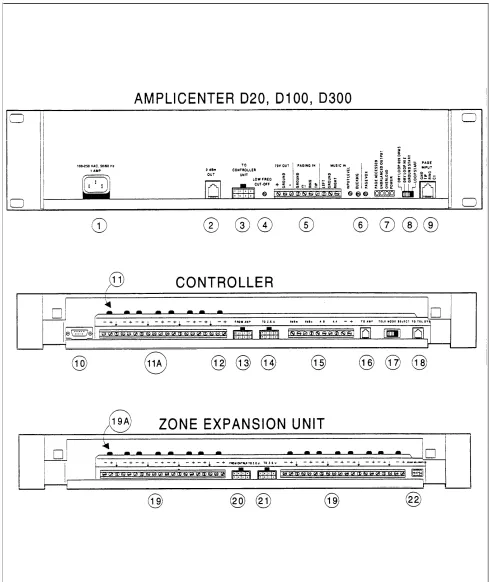
The following items describe all back panel functions illustrated in figure 1-2:
Amplicenter:
Controller Unit:
Zone Expansion Unit:
AC Power in; 110VAC at 60 Hz or 220VAC at 50 Hz
OdBm out, control and audio for remote amplifier
DC Power and 70V audio out to controller
Bass (low frequency) control adjustment
70V out; paging in (redundant to item #9); music in
Level adjustments: Music level, Music "ducking" (mute level), VOX audio level
LEDs: green - page accessed, red – unbalanced output, red – overload, green – power on
Telephone system mode switch: Dry loop 600 ohms, Dry Loop Hi Z, ground start, and loop start
From controller item #16 RJ11 connector (in constant voltage distribution system) audio and control
DB9 connector for the RS2232 port, which is used to connect a PC computer for programming (optional) or PC monitoring
Zone option 3-position zone slide switches: set to 70V audio out, contact closure input, or contact closure output
Zone connector for zones 1-8, plus, minus, and ground terminals
LEDs: Yellow - attendant access active, Green – tele. access active
DC Power and 70V audio from D-series amplicenter
DC Power, control, and audio 70V output to next expansion Unit
10 position connector (pins 1/2) 0dB 600 ohm, (pins 3/4) 0dB out
for additional controller and remote amplicenters, (pins 5/6) night bell input, (pins 7/8) control closure for attendant access input, (9/10)
audio source (mic) attendant access input
Audio And Control to amplicenter RJ11 jack, item #9
Telephone mode switch: Dry Loop, station access, ground start, and loop start
Telephone system interface for PBX, KTS, or Centrex; standard RJ 11 connector
Zone connector for expansion zones: plus, minus, and ground terminals
Zone option 3-position zone slide switches: set to 70V audio out, control closure in, or control closure out
From controller: power, control, and audio or previous expansion unit
To Additional expansion unit: power, control, and audio
Selection and DIP switch when zone expansion units are used
Figure 1-2. Amplicenter, Controller, and Zone Expansion Unit Back Panels
Connectors on Rear
You have access to controls and connections on the back panel, which is covered with a removable lid (see figure 1-2). For instructions on installing the PagePac Plus system and making correct interconnects, see the
Installation Guide.
■
■
■
■
■
■
■
■
The rear panel of the PagePac Plus Control Unit contains:
Two RJ11 telephone-type jacks, one for your PBX telephone system to connect to the PagePac Plus (Telephone Access) and one for the interconnect from the PagePac Plus to the PagePac Plus Amplicenter.
A telephone interface mode selection switch (set during installation) to match your telephone system.
A connector for the RS-232 port, which is used to connect a PC computer.
A 10 position connector for Attendant Access inputs (from microphone or master telephone console), the Night Bell ringer input, and two audio outputs.
A 20 position connector for zone connections and shields.
Two 8-position connectors, one for the interconnect to the PagePac Plus Amplicenter, which supplies power and 70V audio to the controller, and one for an interconnect to Zone Expansion Units (if used).
Eight 3-position zone switches, to manually configure a zone to be contact closure (switch), input, or audio output.
Power
Two DC voltages derived from the PagePac Plus Amplicenter (D-20, D-100, or D-300) via the interconnect cable are the source for all power required by the PagePac Plus Control Unit and any attached Zone Expansion Units.
See discussion of the front panel Power On LED, above under "LED Indicators."
Interface Considerations
The hardware installation configuration may have these impacts on programming and use of the PagePac Plus system:
Setting correct
addresses for Zone
Expansion Unit(s)
Telephone Mode
Zone Option Switches
on Control Unit
Zone Expansion Unit
Option Switches
Other Interfaces
See the important explanation about setting the internal dip switches to address each Zone Expansion Unit, in the Installation Guide.
Be sure the telephone interface mode switch on the rear of the PagePac Plus unit has been set correctly, matching the telephone system of your facility (see Installation Guide). However, whichever mode is selected has no bearing on programming or using the PagePac Plus Controller.
The default priority for telephone access is 3. The telephone input can access any zone or zone group to output audio paging or to trigger an output contact-closure action. Programming can also be accomplished via telephone access.
The eight Zone Option switches on the rear of the PagePac Plus Controller MUST be set to match the zone option to be programmed.
The slide switch for each zone must be manually set to Contact Closure (to switch on/off a device, such as a door security lock, remote amplifier, etc.), Input (such as doorbell or security alarm), or Audio Output,
depending on the programmed mode selected for each zone. See Zone Map (table 1-2) and Zone Configuration Tables (1-3 and 1-4), below (both to be filled out).
The Zone Option switches must be set before the PagePac Plus system is powered up, and therefore before programming commences.
The 16 Zone Option switches on the Zone Expansion Unit must also be configured to match the intended zone mode. It is recommended that the paging zone decisions be made prior to beginning programming. See Zone Map (table 1-2) and Zone Configuration Tables (1-3 and 1-4), below (both to be filled out).
The Zone Option switches and dip switches on Zone Expansion Unit(s) must be set prior to system power-up.
Night Bell, Music Input, Computer Monitor Logging, Alarm System, and Door Control interfaces are illustrated in the Application Notes, at the end of this guide.
Zone Map
Description of Zone
Physical Zone Number
Physical Zone Code
NOTE: If an ALIAS number is assigned to any zone, ALIAS numbers must be assigned to ALL zones.
ALIAS Zone Number
Input or Output
NOTE: Attendant Access, Telephone Access, Night Bell, and Music input are default inputs to the PagePac Plus, and are not to be identified as zones. Computer Monitor is an optional output device connected to the PagePac Plus, and is also not to be identified as a zone.
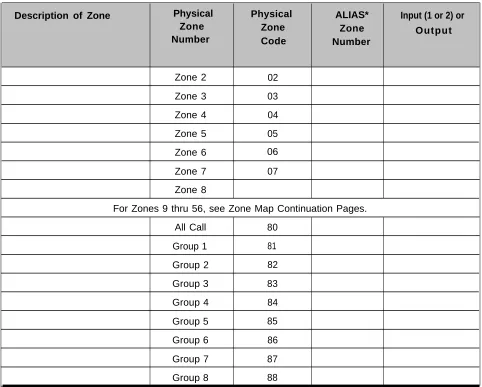
The Zone Map is to be filled out by your system administrator or the person responsible for programming your PagePac Plus system. It assists in identifying the zones, both inputs and outputs, of your particular system. Make photocopies of the blank Zone Map to use in laying out your system. Refer to the example Zone Map for an idea how to proceed.
Write a brief description of each zone in your facility.
Preprinted on the form, this number identifies the zones and groups.
Preprinted on the form, these are the physical addresses (default dial codes) of the different zones. You would dial this code for a zone if no ALlAS number has been assigned.
Using ALlAS zone numbers is optional. An ALlAS number for zone is the extension number you intend to dial to reach this zone. All ALlAS
numbers must have the same number of digits (all 3-digit, or all 4-digit codes). When assigning ALlAS zone numbers, consider assigning
consecutive numbers to similar zones. Choose numbers that are relatively easy to remember and easy to enter into the telephone keypad. If you choose not to use ALlAS numbers, you will use the Physical Zone Codes, above, to dial the zones.
Write an I-1, I-2, or an O to indicate the type of zone. I-1 means input priority level 1; I-2 means input priority 2. "Input" and "output" here mean inputs to or outputs from the controller.
After completing your Zone Map, you are ready to set System Options (beginning with table 2-1 in section 2) and then do Zone Map programming (table 2-12).
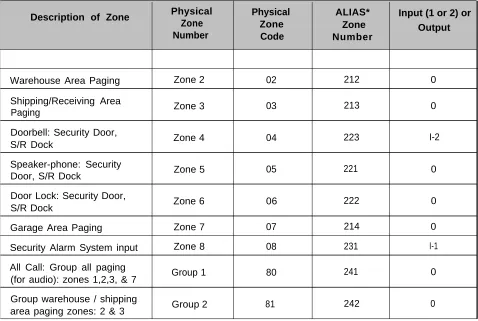
Table 1-1. Zone Map Example
Description of Zone Physical Zone Number
Physical Zone Code
ALIAS* Zone Number
Input (1 or 2) or Output
Warehouse Area Paging Zone 2 02 212 0
Shipping/Receiving Area
Zone 3 03 213 0
Paging
Doorbell: Security Door,
S/R Dock Zone 4 04 223 I-2
Speaker-phone: Security
Door, S/R Dock Zone 5 05 221 0
Door Lock: Security Door,
S/R Dock Zone 6 06 222 0
Garage Area Paging Zone 7 07 214 0
Security Alarm System input Zone 8 08 231 I-1
All Call: Group all paging
(for audio): zones 1,2,3, & 7 Group 1 80 241 0
Group warehouse / shipping
Group 2 81
area paging zones: 2 & 3 242 0
* Optional
Table 1-2. Zone Map
Description of Zone Physical Zone Number
Physical Zone Code
ALIAS* Zone Number
Input (1 or 2) or Output
Zone 2 02
Zone 3 03
Zone 4 04
Zone 5 05
Zone 6 06
Zone 7 07
Zone 8
For Zones 9 thru 56, see Zone Map Continuation Pages.
All Call 80
Group 1 81
Group 2 82
Group 3 83
Group 4 84
Group 5 85
Group 6 86
Group 7 87
Group 8 88
* Optional
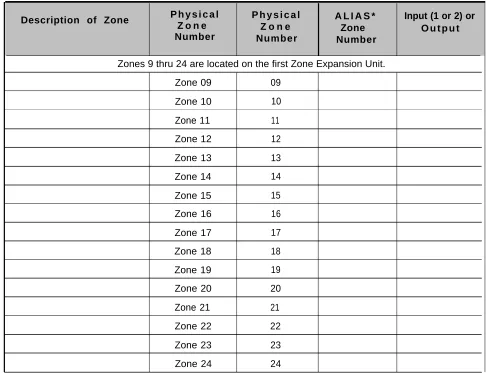
Table 1-2. Zone Map
(Continuation Page 1)Description of Zone P h y s i c a l Z o n e Number
P h y s i c a l Z o n e Number
A L I A S * Zone Number
Input (1 or 2) or O u t p u t
Zones 9 thru 24 are located on the first Zone Expansion Unit.
Zone 09 09
Zone 10 10
Zone 11 11
Zone 12 12
Zone 13 13
Zone 14 14
Zone 15 15
Zone 16 16
Zone 17 17
Zone 18 18
Zone 19 19
Zone 20 20
Zone 21 21
Zone 22 22
Zone 23 23
Zone 24 24
* Optional
Table 1-2. Zone Map
(Continuation Page 2)Description of Zone P h y s i c a lz o n e n u m b e r
P h y s i c a l Z o n e C o d e
A L I A S * Zone N u m b e r
Input (1 or 2) or O u t p u t
Zones 25 thru 40 are located on the second Zone Expansion Unit.
Zone 25 25
Zone 26 26
Zone 27 27
Zone 28 28
Zone 29 29
Zone 30 30
Zone 31 31
Zone 32 32
Zone 33 33
Zone 34 34
Zone 35 35
Zone 36 36
Zone 37 37
Zone 38 38
Zone 39 39
Zone 40 40
* Optional
Table 1-2. Zone Map
(Continuation Page 3)Description of Zone
P h y s i c a l Z o n e N u m b e r
P h y s i c a l Z o n e
Code
A L I A S * Z o n e N u m b e r
Input (1 or 2) or
O u t p u t
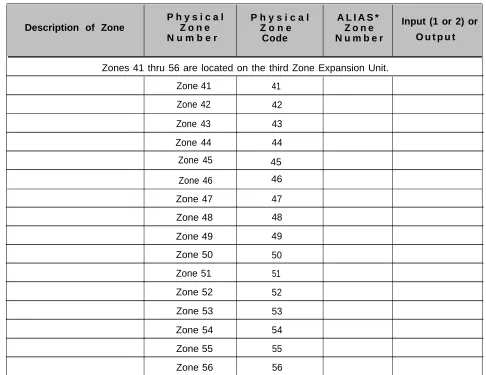
Zones 41 thru 56 are located on the third Zone Expansion Unit.
Zone 41 41
Zone 42 42
Zone 43 43
Zone 44 44
Zone 45 45
Zone 46 46
Zone 47 47
Zone 48 48
Zone 49 49
Zone 50 50
Zone 51 51
Zone 52 52
Zone 53 53
Zone 54 54
Zone 55 55
Zone 56 56
* Optional
Zone Configuration Tables
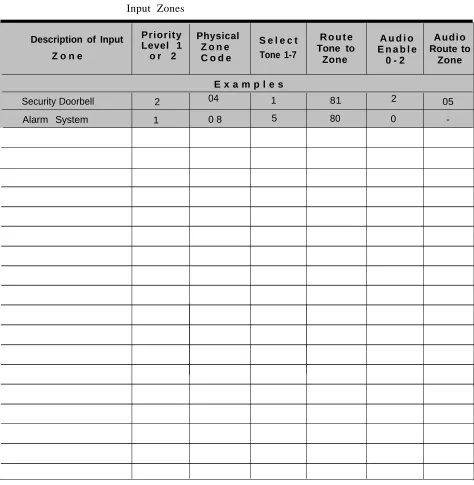
The Zone Configuration Table consists of two parts, one for input zones and another for output zones. The table is to be filled out by your system administrator, or the person responsible for programming your PagePac Plus system.
The top two lines of each table have been filled as an example. The items in the examples are taken from the Example Zone Map.
Table 1-3. Zone Configuration Table
Output Zones
Description of Output
Zone
Phys. Zone Code
Type of Output
Page E n a b l e
Y / N
Music Enable
Y / N
Talk-back Enable
Y / N
N i g h t B e l l Enable
Y / N
DTMF Pass thru Y/N
Examples
Office Loudspeakers 01 Audio Y Y N Y N
Security Door
Speaker-Phone 05 Audio Y N Y N N
Security Door Lock 06 M.O. N N N N N
Table 1-4. Zone Configuration Table
Input Zones
Description of Input
Z o n e
Priority Level 1 o r 2
Physical Z o n e C o d e
S e l e c t Tone 1-7
R o u t e Tone to
Zone
A u d i o E n a b l e
0 - 2
A u d i o Route to
Zone
E x a m p l e s
Security Doorbell 2 04 1 81 2 05
Alarm System 1 0 8 5 80 0
Programming The Controller
2
Contents
Introduction
■ Programming by Touchtone Telephone
■ Programming by PC
Software Configuration—Overview
■ Zone Group versus Individual Zones
■ At Power Up
Programming Options and Instructions
■
■
■
■
■
■
■
■
■
■
■
Enter Programming Mode
System Configuration Options Overview
Reset to Factory Defaults
Define Length of ALIAS Numbers
Connect Password
Programming Password
Forgot the Password?
Confirmation Tone ON/OFF
Pre-Announcement Tone ON/OFF
Talk-Back Warning Tone
VOX Disconnect Timing
2-3
2-3
2-3
2-4
2-4
2-4
2-5
2-5
2-5
2-6
2-7
2-8
2-10
2-11
2-11
2-12
2-13
2-14
■ ■ ■ ■ ■ ■ ■ ■ ■ ■ ■ ■ ■ ■ ■ ■ ■ ■ ■ ■ ■ Computer Monitor
Input Computer Monitor
General Zone / Group Configurations Overview
COPY Command
Zone Map Option—Assigning ALlAS Numbers
Type of Zone: Input or Output
lnput Priority Arrangement
Zone Monitor
Zone Grouping
Output Zone/Group Configurations Overview
Type of Output
Page Enable
Music Enable
Talk-Back Enable
Night Bell Enable
Pass DTMF to the Output
Input Zone / Group Options Overview
Tone Selection
Tone Routing
Audio Source Enable
Audio Routing
Error Tones
Programming Quick Reference Chart
2-15 2-16 2-16 2-17 2-18 2-19 2-20 2-21 2-22 2-23 2-23 2-25 2-26 2-27 2-28 2-29 2-31 2-31 2-33 2-34 2-35 2-36 2-37
Introduction
The operation of the PagePac Plus Controller can be customized to meet the requirements of your business. It can be programmed in either of two ways, using a telephone keypad or a PC, and nearly all features1
can be programmed by either method.
The zone option switches on the controller and on any attached Zone Expansion Unit(s) MUST be set before the PagePac system is
powered up.
Programming by Touchtone Telephone
This section details the programming the PagePac Plus Controller by using the telephone keypad to enter your selections. This programming method works via the Telephone Access port, which accepts only Touchtone telephone keypad inputs (DTMF). The PagePac Plus Controller itself has the ability to retain the programming options indefinitely, in its onboard memory.
See the Programming Quick Reference Chart at the end of this section for a summary of programming steps.
Programming by PC
The second means of programming is using an lBM-compatible PC (personal computer), which connects to an RS-232 port on the back of the controller by means of a crossover cable (also called a null-modem cable).
NOTE: The PagePac Plus unit An advantage of using a PC to configure the PagePac Plus unit is that can be configured remotely via screens can be viewed on the monitor to aid in selecting the zones for the RS-232 port using a modem.
various options. Using a PC to program the PagePac Plus Controller, you can view the system as a diagram, see your options, and observe the changes being made. Your programming can be saved to a computer file on a diskette and recalled in the future.
In either case, the controller itself has the ability to retain the programming options indefinitely.
1 Only the International Timing option requires programming via the PC. The default setting for this option is USA/Canada.
Software Configuration—Overview
The PagePac Plus Controller is pre-programmed with certain default values when shipped, However, not all paging systems will have the same requirements, and therefore you (or the installation technician) may want or need to change the options on the system.
Some of the various programming configurations, which are presented in detail later in this section, include:
■
■
■
■
■
■
The ability to option a zone as an audio output zone, as either of two levels of input zone, or as an output contact-closure zone.
If a zone is optioned as a paging zone or a switch-closure zone, then other options are available, such as zone grouping.
Zone groups and individual zones can be configured to perform a variety of functions such as page enabled/ disabled or talk-back enabled/disabled.
If a zone is selected to be input, then options may be selected such as energizing an output switch-closure zone(s), whenever the input is active, or a selected tone can be sent out to selected zones whenever the input is active.
If multiple zones are configured as inputs with the same priority (for example, two zones coded l-l ), access will be granted on a first-come, first-sewed basis.
Zone mapping is also permitted.
Zone Group versus Individual Zones
The PagePac Plus Controller can be optioned at two different levels, Zone Group and Individual Zone programming. Zone group configurations will override individual zone configurations whenever a zone group is selected.
At Power Up
When the PagePac Plus Controller is first powered up, it polls the zones to determine how many (if any) zone expansion units are present. The PagePac Pius has the capacity to serially access up to 48 external zones.
The Zone Option switches, both on the controller and on any attached Zone Expansion Units, must be set before the PagePac Plus system is powered up, and therefore before programming commences.
Programming Options and Instructions
CAUTION:
The Zone Option switches must be set before the PagePac Plus system is powered up, and therefore before programming commences.
The 8 Zone Option switches on the rear of the PagePac Plus unit MUST be set to match the zone option selected via programming. The slide switch for each zone must be manually set to Contact Closure (to switch on/off a device, such as a door security lock, remote amplifier, etc.), Input, or Audio Output, depending on the mode selected for each zone.
The 16 Zone Option switches on the Zone Expansion Unit MUST also be configured to match the zone modes you intend to program.
It is recommended that the paging zone decisions be made and
diagramed prior setting these switches. See Zone Configuration Tables (1-3 and 1-4 in section 1, to be filled out) and programming instructions, below.
Enter Programming Mode
To enter the programming mode:
1.
2.
3.
4.
5.
Access the PagePac Plus system via the telephone interface (dial the paging access extension).
Dial the Connect password (if optioned). (See Connect Password, below.)
Hear the PagePac Plus dial tone.
Dial [ * ] [ * ]. Hear confirmation tone and then dial tone again.
Dial the Programming password (if optioned). (See Programming Password, below.)
Program the system options (go on to the next paragraphs). You may exit the programming mode by dialing [ # ] .
System Configuration Options Overview
System Configuration Options are options that effect the entire system, and are not specific or unique to any one zone or zone group. See the Programming Quick Reference Chart at the end of this section for a listing of these. The paragraphs below provide instructions for programming these system options (from a telephone keypad), if you wish to change them.
Reset to Factory Defaults
This system option allows you to "undo" all system changes you have made, in order to "start over." This Reset option takes all programmed options and restores them to their factory default settings.
First access the PagePac Plus system and enter the programming mode
You may exit the programming mode by dialing [ # ].
by pressing [ * ] [ * ] and entering your Programming password (if optioned). 1. Dial [ 1 ] [ 0 ] to select this option.
Hear a DOUBLE beep.
2 . Enter [ 2 ] [ 5 ] [ 3 ] [ 2 ] [ 7 ] to reset. (Enter any invalid number string to
escape.)
Hear TRIPLE beeps.
Note that the factory default condition for Connect password is NO password, and for Programming password the default is [ * ] [ * ].
These actions are summarized in table 2-1.
Table 2-1. Reset to Factory Defaults
Feature Mode Option/ Verify
Dial Listen For
Choose Option Listen For
Default
Reset to Factory Defaults
To Select 10 Double
Beep
Enter 25327 to reset. Enter any invalid number string to escape.
Triple Beeps
25327 (CLEAR)
Define Length of ALIAS Numbers
This system option allows you to set the length (2, 3, or 4 digits) of the ALlAS number field. The default is 2 digits. If you wish to assign ALlAS numbers to the paging zones, you must set the length parameter. The ALIAS number is the dialing extension for the zone. If no ALlAS numbers are used, the Physical Zone Code is the dialing extension for a zone.
This MUST be done before "Zone Map Option – Assigning ALlAS Numbers", later in this section. (see table 2-12)
Programming Steps
First access the PagePac Plus system and enter the programming mode by pressing [ * ] [ * ] and then entering your Programming password (ifoptioned). You may exit the programming mode by dialing [ # ]. 1.
2.
Dial [ 2 ] [ 0 ] to select this option.
Hear a DOUBLE beep.
Enter [ 2 ] [ 3 ] or [ 4 ], to set length of ALlAS number filed (number of
digits).
Hear TRIPLE beeps.
To verify the setting, dial [ 2 ] [ 1 ] and repeat step 2 above.
These actions are summarized in table 2-2.
Table 2-2. Defining Length of ALIAS Numbers
F e a t u r e Mode Option/ V e r i f y D i a l
Listen
F o r Choose Option
L i s t e n
F o r D e f a u l t
Number of Zone Map Digits
To Select To Verify
20 21
Double Beep
2 (digits) 3 (digits) 4 (digits)
T r i p l e Beeps
2
Connect Password
This feature will not become active until the first time you enter a password, via the programming mode. The factory default is NO password.
The Connect password operates as a security block into the paging system, restricting paging access to authorized users.
You may want to use a short Connect password (2 or 3 digits only) for ease of use.
When a user accesses the PagePac Plus unit via Telephone Access, a dial tone will be returned to the user. At this time the user will have unlimited chances to enter the correct password. If the correct password is entered, the user will receive the confirmation tone, then a new dial tone from the PagePac Plus unit, and then can either select a zone, zone group, or enter the programming mode.
If the wrong password is entered, the user will not receive any confirmation tone or new dial tone. He can continue to enter digit strings (without hanging up) until the correct password is entered, or he can hang up and try again by re-accessing the paging system.
In the event that the user forgets the password, see "Forgot the Password?"
Programming Steps
First access the PagePac Plus system and enter the programming mode by pressing [ * ] [ * ] and entering your Programming password (if optioned).You may exit the programming mode by dialing [ # ].
1.
2.
Dial [ 3 ] [ 0 ] select this option.
Hear a DOUBLE beep.
Enter the Password you wish to use (up to 6 digits). If the password has fewer than 6 digits, enter the [ # ] to terminate the string.
For example, [ 1 ] [ 2 ] [ 3 ] [ 4 ] [ 5 ] [ 6 ] is a valid password entry. [ 1 ] [ 2 ]
[ 3 ] [ # ] is also a valid password entry, resulting in the password
[ 1 ] [ 2 ] [ 3 ].
If you already have entered a password and want to remove it (to have NO password), just enter the [ # ] alone.
Hear TRIPLE beeps.
To verify that the new Connect password has been established, dial [ 3 ] [ 1 ] and repeat step 2 above.
These actions are summarized in table 2-3.
Table 2-3. Selecting a Connect Password
F e a t u r e Mode Option/
Verify Dial L i s t e nF o r Choose Option
Listen For
D e f a u l t
Connect To Select 30 Double Enter Password, enter # Triple None
Password To Verify 31 Beep to terminate the string Beeps
Programming Password
Establishing a Programming password will restrict access to the programming mode of the PagePac Plus paging system. It is
recommended that access to programming be restricted to the System Administrator, Telecommunications Manager, or other selected users.
This feature will become active once any programming password has been entered via the programming mode. You are not required to establish such a password. The factory-set default programming password is
[ * ] [ * ]. Your Connect and Programming passwords should not be the
same.
If this feature is active and the system has been accessed via the
telephone interface, then after the first digit of your Programming password is pressed, the dial tone will stop and will not be returned until the correct password is entered or until the user hangs up and re-enters the system.
Programming Steps
First access the PagePac Plus system and enter the programming mode by pressing [ * ] [ * ] and entering your Programming password (if previouslyoptioned). You may exit the programming mode by dialing [ # ].
1.
2.
Dial [ 3 ] [ 2 ] to select this option.
Hear a DOUBLE beep.
Enter the Password you wish to use (up to 6 digits). If the password has fewer than 6 digits, enter the [ # ] to terminate the string.
For example, [ 2 ] [ 3 ] [ 4 ] [ 5 ] [ 6 ] [ 7 ] is a valid password entry. [ 2 ] [ 3 ]
[ 4 ] [ # ] is also a valid password entry, resulting in the password
[ 2 ] [ 3 ] [ 4 ].
If you already have entered a password and now want to remove it (to have NO password), just enter the [ # ] alone.
Hear TRIPLE beeps.
To verify that the new Programming password has been established, dial [ 3 ] [ 3 ] and repeat step 2 above.
These actions are summarized in table 2-4.
Table 2-4. Selecting a Programming Password
F e a t u r e Mode Option/V e r i f y D i a l Listen
F o r Choose Option
Listen
F o r D e f a u l t
Programming To Select 32 Double Enter Password, Triple * *
Password To Verify 33 Beep enter # to terminate the Beeps string
Forgot the Password?
In the event that either or both the connect password and programming password are forgotten, it will be necessary to call the Harris-Dracon Technical Help line (1-800-437-2266) for instructions how to erase the two passwords and be able to enter new ones.
Confirmation Tone ON/OFF
Your choice for this selection is ON or OFF, with the default setting as ON. When the option is ON, a tone will be sent to the telephone interface after a zone has been selected and before a page can be made.
Programming Steps
First access the PagePac Plus system and enter the programming mode by pressing [ * ] [ * ] and entering your Programming password (if optioned).You may exit the programming mode by dialing [ # ].
1. Dial [ 4 ] [ 0 ] to select this option.
Hear a DOUBLE beep.
2. Dial [ 0 ] to turn OFF. Dial [ 1 ] to turn ON.
Hear TRIPLE beeps.
To verify the condition (OFF or ON) of the Confirmation tone, dial [ 4 ] [ 1 ] and repeat step 2 above.
These actions are summarized in table 2-5.
Table 2-5. Confirmation Tone ON/OFF
Feature Mode Option/ V e r i f y
D i a l Listen
For Choose Option
L i s t e n
F o r Default
Confirmation To Select 40 Double 0 — Off Triple On
Tone To Verify 41 Beep 1 — O n Beeps
Pre-Announcement Tone ON/OFF
The choice for this parameter is ON/OFF, with the default setting ON. This tone is very similar to the initial talk-back warning tone, in the sense that it is sent to a zone when the zone is accessed. This tone will be sent out to both the zone selected and to the telephone interface. After this tone is sent, you may begin your page message.
Programming Steps
First access the PagePac Plus system and enter the programming mode by pressing [ * ] [ * ] and entering your Programming password (if optioned).You may exit the programming mode by dialing [ # ].
1 .
2 .
Dial [ 4 ] [ 2 ] to select this option.
Hear a DOUBLE beep.
Dial [ 0 ] to turn OFF. Dial [ 1 ] to turn ON.
Hear TRIPLE beeps.
To verify the condition (OFF or ON) of the Pre-Announcement tone, dial [ 4 ] [ 3 ] and repeat step 2 above.
These actions are summarized in table 2-6.
Table 2-6. Pre-Announcement Tone ON/OFF
Feature Mode Option/
V e r i f y D i a l
L i s t e n
For Choose Option Listen For
Default
Pre-Announcement To Select 42 Double 0 - O f f Triple On
Tone To Verify 43 Beep 1 – O n Beeps
Talk-Back Warning Tone
This tone is intended to alert a person that their conversation is being monitored through the paging system loudspeaker. If Talk-back is optioned for YES, then the choices will be INITIAL, 30 SECOND REPETITION, or OFF. The default setting for this parameter is INITIAL and 30 SECOND REPETITION.
Programming Steps
First access the PagePac Plus system and enter the programming mode by pressing [ * ] [ * ] and entering your Programming password (if optioned).You may exit the programming mode by dialing [ # ].
1.
2.
Dial [ 4 ] [ 4 ] to select this option.
Hear a DOUBLE beep.
Dial [ 0 ] to turn OFF. Dial [ 1 ] to select INITIAL tone only. Dial [ 2 ] to
select INITIAL and 30 SECOND repeat.
Hear TRIPLE beeps.
To verify the condition of the Talk-Back Warning tone, dial [ 4 ] [ 5 ] and
repeat step 2 above.
These actions are summarized in table 2-7.
Table 2-7. Talk-Back Warning Tone
Feature Mode Option/ V e r i f y D i a l
Listen
For Choose Option
Listen
For Default
Talk-back Warning To Select 44 Double 0 – Off Triple Initial and
Tones To Verify 45 Beep 1 – Initial Beeps 30 sec.
2 – Initial and 30 sec.
VOX Disconnect Timing
This is a loop supervision parameter for the station mode of the Telephone Interface. The PagePac Plus unit will return to an ON HOOK condition after no audio is detected in the page mode for the programmed amount of time. The default time is 30 seconds, but can be varied from 10 seconds to 60 seconds, in 10 second increments, or can be disabled completely.
Programming Steps
To alter the duration of the VOX Disconnect Timing, first access thePagePac Plus system and enter the programming mode by pressing [ * ] [ * ]
and entering your Programming password (if optioned). You may exit the programming mode by dialing [ # ].
1.
2.
Dial [ 5 ] [ 0 ] to select this option.
Hear a DOUBLE beep.
Dial the code to select a duration for the VOX Disconnect Timing:
[ 0 ] to turn OFF
[ 1 ] to select 10 seconds [ 2 ] to select 20 seconds
[ 3 ] to select 30 seconds
[ 4 ] to select 40 seconds
[ 5 ] to select 50 seconds
[ 6 ] to select 60 seconds
Hear TRIPLE beeps.
To verify the duration of the VOX Disconnect Timing, dial [ 5 ] [ 1 ] and
repeat step 2 above.
These actions are summarized in table 2-8.
Table 2-8. VOX Disconnect Timing
Feature Mode Option/ V e r i f y Dial
L i s t e n
For Choose Option
Listen For Default VOX Timer Disconnect To Select To Verify 50 51 Double Beep Enter Duration 0 – Off 1 – 10 sec. 2 – 20 sec. 3 – 30 sec. 4 – 40 sec. 5 – 50 sec. 6 – 60 sec.
Triple Beeps
30 Sec.
Computer Monitor
Computer Monitor
Mode
NOTE: Since the default option is the ONLY option, there is no need to program this.
Programming Steps
NOTE: For Zone or group zone level monitoring see the Zone Monitor section.
NOTE: If Computer Monitor has been connected and PagePac Plus software loaded, you will need to select the types of paging inputs to be displayed or recorded. See next
programming option "Input Computer Monitor."
This option selects a device to be connected to the RS-232 port, a computer monitor for logging of all paging activity. The default setting is Computer Monitor.
By selecting Computer Monitor (the default option), the PagePac Plus is enabled to monitor activity on Attendant Access, Telephone Interface, and Night Bell inputs. This feature requires that a PC computer be connected to the RS-232 port of the PagePac Plus Controller. Whenever the input becomes active, ASCII characters will be sent out the RS-232 port (DB9 pin connector) to the computer. The ASCII characters will be intercepted by a special software package in the computer that logs the time, date, input zone, type of activity, zone that was paged, and duration of the activity. All such input activity to the paging system can then be viewed (and recorded) on the computer.
First access the PagePac Plus system and enter the programming mode by pressing [ * ] [ * ] and entering your Programming password (if optioned). You may exit the programming mode by dialing [ # ]. The default setting for
this option is Computer Monitor. 1. Dial [ 5 ] [ 2 ] to select this option.
Hear a DOUBLE beep.
2. Dial the code to activate this option:
[ 0 ] to select Computer Monitor
Hear TRIPLE beeps.
To verify the status of this option, dial [ 5 ] [ 3 ] and repeat step 2 above.
These actions are summarized in table 2-9.
Table 2-9. Computer Monitor Option
Feature Mode Option/ V e r i f y Dial
Listen
For Choose Option
Listen
For Default
Computer Monitor To Select 52 Double 0 – Computer Monitor Triple Computer
To Verify 53 Beeps Monitor
Input Computer Monitor
Programming Steps
This option turns ON or OFF the inputs of Attendant Access, Telephone Access, and Night Bell to be recorded and displayed by the Computer Monitor if you have activated it in the preceding programming option.
The factory default is OFF for all three.
First access the PagePac Plus system and enter the programming mode by pressing [ * ] [ * ] and entering your Programming password (if optioned).
You may exit the programming mode by dialing [ # ].
You will repeat this procedure 3 times in order to reset all three inputs.
1.
2.
Dial [ 5 ] [ 4 ] to select this option.
Hear a DOUBLE beep.
Dial the code to select an option for one of the three inputs:
[ 0 ] to turn OFF the Attendant Access
[ 1 ] to turn ON the Attendant Access
[ 2 ] to turn OFF the Telephone Access
[ 3 ] to turn ON the Telephone Access
[ 4 ] to turn OFF the Night Bell
[ 5 ] to turn ON the Night Bell
Hear TRIPLE beeps.
To verify the status of this option, dial [ 5 ] [ 5 ] and repeat step 2 above.
These actions are summarized in table 2-10.
Table 2-10. Inputs to Computer Monitor
Feature Mode Option/ Verify Dial
L i s t e n
For Choose Option ListenFor Default
Input Computer Monitor To Select To Verify 54 55
Double 0 – AA Off
Beep 1 – AA On
2 – T/R Off 3 – T/R On 4 – N.B. Off 5 – N.B. On
Triple Beeps
AA – Off T/R – Off N.B. – Off
General Zone Group Configurations Overview
General Zone and Zone Group Configurations are options that apply to selected zones or groups, not to the entire system. Refer to the
Programming Quick Reference Chart for a summary of these options. The paragraphs following "Copy Command," describe each option and give programming instructions.
COPY Command
The COPY command can be used to copy the configuration of a zone that has already been optioned, to one or more additional zones. This saves recentering the same parameters over again, to duplicate the parameters of an existing zone. The digits [ 1 ] [ 2 ] are used as the COPY command.
First access the PagePac Plus system and enter the programming mode by pressing [ * ] [ * ] and entering your Programming password (if optioned). You may exit the programming mode by dialing [ # ].
1. Dial [ 1 ] [ 2 ] to activate COPY command.
Hear a DOUBLE beep tone.
2.
3.
4.
Enter the zone number that you wish to copy (for example, 01).
Hear DOUBLE beep tone.
Enter the zone number of the beginning of the range of zones you wish to copy to. To copy the parameters of zone 01 to ALL other zones, the range zone 02 to 56 would be entered in this step and the next. To copy to a single zone (for example, 02) enter that zone
number as both the beginning and the end of the range (02 to 02). in this step, enter only the beginning zone of the zone range.
Hear a DOUBLE beep tone.
Enter the zone number of the END of the zone range to be copied to. (See explanation in step 3.)
Hear a TRIPLE beep tone.
See table 2-11 for a summary of these actions.
Table 2-11. Copy Command
Copy Dial 12 Double Enter zone Double Enter the Double Enter end of Triple
Command Beeps number that is Beeps beginning of Beeps the range. Beeps
to be copied. the range.
NOTES:
Program the PagePac Plus using the physical zone number Exit the programming mode by dialing #
Zone Map Option—Assigning ALIAS Numbers
NOTE: Before doing this option, you MUST do "Define Length of ALIAS Numbers" above. (see table 2-2)
NOTE: If ALIAS numbers are enabled, you MUST use them for programming from now on.
Programming Steps
Zone Map permits you to assign the dialing code, called the ALIAS zone code, that you will dial to access a particular zone by telephone. The factory default is NONE: no ALIAS numbers are pre-programmed. The zones are identified by their 2-digit Physical Zone Codes – 01 thru 88- as the default condition.
Digit string length for an ALIAS code can be 2, 3 or 4 digits, but all ALIAS codes must have the same number of digits (see table 2-2 to set length). The [ * ] and [ # ] digits are not applicable digits for zone ALIAS numbers.
Refer to your own Zone Map (table 1-2) and the Example Zone Map (table 1-1), in section 1.
First access the PagePac Plus system and enter the programming mode by pressing [ * ] [ * ] and entering your Programming password (if optioned).
You may exit the programming mode by dialing [ # ]. 1.
2.
3.
Dial [ 6 ] [ 0 ] to select this option.
Hear a DOUBLE beep.
Enter the 2-digit physical zone/group code, of the zone to be given an ALIAS number.
Hear a DOUBLE beep.
Enter the ALIAS zone/group number you have chosen. (Refer to your filled-in Zone Map, table 1-2.)
Hear TRIPLE beeps.
To verify the assignment of an ALIAS to a selected zone or group, dial [ 6 ] [ 1 ] and repeat steps 2 and 3 above.
These actions are summarized in table 2-12.
Table 2-12. Zone Map Option: ALIAS Number Assignment
Feature Mode Option/ V e r i f y Dial
Listen
For Z o n e / G r o u pS e l e c t i o n
L i s t e n
F o r Choose Option
Listen
For Default
Zone Map To Select 60 Double Enter physical Double Enter alias Triple None
To Verify 61 Beep zone/group Beep zone/group Beeps
number. number.
NOTES:
All zones/zone groups ALlAS codes must have the same number of digits. See table 2-2 to set length of ALIAS codes.
When an ALlAS number for a zone is changed, all the previous zone options for that zone will be transferred to the new zone number.
Type of Zone: Input or Output
The choices here are INPUT #1, INPUT #2, and OUTPUT. Be sure the manually selectable Zone Option switch on the rear of the PagePac Plus
NOTE: The INPUT #l option Controller is set to match the type of zone selected (input or output). must only be assigned to Input #1 would be used for an emergency alert, say a connection to your physical zones 1 through 8. alarm system. Input #2 would be a lower priority, say a doorbell input.
The factory default is OUTPUT (i.e., all zones are output type, by default).
Programming Steps
First access the PagePac Plus system and enter the programming mode by pressing [ * ] [ * ] and entering your Programming password (if optioned).You may exit the programming mode by dialing [ # ].
1.
2.
3.
Dial [ 6 ] [ 2 ] to select this option.
Hear a DOUBLE beep.
Enter the number of the zone or zone group to be optioned. Use ALIAS numbers, if optioned. Otherwise, use Physical zone/group numbers.
Hear a DOUBLE beep.
Enter [ 0 ] to designate the zone as OUTPUT
Enter [ 1 ] to designate it as INPUT #1
Enter [ 2 ] to designate it as INPUT #2
Hear TRIPLE beeps.
To verify the zone type assignment, dial [ 6 ] [ 3 ] and repeat steps 2 and 3
above.
These actions are summarized in table 2-13.
Table 2-13. Type of Zone
Feature Mode Option/
V e r i f y D i a l ListenF o r
Z o n e / G r o u p
Selection L i s t e nFor Choose Option
Listen
F o r Default
Type of To Select 62 Double Enter Double 0 – Output Triple Output
Zone To Verify 63 Beep zone/group Beep 1 – Input 1 Beeps
number. 2 – Input 2
Input Priority Arrangement
NOTE: These priorities cannot
be rearranged.
Also, if you select more than one zone to be inputs of the same level (Input 1, for example), such inputs will be handled on a first in, first served basis. See Type of Zone option, under General Zone / Group Configurations programming, later in this section.
The input priorities are pre-set at the factory. You may only assign a priority level to inputs such as doorbell or security alarm, by assigning them to Input #1 or Input #2, which differ in priority.
The default setting is: 1 – Attendant Access 2 – Input #1
3 – Telephone Access 4 – Input #2
5 – Night Bell
Music (always lowest priority)
Zone Monitor
This option selects a device to be connected to the RS-232 port, a computer monitor for logging of all zone or group zone paging activity. The default setting is off.
Computer Monitor
By selecting Zone Monitor, the PagePac Plus is enabled to monitor activityMode
on specific zone or group zone. This feature requires that a PC computerbe connected to the RS-232 port of the PagePac Plus Controller.
Whenever the input becomes active, ASCII characters will be sent out the RS-232 port to the monitor. The ASCII characters will be intercepted by a special software package in the computer that logs the time, date, input zone, type of activity, zone that was paged, and duration of the activity. All such input activity to the paging system can then be viewed (and recorded) on the computer.
Programming Steps
First access the PagePac Plus system and enter the programming mode by pressing [ * ] [ * ] and entering your Programming password (if optioned).You may exit the programming mode by dialing [ # ]. The default setting for this option is Computer Monitor.
NOTE: For Zone or group zone 1. Dial [ 6 ] [ 6 ] to select this option. level monitoring see the Zone
Monitor section. Hear a DOUBLE beep.
2 . Dial the code to activate this option:
[ 0 ] to select OFF
[ 0 ] to select ON.
Hear TRIPLE beeps.
To verify the status of this option, dial [ 6 ] [ 7 ] and repeat step 2 above.
These actions are summarized in table 2-14.
Table 2-14. Computer Monitor Option
Feature Mode Option/
Verify Dial ListenFor Zone/GroupSelection Choose Option
Listen
For Default
Computer
Monitor To SelectTo Verify 666 7 DoubleBeep Enter zone orgroup number 0 - OFF1 - ON TripleBeeps OFF