FINANCIAL INCLUSION IN INDIA
ARUP KUMAR SARKAR
Research Scholar, Dept. of Commerce with Farm Management, Vidyasagar University, Midnapore-721 102, West Bengal, India
ABSTRACT
Jare tumi niche phalo, se tomare bandhibe je niche. Paschate rekhecho jare, se tomare poschate taniche. Inclusive growth is much needed to include common people into the orbit of development. Social and economic justice can be provided only with the inclusion of previously excluded deprived section of people. In this paper an attempt is made to make a conceptual discussion on financial inclusion. Discussion is made on financial exclusion, financial inclusion, approaches adopted by banks, measures taken by other regulatory bodies and various government initiatives for promoting financial inclusion, the impact of financial inclusion on social development. At the end an attempt is also made to make some concluding remarks.
Key words: Financial exclusion, financial inclusion, Regulatory bodies, social development.
BACKGROUND OF THE STUDY
The term “Financial Inclusion” has gained importance since the early 2000s, and is a result of findings about financial exclusion and its direct correlation to poverty. (Wikipedia)
Financial inclusion or inclusive financing is the delivery of financial services, at affordable costs, to sections of disadvantaged and low-income segments of society. The importance of an inclusive financial system is widely recognised in policy circles and has become a policy priority in many countries. Several countries across the globe now look at financial inclusion as the means to more comprehensive growth, wherein each citizen of the country is able to use earnings as a financial resource that can be put to work to improve future financial status and adding to the nation’s progress. Initiatives for financial inclusion have come from financial regulators, governments and the banking industry. (Chakrabarty, K. C., Sep 21, 2011). In India the financially excluded sections comprise largely rural masses including marginal farmers, landless labourers, oral lessees, self- employed and unorganised sector enterprises, urban slum dwellers, migrants, ethnic minorities and socially excluded groups, senior citizens, and women and they are mostly excluded from insurance, bank account, access to free money advice, affordable credit-reliance on extortionate credit, savings, assets, poor financial knowledge and understanding. Keeping in mind the background of the study given above this study is an attempt to make a conceptual discussion on financial inclusion in India.
OBJECTIVE OF THE STUDY
Objectives always provide the route and direction to a study to achieve its ultimate goal. Given the background previously provided, the principal objective of the present study is to make a conceptual discussion on financial inclusion and the principal objectives can be decomposed into the following specific objectives
1. To understand the term “financial exclusion”. 2. To comprehend the term “financial inclusion”.
3. To highlight the initiatives taken by banks, other regulatory bodies and government for promoting financial inclusion.
LITERATURE REVIEW
landscape of the current progress of the much needed and wanted, Financial Inclusion Program. Deepak and Prakash (2014)10 try to identify the various initiatives of the RBI in crafting & delivering financial products, oriented towards those groups who are financially excluded. On the other hand they also comprehend the policy schemes of the government considering factors such as poverty, illiteracy (financial illiteracy) and human development index. They make this attempt to outline the fact that financial inclusion is contemplation unless inclusive growth is achieved. They conclude that the RBI despite making significant improvements in all the areas relating to financial viability, profitability and competitiveness, there are concerns that much needed banking services have not reached a vast segment of the population, especially the underprivileged sections of the society. They also opine that development of a country like India is possible only when there is an inclusive growth where the poverty & the financially illiterate are brought to the main stream by the RBI & Government through its policies & schemes. Bagli and Dutta (2012)11 seek to examine the achievement of the Indian states regarding the financial inclusion. They compute a comprehensive measure of financial inclusion for each state applying the methodology of Rotated Principal Component Analysis. For this analysis they consider ten indicators of financial Inclusion. They use the data published by the Reserve Bank of India (RBI) and the Government of India. According to them ranks of the states in accordance with the composite score show that although the state of Goa is the best, most of the states in southern region have performed better in terms of financial inclusion. However, the levels of financial inclusion of the states in India have a low mean and high disparity. This study reveals a strong positive association between the human development and the financial inclusion of the states in India.
FINANCIAL EXCLUSION
Financial exclusion refers to a situation where people faces difficulties in accessing and/or using financial services and products in the mainstream market that are appropriate to their needs, and which enable them to lead a normal life in the society. The poor, rural masses including marginal farmers, landless labourers, self- employed and unorganised sector enterprises, socially under-privileged, disabled, migrants, uneducated, ethnic minorities, senior citizens as well as children, women and unemployed are mostly financially excluded in India.
CAUSES OF FINANCIAL EXCLUSION
A number of factors may be the cause of financial exclusion. A summary of the factors that may be the causes of financial exclusion are as follows. On demand side are low literacy rate coupled with scant financial literacy, low income levels, absence of collateral/ assets, lack of awareness and social exclusion. The supply side factors are distance, costs, timings, complicated procedures, sub-optimal attitude of staff and offering of inappropriate products, etc. The requirements of identity proof and address proof can be a vital cause of financial exclusion.
EFFECTS OF FINANCIAL EXCLUSION
FINANCIAL INCLUSION
“Financial inclusion is process of ensuring access to financial services and timely and adequate credit where needed by vulnerable groups such as weaker sections and low income groups at an affordable cost.”
– C Rangarajan, Chairman of Committee on Financial Inclusion
“Financial inclusion is expanding access to financial services, such as payments services, savings products, insurance products, and inflation-protected pensions.”
_ Raghuram Committee on Financial Sector reforms (CFSR)
IMPORTANCE OF FINANCIAL INCLUSION
Inclusive growth will act as a source of empowerment and allow people to participate more effectively in the economic and social process. It will help in extending economic horizon to the underprivileged class. Financial inclusion will bring unbanked sections under the banking and non-banking operation/system to enlarge the banking edge. This process will warn the victimised classes from the culture of money markets and money lenders. The economically-deprived section will have a scope to enrich them with more financial empowerment and increase their social prestige, status. Financial inclusion will leverage the scope for inclusive growth and it will tend more non-banking products and offering more business opportunities by building a link between financial institution and untapped potential for future economic expansion.
INITIATIVES TAKEN BY BANKS, OTHER REGULATORY BODIES AND GOVERNMENT
In India different regulatory bodies have taken various measures for financial inclusion. RBI has come out with a major initiative towards ensuring the inclusive growth through financial inclusion so that the access of financial service will reach to the mass population (Anuradha Gupta, 2010)
No Frills Accounts (NFAs): This concept was introduced by RBI in November 2005 to provide access to basic baking services by financially excluded peoples. Under this approach banks open accounts with zero balance or very minimum balance requirement for the under-privileged. In 2012, the banks under RBI guidelines came-up with a better version of the no-frill accounts where they would open Basic Savings Bank Deposit Accounts (BSBDAs) for all individuals with the facility of debit card, cheque book, internet banking, overdraft limits at minimal charges. Relaxation on KYC norms: In order to ensure that people belonging to the low income groups,
both in urban and rural areas, do not face difficulties in opening bank accounts, the KYC (Know Your Customer) procedure for opening accounts is simplified for those accounts with balances not exceeding Rs. 50000 and credits thereto not exceeding Rs. 100000 in a year.
Introduction of GCC: In 2005 Reserve bank of India, issue guidelines to banks that to provide General Purpose Credit Card (GCC) which facilitate credit up to Rs.25000/- without any collateral requirement for rural and semi urban people based on assessment of household cash flows. Now as per the revised guidelines in Dec.‟2013 under this approach bank also fulfil Non- farm entrepreneurial credit requirement of individuals (e.g. Artisan Credit card, Laghu Udyami Card, Swarojgar Credit Card, Weavers’ Card etc) There will be no ceiling on the loan amount as long as the loan is for the purpose of non-farm entrepreneurial activity and is otherwise eligible for classification as priority sector. Security norms will be applicable as per Reserve Bank guidelines on collateral free lending for micro and small units issued from time to time.
Business Correspondents (BCs) and Business Facilitators (BFs) Model: The Reserve Bank permitted banks to engage BCs and BFs as intermediaries for providing financial and banking services. The BC model ensures a closer relationship between poor people and organised financial system.
model where the accounts can be operated by even illiterate customers by using biometrics, thus ensuring the security of transactions and enhancing confidence in banking.
EBT through Banks: The Reserve Bank is in consultation with state government has adopted Electronic Benefit Transfer (EBT) by banks to direct transfer of cash benefit/subsidy to the needy people. As per government is concerned, financial inclusion ends with EBT, which means that all its subsidy such as LPG, Fertilisers, wages for MGNREGA workers and other financial benefits payments are transferred electronically into beneficiary account.
Creation of Funds for Financial Inclusion: Central Government has created Financial Inclusion Fund and financial Inclusion Technology Development fund for meeting the costs of development, and promotional and technology interventions. A fund of Rs. 5000 crore in NABARD was also created to enhance its re-finance operations to short term co-operative credit institutions.
Consolidation of RRBs: The Regional Rural banks are consolidated by the Central Government. Parameters for performance appraisal of bank staff: RBI has advised to the banks to integrate
board-approved FIPs with their business plan and to include the criteria on financial inclusion as a parameter in the performance evaluation of their staff.
IMPACT OF FINANCIAL INCLUSION ON SOCIAL DEVELOPMENT
Fig 1 Number of People below Poverty Line (in millions)
Rural Urban Total
1993-94 328.6 74.5 403.1
2004-05 326.3 80.8 407.1
2011-12 216.5 52.8 269.3
Source: Planning Commission (Now renamed as NITI Aayog)
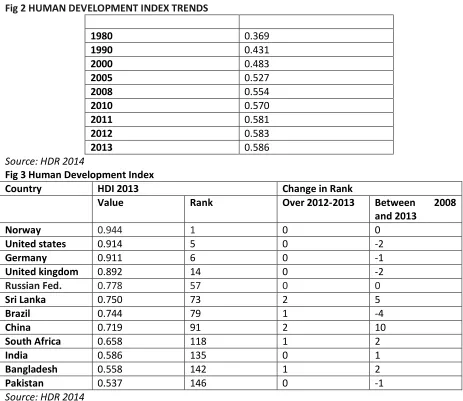
The 2014 Human Development Report (HDR) presents the Human Development Index (HDI) values and ranks for 187 countries in terms of three basic parameters: to live a long and healthy life, to be educated and knowledgeable, and to enjoy a decent standard of living. If we see the HDI of India from 1980 to 2013 we can see that there is an increasing trend. India’s HDI value for 2013 is 0.586, positioning the country at 135 out of 187 countries and territories. When among the BRICKS countries Russia is at 57, Brazil is at 79, China is at 91, and South Africa is at118.
Fig 2 HUMAN DEVELOPMENT INDEX TRENDS
1980 0.369
1990 0.431
2000 0.483
2005 0.527
2008 0.554
2010 0.570
2011 0.581
2012 0.583
2013 0.586
Source: HDR 2014
Fig 3 Human Development Index
Country HDI 2013 Change in Rank
Value Rank Over 2012-2013 Between 2008
and 2013
Norway 0.944 1 0 0
United states 0.914 5 0 -2
Germany 0.911 6 0 -1
United kingdom 0.892 14 0 -2
Russian Fed. 0.778 57 0 0
Sri Lanka 0.750 73 2 5
Brazil 0.744 79 1 -4
China 0.719 91 2 10
South Africa 0.658 118 1 2
India 0.586 135 0 1
Bangladesh 0.558 142 1 2
Pakistan 0.537 146 0 -1
CONCLUSION
Financial inclusion should be the ultimate objective as it is a source of empowerment that allows people to participate more effectively in the economic and social process. Many people in India are deprived of financial services from both formal and semi-formal sources of credit. As a result, dependence on money lenders and other informal sources of finance is increasing. To face this type of threats speedy implementation of financial inclusion is needed. Speedy and effective implementation of financial inclusion necessitates some factors to be handled carefully such as awareness campaigning, appointment and compensation of the business correspondents, attitude of the people, political interference, and staff related matters, government policy, etc. Though there is an increasing trend in the HDI from 1980 to 2013, India’s HDI value for 2013 is 0.586, positioning the country at 135 out of 187 countries and territories which is the lowest among the BRICS countries, with Russia is at 57, Brazil is at 79, China is at 91, and South Africa is at118, and India is slightly ahead of Bangladesh and Pakistan. While China improved its ranking by ten places between 2008 and 2013, India’s position improved by just one rank. Thus a lot remains to be done.
References
1. Rabindranath Tagore. Durvaga Desh.
2. Divya, H. K. (2013). A Study on Impact of Financial Inclusion with reference to Daily Wage Earners. Journal of Business Management & Social Sciences Research. 2(6). 85-92.
3. Kumar, D. and Venkatesha, H. R. (2014). Financial Inclusion Using Pradhan Mantri Jan-Dhan Yojana – A Conceptual Study. Asia Pacific Journal of Research. 1(xx). 37-42.
4. Dangi, N. and Kumar, P. (2013). Current Situation of Financial Inclusion in India and Its Future Visions. International Journal of Management and Social Sciences Research. 2(8). 155-166.
5. Garg, B. (2014). Financial Inclusion and Rural Development. Researchjournali’s Journal of Commerce. 2(1). 1-6.
6. Sarania, R. and Maity, S. (2014). Self Help Groups (SHGs) and Financial Inclusion- A Case Study in Baksa District of Assam. International Journal of Humanities & Social Science Studies. 1(3). 137-146.
7. Sharma, A. and Kukreja, S. (2013). An Analytical Study: Relevance of Financial Inclusion for Developing Nations. Research Inventy: International Journal of Engineering and Science. 2(6). 15-20.
8. Uma, H. R. and Rupa, K. N. (2013). The Role of SHGs in Financial Inclusion- a Case Study. International Journal of Scientific and Research Publications. 3(6). 1-5.
9. Garg, S. and Agarwal, P. (2014). Financial Inclusion in India – a Review of Initiatives and Achievements. IOSR Journal of Business and Management. 16(6). 52-61.
10. Deepak, K. V. and Prakash, R. P. (2014). A Conceptual Study on the Role of Financial Inclusion on Economic & Social Development of India. International Journal of Management Research & Review. 4(12). 1151- 1157.
11. Bagli, S. and Dutta, P. (2012). A Study of Financial Inclusion in India. Radix International Journal Of Economics & Business Management. 1(8). 1-18.
12. Economic survey 2014-2015. Vol - I. 13. Economic Survey 2014-2015. Vol – II.
14. Financial Inclusion and Banks: Issues and Perspectives”, RBI Monthly Bulletin, November 2011. 15. Millenium Development Goals, India Country reports 2014.
16. Millenium Development Goals, India Country reports 2015.
17. C Rangarajan, Report of the committee on Financial Inclusion, 2008,1- 31.
18. Chakrabarthy, K. C. (2011), Deputy Governor, RBI, Financial Inclusion – RBI Initiatives. 19. Human Development Report 2011 and Human Development Report 2014, UNDP,
20. Vighneswara Swamy and Vijayalakshmi (2010). Role of Financial Inclusion for Inclusive Growth in India – issues and challenges.