International Journal of COPD
Mannose-binding lectin deficiency and acute
exacerbations of chronic obstructive
pulmonary disease
Richard K Albert1
John Connett2
Jeffrey L Curtis3,4
Fernando J Martinez3
MeiLan K Han3
Stephen C Lazarus5
Prescott G Woodruff5
1Medicine Service, Denver Health and Department of Medicine, University of Colorado Denver, Denver, CO, 2Division of Biostatistics, School of Public Health, University of Minnesota, Minneapolis, MN, 3Pulmonary and Critical Care Medicine, Department of Medicine, University of Michigan, Ann Arbor, MI, 4Pulmonary and Critical Care Medicine, VA Medical Center, Ann Arbor, MI, 5Pulmonary and Critical Care Medicine, Department of Medicine, and Cardiovascular Research Institute, University of California, San Francisco, CA, USA
Correspondence: Richard K Albert Email [email protected]
Background: Mannose-binding lectin is a collectin involved in host defense against infection. Whether mannose-binding lectin deficiency is associated with acute exacerbations of chronic obstructive pulmonary disease is debated.
Methods: Participants in a study designed to determine if azithromycin taken daily for one year decreased acute exacerbations had serum mannose-binding lectin concentrations measured at the time of enrollment.
Results: Samples were obtained from 1037 subjects (91%) in the trial. The prevalence of mannose-binding lectin deficiency ranged from 0.5% to 52.2%, depending on how deficiency was defined. No differences in the prevalence of deficiency were observed with respect to any demographic variable assessed, and no differences were observed in time to first exacerbation, rate of exacerbations, or percentage of subjects requiring hospitalization for exacerbations in those with deficiency versus those without, regardless of how deficiency was defined.
Conclusion: In a large sample of subjects with chronic obstructive pulmonary disease selected for having an increased risk of experiencing an acute exacerbation of chronic obstructive pulmo-nary disease, only 1.9% had mannose-binding lectin concentrations below the normal range and we found no association between mannose-binding lectin concentrations and time to first acute exacerbation or frequency of acute exacerbations during one year of prospective follow-up.
Keywords: COPD, acute exacerbations, mannose-binding lectin
Introduction
Mannose-binding lectin (MBL) is a pattern-recognition collectin that is related to surfactant proteins A and D and has two roles in host defense. MBL activates complement via serine proteases, particularly MBL-associated serine protease-2, with which it circulates.1,2 MBL is also involved in opsonophagocytosis, binding several types of pathogens to phagocytes via its carbohydrate recognition domain, triggering release of a number of proinflammatory cytokines3–5 and facilitating clearance of apoptotic cells.6
MBL is secreted primarily by the liver and circulates in the serum. Low MBL concentrations occur as a result of one of three single nucleotide polymorphisms on exon 1, but the most common cause of deficiency in Caucasians is the LXP haplotype resulting from polymorphisms of the promoter region of the gene, presenting either as a homozygous mutation or in combination with other haplotypes.7–9
Several observations suggest that MBL deficiency may compromise host defense in the lungs. MBL binds to carbohydrates on the surface of a number of respiratory pathogens that are associated with acute exacerbations of chronic obstructive pulmonary disease
Dove
press
O R I G I N A L R E S E A R C H
open access to scientific and medical research
Open Access Full Text Article
International Journal of Chronic Obstructive Pulmonary Disease downloaded from https://www.dovepress.com/ by 118.70.13.36 on 22-Aug-2020
For personal use only.
Number of times this article has been viewed
This article was published in the following Dove Press journal: International Journal of COPD
(COPD), including Haemophilus influenzae,10,11Mycoplasma
pneumoniae,12 and influenza.13 Patients with cystic fibrosis and low MBL concentrations have decreased lung function, an increased prevalence of Burkholderia cepacia infection, and reduced survival relative to patients with cystic fibrosis and normal MBL concentrations. The difference in survival is particularly notable in those with chronic Pseudomonas aeruginosa infection and those with homozygous mutations in the MBL-2 gene.14–17 Low MBL concentrations have been associated with an increased risk of respiratory infections in immunocompetent subjects,18–21 with an increased frequency of respiratory syncytial virus infections,22 and with worse outcomes in patients with community-acquired pneumonia and Streptococcus pneumoniae infections.23–26 MBL con-centrations in bronchoalveolar lavage fluid obtained from a small number of current and former smokers with COPD are lower than those in fluid from healthy controls and tend to be higher in former smokers than in current smokers,27,28 but no association has been found between genotypes producing low MBL concentrations and the prevalence of COPD.29 However, studies assessing the association of low MBL con-centrations with acute exacerbations of COPD (AECOPDs) report conflicting results.30–32 Accordingly, we prospectively measured MBL concentrations in a large cohort of subjects with COPD who were at increased risk of experiencing acute exacerbations and followed them for one year while track-ing the number of acute exacerbations that occurred. Our hypothesis was that subjects with COPD who had an increased risk of experiencing an AECOPD would have more frequent acute exacerbations during one year of follow-up if they were deficient in MBL than if they were not.
Materials and methods
Patient population
Subjects were men and women enrolled in a multicenter randomized trial designed to determine if azithromycin, taken daily for one year, decreased the frequency of AECOPDs.33 Eligibility criteria included age $ 40 years, a clinical diag-nosis of COPD, and an increased risk of experiencing an AECOPD based on criteria defined by Niewoehner et al.34 Patients had to be free of AECOPDs for a minimum of 4 weeks prior to enrollment. Exclusion criteria included a diagnosis of asthma or bronchiectasis, among others.33
Acute exacerbations were defined as “a complex of respiratory symptoms (increased or new onset) of more than one of the following: cough, sputum, wheezing, dyspnea, or chest tightness with a duration of at least three days requiring treatment with antibiotics or systemic steroids”.34
MBL assays
Serum was collected at the time subjects were enrolled in the study when they had not experienced an AECOPD for a minimum of 4 weeks and was stored at −80°C until MBL con-centrations were assayed by enzyme-linked immunosorbent assay (R & D Systems, Minneapolis, MN). Samples were diluted 1/500 for this assay and assayed in duplicate wells. At this dilution, the range of the standard curve corresponds to concentrations ranging from 78 ng/mL to 5000 ng/mL. When concentrations were extrapolated above 5450 (n = 7) or below 60 (n = 6), the samples were reassayed at either a 1/2500 or a 1/20 dilution and these new values used as MBL serum concentrations. In one case, a sample was still less than the detection limit at 1/20 dilution and this sample was assigned the concentration of less than 3 pg/mL.
The MBL concentration that def ines MBL def i-ciency is debated. Some define defii-ciency as a serum concentration , 500 ng/mL.24,31,35,36 Others define it as #100 ng/mL, and still others define severe deficiency as #50 ng/mL and partial deficiency as .50 ng/mL but ,1000 ng/mL.9,10,21,25,31,37–40 The normal value reported by the manufacturer of the assay is 1135 ng/mL with a range of 103–3308 ng/mL (R&D Systems). Because of these uncertainties, we defined MBL deficiency in four ways, ie, #50 ng/mL, #100 ng/mL, #500 ng/mL, and .50 but #1000 ng/mL.
Azithromycin increases expression of the mannose receptor, and uptake of apoptotic cells by human alveolar macrophages, and decreases recovery of apoptotic bronchial epithelial cells.27 Accordingly, MBL concentrations from patients randomized to receive azithromycin or placebo were analyzed both separately and together.
Statistical analysis
A Cox proportional-hazards model analysis was used with time-to-first-exacerbation as the outcome variable and MBL group (ie, below versus above specified limits) as the primary variable of interest. Bootstrap methods were used to compute confidence intervals for median survival times. Rates of AECOPDs were determined by dividing the number of AECOPDs by person-years of follow-up and were ana-lyzed as a function of MBL concentration using a negative binomial model.
MBL concentrations are presented as medians and interquartile ranges. P , 0.05 was considered to be statis-tically significant. The study (ClinicalTrials.gov number NCT00325897) was approved by the institutional review boards at all participating centers.
Dovepress
Albert et al
International Journal of Chronic Obstructive Pulmonary Disease downloaded from https://www.dovepress.com/ by 118.70.13.36 on 22-Aug-2020
Results
MBL assays were performed at baseline in 1037 (91%) of the 1142 subjects enrolled in the azithromycin trial. Of these, 909 had experienced one or more AECOPDs in the year prior to enrollment. Duplicate measurements of MBL had coefficients of variations ,15% in all cases and ,5% in most.
The median MBL concentration for all patients was 918 ng/mL (interquartile range 508–1683 ng/mL, inclusive range 0–8194 ng/mL). The median MBL concentration in subjects randomized to receive azithromycin or placebo was 1008 ng/mL (95% confidence interval [CI] 909–1082) and 850 ng/mL (95% CI 776–929), respectively (P= 0.017).
Patient demographics and clinical characteristics, strati-fied by MBL concentration, are summarized in Table 1. The prevalence of MBL deficiency was 0.5%, 1.9%, 24.2%, or 52.3%, when deficiency was defined as #50, #100, #500, or .50 and #1000 ng/mL, respectively (Table 1). Regard-less of the concentration of MBL used to define MBL deficiency, no difference was observed with respect to the prevalence of MBL deficiency by gender, race, or age (with the exception that a greater fraction of women had MBL deficiency defined as .50 ng/mL and #1000 ng/mL than was seen with the other definitions), smoking status, chronic bronchitis, or steroid use, and there was no suggestion that airflow limitation was worse or that GOLD (Global Initiative for Chronic Obstructive Lung Disease) stage was higher in subjects with MBL deficiency (Table 1). The same findings were also observed for the subgroups of subjects receiving azithromycin or placebo (data not shown).
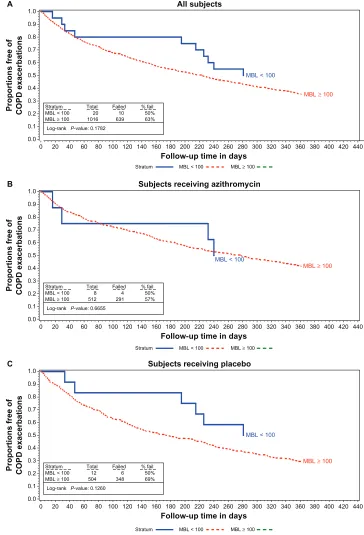
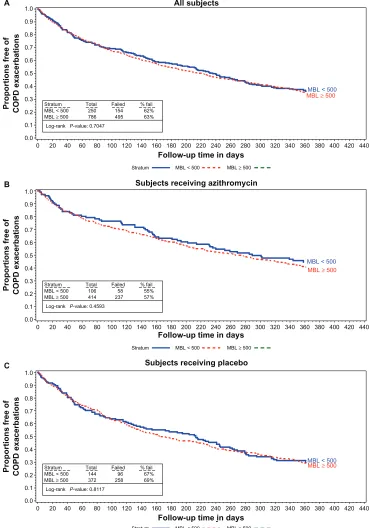
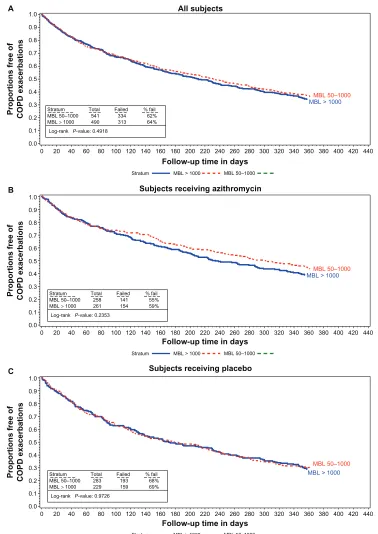
When analyzing time-to-first AECOPD using a model that included treatment group (ie, azithromycin versus pla-cebo) and log-transformed MBL concentration stratified by clinic, treatment group was significant (P , 0.0001) and log-transformed MBL concentration was not (P= 0.629). The hazard ratio for a one-unit increase in log-transformed MBL concentration was 1.02 (95% CI 0.94–1.12). For the rate per person-year of AECOPDs, a negative-binomial analysis of a model that included treatment group and log-transformed MBL concentration found that treatment group was significant (P= 0.010) but log-transformed MBL concentration was not (P= 0.470). The coefficient for log-transformed MBL concen-tration in this model was 0.031 (95% CI, −0.053 to +0.115). The median time to first AECOPD and the rate of AECOPD per patient-year are shown in Figures 1–3 and in Table 2 rela-tive to the various definitions of MBL deficiency (only five patients had MBL concentrations # 50 ng/mL, precluding life table analyses for patients in this subgroup). Regardless of the MBL concentration used to define deficiency, no association
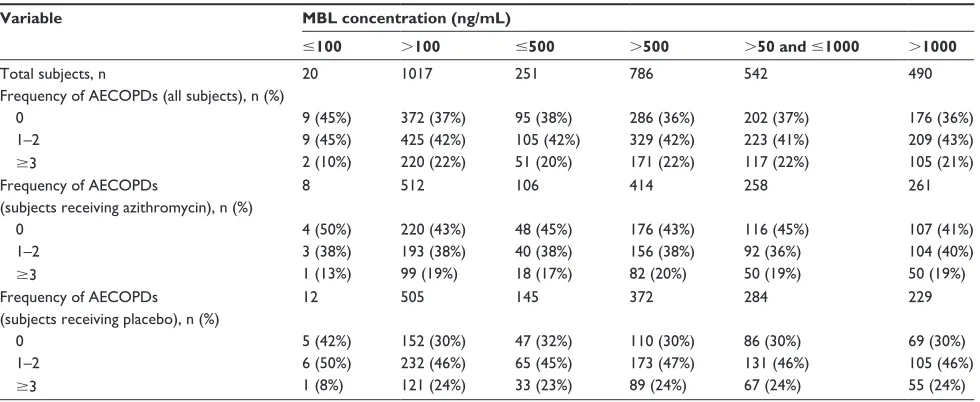
between the time to first AECOPD, or the rate of AECOPDs and MBL concentration was observed in the population as a whole, or in either treatment subgroup. Nonsignificant trends favoring a longer time to first AECOPD were seen in the subgroup of subjects with MBL concentrations , 100 ng/ mL compared with those with concentrations $ 100 ng/mL (Figure 1A and C). No difference was observed in MBL con-centrations in subjects experiencing no, one, two, or at least three AECOPDs during the course of the study in the popula-tion as a whole, or in either treatment group (Table 3).
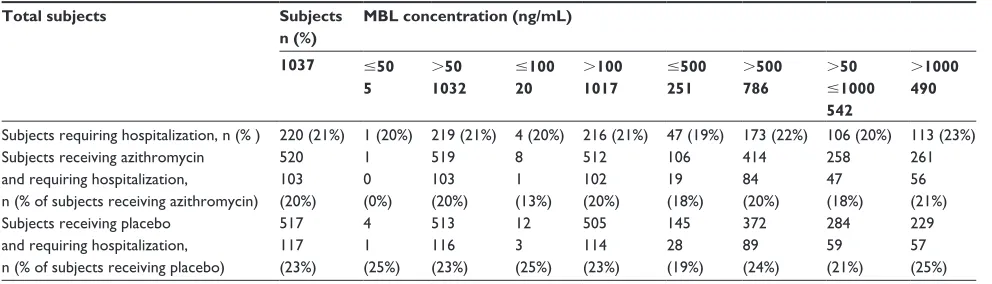
Of the 1037 subjects in the study, 220 (21%) required hos-pitalization for AECOPDs. The median MBL concentration in these 220 subjects was 1055 (95% CI 861–1213) ng/mL [1091 (958–1450) for those on azithromycin and 891 (816–1276) for those on placebo]. The median MBL concentration in the 817 subjects who were not hospitalized was 904 (833–980,
P= 0.17, Table 4).
Discussion
The important findings of this study are that, in this large sample of subjects with COPD selected for having an increased risk of experiencing an AECOPD within one year, only 1.9% had MBL concentrations below the normal range reported by the manufacturer of the assay, and regardless of the MBL concentration used to define MBL deficiency, we found no association between deficiency and time to first AECOPD, rate of AECOPDs, or need for subjects to be hospitalized for AECOPDs.
Two studies concluded that MBL deficiency was associated with an increased incidence of AECOPDs and one concluded that it was not. The age, spirometry, and smoking histories of the subjects in these three studies were similar to those we evaluated, with the exception that none of the three studies selected patients who were at increased risk of experiencing acute exacerbations as we did. Yang et al30 found that 24 of 82 (29%) subjects with COPD had MBL-deficient genotypes. These subjects had lower MBL concentrations than those with the wild-type genotype (107 ng/mL, IQR 30–246, range 21–7675 versus 920 ng/mL, IQR 398–1355, range 21–2256,
P , 0.001). MBL concentrations were not presented in a fashion that allowed determination of the prevalence of MBL deficiency based on the definitions used in the literature. Forty of the 82 patients (49%) had one or more admissions for AECOPDs during a two-year follow-up period and 18 of these (45%) had MBL-deficient genotypes. Forty-two patients had no AECOPDs and only six (14%) of these had MBL-deficient genotypes (odds ratio 4.9 95% CI 1.7–14.4, P = 0.0037). We did not determine MBL genotypes but genotypes do not
Dovepress Mannose-binding lectin deficiency and COPD
International Journal of Chronic Obstructive Pulmonary Disease downloaded from https://www.dovepress.com/ by 118.70.13.36 on 22-Aug-2020
Table
1
Demographics stratified by mannose-binding lectin deficiency definitions
All subjects
MBL concentration (ng/mL) #50
. 50 # 100 . 100 # 500 . 500 . 50 and # 1000 . 1000
All subjects, n (%)
1037 (100) 5 (0.5) 1032 (99.5) 20 (1.9) 1017 (98.1) 251 (24.2) 786 (75.8) 542 (52.3) 490 (47.3)
Gender Female, n (% of total female)
412 (100) 2 (0.5) 410 (99.5) 10 (2.4) 402 (97.6) 126 (30.6) 286 (69.4) 239 (58.0)* 171 (41.5)*
Male, n (% of total male)
625 (100) 3 (0.5) 622 (99.5) 10 (1.6) 615 (98.4) 125 (20.0) 500 (80.0) 303 (48.5) 319 (51.0)
Race Caucasian, n (% total Caucasian)
854 (100) 3 (0.3) 851 (99.7) 12 (1.4) 842 (98.6) 194 (22.7) 660 (77.3) 442 (51.8) 409 (47.9)
Black, n (% total black)
136 (100) 2 (1.5) 134 (98.5) 7 (5.1) 129 (94.9) 49 (36.0) 87 (64.0) 80 (58.8) 54 (39.7)
Hispanic, n (% total Hispanic)
25 (100) 0 (0.0) 25 (100) 1 (4.0) 24 (96.0) 7 (28.0) 18 (72.0) 14 (56.0) 11 (44.0)
Age, years (
± SD) 65.4 (8.6) 62.2 (5.3) 65.4 (8.6) 64.3 (9.0) 65.4 (8.6) 65.6 (8.4) 65.4 (8.6) 65.5 (8.5) 65.3 (8.7) Post-bronchodilator FEV 1
, L (
± SD) 1.11 (0.51) 1.07 (0.72) 1.11 (0.50) 1.10 (0.45) 1.11 (0.51) 1.06 (0.45) 1.13 (0.52) 1.09 (0.48) 1.13 (0.54) Post-bronchodilator FEV 1
, % predicted (
± SD) 39.5 (15.5) 34.8 (17.1) 39.5 (15.5) 39.7 (13.9) 39.5 (15.6) 39.4 (14.6) 39.5 (15.8) 39.7 (15.3) 39.4 (15.8) FEV 1
/FVC, % (
± SD) 42.5 (12.7) 46.4 (18.0) 42.5 (12.7) 47.0 (14.0) 42.4 (12.7) 43.2 (12.4) 42.3 (12.8) 42.9 (12.4) 42.0 (12.9)
GOLD stage 2, n (% of total stage 2)
266 (100) 2 (0.8) 264 (99.3) 5 (1.9) 261 (98.1) 60 (22.6) 206 (77.4) 133 (50.0) 131 (49.2)
3, n (% of total stage 3)
428 (100) 1 (0.2) 427 (99.8) 10 (2.3) 418 (97.7) 113 (26.4) 315 (73.6) 241 (56.3) 186 (43.5)
4, n (% of total stage 4)
339 (100) 2 (0.6) 337 (99.4) 5 (1.5) 334 (98.5) 78 (23.0) 261 (77.0) 165 (48.7) 172 (50.7)
Current smoker, n (%)
220 (21.2) 1 (0.5) 219 (99.5) 2 (0.9) 218 (99.1) 49 (22.3) 171 (77.7) 105 (47.7) 114 (51.8)
Former smoker, n (%)
816 (78.8) 4 (0.5) 812 (99.5) 18 (0.2) 798 (97.8) 202 (24.8) 614 (75.2) 436 (53.4) 376 (46.1)
Use of inhaled steroids, n (%)
806 (77.7) 4 (0.5) 802 (99.5) 17 (2.1) 789 (97.9) 207 (25.7) 599 (74.3) 429 (53.2) 373 (46.3)
No inhaled steroids, n (%)
231 (22.3) 1 (0.4) 230 (99.6) 3 (1.3) 228 (98.7) 44 (19.0) 187 (81.0) 113 (48.9) 117 (50.7)
Chronic bronchitis, n (%)
485 (47.0) 2 (0.4) 483 (99.6) 5 (1.0) 480 (99.0) 108 (22.3) 377 (77.7) 248 (51.1) 235 (48.5)
No chronic bronchitis, n (%)
546 (53.0) 3 (0.5) 543 (99.5) 15 (2.7) 531 (97.3) 142 (26.0) 404 (74.0) 290 (53.1) 253 (46.3) Note: * P , 0.05. Abbreviations: FEV 1
, forced expiratory volume in one second; FVC, forced vital capacity; GOLD, Global Initiative for Chronic Obstructive Lung Disease; MBL, mannose-binding le
ctin; SD, standard devi
ation.
Dovepress
Albert et al
International Journal of Chronic Obstructive Pulmonary Disease downloaded from https://www.dovepress.com/ by 118.70.13.36 on 22-Aug-2020
0.0
0 20 40 60 80 100 120 140 160 180 200 220 240 260 280
Follow-up time in days
A All subjects
Proportions free of COPD exacerbations
300 320 340 360
MBL ≥ 100
MBL < 100
MBL ≥ 100
MBL ≥ 100
MBL < 100
MBL < 100
380 400 420 440 0.1
0.2 0.3 0.4 0.5 0.6 0.7 0.8 0.9 1.0
0.0
0 20 40 60 80 100 120 140 160 180 200 220 240 260 280
Follow-up time in days
B Subjects receiving azithromycin
Proportions free of COPD exacerbations
300 320 340 360 380 400 420 440 0.1
0.2 0.3 0.4 0.5 0.6 0.7 0.8 0.9 1.0
0.0
0 20 40 60 80 100 120 140 160 180 200 220 240 260 280
Follow-up time in days
C Subjects receiving placebo
Proportions free of COPD exacerbations
300 320 340 360 380 400 420 440 0.1
0.2 0.3 0.4 0.5 0.6 0.7 0.8 0.9 1.0
Stratum MBL < 100 MBL ≥ 100
Stratum MBL < 100 MBL ≥ 100
Stratum MBL < 100 MBL ≥ 100
Stratum MBL < 100 MBL ≥ 100 Log-rank P-value: 0.1782
Total 20 1016
Failed 10 639
% fail 50% 63%
Stratum MBL < 100 MBL ≥ 100
Log-rank P-value: 0.6655 Total
8 512
Failed 4 291
% fail 50% 57%
Stratum MBL < 100 MBL ≥ 100
Log-rank P-value: 0.1260 Total
12 504
Failed 6 348
% fail 50% 69%
Figure 1 Proportions free of exacerbations MBL concentrations , 100 vs 100 or larger in all subjects (A) subjects receiving azithromycin (B) and in subjects receiving the placebo (C).
Abbreviations: COPD, chronic obstructive pulmonary disease; MBL, mannose binding lectin.
accurately predict MBL concentrations (see below, and note that at least one of the subjects with an MBL-deficient genotype included in the study by Yang et al had an MBL concentration of 7675 ng/mL and one with the wild-type genotype had an MBL concentration of 21 ng/mL).
Lin et al32 studied 215 Chinese subjects with COPD. MBL concentrations were again not presented in a fashion that allowed determination of the prevalence of MBL deficiency by literature-based definitions, but the median MBL concen-tration they reported of 777 ng/mL was comparable with the
Dovepress Mannose-binding lectin deficiency and COPD
International Journal of Chronic Obstructive Pulmonary Disease downloaded from https://www.dovepress.com/ by 118.70.13.36 on 22-Aug-2020
0.0
0 20 40 60 80 100 120 140 160 180 200 220 240 260 280
Follow-up time in days
A All subjects
Proportions free of COPD exacerbations
300 320 340 360
MBL MBL < 500≥ 500
MBL ≥ 500
MBL ≥ 500
MBL < 500
MBL < 500 380 400 420 440 0.1
0.2 0.3 0.4 0.5 0.6 0.7 0.8 0.9 1.0
0.0
0 20 40 60 80 100 120 140 160 180 200 220 240 260 280
Follow-up time in days
B Subjects receiving azithromycin
Proportions free of COPD exacerbations
300 320 340 360 380 400 420 440 0.1
0.2 0.3 0.4 0.5 0.6 0.7 0.8 0.9 1.0
0.0
0 20 40 60 80 100 120 140 160 180 200 220 240 260 280
Follow-up time in days
C Subjects receiving placebo
Proportions free of COPD exacerbations
300 320 340 360 380 400 420 440 0.1
0.2 0.3 0.4 0.5 0.6 0.7 0.8 0.9 1.0
Stratum MBL < 500 MBL ≥ 500 Stratum MBL < 500 MBL ≥ 500 Stratum MBL < 500 MBL ≥ 500 Stratum
MBL < 500 MBL ≥ 500
Log-rank P-value: 0.7047 Total
250 786
Failed 154 495
% fail 62% 63%
Stratum MBL < 500 MBL ≥ 500
Log-rank P-value: 0.4593 Total
106 414
Failed 58 237
% fail 55% 57%
Stratum MBL < 500 MBL ≥ 500
Log-rank P-value: 0.8117 Total
144 372
Failed 96 258
% fail 67% 69%
Figure 2 Proportions free of exacerbations MBL concentrations , 500 vs 500 or larger in all subjects (A) subjects receiving azithromycin (B) and in subjects receiving the placebo (C).
Abbreviations: COPD, chronic obstructive pulmonary disease; MBL, mannose binding lectin.
median of 918 ng/mL that we observed. In 96 of their subjects who had three or more AECOPDs per year over a 3-year period, the mean MBL concentration was 534 ± 932 ng/mL compared with 1127 ± 1469 ng/mL in subjects with two or fewer exacerbations (P= 0.027). Twelve of the 96 more frequent exacerbators (12.5%) had MBL genotypes asso-ciated with MBL deficiencies compared with only 5/119
(4.2%) of the less frequent exacerbators (P= 0.025). Patients with MBL-deficient genotypes also had a higher mortality (66.7% versus 31.0%, respectively, P= 0.015).
However, in a cross-sectional study, Eagan et al31 found that 18.2% and 42.9% of healthy Norwegian subjects had MBL concentrations # 100 ng/mL and #500 ng/mL, respec-tively, compared with 22.2% and 49.6% of subjects with
Dovepress
Albert et al
International Journal of Chronic Obstructive Pulmonary Disease downloaded from https://www.dovepress.com/ by 118.70.13.36 on 22-Aug-2020
0.0
0 20 40 60 80 100 120 140 160 180 200 220 240 260 280
Follow-up time in days
A All subjects
Proportions free of COPD exacerbations
300 320 340 360
MBL 50–1000 MBL 50–1000
MBL > 1000 MBL > 1000
MBL 50–1000
MBL > 1000
380 400 420 440 0.1
0.2 0.3 0.4 0.5 0.6 0.7 0.8 0.9 1.0
0.0
0 20 40 60 80 100 120 140 160 180 200 220 240 260 280
Follow-up time in days
B Subjects receiving azithromycin
Proportions free of COPD exacerbations
300 320 340 360 380 400 420 440 0.1
0.2 0.3 0.4 0.5 0.6 0.7 0.8 0.9 1.0
0.0
0 20 40 60 80 100 120 140 160 180 200 220 240 260 280
Follow-up time in days
C Subjects receiving placebo
Proportions free of COPD exacerbations
300 320 340 360 380 400 420 440 0.1
0.2 0.3 0.4 0.5 0.6 0.7 0.8 0.9 1.0
Stratum MBL > 1000 MBL 50–1000
Stratum MBL > 1000 MBL 50–1000
Stratum MBL > 1000 MBL 50–1000 Stratum
MBL 50–1000 MBL > 1000
Log-rank P-value: 0.4918 Total
541 490
Failed 334 313
% fail 62% 64%
Stratum MBL 50–1000 MBL > 1000
Log-rank P-value: 0.2353 Total
258 261
Failed 141 154
% fail 55% 59%
Stratum MBL 50–1000 MBL > 1000
Log-rank P-value: 0.9726 Total
283 229
Failed 193 159
% fail 68% 69%
Figure 3 Proportions free of exacerbations MBL concentrations between 50 and 1000 vs 1000 or larger in all subjects (A) subjects receiving azithromycin (B) and in subjects receiving the placebo (C).
Abbreviations: COPD, chronic obstructive pulmonary disease; MBL, mannose binding lectin.
COPD (P= 0.23 and P= 0.10, respectively). No association between MBL concentration and a history of AECOPDs was observed, but no information was provided with respect to how AECOPDs were defined. Eagan et al31 also noted that subjects with GOLD stage 3 disease had a higher prevalence of MBL deficiency (defined as #100 ng/mL). We found no demographic or COPD severity indicators that were more or
less common in subjects with MBL deficiency, regardless of how deficiency was defined (Table 1).
The strengths of our study include the large sample size, the multicenter design, and the prospective ascertainment of AECOPDs using an event-based (ie, health care utilization) definition. Our study population was enriched by enroll-ing subjects whom we anticipated would be at increased
Dovepress Mannose-binding lectin deficiency and COPD
International Journal of Chronic Obstructive Pulmonary Disease downloaded from https://www.dovepress.com/ by 118.70.13.36 on 22-Aug-2020
Table 2 Association of mannose-binding lectin concentration with acute COPD exacerbations
Variable MBL concentration (ng/mL)
#100 .100 #500 .500 .50 and #1000** .1000
Days to first AECOPD, median (95% CI)
All patients 326 (215–370) 223 (193–242) 236 (193–279) 223 (188–242) 231 (194–266) 211 (175–242) Azithromycin NA* 277 (227–320) 289 (214, $375) 266 (223–320) 302 (245–376) 234 (197–299) Placebo 326 (215–370) 173 (139–215) 213 (133–246) 166 (136–216) 178 (131–224) 171 (136–232) Rate of AECOPD per patient-year (95% CI)
All patients 1.03 (0.47–1.59) 1.65 (1.50–1.80) 1.70 (1.29–2.11) 1.62 (1.48–1.76) 1.67 (1.44–1.90) 1.61 (1.44–1.79) Azithromycin 1.04 (0.00–2.25) 1.46 (1.29–1.63) 1.29 (0.96–1.62) 1.50 (1.30–1.70) 1.43 (1.18–1.68) 1.49 (1.25–1.72) Placebo 1.03 (0.34–1.71) 1.84 (1.61–2.08) 2.01 (1.34–2.67) 1.75 (1.56–1.95) 1.89 (1.52–2.26) 1.76 (1.51–2.02)
Notes: *Too few patients for life table analysis; **number of subjects in this column is one greater than the number indicated on Figure 3 because the life table analyses were truncated at 365 days eliminating one patient.
Abbreviations: AECOPD, acute exacerbations of chronic obstructive pulmonary disease; CI, confidence interval; MBL, mannose-binding lectin.
Table 3 Association of mannose-binding lectin concentration with number of COPD exacerbations
Variable MBL concentration (ng/mL)
#100 .100 #500 .500 .50 and #1000 .1000
Total subjects, n 20 1017 251 786 542 490
Frequency of AECOPDs (all subjects), n (%)
0 9 (45%) 372 (37%) 95 (38%) 286 (36%) 202 (37%) 176 (36%)
1–2 9 (45%) 425 (42%) 105 (42%) 329 (42%) 223 (41%) 209 (43%)
$3 2 (10%) 220 (22%) 51 (20%) 171 (22%) 117 (22%) 105 (21%)
Frequency of AECOPDs
(subjects receiving azithromycin), n (%)
8 512 106 414 258 261
0 4 (50%) 220 (43%) 48 (45%) 176 (43%) 116 (45%) 107 (41%)
1–2 3 (38%) 193 (38%) 40 (38%) 156 (38%) 92 (36%) 104 (40%)
$3 1 (13%) 99 (19%) 18 (17%) 82 (20%) 50 (19%) 50 (19%)
Frequency of AECOPDs (subjects receiving placebo), n (%)
12 505 145 372 284 229
0 5 (42%) 152 (30%) 47 (32%) 110 (30%) 86 (30%) 69 (30%)
1–2 6 (50%) 232 (46%) 65 (45%) 173 (47%) 131 (46%) 105 (46%)
$3 1 (8%) 121 (24%) 33 (23%) 89 (24%) 67 (24%) 55 (24%)
Abbreviations: AECOPD, acute exacerbations of chronic obstructive pulmonary disease; MBL, mannose-binding lectin.
risk of experiencing an AECOPD within the one-year follow-up period, based on previous predictors identified by Niewoehner et al.34 This should have increased the likelihood of finding a higher prevalence of MBL deficiency, regardless of how deficiency was defined, compared with the prevalence in healthy controls.
Our study has a number of limitations. First, we only mea-sured MBL concentrations on one occasion. Several groups have demonstrated that MBL is an acute phase reactant.41–43 However, in clinically stable patients, MBL concentrations are constant over time,42,44 and our patients had to be free of AECOPDs for at least 4 weeks before meeting inclusion criteria. In addition, even during acute phase responses, MBL concentrations in patients with low concentrations only increase by 1.5–4.3-fold and do not reach normal values.45,46
Accordingly, we suggest that there is a low likelihood of our data being confounded by spuriously elevated
concentrations of MBL resulting in an underestimate of the prevalence of MBL deficiency.
We did not confirm by genotyping that low MBL con-centrations were the result of variant alleles. Approximately 30% and 4%–8% of the normal population have heterozy-gous or homozyheterozy-gous genetic mutations, respectively, associated with low MBL concentrations.35 Although MBL concentrations are well correlated with genotypes, (eg, MBL concentrations , 50 ng/mL are 100% sensitive and 83% specific for variant exon-1 polymorphisms43) subjects with wild-type MBL genes may still have low concentra-tions of MBL,35 and MBL concentrations may vary as much as 10-fold in patients with identical genotypes for all of the MBL variants described to date.38 Accordingly, assessing relationships between MBL concentrations and AECOPDs is likely to be a more sensitive approach than genotyping.21,25
Dovepress
Albert et al
International Journal of Chronic Obstructive Pulmonary Disease downloaded from https://www.dovepress.com/ by 118.70.13.36 on 22-Aug-2020
Table 4 Relationship between mannose-binding lectin concentrations and hospitalization for acute exacerbations of chronic obstructive pulmonary disease
Total subjects Subjects
n (%)
MBL concentration (ng/mL)
1037 #50
5
.50
1032
#100
20
.100
1017
#500
251
.500
786
.50
#1000
542
.1000
490
Subjects requiring hospitalization, n (% ) 220 (21%) 1 (20%) 219 (21%) 4 (20%) 216 (21%) 47 (19%) 173 (22%) 106 (20%) 113 (23%) Subjects receiving azithromycin
and requiring hospitalization, n (% of subjects receiving azithromycin)
520 103 (20%)
1 0 (0%)
519 103 (20%)
8 1 (13%)
512 102 (20%)
106 19 (18%)
414 84 (20%)
258 47 (18%)
261 56 (21%) Subjects receiving placebo
and requiring hospitalization, n (% of subjects receiving placebo)
517 117 (23%)
4 1 (25%)
513 116 (23%)
12 3 (25%)
505 114 (23%)
145 28 (19%)
372 89 (24%)
284 59 (21%)
229 57 (25%)
Abbreviation: MBL, mannose-binding lectin.
Similarly, we did not assess MBL function using a complement deposition assay. Bouwman et al47 and Eisen48 suggested that while MBL function was a better way of defin-ing MBL deficiency than determindefin-ing MBL concentrations, assessing MBL concentrations was “most appropriate” for defining MBL deficiency in studies seeking associations with infections. Differences between MBL binding and complement activation may vary depending on the method of assessment,49 and MBL concentrations from 500 ng/mL to 1000 ng/mL are associated with decreases in function by up to 90%.9
While we saw no association between MBL deficiency and AECOPDs, MBL deficiency could still be associated with AECOPDs that result from infection with one or more specific pathogens if the frequency with which these specific pathogens affected our subjects was too low to discern the association. However, we think this possibility is unlikely, because the two studies documenting the association between MBL deficiency and AECOPDs found an association with AECOPDs that were not otherwise defined by cause or potential infecting organism.30,32 In addition, Lin et al32 found no difference in the distribution of pathogens in those subjects with AECOPD and without MBL-deficient genotypes.
Because we only found 20 subjects (1.9%) with MBL concentrations below the lower range of normal reported by the manufacturer of the assay, we cannot exclude the possibility that very low concentrations of MBL have an association with AECOPDs. However, the infrequency of this finding implies that even if this association were found, it would pertain only to a small minority of patients suffer-ing AECOPDs.
In conclusion, we found a very low prevalence of MBL deficiency in subjects who were at increased risk for
experiencing AECOPDs and no association between MBL deficiency and time to first acute exacerbation, frequency of acute exacerbations, or percent of subjects requiring hospitalization for acute exacerbations in subjects with MBL deficiency regardless of how deficiency was defined. Accordingly, our data do not support the idea that MBL might be a therapeutic target to reduce the incidence of AECOPDs. Rather, they imply that, while COPD is an inflammatory disorder with systemic manifestations, the fundamental pathophysiology of COPD differs from conditions in which MBL deficiency seems to be a clear risk factor (ie, childhood pneumonia, rheumatoid arthritis, systemic lupus).
Acknowledgments
The hypothesis tested in this study was suggested by William Van Divier. Wilford Wong and Professor Yu-Lung Lau kindly provided additional information pertaining to MBL concentrations from subjects they had previously reported.24 This paper is published on behalf of the COPD Clinical Research Network, and is supported by National Institutes of Health-National Heart, Lung, and Blood Institute grants U10 HL074407, U10 HL074408, U10 HL074409, U10 HL074416, U10 HL074418, U10 HL074422, U10 HL074424, U10 HL074428, U10 HL074431, U10 HL074439, and U10 HL074441.
Disclosure
FJM has served on advisory boards relating to COPD or IPF-related topics for Actelion, Almirall, Bayer, Boehringer Ingelheim, BoomComm, Elan, Forest Laboratories, Glaxo-SmithKline, HCRC, Ikaria, IntraMed, Jannssens, JK Asso-ciates, MedImmune/AstraZeneca, Merck/Schering-Plough, Nycomed/Takeda, Pearl Therapeutics, Novartis, Pfizer, Sudler & Hennessey, United BioSource Corporation and
Dovepress Mannose-binding lectin deficiency and COPD
International Journal of Chronic Obstructive Pulmonary Disease downloaded from https://www.dovepress.com/ by 118.70.13.36 on 22-Aug-2020
Vertex. He has served on speaker’s or CME bureaus for American Lung Association, AstraZeneca, Bayer, Boehringer Ingelheim, Center for HealthCare Education, CME Incite, ePocrates, Forest, France Foundation, GlaxoSmithKline, Lovelace Clinic, National Association for Continuing Educa-tion, Med-Ed, MedScape, Nycomed/Takeda, Potomac Center for Medical Education, Prescott, Sanofi, St Luke’s Hospital, UpToDate, University of Virginia, William Beaumont Hospital. His institution has received funds from Boehringer Ingelheim for a clinical trial; has served on steering commit-tees for clinical trials supported by Actelion, Forest Labora-tories, Gilead, GlaxoSmithKline, Mpex, Nycomed/Takeda. MKH has participated in advisory boards for Boehringer Ingelheim GmbH, Pfizer, GlaxoSmithKline, Genentech, Novartis, Ikaria and Medimmune. She has participated on speaker’s bureaus for Boehringer Ingelheim GmbH, Pfizer, GlaxoSmithKline, Grifols Therapeutics, Forest Pharmaceu-ticals, the National Association for Continuing Education, and WebMD. She has consulted for Novartis and Nycomed, and has received royalties from UpToDate and ePocrates, Inc. All other authors report no conflicts of interest in this work.
References
1. Ikeda K, Sannoh T, Kawasaki N, Kawasaki T, Yamashina I. Serum lectin with known structure activates complement through the classical
pathway. J Biol Chem. 1987;262:7451–7454.
2. Thiel S, Vorup-Jensen T, Stover CM, et al. A second serine protease
associated with manna-binding lectin that activates complement. Nature.
1997;386:506–510.
3. Soell M, Lett E, Holveck F, Scholler M, Wachsmann D, Klein JP. Activa-tion of human monocytes by streptococcal rhamnose glues polymers is mediated by CD14 antigen and mannan binding protein inhibits
TNF-alpha release. J Immunol. 1995;154:851–860.
4. Chaka W, Verheul AF, Vaishnav VV, et al. Induction of TNF-alpha in human peripheral blood mononuclear cells by the mannoprotein of
Cryptococcus neoformans involves human mannose binding protein.
J Immunol. 1997;159:2979–2985.
5. Jack DL, Read RC, Tenner AJ, Frosch M, Turner MW, Klein NH. Mannose-binding lectin regulates the inflammatory response of human
professional phagocytes to Neisseria meningitides serogroup B. J Infect
Dis. 2001;184:1152–1162.
6. Stuart LM, Takahashi K, Shi L, Savill J, Ezekowitz RAB. Mannose-binding lectin-deficient mice display defective apoptotic cell clearance
but no autoimmune phenotype. J Immunol. 2005;174:3220–3226.
7. Masden HO, Satz ML, Hogh B, Svejgaard A, Garred P. Different molecular events result in low protein concentrations of
mannan-binding lectin in populations from southeast Africa and South America.
J Immunol. 1998;161:3169–3175.
8. Thiel S, Frederiksen PD, Hensenius JC. Clinical manifestations of
mannan-binding lectin deficiency. Mol Immunol. 2006;43:86–96.
9. Bronkhorst MW, Bouwman LH. Mannose-binding lectin deficiency.
UpToDate. Available from: http:\\www.uptodate.com. Accessed
September 3, 2010.
10. Neth O, Jack DL, Dodds AW, Holzel HJ, Klein MH, Turner MW. Mannose-binding lectin binds to a range of clinically relevant
micro-organisms and promotes complement deposition. Infect Immun.
2000;68:688–693.
11. van Emmerick LC, Kuijper EJ, Fifjen CA, Dankert J, Thiel S. Binding of mannan-binding protein to various bacterial pathogens of meningitis.
Clin Exp Immunol. 1994;97:411–416.
12. Hamvas RM, Johnson M, Vlieger AM, et al. Role for mannose
bind-ing lectin in the prevention of Mycoplasma infection. Infect Immun.
2005;73:5238–5240.
13. Anders EM, Hartley CA, Reading PC, Ezekowitz RA. Complement-dependent neutralization of influenza virus by a serum mannose-binding
lectin. J Gen Virol. 1994;75:615–622.
14. Garred P, Pressler T, Madsen HO, et al. Association of mannose-blinding lectin gene heterogeneity with severity of lung disease and survival in
cystic fibrosis. J Clin Invest. 1999;104:431–437.
15. Gabolde M, Guilloud-Bataille M, Feingold J, Besmond C. Association of variant alleles of mannose binding lectin with severity of pulmonary
disease in cystic fibrosis: cohort study. BMJ. 1999;319:1166–1167.
16. Yarden J, Radojkovic D, De Boeck K, et al. Polymorphisms in the man-nose binding lectin gene affect the cystic fibrosis pulmonary phenotype.
J Med Genet. 2004;41:629–633.
17. Davies JC, Turner MW, Klein N; London MBL CF Study Group. Impaired pulmonary status in cystic fibrosis adults with two mutated
MBL-2 alleles. Eur Respir J. 2004;24:798–804.
18. Koch A, Melbye M, Sorensen P, et al. Acute respiratory tract infections and mannose-binding lectin insufficiency during early childhood.
JAMA. 2004;285:1316–1321.
19. Gomi K, Tokue Y, Kobayashi T, et al. Mannose-binding lectin gene polymorphism is a modulating factor in repeated respiratory infections.
Chest. 2004;126:95–99.
20. Rantala A, Lajunen T, Juvonen R, et al. Mannose-binding lectin con-centrations, MBL2 polymorphisms and susceptibility to respiratory
tract infections in young men. J Infect Dis. 2008;198:1247–1253.
21. Hoeflich C, Unterwalder N, Schuett S, et al. Clinical manifestations of MBL deficiency in adults independent of concomitant immunodeficiency.
Hum Immunol. 2009;70:809–812.
22. Ribeiro LZG, Tripp RA, Rossi LMG, et al. Serum mannose-binding lectin concentrations are linked with respiratory syncytial virus (RSV)
disease. J Clin Immunol. 2008;28:166–173.
23. Roy S, Knox K, Segal SH; the Oxford Pneumococcal Surveillance Group. MBL genotype and risk of invasive pneumococcal disease:
a case-control study. Lancet. 2002;359:1569–1573.
24. Ip WKE, Chan KH, Law HKW, et al. Mannose-binding lectin in
severe acute respiratory syndrome coronavirus infection. J Infect Dis.
2005;191:1697–1704.
25. Eisen DP, Dean MM, Boermeester MA, et al. Low serum mannose-binding lectin concentration increases the risk of death due to
pneu-mococcal infection. Clin Infect Dis. 2008;47:510–520.
26. Garcia-Laorden MI, Sole-Violan J, Rodriguez de Castro F, et al. Mannose-binding lectin and mannose-binding lectin-associated serine protease 2 in susceptibility, severity, and outcome of pneumonia in
adults. J Allergy Clin Immunol. 2008;122:368–374.
27. Hodge S, Hodge G, Jersmann H, et al. Azithromycin improves macrophage phagocytic function and expression of mannose receptor
in chronic obstructive pulmonary disease. Am J Respir Crit Care Med.
2008;178:139–148.
28. Hodge S, Matthews G, Dean MM, et al. Therapeutic role for mannose- binding lectin in cigarette smoke-induced lung inflammation?
Evidence from a murine model. Am J Respir Cell Mol Biol. 2010;42:
235–242.
29. Dahl M, Tybjaerg-Hansen A, Schnohr P, Nordestgaard BG. A polulation-based study of morbidity and mortality in mannose-binding
lectin deficiency. J Exp Med. 2004;199:1391–1399.
30. Yang IA, Sleeney SL, Wolter JM, et al. Mannose-binding lectin gene
polymorphism predicts hospital admissions for COPD infections. Genes
Immun. 2003;4:269–274.
31. Eagan TML, Aukrust P, Bakke PS, et al. Systemic mannose-binding lectin is not associated with chronic obstructive pulmonary disease.
Respir Med. 2010;104:283–290.
Dovepress
Albert et al
International Journal of Chronic Obstructive Pulmonary Disease downloaded from https://www.dovepress.com/ by 118.70.13.36 on 22-Aug-2020
International Journal of COPD
Publish your work in this journal
Submit your manuscript here: http://www.dovepress.com/international-journal-of-copd-journal
The International Journal of COPD is an international, peer-reviewed journal of therapeutics and pharmacology focusing on concise rapid reporting of clinical studies and reviews in COPD. Special focus is given to the pathophysiological processes underlying the disease, intervention programs, patient focused education, and self management protocols.
This journal is indexed on PubMed Central, MedLine and CAS. The manuscript management system is completely online and includes a very quick and fair peer-review system, which is all easy to use. Visit http://www.dovepress.com/testimonials.php to read real quotes from published authors.
32. Lin C-L, Siu LK, Lin J-C, et al. Mannose-binding lectin gene poly-morphism contributes to recurrence of infective exacerbation in COPD
patients. Chest. 2011;139:43–51.
33. Albert RK, Connett J, Bailey WC, et al; COPD Clinical Research Network. Azithromycin for prevention of exacerbations of COPD.
N Engl J Med. 2011;365:689–698.
34. Niewoehner DE, Rice K, Cote C, et al. Prevention of exacerbations of chronic obstructive pulmonary disease with tiotropium, a once-daily
inhaled anticholinergic bronchodilator: a randomized trial. Ann Intern
Med. 2005;143:317–326.
35. Minchinton RM, Dean MM, Clark TR, Heatley S, Mullighan CG. Analysis of the relationship between mannose-binding lectin (MBL) genotyhpe, MBL concentrations and function in an Australian blood
donor population. Scand J Immunol. 2002;56:630–641.
36. Saevarsdottir S, Kristjansdottir H, Grondal G, Vikingsdottir T, Steinsson K. Mannan-binding lectin and complement C4A in Icelandic
multi-case families with systemic lupus erythematosus. Ann Rheum Dis.
2006;65:1462–1467.
37. Christiansen OB, Kilpatrick DC, Souter V, Varming K, Thiel S, Jensenius JC. Mannan-binding lectin deficiency is associated with
unex-plained recurrent miscarriage. Scand J Immunol. 1999;49:193–199.
38. Steffensen R, Thiel S, Varming K, Jersild C, Jensenius JC. Detection of structural gene mutations and promoter polymorphisms in the mannan-binding lectin (MBL) gene by polymerase chain reaction
with sequence-specific primers. J Immunol Methods. 2000;241:
33–42.
39. Peterslund NA, Koch C, Jensenius JC, Thiel S. Association between deficiency of mannose-binding lectin and severe infections after
chemotherapy. Lancet. 2001;358:637–638.
40. Kruse C, Rosgaard A, Steffesnsen R, Varming K, Jensenius JC, Christiansen OB. Low serum concentration of mannan-binding lectin is a determinant for pregnancy outcome in women with recurrent
spontaneous abortion. Am J Obstet Gynecol. 2002;187:1313–1320.
41. Ezekowitz RA, Day LE, Herman GA. A human mannose-binding protein is an acute-phase reactant that shares sequence homology with other
vertebrate lectins. J Exp Med. 1988;167:1034–1046.
42. Thiel S, Holmskov U, Hviid L, Laursen SB, Jensenius JC. The con-centration of the C-type lectin, mannan-binding protein, in human
increases during an acute phase response. Clin Exp Immunol.
1992;99:311–315.
43. van Till JWO, Boermeester MA, Modderman PW, et al. Variable mannose-binding lectin expression during postoperative acute-phase
response. Surg Infect (Larchmt). 2006;7:443–452.
44. Ip W, To YF, Cheng SK, Lau YL. Serum mannose-binding lectin concentrations and mbl2 gene polymorphisms in different age and
gender groups of southern Chinese adults. Scand J Immunol. 2004;59:
310–314.
45. Dommett RM, Klein N, Turner MW. Mannose-binding lectin in
innate immunity: past, present and future. Tissue Antigens. 2006;68:
193–209.
46. Dean MM, Minchinton RM, Heatley S, Eisen DP. Mannose binding
lectin acute phase activity in patients with severe infection. J Clin
Immunol. 2005;25:346–352.
47. Bouwman LH, Roep BO, Roos A. Mannose-binding lectin: clinical
implications for infection, transplantation, and autoimmunity. Hum
Immunol. 2006;67:247–256.
48. Eisen DP. Mannose-binding lectin deficiency and respiratory tract
infection. J Innate Immun. 2010;2:114–122.
49. Kuipers S, Aerts PC, van Dijk H. Differential microorganism-induced
mannose-binding lectin activation. FEMS Immunol Med Microbiol.
2003;36:33–39.
Dovepress
Dove
press
Mannose-binding lectin deficiency and COPD
International Journal of Chronic Obstructive Pulmonary Disease downloaded from https://www.dovepress.com/ by 118.70.13.36 on 22-Aug-2020