Article
1
Long Non-Coding RNA Expression Levels Modulate
2
Cell-Type Specific Splicing Patterns by Altering
3
Their Interaction Landscape with RNA-Binding
4
Proteins
5
Felipe Wendt Porto1, Swapna Vidhur Daulatabad1, Sarath Chandra Janga1, 2, 3, *
6
1 Department of BioHealth Informatics, School of Informatics and Computing, IUPUI, Indianapolis, IN,
7
USA.; [email protected]; [email protected]
8
2 Department of Medical and Molecular Genetics, Indiana University School of Medicine, Indianapolis, IN,
9
USA.
10
3 Centre for Computational Biology and Bioinformatics Indiana University School of Medicine, Indianapolis,
11
IN, USA.
12
* Correspondence: [email protected]
13
Abstract:
14
(1) Background: Recent developments in our understanding of the interactions between long
non-15
coding RNAs (lncRNAs) and cellular components have improved treatment approaches for various
16
human diseases including cancer, vascular diseases, and neurological diseases. Although
17
investigation of specific lncRNAs revealed their role in the metabolism of cellular RNA, our
18
understanding of their contribution to post-transcriptional regulation is relatively limited. In this
19
study, we explore the role of lncRNAs in modulating alternative splicing and their impact on
20
downstream protein-RNA interaction networks. (2) Results: Analysis of alternative splicing events
21
across 39 lncRNA knockdown and wildtype RNA-sequencing datasets from three human cell lines:
22
HeLa (Cervical Cancer), K562 (Myeloid Leukemia), and U87 (Glioblastoma), resulted in high
23
confidence (fdr < 0.01) identification of 11630 skipped exon events and 5895 retained intron events,
24
implicating 759 genes to be impacted at post-transcriptional level due to the loss of lncRNAs. We
25
observed that a majority of the alternatively spliced genes in a lncRNA knockdown were specific to
26
the cell type, in tandem, the functions annotated to the genes affected by alternative splicing across
27
each lncRNA knockdown also displayed cell type specificity. To understand the mechanism behind
28
this cell-type specific alternative splicing patterns, we analyzed RNA binding protein (RBP)-RNA
29
interaction profiles across the spliced regions, to observe cell type specific alternative splice event
30
RBP binding preference. (3) Conclusions: Despite limited RBP binding data across cell lines,
31
alternatively spliced events detected in lncRNA perturbation experiments were associated with
32
RBPs binding in proximal intron-exon junctions, in a cell type specific manner. The cellular
33
functions affected by alternative splicing were also affected in a cell type specific manner. Based on
34
the RBP binding profiles in HeLa and K562 cells, we hypothesize that several lncRNAs are likely to
35
exhibit a sponge effect in disease contexts, resulting in the functional disruption of RBPs, and their
36
downstream functions. We propose that such lncRNA sponges can extensively rewire the
post-37
transcriptional gene regulatory networks by altering the protein-RNA interaction landscape in a
38
cell-type specific manner.
39
Keywords: long non-coding RNA; cell type specific; alternative splicing; functional enrichment;
40
RNA-binding proteins; protein binding lncRNA sponges; secondary RNA structure; cancer
41
42
43
1. Introduction
44
One of the major challenges in the post-genomic era is to understand fundamental mechanisms
45
of long non-coding RNAs’ (lncRNAs) and their role in modulating cellular homeostasis. Despite
46
increased awareness of their influence on alternative splicing and alterations in notable cancers: most
47
lncRNAs are still not known to have a function and thousands of lncRNAs are believed to be a result
48
of transcriptional noise[1]. Their length and low expression have acted as a barrier for experimental
49
assays as well as for building computational models [2,3], resulting in the lack of approaches to
50
confidently assess the full scope of lncRNA function and structure. However, with the help of novel
51
genome editing technologies such as “catalytic dead” Cas9 (dCas9) silencing [4], genome-scale
52
probing methods which study the loss of function phenotypes for lncRNAs are beginning to emerge.
53
54
By combining sequential dCas9-KRAB guides predicted via in silico models, effective
55
knockdowns of whole lncRNA genes have been recently made, providing a promise for expanding
56
genome-wide knockdown protocols[4]. With the help of such improved lncRNA knockdown
57
experiments, one can begin to confidently analyze and associate the downstream phenotypic changes
58
and resulting interaction networks of lncRNAs across cell types. CRISPR guided knockdown assays
59
[5] and large scale lncRNA functional analysis [6] demonstrate the translational significance of
60
CRISPR mediated lncRNA perturbations.
61
62
Other studies of lncRNAs have repeatedly shown that lncRNAs perturb or enhance biological
63
functions in a cell-type or tissue-specific manner [7,8]. Putative lncRNAs like HOTAIR, NEAT1 and
64
MALAT1 have been demonstrated to interact with specific RNA binding proteins (RBPs) like HUR
65
and ELAVL1, in a tissue specific fashion [8,9]. However, few databases have curated useful
cross-66
linking immunoprecipitation (CLIP) [10] data with lncRNAs and annotated functional effects that
67
match the quality of Seten, [11] CLIPdb’s POSTAR2 [12], and ENCODE [13]. RBPs have been shown
68
to influence alternative splicing and their interaction with pre-mRNAs [14], thereby impacting
69
cellular functions and phenotypes. Yet, in a post-transcriptional regulatory context, our
70
understanding of the association between RBPs and the non-coding transcriptome remains unclear.
71
72
To understand the influence of lncRNAs on alternative splicing, we integrate: dCAS9
73
mediated lncRNA knockdown RNA-sequencing data [4] across three cancer cell lines along with
74
protein-RNA interaction maps from eCLIP[15] experiments performed as part of the ENCODE
75
project. This study examines the role of lncRNAs in modulating the cell-type specific alternative
76
splicing outcomes due to their physical interactions with RBPs.
77
2. Materials and Methods
78
To dissect the functional impact of lncRNAs on splicing, we downloaded publicly available
79
RNA-seq data from a study (GSE85011)[4] where multiple lncRNAs were knocked down across 3
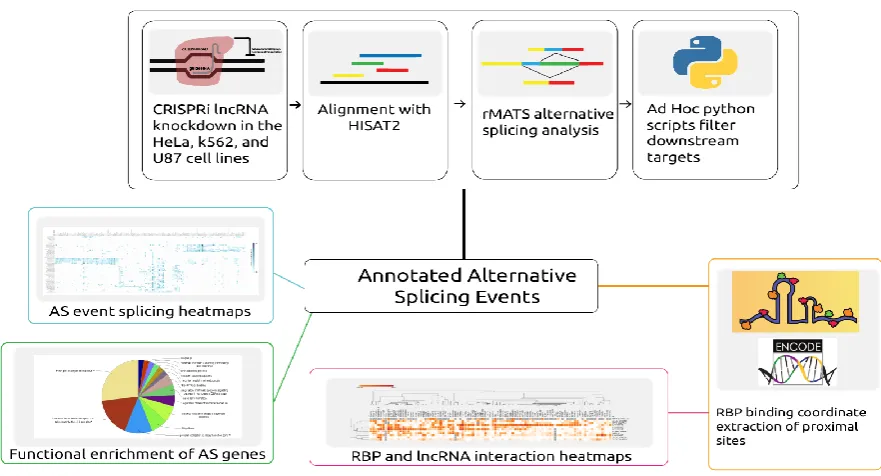
80
human cancer cell lines. As illustrated in the workflow (Figure 1), the RNA-seq data was aligned to
81
the human reference genome. The aligned data was further analyzed for identifying alternative
82
splicing events across lncRNA knockdowns and corresponding control samples. RBP binding
83
profiles were analyzed to understand their binding preference around alternative splice events. The
84
following sections discuss individual steps involved in our workflow in detail.
85
87
88
Figure 1. Depiction of the workflow and analysis conducted in this study. Automated scripts were
89
developed to download data, align reads to the corresponding reference, and predict the alternative
90
splicing events across samples. From further processing of the predicted events, both alternative
91
splicing event information and proximal RBP binding locations were extracted. Alternative splicing
92
events were then analyzed by generating heatmaps and by performing functional enrichment analysis
93
of the alternatively spliced genes. The overlapping proximal RBP binding locations were extracted by
94
analyzing RBP binding profiles obtained from ENCODE.
95
2.1. Sequence alignment of RNA-Seq reads using HISAT
96
Data from the study GSE85011 was generated by creating a guide RNA library to facilitate
97
CRISPRi lncRNA knockdowns via precise heterochromatization[4]. Single end RNA-seq data of
98
lncRNA knockdowns and controls in the HeLa (cervical cancer), U87 (glioblastoma), and K562
99
(leukemia) cell lines, was downloaded from GEO[16] in the ‘fastq’ format using NCBI’s sratoolkit
100
(version 2.8.2) [17]. We used a highly efficient short-read RNA-seq alignment tool, HISAT2 [18], to
101
align the downloaded data to the human reference genome. Default parameters of HISAT2 were used
102
to align the reads against hg38 reference genome. By utilizing SAMtools (version 1.3.1) [19] for data
103
processing, the SAM (Sequence Alignment/Map) files from HISAT2 alignment were converted to the
104
BAM (Binary Alignment/Map) format. Concurrently, the BAM files were transformed into the
sorted-105
BAM format. The average alignment rate across the samples was 91%. The corresponding SRA
106
sample run IDs (SRR IDs) and their respective alignment statistics are reported in Supplementary
107
table 1.
108
2.2. Identifying differentially spliced events using rMATS
109
RNA-seq data enables us to observe alternative splicing events across two given conditions. In
110
this study we deployed rMATS (version 3.2.5) [20] on samples corresponding to 39 lncRNA
111
knockdowns and their respective controls, to identify the differential alternative splice (AS) events.
112
rMATS takes sorted-BAM files as input and identifies a variety of splicing events, that are differential
113
across two conditions. We used sorted-BAM files of lncRNA knockdowns, control reads, and
114
corresponding replicates as input for rMATS. Additionally, human transcript annotation was
115
provided with a GTF (Gene transfer format, version 84) file from Ensembl [21]. By implementing our
116
inputs into the pipeline with default thresholds, we could compare AS patterns in the presence and
117
absence of a lncRNA. Thereby, rMATS enabled us to analyze the inclusion/exclusion of target
118
exons/introns pertaining to different types of AS events: skipped exon (SE), alternative 5′ splice site
(A5SS), alternative 3′ splice site (A3SS), mutually exclusive exons (MXE), and retained intron (RI)
120
across lncRNA knockdown experiments. We ran rMATS on 54 comparisons of samples pertaining to
121
39 lncRNA knockdowns in three cell lines; however, not all the lncRNAs had knocked down
RNA-122
seq data available across the three cell lines.
123
124
Custom python scripts were developed to parse through rMATS output files across all
125
comparisons to generate AS event frequency matrices. A filter of False Discovery Rate < .10 and
p-126
value < .05 was employed over these tables, thereby enabling us to extract only the significant AS
127
events [Supplementary table 3].
128
2.3. Visualizing incidence of differentially spliced genes in lncRNA knocked down cell lines
129
The frequency matrices generated from the rMATS output were further analyzed to gauge how
130
often each gene was alternatively spliced when a specific lncRNA is knocked down in a given cell
131
line. To optimize data processing and visualization, the matrix was further filtered to remove
132
instances which were not populated with data. LncRNA’s genome wide influence over splicing was
133
visualized by generating a heatmap that depicts the incidence of a gene being alternatively spliced in
134
a lncRNA knock down by using Morpheus[22], a heatmap generation tool from broad institute. Both,
135
rows and columns were clustered hierarchically based on the “one minus spearman rank correlation”
136
distance option. The spearman distance option was the most relevant method to discriminate the
137
genes’ cell type specificity, as it was a non-parametric test and gave the most consistent groupings
138
after trials of similar distance metrics. We used Venny (v2.1) [23], to generate Venn Diagrams to
139
depict the differentially spliced gene overlaps across cell lines.
140
2.4. Functional enrichment analysis of alternatively spliced genes
141
To understand the functional impact of lncRNAs on cellular functions, we performed functional
142
enrichment analysis using ClueGO (v2.50) [24] over alternatively spliced gene sets from each lncRNA
143
knockdown. ClueGO is a Cytoscape[25] plug-in which enables users to perform comprehensive
144
functional interpretation of gene sets. ClueGO can analyze gene sets and visualize the respective
145
functionally grouped annotations based on pathway enrichments recognized in the corresponding
146
gene sets. We extracted the gene sets that were exclusively alternatively spliced in a given cell line
147
and plugged them into ClueGO, thereby extracting functional contributions of lncRNAs. We used all
148
the GO terms irrespective of their level in the GO hierarchy for identifying enrichment terms after
149
searching for term annotations from databases like KEGG[26], GO Cellular Components[27,28], GO
150
Biological Process[27,28], and REACTOME Pathways[29]. Only significantly enriched terms (p-value
151
< .05) were used for the downstream analysis. The functional enrichment of the smaller gene sets
152
affected by alternative splicing across cell types revealed no significant (pvalue < .05) pathways or
153
functional annotations.
154
2.5. Extraction of RBP binding profiles across AS events
155
Experimental strategies like CLIP[10], iCLIP[30], and eCLIP[15] have significantly improved our
156
understanding of the RNA bound proteome. By observing variations of RBP binding preferences
157
around AS events in the presence and absence of a given lncRNA, we gained a new perspective on
158
the functional dynamics and crosstalk between lncRNAs and RNA binding proteins (RBPs). Publicly
159
available eCLIP experimental data in the HeLa and K562 cell lines were obtained from the ENCODE
160
project [13]. The eCLIP data was then processed to extract the genome level RBP binding profiles in
161
both cell lines.
162
163
Additionally, we extracted the genomic loci where the AS events occurred from the rMATS
164
output data. Potential genomic loci involved in AS can be captured by examining adjacent upstream
165
and downstream regions in the exon start and end loci. A total of six types of proximal coordinates
166
downstream exon start and end. Each of the six coordinates were given a distance allowance of 500
168
base pairs on either side of the sites to confirm locations which overlap with the binding sites of RBPs.
169
Both, RBP binding profiles and AS event sites were processed and converted into the BED (Browser
170
Extensible Data) format. Bedtools (version 2.18.1) [31] is one of the most efficient tools to analyze
171
genomic loci based information. We used the Bedtools-intersect option to extract the overlaps across
172
RBP binding sites and AS events and proximal loci, to understand which RBPs are potentially
173
associated with a specific AS event [see Supplementary materials 11]. However, the eCLIP data on
174
ENCODE did not host high confidence U87 cell line experiments, therefore no RBP binding profiles
175
from U87 were extracted.
176
2.6. Enrichment of RBP binding over alternative splicing events
177
Although we have identified RBP and AS event interactions based on eCLIP data, we wanted to
178
identify only the most likely interactions for further analysis. A hyper geometric statistical test was
179
performed to observe the enrichment of a RBP’s binding preference with respect to each lncRNA that
180
was knocked down, thereby, determining significant relative RBP binding preference.
181
182
The relationship between RBP binding frequencies was highly influenced by many missing
183
values, which might not be representative of the whole relationship of binding. The importance of a
184
reported binding had no numerical value attached, so a hypergeometric probability was needed. A
185
majority of the lncRNAs had a higher proportion of binding rather than non-binding, and the fishers
186
exact odds ration test evaluated the representation of binding. A fisher’s exact test ran for each of the
187
bound and unbound genes to a motif created by a lncRNA knockdown and all the genes from each
188
lncRNA. The p-values from each fisher’s test were then adjusted in reference to all the other fisher’s
189
exact tests.
190
191
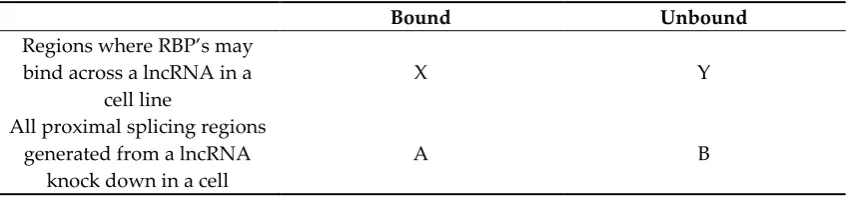
Table 1 shows the contingency table of bound and unbound protein frequencies used to conduct
192
the fishers exact test. Each square in the heatmaps shown in Figure 4A and 4B demonstrate the
193
significance (-log(corrected pvalue)) from each of these tests. The maps were clustered hierarchically
194
to see if there was a relationship between RBP and lncRNAs.
195
196
Table 1. Representation of Fisher’s exact test input contingency table for each iteration of RBP binding data.
197
Conservative hypergeometric tests were performed in order to evaluate the importance of reported
198
proximal RBP binding activity to a lncRNA. Each iteration of the fisher’s exact test required this input
199
space, which evaluates if a proximal binding with RBP is occurring in significant frequencies or by chance.
200
201
Bound Unbound
Regions where RBP’s may
bind across a lncRNA in a cell line
X Y
All proximal splicing regions generated from a lncRNA
knock down in a cell
A B
202
2.7. Correlation analysis of lncRNA specific RBP binding activity and AS events
203
A correlation analysis was performed across the number of skipped events with the amount of
204
RBPs relative and each lncRNA specifically to determine a relationship between RBP binding
205
frequency and alternative splicing events. However, a significant correlation was not observed given
206
the small amount of data points. Supplementary table 4 depicts the attempts and tables used to show
207
the connection between the lncRNAs and RBP.
208
3.1. Framework for studying alternative splicing outcomes in lncRNA knockdown RNA-sequencing
210
experiments
211
In this study, we investigated alternative splicing events, functions of alternatively spliced gene
212
sets, and RBP-lncRNA binding patterns across 39 lncRNA knockdowns in HeLa (Cervical Cancer),
213
K562 (Myeloid Leukemia), and U87 (Glioblastoma) cell lines. An overview of the three-step analysis
214
is illustrated in Figure 1 (see Materials and Methods). First, we collected and processed the raw
RNA-215
Seq data for multiple lncRNA knockdown samples in human cancer cell lines and identified splicing
216
events using the replicate Multivariate Analysis of Transcript Splicing (rMATS) [20] pipeline.
217
Secondly, alternative splicing summaries were analyzed, and functional enrichment analysis of the
218
effected gene sets was performed. Third, we analyzed the binding profiles of RNA binding proteins
219
(RBPs) with respect to the skipped exon (SE) and retained intron (RI) events across 39 lncRNA
220
knockdowns: finding that the RBPs binding profiles around SE and RI events were also unique to
221
each cell line. Additionally, we observed RBPs’ substantial binding preference for knocked down
222
lncRNAs and proposed that certain lncRNAs demonstrate a sponge-like RBP binding activity.
223
3.2. Skipped Exon events followed by Retained Intron events are the most prominent alternative splicing
224
events occurring due to the loss of lncRNAs across multiple human cell lines
225
We collected the RNA sequencing data from dCAS9 based lncRNA knockdown study [4] which
226
contained 39 lncRNA knockdowns in U87, HeLa, and K562 cell lines (see Materials and Methods).
227
LncRNA knockdown sequence replicates and control samples were aligned onto the human
228
reference genome (hg38) using HISAT2[18]. The overall percentage of alignment is highlighted in
229
Supplementary table 1 demonstrates a high fraction of read alignment to the reference genome
230
(average alignment rate ≥ 91%). The alternative splicing (AS) event identification analysis was
231
performed by deploying the rMATS pipeline over the three cell lines. A filter of fdr < 0.1 and p-value
232
< 0.05 was employed to extract the most likely alternative splicing events (see Materials and
233
Methods). A total of 26167 high confidence AS events were extracted from the rMATS analysis output
234
across three cell lines. Skipped exon (SE) events were the most predominant events, constituting for
235
44.4% of the total events, followed by retained intron (RI) events at 22.5%. Sample wise distributions
236
of splice events are provided as Supplementary table 2. The output from the rMATS analysis was
237
parsed and summarized into a total of 17525 unique, statistically significant splice events (11630 SE
238
and 5895 RI) and their AS event frequency across 39 lncRNA knockdowns in the three cell lines is
239
available as Supplementary table 3.
240
3.3. Hierarchically clustered heatmaps of AS event frequency in lncRNA knockdowns reveal cell type specific
241
alternative splicing signatures
242
Annotated splicing summaries were compiled to generate matrices which depicted the
243
frequency of alternative splicing events occurring in lncRNA knockdowns across three different cell
244
lines. In order to visualize the AS events from the matrix, heatmaps were generated for SE and RI
245
events. A legible resolution of the SE and RI heatmaps were obtained after missing data was filtered
246
out. Across RI and SE events, we observed that the alternatively spliced gene clusters were
247
predominantly unique across each cell line [Supplementary figures 4 and 5]. Consequently, even
248
though the same lncRNA was knocked out across two cell lines, the genes that were alternatively
249
spliced are cell type specific. SE events had the most pronounced cell type specificity, in comparison
250
to other AS events. In tandem, we also observed that the cellular and phenotypic functions affected
251
by genes alternatively spliced across SE and RI events were specific to each cell line.
252
253
Among the lncRNA knockdown dataset described in the materials and methods section, we
254
found only 12 lncRNAs to be common across three cell lines. Amongst all the AS events in the 3
255
different cell lines, not a single gene was affected in the same way by a knockdown. The resulting
256
alternatively spliced genes from the 12 lncRNA knockdowns which were present in at least 2 cell
257
knocked down affected the frequency of SE events in specific genes. The genes affected by RI events
259
were altered in a cell type specific manner as well. However, the intensity of the signal was relatively
260
lower in RI events when compared to SE events.
261
262
263
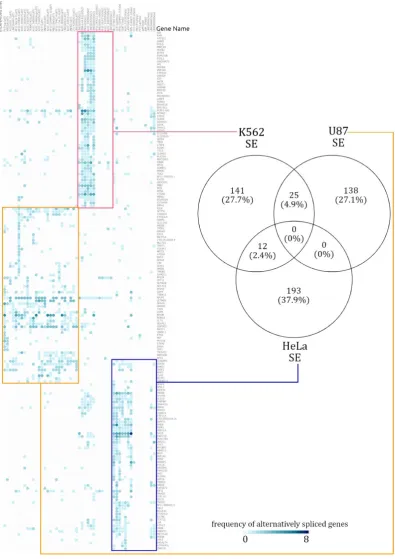
264
Figure 2. Summary of cell type specific Skipped Exon events. A hierarchically clustered heatmap
265
demonstrates that the genes which are spliced via skipping exon: isolate themselves in a mostly cell type
266
specific manner. The numbers in the Venn diagram show how many alternatively spliced genes are shared
267
across cell lines. Across all the alternatively spliced events in the 3 different cell lines, not a single gene
268
displayed the same pattern.
269
In the AS event frequency heatmap, the SE events had very defined clusters and continued to be
271
clustered in a distinct cell type specific manner [see Supplementary figure 5]. The genes which were
272
annotated with SE events, were rarely shared across two cell lines. Out of the total 759 alternatively
273
spliced genes, only 7.3% (37 genes) were alternatively spliced across at least 2 cell lines. When
274
enrichment analysis was performed over the few SE affected genes which were shared across
275
different cell lines, there was too little information for a statistically significant functional annotation
276
to emerge. The number of SE event affected genes shared across cell lines can be seen in the Venn
277
Diagram in Figure 2. Similarly, a heatmap of RI events frequencies was generated, akin to the
278
observations from SE event analysis, the gene sets with RI events were mostly cell type specific [see
279
Supplementary figure 5].
280
281
The gene sets affected by RI events were cell type specific, but these gene sets overlapped slightly
282
more among the cell lines, relative to SE distributions. Given the small number of genes alternatively
283
spliced and RI events shared (maximum of 30 shared events), the scope for significant functional
284
annotation was low. The 162 genes affected by RI events in the K562 cell line had a distinct signal
285
from the other cell lines, further emphasizing their cell type specificity.
286
3.4. lncRNA knockdowns not only enriched for cell type specific functions but occasionally favor similar
287
functions via varied alternatively spliced gene sets
288
In an attempt to understand the downstream functions being influenced by lncRNAs, functional
289
enrichment analysis was performed over 759 alternatively spliced genes corresponding to 39 lncRNA
290
knockdowns in three cell lines (see Materials and Methods). Only 28 genes were shared between the
291
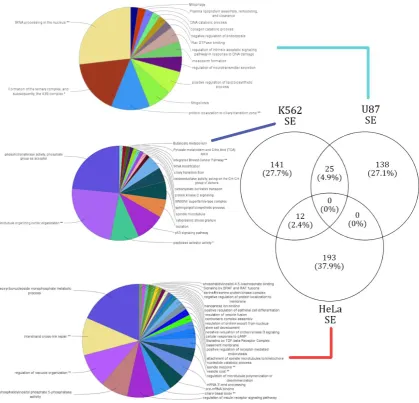
SE and RI events, while 481 genes were unique to SE events, and 250 genes were unique to RI events.
292
Figure 3 illustrates the significant (p < 0.05) potential functions associated to genes alternatively
293
spliced in each cell line resulting from a lncRNA knockdown. As expected, the functions affected
294
within each cell line, were also unique to each cell line. On the rare occasion of a common enriched
295
function between cell lines, gene set composition leading to that function varied drastically.
296
3.4.1. Genes alternatively spliced via SE events in U87, HeLa, and K562 reveal cell type specific
297
functional enrichment
298
SE events affected a total of 509 genes, and the respective functional annotation terms were
299
enriched from four different pathway databases (see Materials and Methods). A unique gene set of
300
138 genes corresponding to 14 terms were enriched in the U87 cell line. The highest number of genes
301
that were alternatively spliced in samples were induced by the knockdown of lncRNA families XLOC
302
and RP11. The U87 cell type specific gene cluster has areas of higher magnitude of splicing events
303
and shared only 25 genes with the K562 cell line. Of the 25 shared genes no significant pathways were
304
annotated. The top functions that are affected by the alternative splicing induced by the lncRNA
305
knockdowns in the U87 cell line correspond with DNA endonuclease repair (37% of genes), and with
306
ribosomal complex formation (16% of genes) [see Supplementary figure 6]. These functional
307
observations are in coherence with literature, as it is known that endonuclease repair activity is a
308
function targeted by cancerous U87 [32].
309
311
Figure 3. Summary of cell type specific GO functional annotation in Skipped Exon events. Functional
312
annotation of cell type specific gene sets that were affected by SE events. The lines connecting the
313
corresponding gene sets across each cell type to respective functional annotation. The functions enriched
314
in each cell type are exclusive.
315
316
The 141 genes affected in the K562 cell line were enriched for a total of 17 functional terms. The
317
top functions affected by SE events in the K652 cell line were: cell microfiber construction (45% of
318
genes), phosphotransferase activity (23% of genes), and p53 signaling pathway (12% of genes) [see
319
Supplementary figure 7]. Functional annotations like cell growth and cell death have been identified
320
as key checkpoints in various cancers, including leukemia (K562) [33]. However, this study appears
321
to provide a novel functional annotation of ‘cell microfiber construction’ being affected in leukemia
322
(K562). Thereby, our genome wide functional analysis is not only able to predict novel functions
323
based on genes affected by AS events, but also support functions previously annotated to these cell
324
lines.
325
326
The HeLa clusters affected genes in a large gene cluster, with 193 unique genes over represented
327
with 28 functional terms. The top functions affected by SE events in the HeLa cell line were:
328
deoxyribonucleoside monophosphate metabolic processes (29% of genes), and vesicle formation and
329
vesicle movement (15% of genes) [see Supplementary figure 8]. Vesicle formation and movement
330
have been observed to be attenuated in the HeLa cell line, in a gene (SPIN90) dependent manner,
331
which our analysis was able to capture [34]. No significant pathways were annotated for the 12 genes
332
3.4.2. Genes alternatively spliced via RI events in HeLa, and K562 reveal cell type specific functional
334
enrichment
335
RI events affected a total of 278 genes across three cell lines. The respective functional annotation
336
terms were enriched from four different pathway databases (see Materials and Methods). While the
337
clustered gene set in the HeLa cell line yielded no significant (p < 0.05) pathways, the knockdown of
338
RP5-1148A21.3 in the HeLa cell line was able to alternatively splice all 278 genes [see Supplementary
339
figure 5]. Thus, the 278 genes affected in the HeLa cell line by RP5-1148A21.3, enriched 53 functional
340
terms: responses to endoplasmic reticulum stress (19% of genes), holiday junction resolvase complex
341
(9% of genes), and RNA splicing (8% of genes). The few genes affected within the U87 cell line did
342
not enrich any significant pathways.
343
344
The 162 genes affected in the K562 cell line were enriched for 18 functional terms composed of
345
concepts such as ‘ribosomal construction’ and ‘negative regulation of autophagy’. ‘Cytosolic large
346
ribosomal subunit’ constituted for 50% of the genes alternatively spliced in the K562 gene set [see
347
Supplementary figure 9]. Other prominent functions associated with the K562 were ribosomal RNA
348
processing in the nucleus and cytosol (7% of genes), and negative regulation of autophagy. The
349
functional annotation of the term ‘targeted rRNA processing’, onto K562, is in coherence with
350
literature; as ‘targeted rRNA processing’ has been identified to play a key role in K562 cells [35].
351
3.5. Analysis of lncRNA AS events proximal to RBP binding sites reveals cell type specific interactions and
352
supports a lncRNA-RBP sponge model
353
As a conduit to understand lncRNA’s role in alternative splicing: lncRNA’s interactions with
354
RBPs were extracted. RBP binding profiles for 22 lncRNAs were obtained from documented eCLIP
355
experiments from the ENCODE database. Supplementary material 11 highlights the binding profiles
356
which overlapped with proximal (±500bp) alternative splice site locations revealing 4261897 RBP
357
binding locations for 148 RBPs on 22 lncRNAs. The significance of relative frequencies of bound and
358
unbound RBP sites was gauged by deploying the fisher’s exact test on each lncRNA’s RBP binding
359
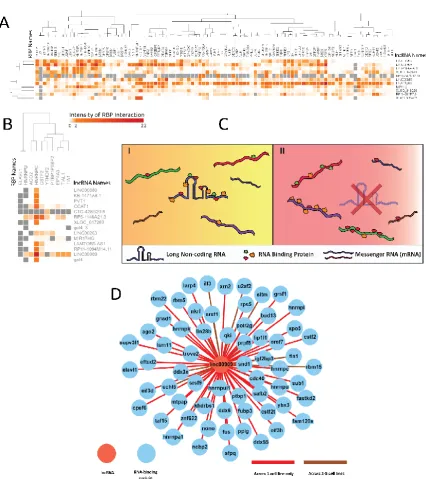
preferences. Figure 4 showcases the intensity of each RBPs’ interactions to their respective 11
360
lncRNAs in the K562 cell line (Figure 4A) and 14 lncRNAs in the HeLa cell line (Figure 4B).
361
Additionally, we observed lncRNAs which acted as an RBP sequestering sponge, which is illustrated
362
in Figure 4C, based on their extensive interactions with RBPs. Figure 4D demonstrates how sponging
363
lncRNAs like LINC00909 have many interactions with a variety of RBPs.
364
365
The lncRNA – RBP binding profile-based clustering analysis across both cell lines was not very
366
informative. However, an interesting behavior was revealed where certain lncRNAs, like LINC00909,
367
LINC00263, and LINC00910, had extensive number of binding events across many RBPs. Therefore,
368
the downstream alternative splicing caused by the loss of a lncRNA is induced by the absence of an
369
RBP binding sponge. As highlighted in the model shown in Figure 4C, in cancer cells a lncRNA might
370
bind to many RBPs where its expression level could facilitate extensive number of RBP interactions.
371
However, in the event of a lncRNA knockdown or due to the loss of function of a lncRNA, an
372
abundance of RBPs interact with pre-mRNA targets illustrated in Figure 4C, thereby inducing
373
alternative splicing.
374
375
As highlighted in Figure 4A, most lncRNAs in the K562 cell line bound generally to RBPs like:
376
KHSRP, CSTF2T, YBX3, ZNF622, SAFB2, SRSF1, and QKI. LncRNAs LINC00910, LINC00680,
RP11-377
392P7.6, and LINC00909 showed a very high number of RBP interactions in the K562 cell line [see
378
Supplementary figure 4] (Figure 4D) and exemplify the proposed RBP-sponge binding model. Other
379
interesting patterns of lncRNA-RBP binding included distinct RBP binding preferences for lncRNAs
380
from the same family, namely XLOC_042889 and XLOC_038702.
381
383
384
Figure 4. RNA-Binding Protein eCLIP based binding profile analysis reveals possible lncRNAs acting
385
as an RBP sponge. The intensities are log scaled FDRs of RBP protein interaction with genes alternatively
386
spliced in corresponding lncRNA knockdown. Figures 4A and 4B showcase the lncRNAs knocked down
387
in respective cell lines A) K562 and B) HeLa and the resulting proximal RBP interaction intensity. The grey
388
values represent NA values within the heatmaps. C) An illustration of the proposed RBP sponge model,
389
portraying lncRNA – RBP proposed behavior, in the presence and absence of a lncRNA. C(I) demonstrates
390
when the lncRNA is present, and C(II) demonstrates the proliferated RBP interactions with mRNAs, when
391
the corresponding lncRNA is absent or less abundant. D) Shows the extent of RBPs interacting with lncRNA
392
LINC00909 (data from ENCODE), and supports the lncRNA- RBP sponge model.
393
394
Despite only having 10 RBPs binding within the Hela cell line proximal AS events, lncRNA
395
LINC00909’s RBP interactions further reinforce our proposed lncRNA-RBP sponge model. As
396
illustrated in Figure 4B, RBPs ELAVL1 and HNRNPU were observed to have many nan values across
397
lncRNA knockdown samples and one RBP (HNRNPC) had many significant binding associations
398
across all lncRNA knockdowns. The parameters of the fisher’s exact test require bound and unbound
399
reported to be unbound to a lncRNA will yield a nan result. Both ELAVL1 and HNRNPU were
401
manually checked across all lncRNAs inside of the HeLa cell line, and they only have values for
402
binding across lncRNAs. Thus, the binding preference of ELAV1 and HNRNPU is very indifferent
403
and will not be considered as a contributor to the RNA binding protein sponge model; however,
404
binding specificity of these RBPs can be revealed as more interaction data is collected across other
405
lncRNAs.
406
4. Discussion
407
In this study, we investigated the splicing alterations in lncRNA knockdown experiments, and
408
depicted a molecular mechanism of RBP’s influence on alternative splicing. The analysis of the
409
alternative splicing heat maps that transcriptional networks were perturbed in a cell type specific
410
pattern. The observed cell type specific pattern of perturbation is in line with previous profiling of
411
expression in lncRNA knockdowns [4]. Unique to this experiment, alternative splicing displays
412
characteristics of being cell type specific over many lncRNAs, with extreme examples depicted in the
413
SE experiments.
414
415
Based on our RBP binding analysis, lncRNAs display RBP sponge-like behavior and hint at other
416
methods of inducing alternative splicing. This study also tries to implicate that lncRNAs like
417
LINC00909 and LINC00910 act as sponges; however, there could be other means of inducing splicing.
418
For instance, lncRNAs like RP5-1148A21.3 seem to participate in a different narrative, which is
419
depicted in its high involvement in RI events with only 18 RBPs reported to be bound. Other studies
420
implicate lncRNAs’ potential interaction with themselves to make silencing structures, crystalline
421
structures, or molecular machinery [9,36]. Additionally, subnuclear bodies have shown promise in
422
understanding lncRNA’s potential in creating other cellular machinery [37], and lncRNAs which bind
423
to many RBPs could be recruiting those proteins to form a subnuclear body. Groups invested in
424
mechanisms of post-transcriptional regulation may begin to examine RBP binding data, and multiple
425
sequence alignment of lncRNAs in order to understand intramolecular interactions in subnuclear
426
bodies and secondary lncRNA structure [38,39]. Hence, further attempts to understand non-coding
427
RNA structure, should account for interactions of lncRNAs and RBPs inside of the nucleus and in the
428
cytoplasm in order to reveal other means of lncRNAs’ involvement in splicing.
429
430
While it is known that lncRNAs bind to microRNAs through a binding sponge mechanism [40],
431
lncRNA-RBP binding activity is not often described as a sponge titration. By sponging microRNAs,
432
lncRNAs revealed many significant instances of their influence on post-transcriptional regulation in
433
a variety of cancers [41,42]. Their influence is controlled through mechanisms like the competitive
434
endogenous model (ceRNA) [43] which will ultimately affect gene expression based on the binding
435
activity of microRNAs. Despite established investigations of miRNA and lncRNA interactions,
436
lncRNA-RBP binding activity is not well explored in a context of post-transcriptional regulation.
437
Other non-coding RNAs like circular RNAs have been reported to act as protein binding sponges [44]
438
and lncRNAs have been reported to act as a binding sponge for the Hur protein [45]. However, this
439
study identifies many RBPs binding to a handful of lncRNAs which act as a binding sponge. Thereby,
440
a direct relationship between all the alternative splicing and RBP sponge activity is not clear, but
441
further analysis of RBP and lncRNA binding activity can evaluate the strength of the proposed
442
sponge model.
443
5. Conclusions
444
Alternative splicing induced by lncRNA knockdowns has been shown to be cell type specific
445
within the human cancer cell lines: HeLa, K562, and U87. The downstream cellular functions of 759
446
genes were significantly affected by 11630 skipped exon events and 5895 retained intron events,
447
specifically within each cell line. LncRNA and RBP interactions were also shown to be cell type
448
specific. We hypothesize that several lncRNAs like LINC00909, LINC00910, and LINC00263 are likely
449
functions. We propose that such lncRNA sponges can extensively rewire the post-transcriptional
451
gene regulatory networks by altering the protein-RNA interaction landscape in a cell-type specific
452
manner. Our study is one of the first to implicate lncRNAs as an RBP sponge, and it reveals more
453
diverse RBP sponge activity than previously observed [39].
454
455
However, the sponge model was not able to represent all lncRNAs which played a significant
456
role in splicing. LncRNAs, like RP5-1148A21.3, which affected splicing very significantly and had few
457
reported RBPs bound could have its structure researched. Investigations of lncRNA secondary
458
structure and tertiary structure have revealed methods of epigenetic and post-transcriptomic
459
regulation [38,46] and may further implicate lncRNA’s influence over alternative splicing. Thereby,
460
we propose that lncRNAs like RP5-1148A21.3 may interact intramolecularly and alter
post-461
transcriptional gene regulatory networks.
462
463
Reports on the interactions between lncRNAs in unique human cell lines are becoming more
464
prevalent as well curated databases are emerging to improve the quality of lncRNA annotation [6,47].
465
As more lncRNA knockdown procedures and RBP binding data are released to the public, pipelines
466
like the one conducted in this study can be utilized to investigate the mechanisms of lncRNAs in
467
alternative splicing.
468
469
Supplementary Materials
470
Supplementary Table 1: Table of alignment percentages of control reads to appropriate experimental reads.
471
“Supplementary materials 1.xlsx”
472
The table contains the SRR read id from and its respective HISAT2 RNA-seq alignment percentages with control
473
sequences and human genome: hg38. The overall alignment had a median of 77%, and a mean of 91%. These
474
initial percentages indicated a good quality of alignment so that the next step of analysis could continue.
475
Supplementary Table 2: RMATs event summaries for each lncRNA combination. “Supplementary materials
476
2.xlsx”
477
A table that neatly summarizes the alternative splicing predictions from RMATs. After looking at the quantity
478
of different splicing events and the difficulty of predicting different methods of splicing, the relative frequencies
479
of alternative splicing events indicated that skipped exon and retained intron events would be the most
480
statistically sound events to investigate.
481
Supplementary Tables 3: Annotated alternative splicing summaries and correlation analysis of RBP binding
482
activity with frequency of splicing events. “Supplementary materials 3.xlsx”
483
The first two tables contain the annotated skipped exon and retained intron splicing events from each lncRNA
484
respectively. Attempts to correlate the amount of RBP binding to number of splicing events are contained in the
485
third table with respective graphs. The plots within the correlation analysis reveal that there is no linear
486
correlation between bound RBP frequencies and alternative splicing event frequencies.
487
Supplementary Figure 4: Heatmap of skipped exon events induced by the respective knockdowns of lncRNAs
488
in three cell lines. “Supplementary materials 4.pdf”
489
The entire heatmap of skipped exon splicing alternative splicing across the 39 lncRNAs in their own respective
490
cell line. The columns of the heatmap are lncRNAs which have been knocked down, and annotated with the
491
name of their originating cell line. The rows represent the genes which have been alternatively spliced via
492
skipped exon events. The hierarchical clustering of both rows and columns reveals cell type specific influences
493
of splicing.
494
Supplementary Figure 5: Heatmap of retained intron events induced by the respective knockdowns of lncRNAs
495
The entire heatmap of retained intron splicing alternative splicing across the 39 lncRNAs in their own respective
497
cell line. The columns of the heatmap are lncRNAs which have been knocked down, and annotated with the
498
name of their originating cell line. The rows represent the genes which have been alternatively spliced via
499
retained intron events. The hierarchical clustering of both rows and columns reveals cell type specific influences
500
of splicing.
501
Supplementary Figure 6: Functional enrichment of genes affected by skipped exon splicing in U87.
502
“Supplementary materials 6.png”
503
A pie chart of functionally enriched terms affected by skipped exon splicing due to the knockdown of the
504
lncRNAs within the u87 cell line. The terms annotated to the many genes which were affected related to tRNA
505
processing formation, formation of the 43S ternary complex, and protein localization to ciliary transition zone.
506
Supplementary Figure 7: Functional enrichment of genes affected by skipped exon splicing in K562.
507
“Supplementary materials 7.png”
508
A pie chart of functionally enriched terms affected by skipped exon splicing due to the knockdown of the
509
lncRNAs within the K562 cell line. The affected terms were annotated to many genes relating to microtubular
510
organization, phosphotransferase activity, and the p53 signaling pathway. The found terms are indicative of
511
cancer proliferation.
512
Supplementary Figure 8: Functional enrichment of genes affected by skipped exon splicing in HeLa.
513
“Supplementary materials 8.png”
514
A pie chart of functionally enriched terms affected by skipped exon splicing due to the knockdown of the
515
lncRNAs within the HeLa cell line. The top terms were annotated to many genes relating to vacuole organization,
516
interstrand cross-link repair, and monophosphate metabolic processes.
517
Supplementary Figure 9: Functional enrichment of genes affected by retained intron splicing in K562.
518
“Supplementary materials 9.png”
519
A pie chart of functionally enriched terms affected by retained intron splicing due to the knockdown of the
520
lncRNAs within the K562 cell line. The top terms were annotated to many genes relating to cytosolic large
521
ribosomal subunits and large ribosomal subunit biogenesis. Other functions include negative regulation of
522
autophagy and nucleic sugar biosynthesis.
523
Supplementary Figure 10: Functional enrichment of genes affected by retained intron splicing in HeLa from the
524
knockdown of RP5-1148A21.4. “Supplementary materials 10.png”
525
A pie chart of functionally enriched terms affected by retained intron splicing due to the knockdown of
RP5-526
1148A21.4. The top terms annotated to the many genes which the lncRNA affected were translation, response to
527
endoplasmic reticulum stress, holiday junction resolvase complex, and RNA splicing.
528
Supplementary materials 11: Zip file which contains the bedfiles of the proximal RBP splicing locations which
529
overlapped with RBP binding locations noted in ENCODE “Supplementary materials 11.zip”
530
Inside each bedfile, there will be columns from the lncRNA which was overlapped “lncRNA name|cell
531
line|ENSG id|location relative to splice site” and from RBP locations “RBP name|cell line”. Take note that there
532
are regions in one cell line that have reported RBP data in other cell lines.
533
Author Contributions: F.P., S.D., and S.J. conceived the study. S.J. supervised the study. S.D. assisted in data
534
curation and provided guidance and manuscript reviews. S.D. designed a representation of the sponge model
535
used in Figure 4C, and F.P. designed and generated all other figures. F.P. performed formal analysis, prepared
536
the original draft, and wrote the manuscript. All authors read and approved the final manuscript.
537
Funding: This study was supported by the National Institute of General Medical Sciences (NIGMS) under
538
Award Number R01GM123314. This material is based upon work supported by the National Science Foundation
539
under Grant No. CNS-0521433. This research was supported in part by Lilly Endowment, Inc., through its
540
Acknowledgments: The authors acknowledge the team at Janga Lab for the guidance, comradery, and feedback
542
which they have provided. The authors would also like to thank the IU School of Informatics and Computing
543
for providing access to high performance computing resources.
544
Conflicts of Interest: The authors declare no conflict of interest.
545
References
546
1. Kopp, F.; Mendell, J.T. Functional Classification and Experimental Dissection of Long Noncoding
547
RNAs. Cell 2018, 172, 393-407, doi:10.1016/j.cell.2018.01.011.
548
2. Leone, S.; Santoro, R. Challenges in the analysis of long noncoding RNA functionality. FEBS Lett 2016,
549
590, 2342-2353, doi:10.1002/1873-3468.12308.
550
3. Shukla, C.J.; McCorkindale, A.L.; Gerhardinger, C.; Korthauer, K.D.; Cabili, M.N.; Shechner, D.M.;
551
Irizarry, R.A.; Maass, P.G.; Rinn, J.L. High-throughput identification of RNA nuclear enrichment
552
sequences. EMBO J 2018, 37, doi:10.15252/embj.201798452.
553
4. Liu, S.J.; Horlbeck, M.A.; Cho, S.W.; Birk, H.S.; Malatesta, M.; He, D.; Attenello, F.J.; Villalta, J.E.; Cho,
554
M.Y.; Chen, Y., et al. CRISPRi-based genome-scale identification of functional long noncoding RNA
555
loci in human cells. Science 2017, 355, doi:10.1126/science.aah7111.
556
5. Zare, K.; Shademan, M.; Ghahramani Seno, M.M.; Dehghani, H. CRISPR/Cas9 Knockout Strategies to
557
Ablate CCAT1 lncRNA Gene in Cancer Cells. Biol Proced Online 2018, 20, 21,
doi:10.1186/s12575-018-558
0086-5.
559
6. Xu, J.; Shi, A.; Long, Z.; Xu, L.; Liao, G.; Deng, C.; Yan, M.; Xie, A.; Luo, T.; Huang, J., et al. Capturing
560
functional long non-coding RNAs through integrating large-scale causal relations from gene
561
perturbation experiments. EBioMedicine 2018, 35, 369-380, doi:10.1016/j.ebiom.2018.08.050.
562
7. Gilbert, L.A.; Larson, M.H.; Morsut, L.; Liu, Z.; Brar, G.A.; Torres, S.E.; Stern-Ginossar, N.; Brandman,
563
O.; Whitehead, E.H.; Doudna, J.A., et al. CRISPR-mediated modular RNA-guided regulation of
564
transcription in eukaryotes. Cell 2013, 154, 442-451, doi:10.1016/j.cell.2013.06.044.
565
8. Yu, D.; Zhang, C.; Gui, J. RNA-binding protein HuR promotes bladder cancer progression by
566
competitively binding to the long noncoding HOTAIR with miR-1. Onco Targets Ther 2017, 10,
2609-567
2619, doi:10.2147/OTT.S132728.
568
9. Hirose, T.; Virnicchi, G.; Tanigawa, A.; Naganuma, T.; Li, R.; Kimura, H.; Yokoi, T.; Nakagawa, S.;
569
Benard, M.; Fox, A.H., et al. NEAT1 long noncoding RNA regulates transcription via protein
570
sequestration within subnuclear bodies. Mol Biol Cell 2014, 25, 169-183, doi:10.1091/mbc.E13-09-0558.
571
10. Ule, J.; Jensen, K.; Mele, A.; Darnell, R.B. CLIP: a method for identifying protein-RNA interaction sites
572
in living cells. Methods 2005, 37, 376-386, doi:10.1016/j.ymeth.2005.07.018.
573
11. Budak, G.; Srivastava, R.; Janga, S.C. Seten: a tool for systematic identification and comparison of
574
processes, phenotypes, and diseases associated with RNA-binding proteins from condition-specific
575
CLIP-seq profiles. RNA 2017, 23, 836-846, doi:10.1261/rna.059089.116.
576
12. Zhu, Y.; Xu, G.; Yang, Y.T.; Xu, Z.; Chen, X.; Shi, B.; Xie, D.; Lu, Z.J.; Wang, P. POSTAR2: deciphering
577
the post-transcriptional regulatory logics. Nucleic Acids Res 2019, 47, D203-D211,
578
doi:10.1093/nar/gky830.
579
13. Consortium, E.P. An integrated encyclopedia of DNA elements in the human genome. Nature 2012,
580
489, 57-74, doi:10.1038/nature11247.
581
14. Neelamraju, Y.; Gonzalez-Perez, A.; Bhat-Nakshatri, P.; Nakshatri, H.; Janga, S.C. Mutational
582
landscape of RNA-binding proteins in human cancers. RNA Biol 2018, 15, 115-129,
583
15. Van Nostrand, E.L.; Pratt, G.A.; Shishkin, A.A.; Gelboin-Burkhart, C.; Fang, M.Y.; Sundararaman, B.;
585
Blue, S.M.; Nguyen, T.B.; Surka, C.; Elkins, K., et al. Robust transcriptome-wide discovery of
RNA-586
binding protein binding sites with enhanced CLIP (eCLIP). Nat Methods 2016, 13, 508-514,
587
doi:10.1038/nmeth.3810.
588
16. Edgar, R.; Domrachev, M.; Lash, A.E. Gene Expression Omnibus: NCBI gene expression and
589
hybridization array data repository. Nucleic Acids Res 2002, 30, 207-210.
590
17. Leinonen, R.; Sugawara, H.; Shumway, M.; International Nucleotide Sequence Database, C. The
591
sequence read archive. Nucleic Acids Res 2011, 39, D19-21, doi:10.1093/nar/gkq1019.
592
18. Kim, D.; Langmead, B.; Salzberg, S.L. HISAT: a fast spliced aligner with low memory requirements.
593
Nat Methods 2015, 12, 357-360, doi:10.1038/nmeth.3317.
594
19. Li, H.; Handsaker, B.; Wysoker, A.; Fennell, T.; Ruan, J.; Homer, N.; Marth, G.; Abecasis, G.; Durbin,
595
R.; Genome Project Data Processing, S. The Sequence Alignment/Map format and SAMtools.
596
Bioinformatics 2009, 25, 2078-2079, doi:10.1093/bioinformatics/btp352.
597
20. Shen, S.; Park, J.W.; Lu, Z.X.; Lin, L.; Henry, M.D.; Wu, Y.N.; Zhou, Q.; Xing, Y. rMATS: robust and
598
flexible detection of differential alternative splicing from replicate RNA-Seq data. Proc Natl Acad Sci U
599
S A 2014, 111, E5593-5601, doi:10.1073/pnas.1419161111.
600
21. Yates, A.; Akanni, W.; Amode, M.R.; Barrell, D.; Billis, K.; Carvalho-Silva, D.; Cummins, C.; Clapham,
601
P.; Fitzgerald, S.; Gil, L., et al. Ensembl 2016. Nucleic Acids Res 2016, 44, D710-716,
602
doi:10.1093/nar/gkv1157.
603
22. Institute, B. Morpheus. Availabe online: https://software.broadinstitute.org/morpheus (accessed on
604
23. Oliveros, J.C. Venny. An interactive tool for comparing lists with Venn's diagrams. Availabe online:
605
http://bioinfogp.cnb.csic.es/tools/venny/index.html (accessed on
606
24. Bindea, G.; Mlecnik, B.; Hackl, H.; Charoentong, P.; Tosolini, M.; Kirilovsky, A.; Fridman, W.H.;
607
Pages, F.; Trajanoski, Z.; Galon, J. ClueGO: a Cytoscape plug-in to decipher functionally grouped
608
gene ontology and pathway annotation networks. Bioinformatics 2009, 25, 1091-1093,
609
doi:10.1093/bioinformatics/btp101.
610
25. Shannon, P.; Markiel, A.; Ozier, O.; Baliga, N.S.; Wang, J.T.; Ramage, D.; Amin, N.; Schwikowski, B.;
611
Ideker, T. Cytoscape: a software environment for integrated models of biomolecular interaction
612
networks. Genome Res 2003, 13, 2498-2504, doi:10.1101/gr.1239303.
613
26. Ogata, H.; Goto, S.; Sato, K.; Fujibuchi, W.; Bono, H.; Kanehisa, M. KEGG: Kyoto Encyclopedia of
614
Genes and Genomes. Nucleic Acids Res 1999, 27, 29-34.
615
27. Ashburner, M.; Ball, C.A.; Blake, J.A.; Botstein, D.; Butler, H.; Cherry, J.M.; Davis, A.P.; Dolinski, K.;
616
Dwight, S.S.; Eppig, J.T., et al. Gene ontology: tool for the unification of biology. The Gene Ontology
617
Consortium. Nat Genet 2000, 25, 25-29, doi:10.1038/75556.
618
28. The Gene Ontology, C. The Gene Ontology Resource: 20 years and still GOing strong. Nucleic Acids
619
Res 2019, 47, D330-D338, doi:10.1093/nar/gky1055.
620
29. Fabregat, A.; Jupe, S.; Matthews, L.; Sidiropoulos, K.; Gillespie, M.; Garapati, P.; Haw, R.; Jassal, B.;
621
Korninger, F.; May, B., et al. The Reactome Pathway Knowledgebase. Nucleic Acids Res 2018, 46,
D649-622
D655, doi:10.1093/nar/gkx1132.
623
30. Huppertz, I.; Attig, J.; D'Ambrogio, A.; Easton, L.E.; Sibley, C.R.; Sugimoto, Y.; Tajnik, M.; Konig, J.;
624
Ule, J. iCLIP: protein-RNA interactions at nucleotide resolution. Methods 2014, 65, 274-287,
625
31. Quinlan, A.R.; Hall, I.M. BEDTools: a flexible suite of utilities for comparing genomic features.
627
Bioinformatics 2010, 26, 841-842, doi:10.1093/bioinformatics/btq033.
628
32. Naidu, M.D.; Mason, J.M.; Pica, R.V.; Fung, H.; Pena, L.A. Radiation resistance in glioma cells
629
determined by DNA damage repair activity of Ape1/Ref-1. J Radiat Res 2010, 51, 393-404.
630
33. Van der Ven, L.T.; Roholl, P.J.; Gloudemans, T.; Van Buul-Offers, S.C.; Welters, M.J.; Bladergroen,
631
B.A.; Faber, J.A.; Sussenbach, J.S.; Den Otter, W. Expression of insulin-like growth factors (IGFs), their
632
receptors and IGF binding protein-3 in normal, benign and malignant smooth muscle tissues. Br J
633
Cancer 1997, 75, 1631-1640.
634
34. Oh, H.; Kim, H.; Chung, K.H.; Hong, N.H.; Shin, B.; Park, W.J.; Jun, Y.; Rhee, S.; Song, W.K. SPIN90
635
knockdown attenuates the formation and movement of endosomal vesicles in the early stages of
636
epidermal growth factor receptor endocytosis. PLoS One 2013, 8, e82610,
637
doi:10.1371/journal.pone.0082610.
638
35. Farrar, J.E.; Quarello, P.; Fisher, R.; O'Brien, K.A.; Aspesi, A.; Parrella, S.; Henson, A.L.; Seidel, N.E.;
639
Atsidaftos, E.; Prakash, S., et al. Exploiting pre-rRNA processing in Diamond Blackfan anemia gene
640
discovery and diagnosis. Am J Hematol 2014, 89, 985-991, doi:10.1002/ajh.23807.
641
36. Novikova, I.V.; Hennelly, S.P.; Tung, C.S.; Sanbonmatsu, K.Y. Rise of the RNA machines: exploring
642
the structure of long non-coding RNAs. J Mol Biol 2013, 425, 3731-3746, doi:10.1016/j.jmb.2013.02.030.
643
37. Bond, C.S.; Fox, A.H. Paraspeckles: nuclear bodies built on long noncoding RNA. J Cell Biol 2009, 186,
644
637-644, doi:10.1083/jcb.200906113.
645
38. Lin, Y.; Schmidt, B.F.; Bruchez, M.P.; McManus, C.J. Structural analyses of NEAT1 lncRNAs suggest
646
long-range RNA interactions that may contribute to paraspeckle architecture. Nucleic Acids Res 2018,
647
46, 3742-3752, doi:10.1093/nar/gky046.
648
39. Rivas, E.; Clements, J.; Eddy, S.R. A statistical test for conserved RNA structure shows lack of
649
evidence for structure in lncRNAs. Nat Methods 2017, 14, 45-48, doi:10.1038/nmeth.4066.
650
40. Chan, J.J.; Tay, Y. Noncoding RNA:RNA Regulatory Networks in Cancer. Int J Mol Sci 2018, 19,
651
doi:10.3390/ijms19051310.
652
41. Du, Z.; Sun, T.; Hacisuleyman, E.; Fei, T.; Wang, X.; Brown, M.; Rinn, J.L.; Lee, M.G.; Chen, Y.;
653
Kantoff, P.W., et al. Integrative analyses reveal a long noncoding RNA-mediated sponge regulatory
654
network in prostate cancer. Nat Commun 2016, 7, 10982, doi:10.1038/ncomms10982.
655
42. Zhuang, M.; Zhao, S.; Jiang, Z.; Wang, S.; Sun, P.; Quan, J.; Yan, D.; Wang, X. MALAT1 sponges
miR-656
106b-5p to promote the invasion and metastasis of colorectal cancer via SLAIN2 enhanced
657
microtubules mobility. EBioMedicine 2019, 41, 286-298, doi:10.1016/j.ebiom.2018.12.049.
658
43. Long, J.; Bai, Y.; Yang, X.; Lin, J.; Yang, X.; Wang, D.; He, L.; Zheng, Y.; Zhao, H. Construction and
659
comprehensive analysis of a ceRNA network to reveal potential prognostic biomarkers for
660
hepatocellular carcinoma. Cancer Cell Int 2019, 19, 90, doi:10.1186/s12935-019-0817-y.
661
44. Du, W.W.; Zhang, C.; Yang, W.; Yong, T.; Awan, F.M.; Yang, B.B. Identifying and Characterizing
662
circRNA-Protein Interaction. Theranostics 2017, 7, 4183-4191, doi:10.7150/thno.21299.
663
45. Kim, J.; Abdelmohsen, K.; Yang, X.; De, S.; Grammatikakis, I.; Noh, J.H.; Gorospe, M. LncRNA
OIP5-664
AS1/cyrano sponges RNA-binding protein HuR. Nucleic Acids Res 2016, 44, 2378-2392,
665
doi:10.1093/nar/gkw017.
666
46. Wang, C.; Wang, L.; Ding, Y.; Lu, X.; Zhang, G.; Yang, J.; Zheng, H.; Wang, H.; Jiang, Y.; Xu, L.
667
LncRNA Structural Characteristics in Epigenetic Regulation. Int J Mol Sci 2017, 18,
668
47. Srivastava, R.; Budak, G.; Dash, S.; Lachke, S.A.; Janga, S.C. Transcriptome analysis of developing lens
670
reveals abundance of novel transcripts and extensive splicing alterations. Sci Rep 2017, 7, 11572,
671
doi:10.1038/s41598-017-10615-4.