etching using robotics and AI
Verity Winslow Dr Paul O’Dowd Ian Chamberlain Prof. Carinna Parraman
UWE, Bristol University of Bristol UWE, Bristol UWE, Bristol
Bristol, UK Bristol, UK Bristol, UK Bristol, UK
.uk [email protected] [email protected] [email protected]
Technological advances, particularly within the fields of AI and robotics in recent years has led to new possibilities when it comes to producing artwork. New robotic machines capable of both creating and physically rendering artefacts have opened up new areas of investigation around machine creativity and
human/robotic collaboration. This paper looks at the potentials afforded by robots when applied to traditional printing techniques such as etching. Through experiments using an adapted drawing robot, this
study explores the possibilities of creating works were a traditional etching needle is placed into a robot, opening up a new field of digital etching.
Etching. Robotics. AI. Digital. Technology.
1. INTRODUCTION
This paper describes an investigation of a robot used within the traditional etching printmaking process. The use of a robot has been studied in two ways. First, for the novel affordances an autonomous robot provides within printmaking, and secondly, as a study of how robotic technologies can be integrated within a traditional process. In this second aspect, the first author has worked as mediator, facilitator and researcher between the robot as tool and with Ian Chamberlain as artist. This paper therefore reflects on both the accessibility and utility of robotics within art as a new tool, and upon the potential expressive capabilities of a robot within the etching printmaking field.
Technological advances, particularly within the fields of AI and robotics in recent years, has led to new possibilities when it comes to producing artwork. New robotic machines capable of both creating and physically rendering artefacts have opened new areas of investigation around machine creativity and human/robotic collaboration.
This paper looks at the potentials afforded by robots when applied to traditional printing techniques such as etching. Through experiments
using an adapted 3D printing robot, this study explores the possibilities of creating works where a traditional etching needle is used by a robot.
The traditional etching medium has a reliance on physical mark making, which is captured on the print plate. Therefore, purely digital approaches, i.e, predominantly screen based digital media, do not sufficiently emulate the nuances of tactile interaction. However, a robot provides a unique opportunity to transform purely digital information through the physical mechanisms of a robot. Therefore, a robot potentially has some capability for nuanced mark making. However, it is not clear how accessible this is, how well it can be used, how valuable it is or how effective it is in complement to human expression.
2. HISTORY OF ETCHING
hold ink, which is printed onto paper in a heavy rolling press.
Due to the tangible nature of drawing onto a plate, etching, up to this point, has been difficult to combine with digital means. Unlike screen-printing that utilises transparency film, which can be fed through a digital printer and exposed or letterpress where digitally prepared flexo plates have been introduced, etching still relies on the physicality of the hand drawn line. Robotic technology could provide a solution to this problem, meaning that digital imagery can be translated successfully, potentially opening up interesting new possibilities into the etching field.
3. HISTORY OF ROBOTIC DRAWING MACHINES
Robots that can emulate the physical mark-making process have been evident within our history for many years. Some of the first examples were produced as early as the eighteenth century.
Pierre Jaquet-Droz’s ‘The Draftsman‘ and ‘The Writer’, designed in the late 1770s, could be considered two of the first drawing and handwriting machines. Both automatons imitated a boy sitting at a table with the ability to draw small portraits or write short sentences. Both the images and text images could be interchanged by adapting the machines mechanics. These devices, that contained over 6,000 moving parts, could achieve incredibly refined results. Even the pressure on the quill could be adjusted. Many believe that the automata built at this time were the world’s first programmable robots (Herath & Kroos 2016).
4. CONTEMPORARY USE OF ROBOTICS DRAWING AND PAINTING MACHINES
More recently there have been a variety of interesting projects utilising robotics to create artworks.
Patrick Tresset, a Lecturer of Creative Robotics and Prof. Frederic Fol Leymarie, a programmer, have developed a series of robots (mainly called Paul) with either one or two robotic drawing arms. Using a webcam, Paul takes an image of his sitter, or still life, and then executes the algorithmic and robotic procedures needed to produce the drawing (Tresset & Fol Leymarie 2013).
MEART, described as the semi-living artist, is collaboration between the University of Western Australia, Georgia Institute of Technology and the Ultrafuturo Group. The project developed a pneumatically actuated robotic arm to create drawings, as controlled by a living network of neurons from rat cortex grown on a multi-electrode
array (MEA). The model system consisted of living neurons, growing in the laboratory for Neuroengineering at Georgia Tech, and connected by internet to the pen-wielding metal and plastic pair of arms behaving in gallery exhibitions around the world (Bakkum et al. 2007).
Since 2009, the University of Konstanz, Konstanz, Germany have been developing eDavid a painting machine that mimics humans distributing real paint onto canvas. Using a visual feedback loop, it evaluates its results, correcting errors and adapting its painting approach accordingly (Deussen, Lindemeier, Pirk, & Tautzenberger 2012).
Leonel Moura, a Portuguese artist, has developed Artsbot employing swarm robotics technology. Utilising multiple mobile robots, Artsbot creates abstract images produced from emergent behaviour derived from the robots interactions (Moura 2007).
There are several other projects that could be mentioned here but where we feel our research differs from many of these contemporary art-robotic investigations is that our primary focus is to examine if a robot can be combined with a traditional practice to allow a new digital outcome to be realised.
5. CASE STUDY
To investigate new ways that printmakers could exploit digital technologies and robotics to adapt and develop traditional etching methods, we conducted a case study with the renowned etcher Ian Chamberlain. Due to the exacting nature offered by both digital software and robotic hardware, the research also looks to consider if new techniques could be realised that were previously problematic or impossible to obtain through traditional practices.
Digital drawing devices and tablets have allowed artworks to be realised in a wealth of different ways. Tools within vector software permit artists and designers to create imagery with near perfect precision. The ability to delete and instantly reinstate elements of a composition permits a freedom not obtained through conventional drawing methods.
The ability to digitally recreate, rotate, overlay and rescale objects also opens up new possibilities that were previously challenging or extremely time-consuming using traditional approaches.
this case study we hope to obtain a wider overview of how new robotic technology might be adopted by artists within the etching discipline. To achieve this the first author becomes a mediator, facilitator and researcher between the robot and the artist. Through this framework we hope to:
Study a contemporary artist’s working techniques
Gain a better understanding of why artists might be interested in using this technology
Explore the way in which they wish to usethe technology within their practice
Investigate how it affects their normal working methods
Obtain an outsider’s perspective on the development of the machines
Investigate drawing techniques5. INTRODUCTION TO THE ARTIST
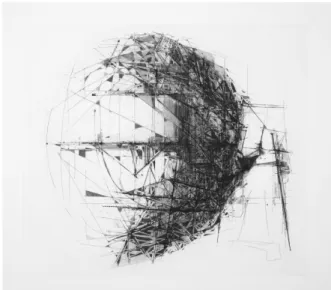
Ian Chamberlain is an artist and printmaker predominately working within the field of etching. His work is held in internationally renowned collections including the V&A and the Tate Modern. He has been shortlisted for both the Jerwood and John Ruskin Drawing Prize. His work takes reference from an on-going interest in manmade technological forms of industrial structures such as bridges, the scientific radio telescopes at Goonhilly Satellite Earth Station, or ex military structures such as the Acoustic sound mirrors.
The majority of the subjects and locations he records were once considered at the forefront of technology during their lifetime. Some of those technologies are now defunct or have been reconfigured for different uses. The subject matter therefore is echoed in the process used to record it. The etching process enables him to make a sustained enquiry into the subject’s structure, location and the effects of time passing. It becomes his own visual experience and a graphic equivalent to an observed moment in time.
Figure 1: Sat.VI, 2015 © Ian Chamberlain
Figure 2: Transmission V, 2018 © Ian Chamberlain
6. WHY WAS THE ARTIST SELECTED?
7. TESTING CONDUCTED
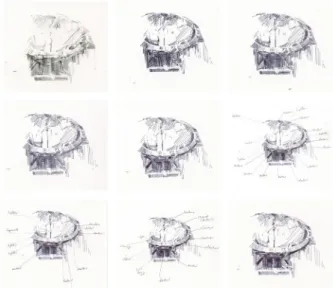
The first step was to conduct a basic feasibility study to ascertain if one of Ian’s drawings could be reproduced by the robot. To do this, a drawing provided by the artist was digitalized and initially drawn by the robot using a pen to gain a clear indication of how the robot was translating it. The image was then manipulated in vector software to determine a more refined result. This involved analysing the robotic drawing, comparing it to the original sketch. Although the on screen image looked homogeneous to the original, it was only when the image was output through the robot that we could ascertain a better understanding of which aspects needed to be adjusted. Due to the digitalisation of the image, this on-going manipulation was easily achieved, removing and adding areas of shade where desired. After a series of iterations, a test image was agreed.
The ability to develop and adapt the image before the plate is etched is a crucial change in the engraving process. To remove lines in traditional etching you have to use burnishing techniques, which can be very time consuming. Through the robots capability of first drawing the image on paper, the artist can reduce the amount of corrections needed when transcribing the image to the copper plate.
It is also within this iterative process that we start to examine human gesture. By comparing the robots marks to that of Ian’s pencil lines we can start to analyse the way the artist has built up the composition and creation of depth and shade. As well as this giving us a better understanding of the way in which humans draw, it also allows us to examine the subtly and nuances’ within the robot’s mark making.
Figure 3: Original pencil drawing provided by the artist
Figure 4: Drawing robot iterations
At this point a copper plate was prepared with hard ground in the traditional way and an etching needed was inserted into the robot. The plate was then added and etched.
Figure 5: Robot etching the plate
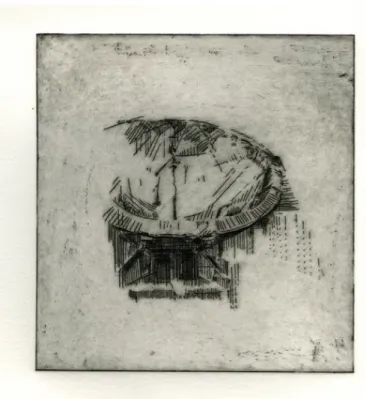
Figure 6: First test etching
Although the results at this early stage cannot be compared to Ian’s finished etchings, as an initial starting point, it was felt that there was interesting potential. Ian’s final prints are made up of many phases, which include much reworking of the plate. It also incorporates techniques such as aquatint, stopping out and burnishing until the desired outcome is achieved. As our testing is still in the feasibility stage, these extensions to the etching process will be left to one side for the moment. It is acknowledged though, that these additional elements pose a potential problem for the machine if we wish it to accomplish more refined results through purely robotic means.
To explore our preliminary mark-making findings further, another of Ian’s images was digitalised, this time both drypoint and hard ground etching were investigated to see if the machine was able to engrave into a variety of materials and how the printed outcomes varied. This would enable us to determine the most suitable substrate and tools for the robotic process.
Figure 7: New original pencil drawing provided by artist
Figure 7: Hard ground etching
**(check this) put in image from dry point.**
The robot struggled at times with the drypoint due to the pressure needed to engrave the material. The printing method, where no acid bath is used, also meant that it was much more difficult to acquire a variation in printed line depth and therefore hard ground etching was considered more complementary.
7. RESULTS/ ANALYSIS
The results were then fed back to the artist and a dialogue opened up to discuss the potentials of the medium. The first observation was that as a starting point, from nothing to the given results the outcomes are surprisingly positive, the robot was well suited to the method.
utilised to produce under-drawings, which the artist could then rework. The ability to explore pattern and repeat elements were also of interest, as was the opportunity to experiment with scale
In regards to further areas of development, the robots ability to produce a dot matrix could lend itself well to the Mezzotint printmaking method, also part of the intaglio family. This could also be used to create halftone, something that is considered very difficult using the conventional hand-rendered means. Experimenting with miss-registration, overlapping and tiling could produce some interesting variation and was considered as an area that needed further investigation. Digital typography and vector graphics could also bring a new aesthetic to the medium, which could open up etchings appeal to a wider audience.
Potential problems were also highlighted. The artist felt that roughly only about forty per cent of his etching process lies in the line generation. To obtain the real elegance and depth associated with many fine works, supplementary practices would have to be introduced. Further research would be needed to see if the robot was able to contribute to aspects such as burnishing and/or aquatint.
Another concern that was raised resided around the removal of the human touch. For many, a large part of etching’s charm lies within its reliance on the haptic and the craftsmanship with the hand-rendered technique. However, as with many other traditional methods, the introduction of digital aspects may change how some artists approach the medium but it is unlikely to cause the traditional method to disappear.
8. CONCLUSION
With an increasing number of artists utilising more digital means and tablets as a drawing method, it makes sense to look at new ways to output these images. A robot with its ability to make marks in a physical manner analogous to that of human gesture lends itself particularly well for this use. At this time, this robotic machinery is mainly residing within research labs but as the technology becomes more widely available, the potentials are extremely exciting.
As seen with letterpress in more recent years, a new generation of tech savvy artists are revitalising a traditional method through digital means. Historically within printmaking, with each new technological breakthrough there has been a desire to rekindle traditional processes combining it with cutting edge technology. Vector software gives artists an ability to incorporate a magnitude of graphic elements and typography not generally associated the etching field, with the potential of breaking it into new ground.
And of course there is the whole field of AI art that can also be explored. Now we have robots that can produce both the visual compositions and also physically render them, we open up another wave of possibilities that can be translated into print.
As with all new technological developments within the art field, it generates fears of traditional techniques being striped of their unique haptic quality. That is in no way our intention. Our hope is to add something new and reinvigorate interest in the medium. Due to the fundamental differences between people and machines, necessary robot-solutions will always need to be fostered and will provide interesting disparities in both technique and effect for the purpose of etching. Hopefully with these new opportunities and challenges, a new breed of digital etcher will arise.
9. REFERENCES
Bakkum, D. J. et al. (2007) ‘MEART: The semi-living artist’, Frontiers in Neurorobotics, 1. doi: 10.3389/neuro.12.005.2007.
Deussen, O., Lindemeier, T., Pirk, S., &
Tautzenberger, M. (2012). Feedback-guided stroke placement for a painting machine, 25-33.
Herath, D., and C. Kroos. (2016) Robots and Art: Exploring an Unlikely Symbiosis. Springer,
Moura, L. (2007). A new kind of art: The robotic action painter. X Generative Art Conferece, Politecnico di Milano University.