The
Connection Machine
System
CM Fortran
Programming Guide
_<:·~::'*..'.~'..:?,'_.,.:
'.-!''',.':
· "
'
Version 1.0
January 1991
First printing, November 1989 Revised, February 1990 Revised, January 1991
The information in this document is subject to change without notice and should not be construed as a commitment by Thinking Machines Corporation. Thinking Machines Corporation reserves the right to make changes to any products described herein to improve functioning or design. Although the information in this document has been reviewed and is believed to be reliable, Thinking Ma-chines Corporation does not assume responsibility or liability for any errors that may appear in this document. Thinking Machines Corporation does not assume any liability arising from the applica-tion or use of any informaapplica-tion or product described herein.
Connection Machine® is a registered trademark of Thinking Machines Corporation. C*(is a registered trademark of Thinking Machines Corporation.
CM, CM-1, CM-2, CM-2A, and DataVault are trademarks of Thinking Machines Corporation. Paris, *Lisp, and CM Fortran are trademarks of Thinking Machines Corporation.
C/Paris, Lisp/Paris, and Fortran/Paris are trademarks of Thinking Machines Corporation.
In Parallel® is a trademark of Thinking Machines Corporation.
VAX and VAX FORTRAN are trademarks of Digital Equipment Corporation. Sun and Sun FORTRAN are trademarks of Sun Microsystems, Inc.
UNIX is a registered trademark of AT&T Bell Laboratories.
Copyright © 1989, 1990, 1991 by Thinking Machines Corporation. All rights reserved. Thinking Machines Corporation
245 First Street
Cambridge, Massachusetts 02142-1264
Contents
M.. "x.,.., .'.':.. ., .... s...wff.: -. ~.,v<. v ~
About
This
Manual
..
.. ... ... .. ...
...
Customer
Support
...
... ..
...
...
Part I Getting Started
Chapteir 1 What Is CM Fortran? ....
...
1.1 Aray Processing in CM Fortran ... 1.1.1 Compared with Fortran 77 ... 1.1.2 Example in Fortran 77 and CM Fortran .. 1.1.3 Compared with Fortran 90 .
1.2 Data Parallel Processing ...
1.2.1 Compared with Serial Processing ...
1.2.2 In the CM System . ... ... ... 1.3 Memory Management in CM Fortran ... ... 1.4 The Features of CM Fortran ... ... 1.5 CM Fortran Documentation ...
Chapter 2 Basic Operations ...
2.1 A Simple Program ... 2.2 Declaring and Initializing Arrays ... 2.3 Array Operations ... ...
2.3.1 Conformable Arrays ... 2.3.2 Scalar Extension ... 2.3.3 Array Homes ... 2.4 Retrieving CM Data ... 2.5 Compiling and Executing ...
2.5.1 Specifying Execution Model ...
2.5.2 Incorporating Existing Routines ...
i :i " if .v. f 'CMi' P ramming G
Part 11 Programming in CM Fortran
Chapter 3
Array Declarations and Initial Values
253.1 Declaring Arrays ... ... 26
3.1.1 Using the ARRAY Attribute ... ... 26
3.1.2 Array Properties ... ... . 27
3.2 Defining Named Constants ... 27
3.3 Setting Array Values ... ... 28
3.3.1 Assignment ... 28
3.3.2 CMF RANDOM Subroutine ... 29
3.3.3 DATA Statement ... 29
3.3.4 Array Constructors ... 30
3.3.5 DATA Attribute ... 31
3.4 A Note on Common Arrays ... 32
Chapter 4 Selecting Array Elements ....
4.1 Conditional Operations ... 4.1.1 The WHERE Statement ... 4.1.2 The WHERE Construct ... 4.1.3 Conditional Intrinsic Functions.. 4.1.4 Front-End Conditionals ... 4.2 Array Sections ...
4.2.1 Triplet Examples ... 4.2.2 Using Array Sections ...
Chapter 5
33 33 34 35 36 37 39 39 42 45 46 48 48 48 49 49
Subroutines
...
5.1 Array Objects as Arguments ... 5.1.1 The SAVE Attribute ... 5.2 Homes of Array Arguments ...
5.2.1 Mismatched Homes ... 5.2.2 Avoiding Mismatched Homes . 5.2.3 Verifying Array Homes ...
Version 1.0, January 1991
iv CMFortran Programming Guide
intes i
;
:
ii:
'.
M:
:.:.:i .
I
::
'
5.3 Types and Shapes of Array Arguments ... 5.3.1 Declaring Dummy Array Shapes ... 5.3.2 Declaring Local Array Shapes ... 5.3.3 Making Subroutine Interfaces Explicit... 5.4 Array Sections as Arguments ...
5.4.1 Passing Array Sections ... 5.4.2 The INTENT Attribute ... 5.4.3 Example of INTENT ... 5.5 Retrieving Array Properties ...
5.5.1 Array Shape ...
5.5.2 Array Size ... 5.5.3 Dimension Bounds ... 5.5.4 Inquiry Example ... 5.6 Array-Valued Functions ... 5.7 Common Arrays ...
5.7.1 Common Array Homes ... 5.7.2 Declaring Common Arrays ... 5.7.3 Initializing Common Arrays ...
r6
Data Movement ...
6.1 Array Sections ... 6.1.1 Dimensional Shifts ... 6.1.2 Shifting Noncontiguous Sections 6.1.3 Efficiency Note ... 6.1.4 Permutations ... 6.2 Vector-Valued Subscripts ...
6.2.1 Examples ... 6.2.2 Permutations ...
6.2.3 Assigning Permuted Sections .. 6.2.4 Replicating Data ... 6.3 Intrinsic Shift Functions ...
6.3.1 Using CSHIFT ...
6.3.2 Using EOSIIFT ...
6.4 The TRANSPOSE Function ...
50 50 52 53 54 55 56 56 58 58 58 59 60 60 61 61 62 64
Chaptei
...
67
...
67
...
68
...
69
...
70
...
70
...
71
...
71
...
73
vi ff sssfS:f' ff' -f' -'f'-5' f.'.... CM.. Fortran Prgamn Gud e..
Chapter 7 Array Transformations ...
797.1 Array Reduction ... ... 80
7.1.1 The ARRAY Argument ... 80
7.1.2 The MASK Argument ... 81
7.1.3 Logical Arrays ... 82
7.2 Element Location ... 83
7.2.1 Numeric Arrays ... 83
7.2.2 Logical Arrays ... 85
7.2.3 Element Location Example ... 86
7.3 Array Construction ... 87
7.3.1 Reshaping an Array ... 88
7.3.2 Merging Arrays ... 90
7.3.3 Spreading an Array ... 91
7.4 Array Multiplication ... .. ... ... 92
Chapter 8 The FORALL Statement ...
8.1 Syntax ...
8.1.1 The FORALL Assignment ... 8.1.2 The FORALL Mask ... 8.2 Execution Model ...
8.2.1 As If Simultaneous ... 8.2.2 Serial versus Parallel ... 8.3 Data Motion ...
8.3.1 Compared with Other Features ... 8.3.2 Operations on Irregular Data ... 8.3.3 Parallel Prefix Operations ...
93
94 95 99
100
100
102
104
104 107 108
Version 1.O, January 1991
ConnRts vi
Part
m
Optimization
Chapter 9 Optimizing CM Array Layout ...
9.1 Specifying Directives ... 9.1.1 Scope of Directives ...
9.1.2 Noncanonical Arrays as Arguments ... 9.2 The Virtual Machine Model ...
9.2.1 Two Execution Models ... 9.2.2 Virtual Processing ... 9.2.3 VP Geometries ... 9.3 Canonical Array Layout ... 9.4 The LKYOUT Directive ...
9.4.1 Syntax ... 9.4.2 Array Homes ... 9.4.3 Serial Ordering ... 9.4.4 Aligning Multiple Arrays 9.5 The ALIGN Directive ...
9.5.1 Syntax ... 9.5.2 Benefits and Costs ...
Appendix
Appendix A
A.1
A.2 A.3 A.4
Sample Programs ...
Histogram
...
Convolution
...
Prime Number Sieve ... Laplace Solver ......
139
...
139
...
142
...
145
...
149
Index
Index ...
153
About This Manual
Objective
This manual introduces the array-processing features of CM Fortran in a task-oriented way. It is a companion volume to the CM Fortran Reference Manual.
Intended Audience
The reader of this manual is assumed to have a working knowledge of Fortran 77 (either VAX FORTRAN or Sun FORTRAN). No prior knowledge of CM Fortran or of the Connection Machine system is required.
Revision Information
This manual supersedes Getting Started in CM Fortran, Version 5.2-0.6, February 1990. A
condensed version of this Programming Guide is now available as Getting Started in CM Fortran, January 1991.
Organization of This Manual
Part I Getting Started
A gentle introduction to the data parallel programming model, the basics of the Connection Machine system, and a simple program in CM Fortran.
Part II Programming in CM Fortran
The major array-processing features that CM Fortran adds to Fortran 77.
Part 1I Optimization
The techniques of optimizing CM Fortran programs by controlling the layout of arrays in the CM's distributed memory.
Appendix A Sample Programs
*g',-S~,xi~E CM1 Fortrn Pr>85.o-grSjam in;g- Gu-idV5,e,,
Related Documents
* Getting Started in CM Fortran. Introduces the CM Fortran language. It is a condensed
version of the present manual.
* CMFortran Reference Manual. Defines the CM Fortran language, specifying the complete
syntax and semantics of every feature and compiler directive.
* CMFortran User ' Guide. Describes the CM Fortran compiler command and switches, the
CM Fortran library of utility procedures, and various program development tools. The CM libraries-scientific software, parallel I/O, visualization, and Paris (the CM Paral-lel Instruction Set)-are described in separate volumes.
*
CM Fortran Optimization Notes. A pair of manuals that provide hints for getting best performance from CM Fortran programs. The two Optimization Notes manuals describe, respectively, the two execution models for which CM Fortran programs can be compiled.*
CM Fortran Release Notes. Summarizes the new features in the current release and lists restrictions and implementation errors.Version 1.0, January 1991 CMFortran Programming Guide
Customer Support
_ j~~~~i~~~~~'.s. fi5 c s
~
0 scisff.c u~s fRsyic~ MsfW~:s~~ s;:S"ccThinking Machines Customer Support encourages customers to report errors in Connection Machine operation and to suggest improvements in our products.
When reporting an error, please provide as much information as possible to help us identify and correct the problem. A code example that failed to execute, a session transcript, the record of a back-trace, or other such information can greatly reduce the time it takes Thinking Machines to respond to the report.
To contact Thinking Machines Customer Support:
U.S. Mail: Thinking Machines Corporation Customer Support
245 First Street
Cambridge, Massachusetts 02142-1264
Internet
Electronic Mail: Usenet
Electronic Mail:
Telephone:
ames!think! customer-support
Part I
Getting Started
I::... ,', 'I 'A,, ' ,," . ::, k
I'
,AChapter 1
What Is CM Fortran?
The CM Fortran language is an implementation of Fortran 77 supplemented with
array-processing extensions from the ANSI and ISO (draft) standard Fortran 90. These
array-processing features map naturally onto the data parallel architecture of the Connec-tion Machine (CM) system, which is designed for computaConnec-tions on large data sets. CM Fortran thus combines:* The familiarity of Fortran 77, often the language of choice for scientific computing
· The expressive power of Fortran 90, which offers a rich selection of operations and intrinsic functions for manipulating arrays
· The computational power of the CM system, which brings thousands of processors to bear on large arrays, processing all the elements in unison
1.1 Array Processing in CM Fortran
The essence of the Fortran 90 array-processing features is that they treat arrays as first-class objects. An array object can be referenced by name in an expression or passed as an argument to an intrinsic function, and the operation is performed on every element of the array.
1.1.1 Compared with Fortran 77
In Fortran 77, operations are defined only on individual scalars. Operating on an array re-quires stepping through its elements, explicitly performing the operation on each one. With
.:.:,.:,.;.;.:...;...;..:... r:·:Q ,... . .... .... ... :·,,::·:·: .::·:·:·.·.·.·.·.·.·.;·.;·.·. :;· ::i: :~:·:j:::.:·:·: w i:2:·::~::: ::\:::::::jiBi::::I:·:·i:·:~·:·:·.·*~ · ;i·;·:·:·:::,·:·:·e;:~t~·::. ...
Fortran 90 constructions, it is not necessary to reference array elements separately by means of subscripts, and it is not necessary to write DO loops or other such control con-structs to have the operation repeated for each element. It is sufficient simply to name the array as an operand or argument.
1.1.2 Example in Fortran 77 and CM Fortran
Consider a 4-element array A, initialized to [ 1, 2, 3, 4 ]: INTEGER A(4)
DATA A / 1, 2, 3, 4 /
Suppose you want to increment each of the values by 1, so that A contains [2,3,4,5]. The familiar method in Fortran 77 is to reference the elements by subscript and, through a looping construct, explicitly increment each value:
DO 30 I=1,4
A(I) = A(I) + 1 '
30 CONTINUE
If the array is multidimensional, then the control sequence is nested to operate on all the elements:
INTEGER A(4,4) DO 30 I=1,4
DO 40 J=1,4
A(I,J) = A(I,J) + 1 40 CONTINUE
30 CONTINUE
CM Fortran dispenses with the subscript references and the DO loops. Both the above oper-ations are expressed simply as:
A=A+ 1
These code fragments perform the same set of operations, but their semantics are slightly different. The Fortran 77 statements are evaluated in the order specified by the nested
[i
CMFortran Programming Guide
Chapter$ 1.~9^>s8S Wha Is$:$>~g$$>$ CM;$N Fortran?> E.$ $Z$U .>5
loops, whereas the Fortran 90 construction allows the elements of A to be evaluated in any order, including simultaneously.
A Fortran 90 array reference can be used for any size or shape array and for any array operation defined in CM Fortran. The array could, for example, be 4-dimensional, and the operation could be any Fortran operator or intrinsic function:
REAL B( 512, 64, 8, 4 )
B = 8.0 ! Set all 1,048,516 elements to 8.0. B = B * 2.0 ! All 1,048,516 elements contain 16.0. B = SQRT( B ) ! All 1,048,516 elements contain 4.0.
NOTE
The simple array reference A or B is the default form of a Fortran
90 triplet subscript. A triplet subscript, such as A (1: 4:1),
con-tains the information that Fortran 77 expresses in the control specification of a DO loop: the first and last elements and the incre-ment.
Fortran 90 thus replaces DO loops with a form of array reference that indicates all the elements of interest. See Section 4.2 for more information about Fortran 90 array references.
This manual uses the term array object to mean any array that is referenced in the Fortran 90 manner. That is, an array object is one for which the array reference contains an explicit or implicit triplet subscript that indicates all the elements that are to be operated upon.
1.1.3
Compared with Fortran 90
CM Fortran implements the array-processing features of Fortran 90. Features proposed for Fortran 90 in the major areas other than array processing-such as pointers, structures, modules, and precision control-are not part of CM Fortran.
Version 1.0, January 1991
5
6110°
C M>
Fortran
Programing Guide
1.2 Data Parallel Processing
Fortran 90 array processing is reflected in the hardware of the data parallel Connection Machine (CM) system. From the software perspective, an array object refers to all the data elements of the array simultaneously. From the hardware perspective, the separate opera-tions on the array's elements are all performed simultaneously.
1.2.1 Compared with Serial Processing
A serial implementation of Fortran 90 would have the syntactical convenience of referenc-ing arrays as objects, but the compiler would necessarily generate serial loops. However, if the operations on individual data elements are independent of one another, there is no inherent need for them to be sequential. A computer that can store each data element in the memory of a separate processor is free to operate on all the data elements at the same time. For example, given a 40 x 40 x 40 array A, consider the statement:
A = SQRT (A)/2
To execute this statement, a serial computer would need to perform 128,000 arithmetic computations. A data parallel computer, in contrast, provides a processor for each of the 64,000 data elements, and each processor needs to perform only two computations.
1.2.2 In the CM System
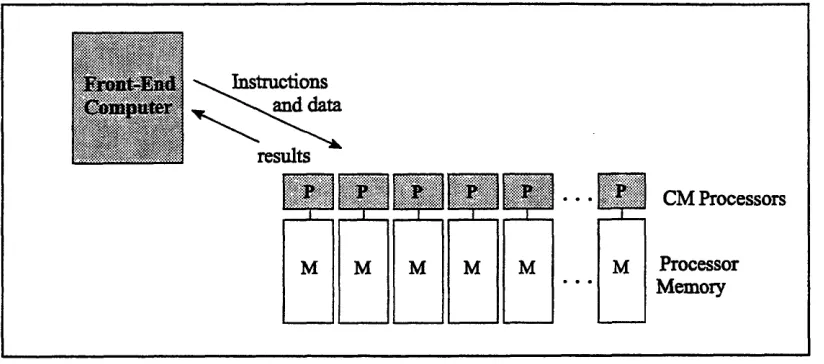
The CM system consists of a collection of simple processors, each with its own memory, all acting under the direction of a conventional processor called the front end. Arrays used in Fortran 90 constructions are stored in CM memory, one element per processor. Since many data sets are larger than even the largest CM, the system uses a virtual processing mechanism, whereby each physical processor simulates some number of virtual processors by subdividing its memory, to ensure that a processor is assigned to each array element.
When the front-end computer executes a CM Fortran program, it performs serial opera-tions on scalar data stored in its own memory, but sends any instrucopera-tions for array operations to the CM. When the CM receives an instruction, each (virtual) processor ex-ecutes it on its own data point. Other instructions transfer data between the front end and the CM or between the CM and a peripheral storage device such as the DataVault mass
storage system.
i ,
Cap 1?.
Wa I Mr.,ta
7
Figure 1. Interactions between front end and CM
Because CM memory is distributed among the processors, the system provides several mechanisms by which processors can access each other's memories. Interprocessor
com-munication is transparent to the user, but many CM Fortran operations map onto
communication instructions in a straightforward way. The three communication mecha-nisms are:* Nearest-neighbor, or NEWS, communication, whereby each processor gets a value from its neighbor on an n-dimensional grid, all at the same time
* General-purpose, or router, communication, whereby each processor gets a value from any arbitrary processor, all at the same time
* Global communication, which includes cumulative computations along grid axes and reduction of an array to a single value
Notice that because there is only one instruction stream, the CM processors are naturally synchronized. Race conditions cannot develop because no processor proceeds to the next instruction until all have finished the current instruction. Processors for which the instruc-tion is not relevant (because they have been used in a condiinstruc-tional construcinstruc-tion, for instance)
are deactivated; they do nothing until a later instruction reactivates them.
The array-processing constructions that CM Fortran has adopted from Fortran 90 map
nat-urally onto this data parallel architecture. Although this manual does not focus on
implementation issues, some of the basic programming practices it discusses follow clearly from even this brief introduction to CM architecture.Version 1.0, January 1991
Instructions and data
results
CM Processors
M Processor
..
f I
MemoryChapter . hat Is CM Fontran? 7
}..
M M M
8e -fst ffs>>rgsssf6isx-s..eS
~~i
S:'i,,XSi'S . ,B2-fS. CM Fortran ProgrammingS Guidefn1.3 Memory Management in CM Fortran
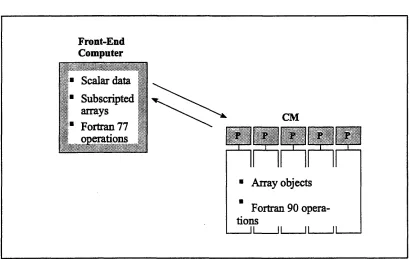
CM Fortran is a superset of Fortran 77. The differences between the two languages reflect a basic fact of CM architecture: a CM Fortran program is directing two CM system compo-nents with different memory organizations. An array can have its home either in the
centralized memory of the front end or in the distributed memory of the CM.
No new data structure is needed to express parallelism, and the programmer need not take any special action to invoke the CM. The CM Fortran compiler allocates arrays in the memory of one machine or the other depending on how the arrays are used. In brief:
* Arrays that are used only in Fortran 77 constructions reside on the front end. The front end stores and processes all scalar data, including subscripted arrays.
* Arrays that are used in Fortran 90 constructions reside on the CM. The CM stores and processes all arrays that are referenced as array objects. (Arrays that are refer-enced in both ways reside on the CM. See Section 2.3.3.)
Figure 2. Division of labor between front end and CM
$ ,,
Front-End Computer
* Scalar data
i Subscripted CM
arrays * Fortran 77
OD)erat~pns
Arrayobjects
Fortran 90 opera-tions11 11 121 1
CM Fortran Programming Guide
8
Iia '.Jf . Ha-itif':f i MF i-Ri i>i'iS rt `an E :ii: 9
The CM Fortran programmer need not, of course, specify where data is stored (although compiler directives and switches do provide this capability). However, even the beginning user needs to understand the division of labor between the two machines so as to avoid trying to perform a CM (parallel) operation on front-end (scalar) data, and vice versa. Such pitfalls are pointed out throughout this manual.
Because of the CM's distributed memory, not all of Fortran 77 can be used with CM array objects. Most Fortran 77 features are extended for use with array objects, as the + and = operators are used above in the array operation A = A + 1. However, certain features
with storage-order dependencies-most notably, the EQUIVALENCE statement-are not supported for CM data.
1.4 The Features of CM Fortran
The array-processing features that CM Fortran draws from Fortran 90 include:
*
Expanded semantics for Fortran 77 operators and intrinsic functions, such that theycan take an array object and operate on its elements
* Array sections and vector-valued subscripts, new syntax for selecting subarrays
from array objects
• The WHERE statement and construct, which operate conditionally on an array's
ele-ments depending on the eleele-ments' values
*
New intrinsic functions for permuting and transforming arrays, as well as forcon-structing arrays and inquiring about their properties
*
Attributed type declarations, an alternative to Fortran 77 type declarations and theDIMENSION statement for declaring arrays
CM Fortran also includes some Fortran 90 features that are not specifically related to array processing, but are commonly found in implementations of Fortran 77. Examples of these
are the control-flow statements CASE, DO TIMES, DO WHILE, and END DO. The CMFortran
Reference Manual gives a complete description of all CM Fortran features.
Version 1.0, January 1991
10 F :S0:S S:S:4S CMFSort'an FC4 Programming GuideSF
Finally, CM Fortran includes some non-standard features that are particularly useful for data parallel programming on the Connection Machine system:
*
The FoRALL statement, a powerful facility for initializing arrays, for selectingsub-arrays, and for specifying data movement in terms of array indices.
*
Compiler directives, several of which control the layout of arrays in ConnectionMachine memory. Layout can have major effects on program performance.
*
Utility routines library, which serves a number of purposes:· Providing language-level capabilities that are not yet implemented in CM Fortran, such as generating random numbers in an array
* Providing CM system services, such as transferring arrays between front-end memory and CM memory or accessing the CM (parallel) file system on a peripheral storage device
* Improving performance in cases where the CM Fortran compiler has a temporary "blind spot" and cannot translate language syntax into the opti-mal parallel instruction
1.5 CM Fortran Documentation
*
CM Fortran Reference Manual defines the language and the compiler directives.*
CMFortran User's Guide describes the compiler and its switches, somedevelop-ment utilities such as the timer and debugger, and the library of utility routines.
*
CMFortran Optimization Notes describe the mapping of CM arrays onto theun-derlying machine and provide some hints about efficient programming practices.
NOTE
Please see the current CMFortran Release Notes for any restric-tions or bugs in the features described in this manual.
CMForfran Programming Guide
Chapter 2
Basic Operations
This chapter examines some simple CM Fortran code to illustrate the operations that are fundamental to any array-processing program:
* Declaring arrays
* Initializing or otherwise moving data into arrays
* Computations on arrays
· Retrieving the results of computations
* Compiling and executing a program
For simplicity, this chapter focuses on elemental operations on whole arrays.
* An elemental operation affects the elements of an array as if it had been applied separately to each element (in undefined order). Such an operation occurs within each CM processor independently of the others. Operations that specify data movement between processors are deferred to Chapter 6.
* A whole array is an array object specified simply by name, which indicates all the elements of the array. Such a reference has an implicit triplet subscript that corre-sponds to the declared bounds of the array. Chapter 4 shows operations that apply only to selected elements of an array.
2.1 A Simple Program
The following program shows all the basic operations noted above. It declares and initial-izes two vectors, computes the sum of the squares of their corresponding elements, and
12a~E";-~ h INgrmmn
>< I<.s*,s:,Aw,,,>
CMM Fortran Guide<m.<Sprints out the result vector and the result vector's highest value. The remainder of this chap-ter steps through this program, pointing out the basic features of CM Fortran.
PROGRAM SIMPLE IMPLICIT NONE
INTEGER A, B, C, N, MAXVALUE PARAMETER (N=5)
DIMENSION A(N), B(N), C(N)
DATA
A /
B=2
1,2,3,4,5 /
! a CM array assignment C = A**2 + B**2
PRINT *, PRINT *,
! array-valued expressions 'Array C contains:'
C ! output of CM data
MAXVALUE = MAXVAL( C ) ! a CMF intrinsic function PRINT *, 'The largest value in C is ', MAXVALUE
STOP END
2.2 Declaring and Initializing Arrays
CM Fortran supports all standard Fortran 77 syntax for declaring and initializing both sca-lar values and arrays.
Program simple. f cm uses Fortran 77 type specification statements, as well as the state-ments DIMENSION, PARAMETER, and DATA, to declare and initialize the scalar values N and
MAXVALUE and the array x Since CM Fortran supports standard Fortran I/O features on the UNIX file system, programs can also use the READ statement for initialization. (To read data from the CM file system, see the volume Connection Machine /0 Programming in the CM documentation set.)
Oi v
Chaper:o,:>
2.S....
Basi O
>:
opri
s
-.
,.''.,:.
:
~2~:~:~
$:.: :..2f..
fX
'+4p..f..f..:
13
CM Fortran supports seven data types:
CHARACTER REAL
LOGICAL DOUBLE PRECISION (real)
INTEGER COMPLEX
DOUBLE COMPLEX (double-precision complex)
The IMPLICIT statement allows the programmer to override Fortran's implicit typing
rules with specified typing rules, each of which associates one or more letters with a data type. The form used in program simple, IMPLICIT NONE, means that all identifiers must be declared. This form is useful for catching misspellings at compile type.
Arrays can be of any type, and from one to seven dimensions. However, character arrays are not supported on the CM. That is, an array declared as type character is always stored in the memory of the front-end computer, and its elements are processed serially in the Fortran 77 manner. All other arrays can be stored and processed either on the front end or on the CM depending on the use the program makes of them.
As an alternative to the Fortran 77 syntax shown, CM Fortran also offers the more econom-ical Fortran 90 syntax. The new declaration syntax can specify type, dimensionality, and initial values all in a single statement (see Chapter 3).
2.3 Array Operations
An array operation is any reference to an array object (that is, any reference using Fortran 90 syntax) in an expression, assignment, or intrinsic function call. Fortran 90 and CM For-tran extend the semantics of ForFor-tran 77 such that operators and intrinsic functions can take array objects and operate on their elements. CM Fortran also adds a number of Fortran 90 intrinsic functions that manipulate or transform array objects.
The various forms of array operations are all illustrated in program simple:
B = 2 ! a CM array assignment C = A**2 + B**2 ! array-valued expressions PRINT *, C ! output of CM data
MAXVALUE = MAXVAL( C ) ! a CMF intrinsic function
Version 1.0, January 1991
14ie>rirs ~r r;~s..~~rrMs~ a r ~ r S E>s. .. ys.iz.>s CMs~r~ Forrtif~rn Pmgam n Guide
Notice the use of the Fortran 77 operators +, =, and **. These features have been extended to operate on all the elements of an array object. Similarly, array objects can be passed as arguments to all the Fortran 77 intrinsic numeric and mathematical functions, such as Ass, MAX, and SIN. However, because character arrays are not supported on the CM, the intrin-sic character functions, such as CHAR and INDEX, cannot take array objects as arguments. The function MAXVAL is an example of the array-processing intrinsic functions that CM Fortran adds to Fortran 77. The array argument(s) to these functions are taken to be CM array objects.
2.3.1 Conformable Arrays
When an expression or assignment involves two or more arrays, the arrays must be
con-formable, that is, they must be of the same size and shape. Each set of corresponding
elements of conformable arrays resides in the memory of a single CM processor, which performs the computation on that set of elements.
For each group of conformable arrays, the system configures a set of virtual processors into a logical grid that reflects the shape of the arrays. Although arrays of many different sizes and shapes can coexist in CM memory, conformable whole arrays are always allocated in the same set of processors in the same order.
A
B
C
1 2 3 4 5 6
i: 2 1 3 1 4 1 5 16 l
I
2 3 2 3j
26 6 8 8::.': ... 61 l8
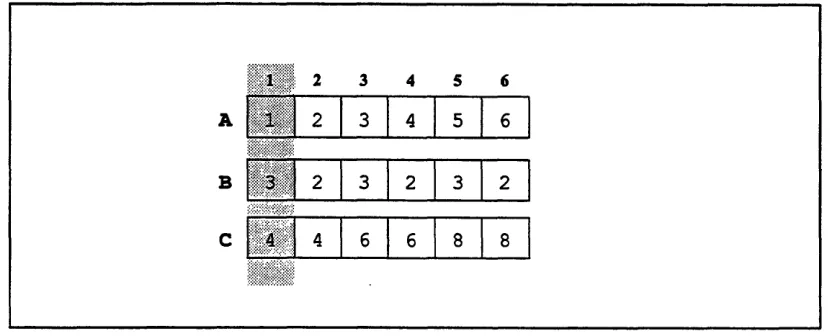
Figure 3. An elemental vector addition, c = A + B, with one processor highlighted
01,,
Chapter 2. Basic Operatins 15
As a result, elemental operations on conformable arrays are extremely efficient. Such oper-ations need not move data into the appropriate processors: it is already there. Each processor need only index within its own memory to locate the operands. For example, Figure 3 highlights the memory of a single processor as the CM adds the corresponding elements of two vectors, A and B, and places the results in a third vector, c.
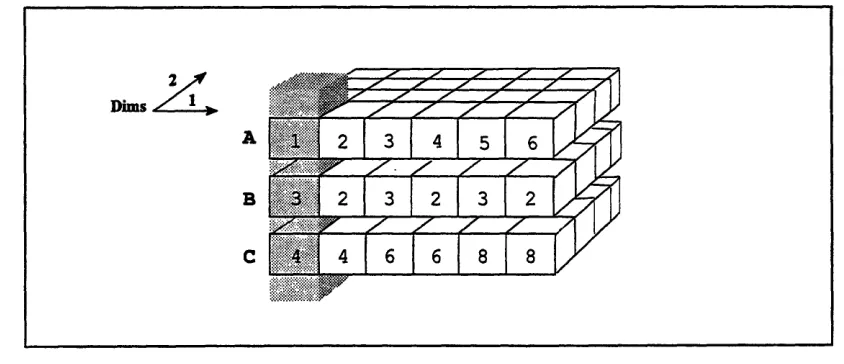
The comparable operation on matrices is shown in Figure 4, assuming three 6 x 4 arrays. As in the figure above, a set of virtual processors is configured to reflect the shape of the arrays, and each processor has a set of corresponding elements within its own memory. Each processor does exactly the same operation it would do for a vector addition; the dif-ference is that the processors are configured differently.
Figure 4. An elemental matrix addition, c = A + B, with one processor highlighted
This manual adopts the Fortran convention of depicting array elements in column-major order, although there is no implication that successive column elements are in contiguous memory locations. That is, element A (2,1) is not necessarily contiguous with element
A (3 ,1) in CM memory, as it would be in the memory of a serial computer. Instead, the CM
virtual processor that contains elements (2, 1) of all three conformable arrays is consid-ered a nearest neighbor of the virtual processor that contains elements (3,1) of all three arrays. Moving data from one array position to another thus entails interprocessor commu-nication, as described in Chapter 6.
Version 1.0, January 1991
9
Dims
A
B
C
2
23
4 51 6
32
tX
2 03 14zff
iW 4 6 6 8 8 /
my
.
.
'>
i
.:i '
!;
:
x
>M
oran..
Proga ing ie..i..
NOTE
CM programmers should avoid the common Fortran 77 practice of declaring one large array and reshaping pieces of it as needed. With distributed memory, and given that arrays of different shapes are allocated in different sets of virtual processors, this practice can lead to unexpected results.
It is preferable instead to declare all the needed arrays separately, each in the desired shape. If you need to reshape a particular array -for instance, to change A (N,M) to A (N*M) -use the intrinsic function RESEIAPE (see Chapter 7).
2.3.2 Scalar Extension
Scalars may be intermixed freely in expressions that have array-valued components. When a scalar appears in such an expression, it is treated as if it were an array conformable with the other array(s) in the expression. For example:
A = B/5
C = D * 3.14159
The first statement divides each element of B by the constant 5 and assigns it to the corre-sponding element of A. In the second statement, each element of C gets the circumference of a circle whose diameter is D.
Recall that scalars are stored in front-end memory. When the CM system encounters a sca-lar in an array-valued expression, the front end "broadcasts" the value to all the CM processors. (The scalar value serves as an immediate operand; no CM space is allocated for it.) In effect, a scalar is conformable with any array and with different arrays in different expressions.
Scalar extension ("broadcasting") is not only good use of CM memory; it is also extremely efficient. It is a waste of memory for a program to store a separate copy of a constant in every processor, since broadcasting a value from the front end takes no more time than
e
I
S5P:):ji'iiiii:i9i
CM Fortran Programming Guide
Chapter 2. Baszc Uperations 17
accessing it in CM memory. In fact, assuming that array A has been set to 5.0, the first of these statements is much faster than the second:
B = B * 5.0
B=B *A
2.3.3 Array Homes
The machine on which an array is allocated is called its home. Aside from character arrays, which always reside on the front end, an array's home is determined by how the array is used within a program unit. A program unit is a main program, a subroutine, or a function.
* The front end stores all scalar data, including arrays that are referenced only as subscripted variables (in the Fortran 77 way) within a program unit. All serial op-erations, including looping operations on array elements, execute on the front end. Essentially, the front end executes all of CM Fortran that is Fortran 77.
This is a front-end operation:
INTEGER A(4)
DATA
A /
1,
2, 3,
4 /
DO 30 I-=1,4A(I) = A(I) + 1 ! A is allocated on front end 30 CONTINUE
* The CM stores all arrays that are referenced at all as array objects within a program unit. All operations on array objects execute on the CM. Essentially, the CM ex-ecutes all of CM Fortran that is drawn from Fortran 90.
This is a CM operation:
INTEGER A(4)
DATA A / 1, 2, 3, 4 /
A = A + 1 ! A is allocated on CM
* The CM stores all arrays that are referenced both as array objects and as sub-scripted variables within a program unit, although the serial operations execute on the front end.
Version 1.0, January 1991
--8. .s ' CM" Fo1--rem't >iOR S. san.,1W1: PIr2 rammi.gE ; . , R, ,YyS.YB 1 .1.*G '
{g<.Z:uidex
$
.>RgThis is a (rather pointless) mixed-home operation:
INTEGER A(4)
A = 5 !A is allocated on CM
DO 30 I=1,4
A(I) = A(I) + 1 ! Loop executes on front end 30 CONTINUE
These mixed-home operations tend to be inefficient, since the system moves the CM array one element at a time to the front end to perform the serial operation. If the algorithm demands a mixed-home operation, it is often advisable to use the CM
Fortran utility routines CMF FE _ARRAY TO CM and CMF iFE ARRAY FROM CM,
which copy an array en masse from one machine to the other. (See the CMFortran
User k Guide for information on CM Fortran utility routines.)
Arrays declared as common reside on the CM unless otherwise specified with a compiler directive or switch. Discussion of common arrays is deferred until the chapter on subroutines, Chapter 5.
CM programmers need to be aware of where particular arrays are allocated so as to avoid using mixed-home operations unintentionally. Using array operations on CM arrays gives the program the performance benefits of parallelism, but using a front-end looping opera-tion on a CM array can exact a high cost in performance as the system moves the array
element by element from one machine to the other.
It is crucial to consider arrays' homes when calling subroutines, since CM Fortran requires that the home of an actual array argument be the same as the home of a dummy argument in the procedure. However, arrays' homes are determined at compile time separately for
each program unit. The programmer must therefore be aware of the homes of arrays used
as arguments and must often take explicit steps to ensure that the homes of actual and dummy arguments match. See Chapter 5 for more information on arrays as arguments and on controlling their homes.
ChapteX~:~:Vr~'~~: 2. Baic ~(~( · O eratons C · 19·.::~%T
2.4
Retrieving CM Data
CM Fortran supports all Fortran I/O operations-the RmD, WRITE, and PRINT state-ments-for both front-end and CM data.
There are various ways to retrieve and display the results of CM computations. Some in-trinsic functions, such as MAxvAL or SUM, perform a combining operation on an array's elements and return the scalar result to the front end. The result of a reduction function such as this can, like any other scalar, be displayed with a PRINT statement. As shown in pro-gram simple. fcm:
INTEGER MAXVALUE
MAXVALUE = MAXVAL( C ) ! a CMF intrinsic function PRINT * -'The largest value in C is ', MAXVALUE
You can also retrieve a scalar value by subscripting a CM array in the Fortran 77 fashion to indicate the desired element. Notice that this is a deliberate use of the mixed-home con-struction: the array element that is referenced with a Fortran 77 subscript is automatically moved to the front end, where it is displayed by the PRINT statement:
PRINT *, 'The third element of array C is ', C(3)
You could also use the PRINT statement to view all the results stored in array c, since For-tran 1/0 statements are extended for use with CM data. As shown in program simple. .fcm:
C = A**2 + B**2 ! array-valued expression PRINT *, 'Array C contains:'
PRINT *, C ! output of CM data
For large vectors or for matrices, a FORMT statement might be used to improve the read-ability of the output:
INTEGER, ARRAY (4,4) :: D
PRINT 10, D 10 FORMAT (419)
Version 1.0, January 1991
· 2 :.: s r . . . .d. S. .,~. CM>. .2:¢.>.,..,::.>~ : For:ran>¥ . . .<..~:.xffi:.. Psa mn .. :.::::..:::g:.:::..:...: G i:de:.:. .
2.5 Compiling and Executing
To compile and execute a CM Fortran program:
1. Place the program in a file with the filename extension . fcm.
2. Compile the file with the CM Fortran compiler command cmf.
% cmf simple.fcm -o simple
3. Execute the program by specifying it as an argument to the CM System Software
command cmattach.
The following command line attaches the front end logically to the CM, making some default number of processors available to execute program simple.
% cmattach simple
Attaching the Connection Machine system NAME... cold booting... done.
Attached to 8192 processors on sequencer 0 Paris safety is off.
Array C contains:
5 8 13 20 29
The largest value in C is 29 FORTRAN STOP
Detaching... done.
See the CM Fortran User 's Guide for more information about compiling and executing CM Fortran programs.
2.5.1 Specifying Execution Model
CM Fortran programs can be compiled for either of two execution models, specified with the switches -paris and -slicewise. The default execution model is determined locally at installation time.
The execution models differ in the way they use the underlying CM hardware. Programs compiled for the slicewise execution model generate special optimizations for CM systems equipped with the optional 64-bit floating-point accelerator; such programs can execute
only on CM systems that include this hardware option. Programs compiled for the Paris
Chapter 2. Basic Operations 21
execution model lack the special optimizations, but they can execute on any CM hardware configuration.
2.5.2 Incorporating Existing Routines
Object modules generated by Fortran 77 compilers, such as Digital Equipment Corpora-tion's VAX FORTRAN compiler and Sun Microsystems' Sun FORTRAN compiler, may be linked with modules produced by the CM Fortran compiler. This facility is very useful for incorporating existing library routines into a CM Fortran application, as well as supporting the incremental conversion of an application from serial code to parallel array operations. Procedures compiled by foreign Fortran compilers will not, of course, make use of the CM processors.
Version 1.0, January 1991
i
Part II
Programming in CM Fortran
M
.mS.~:.
:.'..:...
I.e>..
0...
:':.:
-e-..-. 1 : .. . .. '... .: .'. '.-I.I .
9
I!
Chapter 3
Array Declarations and Initial Values
CM Fortran supports all the Fortran 77 syntax for declaring and initializing arrays. Any array that is declared and/or initialized in the Fortran 77 manner can be used in an array operation; as always, such use will cause the array to be allocated in CM memory and pro-cessed in parallel.
This chapter introduces a number of additional CM Fortran features, many drawn from Fortran 90, for declaring and initializing arrays and, in some cases, scalars as well. These features include:
*
Attributed type declarations, which specify not only an object's type but also suchattributes as ARRAY (dimensionality), DATA, or PARAETER. These attributes sub-stitute for a separate DIMENSION, DATA, or PARAMETER statement.
*
Array constructors, which specify the values of a 1-dimensional array. An arrayconstructor can be used, for example, to initialize a vector or to pass a vector of values as an argument to an intrinsic function or external procedure.
* Dynamic initialization by means of array assignments and a CM Fortran utility routine for generating random numbers.
NOTE
Declaration syntax does not determine where an array is allocated or what operations may be performed on it. The choice of syntax is entirely a matter of style and convenience; it does not affect pro-gram behavior.
Version 1.0, January 1991
'r....i.X
~·,~~·i~~~~:i ~
"..' 926 y O f f YY'U::<f.. . . , >,rZI r,,f."effrfs ,Yf:,5Nyf , r CMSf~f+X...Y~f Fortr~ ranf Progrmming Guide.R I
This chapter focuses on declaring and setting the initial values of local arrays, including arrays that are local to the main program and passed as actual arguments. The subject of common arrays is deferred until the discussion of subroutines in Chapter 5.
3.1 Declaring Arrays
A Fortran 90 attributed type declaration is a single statement that can associate several attributes besides type with the object being declared. One of these attributes is ARRAY, which has the same semantics as the DIMENSION statement.
3.1.1 Using the ARRAY Attribute
An attributed type declaration with the attribute ARRAY has the form:
type, ARRAY ( dims )
:: name [, name, ... ]
For example, the declaration
INTEGER, ARRAY(10) :: ARRAY NAME
is equivalent to the two Fortran 77 statements
INTEGER ARRAY NAME
DIMENSION ARRAYNAME(10)
Attributed type declarations are a convenient way to declare several conformable arrays:
REAL, ARRAY(512) :: A,B,C,D ! four conformable vectors
COMPLEX, ARRAY(100,100) :: E,F,G,H ! four conformable matrices
\.
i
X i
CMForfran Programming Guide
Chapter.:
.!i :.'...:,..::'.
3. Array..
Declarations
·.:??. r,:-;:
and ntial Values
. ... :::...: ,..;.'.. .i.: ,i::: ..'.?:
....:.
..
*... ::.:
.
*:..:...
3.1.2 Array Properties
Declarations of the ARRAY attribute describe two properties of the arrays:
*
Rank (the number of dimensions)
* Shape (the extents of the dimensions in rank order)
Scalars have rank 0, and arrays can have rank 1 through 7. Vectors A, B, C, and D shown above have shape [512]; matrices E, F, G, and all have shape [100,100]. The size of an array is the product of the extents of its dimensions. Thus, the vectors are all of size 512, and the matrices are of size 10,000.
As in Fortran 77, the extent of a dimension can be specified with a lower bound as well as an upper bound. For example:
INTEGER, ARRAY(-40:100) :: CTEMP
This statement declares an array element for each Celsius temperature between the point where the Celsius and Fahrenheit scales converge and the boiling point.
3.2 Defining Named Constants
A type declaration with the attribute PARA_TER defines a named constant. Like the state-ment PARAMTER, this attribute can be used only for scalar objects, not for arrays.
A declaration with the attribute PARAMETER has the form
type,
PARAMETER
:: name = constant-expression
For example:
INTEGER, PARAMETER REAL, PARAMETER LOGICAL, PARAMETER
:: ONE = 1
:: PI = 22.0 / 7.0
:: T = .TRUE., F = .FALSE.
0
Version 1.0, January 1991
28,,
.. ...F rn...a..n...
CM:
o
.i...
: i;
ii..::.
3.3
Setting Array Values
Arrays can be initialized with a DATA statement, as in Fortran 77, or with the DATA attribute
in a type declaration. The values of a DATA attribute for an array are specified with a CM
Fortran feature called an array constructor
As with declaration syntax, the form chosen for static initialization does not affect the home of an array or the operations that may be performed on it.
Initial array values can also be set dynamically by means of assignment. CM array objects can be assigned array constructors, or they can be seeded with random values by means of a CM Fortran utility routine. These operations cannot be performed on front-end arrays.
3.3.1 Assignment
As in Fortran 77, arrays can be initialized dynamically by assigning a value to each ele-ment. However, in CM Fortran the assignment can also be an array operation. For example:
INTEGER, ARRAY(5) :: A, B DO I=1,5
B(I) = 0 ! a front-end loop assignment END DO
A = ! a CM array assignment
Like any array operation, the array assignment that initializes A guarantees that A will be allocated on the CM. Array B, initialized with a serial loop, will be allocated on the front end unless it is used in an array operation elsewhere in the program unit. (Notice that if B
is allocated on the CM, the use of a loop to initialize it is much less efficient than an array operation would be.)
The values assigned to a CM array can be any expression of the appropriate type, including values retrieved by a READ statement or those generated by an array constructor (see Sec-tion 3.3.4).
Initialization is one of several uses of the specialized CM Fortran assignment statements FORALL, or elemental array assignment, and w RE, or masked array assignment. These statements are described later in this manual.
Ch 3...Array... N;'1~a f.em:gr.g~,^ ... ",I DI ecara itia§MX f,,:tfl Ba 29>1
3.3.2 CMF_RANDOM Subroutine
CM Fortran does not yet implement the Fortran 90 intrinsic function RANDOM for filling a numeric array with random values. For the interim, CM Fortran provides a utility proce-dure:
CMF RANOM( ARRAY, LIMIT )
The argument array must be an array object, residing on the CM. This procedure cannot be used with an array that is used only in the Fortran 77 manner (with scalar subscripts) in the program unit.
The range of values generated by cm _Rao depends on the type of the argument array. If ARRAY is of type integer, then the LIMIT argument serves as an exclusive upper bound.
That is, the array is filled with random values in the range 0 to LIMIT - 1. If ARRAY is real or double-precision real, then LIMIT should be 1.0 and the values are in the range 0.0 to
1.0 (exclusive). For example:
DIMENSION I(100), A(50,50)
CALL CMF_RANDOM( I, 1000 ) ! range: (0, 999) CALL CMF_RANDOM( A ) ! range: (0.0, 1.0)
See the CMFortran User Guide for more information about this and other utility proce-dures that generate random numbers.
3.3.3 DATA Statement
A DATA statement can be used in the Fortran 77 fashion to initialize both scalars and arrays. It does not matter which syntax was used to declare the object.
INTEGER I,A(5),B(10) DATA I /1000/
DATA A / 1,2,3,4,5 /
DATA B / 10*0 /
As in Fortran 77, a DATA statement may also have an implied DO loop, which expands under the control of index variables to form a sequence of values. (The effect is similar to using a loop construct for dynamic initialization.) For example, given a 4 x 8 array D, the
following two DATA statements initialize the left half to 0 and the right half to 1:
Version 1.0, January 1991
i. f >. MForjtr mig.rGuide:; a gu,
INTEGER, ARRAY(4,8) :: D
DATA ( ( D(I,J), J=1,4 .) DATA ( ( D(I,J), J=5,8 )
Dim
2S 1 (1,1)
(4,1)
I = 1,4 )
I = 1,4 )
/ 16*0 / / 16*1 /
(108)
(4,8)
3.3.4 Array Constructors
An array constructor is a means of constructing an unnamed, 1-dimensional array by specifying an arbitrary sequence of scalar values.
Assigning an array constructor to a vector serves to initialize the vector with that sequence of values; the assignment is a CM operation, which causes the vector being assigned to be allocated on the CM. An array constructor may also be passed as an argument to a proce-dure, which has the same effect as passing a CM vector as an argument.
Array constructors can be specified in several ways. The simplest form is a list of the desired values, separated by commas and enclosed in square brackets:
INTEGER, ARRAY(4) :: V
V = [ 10, 20, 30, 40 ]
If the values are not of the same type, all values are coerced to the type of the first value:
R = [ 10.0, 20, 30.OdO, 40 C = [ (0.0,0.0), 1, 2.0, 3
! R must be type REAL
! C must be type COMPLEX
II
0 0 0 0 1 1 1 1 1
0 0 0 0 1 1 1 1
0 0 0 0 1 1 1 1
0 0 0 0 1 1 1 1
Chat:e r 3'fs:::.:: Array::~'~k~4ffi'~f DeclarationsS.'~:&&t:B.~ and::::'M::~:':. Ini:.twial:. Values ' ' :::~::: !~~.~<:~~:~.':~:~ ':31:::~:''..~:~>~:.~..
Another form of array constructor uses a repeat count syntax, shown here with 100-element vectors:
A = [ 50[1], 50[0] ! 50 's and 50 O's
B = [ 25[ 1.0,2.0,3.0,4.0 ] ] ! sequence repeated 25 times
Array constructors can also take a form resembling the control variables of a DO loop or a triplet subscript:
[ first : last : increment ]
This form of array constructor uses only integer values. It builds a vector of values in the sequence specified; the resulting vector may be coerced to another type. For example,
C = [1:100] ! integers from 1 to 100 D = REAL( [2:200:2] ) ! even reals from 2 to 200
0 E = CMPLX( [0:99],[0:99] ) ! sequence of 100 complex nos.
F = SQRT( [1:500:5] ) ! sequence of real square roots
3.3.5
DATA
Attribute
The DATA attribute in a type declaration serves to initialize a scalar variable or an array.
The form for a scalar declaration is
type, DATA :: name = value
For example,
INTEGER, DATA :: SIZE = 1024
Version 1.0, January 1991
32
CM>
Fortran.fRfffS.S~Sf>fw.x.~fS:.i~aS0g
Programmingp.,.,sr3fyX.\:.,sssfo~
GuideS#.ssex
To declare and initialize an array, the declaration associates the DATA attribute with an array
constructor. Since array constructors are always 1-dimensional, the DATA attribute can be
applied only to 1-dimensional arrays. The form is
type, ARRAY (dim), DATA :: name= [ array-constructor ]
For example,
INTEGER, ARRAY(10), DATA :: J = [ 0,9,4,7,2,8,6,5,1,3 ] REAL, ARRAY(10), DATA :: R = REAL( [0:9] ), B = [0.0,1:9] DOUBLE PRECISION, ARRAY(10), DATA :: D = [5[0.OdO],5[1.OdO]] COMPLEX, ARRAY(10), DATA :: C = [ (0,0), 1:9 ]
As these examples suggest, the different forms of array constructor provide some flexibil-ity in specifying sequences of values as the DATA attribute of an array. However, unlike a
DATA statement, a DATA attribute cannot be associated with an implied DO loop.
When used in a type declaration, an array constructor is not considered an array operation and has no effect on the array's home. The arrays J, R, B, D, and c could be allocated either on the front end or on the CM, depending on how they are used in the program unit.
As shown in the case of R, the array constructor can be passed as an argument to a type-conversion function in the declaration. However, other elemental and transformational intrinsic functions-such as RESHAPE-cannot be used in specification statements.
3.4 A Note on Common Arrays
The features described in this chapter for declaration and dynamic initialization (assign-ment) apply to arrays in common blocks as well as to local arrays. However, the homes of common arrays are determined differently from those of local arrays, and the home can affect the method of statically initializing a common array. CM Fortran's treatment of com-mon arrays is decribed in conjunction with subroutines in Chapter 5.
. CM Fortran Programming Guide
Chapter 4
Selecting Array Elements
The operations discussed so far have affected all the elements of an array object. CM For-tran offers the two ForFor-tran 90 methods for selecting only certain array elements for an
operation:
* By value: Conditional (or masked) operations include or exclude elements
depending on their values.* By position: Operations on an array section affect only a subarray of elements
9
specified by their positions along each dimension of the parent array.Another method of selecting subarrays, the FORALL statement, can select elements both by value and by position. FORALL is described in Chapter 8. As with whole arrays, the lan-guage references all the elements of an array section or a masked array at once, and the Connection Machine system processes the elements in parallel.
4.1 Conditional Operations
Operations that are conditional on the element values of (CM) array objects include:
* The wnRE statement and construct, which can be used to make an array assign-ment conditional
* CM Fortran intrinsic functions that take a MASK argument
* Front-end (Fortran 77) conditionals or loop constructs that use a scalar value returned from the CM as a control specification
3.M.;
CMFortrProgrammingSGuide
4.1.1 The WHERE Statement
The CM Fortran WHERE statement is similar to the Fortran 77 IF statement. The wHERE. statement tests array elements (in parallel) and then performs an assignment of those that meet the specified condition. The format is:
WHERE
( mask-expression ) array-assignment
For example, to avoid division by zero in an elemental array operation:
WHERE ( A.NE.0 ) C = B/A
When executing this statement, the system creates a logical array containing the results of the relational operation .NE. It uses this array as a mask to deactivate the processors that contain 0 values for A, while the remaining processors perform the division (see Figure 5).
WHERE is thus called a masked array assignment.
WHERE (A.NE. O)
C = B/A
1 2
mask
B
C
"..''=.. --- I
D
included C excluded2 1 E 3
1°.
21~~~~~~~~~~~~~~~~
T ,:--'.. -.: T
-T T "
20 20 :;11:1 20 :;0:' 2
Figure 5. Processors deactivated in a masked array assignment
Notice that arrays can be masked by an expression that does not reference them, but instead references another (conformable) array:
WHERE ( A.NE.0 ) C = B**2
Ci
10 120
6:::'::"-
I I .. :::-:: ..:1
: .. . .O -.: :.: t: .-Im] 1 0 I
1
.:
CM Fort~an Programming Guide 34
6
Chapter~~~~~~~~~~~~~~~~~~~~~~~~~~~~~~~~~~~~~~~~~~~~~~~i~
4.k
Selctig
ArayEleent
3
4.1.2 The WHERE Construct
Like the IF statement, the WHERE statement is expanded into a construct with the END
WHERE statement and an optional ELSEWHERE. The WHERE construct is comparatively re-stricted: Fortran 90 does not define nested WHERE statements, and the body of the construct can contain only array assignments. A simple WHERE construct is:
WHERE
( A.GE.0 )
B = SQRT( A) ELSEWHEREB= 0 END WHERE
When executing this construct, the system computes a logical mask to screen out negative values of A from the SQRT operation. It then inverts the mask, reversing the true and false values, to activate only the processors that have negative values for A. The newly active processors then assign 0 to B.
WHERE (A.GE. O) B = SQRT (A)
A
mask
B
ELSEWHERE
B = 0 A
inverted mask
B
D
included m excludedk..un
16 ... : ·.-64: .: ·.: .' ::' ~ , .) 9 4q 4 ·' ...-:.::...,. o . . ....
::.: : : ..... .....
~',.'2
. r :- :.1 6 s :: *:: : . · ::. ':;: '.
:16 '- 6 ~ I/: : :' :.
1:
01-01
31
}:S^·: O 9 ·
~.0:
, ·~1:
·:: ..- ::,4:·~6
!°L
Figure 6. Inversion of the mask array in a WHERE-ELSEWHERE construct
Version 1.0, January 1991
0
Chapter 4. Selecting Arry Elements 35
i " .... i.. .. I s.... ......
36:::::::: : :CM.::: : :Fortra eam P:g in
4.1.3 Conditional Intrinsic Functions
Many of the array-processing intrinsic functions (described in Chapter 7) perform a mask-ing operation similar to the action of the WHERE statement. With these functions, the mask
is supplied as an argument. For example, to take the product of the non-zero values of array A, invoke the function PRODUCT with a mask that eliminates the zero values:
SCALARPRODUCTOF A = PRODUCT( A, A.NE.0 )
If a masked intrinsic function is used within a WHERE statement, the two masks are
com-pletely separate. The WHERE mask has no effect on the evaluation of the function reference;
the function's mask argument has no effect on the evaluation of the WHERE assignment. For
example:
WHERE ( A.LE.10 ) B = A + PRODUCT( A, A.NE.0 )
The function reference in this example computes the product of A's values, excluding any zero values but not excluding values over 10. This scalar product is then replicated to con-form in shape to array A and added (elementally) to any elements that are less than or equal to 10-including any zero values. Thus:
* An array element of 12 would be included in the computed product but not in-cluded in the addition and assignment operations; it is exin-cluded by the WHERE
mask but not by the function's mask argument.
* An array element of O would not be included in the product but would be included in the addition and assignment; it is excluded by the function's mask argument but not by the WERE mask.
The behavior of masked intrinsic functions within a WHERE statement is a CM Fortran
ex-tension to the standard language. Fortran 90 permits only elemental functions, such as
SQRT, in WHERE statements. None of the elemental functions takes a mask argument.
CMFortran Programming Guide
::.''...::..:.::.:..:.Chate.r., d:.:
Array::.:..
Elements.:.
: . . . . : .:.
.Selecting.::
37::.~~:..:~:.:
4.1.4 Front-End Conditionals
A scalar value derived from a CM array can be used in a serial (front-end) construction to control a conditional or iterative operation. The scalar can be either:
*
The result of scalar subscripting of a CM array, such as CM_ARRAY (3 ,10)* The scalar result returned by an intrinsic reduction function, such as ANY or SUM
(see Chapter 7)
For example, this IF construct uses the logical result of the reduction function ANY as its test condition. It branches according to whether any of the elements of the array object A is O.
IF (ANY ( A.EQ.O) ) THEN
PRINT *, 'Array A contains a 0.' ELSE
PRINT *, 'Array A does not contain a 0.' END IF
A somewhat more elaborate operation combines aWEE construct on the CM with a front-end control construct, such as DO, DO WHILE, DO TIMES, or CASE. The purpose is to perform a parallel operation repeatedly until a local condition is met in each processor. The
WHERE construct masks out the processors that have met the local condition, and the front-end loop construct checks the result of a reduction function after each iteration to determine whether any processors remain active.
For example, the following program uses the scalar result of ANY to control a serial DO
WHILE loop. In this program, the CM computes the floor of the base-2 logarithm of each
element of array A Each CM processor divides its element of A by 2 repeatedly until the element becomes 1, accumulating the iteration count in B. When the A value becomes 1, the processor "drops out," masked out by the WHERE construct. Different processors repeat the operation different numbers of times, depending on their initial values for A The serial
DO WHILE loop continues until no processor is left active.
Version 1.0, January 1991
3WECM Fortran Programming Guide
PROGRAM BASE2_LOG INTEGER N
PARAMETER (N = 256)
INTEGER, ARRAY (N,N) :: A,B IMPLICIT NONE
C Initialize A with non-zero random numbers CALL CMFRANDOM( A, 1000)
A=A+ 1
! A CMF utility routine ! All A.GT.0
C Compute B = log_2(A)
B = 0
DO WHILE ( ANY( A.GT.1 ))
WHERE ( A.GT.1 )
A = A/2 B = B+1
END WHERE END DO
STOP END
! Front-end loop ! CM conditional
Chper e
) ~seng6
Arra Elementsfe@
Zz ss ~ y
o
39>ssggP~eseezs;#gPAAwezR|sy4.2 Array Sections
Fortran 90 defines syntax for specifying some or all of an array's elements in a particular reference. This triplet notation, mentioned above in Section 1.1.2, resembles a DO loop con-trol specification:
lower-bound: upper-bound: stride
For example,
A (1:4:1) references every element of an array declared as A (4), while B (1: 3:1, 1: 5:1) references every element of a matrix declared as B (3, 5). The lower and upper bounds default to the declared bounds of the array; the stride (increment) de-faults to 1. Thus, these array references default to, simply, A and B.As you might expect, you can specify bounds other than the array's declared bounds, or a stride other than 1, to indicate a subset of array elements. A subset of elements is called an
array section; the array from which a section is specified is called the parent array.
4.2.1
Triplet Examples
Given a 10-element vector A, the expression
A(1:5)
refers to its first five elements (the stride defaults to 1); whereas the expression
A(1: 10:2)
refers to elements 1, 3, 5, 7, and 9 in that order.
Negative Strides
Negati