Addressing the challenges of cooperation and coordination in
complex innovation environments: Narratives of openness
Submitted to Sub-theme 46: Open Organisations for an Open Society? Practicing Openness in Innovation and Beyond
Paul Ellwood, University of Liverpool, UK [email protected]
Krsto Pandza, University of Leeds, UK [email protected]
Introduction
An ever-increasing stream of literature proclaims that openness is or should become the central aspiration of a modern innovative organisation (Alexy, George, & Salter, 2013; Almirall & Casadesus-Masanell, 2010; Chesbrough & Rosenbloom, 2002). This very notion of openness in the context of innovation is, however, mostly treated as a strategizing problem of searching for an appropriate business model (Bloodgood, 2013; Chesbrough, 2010; Felin & Zenger, 2014), or an economic problem of efficient use of intellectual property (Lerner & Tirole, 2002). Scholars interested in openness show much less enthusiasm in exploring the fundamental organising principles that enable the production of a collective outcome in a way that allows wide access to, or reveals the content of, scarce knowledge resources. If openness is indeed a major characteristic of an innovative organisation then it requires novel ways of resolving
cooperation (decision to participate and contribute) and coordination (integration of interdependent activities) problems (Puranam, Alexy, & Reitzig, 2014) for achieving collective and innovative outcomes.
borders as well as internally produced knowledge are of equal importance (Chesbrough, 2003). Since markets for knowledge (IP) exist, cooperation is not a central issue as decisions to participate in such an economic exchange are largely driven by unambiguous economic/market rules. The coordination problem is reduced to search (Laursen & Salter, 2006) for an appropriate external partner that will buy and commercialise knowledge, or sell it to a focal organisation for commercialisation. This initial notion of openness says little about organising principles, yet it implicitly suggests that fluidity of organisational boundaries may be a central property of open organisations (Dhanaraj & Parkhe, 2006).
The notion of boundaries is even more pronounced in the literature on crowdsourcing that equates open innovation with distributed problem solving (Afuah & Tucci, 2012). This literature is somehow more sensitive to cooperation and coordination problems as it assumes that coordination of widely dispersed knowledge is made possible by ubiquity of internet technology and social networking. Optimal financial incentives resolve the cooperation problem (Boudreau, Lacetera, & Lakhani, 2011), and the modularity of an innovation task at hand (Baldwin & Clark, 2006) helps with coordination (Afuah & Tucci, 2012). This literature suggests that an open organization will require capability to coordinate (Kogut & Zander, 1996) very dispersed and distant knowledge.
An organisation characterised by openness will most likely coordinate knowledge dispersed across organisational boundaries and strive to incentivise pluralistic constituencies with a variety of backgrounds and interests to participate in an innovation endeavour. It is highly likely that coordination and cooperation problems of such organisations have scarcely been studied as scholars failed to identify a prototypical and novel organizational form (Miller, Greenwood, & Prakash, 2009) whose main mission is delivering innovation in open mode.
Scholars interested in investigating organisational principles of open innovation do not need to search far to identify organizational forms characterised by aspiration for openness. The institutional changes imposed on Universities (Youtie & Shapira, 2008) make this institution a valuable organizational context that produce new organisational forms that develop capabilities for successful cooperation and effective coordination under aspiration for openness.
In this paper we report an in-depth case study of a Medical Technology Innovation Centre (known as “MedTech Centre”). This Centre has been established with a clear mandate to produce valuable knowledge that will be commercialised by corporate partners. Such Centres act as boundary organisations (Perkmann & Schildt, in press) that span scientific and industrial communities, create novel interdependencies among diverse constituencies and respond to new institutional mandates for responsibility of academic research (Pandza & Ellwood, 2013).
Methodology
time (5 years) allows the production of a rich picture of the development of open innovation practices within the centre. This Centre was one of a small number of technology-themed university centres created in a programme funded by the (primarily business-facing) Department of Business, Innovation and Skills and the (primarily university-facing) Research Councils. Two individuals initially conceived the vision, strategy and operational plan for the Centre, but the innovation work of the centre required the leverage of the knowledge and capabilities of a range of different stakeholders and is presented in the Research Findings section.
was thus built upon these repeated cycles of qualitative data analysis by management researchers, and critical reflection on the part of innovation managers.
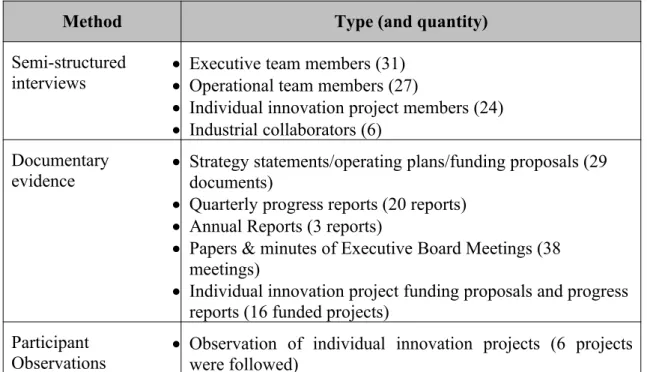
Table 1 – Qualitative data generated through case research
Method Type (and quantity)
Semi-structured
interviews Executive team members (31)Operational team members (27)
Individual innovation project members (24)
Industrial collaborators (6) Documentary
evidence Strategy statements/operating plans/funding proposals (29 documents)
Quarterly progress reports (20 reports)
Annual Reports (3 reports)
Papers & minutes of Executive Board Meetings (38 meetings)
Individual innovation project funding proposals and progress reports (16 funded projects)
Participant
Observations Observation of individual innovation projects (6 projectswere followed)
(2) the middle years (2,3 and 4) of the 5 year funded programme; and (3) the final year of the funded programme. We examined how (if at all) the themes changed across this broad chronological sweep. The findings from this process of coding, clustering and examination for change are presented after a case description.
Case Study – The MedTech Innovation Centre
Focussed primarily on medical technology areas in which the host university had a demonstrable strength, the Centre sought to accelerate the commercialization of new therapies and devices with the introduction of new routines to institutionally established proof of concept (PoC) processes. Conventional PoC processes had been applied at the host university over a number of years and were judged locally to have delivered mixed results. Such PoC processes in keeping with known practices incorporated routines such as: proposal development supported by business development specialists; mandating commercial interest in proposals from academics; funding decisions taken by an independent panel of both university and industry people knowledgeable about medical technology in general. To these general routines, the Centre’s original design intent was to contribute new expertise to support effective early-stage decision-making. Such expertise incorporated that of health economics analysis, clinical trials design, improved diagnostics for enhanced patient targeting and complex simulation methodologies (“patient in the lab”) for improving short-term predictions of the long-term clinical outcomes. The overall aim was to create “innovation in the discovery process by operationalising a philosophy of early testing for failure” [MedTech Centre Chairman at Early Stakeholder consultation event].
Proposal stage and first year of operation
personal networks, combining their capabilities, in order to produce a coherent strategy and operational plan for the centre. These artefacts then formed the basis of a funding application to Government agencies.
This call for funding for university innovation centres did not specify an operating model. A policy document from the main sponsoring department of Government noted: “we regard them as early stage nucleating points for an emerging industry – that is they act as a magnet for those working in an emerging technology area, helping to advance the science, helping companies to explore the potential of that technology in a range of markets to see which are the most promising, and helping to build the skills that will accelerate commercialisation of new products and services” (U.K._Government, 2014, p.15). Recognising the emerging nature of the outcomes from these centres, the 5-year duration of the programme, and given the relatively large size of the investment, performance criteria set by the funders were often vague and subject to policy shifts. Therefore, the process of evaluating the performance of the centre was itself co-developed with funders across the five years. New core capabilities of the centre were mooted, adopted or rejected as the funding bodies sought to align this programme with their wider gamut of the support for business innovation. The Centre’s strategy documents described this approach as “embedding a sector-led approach to direct [Government] funding”.
successful regulatory and reimbursement outcome, thereby reducing the risk of costly late failures” [Prof A].
Whilst the ultimate organizational design and routines for achieving such acceleration was not articulated in detail in the proposal, it did contain some distinctive design elements that had not previously been evident in local practices for the commercialization of science. The key objective for the Centre in this regard was to “develop new methods for the preclinical assessment of clinical performance, assess the economic barriers to translation and clinical trials, and work with standards and regulatory bodies to develop new guidelines to support innovation” [Original Funding Proposal]. University colleagues in health economics and the Clinical Trials Research Unit were recruited to the project to support this initiative, in order to realize its bold promise to “reduce the time to market by half from 10-15 to 5-7 years” [Original Funding Proposal].
Following the award of funding, an interim project director was appointed and a period followed which involved the design of processes to support PoC projects. This process design was undertaken with existing industrial partners, with the espoused approach been one to “use methods to accelerate innovation that were used in industry” (Interim Project Director). The resulting approach was based upon the combination of a stage-gate design (Cooper, 1993) with the use of Nasa’s “Technology Readiness Levels”.
decision making at the early gates. Rather a more highly contextual decision-making processes was mooted; one that required a project to present its claims for clinical and commercial efficacy before the stakeholders present would commit their input. At the consultation event for Academics an important thread of discussion concerned re-thinking failure. The concept of actively seeking to reject ideas at an early stage did not sit comfortably with the academics (at least in comparison with the industrialists in their stakeholder meeting). The language of rejection was replaced with “exit points” from which ideas might be “recycled”. Also there was a desire to articulate “other characteristics of success” than those implicit in the stage-gate methodology.
In these stakeholder engagement meetings, conceived to shape the processes and support mechanisms for the MedTech Centre, we hear the familiar tensions between academic and industry expectations. For industry, the answers sought to project funding decisions allow less room for prevarication; either the prospects are demonstrably favourable and we progress the exploitation, or the project is dropped. The academic approach errs towards continued exploration in order to find a better project concept. For the Centre, managing this industry/academic tension remains at the heart of its innovation challenge. The novel technology ideas are born of the exploratory research world of its network of academics, and only strong candidates for focused processes of exploitation will secure the industrial backing that the whole initiative needs to be successful. How this tension was managed involved organizational design work that took place over the following 12 months.
levelled that the distinctive technological identity of the programme had been discarded in a drive to realize funding targets by progress any medically-related near-to-market project. Extensive discussions occurred at this time amongst the programme’s leadership that spoke to issues of the role of universities in an industrially-centred innovation ecosystem. From out of such discussions the idea of different pathways to innovation gained traction. In addition to the translation of academic research into investment-ready propositions, service offerings in support of company innovation gained in emphasis: undertaking preclinical testing and simulation, design and delivery of robust, effective clinical trials, and health economic evaluations. These discussions also reaffirmed the primary technology identity of the project as one that “develops biological and biomimetic tissue scaffolds, stem cells, hybrid physical devices and also supports technologies such as imaging diagnostics and supply chain technologies” [End of Year 1 Report]. However, one other consequence of this re-positioning of the project was that the Director of Operations left the programme and was replaced by Dr B, the author of the original funding proposal.
The Middle Years
The work of project identification and development fell to ‘Technology Innovation Managers’; only one had been in place at the time of Dr B’s assumption of the Director role, and more were now recruited. In a departure from local practice, individuals who were both educated in science to postdoctoral level and had extensive new product development experience within the medical technology sector filled these roles. Hitherto generalists had filled such business development roles: people with industry experience but whose project portfolios within the technology transfer office would span a range of sectors. The capability of the operational team was also expanded with the recruitment of people into marketing and IP management roles. Building such capabilities gave the appearance of a high degree of independence from the support offered by the home university’s technology transfer office (TTO). The latter had originally viewed the Centre as but the latest initiative offering funding for early stage projects. However, the innovation management capabilities that were being developed at the Centre indicated that this initiated was to do more than simply administer the dispersal of funds. Originally attributed to personal “communication issues”, this antagonism between the Centre and TTO waxed and waned with personnel changes, but it never disappeared completely.
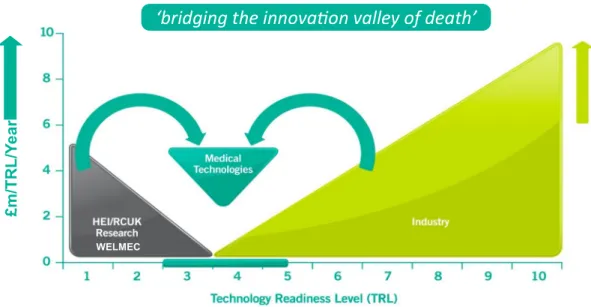
The initial tendency to view the MedTech Innovation Centre as the latest source of innovation funds was not confined to the TTO. Academics adept at detecting changes in the funding landscape were keen to approach the centre for monies. Similarly the Advisory Board noted that external to the university there was confusion about the aims of the Centre. There was a clear imperative to articulate what this Innovation Centre was, and what it was not: both to internal and external stakeholders. The work this prompted led to greater clarity in the strategic positioning the Centre within a wider innovation landscape. In this regard the model of Technology Readiness Levels (Mankins, 1995) became the predominant way to frame the core innovation activities.
ideas surfaced through the existing medical innovation networks on which the Centre had been built. Crucially now, the Technology Innovation Managers were working from a clear understanding of the type of projects that would be supported. The modus operandi of project development would be for the technology innovation managers to immerse themselves in a given project idea and work actively with the academics who generated the idea in order to craft a proposal for funding. The academics and their co-workers would largely write the proposal, but in doing so they were offered very detailed guidance on what they should write. In the background, the Centre Director and Chairman regularly reviewed the project development process in a manner the reinforced in the minds of everyone those features of a proposal that constituted a ‘good project’. The work of the Centre at this point was characterized by a strong learning orientation. Each manager within the team could certainly bring a wealth of experience on project development, but progress was achieved through a process of refining the criteria for a good project, rather than simply executing a list of criteria agreed at the outset.
initiate a clinical trial. As projects continued to be developed with such close attention to detail, it was invariably the case that any proposal that made it as far of the Executive Group met with funding approval. The decision-making processes of refinement and clarification were accomplished along the way. In this manner a total of 11 PoC projects and 4 collaborative developments were initiated during the first full operational year.
Having established their opening portfolio of PoC projects and R&D collaborative projects, the Operations and Executive teams undertook a strategic review of their work. Prompted by a critical funding milestone, this review saw them realizing a number of important goals: refreshing their innovation mission and vision; aligning research competences with technology priorities; consolidation of operational processes; extending their geographical reach through strategic partnerships; developing a plan to sustain the Centre after the end of the grant funding; incorporating all these elements within a rebranding exercise.
‘bridging the innovation valley of death’
WELMEC
£m
/T
R
L
/Y
ea
r
Figure 1 – Graphic representation of MedTech Centre Vision
The Final Year
The period of time following the strategic review could be characterised as the principle implementation phase of the programme. The innovation support systems had been designed, and experienced mangers recruited to deliver them. Routines had been established that drew upon academic support in the complementary disciples of clinical trials design and health economics assessment. Experienced industry professionals were developing new channels for engaging clinicians, and selling intellectual property. The geographical reach of the Centre had expanded: investments were made in Proof of Concept projects at other UK universities and a memorandum of understanding signed for a strategic collaboration with comparable innovation centres in Singapore. And so within this strategic context the individual innovation projects were delivered.
approach to collaborative innovation. The manner in which this strategic narrative changed is covered in the next section. In closing this short case history, it is enough to note that the public sector funders’ were sufficiently satisfied with the innovation impacts achieved by the Centre to award them follow on funding.
Research Findings
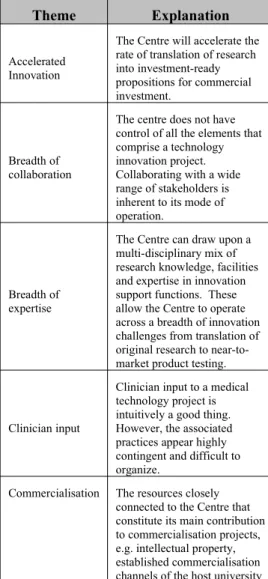
Table 2 explains the themes that we discerned in our coding of innovation narratives within the documentary evidence we examined from the MedTech Centre. Included also is an illustrative vignette drawn from one of the Centre’s strategic innovation narratives.
Table 2 – Themes within MedTech Centre Innovation Narratives
Theme Explanation Illustrative Vignette
Accelerated Innovation
The Centre will accelerate the rate of translation of research into investment-ready propositions for commercial investment.
“The centre and its partners will develop new and different approaches to innovation at an early stage of the innovation cycle, to substantially accelerate innovation, shorten the time period to clinical trials and market, and mitigate technology risks associated with this emergent sector.” (Taken from original funding proposal).
Breadth of collaboration
The centre does not have control of all the elements that comprise a technology innovation project. Collaborating with a wide range of stakeholders is inherent to its mode of operation.
“We facilitate collaboration between companies, engineers, scientists and clinicians to develop innovative technologies that help the body repair and restore function, bridging the translation gap between fundamental research and the development of technology that’s ready for serious commercial investment.” (Taken from an Annual Review at the midpoint of the Centre’s original funded programme).
Breadth of expertise
The Centre can draw upon a multi-disciplinary mix of research knowledge, facilities and expertise in innovation support functions. These allow the Centre to operate across a breadth of innovation challenges from translation of original research to near-to-market product testing.
[The Centre can] translate and deliver high quality multi-disciplinary research through developing strong partnerships with companies. Furthermore, we play a role in validating new medical technology and regenerative therapy products through our Proof of concept investments. It should however, also be noted that the Centre also has significant capacity and capability to support late stage innovation undertaken in companies through the provision of high quality, FDA approved pre-clinical testing laboratories for medical devices as well as virtual simulation, health economic assessments and clinical trial design methodologies.” (Taken from Centre’s “Sustainability Strategy”)
Clinician input
Clinician input to a medical technology project is intuitively a good thing. However, the associated practices appear highly contingent and difficult to organize.
“Clinical engagement is needed to provide a perception of prospective value throughout the product development process by informing concept creation (invention/discovery) and then aligning development with user requirements (innovation). This should ensure end-consumer perception of value is continuously understood and enhanced through the Centre’s innovation process”. (Taken from Centre’s “Clinical Engagement Strategy”)
Commercialisation The resources closely connected to the Centre that constitute its main contribution to commercialisation projects, e.g. intellectual property, established commercialisation channels of the host university
competitive position, which is protected by confidentiality agreements with all staff and NDAs with external organisations. Proposed inventions are subjected to internal review by a dedicated Intellectual Property Management Group and support from the [host] University’s Commercialisation Services team, with advice from patent attorneys where applicable.” (Taken from Interim Report to the Centre’s Public Funders)
De-risking
Practices managed by the centre that de-risk projects to the extent that they are attractive investments for private capital. This in corporates both financial risk and product safety risk.
“As an [Innovation Centre], our role is to reduce the risk and uncertainty associated with a new technology, so the private sector will consider investment to develop commercial products and deliver economic benefits.” (Opening statement of the final year’s annual review document)
Impact
The outcomes of the investments made by the Centre in terms of patient benefits, economic development agendas and geographical reach
“Our integrated research and innovation centre aims to improve the quality of life of the ageing population who expect 50 active years after 50.” (Part of Centre’s vision statement in an Interim Report to its Public Funders)
Industry collaboration
Innovation practices associated with the collaboration of industry partners
“ many of our challenge led research projects are carried out in partnership with companies and so create an early shared relationship to ensure outcomes can be shaped towards commercial needs and also that companies have access to the very latest research findings and so can help identify further opportunities for new technology identification and validation of those technologies that offer potential for further development.” (Taken from the Centre’s “Sustainability Strategy”)
National Centre
The identity of the Centre as being national in in scope and reach (as distinct from being local or regional to the host university)
“We’re widening our reach throughout the UK and have established the MedTech Innovation Centre as a national centre. We now have nine Proof of Concept projects in progress with national university partners. The innovative practice and culture that we’ve nurtured and developed at the Centre is now being embedded in universities around the UK. This is producing a change in how researchers – both early career researchers and seasoned academics - think about the translation of research to reach a defined commercial application.
Plot Dynamics
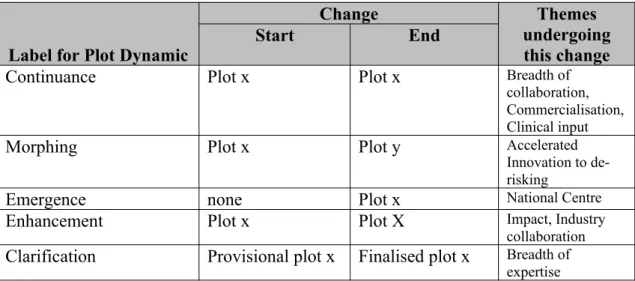
Table 3 – Changes in use of themes (plots) with strategic innovation narratives of MedTech Centre
Label for Plot Dynamic
Change Themes
undergoing this change
Start End
Continuance Plot x Plot x Breadth of
collaboration, Commercialisation, Clinical input
Morphing Plot x Plot y Accelerated
Innovation to de-risking
Emergence none Plot x National Centre
Enhancement Plot x Plot X Impact, Industry
collaboration
Clarification Provisional plot x Finalised plot x Breadth of expertise
We might imagine a possible sixth plot dynamic that is “retirement” (i.e. Plot x to none). However, empirically in this case we did not observe such retirements.
The following subsections describe the different ways in which the use of themes changed within strategic innovation narratives.
Continuance
Examples of plots whose use within strategic narrative did not seem to change markedly through the 5 years of the MedTech Centre were: “breadth of
collaboration”, “commercialisation resources” and “clinical input”. The first two of these represent a set of practices that are institutionalised within university open innovation projects (cf. Perkmann & Walsh, 2007). “Clinical input” is an element of medical innovation practice that appears highly contingent and defies easy
prescription. As a theme within the Centre’s innovation narrative, “clinical input” is presented throughout as a guiding principle to be adopted when possible (i.e. when a suitable clinician can be identified and attracted to connect with a project).
Morphing
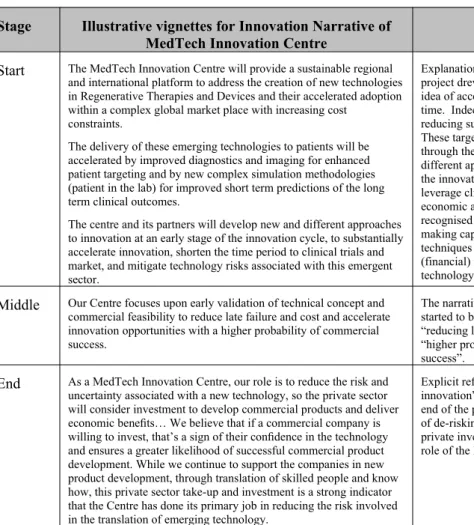
was prompted by a similar theme in the funding call for the programme. However, the same them received a muted response from both academic scientists and industry stakeholders. For them, speed (in some absolute sense) was less important that “making the correct investment decision early”. Whilst still having an implication of speed, such early effective decision-making became couched in terms of risk
mitigation. By the end of the 5 year funding programme, this theme of mitigating financial risk of early technology investments had become a core plot, and use of the “accelerated innovation” plot were much less evident.
Table 4 – Illustration and case commentary concerning the morphing of themes
Stage Illustrative vignettes for Innovation Narrative of MedTech Innovation Centre
Commentary
Start The MedTech Innovation Centre will provide a sustainable regional and international platform to address the creation of new technologies in Regenerative Therapies and Devices and their accelerated adoption within a complex global market place with increasing cost
constraints.
The delivery of these emerging technologies to patients will be accelerated by improved diagnostics and imaging for enhanced patient targeting and by new complex simulation methodologies (patient in the lab) for improved short term predictions of the long term clinical outcomes.
The centre and its partners will develop new and different approaches to innovation at an early stage of the innovation cycle, to substantially accelerate innovation, shorten the time period to clinical trials and market, and mitigate technology risks associated with this emergent sector.
Explanation at the proposal stage of the project drew particular attention to the idea of accelerating the innovation cycle time. Indeed ambitious targets for reducing such times were mooted. These targets were to be realised through the development of “new and different approaches at an early stage of the innovation cycle” (these would leverage clinical trials design and health economic assessment expertise). It was recognised that the enhanced decision-making capability brought by these techniques would also mitigate the (financial) risk in investments in new technology projects.
Middle Our Centre focuses upon early validation of technical concept and commercial feasibility to reduce late failure and cost and accelerate innovation opportunities with a higher probability of commercial success.
The narrative of accelerated innovation started to become expressed in terms of “reducing late failure” and ensuring a “higher probability of commercial success”.
End As a MedTech Innovation Centre, our role is to reduce the risk and uncertainty associated with a new technology, so the private sector will consider investment to develop commercial products and deliver economic benefits… We believe that if a commercial company is willing to invest, that’s a sign of their confidence in the technology and ensures a greater likelihood of successful commercial product development. While we continue to support the companies in new product development, through translation of skilled people and know how, this private sector take-up and investment is a strong indicator that the Centre has done its primary job in reducing the risk involved in the translation of emerging technology.
Emergence
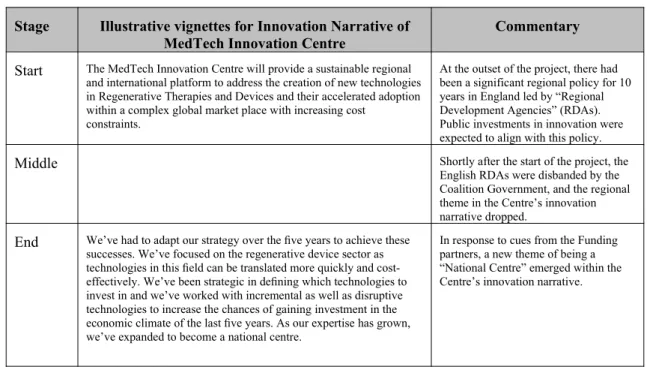
The emergence dynamic relates to the situation where a theme was not originally present in the Centre’s narratives, but rather developed during the course of the funded programme. The development of the theme “National Centre” falls into this category, and resulted from the interactions between the leadership of the Centre and the public sector funders.
Table 5 - Illustration and case commentary concerning the emergence of themes
Stage Illustrative vignettes for Innovation Narrative of
MedTech Innovation Centre Commentary
Start The MedTech Innovation Centre will provide a sustainable regional and international platform to address the creation of new technologies in Regenerative Therapies and Devices and their accelerated adoption within a complex global market place with increasing cost
constraints.
At the outset of the project, there had been a significant regional policy for 10 years in England led by “Regional Development Agencies” (RDAs). Public investments in innovation were expected to align with this policy.
Middle Shortly after the start of the project, the
English RDAs were disbanded by the Coalition Government, and the regional theme in the Centre’s innovation narrative dropped.
End We’ve had to adapt our strategy over the five years to achieve these successes. We’ve focused on the regenerative device sector as technologies in this field can be translated more quickly and cost-effectively. We’ve been strategic in defining which technologies to invest in and we’ve worked with incremental as well as disruptive technologies to increase the chances of gaining investment in the economic climate of the last five years. As our expertise has grown, we’ve expanded to become a national centre.
In response to cues from the Funding partners, a new theme of being a “National Centre” emerged within the Centre’s innovation narrative.
Enhancement
Two themes can be described as having an enhanced role within the Centre’s
Table 6 - Illustration and case commentary concerning the enhancement of themes
Stage Illustrative vignettes for Innovation Narrative of
MedTech Innovation Centre Commentary
Start Therapies and devices, which facilitate the regeneration of body tissues, offer the potential to revolutionise healthcare and be a catalyst for economic growth, creating a new business sector within healthcare technology.
The MedTech Innovation Centre will address the needs and quality of life of the ageing population, and address their expectations of an active lifestyle for "fifty more years after fifty”
Two important sub-themes relating to Impact had a prominent place in early strategic narratives of the Centre. The first of these (“New Business Sector”) originated in the policy rationale for the Government Agency’s funding call. The second (“50 active years after 50”) was a product of the Centre’s own marketing efforts, and it succeeded in placing the Centre’s launch on the front page of national newspapers.
Middle Our integrated research and innovation centre aims to improve the quality of life of the population who expect 50 active years after 50.
Therapies and devices which facilitate the regeneration of body tissues offer the potential to revolutionise healthcare across all sectors and patient groups and be a catalyst for economic growth, creating a new business sector within healthcare technology.
[MedTech Centre] is currently developing strategic collaboration in partnership with the Agency for Science, Technology and Research (A*Star) in Singapore and have discussed an IP sharing and exploitation route through their new IP Intermediaries (IPI) mechanism.
During the course of its 5 years new avenues were explored to extend the geographical impact of the Centre.
End Our funding was approved in April 2008 – and in September of that year the financial crisis hit. Just as we were starting out, the economic conditions meant the private sector became more risk averse and more conservative in terms of taking on and developing new technologies.
This research platform has been successful in securing national and global investments over the past decades and so is well placed to have a wide and deep technology platform that can be utilised for commercial opportunity exploitation and new product and service development in a fast growing and successful business sector.
From our original £10 million funding, we’ve generated and leveraged over £90 million research and innovation funding into the Centre, of which over £12 million has come from industry. More importantly, as a direct result of the Centre de-risking technologies that have been taken up by the sector, industry has invested a further £57 million in their new product development.
There’s no such thing as an ‘average’ patient. Variable factors, such as age, weight, bone density and lifestyle in patients all have an influence on how successful a medical implant might be, and how long it will last. Using world-class simulation facilities at the University of Leeds, researchers are developing robust pre-clinical test methods to ensure implants such as joint replacements, spinal implants or heart valve replacements are reliable and will give patients the improved quality of life that they expect. Our goal is to give people ‘50 active years after 50®’ and improving the quality of joint implants for people is a big step towards that goal.
Additional themes that enriched the original strategic innovation narratives emerged during the course of the Centre’s first 5 years. These include: increased importance of early stage technology investments in context of global recession; attracting international investment; impact of subsequent business innovation.
The two themes that were prominent at the outset, continue to feature. However, as illustrated in these vignettes, mention of “new business sector” and “50 actives years after 50” is now enriched with practical details.
Clarification
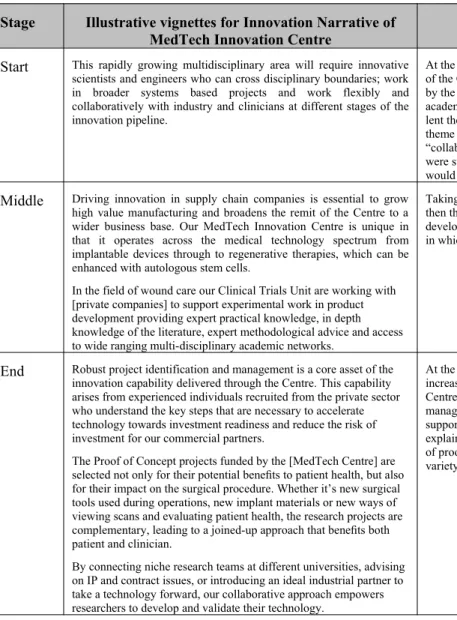
degree. As the project progressed the Centre’s management team created new organisational arrangements to execute these ideas, and provide new routines of support for individual innovation projects. As the practical nature of the support mechanisms became more evident then the associated innovation narratives became more closely specified (Table 7).
Table 7 - Illustration and case commentary concerning the clarification of themes
Stage Illustrative vignettes for Innovation Narrative of
MedTech Innovation Centre Commentary
Start This rapidly growing multidisciplinary area will require innovative scientists and engineers who can cross disciplinary boundaries; work in broader systems based projects and work flexibly and collaboratively with industry and clinicians at different stages of the innovation pipeline.
At the proposal stage, then the strength of the Centre was defined in large part by the scientific credentials of the academic scientists and engineers who lent their support. Key features of this theme were “multi-disciplinarity” and “collaboration”. However, few details were supplied about how these features would be enacted.
Middle Driving innovation in supply chain companies is essential to grow high value manufacturing and broadens the remit of the Centre to a wider business base. Our MedTech Innovation Centre is unique in that it operates across the medical technology spectrum from implantable devices through to regenerative therapies, which can be enhanced with autologous stem cells.
In the field of wound care our Clinical Trials Unit are working with [private companies] to support experimental work in product development providing expert practical knowledge, in depth knowledge of the literature, expert methodological advice and access to wide ranging multi-disciplinary academic networks.
Taking cues from commercial partners, then the multidisciplinary narrative develops to explain the range of contexts in which the Centres expertise will bear.
End Robust project identification and management is a core asset of the innovation capability delivered through the Centre. This capability arises from experienced individuals recruited from the private sector who understand the key steps that are necessary to accelerate technology towards investment readiness and reduce the risk of investment for our commercial partners.
The Proof of Concept projects funded by the [MedTech Centre] are selected not only for their potential benefits to patient health, but also for their impact on the surgical procedure. Whether it’s new surgical tools used during operations, new implant materials or new ways of viewing scans and evaluating patient health, the research projects are complementary, leading to a joined-up approach that benefits both patient and clinician.
By connecting niche research teams at different universities, advising on IP and contract issues, or introducing an ideal industrial partner to take a technology forward, our collaborative approach empowers researchers to develop and validate their technology.
Discussion
The MedTech Innovation Centre, whilst ultimately being judged very successful by its public sector funders, seems unremarkable: there are many comparable initiatives in the arena of Government-supported technology transfer. And yet our close examination of the work of the centre across the whole 5 years suggests that its operation is revealing of the challenges faced by organisations predicated on a principle of openness. These challenges were not resolved simply by means of the Centre having a quantity of finance to disburse as project grants. Across a range of collaborations we observed a dynamic of coordination and cooperation that meant
openness could be a burden and a virtue in equal measure. Conducting a longitudinal study allowed us to observe tensions at the heart of the idea of an open organisation:
fragility of partnership hierarchies vs. strength of extended competence; design of collaborations vs. improvisation in their projects; balancing capabilities that are core
to the Centre with those that are co-opted from Stakeholders.
The process of building an organisational capability to deal with coordination and cooperation is necessitated by the accumulation of open innovation relationships. Simple transactional arrangements between organisations supported by financial resources are insufficient to account of the complexity of the coordination challenge. In addition, narratives of openness became a cultural resource (cf. Rindova, Dalpiaz, & Ravasi, 2011) to attract new partners and provided principles for the delivery of innovation projects (cooperation problem). These narratives were accounts of how the innovation projects at the MedTech Centre might deliver the agendas of different partners.
mechanisms (ibid, p.110) are advanced in relation to innovation within organisations, but it is reasonable to suppose that the same mechanisms are germane to more open forms of innovation that transcend organisational boundaries. However as well as narratives at the level of individual projects, we observed narratives at the level of the Centre itself where they serve strategic level aims of opportunity identification, alignment of agendas and capabilities, differentiation of offering, and leadership of the whole enterprise.
The MedTech Centre inherently requires a more open form of innovation, as it will never have of itself, the capabilities or resources to do innovation. It is reasonable to expect that this openess brings with it additional challenges of coordination and cooperation. That challenge is a consequence of there being very different stakeholder organisations (evident in their different goals, values, and norms) with different institutional logics. Coordination in such circumstances defies easy prescription.
We posit that strategic innovation narratives provide a cultural mechanism that allows such open innovation to be: (1) initiated (i.e. efforts to attract the attention of potential innovation partners); (2) rationalised (i.e. aligning agendas of different organisations); (3) operationalized (i.e. guiding identification and creation of necessary innovation structures and processes at the level of individual projects); and (4) sustained (i.e. continue the strategic collaboration even as the agendas of individual stakeholders are changing). Organisational structures and processes (e.g. Events, meetings websites, proof of concept projects) may be the tangible vehicles of engagements with innovation partners, and yet strategic innovation narratives act to increase the effectiveness of such elements of innovation management (cf. Bartel & Garud, 2009).
within strategic innovation narratives. Our aim is to understand how the challenges of coordination and cooperation are managed by examining the types of plots used by the Centre, and the way in which their use changes over time. In the Research Findings section we reported 9 plots and posited 5 change mechanisms. We suggest that an Innovation Centre predicated on openess requires such dynamics because the different partner organisations make any alignment of agendas fragile and prone to disruption. Coordination of openess thus becomes an on-going challenge that of its nature is never fully resolved. We suggest that whole strategic innovation narratives themselves are unlikely to change to any major degree in the timescales of the project. We expect that such a degree of change would send confusing signals to stakeholders and be disruptive to internal operations. Therefore changes occur at the level of plots, as this enables a more subtle and nuanced interpretation of the whole narrative
References
Afuah, A., & Tucci, C. L. (2012). Crowdsourcing as a solution to distant search.
Academy of Management Review, 37(3), 355-375.
Alexy, O., George, G., & Salter, A.J. (2013). Cui bono? The selective revealing of knowledge and its implications for innovative activity. Academy of Management Review, 38(2), 270-291.
Almirall, E., & Casadesus-Masanell, R. (2010). Open vesus closed innovation: A model of discovery and divergence. Academy of Management Review, 35(1), 27-47.
Baldwin, C.Y., & Clark, K.B. (2006). The architecture of participation: Does code architecture mitigate free riding in the open source development model?
Management Science, 52, 1116-1127.
Bartel, C.A., & Garud, R. (2009). The role of narratives in sustaining organizational innovation. Organization Science, 20(1), 107-117.
Bloodgood, J. (2013). Crowdsourcing: Useful for problem solving, but what about value capture? Academy of Management Review, 38(3), 455-457.
Boudreau, K.J., Lacetera, N., & Lakhani, K.R. (2011). Incentives and problem uncertainty in innovation contests: An empirical analysis. Management Science, 57(5), 843-863.
Chesbrough, H. (2003). Open innovation: The new imperative for creating and profiting from technology. Boston: Harvard Business School Press.
Chesbrough, H. (2010). Business model innovation: Opportunities and barriers. Long Range Planning, 43(2-3), 354-363.
Chesbrough, H., & Rosenbloom, R. S. (2002). The role of business model in capturing value from innovation: Evidence fromxerox corporation's technology spin-off companies. Industrial and Corporate Change, 11(3), 529-555.
Dhanaraj, C., & Parkhe, A. (2006). Orchestrating innovation networks. Academy of Management Review, 31(3), 659-669.
Eisenhardt, K. M. (1989). Building theories from case study research. Academy of Management Review, 14(4), 532-550.
Faulkner, P., & Runde, J. (2009). On identity of technological objects and user innovations in function. Academy of Management Review, 34(3), 442-462. Felin, T., & Zenger, T.R. (2014). Closed or open innovation? Problem solving and
governance choice. Research Policy, 43(5), 914-925.
Kogut, A., & Zander, U. (1996). What do firms do? Coordination, identity and learning. Organization Science, 7(5), 502-518.
Laursen, K., & Salter, A. (2006). Open for innovation: The role of openness in explaining innovation performance among uk manufacturing firms. Strategic Management Journal, 27(2), 131-150. doi: 10.1002/smj.507
Leonardi, P.M. (2011). Innovation blindness: Culture, frames and cross-boundary problem construction in the development of new technology concepts.
Organization Science, 22(2), 347-369.
Lerner, J., & Tirole, J. (2002). Some simple economics of open source. Journal of Industrial Economics, 50(2), 197-234.
Mankins, J.C. (1995). Technology readiness levels, 11th November 2014, from http:// orion.asu.edu/Additional Reading/Mankins_trl.pdf
Miles, M. B., & Huberman, A. M. (1994). Qualitative data analysis. Beverley Hills, CA: Sage.
Miller, D., Greenwood, R., & Prakash, R. (2009). What happened to organization theory? Journal of Management Inquiry, 18(4), 273-279.
O'Mahoney, S., & Bechky, B. (2008). Boundary organizations: Enabling collaboration among unexpected allies. Administrative Science Quarterly, 53(3), 422-459.
Pandza, K., & Ellwood, P. (2013). Strategic and ethical foundations for responsible innovation. Research Policy, 42(5), 1112-1125.
Perkmann, M., & Schildt, H. (in press). Open data partnerships between firms and universities: The rule of boundary organizations. Research Policy,
http://dx.doi.org/10.10.1016/j.respol.2014.12.006.
Perkmann, M., & Walsh, K. (2007). University-industry relationships and open innovation: Towards a research agenda. International Journal of Management Reviews, 9, 259-280. doi: 10.1111/j.1468-2370.2007.00225.x
Puranam, P., Alexy, O., & Reitzig, M. (2014). What's "new" about new forms of organising? Academy of Management Review, 39(2), 162-180.
Rindova, V., Dalpiaz, E., & Ravasi, D. (2011). A cultural quest: A study of organizational use of new cultural resources in strategy formation.
Organization Science, 22(2), 413-431. doi: 10.1287/orsc.1100.0537
Siggelkow, N. (2007). Persuasion with case studies. Academy of Management Journal, 50(1), 20-24.
U.K._Government. (2014). Emerging technologies and industries: Strategy
2014-2018, 11th November 2014, from
https://http://www.gov.uk/government/uploads/system/uploads/attachment_dat a/file/370017/Emerging_technologies_-strategy_2014-2018.pdf
Webb, E., & Weick, K. E. (1979). Unobtrusive measures in organizational theory - a reminder. Administrative Science Quarterly, 24(4), 650-659.