Volume 2006, Article ID 57308, Pages1–21 DOI 10.1155/ASP/2006/57308
Motion Estimation and Signaling Techniques for
2D+t Scalable Video Coding
M. Tagliasacchi, D. Maestroni, S. Tubaro, and A. Sarti
Dipartimento di Elettronica e Informazione, Politecnico di Milano, Piazza Leonardo da Vinci, 32 20133 Milano, Italy
Received 1 March 2005; Revised 5 August 2005; Accepted 12 September 2005
We describe a fully scalable wavelet-based 2D+t (in-band) video coding architecture. We propose new coding tools specifically designed for this framework aimed at two goals: reduce the computational complexity at the encoder without sacrificing
compres-sion; improve the coding efficiency, especially at low bitrates. To this end, we focus our attention on motion estimation and motion
vector encoding. We propose a fast motion estimation algorithm that works in the wavelet domain and exploits the geometrical properties of the wavelet subbands. We show that the computational complexity grows linearly with the size of the search window, yet approaching the performance of a full search strategy. We extend the proposed motion estimation algorithm to work with blocks of variable sizes, in order to better capture local motion characteristics, thus improving in terms of rate-distortion behavior. Given this motion field representation, we propose a motion vector coding algorithm that allows to adaptively scale the motion
bit budget according to the target bitrate, improving the coding efficiency at low bitrates. Finally, we show how to optimally scale
the motion field when the sequence is decoded at reduced spatial resolution. Experimental results illustrate the advantages of each individual coding tool presented in this paper. Based on these simulations, we define the best configuration of coding parameters and we compare the proposed codec with MC-EZBC, a widely used reference codec implementing the t+2D framework.
Copyright © 2006 Hindawi Publishing Corporation. All rights reserved.
1. INTRODUCTION
Today’s video streaming applications require codecs to pro-vide a bitstream that can be flexibly adapted to the charac-teristics of the network and the receiving device. Such codecs are expected to fulfill the scalability requirements so that en-coding is performed only once, while deen-coding takes place each time at different spatial resolutions, frame rates, and bi-trates. Consider for example streaming a video content to TV sets, PDAs, and cellphones at the same time. Obviously each device has its own constraints in terms of bandwidth, display resolution, and battery life. For this reason it would be useful for the end users to subscribe to a scalable video stream in such a way that a representation of the video con-tent matching the device characteristics can be extracted at decoding time. Wavelet-based video codecs have proved to be able to naturally fit this application scenario, by decom-posing the video sequence into a plurality of spatio-temporal subbands. Combined with an embedded entropy coding of wavelet coefficients such as JPEG2000 [1], SPIHT (set par-titioning in hierarchical trees) [2], EZBC (embedded zero-block coding) [3], or ESCOT (motion-based embedded sub-band coding with optimized truncation) [4], it is possible to support spatial, temporal, and SNR (signal-to-noise ratio)
scalability. Broadly speaking, two families of wavelet-based video codecs have been described in the literature:
(i) t+2D schemes [5–7]: the video sequence is first filtered in the temporal direction along the motion trajecto-ries (MCTF—motion-compensated temporal filtering [8]) in order to tackle temporal redundancy. Then, a 2D wavelet transform is carried out in the spatial do-main. Motion estimation/compensation takes place in the spatial domain, hence conventional coding tools used in nonscalable video codecs can be easily reused; (ii) 2D+t (or in-band) schemes [9, 10]: each frame of the video sequence is wavelet-transformed in the spatial domain, followed by MCTF. Motion esti-mation/compensation is carried out directly in the wavelet domain.
transform) [12], redundant DWT [10]), all the solutions rep-resent different implementations of the algorithm ´a trous
[13], that computes an overcomplete wavelet decomposition by omitting the decimators in the fast DWT algorithm and stretching the wavelet filters by inserting zeros. A two-level ODWT transform on a 1D signal is illustrated inFigure 1, whereH0(z) andH1(z) are, respectively, the wavelet low-pass
and high-pass filters used in the conventional critically sam-pled DWT. Hk
i(z) is the dilated version ofHi(z) obtained
by inserting k−1 zeros between two consecutive samples. The extension to 2D signals is straightforward with a separa-ble approach. Despite its higher complexity, a 2D+t scheme comes with the advantage of reducing the impact of blocking artifacts caused by the failure of block-based motion mod-els. This is because such artifacts are canceled out by the inverse DWT spatial transform, without the need to adopt some sort of deblocking filtering. This fact greatly enhances the perceptual quality of reconstructed sequences, especially at low bitrates. Furthermore, as shown in [14, 15], 2D+t approaches naturally fit the spatial scalability requirements providing higher coding efficiency when the sequence is de-coded at reduced spatial resolution. This is due to the fact that with in-band motion compensation it is possible to limit the problem of drift that occurs when decoder does not have access to all the wavelet subbands used at the encoder side. Fi-nally, 2D+t schemes naturally support multi-hypothesis mo-tion compensamo-tion taking advantage of the redundancy of the ODWT [10].
1.1. Motivations and goals
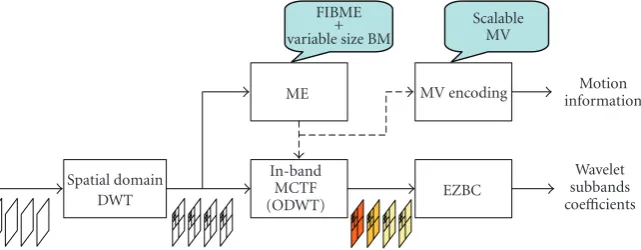
In this paper we present a fully scalable video coding archi-tecture based on a 2D+t approach. Our contribution is at the system level.Figure 2depicts the overall video coding archi-tecture, emphasizing the modules we are focusing on in this paper.
It is widely acknowledged that motion modeling has a fundamental importance in the design of a video cod-ing architecture in order to match the codcod-ing efficiency of state-of-the-art codecs. As an example, much of the cod-ing gain observed in the recent H.264/AVC standard [16] is due to more sophisticated motion modeling tools (vari-able block sizes, quarter-pixel motion accuracy, multiple ref-erence frames, etc). Motion modeling is particularly rele-vant especially when the sequences are decoded at low bi-trates and at reduced spatial resolution, because a signifi-cant fraction of the bit budget is usually allocated to describe motion-related information. This fact motivates us to focus our attention on motion estimation/compensation and mo-tion signaling techniques to improve the coding efficiency of the proposed 2D+t wavelet-based video codec. While achiev-ing better compression, we also want to keep the computa-tional complexity of the encoder under control, in order to design a practical architecture.
In Section 2, we describe the details of the proposed
2D+t scalable video codec (seeFigure 2). Based on this cod-ing framework, we propose novel techniques to improve the coding efficiency and reduce the complexity of the encoder.
H0(z) H0(2)(z) H0(4)(z) L3
H1(4)(z) H3
H1(2)(z) H2
H1(z) H1
Figure1: Two level overcomplete DWT (ODWT) of a 1D signal
according to the algorithm´a trousimplementation.
Specifically, we propose the following:
(i) inSection 2.1, a fast motion estimation algorithm that is meant to work in the wavelet domain (FIBME—fast in-band motion estimation), exploiting the geomet-rical properties of the wavelet subbands. Section 2.1 elaborates on this topic comparing the computational complexity of the proposed approach with that of an exhaustive full search;
(ii) in Section 2.2, the FIBME algorithm is further ex-tended to work with blocks of variable size;
(iii) in Section 2.3, a scalable representation of the mo-tion model is introduced, which is suitable for vari-able block sizes and allows to adapt the bit budget al-located to motion according to the target bitrate (see
Section 2.3);
(iv) in Section 2.4, a formal analysis describing how the motion field estimated at full resolution can be adapted at reduced spatial resolutions. We show that motion vector truncation, adopted in the reference im-plementation of the MC-EZBC codec [5], is not the optimal choice when the motion field resolution needs to be scaled.
The paper builds upon our previous work appeared in [17–19].
1.2. Related works
FIBME + variable size BM
Scalable MV
ME MV encoding informationMotion
Spatial domain DWT
In-band MCTF (ODWT)
EZBC
Wavelet subbands coefficients
Figure2: Block diagram of the proposed scalable 2D+t coding architecture. Call-outs point to the novel features described in this paper.
algorithm shares the multi-resolution approach of [21,22]. Despite this similarity, the proposed algorithm takes full ad-vantage of the geometrical properties of the wavelet sub-bands, and different motion vectors are used to compensate subbands at the same scale but having different orientation
(seeSection 2.1), thus giving more flexibility in the
model-ing of local motion.
Variable size block matching is well known in the liter-ature, at least when it is applied in the spatial domain. The state-of-the-art H.264/AVC [16] standard efficiently exploits this technique. In [23], a hierarchical variable size block matching (HVSBM) algorithm is used in the context of a t+2D wavelet-based codec. The MC-EZBC codec [5] adopts the same algorithm in the motion estimation phase. The au-thors of [24] independently proposed a variable size block matching strategy within their 2D+t wavelet-based codec. The search for the best motion partition is close to the idea of H.264/AVC, since all the possible block partitions are tested in order to determine the optimal one. On the other hand, the algorithm proposed in this paper (see Section 2.2) is more similar to the HVSBM algorithm [23], as the search is suboptimal but faster.
Scalability of motion vector was first proposed in [25] and later further discussed in [26], where JPEG2000 is used to encode the motion field components. The work in [26] assumes that fixed block sizes (or regular meshes) are used in the motion estimation phase. More recently, other works have appeared in the literature [27–29], describing coding algorithms for motion fields having arbitrary block sizes specifically designed for wavelet-based scalable video codecs. The algorithm described in this paper has been designed in-dependently and shares the general approach of [26, 27], since the motion field is quantized when decoding at low bi-trates. Despite these similarities, the proposed entropy cod-ing scheme is novel and it is inspired to SPIHT [2], allow-ing lossy to lossless representation of the motion field (see
Section 2.3).
2. PROPOSED 2D+t CODEC
Figure 2illustrates the functional modules that compose the
proposed 2D+t codec. First, a group of pictures (GOP) is fed in input and each frame is wavelet transformed in the spatial
domain using Daubechies 9/7 filters. Then, in-band MCTF is performed using the redundant representation of the ODWT to combat shift variance. The motion is estimated (ME) by variable size block matching with the FIBME algorithm (fast in-band motion estimation) described inSection 2.1. Finally, wavelet coefficients are entropy coded with EZBC (embed-ded zero-block coding) while motion vectors are enco(embed-ded in a scalable way by the algorithm proposed inSection 2.3.
In the following, we concentrate on the description of the band MCTF module, as we need the background for in-troducing the proposed fast motion estimation algorithm. MCTF is usually performed taking advantage of the lift-ing implementation. This technique enables to split direct wavelet temporal filtering into a sequence of prediction and update steps in such a way that the process is both perfectly invertible and computationally efficient. In our implementa-tion a simple Haar transform is used, although the extension to longer filters such as 5/3 [6,7] is conceptually straight-forward. In the Haar case, the input frames are recursively processed two-by-two, according to the following equations:
H= √1 2
B−WA→B(A),
L=√2A+WB→A(H),
(1)
whereAandBare two successive frames andWB→A(·) is a
motion warping operators that warps frameAinto the co-ordinate system of frame B.LandH are, respectively, the low-pass and high-pass temporal subbands. These two lift-ing steps are then iterated on theLsubbands of the GOP such that for each GOP only one low-pass subband is obtained.
The prediction step is the counterpart of motion com-pensated prediction in conventional closed loop schemes. The energy of frame H is lower than that of the original frame, thus achieving compression. On the other hand, the update step can be thought as a motion-compensated aver-aging along the motion trajectories: the updated frames are free from temporal aliasing artifacts and at the same timeL requires fewer bits for the same quality than frameAbecause of the motion-compensated denoising performed by the up-date step.
Reference subband AO1
Current subband B1 E
B A
−√1 2 + 1
√ 2
C=A−B H
IDWT ODWT
F
√ 2
1 HO
1
D=E+F +
L1
(a)
L1 H1
D
IDWT ODWT F C 1
√
2 −1
√ 2
HO
1 +
E=D−F
A1
IDWT ODWT
RO
B
√ 2 1
AO
1 +
Current A=B+C
B1
(b)
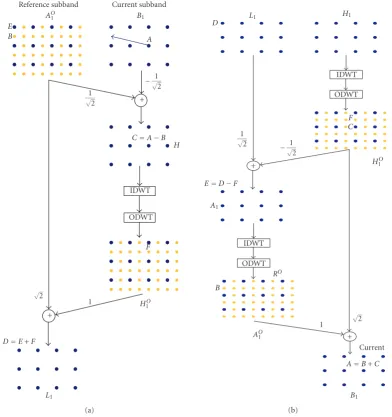
Figure3: In-band MCTF: (a) temporal filtering at the encoder side (MCTF analysis); (b) temporal filtering at the decoder side (MCTF synthesis).
its overcomplete version in order to combat the shift variance of the wavelet transform. In what follows we illustrate an implementation of the lifting structure, which works in the overcomplete wavelet domain. Figure 3 shows the current and the overcomplete reference frame together with the es-timated motion vector (dx,dy) in the wavelet domain. For the sake of clarity, we refer to one wavelet subband at decom-position level 1 (LH1,HL1, orHH1). The computation ofHi
is rather straightforward. For each coefficient of the current frame, the corresponding wavelet transformed coefficient in the overcomplete transformed reference frame is subtracted:
Hi(x,y)=√1
2
Bi(x,y)−AOi
2ix+dx, 2iy+dy, (2)
whereAOi is the overcomplete wavelet-transformed reference
frame subband at leveliand it has the same number of sam-ples as the original frame. The computation of theLisubband
is not as trivial. WhileHishares the coordinate system with
the current frame,Liuses the reference frame coordinate
sys-tem. A straightforward implementation could be
Li(x,y)=
√ 2AO
i
2ix, 2iy+Hi
x−dx/2i,y−dy/2i. (3)
The problem here is that the coordinates (x−dx/2i,y−dy/2i)
might be noninteger valued even if full pixel accuracy of the displacements is used in the spatial domain. Consider, for example, the coefficient Din the Li subband, as shown in
Figure 3. This coefficient should be computed as the sum
be-tween coefficientsEandF. Unfortunately, the latter does not exist in subbandHi, which suggests that an interpolated
ver-sion ofHiis needed. First, we need to compute the inverse
DWT (IDWT) of theHisubbands, which transforms it back
DWT,HiO. TheLiframe can be now computed as
Li(x,y)=
√ 2AOi
2ix, 2iy + ODWTIDWTHi
2ix−dx, 2iy−dy
=√2AOi
2ix, 2iy+HiO
2ix−dx, 2iy−dy. (4)
The process is repeated in reverse order at the decoder side. The decoder receivesLiandHi. First the overcomplete copy
of Hi is computed through IDWT-ODWT. The reference
frame is reconstructed as
Ai(x,y)=√1
2
Li(x,y)−ODWT
IDWTHi
×2ix−dx, 2iy−dy
=√1 2
Li(x,y)−HiO
2ix−dx, 2iy−dy. (5)
At this point, the overcomplete version of the reference frame must be reconstructed via IDWT-ODWT in order to com-pute the current frame:
Bi(x,y)=
√
2Hi(x,y)
+ ODWTIDWTAi
2ix−dx, 2iy−dy =√2HiO
2ix−dx, 2iy−dy
+AO i
2ix+dx, 2iy+dy.
(6)
Figure 3 shows the overall process diagram that illustrates
the temporal analysis at the encoder and the synthesis at the decoder. Notice that the combined IDWT-ODWT opera-tion takes place three times, once at the encoder and twice at the decoder. In the actual implementation, the IDWT-ODWT cascade can be combined in order to reduce the memory bandwidth and the computational complexity ac-cording to the complete-to-overcomplete (CODWT) algo-rithm described in [20].
2.1. Fast in-band motion estimation
The wavelet in-band prediction mechanism (2D+t), as il-lustrated in [9], works by computing the residual error after block matching. For each wavelet block, the best-matching wavelet block is searched in the overcomplete wavelet-transformed reference frame, using a full search ap-proach. The computational complexity can be expressed in terms of the number of required operations as
T=2W2N2, (7)
whereWis the size of the search window andNis the block size. As a matter of fact, for every motion vector, at leastN2
subtractions andN2summations are needed to compute the
MAD (mean absolute difference) of the residuals, and there existW2different motion vectors to be tested.
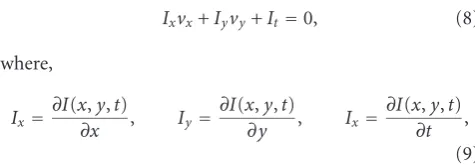
The proposed fast motion estimation algorithm is based on optical flow estimation techniques. The family of differ-ential algorithms, including Lucas-Kanade [30] and Horn-Schunk [31], assumes that the intensity remains unchanged
along the motion trajectories. This results in the brightness constraint in differential form:
Ixvx+Iyvy+It=0, (8)
where,
Ix=∂I
(x,y,t)
∂x , Iy=
∂I(x,y,t)
∂y , Ix=
∂I(x,y,t) ∂t ,
(9)
Ix,Iy, andIt are the horizontal, vertical, and temporal
gra-dients, respectively. Notice that whenIx Iy, that is, when
the local texturing is almost vertically oriented, only thedx (dx=vxdt) component can be accurately estimated because:
Ix
Ixvx+
Iy
Ixvy+
It
Ix vx+
It
Ix =0. (10)
This is the so-called “aperture problem” [32], which consists of the fact that when the observation window is too small, we can only estimate the optical flow component that is parallel to the local gradient. That of the aperture is indeed a prob-lem for traditional motion estimation methods, but in the proposed motion estimation algorithm we take advantage of this fact.
For the sake of clarity, let us consider a pair of images that exhibit a limited displacement between corresponding ele-ments, and let us focus on theHLsubband only (before sub-sampling). This subband is low-pass filtered along the verti-cal axis and high-pass filtered along the horizontal axis. The output of this separable filter looks like the spatial horizontal gradientIx. In fact, theHLsubbands tend to preserve only
those details that are oriented along the vertical direction. This suggests us that the family ofHLsubbands, all sharing the same orientation, could be used to accurately estimate the dxmotion vector component. Similarly,LHsubbands have details oriented along the horizontal axis, therefore they are suitable for computing thedycomponent. For each wavelet block, a coarse full search is applied to theLLKsubband only,
where the subscriptKis the number of the considered DWT decomposition levels. This initial computation allows us to determine a good starting point (dxFS,dyFS)1 for the fast
search algorithm, which reduces the risk of getting trapped into local minima. As theLLKsubband has 22Kfewer samples
than the whole wavelet block, block matching is not compu-tationally expensive. In fact, the computational complexity of this initial step expressed in terms of the number of additions and multiplications is
T=2
W 2K
2 N 2K
2
=W2N2
24K−1. (11)
At this point we can focus on theHLsubbands. In fact, we use a block matching process on these subbands in order to compute the horizontal displacements and estimate thedx
component for blockkwhose top-left corner has coordinates (xk,yk). The search window is reduced toW/4, as we only
need to refine the coarse estimate provided by the full search:
dxk=arg min dxj
K
i=1
MADHLi
xk,yk,dxFS+dxj,dyFS
+ MADLLK
xk,yk,dxFS+dxj,dyFS
, (12)
where MADHLi(xk,yk,dx,dy) and MADLLK(xk,yk,dx,dy) are the MAD obtained compensating the block (xk,yk) in the
subbandsHLiandLLK, respectively, with the motion vector
(dx,dy):
MADHLi
xk,yk,dx,dy
=
xk,i+N/2i
x=xk,i
yk,i+N/2i
y=yk,i
HLcur
i (x,y)HLref
O
i
2ix+dx, 2iy+dy ,
MADLLK
xk,yk,dx,dy
=
xk,i+N/2K
x=xk,i
yk,i+N/2K
y=yk,i
LLcur
K (x,y)LLref
O
K
2Kx+dx, 2Ky , (13)
(xk,i,yk,i) are the top-left corner coordinates of blockk
sub-band at leveliand it is equal to (xk/2i,yk/2i).
Because of the shift-varying behavior of the wavelet transform, block matching is performed considering the overcomplete DWT of the reference frame (HLrefO
i (·) and
LLrefKO(·)). Similarly we can work on theLHsubbands to
esti-mate thedycomponent. In order to improve the accuracy of the estimate, this second stage takes (xk+dxFS+dxk,yk+dxFS)
as a starting point:
dyk=arg min dyj
K
i=1
MADLHi
xk,yk,dxFS+dxk,dyFS+dyj
+MADLLK
xk,yk,dxFS+dxk,dyFS+dyj
, (14)
where MADLHi(xk,yk,dx,dy) is defined in a similar way to MADHLi(xk,yk,dx,dy).
We refer to this algorithm for motion estimation as fast in-band motion estimation (FIBME). The algorithm achieves a good solution that compares favorably with re-spect to a full search approach with a modest computational effort. The computational complexity of this method is
T2·2 3·
W 4 N
2+W2N2
24K−1 =
1
3WN
2+W2N2
24K−1 , (15)
whereW/4 comparisons are required to compute the hori-zontal component and otherW/4 for the vertical component. Each comparison involves eitherHLorLHsubbands, whose size is approximately one third of the whole wavelet block (if we neglect the LLK subband). If we keep the block size
Nfixed, the proposed algorithm runs in linear time with the search window size, while the complexity of the full search grows with the square power. The speedup factor with re-spect to the full search in terms of number of operations is
speedup= 2W2N2
(1/3)WN2+W2N2/24K−1 6W. (16)
It is worth pointing out that this speedup factor refers to the motion estimation task, which is only part of the overall computational burden at the encoder. InSection 3, we give more precise indications, based on experimental evidence, about the actual encoding time speedup, including wavelet transforms, motion compensation, and entropy coding. At a fraction of the cost of the full search, the proposed algo-rithm achieves a solution that is suboptimal. Nevertheless,
Section 3 shows through extensive experimental results on
different test sequences that the coding efficiency loss is lim-ited approximately to 0.5 dB on sequences with large motion. We have investigated the accuracy of our search algo-rithm in case of large displacements. If we do not use a full search for theLLKsubband, our approach tends to give a bad
estimate of the horizontal component when the vertical dis-placement is too large. In this scenario, when the search win-dow scrolls horizontally, it cannot match the reference dis-placed block. We observed that the maximum allowed ver-tical displacement is approximately as large as the low-pass filter impulse response used by the critically sampled DWT. This is due to the fact that such filter operates along the ver-tical direction by stretching the details proportionally to its impulse response extension.
The same conclusions can be drawn if we take a closer look atFigure 4. A wavelet block from the DWT-transformed current frame is taken as the current block, while the ODWT transformed reference frame is taken as the reference. For all possible displacements (dx,dy), the MAD of the prediction residuals is computed by compensating only the HL sub-band family, that is, the one that we argue being suitable for estimating the horizontal displacement. InFigure 4(a), the global minimum of this function is equal to zero and is located at (0, 0). In addition, around the global minimum there is a region that is elongated in the vertical direction, which is characterized by low values of the MAD. Let us now consider a sequence of two images, one obtained from the other through translation of the vector (dx,dy)= (10, 5)
(seeFigure 4(b)). Considering a wavelet block on the current
−15 −10 −5 0 5 10 15
dy
−15 −10 −5 0 5 10 15 dx
(a)
−15 −10 −5 0 5 10 15
dy
−15 −10 −5 0 5 10 15
dx
A B
M
(b)
Figure4: Error surface as a function of the candidate motion vector (dx,dy): (a) global minimum in (0, 0); (b) global minimum in (15, 5).
HL1 HH1
HL2 HH2
LH1 LH2
HL3HH3 LL3 LH3
(a)
HL1 HH1
HL2 HH2
LH1 LH2
HL3HH3 LL3 LH3
(b)
HL1 HH1
HL2 HH2
LH1 LH2
HL3HH3 LL3 LH3
(c)
Figure5: Motion field assigned to a 16×16 wavelet block: (a) one vector per wavelet block; (b) four vectors per wavelet block; (c) further splitting of the wavelet subblock.
2.2. Variable size block matching
As described so far, the FIBME fast search algorithm works with wavelet blocks of fixed sizes. We propose a simple ex-tension that allows to adopt blocks of variable sizes by gener-alizing the HVSBM (hierarchical variable size block match-ing) [23] algorithm to work in the wavelet domain. Let us consider a three-level wavelet decomposition and a wavelet block of size 16×16 (refer toFigure 5(a)). In the fixed size implementation, only one motion vector is assigned to each wavelet block. If we focus on the lowest frequency subband, the wavelet block covers a 2×2 pixel area. Splitting this area into four and taking the descendants of each element, we generate four 8×8 wavelet blocks, which are the offspring of the 16×16 parent block (seeFigure 5(b)). Block match-ing is performed on those smaller wavelet blocks to estimate four distinct motion vectors. In that figure, all the elements that have the same color are assigned the same motion vector.
Like in HVSBM, we build a quadtree-like structure where in each node we store the motion vector, the rateRneeded to encode the motion vector and the distortion D(MAD). A pruning algorithm is then used to select the optimal splitting configuration for a given bitrate budget [23]. The numberB of different block sizes relative to the wavelet block sizeNand the wavelet decomposition levelKis
B=log2
N 2K
+ 1 (17)
that corresponds to the block sizes:
N 2i ×
N 2i
, i=0,. . .,B−1. (18)
example, withB=2, we have
log2
N 2K
>1=⇒ N
2K >2=⇒N >2K
+1. (19)
Having fixedK, the previous equation sets a lower bound on the size of the smallest wavelet block. By settingN =16 andK =3, three different block sizes are allowed: 16×16, 8×8, and 4×4. We can take this approach one step fur-ther in order to overcome the lower bound. IfN = 2K or
if we have already split the wavelet block in such a way that there is only one pixel in theLLKsubband, further split can
be performed according to the above scheme. In order to provide a motion field of finer granularity, we can still as-sign a new motion vector to each subbandLHK,HLK,HHK,
plus the refined version ofLLK alone. This way we produce
four children motion vectors, as shown inFigure 5(c). In this case, the motion vector shown in subbandHL3 is the same
one used for compensating all of the coefficients in subbands HL3,HL2, andHL1. The same figure shows a further splitting
step performed on the wavelet block of theLH3subband. In
fact, the splitting can be iterated at lower scales, by assigning one motion vector to each one-pixel subblock at levelK−1 (in subbandLH2in this example).Figure 5(c)shows that the
wavelet block with roots on the blue pixel (in the top-left po-sition) in subbandLH3, is split into four subblocks in theLH2
subband. These refinement steps allow us to compensate el-ements in different subbands with different motion vectors that correspond to the same spatial location. We need to em-phasize that this last splitting step makes the difference be-tween spatial domain variable size block matching and the proposed algorithm. In fact, in the latter case it is possible to compensate the same spatial region with separate motion vectors, according to the local texture orientation. Following this simple procedure, we can generate subblocks of arbitrary size in the wavelet domain.
2.3. Scalable coding of motion vectors
In both t+2D and 2D+t, wavelet-based video codec SNR scal-ability is achieved by truncating the embedded representa-tion of the wavelet coefficients. In this way, only the texture information is scaled, while the motion information is loss-less encoded, thus occupying a fixed amount of the bit bud-get decided at encoding time and unaware of the decoding bitrate. This fact has two major drawbacks. First, the video sequence cannot be encoded at a target bitrate lower than the one necessary to lossless encode the motion vectors. Second, no optimal tradeoffbetween motion and residuals bit budget can be computed.
Recently, it has been demonstrated [26] that in the case of open-loop wavelet-based video coders it is possible to use a quantized version of the motion field during decoding to-gether with the residual coefficients computed at the encoder with the lossless version of the motion. A scalable representa-tion of the morepresenta-tion is achieved in [26] by coding the motion field as a two-component image using a JPEG2000 scheme. This is possible as long as the motion vectors are disposed on a regular lattice, as it is the case for fixed size block matching or deformable meshes using equally spaced control points.
In this section, we introduce an algorithm able to build a scalable representation of the motion vectors which is specifi-cally designed to work with blocks of variable sizes produced in output by the motion estimation algorithm presented in Sections2.1and2.2.
Block sizes range fromNmax×NmaxtoNmin×Nminand
they tend to be smaller in regions characterized by complex motion. Neighboring blocks usually manifest a high degree of similarity, therefore a coding algorithm able to reduce their spatial redundancy is needed. In the standard imple-mentation of HVSBM [23], a simple nearest neighbor pre-dictor is used for this purpose. Although it achieves a good lossless coding efficiency, it does not provide a scalable rep-resentation. The proposed algorithm aims at achieving the same performance when working in lossless mode allowing at the same time a scalable representation of the motion in-formation.
In order to tackle spatial redundancy, a multi-resolution pyramid of the motion field is built in a bottom-up fashion. As shown inFigure 6, variable size block matching generates a quadtree-like representation of the motion model. At the beginning of the algorithm, only the leaf nodes are assigned with a value, representing the two components of the mo-tion vector. For each component, we compute the value of the node as a simple average of its four offspring. Then we code each offspring as the difference between each value and its parent. We iterate these steps further up the motion vec-tor tree. The root node contains an average of the motion vectors over the whole image. Depending on the size of the image andNmin, the root node might have fewer than four
offspring.
Figure 6illustrates a toy example that clarifies this
multi-resolution representation. The motion vector components are the numbers indicated just below each leaf node. The av-erages computed on intermediate nodes are shown in grey, while the values to be encoded are written in bold typeface. The same figure also shows the labeling convention we use: each node is identified by a pair (i,d), wheredrepresents the depth in the tree whileiis the index number starting from zero of the nodes at a given depth. Since the motion field usually exhibits a certain amount of spatial redundancy, the leaf nodes are likely to have a smaller absolute values. In other words, walking down from the root to the leaves, we can ex-pect the same sort of energy decay that is specific of wavelet coefficients across subbands following parent-children rela-tionships. This fact suggested us that the same ideas under-pinning wavelet-based image coders could be exploited here. Specifically, if an intermediate node is insignificant with re-spect with a given threshold, then it is likely that its de-scendants are also insignificant. This is the reason why the proposed algorithm inherits some of the basic concepts of SPIHT [2] (set partitioning in hierarchical trees).
0 0 0 0
0,1 1,1 2,1 3,1
2 2 2 2
0 −1 3 −2 0 1 −1 3
2 1 5 0 2 3 1 2 0,2 1,2 2,2 3,2 4,2 5,2 6,2 7,2
−1 0 1 0
0,3 1,3 2,3 3,3
1 2 3 4
2 0,0
2
Motion vector difference Node coordinates Motion vector component Average of children motion vectors
Δmv x
i,d mv x mv avg
Figure6: Quadtree-like representation of the motion model generated by the variable size block matching algorithm.
will be quantized. If we make an error in the parent node, that will badly affect its offspring, while the same error will have fewer consequences if one of the children is involved. If we use the mean squared error as a distortion measure, the parent node needs to be multiplied by a factor of 2, in such a way that errors are weighted equally and the same quantiza-tion step sizes can be used regardless of the node depth.
The proposed algorithm encodes the nodes of the quadtree from top to bottom starting from the most signif-icant bitplane. As in SPIHT, the algorithm is divided into a sorting pass that identifies which nodes are significant with respect to a given threshold, and a refinement pass that refines the nodes already found significant in the pre-vious steps. There are four lists that are maintained both at the encoder and the decoder, which allow to keep track of each node status. The LIV (list insignificant vectors) con-tains those nodes that have not been found significant yet. The LIS (list insignificant sets) represents those nodes whose descendants are insignificant. On the other hand, LSV (list significant vectors) and LSS (list significant sets) contain ei-ther nodes found significant or whose descendants are signif-icant. A node can be moved from LIV to LIS and from LIS to LSS, but not vice versa. Only the nodes in the LSV are refined during the refinement pass. The following notation is used:
(i) P(i,d): coordinates of parent node of nodeiat depth d;
(ii)O(i,d): set of coordinates of all offspring of nodeiat depthd;
(iii)D(i,d): set of coordinates of all descendants of nodei; at depthd;
(iv)H(0, 0): coordinate of the quadtree root node.
The algorithm is described in detail by pseudocode listed in
Algorithm 1. Note thatdkeeps track of the depth of the
cur-rent node. This way instead of scaling by a factor of 2 all the intermediate nodes with respect to their offspring, the signif-icance test is carried out at bitplanen+d, that is,Sn+d(id,d).
As for SPIHT, encoding and decoding use the same algo-rithm, where the word output is substituted by input at the
decoder side. The symbols emitted by the encoder are arith-metic coded.
The bitstream produced by the proposed algorithm is completely embedded, in such a way that it is possible to truncate it at any point and obtain a quantized representation of the motion field. In [26], it is proved that for small dis-placement errors, there is a linear relation between the MSE (mean square error) of the quantized motion field parame-ters (MSEW) and the MSE of the prediction residue (MSEr):
MSEr=kψx
+ψy
2 MSEW, (20)
where the motion sensitivity factors are defined as
ψx=
1 (2π)2
Sf(ω)ω2xdω,
ψy= 1
(2π)2
Sf(ω)ω2ydω,
(21)
where Sf(ω) is the power spectrum of the current frame
f(x,y). Using this result it is possible to estimate a priori the optimal bit allocation between motion information and residual coefficients [26]. Informally speaking, at low bitrates the motion field can be heavily quantized in order to reduce its bit budget and save bits to encode residual information. On the other hand, at high bitrates the motion field is usu-ally sent lossless as it occupies a small fraction of the overall target bitrate.
2.4. Motion vectors and spatial scalability
(1) Initialization:
(1.1) output msb=n= log2max(i,d)(ci,d)
(1.2) output max depth=max(d)
(1.3) set the LLS and the LSV as empty lists addH(0, 0) to the LIV and to the LIS.
(2) Sorting pass
(2.1) setd=0, setid=0 (d=0, 1,. . ., max depth)
(2.2) if 0≤n+d≤msb do:
(2.2.1) if entry (id,d) is in the LIV do:
(i) outputSn+d(id,d)
(ii) ifSn+d(id,d)=1 then move (id,d) to LSV and output the sign ofcid,d
(2.3) if entry (id,d) is in the LIS do:
(2.3.1) ifn+d < msb do:
(i)SD=0
(ii) forh=d+ 1 to max depth do:
– for each (j,h)∈D(id,d), ifSn+h(j,h)=1 thenSD=1
(iii) outputSD
(iv) ifSD=1 then move (id,d) to LSS, add each (k,l)∈O(id,d) to the LIV and to the LIS, incrementd by 1, and go to Step (2.2)
(2.4) if entry (id,d) is in the LSS the incrementdby 1 and go to Step (2.2).
(3) Refinement pass
(3.1) if 0≤n+d≤msb do:
(i) if entry (id,d) is in the LSV and was not included during the last sorting pass, then output thenth most signifi-cant bit of|ci,d|
(3.2) ifd≥1 do
(i) incrementidby 1
(ii) if (id,d)∈O(P(id−1,d)) then go to Step (2.2); otherwise decrementdby 1 and go to Step (3).
(4) Quantization step update: decrementnby 1 and go to Step (2).
Algorithm1: Pseudocode of the proposed scalable motion vector encoding algorithm.
of the following subbands:LLt
i,LHit,HLti,HHitwith spatial
subband indexi=1,. . .,Kand temporal subband indext= 1,. . .,T. Let us assume that we want to decode a sequence at a resolution 2(k−1)times lower than the original one. We need
to send only those subbands with i = k,. . .,K. At the de-coder side, spatial decomposition and motion-compensated temporal filtering is inverted in the synthesis phase. It is a de-coder task to adapt the full resolution motion field to match the resolution of the received subbands.
In this section we compare analytically the following two approaches:
(a) the original motion vectors are truncated and rounded in order to match the resolution of the decoded se-quence,
(b) the original motion vectors are retained, while a full resolution sequence is interpolated starting from the received subbands.
The former implementation tends to be computationally simpler while not as efficient as the latter in terms of coding efficiency as it will be demonstrated in the following. Fur-thermore, this is the technique adopted in the MC-EZBC [5] reference software, used as a benchmark inSection 3.
Let us concentrate our attention on a one-dimensional discrete signalx(n) and its translated version by an integer displacementd, that is,y(n)=x(n−d). Their 2D counter-part are the current and the reference frame, respectively. We are thus neglecting motion compensation errors due to com-plex motion, reflections, and illumination changes. Temporal analysis is carried out with the lifting implementation of the Haar transform along the motion trajectoryd:
H(n)= √1 2
y(n)−x(n−d)=0, L(n)=√2x(n) +H(n+d)=√2x(n),
L(n) andH(n) are wavelet-transformed and, in the case of spatial scalability, only a subset of their subbands is sent. If we scale at half the original resolution, the decoder receives the following signals:
Hlow(n)=0, Llow(n)=
√
2xlow(n)= √
2x∗h(k)k=2n. (23) Temporal synthesis reconstructs a low resolution approxima-tion of the original signals:
xlow(n)=√1
2
Llow(n)−Hlow
n+d 2
=xlow(n),
ylow(n)= √
2Hlow(n) +xlow
n−d 2
=xlow
n−d 2
. (24)
We compute the reconstruction error using the spatially low-pass filtered and subsampled version of the original frames as reference:
ex(n)=xlow(n)−xlow(n)=0, ey(n)=ylow(n)−ylow(n)=xlow
n−d 2
−ylow(n).
(25)
We derive the solution for scenario (b) first, since we will see (a) as a particular case.
First, the decoder reconstructs an interpolated version of the original sequence. This is accomplished by setting to zero the coefficients of the missing subbands before perform-ing the wavelet synthesis. It is worth pointperform-ing out that this is equivalent to estimating the missing samples using the wavelet scaling function as interpolating kernel. The recon-struction error can be written as
N/2−1 n=0
e2y= N−1
n=0 e2rec=
N/2−1 n=0
xrec
b(n−d)−yrec(n)
2 . (26)
The first equivalence holds as far as we use an orthogonal transform to reconstruct a full resolution approximation of the signals.
Figure 7illustrates howerec(n) is computed starting from
x(n) andy(n).H(z) represents the analysis wavelet low-pass filter, whileG(z) is the synthesis low-pass filter. In the rest of this paper, we assume that they are Daubechies 9/7 biorthog-onal filters. As they are nearly orthogbiorthog-onal, (26) is satisfied in practice. The reconstructed signal xrec(n) is an
approxima-tion ofx(n) having the same number of samples. Therefore motion compensation can use the original motion vectord. Using the Parseval’s theorem and further manipulating the expression, the prediction error in (26) becomes (for any odd displacementd)
N/2−1 n=0
e2 recb=2
+π
0
G(ω+π) 2 H(ω) 2 X(ω) 2dω. (27)
Ifdis even the error expression is identically equal to zero.
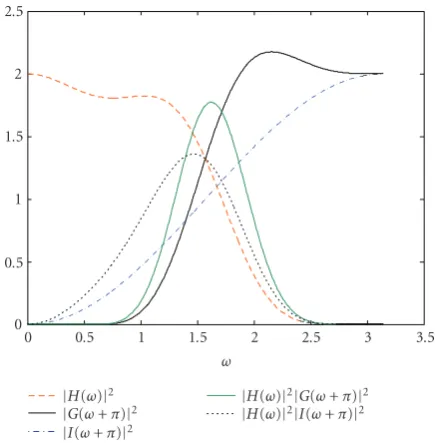
Figure 8depicts|G(ω+π)|2and|H(ω)|2together with their
(x)n
H(z) G(z)
xrec(n) erec(n) − z−d
y(n) H(z) G(z)
zd
yrec(n)
Figure7: Reconstruction error computation without motion vec-tor truncation (scenario (b)).
0 0.5 1 1.5 2 2.5
0 0.5 1 1.5 2 2.5 3 3.5
ω
|H(ω)|2 |G(ω+π)|2 |I(ω+π)|2
|H(ω)|2|G(ω+π)|2 |H(ω)|2|I(ω+π)|2
Figure8: Frequency responses of the filters cited in the paper.
product. We can conclude that the error depends on the fre-quency characteristics of the signal and it is close to zero if its energy is mostly concentrated at low frequencies. Indeed the approximation we get interpolating withG(ω) is very much similar to the original.
The error in scenario (a) can be derived as a special case of scenario (b). Since the received signal has lower resolution than the motion field, vectors are truncated. If the compo-nents are odd, they are also rounded to the nearest integer. The reconstruction error is
N/2−1 n=0
e2 y=
N/2−1 n=0
xlow
n−round
d 2
−ylow(n)
2. (28)
0 0.2 0.4
Er
ro
r
0.65 0.7 0.75 0.8 0.85 0.9 0.95 11.5 2 2.5
Er
ro
r
ratio
Erra
Errb Erra/Errb
Figure9: Comparison between the (normalized) error in scenario (a) and (b) as a function of the correlation coefficientρ.
field. As a matter of fact, the error can be expressed as
N/2−1 n=0
e2y= N−1
n=0 e2reca(n)
=2
+π
0
e√jω
2− 1 √ 2
2 H(ω) 2 X(ω) 2dω
=2
+π
0
I(ω+π) 2
H(ω) 2 X(ω) 2dω. (29)
The equivalence holds because the interpolating sample and hold filterI(ω) is equivalent to the inverse Haar DWT, where the low-frequency subband is the subsampled signal and the high-frequency subband coefficients are set to zero. Having fixed|H(ω)|2, we are unable to state which of the two
ap-proaches is better, that is, has smaller error, since|I(ω)|2is
not greater than|G(ω)|2for allω(seeFigure 2) and we do
not know the power spectrum of the signal. Nevertheless, if we assume that most of the energy is concentrated at low fre-quencies, approach (b) gives better coding efficiency. In fact, taking the expectation of (27) and (29) with respect tox(n):
Erra=E
N−1
n=0 e2
reca(n)
=2
+π
0
I(ω+π 2
H(ω) 2Sx(ω)dω,
Errb=E
N−1
n=0 e2
recb(n)
=2
+π
0
G(ω+π) 2
H(ω) 2Sx(ω)dω.
(30)
If we model the signal as an autoregressive process of order 1 with correlation coefficientρ, the signal power spectrum
Sx(ω) can be expressed in closed form as
Sx(ω)=
1−ρ2
1−ρejω 2. (31)
We are now able to evaluate numerically (30). As illustrated
inFigure 9, for anyρ, in [0.7, 1]2Err
a > Errb and their
ra-tio is higher forρclose to 1, meaning that the penalty due to motion vector truncation with respect to interpolating at full resolution withG(ω) is greater when the input signal has energy concentrated in the low-frequency range.
Section 3validates the results of the formal analysis by
giving experimental evidence about the better coding effi-ciency achievable without truncating the motion vectors.
3. EXPERIMENTAL RESULTS
In this section, we discuss the overall performance of the 2D+t scalable video codec presented inSection 2in terms of complexity and coding efficiency. We emphasize the impact of each of the coding tools detailed in this paper, in order to evaluate the best combination of the coding parameters.
As a benchmark, we use the MC-EZBC codec (motion-compensated embedded zero-block coding) [5] for the t+2D case, as the proposed 2D+t codec shares some of its func-tional modules (i.e., spatial and temporal filters, entropy cod-ing algorithm).
Throughout our simulations, we used the following set of parameters:
(i) sequence spatio-temporal resolution:
– QCIF (176×144) at 30 fps:Silent
– CIF (352×288) at 30 fps: Mobile & Calendar,
Foreman,Football
– 4CIF (704×576) at 60 fps:City,Soccer;
(ii) number of frames: 300;
(iii) spatial wavelet transform: Daubechies 9/7:
– QCIF:K=3 – CIF:K=3 – 4CIF:K=4;
(iv) temporal transform: Haar; (v) GOP size: 16 frames;
(vi) search window: [−W/2, +W/2]:
– QCIF: [−16, +16] – CIF: [−32, +32] – 4CIF: [−48, +48];
(vii) motion accuracy: 1/4 pixel; (viii) block size:
– QCIF and CIF: fixed size 16×16, variable size 64×64 to 4×4
– 4CIF: fixed size 32×32, variable size 128×128 to 4×4;
(ix) entropy coding: EZBC.
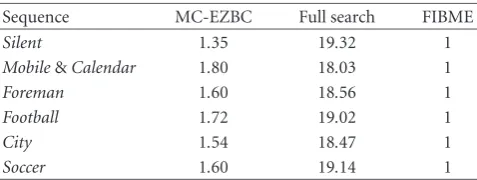
In the first experiment, we compare the proposed fast motion estimation algorithm (FIBME) (seeSection 2.1) with the computationally demanding full search strategy. As a ref-erence, we include the rate-distortion curve obtained with MC-EZBC. In terms of encoding complexity, the proposed algorithm allows a speedup factor of the overall encoding phase equal to 18–19. To this regard,Table 1shows, for each sequence, the encoding time normalized with respect to the encoding time needed when FIBME is used for the same se-quence. Note that also MC-EZBC uses a fast motion estima-tion algorithm (HVSBM [23]).
Figure 10 andTable 2 show the rate-distortion
perfor-mance of the proposed 2D+t codec with FIBME with respect to a full search motion estimation algorithm. In both cases, blocks of variable sizes are used. From these results we can conclude that, apart from theMobile& Calendarsequence andForemanat high bitrates, the rate-distortion gap between FIBME and full search remains within the 0 dB–0.3 dB range. In all of the remaining experiments, the 2D+t codec always uses the FIBME algorithm in the motion estimation phase.
Figure 11andTable 3show the objective PSNR gain that
can be obtained by using blocks of variable sizes with the FIBME algorithm. It should be noticed that the eff ective-ness of this feature depends on the complexity of the scene to be encoded. The more complex the motion, the highest the benefit of using blocks of variable size would be. For rea-sons of space, we report the results forForemanandFootball. The other sequences are characterized by a simpler motion, therefore the coding gain tends to be more limited. In all of the remaining simulations, blocks of variable sizes are always used.
Table1: Normalized encoding time.
Sequence MC-EZBC Full search FIBME
Silent 1.35 19.32 1
Mobile&Calendar 1.80 18.03 1
Foreman 1.60 18.56 1
Football 1.72 19.02 1
City 1.54 18.47 1
Soccer 1.60 19.14 1
Figure 12 and Table 4 show the results of the
simula-tions conducted when the scalable motion coding algorithm presented in Section 2.3is introduced. In the 2D+t codec, both FIBME and blocks of variable sizes are turned on. For the nonscalable case, motion vectors are encoded as in MC-EZBC, by arithmetic coding the prediction residue obtained as the difference between the motion vector and its causal predictor. We can conclude the following:
(i) when the motion information is scaled, it is possible to achieve a lower target bitrate. InFigure 12, it can be noticed that in the nonscalable case, for the Foot-ballsequence, the minimum target bitrate is equal to 128 kbps, whereas it is possible to decode at 64 kbps when the proposed algorithm is used;
(ii) at low bitrates, a PSNR improvement (up to +3 dB) is obtained by scaling the motion information as a fraction of the bit budget can be allocated to encode wavelet residual coefficients;
(iii) at high bitrates, the proposed algorithm causes a lim-ited coding efficiency loss (less than 0.1 dB) due to the fact that the lossless representation produced in the scalable case is not as efficient as in the nonscalable case. This is the cost associated to the embedded rep-resentation of the motion information.
Finally, we discuss the effect of truncating the motion vectors when a sequence is decoded at reduced spatial resolu-tions. In this case, there is no unique reference for the PSNR computation [33], since the truncation of motion vectors af-fects the MCTF synthesis phase. For this reason, inFigure 13
andTable 5, PSNR values are computed using the spatially
downsampled sequence obtained extracting the LLK
sub-band from the wavelet spatial analysis. When the sequences are decoded at reduced frame rate, the frame skipped se-quence is used as a reference. Experimental subjective results [33] demonstrated that the relationship between visual qual-ity and objective PSNR measurements is usually weak, unless the reference stays the same. For this reason, we also carried out visual tests in order to assess the effect of motion vec-tors truncation in terms of visual quality. InFigure 14, it is possible to see a sample frame from theMobile& Calendar
sequence where it is clearly visible that motion vector trunca-tion affects the visual quality of the reconstructed sequence. The same evidence is also true for all of the other tested se-quences.
25 30 35 40 45 50 55
A
ver
age
Y
PSNR
256 512 768 1024 1280 1536 Rate (kbps)
t+2D (MC-EZBC) 2D+t-full search 2D+t-FIBME
Silent QCIF@30 fps
(a)
16 18 20 22 24 26 28 30 32 34 36
Av
er
ag
e
Y
PSNR
256 512 768 1024 1280 1536 1792 2048 Rate (kbps)
t+2D (MC-EZBC) 2D+t-full search 2D+t-FIBME
Mobile & Calendar CIF@30 fps
(b)
22 24 26 28 30 32 34 36 38 40 42
Av
er
ag
e
Y
PSNR
256 512 768 1024 1280 1536 1792 2048 Rate (kbps)
t+2D (MC-EZBC) 2D+t-full search 2D+t-FIBME
Foreman CIF@30 fps
(c)
22 24 26 28 30 32 34 36
Av
er
ag
e
Y
PSNR
256 512 768 1024 1280 1536 1792 2048 Rate (kbps)
t+2D (MC-EZBC) 2D+t-full search 2D+t-FIBME
Football CIF@30 fps
(d)
22 24 26 28 30 32 34 36 38
Av
er
ag
e
Y
PSNR
512 1536 2560 3584 4608 5632 Rate (kbps)
t+2D (MC-EZBC) 2D+t-full search 2D+t-FIBME
City 4CIF@60 fps
(e)
24 26 28 30 32 34 36 38 40
Av
er
ag
e
Y
PSNR
512 1536 2560 3584 4608 5632 Rate (kbps)
t+2D (MC-EZBC) 2D+t-full search 2D+t-FIBME
Soccer 4CIF@60 fps
(f)
Table2: Comparison between MC-EZBC (t+2D with HVSBM), 2D+t with full search motion estimation, and 2D+t with FIBME.
kbps MC- 2D+t 2D+t (c)–(a) (c)–(b)
EZBC (a) FS (b) FIBME (c)
32 — 27.30 27.25 — −0.05
64 30.61 31.59 31.58 0.97 −0.01
128 34.90 35.73 35.71 0.81 −0.02
256 39.56 40.58 40.56 1.00 −0.02
512 45.35 46.17 46.15 0.80 −0.02
768 48.87 49.63 49.62 0.75 −0.01
1024 51.33 51.84 51.83 0.50 −0.01
1536 53.37 53.47 53.46 0.09 −0.01
(a)SilentQCIF@30 fps
kbps MC- 2D+t 2D+t (c)–(a) (c)–(b)
EZBC (a) FS (b) FIBME (c)
64 — 17.46 17.07 — −0.39
128 — 20.95 20.54 — −0.41
256 23.31 24.31 23.76 0.45 −0.55
512 28.02 28.05 27.27 −0.75 −0.78
768 30.34 30.06 29.46 −0.88 −0.60
1024 31.74 31.56 31.05 −0.69 −0.51
1536 33.69 33.52 33.15 −0.54 −0.37
2048 35.27 35.19 34.86 −0.41 −0.33
(b)Mobile&CalendarCIF@30 fps
kbps MC- 2D+t 2D+t (c)–(a) (c)–(b)
EZBC (a) FS (b) FIBME (c)
64 — 23.86 23.69 — −0.17
128 — 28.37 28.16 — −0.21
256 31.29 31.65 31.31 0.02 −0.34
512 34.53 34.82 34.34 −0.19 −0.48
768 36.19 36.55 36.03 −0.16 −0.52
1024 37.56 38.03 37.49 −0.07 −0.54
1536 39.44 39.89 39.38 −0.06 −0.51
2048 40.98 41.49 40.98 0 −0.51
(c)ForemanCIF@30 fps
kbps MC- 2D+t 2D+t (c)–(a) (c)–(b)
EZBC (a) FS (b) FIBME (c)
64 — — — — —
128 — 22.83 23.00 — 0.17
256 — 25.59 25.58 — −0.01
512 27.70 28.26 28.18 0.48 −0.08
768 29.45 29.94 29.81 0.36 −0.13
1024 30.80 31.48 31.32 0.52 −0.16
1536 32.83 33.69 33.51 0.68 −0.18
2048 34.63 35.63 35.40 0.77 −0.23
(d)FootballCIF@30 fps
kbps MC- 2D+t 2D+t (c)–(a) (c)–(b)
EZBC (a) FS (b) FIBME (c)
256 — 23.48 23.34 — −0.14
512 23.82 26.71 26.52 2.70 −0.19
768 28.16 28.49 28.26 0.10 −0.23
1024 30.13 29.68 29.42 −0.71 −0.26
1536 32.34 31.50 31.22 −1.12 −0.28
2048 33.71 32.73 32.44 −1.27 −0.29
3000 35.19 34.41 34.15 −1.04 −0.26
6000 37.47 37.02 36.85 −0.62 −0.17
(e)City4CIF@60 fps
kbps MC- 2D+t 2D+t (c)–(a) (c)–(b)
EZBC (a) FS (b) FIBME (c)
256 — 24.57 24.97 — 0.40
512 — 27.84 27.65 — −0.19
768 — 29.42 29.17 — −0.25
1024 29.61 30.47 30.26 0.65 −0.21
1536 31.84 32.17 31.96 0.12 −0.21
2048 33.09 33.34 33.18 0.09 −0.16
3000 34.73 35.06 34.93 0.20 −0.13
6000 37.65 38.12 37.89 0.24 −0.23
(f)Soccer4CIF@60 fps
22 24 26 28 30 32 34 36 38 40 42
Av
er
ag
e
Y
PSNR
256 512 768 1024 1280 1536 1792 2048 Rate (kbps)
t+2D (MC-EZBC) 2D+t-FIBME-VSBM 2D+t-FIBME-FSBM
Foreman CIF@30 fps
(a)
22 24 26 28 30 32 34 36
Av
er
ag
e
Y
PSNR
256 512 768 1024 1280 1536 1792 2048 Rate (kbps)
t+2D (MC-EZBC) 2D+t-FIBME-VSBM 2D+t-FIBME-FSBM
Football CIF@30 fps
(b)
Table3: FIBME: fixed block sizes (FSBM) versus variable block sizes (VSBM).
kbps MC- 2D+t FIBME 2D+t FIBME (c)–(a) (c)–(b)
EZBC (a) FSBM (b) VSBM (c)
64 — — 23.69 — —
128 — — 28.16 — —
256 31.29 28.73 31.31 0.02 2.58
512 34.53 31.99 34.34 −0.19 2.35
768 36.19 34.03 36.03 −0.16 2.00
1024 37.56 35.30 37.49 −0.07 2.19
1536 39.44 37.54 39.38 −0.06 1.84
2048 40.98 39.05 40.98 0 1.93
(a)ForemanCIF@30 fps
kbps MC- 2D+t FIBME 2D+t FIBME (c)–(a) (c)–(b)
EZBC (a) FSBM (b) VSBM (c)
64 — — — — —
128 — — 23.00 — —
256 — 24.24 25.58 — 1.34
512 27.70 27.09 28.18 0.48 0.72
1024 30.80 30.57 31.32 0.52 0.75
1536 32.83 32.76 33.51 0.68 0.75
2048 34.63 34.73 35.40 0.77 0.67
(b)FootballCIF@30 fps
Table4: Nonscalable versus scalable motion vectors.
kbps MC- Nonscal. Scal. (c)–(a) (c)–(b)
EZBC (a) MV (b) MV (c)
32 — 27.25 27.50 — 0.25
64 30.61 31.58 31.70 1.09 0.12
128 34.90 35.71 35.80 0.90 0.09
256 39.56 40.56 40.60 1.04 0.04
512 45.35 46.15 46.14 0.79 −0.01
768 48.87 49.62 49.60 0.73 −0.02
1024 51.33 51.83 51.79 0.46 −0.04
1536 53.37 53.46 53.40 0.03 −0.06
(a)SilentQCIF@30 fps
kbps MC- Nonscal. Scal. (c)–(a) (c)–(b)
EZBC (a) MV (b) MV (c)
64 — 17.07 20.01 — 2.94
128 — 20.54 22.10 — 1.56
256 23.31 23.76 24.90 1.59 1.14
512 28.02 27.27 27.60 −0.42 0.33
768 30.34 29.46 29.45 −0.89 −0.01
1024 31.74 31.05 31.02 −0.72 −0.03
1536 33.69 33.15 33.10 −0.59 −0.05
2048 35.27 34.86 34.80 −0.47 −0.06
(b)Mobile&CalendarCIF@30 fps
kbps MC- Nonscal. Scal. (c)–(a) (c)–(b)
EZBC (a) MV (b) MV (c)
64 — 23.69 25.80 — 2.11
128 — 28.16 29.27 — 1.11
256 31.29 31.31 32.01 0.72 0.70
512 34.53 34.34 34.40 −0.13 0.06
768 36.19 36.03 36.02 −0.17 −0.01
1024 37.56 37.49 37.47 −0.09 −0.02
1536 39.44 39.38 39.33 −0.11 −0.05
2048 40.98 40.98 40.93 −0.05 −0.05
(c)ForemanCIF@30 fps
kbps MC- Nonscal. Scal. (c)–(a) (c)–(b)
EZBC (a) MV (b) MV (c)
64 — — 24.30 — —
128 — 23.00 25.30 — 2.30
256 — 25.58 26.80 — 1.22
512 27.70 28.18 28.80 1.10 0.62
768 29.45 29.81 30.10 0.65 0.29
1024 30.80 31.32 31.32 0.52 0.00
1536 32.83 33.51 33.49 0.66 −0.02
2048 34.63 35.40 35.35 0.72 −0.05
(d)FootballCIF@30 fps
kbps MC- Nonscal. Scal. (c)–(a) (c)–(b)
EZBC (a) MV (b) MV (c)
256 — 23.34 25.80 — 2.46
512 23.82 26.52 27.82 4.00 1.30
768 28.16 28.26 28.88 0.72 0.62
1024 30.13 29.42 29.70 −0.43 0.28
1536 32.34 31.22 31.20 −1.14 −0.02
2048 33.71 32.44 32.40 −1.31 −0.04
3000 35.19 34.15 34.09 −1.10 −0.06
6000 37.47 36.85 36.78 −0.69 −0.07
(e)City4CIF@60 fps
kbps MC- Nonscal. Scal. (c)–(a) (c)–(b)
EZBC (a) MV (b) MV (c)
256 — 24.97 26.50 — 1.53
512 — 27.65 28.75 — 1.10
768 — 29.17 29.90 — 0.73
1024 29.61 30.26 30.80 1.19 0.54
1536 31.84 31.96 32.03 0.19 0.07
2048 33.09 33.18 33.15 0.06 −0.03
3000 34.73 34.93 34.90 0.17 −0.03
6000 37.65 37.89 37.85 0.20 −0.04