Model Order Selection in Multi-baseline
Interferometric Radar Systems
Fabrizio Lombardini
Dipartimento di Ingegneria dell’Informazione, Universit´a di Pisa, via Diotisalvi 2, 56126 Pisa, Italy Email:[email protected]
Fulvio Gini
Dipartimento di Ingegneria dell’Informazione, Universit´a di Pisa, via Diotisalvi 2, 56126 Pisa, Italy Email:[email protected]
Received 18 August 2004; Revised 23 May 2005
Synthetic aperture radar interferometry (InSAR) is a powerful technique to derive three-dimensional terrain images. Interest is growing in exploiting the advanced multi-baseline mode of InSAR to solve layover effects from complex orography, which generate reception of unexpected multicomponent signals that degrade imagery of both terrain radar reflectivity and height. This work addresses a few problems related to the implementation into interferometric processing of nonlinear algorithms for estimating the number of signal components, including a system trade-offanalysis. Performance of various eigenvalues-based information-theoretic criteria (ITC) algorithms is numerically investigated under some realistic conditions. In particular, speckle effects from surface and volume scattering are taken into account as multiplicative noise in the signal model. Robustness to leakage of signal power into the noise eigenvalues and operation with a small number of looks are investigated. The issue of baseline optimization for detection is also addressed. The use of diagonally loaded ITC methods is then proposed as a tool for robust operation in the presence of speckle decorrelation. Finally, case studies of a nonuniform array are studied and recommendations for a proper combination of ITC methods and system configuration are given.
Keywords and phrases:multichannel and nonlinear array signal processing, multicomponent signals, radar interferometry, syn-thetic aperture radar.
1. INTRODUCTION
Synthetic aperture radar interferometry (InSAR) is a pow-erful and increasingly expanding technique to derive digital height maps of the land surface from radar images, with high spatial resolution and accuracy [1,2]. The surface height is estimated from the phase difference between two complex SAR images, obtained by two sensors slightly separated by a cross-track baseline. The InSAR technique is finding many applications in radar remote sensing, for example, for to-pographic and urban mapping, geophysics, forestry, hydrol-ogy, glaciolhydrol-ogy, sighting for cell phones, flight simulators [1,2]. Accurate measurement of radar reflectivity is useful for vegetation and snow mapping, forestry, land-use moni-toring, agriculture, soil moisture determination, mineral ex-ploration, and again for hydrology and geophysics [3].
This is an open access article distributed under the Creative Commons Attribution License, which permits unrestricted use, distribution, and reproduction in any medium, provided the original work is properly cited.
y H
h1
h2 r
θ1 r
θ2
R 1
2 K
z B
Figure1: Geometry of the interferometric system in the presence of layover.B: orthogonal baseline,H: height of the system,hi: height
of the terrain,θi: elevation angle,r: slant-range,R: slant-range
res-olution;z: height axis,y: ground-range axis. Distances and angles are not in scale.
systems [8], planned single-pass MB distributed interferom-eters based on satellite formations [9], and repeat-pass MB systems [4]. A step in the direction of an effective layover so-lution with multi-baseline InSAR (MB-InSAR) is the use of modern spectral estimation techniques, such as adaptive [10] or model-based methods, to obtain a better resolution than the Rayleigh limit and reduced masking effects [6,11,12]. However, the problem of model order selection (MOS) in MB-InSAR imaging is still somewhat overlooked in the lit-erature [13], despite the fact that the correct definition of the number of signal components is a critical problem for good operation of model-based signal-subspace methods [14].
This work constitutes a first step to address some prob-lems related to the implementation of MOS eigenvalues-based information-theoretic criteria (ITC) methods into a practical MB-InSAR for radar imaging of layover areas. The ITC methods considered here are the Akaike information criterion (AIC), the minimum description length (MDL), and the efficient detection criterion (EDC) [15,16,17]. All these parametric detection methods have been conceived for line spatial spectra, which is the case with point-like targets. Therefore, in the presence of speckle from extended natural targets, modeled as complex correlated multiplicative noise, they are mismatched to the actual data model, and leakage of signal power into the noise eigenvalues (EVs) is expected [18]. In this framework, the novelties of this work are (i) to analyze the impact of speckle noise due to surface scatter-ing from locally flat terrains or to volume scatterscatter-ing from rough terrains; (ii) to investigate the classical baseline opti-mization problem in the new context of estimating the num-ber of terrain patches, as a trade-offbetween resolution and speckle decorrelation; (iii) to analyze performance in the re-alistic scenarios of small number of available looks and pos-sible strong scattering from the layover patches, which can cause increased leakage of signal power into the noise EVs;
(iv) to investigate the use of diagonally loaded ITC methods for robust operation in the presence of speckle decorrelation, leakage of signal power, and small number of looks regime; (v) to link the case of MOS with realistic nonuniform array structures to the area of multisource identifiability problems [19], and to analyze a noncritical case of nonuniform dual-baseline array, typical of advanced airborne or formation-based spaceborne systems.
2. STATISTICAL DATA MODEL AND PROBLEM FORMULATION
The MB system is modeled as a cross-track array ofK two-way phase centres, which for ease of analysis can be assumed to be linear and orthogonal to the nominal radar line of sight after local phase aligning (deramping) [7], seeFigure 1. As usual in SAR interferometry, in each radar image we con-siderNindependent and identically distributed looks [1,2]. For each look, the complex amplitudes of the pixels corre-sponding to the same imaged area on ground, observed in theKSAR images, are arranged in theK×1 vectory(n). The observed vectors can be modeled as [20,21]
y(n)= Ns
m=1
√τm
amxm(n) +v(n), n=1, 2,. . .,N, (1)
where is the Hadamard (element-by-element) product, andNsis the number of terrain patches in layover; we as-sume that Ns ≤ K−1 (Ns = 2 inFigure 1). Parameterτm denotes the mean pixel intensity contribution from themth patch (texture in the radar jargon). Vectoram=a(ϕm) is the steering vector pertinent to the mth source; it encodes the various interferometric phases at the MB array due to the imaging geometry. Parameterϕmis the interferometric phase at the overall baseline; it is related to elevation angleθmby
ϕm=4πλ−1Bsinθm−θ, m=1,. . .,Ns, (2)
where λ is the radar wavelength, Bis the overall orthogo-nal baseline length, andθis the nominal (line of sight) off -nadir incidence angle [1]. Note that for fixedλ,θ, andθm, ϕm is proportional to the baselineB. The steering vector is given byam =[1 ejϕmB12/B ejϕmB13/B· · · ejϕmB1K/B]T, which
in general can be nonuniformly spatially sampled;B1lis the
orthogonal baseline between phase centres 1 andl;B1K =B
is the overall baseline. The multiplicative noise termxm(n) is the speckle vector pertinent to themth terrain patch in iso-lation. Considering homogeneous terrain patches, speckle is fully developed and can be modeled as a stationary, circu-lar, complex Gaussian-distributed random process; its spa-tial autocorrelation function is triangular shaped when only baseline decorrelation effect from locally smooth terrain is considered [1,2]. The autocorrelation linearly decreases for increasing baseline between the two spatial samples, reaching zero for the critical baseline value, which is given by
BCm=λr(2R)−1tan
y h1
h2 r
r R
z
Figure2: Geometry of the layover problem: surface illumination from SAR impulse response, projected onto the cross-range eleva-tion axis (example with two adjacent layover sources,z: height axis, y: ground-range axis,r: slant range,R: slant-range resolution,hi:
source height).
whereris the slant range,Rthe slant-range resolution, and δym the local slope ofmth patch [1]. To model additional volumetric decorrelation for locally Gaussian-distributed to-pography (rough patch), a Gaussian-times-triangular auto-correlation function is assumed in this paper, as formal-ized in the sequel. Vectorsxm1(n) andxm2(n) are assumed to be independent for m1 = m2, since they collect
scatter-ing from different terrain patches. Vectorv(n) models the additive white Gaussian thermal noise (AWGN). The data spatial power spectral density (PSD) is the Fourier trans-form of the spatial autocorrelation. It corresponds to the profile of the backscattered power as a function of the ele-vation, for theNsterrain patches “illuminated” through the Sinc SAR slant-range impulse response [21,22]. For a ho-mogeneous and smooth patch (triangular autocorrelation), the corresponding spatial PSD component is squared-Sinc shaped [21]. Data model (1) neglects the truncation of the tails of the illumination function, thus it is slightly approxi-mated for neighboring flat terrain patches (seeFigure 2); for rough terrain patches, approximation is good only for non-neighboring patches.1
The problem of multi-baseline layover solution is there-fore equivalent to the problem of jointly estimating the num-ber Ns of signal components and the Ns interferometric
1In more complex layover scenarios, terrain patches may be nonhomo-geneous, possibly including one or more predominant point-like scatter-ers. For a nonhomogeneous terrain patch without predominant scatterers, speckle is still fully developed but reflectivity is not constant within the patch. The corresponding signal component would exhibit a spatial PSD that is a weighted version of that described above, the elevation-varying re-flectivity in the patch constituting the weighting factor. For a nonhomoge-neous terrain patch with predominant point-like scatterers, speckle would not be fully developed because of the additive deterministic contributions, theNlooks would not be independent and identically distributed, and the spatial PSD would exhibit line components in correspondence to the eleva-tions of the predominant scatterers.
phases {ϕm}and radar reflectivities {τm} [6,7,11,12] in the presence of multiplicative correlated noise with unknown PSD and AWGN [20]. The problem of layover solution can be divided into two subproblems: (i) estimating the num-ber of sources, which is the so-called detection problem or model order selection problem; (ii) retrieving the parame-ters of each single component, which is the estimation prob-lem. The final appeal for the user of an MB layover solu-tion processing chain strongly depends on the automatic estimation of Ns, and accuracy of the overall layover solu-tion depends on the successful determinasolu-tion of the num-ber of signal components. In particular, most of the reported good properties of model-based signal-subspace methods are valid only if the assumed model order is the correct one. Also when nonmodel-based (possibly adaptive) spec-tral estimation methods are employed, model order has to be selected in the height/reflectivity map reconstruction stage of the layover area from the continuous elevation profiling [7,10].
The focus in this paper is on system and estimation problems for the retrieval of the number of overlaid terrain patchesNsfrom the observation of the MB data{y(n)}Nn=1,
withNthe number of looks. In this framework, the intensi-ties and interferometric phases of the patches, the autocor-relation matrices of the corresponding speckle vectors, and possibly the thermal noise power are modeled as unknown deterministic parameters. This formulation of the detection problem shows that it is equivalent to the problem of estimat-ing the order of a multicomponent signal composed by mul-tiple complex exponentials corrupted by correlated complex Gaussian multiplicative noise with unknown power spectral shape, embedded in AWGN.
3. MODEL ORDER SELECTION METHODS
Estimation of the number of components in MB-InSAR data in the presence of layover is an atypical detection prob-lem, because of the presence of multiplicative noise. In fact, the most extensively used methods, based on information-theoretic criteria, have been conceived to estimate the num-ber of signal components in the presence of additive white noise only (see [15] and references therein, and the summa-rized theory in the sequel). In this case, the dimension of the signal subspace isNs, provided that theNssteering vectors, {am}, are linearly independent; this is always the case for uni-form linear arrays (ULA) [19], and sources within the unam-biguous phase range [21,22]. TheK−Nssmallest eigenvalues of the data covariance matrix are all equal [15], so the MOS problem is equivalent to the estimation of the multiplicity of the smallest eigenvalues of the data covariance matrix. In presence of multiplicative noise, the EV spectrum broadens [18]. Consequently, ITC operates under model mismatch. We want to investigate the effects of this model mismatch-ing and possible cures for it.
consist of minimizing a criterion over the hypothesized num-bermof signals that are detectable, form=0, 1,. . .,K−1. To construct these criteria, a family of probability densities, {f(y|χ(m))}K−1
m=0, is needed, whereχis the vector of
param-eters which describe the model that generated the datayand it is a function of the hypothesized numbermof sources. The criteria are composed of the negative log-likelihood function of the density f(y|χ(m)), where χ(m) is the maximum like-lihood estimate ofχ under the assumption thatm compo-nents are present, plus an adjusting term, the penalty func-tionp(η(m)), which is related to the numberη(m) of the de-grees of freedom (DOF):2
ITC(m)=−lnfy|χ(m) +pη(m), m=0, 1,. . .,K−1. (4) The number of componentsNSis estimated as
NS=arg min
m ITC(m). (5)
The introduction of a penalty function is necessary be-cause the negative log-likelihood function always achieves a minimum for the highest possible model dimension. There-fore, the adjusting term will be a monotonically increasing function ofmand it should be chosen so that the algorithm is able to determine the correct model order. The choice of the penalty function is the only difference among AIC, MDL, and EDC. Akaike [24] introduced the penalty function so that the AIC is an unbiased estimate of the Kullback-Liebler distance between f(y|χ(m)) andf(y|χ(m)):
AIC(m)= −lnfy|χ(m) +η(m). (6)
Two different approaches were taken by Schwartz [25] and Rissanen [26]. Schwartz utilized a Bayesian approach, assign-ing a prior probability to each model, and selected the model with the largest a posteriori probability. Rissanen used an information-theoretic argument: one can think of the model as an encoding of the observation; he proposed choosing the model that gave the minimum code length. In the large sam-ple limit, both approaches lead to the same criterion:
MDL(m)= −lnfy|χ(m) +1
2η(m) logN, (7)
whereN is the number of independent observations of the data vector y (in our InSAR problem it is the number of looks). MDL is a particular case of the EDC procedure. EDC is a family of criteria developed by statisticians at the Uni-versity of Pittsburgh [16,17], chosen such that they are all consistent:
EDC(m)= −lnfy|χ(m)+η(m)CN, (8)
2DOF is the number of real independent parameters inχ.
whereCN can be any function ofNsuch that
lim N→∞
CN
N =0, Nlim→∞
CN
ln(lnN)= ∞. (9)
The EDC is implemented here by choosing CN = logN (EDC1) andCN =
NlogN(EDC2). For the statistical data
model of Gaussian data with a line spectrum in AWGN, typi-cal in sensor array processing applications, the handy expres-sion for the log-likelihood function is [23]
lnfy|χ(m)=N(K−m) ln
K−m
K
i=m+1λi
1/(K−m) Ki=m+1λi
,
m=0, 1,. . .,K−1, (10)
where{λi}Ki=1are the eigenvalues in descending order of the
estimated data covariance matrix. Thus, as hinted in the be-ginning of this section, the solution of the MOS problem by ITC methods relies on a particular uniformity test on the eigenvalues of the covariance matrix of the array data to de-tect the number of the smallest constant ones. Their unifor-mity is measured by the ratio of the harmonic and algebraic mean of the values, as from (10).
When the multi-baseline array is nonuniform (non ULA), we derive the{λi}Ki=1 from the unstructured sample
covariance matrix estimate (forward-only averaging, F-only)
Ry= N1 N
n=1
y(n)yH(n). (11)
When the array is ULA, it can be convenient to use the struc-tured forward-backward (FB) averaging covariance estimate accounting for the Toeplitz form of the true covariance ma-trix [15]
RFB=
Ry+JRHyJ
2 , (12)
whereJis the so-called exchange matrix, that has ones on the main anti-diagonal [21,22]. FB averaging is essentially a way of preprocessing the data which preserves the desired infor-mation and removes to some extent unwanted perturbations (noise) by effectively doubling the number of observations of the data vector. However, FB averaging significantly changes the statistical properties of noise, introducing noise correla-tion [15, Section 7.8], [27]. Consequently, when FB averag-ing is employed, ITC methods must be changed to correctly account for this preprocessing of data. Concerning the DOF expression, this has been derived by Wax and Kailath [23] for F-only covariance matrix estimation and again the standard model of Gaussian data with line spectrum in AWGN:
Xu et al. [27] solved the problem of how the ITC detection tests should be modified to account for the use of the FB co-variance matrix. AIC, MDL, and EDC are applicable modi-fying the number of DOF as [15]
ηFB(m)=m
2(2K−m+ 1), m=0, 1,. . .,K−1. (14)
As regards the performance of these criteria using the F-only covariance matrix, Zhao et al. showed that, under the data assumptions of the standard model [23], MDL is con-sistent and generally performs better than AIC [17]. They also showed that AIC is not consistent and will tend to over-estimate the number of sources as N goes to infinity. The EDC criteria are all consistent [28]. As concerning the perfor-mance using the FB covariance matrix, Xu et al. [27] showed that MDL-FB is consistent (as MDL), whereas AIC-FB is not (as AIC). The assumption of whiteness of the additive noise is critical for the ITC methods. If the noise covariance matrix is not proportional to the identity matrix, the noise eigenval-ues are no longer all equal. The effect of the noise eigenvalues dispersion on AIC and MDL performance has been studied by Liavas and Regalia [29]. They showed that when the noise eigenvalues are not clustered sufficiently closely, the AIC and the MDL may lead to overestimatingNS. For fixed disper-sion, overmodeling becomes more likely for increasing the number of data samples [30]. Undermodeling may happen in the cases where the signal and the noise eigenvalues are not sufficiently closely clustered [29]. In the InSAR applica-tion additive noise is white, yet model mismatch problems are expected from the presence of multiplicative noise.
4. PERFORMANCE AND TRADE-OFF ANALYSIS Numerical analysis of the estimation accuracy of the vari-ous ITC methods in the InSAR application has been derived by Monte Carlo simulation, by generating 10 000 multilook pixel vector realizations according to model (1). The speckle vectors{xm(n)}have been generated assuming a triangular-time-Gaussian shaped spatial autocorrelation function:
rxm(u,v)
=Exm(n)ux∗m(n)v=
1−BBuv
Cm
e−(Buv/BCm)2/s2, u,v=1, 2,. . .,K,m=1,. . .,Ns,n=1, 2,. . .,N,
(15)
forBuv/BCm≤1, andrxm(u,v)=0 otherwise;Buvis the or-thogonal baseline between phase centresuandv,BCmis the
critical baseline for themth speckle term. For a ULA system, Buv =(u−v)B/(K−1) andrxm(u,v)=rxm(u−v)=rxm(l) withl =u−vthe array lag for phase centresuandv. The terms2 =2R2cos2(ϑ)/σ2
s is a smoothness parameter,σs2/R2 is the vertical variance of the scatterers in the sensed scene in slant-range resolution units [22]. The true spatial PSD of the mth speckle term can be expressed by assuming a ULA con-figuration and Fourier transforming the nontruncated auto-correlation sequencerxm(l), that is, allowingl > K−1. When
s → ∞ the autocorrelation sequence is triangular shaped and the corresponding spatial PSD is a discrete squared Sinc [20,21], as mentioned inSection 2.
4.1. Eigenvalues leakage from
multiplicative speckle noise
It is known that performance of ITC methods degrades when errors in real systems affect the separation between signal and noise EVs [14]. Several phenomena in array processing can produce leakage of the signal power into the noise sub-space. The random modulation induced by the speckle re-sults in a covariance matrix tapering (CMT) of the unmodu-lated (absence of the speckle phenomenon or fully correunmodu-lated speckle) signal covariance matrix. CMT models also the ef-fects on radar data of other well-known phenomena, such as, for example, internal clutter modulation (ICM), scintil-lation, bandwidth dispersion, uncompensated antenna jit-ter/motion, and transmitter/receiver instabilities [31]. It pro-duces subspace leakage (or eigenspectrum modulation), that is, an increase of the effective rank of the data covariance ma-trix, which in turn heavily impacts the performance of many adaptive sensor array processing algorithms.
In the InSAR application, an important source of leak-age is the presence of the multiplicative noise [13]. In fact, speckle decorrelation results in the noise EVs of the true data covariance matrix being no longer all equal, and in the ma-trix being full rank, even in the limit of thermal noise power σ2
v→0 [13,18]. This phenomenon, and the other effects and trends of the MOS problem in InSAR, are first analyzed with reference to ULA systems in this and in the following sec-tion. This scenario is representative of advanced MB single-pass platforms such as PAMIR from FGAN [8], and is also useful to capture the basics of the problem in more com-plex configurations. An analysis for a non-ULA system is pre-sented inSection 6. The mentioned EV leakage effect is illus-trated in Figure 3, where the actual EV spectrum is plotted for a ULA system withK =8,Ns=2, signal-to-noise ratios SNRm = τm/σv2 = 12 dB, form = 1, 2,σv2 = 1, same crit-ical baselineBC1 =BC2 =BC, flat terrain patches (s→ ∞), ∆ϕ=ϕ1−ϕ2∼=4πλ−1B(ϑ1−ϑ2)=540◦. For increasing
slant-range resolution, or patch slope producing local grazing an-gle, the critical baseline tends to infinity and the backscatter-ing sources behave like point-targets as far as speckle spatial correlation is concerned, that is, completely correlated multi-plicative disturbance. In this conditionB/BC→0 and there is a large gap between the signal EVs and the noise EVs, which are all equal to σ2
v. Conversely, in the presence of extended backscattering sources, the multiplicative disturbance is only partially correlated, and as a result there is not a large separa-tion between the signal and the noise EVs, despite the good SNR (see the curve inFigure 3relative toB/BC = 0.2). EV leakage may affect differently the behavior of ITC methods.
4.2. Baseline optimization for detection
B/BC=0 B/BC=0.2
1 2 3 4 5 6 7 8
EV order −5
0 5 10 15 20 25
EV
sp
ec
tr
u
m
(d
B
)
Figure3: Leakage effect on the actual EV spectrum from
multipli-cative noise,∆ϕ=540◦.
decorrelation [2]. Here, the issue of baseline optimization for detection is investigated for the first time, extending the clas-sical analysis in [2] to the layover scenario. The trade-offto be analyzed is now between speckle decorrelation effects and source resolution problems. To this aim, we consider a given critical baseline common to all the layover sources, that is, same local incidence angles, coding given slant-range resolu-tion and patch slopes. We then analyze the behavior of the es-timated EV spectrum and the performance of ITC methods as a function of the baselineB. It is important to note that both the ratioB/Bcand∆ϕ= ϕ1−ϕ2 =∼4πλ−1B(ϑ1−ϑ2)
are proportional to the system baselineB. Where not other-wise stated, performance is evaluated assuming a ULA sys-tem withK =8,Ns =2, SNR1 =SNR2 =12 dB,s → ∞,
N=32, and FB averaging. Two scenarios are analyzed in this trade-offanalysis: theclose sources scenario and thespaced sources scenario. In the former the two squared Sinc main lobes of the source spatial spectra are adjacent [20,21,22], as inFigure 2. Consequently, the difference∆ϕbetween the two interferometric phases is equal to the spatial bandwidth of the two spectral contributions (expressed in terms of in-terferometric phase), that is, ∆ϕ = 4πB/Bc [20,21]. This condition encodes adjacent layover patches. In the spaced sources scenario, the source separation is larger than their spatial extent; in particular, we consider the case where∆ϕ= 15πB/Bc. The spaced sources scenario model is also valid for rough patches. Where not otherwise stated, the close sources scenario is considered. Detection performance is evaluated in terms of the probability of correct model order estima-tion (PCE), the probability of overestimation (POE), and the
probability of underestimation (PUE), which are related by
PCE+POE+PUE=1.
The baseline influence on the detection performance of the four ITC methods is investigated in Figure 4. Perfor-mance curves are plotted as a function of the ratioB/BCfor
EDC2 EDC1
MDL AIC
0 0.2 0.4 0.6 0.8 1
B/BC
0 0.2 0.4 0.6 0.8 1
PCE
Figure4: Baseline optimization.
normalization purposes; however, one should bear in mind thatBCis fixed and∆ϕvaries withB/BCaccording to the se-lected scenario. For the given close sources scenario, speckle decorrelation increases with increasing B/BC, while at the same time the source separation in terms of∆ϕincreases. A similar trend stands also for the spaced sources scenario, with ∆ϕ increasing more rapidly.Figure 4 shows that AIC and MDL generally fail to correctly determine the number of sig-nal components in the presence of partially correlated mul-tiplicative noise, whatever baseline is selected. EDC methods show better robustness to model mismatching. Specifically, EDC2 can be considered the best performing, having
gen-erally the highest PCE. Note however that none of the ITC
methods is uniformly most efficient; this condition will show up also in the subsequent analyses, and some subjective judg-ment in selecting the globally best method may be required again. The results in Figure 4 can be used to derive indi-cations for baseline optimization. In fact, the trade-off be-tween speckle decorrelation effects and resolution problems for varying baseline results in an optimal range for B/BC. This is, say, 0.1–0.4 for EDC2. Of course one should also
con-sider that for increasing baseline the equivocation height cor-responding to the unambiguous phase range decreases [1].3
The trade-offproblem is clear fromFigure 5, where the average values of the eight estimated EVs are plotted ver-susB/BC(each EV order is marked). ForB/BC ∼=0.1−0.4, two dominant (signal) EVs can be identified, a number that
3It is worth noting another possible use of this analysis whereB/BCand
0 0.2 0.4 0.6 0.8 1 B/BC
−5 0 5 10 15 20 25
Estimat
ed
E
Vs
(dB)
1 2
3 4
5 6
7 8
Figure5: Leakage effect on the average estimated EVs for varying
baselines.
corresponds to what is expected forNs = 2 and negligible multiplicative noise effect. However, forB/BC→0,∆ϕ→0, and one signal EV migrates towards the noise EVs, leaving one dominant EV only: because of resolution problems, all the ITC methods produce E{Ns} ∼= 1, where the loss of PCEin the leftmost part of plots inFigure 4. Conversely, for
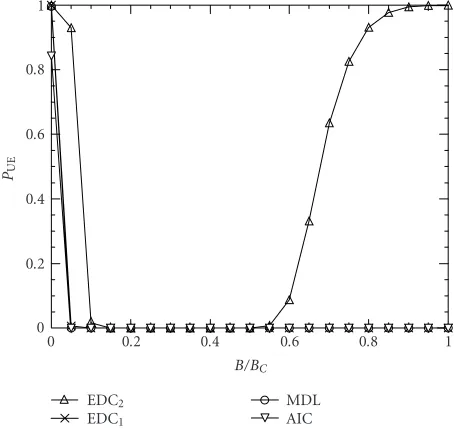
largeB/BC the corresponding∆ϕis large and resolution is no more a problem; forB/BC >0.5,∆ϕ >2πand the inter-source distance is larger than the classical Rayleigh resolu-tion limit [21]. However, speckle decorrelation causes the noise EVs to diffuse making fuzzy the gap between noise and signal EVs. In this condition, none of the ITC meth-ods can estimate the correct value Ns = 2, as shown in the rightmost part of Figure 4, but their estimation errors can be different. EDC2 can underestimateNs, as shown in Figure 6, where PUE is plotted, whereas the other methods
overestimateNs. In particular, forB/BC → 1, for EDC2we
find E{Ns} ∼ = 0, which can be termed a“blind baseline” effect: the diffused EV spectrum is interpreted by EDC2 as
originated by noise only. Conversely, the other ITC meth-ods tend to interpret the EV spectrum from two extended sources as originated by a greater number of point sources. So far, we have considered the highestPCEas best index of
quality of MOS methods, which is undoubtedly a reason-able judgment criterion from a pure statistical point of view. However, in an engineering framework a low probability of underestimationPUE is also important in judging MOS
al-gorithms for the system application at hand. In fact, when PCEis not high, in terms of impact on the subsequent InSAR
processing, the overestimation condition can be better than underestimation. Thus, from a practical point of view, by jointly inspecting Figures4and6, one might consider EDC1
as producing overall performance comparable to or better than EDC2for the examined scenario. A definite judgment
would require simulation of the complete layover solution
EDC2 EDC1
MDL AIC
0 0.2 0.4 0.6 0.8 1
B/BC
0 0.2 0.4 0.6 0.8 1
PUE
Figure6: Blind baseline effect.
CE, #2 UE, #2
CE, #1 UE, #1
1 2 3 4 5
Ns
0 0.2 0.4 0.6 0.8 1
PCE
,
PUE
Figure 7: Effect of varying number of patches on EDC methods
(CE: correct estimation, UE: underestimation, label #kstands for EDCk),B/BC=0.3.
processing chain, including estimation of the heights and re-flectivities of theNs layover terrain patches, post-processing, and height/reflectivity map derivation, which is out of the scope of this paper.
here for lack of space, reveal that the optimal baseline range for detection tends to vary withNS. Thus, in practice it may be difficult to get good baseline optimization. However, for B/BC = 0.3 shown inFigure 7, EDC2 performance is good
up to four layover sources (a realistic upper bound value for NSis about three-four), both in terms of highPCEand low
PUE.
4.3. Effect of volumetric speckle decorrelation
InFigure 8, both the probability of correct order estimation and that of overestimation of the EDC2method are reported
for the case of spaced sources, for both flat (s → ∞) and very rough patches (s = 1). The curves stop when the two sources reach the maximum distance possible within the un-ambiguous phase range 2π(K −1) [21, 22], which corre-sponds to the equivocation height [2]. Compared toFigure 4, the range of baselines for optimum operation of EDC2 is
wider. Note that the Rayleigh resolution limit corresponds now toB/BC=0.13. Conversely, other numerical results not reported here showed that EDC1 in this scenario tends to
perform worse than for close sources, exhibiting aPCE
simi-lar to that of MDL inFigure 4. Thus, for spaced sources the trade-offbetween speckle decorrelation effects and resolu-tion problems for varying baseline is not critical, and EDC2
has the best performance for the whole range of operating B/BCvalues. Also, inFigure 8it can be seen how the addi-tional decorrelation from volumetric scattering can increase POEof EDC2 aroundB/BC = 0.15, whilePUE is slightly
in-creased aroundB/BC=0.45. Interestingly, the increased EV leakage effect from volumetric decorrelation is not very sen-sible and does not significantly impair PCE, which remains
high. Thus, EDC2is a good choice when source separation
can vary from the close to the spaced sources condition and volumetric decorrelation can be present.
5. DIAGONALLY LOADED ITC METHODS
So far, we have analyzed the impact of surface and volume speckle decorrelation on the performance of classical ITC methods. To increase the robustness of the ITC methods to speckle effects, we propose here to resort todiagonal loading (DL). In fact, it is well known that DL can be quite effective in stabilizing the variations of the small eigenvalues, to which ITC methods are highly sensitive [14]. This stabilization ef-fect is independent of the particular source of the leakage phenomenon, thus should have some efficacy also to reduce leakage problems from multiplicative noise. The diagonally-loaded covariance matrix estimateRY is obtained as
RY =RY+δσv2I, (16)
whereRYis the sample (or the FB) covariance matrix,δis the DL factor, andσ2
vis the AWGN power that in practice can be obtained by noise calibration data. The corresponding mod-ified ITC methods are denoted by AIC, MDL, DL-EDC1, and DL-EDC2. DL is a simple yet effective technique.
However, a definite recipe for setting the DL factorδis not
CE OE
CE,s=1 OE,s=1
0 0.1 0.2 0.3 0.4 0.5
B/BC
0 0.2 0.4 0.6 0.8 1
PCE
,
POE
Figure8: Effect of volumetric decorrelation on EDC2method for spaced sources (CE: correct estimation, OE: overestimation).
B/BC=0.3,δ=0 B/BC=0.3,δ=1
1 2 3 4 5 6 7 8
EV order −5
0 5 10 15 20 25
E
st
im
at
edE
Vs
p
ec
tr
u
m(
d
B
)
Figure9: EV stabilization by diagonal loading.
available, thus one has to resort to simulations to evaluate the bestδchoice [14] in the application and typical scenarios at hand.
5.1. Robustness to multiplicative speckle noise
As a reference for the effect of DL on EV leakage, Figure 9
CE,δ=0 OE,δ=0
CE,δ=1 OE,δ=1
0 0.2 0.4 0.6 0.8 1
B/BC
0 0.2 0.4 0.6 0.8 1
PCE
,
POE
Figure10: Effect of diagonal loading, EDC2, and DL-EDC2.
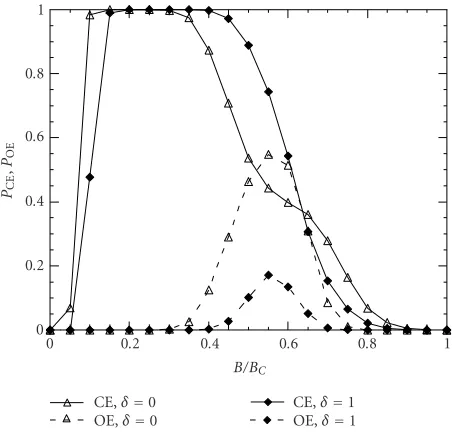
MOS performance in presence of multiplicative noise is an-alyzed in Figure 10, which plots the performance of EDC2
and DL-EDC2. The loaded EDC2provides significantly
re-ducedPOE, as expected, and enhancedPCEat medium
val-ues ofB/BC, at the cost of a slight reduction ofPCEfor low
B/BC. The loading factorδ=1 has been chosen among oth-ers by simulation, to get the above mentioned benefits onPOE
andPCEwith little loss forB/BC ∼=0. The range of optimal
baselines for detection is slightly enlarged compared to the classical EDC2. Thus, increased robustness to multiplicative
noise is generally achieved by DL-EDC2.
5.2. Strong SNR regime
Strong signals can arise in the layover geometry because of the possible high local slopes facing the radar, or in the case of layover in man-made structures. EV leakage from mul-tiplicative noise increases when signals are strong. This can produce the counter-intuitive degradation of performance shown inFigure 11:POEof EDC2increases when the SNRs
of both sources change from 12 dB to 18 dB. Again, the sta-bilization of noise EVs operated by loading produces some benefit, limiting the increment ofPOE. However, in the case
shown inFigure 11, the beneficial effect of DL results from an almost-rigid shift towards higherSNRof thePOEandPCE
performance as a function ofSNR. Actually, a similar effect of robustness to EV leakage from strong scattering could be obtained by lowering SNR through the radar pulse energy reduction, which would also result in a cheaper system.
A much more amenable effect of DL against the strong signal regime is exhibited for the AIC method, as reported in
Figure 12forB/BC = 0.2. ThePCEis plotted as a function
ofSNR. The DL-AIC curve is not almost equal to a merely shifted copy of the AIC curve; there is also an improvement of the maximum value. This robustness effect is not possible by a mere radar pulse energy reduction, and makes DL-AIC a
12 dB,δ=0 18 dB,δ=0 18 dB,δ=1
0 0.2 0.4 0.6 0.8 1
B/BC
0 0.2 0.4 0.6 0.8 1
POE
Figure11: Effect of SNR, EDC2, and DL-EDC2.
CE,δ=0 OE,δ=0
CE,δ=3 OE,δ=3
−10 0 10 20 30
SNR (dB) 0
0.2 0.4 0.6 0.8 1
PCE
,
POE
Figure12: Performance as a function of SNR, AIC, and DL-AIC, B/BC=0.2.
possible candidate for robust operation, taking into account also its lowPUEfor largeB/BC(no blind baseline effect).
5.3. Small-sample regime
CE,δ=0 OE,δ=0
CE,δ=3 OE,δ=3
0 0.2 0.4 0.6 0.8 1
B/BC
0 0.2 0.4 0.6 0.8 1
PCE
,
POE
Figure13: Small-sample regime, AIC and DL-AIC,N=4.
methods significantly degrade.Figure 13refers toN=4 looks and shows how both the badPCEandPOEof AIC in this
In-SAR scenario are largely improved by DL withδ=3. This is due to the restoration of the positive definiteness of the co-variance matrix estimate operated by the DL. As a drawback, DL-AIC tends to be partially affected by the blind baseline effect for largeB/BC.
6. DUAL-BASELINE NON-ULA SYSTEM
When the array is nonuniform, the change of structure of the array steering vector with respect to the classical ULA struc-ture impacts on the achievable performance. In addition to that, the structured FB covariance matrix estimate cannot be adopted. Moreover, in the airborne case, non-ULA systems generally have a lower numberKof phase centres than ULA systems; also formation-based spaceborne systems have low K. To gain some insight on the behavior of ITC methods in non-ULA InSAR systems, we first simulated performance for a system withK =4 phase centres and ULA structure. The PCEof the four ITC methods for F-only processing is shown
inFigure 14. The curves stop when the two adjacent sources reach the maximum distance possible within the unambigu-ous range. Notably, in this case study the rankings of AIC, MDL, EDC1, EDC2are different with respect to theK =8
ULA (FB) case. The ranking derived fromFigure 4is no more valid: EDC1is now to be considered the best performing,
fol-lowed by MDL and AIC, whereas EDC2 is now the worst.
This new ranking is partly due to the loweredK, in part due to abandoning FB averaging, as revealed by the results for K=4 FB, not shown here. In particular, loweringKresults in significant improving of EDC1, MDL, and AIC; subsequent
turning to F-only processing produces a strong degradation of EDC2. Thus, it is expected that for non-ULA with lowK,
a ranking stands similar to this new one.
EDC2 EDC1
MDL AIC
0 0.2 0.4 0.6 0.8 1
B/BC
0 0.2 0.4 0.6 0.8 1
PCE
Figure14: Effect of small number of phase centres, F-only
process-ing,K=4.
Before quantifying this expected trend by simulation, it is worth noting that non-ULA arrays can lead to identifia-bility problems of multiple sources with specific spatial fre-quency separations [19], which in our InSAR application mean specific separations among the multiple interferomet-ric phases [20, 22] or patch heights. This is due to pos-sible linear dependence among the multiple steering vec-tors, which can arise also when all the sources are located within the same unambiguous interval (nontrivial noniden-tifiability). The reason is that the nonuniform spatial sam-pling makes the matrix collecting theNssteering vectors to loose the Vandermonde structure that it exhibits in the ULA case. On the other hand, non-ULA arrays theoretically al-low estimation of a greater number of sources thanK−1, which is the limit for ULA arrays, conditioned to the use of proper sophisticated processing and large number of looks [19].
A case of non-ULA array is investigated in Figure 15. HereK=3 (dual-baseline system), and the smallest baseline is 1/3 of the overall baseline, which is a minimum redun-dant array [19] that may be obtained by thinning the array employed for Figure 14. This case is a good representative of advanced three-antenna airborne systems such as AER-II from FGAN [12], and can give a flavor of performance for formation-based spaceborne systems [9]. It can easily be proved that theK =3 phase centre non-ULA array has no identifiability problem whenNS ≤2. As expected, the rank-ing of AIC, MDL, EDC1, EDC2is quite similar to that for the
K = 4 ULA F-only. AIC is now the best-performing algo-rithm, closely followed by MDL and EDC1, whereas EDC2is
again the worst (it is strongly affected by the blind baseline effect). Note that nowPOE=0, sinceNS=2 coincides with
EDC2 EDC1
MDL AIC
0 0.2 0.4 0.6 0.8 1
B/BC
0 0.2 0.4 0.6 0.8 1
PCE
Figure15: Non-ULA system, F-only processing,K=3.
EDC2 EDC1
MDL AIC
0 0.2 0.4 0.6 0.8 1
B/BC
0 0.2 0.4 0.6 0.8 1
PCE
Figure 16: Non-ULA system, effect of volumetric decorrelation,
spaced sources,s=1.
show that it is not enlarged by DL, conversely from what hap-pens whenK = 8 (seeFigure 10). This is reasonable given that for NS = 2 we find POE = 0, so there is no space
for improvement through stabilization of EV leakage. The rankings found for this non-ULA configuration andNS=2 stand also when volumetric decorrelation is present, see the results in Figure 16for spaced sources, very rough patches (s=1).
However, as seen inFigure 7for the ULA withK=8, ITC rankings tend to vary with different number of sources, this should be considered for the selection of a globally optimal
EDC2 EDC1
MDL AIC
0 0.2 0.4 0.6 0.8 1
B/BC
0 0.2 0.4 0.6 0.8 1
PCE
Figure17: Non-ULA system, effect of different number of patches
(Ns=1).
method. InFigure 17PCEis reported for the four ITC
meth-ods and a single source present. Notably, AIC is now the worst performing method, while EDC1 and EDC2 can be
considered the best ones. It is now apparent that the reason for the good performance of AIC withNS =2 inFigure 15
was merely its tendence to overestimation:NS =NSwith high probability simply because AIC typical output is the maxi-mum number of signals that is detectable, which equals 2. Thus, whenNs =1 AIC typically fails, it tends to declare a layover situation that does not exist. In conclusion, consider-ing both the case studiesNS=2 andNs =1, one can select EDC1as globally optimum method for the given non-ULA
configuration: it performs reasonably well forNS = 2, also when volumetric decorrelation is present, and is one of the best forNs=1. Notably, forNs=1 there is some space for improvement for the non-ULA case through stabilization of EV leakage by DL.Figure 18shows the increase ofPCEwhich
is achievable by applying DL withδ=1 to the selected EDC1.
7. FINAL DISCUSSION AND FUTURE DEVELOPMENTS
EDC1,δ=0 EDC1,δ=1
0 0.2 0.4 0.6 0.8 1
B/BC
0 0.2 0.4 0.6 0.8 1
PCE
Figure18: Non-ULA system, effect of diagonal loading, EDC1, and
DL-EDC1,Ns=1.
can be found in [13]. The issue of baseline optimization for detection has been discussed. The analyzed trade-off be-tween EV leakage and source resolution problems results in some guidelines for optimal baseline selection. The use of diagonally loaded ITC methods has also been proposed for more robust operation in presence of speckle. The benefits of diagonal loading have been demonstrated in terms of ex-tended range of optimal baseline, robustness to leakage of signal power from strong sources into the noise EV, and im-proved operation with a small number of looks. Benefits of loading proved to be particularly effective for small-sample operation. Case studies of a nonuniform dual-baseline array have finally been discussed. Performance rankings of the ITC methods in terms of probability of correct model order es-timation are summarized in Table 1, for the ULA (K = 8) and the non-ULA (K = 3) configuration, for the condi-tions of varying-baseline-to-critical-baseline ratio (adjacent sources), varying number of layover patches, and volumetric decorrelation (spaced sources); results for ITC methods not included in Figures7 and8have also been considered. An important result is represented by the change of the globally best-performing method from EDC2to EDC1for decreasing
number of phase centres and forward-only processing (see the highlighted fields inTable 1). Despite model mismatch-ing, performance of model order selection can be generally satisfactory after proper choice of the best ITC method, es-pecially if diagonal loading is adopted with loading factor in the range 1–3 and the number of phase centres and looks is large enough.
The model order selection techniques investigated in this paper can be useful in conjunction with spectral estimators in MB-InSAR applications of layover solution [6,7,11,12,
21,22,32], to fully exploit both existing repeat-pass SAR data archives [4,7,11,32] and advanced experimental or planned single-pass MB systems [8,9,12]. In particular, implications
of MB layover solution for InSAR topographic and reflec-tivity mapping are the following. The new functionality of operation in presence of discontinuous surfaces (e.g., cliffs) may be provided, which is not possible with classical InSAR. Conventional change of perspective methods of ascending-descending passes mosaicing [33] or possible incidence angle flexibility [34] cannot solve the layover problem in this sce-nario. Also, operation in steep areas may be possible through MB layover solution for systems with fixed incidence angle [4,11,32], allowing efficient use of the available data set. Moreover, fusion of ascending-descending passes, if avail-able, would be possible in place of a mere mosaicing, thus obtaining improved topographic accuracy (both the pass ge-ometries would produce estimates since operation of that af-fected by layover would be restored by the MB processing). Even when the system has angle flexibility that can be use-ful to solve the layover problem in steep areas, MB layover solution may furnish the improved functionality of reflectiv-ity measuring in homogeneous conditions, avoiding the need of changing incidence angle. Again, also improved topo-graphic accuracy may be possible through fusion of estimates obtained with different incidence angles (operation with a layover-affected angle would be restored by MB processing). As regards the complexity of the MB array needed, to de-tect the typically low number of layover patches a few base-lines are enough. Current single-pass airborne MB systems [12,35,36] and some planned single-pass MB distributed interferometers based on satellite formations [9] have two baselines (K = 3), thus they would be limited to detection of no more than two layover sources [12]. For detecting also three-layover sources at least three baselines (K≥4) are re-quired, which are already available from airborne and space-borne repeat-pass SAR data sets [4,7,11,32], are going to be available with the upgrading experimental single-pass air-borne MB system [8], and possibly in the future with forma-tions of many satellites [37].
Concerning the application to real data, it is worth re-calling that baseline errors [4], in addition to phase arte-facts from changes in atmospheric propagation in repeat-pass spaceborne implementations of MB arrays [32], pro-duce deviations of the steering vector from the nominal one. However, the impact of imperfect knowledge of the steer-ing vector structure on model order selection has not been numerically investigated, since it is known in the array pro-cessing literature that it is negligible [14]. ITC methods do not directly exploit this knowledge, thus it is expected that in presence of steering vector errors, ITC performance is not significantly affected.
Table1: Summary of rankings of the ITC methods (A: good, E: bad, highlight: globally best performance).
Method
ULA (K=8) Non-ULA (K=3)
VaryingB/Bc Varying no. Volumetric VaryingB/Bc Varying no. Volumetric
of patches decorrelation of patches decorrelation
EDC2 A B A E A E
EDC1 B E D B B B
MDL D E D A D A
AIC E E E A D A
ACKNOWLEDGMENTS
The authors wish to thank the anonymous referees for useful comments on the first draft of the paper. This work has been partially supported by the Italian National Research Council (CNR-IEIIT).
REFERENCES
[1] R. Bamler and P. Hartl, “Synthetic aperture radar interferom-etry,”Inverse Problems, vol. 14, no. 4, pp. R1–R54, 1998. [2] P. A. Rosen, S. Hensley, I. R. Joughin, et al., “Synthetic
aper-ture radar interferometry,”Proc. IEEE, vol. 88, no. 3, pp. 333– 382, 2000.
[3] C. Oliver and S. Quegan, Understanding Synthetic Aperture Radar Images, Artech House, Norwood, Mass, USA, 1998. [4] A. Ferretti, A. Monti Guarnieri, C. Prati, and F. Rocca,
“Multi-baseline interferometric techniques and applications,” inProc. ESA Workshop on Applications of ERS SAR Interferometry (FRINGE ’96), pp. 243–252, Zurich, Switzerland, September– October 1996.
[5] G. Corsini, M. Diani, F. Lombardini, and G. Pinelli, “Simu-lated analysis and optimization of a three-antenna airborne InSAR system for topographic mapping,”IEEE Trans. Geosci. Remote Sensing, vol. 37, no. 5, pp. 2518–2529, 1999.
[6] S. Xiao and D. C. Munson Jr., “Spotlight-mode SAR imaging of a three-dimensional scene using spectral estimation tech-niques,” in Proc. IEEE International Geoscience and Remote Sensing Symposium (IGARSS ’98), vol. 2, pp. 642–644, Seat-tle, Wash, USA, July 1998.
[7] A. Reigber and A. Moreira, “First demonstration of airborne SAR tomography using multibaseline L-band data,” IEEE Trans. Geosci. Remote Sensing, vol. 38, no. 5, pp. 2142–2152, 2000.
[8] J. H. G. Ender and A. R. Brenner, “PAMIR—a wideband phased array SAR/MTI system,” inProc. 4th European Confer-ence on Synthetic Aperture Radar (EUSAR ’02), pp. 157–162, Cologne, Germany, June 2002.
[9] H. Fiedler, G. Krieger, F. Jochim, M. Kirschner, and A. Mor-eira, “Analysis of bistatic configurations for spaceborne SAR interferometry,” inProc. 4th European Conference on Synthetic Aperture Radar (EUSAR ’02), pp. 29–32, Cologne, Germany, June 2002.
[10] F. Lombardini and A. Reigber, “Adaptive spectral estima-tion for multibaseline SAR tomography with airborneL-band data,” inProc. IEEE International Geoscience and Remote Sens-ing Symposium (IGARSS ’03), vol. 3, pp. 2014–2016, Toulose, France, July 2003.
[11] Z. She, D. A. Gray, R. E. Bogner, and J. Homer, “Three-dimensional SAR imaging via multiple pass processing,” in Proc. IEEE International Geoscience and Remote Sensing Sym-posium (IGARSS ’99), vol. 5, pp. 2389–2391, Hamburg, Ger-many, June–July 1999.
[12] L R¨ossing and J. H. G. Ender, “Multi-antenna SAR tomogra-phy using super resolution techniques,” inProc. 3rd European Conference on Synthetic Aperture Radar (EUSAR ’00), pp. 55– 58, Munich, Germany, May 2000.
[13] F. Gini and F. Bordoni, “On the behavior of information theoretic criteria for model order selection of InSAR signals corrupted by multiplicative noise,”Signal Processing, vol. 83, no. 5, pp. 1047–1063, 2003.
[14] U. R. O. Nickel, “On the application of subspace methods for small sample size,”AEU - International Journal of Electronics and Communications, vol. 51, no. 6, pp. 279–289, 1997. [15] H. L. Van Trees,Optimum Array Processing: Part IV of
Detec-tion, EstimaDetec-tion, and Modulation Theory, John Wiley & Sons, New York, NY, USA, 2002.
[16] Z. D. Bai, P. R. Krishnaiah, and L. C. Zhao, “On rates of con-vergence of fast detection criteria in signal processing with white noise,” Tech. Rep. 84-85, Centre for Multivariate Analy-sis, University of Pittsburgh, Pittsburgh, Pa, USA, 1985. [17] L. C. Zhao, P. R. Krishnaiah, and Z. D. Bai, “On detection of
the number of signals in presence of white noise,”Journal of Multivariate Analysis, vol. 20, no. 1, pp. 1–25, 1986.
[18] Y. Meng, P. Stoica, and K. M. Wong, “Estimation of the direc-tions of arrival of spatially dispersed signals in array process-ing,”IEE Proceedings—Radar, Sonar and Navigation, vol. 143, no. 1, pp. 1–9, 1996.
[19] Y. I. Abramovich, N. K. Spencer, and A. Y. Gorokhov, “Detection-estimation of more uncorrelated Gaussian sources than sensors in nonuniform linear antenna arrays .I. Fully augmentable arrays,”IEEE Trans. Signal Processing, vol. 49, no. 5, pp. 959–971, 2001.
[20] F. Lombardini, F. Gini, and P. Matteucci, “Application of ar-ray processing techniques to multibaseline InSAR for layover solution,” inProc. IEEE Radar Conference (RADAR ’01), pp. 210–215, Atlanta, Ga, USA, May 2001.
[21] F. Lombardini, M. Montanari, and F. Gini, “Reflectivity estimation for multibaseline interferometric radar imaging of layover extended sources,”IEEE Trans. Signal Processing, vol. 51, no. 6, pp. 1508–1519, 2003.
[22] F. Gini, F. Lombardini, P. Matteucci, and L. Verrazzani, “Sys-tem and estimation problems for multibaseline InSAR imag-ing of multiple layovered reflectors,” inProc. IEEE Interna-tional Geoscience and Remote Sensing Symposium (IGARSS ’01), vol. 1, pp. 115–117, Sydney, NSW, Australia, July 2001. [23] M. Wax and T. Kailath, “Detection of signals by information
theoretic criteria,”IEEE Trans. Acoust., Speech, Signal Process-ing, vol. 33, no. 2, pp. 387–392, 1985.
[24] H. Akaike, “A new look at the statistical model identification,” IEEE Trans. Automat. Contr., vol. 19, no. 6, pp. 716–723, 1974. [25] G. Schwarz, “Estimating the dimension of a model,”Annals of
Statistics, vol. 6, no. 2, pp. 461–464, 1978.
[27] G. Xu, R. H. Roy III, and T. Kailath, “Detection of number of sources via exploitation of centro-symmetry property,”IEEE Trans. Signal Processing, vol. 42, no. 1, pp. 102–112, 1994. [28] D. B. Williams, “Detection: determining the number of
sources,” inThe Handbook of Digital Signal Processing, V. K. Madisetti and D. B. Williams, Eds., chapter 67, IEEE Press, Boca Raton, Fla, USA, 1998.
[29] A. P. Liavas and P. A. Regalia, “On the behavior of informa-tion theoretic criteria for model order selecinforma-tion,”IEEE Trans. Signal Processing, vol. 49, no. 8, pp. 1689–1695, 2001. [30] W. Xu and M. Kaveh, “Analysis of the performance and
sen-sitivity of eigendecomposition-based detectors,”IEEE Trans. Signal Processing, vol. 43, no. 6, pp. 1413–1426, 1995. [31] J. R. Guerci and J. S. Bergin, “Principal components,
covari-ance matrix tapers, and the subspace leakage problem,”IEEE Trans. Aerosp. Electron. Syst., vol. 38, no. 1, pp. 152–162, 2002. [32] G. Fornaro, “Three-dimensional SAR imaging with ERS data,” inProc. Tyrrhenian International Workshop on Remote Sensing (TIWRS ’03), pp. 271–280, Elba Island, Italy, Septem-ber 2003.
[33] F. Holecz, J. Moreira, P. Pasquali, S. Voigt, E. Meier, and D. Nuesch, “Height model generation, automatic geocoding and a mosaicing using airborne AeS-1 InSAR data,” inProc. IEEE International Geoscience and Remote Sensing Symposium (IGARSS ’97), vol. 4, pp. 1929–1931, Singapore, August 1997. [34] F. Impagnatiello, R. Bertoni, and F. Caltagirone, “The SkyMed/COSMO system: SAR payload characteristics,” in Proc. IEEE International Geoscience and Remote Sensing Sym-posium (IGARSS ’98), vol. 2, pp. 689–691, Seattle, Wash, USA, July 1998.
[35] J. J. Van Zyl, A. Chu, S. Hensley, L. Yunling, K. Yunjin, and S. N. Madsen, “The AIRSAR/TOPSAR integrated multi-frequency polarimetric and interferometric SAR processor,” in Proc. IEEE International Geoscience and Remote Sensing Symposium (IGARSS ’97), vol. 3, pp. 1358–1360, Singapore, August 1997.
[36] M. Rombach and J. Moreira, “Description and applications of the multipolarized dual band OrbiSAR-1 InSAR sensor,” in Proc. International Radar Conference (RADAR ’03), pp. 245– 250, Adelaide, SA, Australia, September 2003.
[37] D. Massonnet, “Capabilities and limitations of the interfero-metric cartwheel,”IEEE Trans. Geosci. Remote Sensing, vol. 39, no. 3, pp. 506–520, 2001.
[38] P. Pasquali, C. Prati, F. Rocca, et al., “A 3-D SAR experiment with EMSL data,” inProc. IEEE International Geoscience and Remote Sensing Symposium (IGARSS ’95), vol. 1, pp. 784–786, Firenze, Italy, July 1995.
Fabrizio Lombardini received the Ital-ian Laurea degree, with honors, in elec-tronic engineering and the Ph.D. degree in telecommunication engineering from the University of Pisa, Italy, in 1993 and 1997, respectively. He was then granted by the EU Marie Curie Fellowship of the TMR Pro-gram, which he spent as Postdoctoral Re-searcher at the Department of Electronic and Electrical Engineering of University
College London, UK, from 1998 to 1999. Then, he joined Di-partimento di Ingegneria dell’Informazione of University of Pisa, where he currently holds the position of Assistant Professor. He is IEEE Senior Member since January 2003. He has given lec-tures at universities and institutions in Italy and abroad, and has chaired special sessions at international conferences. He is coauthor of a tutorial entitled “Multi-baseline post-processing for
SAR interferometry” presented at the IEEE SAM Workshop (July 2004). His general interests are in the areas of statistical signal processing, estimation and detection theory, adaptive and super-resolution spectral analysis, array processing, and performance bounds evaluation, with application to radar systems. In particular, his research interests include multi-baseline and multifrequency in-terferometric SAR algorithms and systems, cross- and along-track, three-dimensional SAR tomography, differential SAR interferome-try, multisensor data fusion, and radar detection in non-Gaussian clutter.
Fulvio Ginireceived the Doctor Engineer (cum laude) and the Research Doctor de-grees in electronic engineering from the University of Pisa, Italy, in 1990 and 1995, respectively. In 1993, he joined Diparti-mento di Ingegneria dell’Informazione of the University of Pisa, where he is an As-sociate Professor since October 2000. He is an Associate Editor for the IEEE Transac-tions on Signal Processing and a Member