Thesis by
Rex Bredesen Peters
In Partial Fulfillment of the Requirements For the Degree of
Mechanical Engineer
California Institute of Technology Pasadena, California
1969
ACKNOWLEDGMENTS
The author wishes to thank Professor D. E. Hudson for his guidance and assistance throughout the investigation and in the preparation of this report. Thanks also are due to the other
members of the advisory committee, Professors W. D. Iwan and J. Miklowitz.
The cooperation of H. T. Halverson, R. Obenchain, and L. H. Mauk of Earth Sciences, a Teledyne company, in making developmental changes suggested by the author during testing of the RMT-280 strong motion accelerograph is greatly appreciated.
ABSTRACT
A brief study is made of the effect of common instrument errors on the accuracy of data obtained from strong motion earth-quake accelerographs. Error sources considered include zero drift, tilts, nonlinearities, cross-axis sensitivity, lack of initial conditions, noise, and time base errors. It is concluded that most data of current engineering interest are not critically affected by the level of errors found in existing accelerographs. Techniques are suggested for reducing or eliminating many of these errors by instrument design changes.
An experimental study is made of a new strong motion accelerograph during its engineering development. This new accel-erograph is designed to record an FM analog of ground acceleration on magnetic tape, providing a record which may be rapidly and automatically converted to digital form. The accuracy limits of the accelerograph are explored and the design reasons for these limits investigated. The more significant findings may be briefly
summarized:
{l) Static accuracy. The sensitivity and linearity of the instrument are found to depend critically on a series of interdependent
are possible, but require much more time and care, primarily due to the limiting effect of mechanical drift in the accelerometers.
(2) Zero point drift. Uncertainties in the accelerometer zero point arise from both mechanical and electronic drifts. Long
term drifts may be related to temperature or relative humidity, or may be entirely random. Short term drifts of up to 2% of full scale may occur during the course of a typical record. The total
variation may be as much as± 30% of full scale for a l00°F range of temperatures. These variations require adjustment of the data before processing, but are not sufficient to interfere with operation of the accelerograph.
(3) Noise. Random noise in the system as tested amounted to 1. 4% of full scale, RMS, and was mostly due to the tape recording system. By comparison with optical accelerographs, this noise figure is marginal, but acceptable, and can be improved by changes to the compensation system.
The overall performance of the test accelerograph is
TABLE OF CONTENTS
1. INTRODUCTION l
2. ACCURACY CONSIDERATIONS IN STRONG MOTION EARTHQUAKE RECORDING
2. 1 Response of a single degree of freedom system to a transient input such as an earthquake
2. 2 Common accelerograph errors
2. 3 Some remarks on the standard baseline adjustment technique
2. 4 An idealized FM seismographic recorder 3. TEST ACCELEROGRAPH ANALYSIS
3. 1 Instrument description
3. 2 Short period noise generation in the
8
8 14
27 31 35 35
accelerograph system 39
3. 3 Short term drift 52
3. 4 Long term drift and temperature response 79
.3. 5 Linearity and adjustment 89
4. ACCELEROGRAPH SYSTEM TEST 94
5. SUMMARY AND CONCLUSIONS 107
REFERENCES 114
APPENDIX A - Test instrumentation 115
APPENDIX B - Development of a small shaking table for earthquake simulation
APPENDIX C - Magnetic and mechanical forces acting in the test accelerometers
123
1. INTRODUCTION
For about the last century, geophysical studies have been
aided by systems of sensitive instruments for the measurement of
earth motions. Set up in well supervised seismological stations
around the world, these instruments record continuously the faint
motions caused by earthquake activity throughout the earth. The high
sensitivities which rµake this long range monitoring possible
unfor-tunately prevent these instruments from giving useful data on the
strong motions associated with nearby earthquakes, since the
recorders then simply go off scale. This shortcoming has not been
considered to be of great importance for geophysical reasons since
nearby earthquakes are comparatively rare.
If local earthquake effects differed only quantitatively from
those recordable at greater distances, this attitude might still prevail.
It has long been suspected, though, that such is not the case, and that
the local effects which are responsible for the major economic impact
of large earthquakes are worthy of study in their own right. The
pursuit of this study soon led to the development of a new class of
instruments - strong motion seismographs.
Strong motion seismographs have to meet a number of rather
special requirements, the most trivial of which is reduced sensitivity
dictated by the very nature of their task: to give a good indication of local effects there should be at least several of them, spread over an area surrounding an earthquake epicenter. To have a reasonable probability of detecting an earthquake they must be located in as many as possible of the areas where earthquakes occasionally occur. Since the instruments must thus be rather numerous, they must be individ-ually relatively inexpensive. Since they must be spread over large areas, they cannot be continuously supervised, and must be capable of reliable automatic operation after long periods of sitting unattended.
The numerous field instruments produce automatic records which are then analyzed at relatively few data reduction centers. Figures 1 and 2 show block diagrams of several such instrumentation systems either currently in use or undergoing active development. These systems differ considerably in their mechanical details, but they all show quite similar system organization and are subject to
similar analysis.
Each of the boxes in these two figures stands for a transfer operation, and each may be represented by a transfer function showing the relationship of input to output. Some parts of this relationship may be functionally described, e.g. frequency or impulse response of a viscously damped accelerometer. Others are best related in terms of statistical properties, e.g. distortion of photographic paper during chemical processing and drying. The product of all these
VECTOR ACCELERATION_ 3 AXIS ---it:>= l> ACCEL. VS TIME
~VERT
.
STARTERh
OPTICAL_.,,...
35mm t>-11 VELOCITY 11 VS Tl ME ACCELER-PHOTO. ..+- ENLARGE-~ MANUAL -+-~ 11 DISPLACEMENT 11 VS TIME OM ET ER f- >-FILM MENT DIGITIZER COMPUTER I ~ SPECTRA ~---, RECORDER L_ --TIMING*r->-~ STATISTICAL PROPERTIES
M0-2 (NEW
ZEALAND) *BRIGHTNESS MODULATION OF DATA TRACES VECTOR ACCELERATION . 3 AXIS ~ SPRING ~ ACCEL. VS TIME YvERT. STARTER
~
1
MECHANICAL P... 11 VELOCITY 11 VS TIME ~ DRIVEN PHOTO. ACCELER-WAXED ~ - ENLARGE-~ MANUAL ~ COMPUTER ~ 11 DISPLACEMENT 11 VS TIME OMETER I-?-DIGITIZER I PAPER MENT b!-SPECTRA·-
----e
RECORDER L -{ TIMINGl->
~ STATISTICAL PROPERTIESSMAC-B (JAPAN) HORIZONTAL
HORIZ
.
STARTER
3
AXIS
OPTICAL ACCELER- OMETER
I
-
•
-
--A
TIMING 12 11 WIDEPHOTO. PAPER .RECORDER
AR -240 VECTOR ACCELERATION 3 AXIS
w
··
OPTICAL~
HORIZ . STARTERt
ACCELER-1 O M ETERI
.
-
' --~l TI M I N G RFT-250 VECTOR ACCELERATIONy
r 3 AXIS~
HORIZ . STARTER~J
ACCEL .I
·-
-
-R M T-280·
-TI M ING 8 FIELD INSTRU M ENTS70mm PHOTO
.
FILM RECORDER MAGNETIC
=i
TAPE RECORDER
DATA
--)-CONTROL
---1>
MANUAL DIGITIZER
ENLARGE- MENT F
M DISCRIM- INATOR I ~ I COMPUTER M ANUAL
DIGITIZER A/D CON- VERTER COMPUTER COMPUTER
ACCEL. VS TIME 11 VELOCITY 11 VS TIME 11 D IS PLACEMENT 11 VS
SPECTRA STATISTICAL
PROPERTIES
SAME SAME
on the right. Considerable work has been devoted to studies of the
data reduction area of these systems, comparing outputs at the far
right for a given record input to several data reduction systems,
but comparatively little has been done about the left half and
especially about box by box analysis of the overall system.
Studies of the right half of these diagrams have had their
effect on the left half, however, in that human judgment has been
identified as a principal variable in all of these systems, and that,
plus the sheer man-hours required for manual digitization of a
record of any length, has led to development of systems which
permit data flow from extreme left to extreme right with no
signi-ficant human intervention. An important step in this direction is
the development of magnetic tape recording instrumentation, and
this report is largely concerned with an analysis of such a system.
In analyzing the operation of an instrument system it is
necessary to keep in mind the information which is to be obtained
from it and the use to whiqh that information will be put. Presently
available systems produce acceleration/time records and response
spectra which are of great value in assessing possible damage to an
instrumented building following an earthquake, and for use in design
criteria for new buildings in a given area. They also may yield
statistical properties which are of value, for instance, in the
defining of model earthquakes for theoretical and experimental
studies of structure responses. And they produce 11
velocity11/time
identify the mechanisms of strong earth motions.
The quotation marks around the words 11velocity11 and
11displacement11
are significant. Presently used or considered
instrumentation systems are able to define velocities and
displace-ments only to within a long period component whose amplitude is not
accurately known and whose period may be as short as about one-half
the record duration. This uncertainty reflects to some extent the
lack of initial conditions in the records of existing instruments and
also the accuracy limits of the overall systems. It is of little
con-sequence in the parts of the response spectra curves which are of
interest in determining the response of most engineering structures.
But in
a
few cases, such as seiches in harbors and reservoirs, andbreakage of underground structures, it is a significant limitation. It
is also something of an impediment to studies of earthquake
mechan-isms, since it prevents any easy measurement of the grosser ground
motions associated with an earthquake.
One desirable direction for instrument development, then, is
in the direction of what might be called an "ultimate 11 instrument: one
which is in effect a cross between the usual strong motion seismograph
and an inertial navigation system, and capable of recording the actual
motions in an earthquake with an uncertainty of an inch or so, rather
than many feet, and with corresponding improvements in the reliability
of the velocity and acceleration data. The basic system studied in this
report is capable, at least conceptually, of producing such performance
immense, as this study shows. The problems which stand in the way
of the improvement of current instruments up to the "ultimate"
system are indicative of the difficulty of development and probable
expense of any such system, barring an unforeseeable dramatic
2. ACCURACY CONSIDERATIONS IN STRONG MOTION EARTHQUAKE RECORDING
2. 1 Response of a Single Degree of Freedom System to a Transient Input Such as an Earthquake
The instruments traditionally used for earth motion recording are single degree of freedom, mass- spring-dashpot devices. The basic system with its equations of motion is shown schematically in the figure:
k
m
c
m
(x -
y)
+
ex
+
kx = 0w =
Jk/m
= radian natural frequency 0'
= c = fraction of critical damping 2JkmFor a record starting at t = 0 with known initial conditions an integral solution of this equation is:
S
t
2st sT
y(t) = y(O)
+
ty(O)+
x(t)+
Zw'
x(T) dT+
w0 x(s) ds dT0
0 0 0
(1)
In seismic instrumentation, the motion y of the support is the ground motion, and the relative displacement x the measured quantity. Seismic instruments fall broadly into three categories, depending on the choice of
w
andC •
These choices are reflected in the relative0
importance of the last three terms in equation ( 1). When the instru-ment period is longer than the longest period in the motion y, the x term predominates (displacement meter). When the frequencies contained in y are near w and ' is several times larger than unity,
0
the middle term predominates (velocimeter). When the frequencies contained in y are all below w , the last term predominates
(acceler-o
ometer}. In common usage, strong motion instruments for earthquake engineering are nearly always of the accelerometer type, whereas seismographs for teleseismic use usually fall somewhere between the displacement and velocity classes. Some of the advantages of the accelerometer for strong motion use are:
(2) Accelerometers provide records which measure directly the quantity which is of primary interest to earthquake engineers.
From the acceleration-time record, response spectrum curves can be computed.
(3) Displacement meters have the difficulty that earth motions near earthquake epicenters sometimes reach amplitudes of a few yards. Such large relative displacements cannot be accommodated in an instrument of reasonable size.
(4) The sensitivity of velocimeters is critically dependent on the value of
C ,
while that of an accelerometer depends only onw
0
Where a range of temperatures is involved, precise control of w 0
is relatively easy, whereas a corresponding precision in the control of
C
is much more difficult.The transient response of a mechanical system may be written as:
t
x(t)
=
J
y(T)h(t-T}dT 0where h(t) is the impulsive response. For a damped single degree of freedom system, initially at rest, this response is given by:
t x(t)
=
J
y{T)0
e
-
w
e
(t - T).
r--:2
Slll W
where:
As a representative input function, y(t) will be taken as: N
y(t) =
l
an sin n;tn=l
a = real constants
n
T = record duration
Substituting (3) into (2) gives
(3)
N -a.t t
x(t) =
l
anT
J
(sin f3t sin m T cos f3Te O.T - cos f3t sin mT sin f3Tg.T)d Tn=l 0
where: a. =
woe
x(t)
where
f3 =
woJ1-c2
n'll"
m
= T
Performing the indicated integration then gives
N
=
l
an ( 2 1 2 2) { ( ps - Zm 2p )sm mt - Zmpa. cos mtn= 1 f3 s - 4m f3
+ [ (ms - Zmp2)sm pt+ Zmpa. cos pt
J
e -a.t } (4)For a typical strong motion accelerograph the exponentially
decaying terms in equation (4) are of little importance. Common
-1 -1
values are
s
= O.6,
w
= 75 radians sec , so that a.= 45 sec . If.0
the start-up time is . 1 seconds, which is also common, these terms
are already decayed to 1
% of their initial amplitude by the start of
the accelerogram, which is less than 1% of the remaining terms.
coefficients in a series of the form:
co
x ( t) =
l
b n sin n; ( t+
Cj) n)n=l and it will be found that
a /w 2
a
n n o
b
=
=
n
j
s2 - 4m2f32
(1
n2ir2 )T2w 2
\ 0
(5)
4n2rr 2 ,2
+
T2w 2
(6)
0
The form of the denominator in the righthand side of equation
· (6) is the same as the well known steady state response of a damped
single degree of freedom system to a sinusoidal input at frequency
n rr
w
= T
From this it is clear that the Fourier amplitudecoef-..
ficients of x(t) may be made approximately equal to those for y(t), 2
to within the multiplicative constant w
0 , to any desired degree of
accuracy by proper choice of w0 and ' to make the denominator
of b approximately 1.
n
Even if the denominator in equation (6) were always exactly 1,
the numerical value of y(t) would depend upon the variable phase shift
term in equation (5). This term has no effect on the Fourier amplitude
spectra, .but does modify the instantaneous acceleration values. This
effect can be minimized by taking ' """ 0. 7, which leads to an
approximately linear relationship between cp and n. In this case
n
the phase shift produces a simple time shift in the record, combined
with the already noted transient terms. For typical modern recorders,
which do not record the transient part of the response and have no
If displacements are to be calculated from the acceleration
vs. time record, though, the possibility remains that errors may still
be produced by the effect of double integrating the initial transients,
To investigate this possibility, assume that the denominators in
equation (6) are unity and multiply x by w 2 to get the recorded
0
acceleration. A measure of the displacement error would then be:
displacement error =
I
tst
w 2 x(t) dt - y(t) 20 0
°
Using equation (4) for x(t) and carrying out the algebra then gives:
displacement error
=
This error is non-decaying. For a typical term having a = 50 in/
sec~
n
n = 100,
C
= 0, 7, T = 50 seconds, andw
= 75 rad/sec, thecoef-o
ficient is 0. 15 inches. The total effect depends on the particular
record considered, since the coefficients a as originally defined
n
can be mixed positive and negative and may either add or cancel. The
possibility exists, however, especially for long records, that a
significant difference could appear. Any such difference could be
eliminated either by applying the inverse transform of the mechanical
system to the record, if the transient part is included, or by taking
the value of
Clw
sufficiently small in the original design.0
Ordinarily, other factors cause the accuracy of displacement
2. 2 Common Accelerograph Errors
The discussion so far has covered a few of the things which
must be considered in evaluating the processing of an accelerograph
record because of mechanical characteristics of an idealized
acceler-ometer. Real instruments are subject to departures from ideal
behavior which introduce additional factors. These departures may
be of great or minor consequence depending on the intended use of the
records. A few of the most significant ones follow, with estimates
of their effects on (1) instantaneous accelerations, (2) Fourier spectra,
and (3) the displacement calculated at t = 50 seconds.
Baseline Shift. Uncertainties in the record value corresponding to
zero acceleration can arise in many ways; for example,
acceler-ometer drift, record/playback errors, or simple lack of resolution.
For a baseline error consist,ing of a simple small translation:
(1) Instantaneous acceleration: error = shift. Typically not
significant.
(2) Fourier spectra: Ideally affects lowest order term only,
which is of no concern, but may have shorter period effects
through interaction with common computing techniques, one of
which is discussed briefly in Section 2. 3.
assumed linear, this error term may be treated independently of
the remainder of the signal. In this case a displacement error will
occur which reaches a maximum value at the end of the record and
is given by:
displacement error
=
1/2 (baseline error)T2For a 50 second record duration and one inch permissible
displace-ment error, the permissible baseline error is 1. 2 x l0-6g, or about
• 0004% of 1/2 g full scale. This is several orders of magnitude
beyond the capabilities of existing recorders.
Instrument Tilt. If the instrument's orientation with respect to
gravity changes between the final in-place calibrations and the taking
of a record, a condition identical to the just mentioned baseline shift
will occur. It is mentioned separate! y here because of its special
consequences as regards ins.trument design. Tilts of the earth's
surface have been observed which were sufficient to close the starting
pendulums of AR-240 earthquake recorders and run out the paper
supply. That calculates to be in excess of . 002 radians, or sufficient
to produce a 50 second displacement error of more than 75 feet in a
horizontal accelerometer. The obvious conclusion is that instruments
intended for displacement computations must have means to nullify
such tilts, such as a servo leveling system, or perhaps use of
accelerometers which do not have true static response but rather are
Transduction Nonlinearities: If the overall transfer function of an
instrument system from accelerometer relative motion to playback is
nonlinear in a way which cannot conveniently be compensated for,
errors will result. The question is pertinent here because such
non-linearities have been observed in the RMT-280, which is the principal
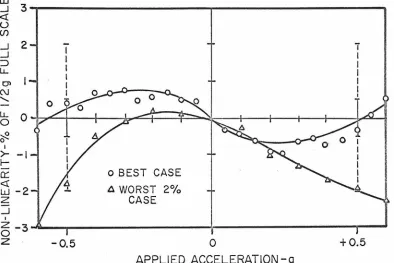
subject of this report. (See Section 3. 5. )
(1) Instantaneous acceleration: Since the subject here is
trans-duction nonlinearities rather than mechanical nonlinearities, the
error at any level is simply the difference between the actual
instrument transfer function and the straight lin.e which is chosen
to approximate it.
(2) Fourier spectrum: The effect of nonlinearities on Fourier
spectra does not lend itself to easy, generalized analytical
representation. An estimate of the effect for small nonlinearities
may be obtained by considering one simple case involving an
unsymmetrical nonlinearity similar in nature to one which
some-times occurs in the RMT-280. (For purposes of this report, an
unsymmetrical nonlinearity will be defined as one which cannot be
approximated by a single straight line which is simultaneously
best for both positive and negative accelerations, e.g. one which
has significant even power terms in its power series expansion. )
Take the idealized case of a record consisting of a single
contains just a linear and a quadratic term:
y = A sin wt
..
y =y+
indicated
0 .• 2
Ymax y A
. A . 2
= sin wt +
o
s in wt= A sin wt+ 0:
~A
sin 2 wt(6)
For this simple case, the effect of the non-linearity has been to
introduce an additional coefficient into the Fourier spectrum at
twice the original frequency with an amplitude of the same order as
the per unit nonlinearity. The only general conclusion which
should be drawn from this is that Fourier spectra do not appear to
be critically sensitive to small nonlinearities in the range of
engineering interest. However, behavior remarkably similar to
this simple example was actually observed ,in the system tests
described in Section 4.
(3) 50 second displacement: A similar simplified example may
also be used to estimate the effect of nonlinearity on displacement.
An idealized earth motion consisting essentially of a step change
in displacement is shown in Fig. 3. The acceleration associated
with this idealized motion is a single cycle sine wave. A one second
period and an amplitude of 6. 28 feet second-2 would produce a
dis-placement of one foot. If this signal is subjected to the same
---~~~ ~ ~~~
...
..-~ ~ .,~ ~ ~~~~~~~~~~ ~~ ~~~~~~ ~~~~ ~ ~~ ~ I-.t---..
. \ ...---·.
. ·
DISPLACEMENT,
FT
1 r
·
.
...
.
··
0
2
term generated in the indicated acceleration will produce a
velocity error which leads to a displacement error which increases
linearly with time:
Yindicated - y"" (
0:/:
ft sec-2)
(1 sec)(T sec)~
If y. d" in ica e t d - y
=
1 inch when T=
50 seconds, thenoAT ft 2
0
= .
0004=
• 04%. Extrapolated to 1 /2 g full scale, the permissible nonlinearity
grows to:
Y indicated - Y
y
=
o.
1%
The simple example chosen represents a worst case for an
unsymmetrical nonlinearity, but would produce at most a
displace-ment error of the same order as the nonlinearity (no velocity
error) for a symmetrical nonlinearity. This difference in
sensitivity is the reason for making a distinction between the two
kinds of nonlinearity. Both cases are applied to a more typical
record in the system tests of Section 4.
Cross Axis Sensitivity: There are two kinds of cross axis sensitivity:
The first is a small misalignment of the accelerometer sensitive axis,
so that the acceleration axes recorded are not quite in their intended
directions. The second is a change in the direction of the sensitive
axis as a function of applied acceleration, e.g. a pendulum
In the first case, the measuring error is given approximately by:
Yindicated - Y ~
y
where: = acceleration parallel to intended sensitive
axis
..
yJ_
=
acceleration perpendicular to intendedsensitive axis
e
= misalignment angle, radiansIn the second case, for a pendulum accelerometer:
y - y
indicated
y
where: a.
=
sensing element rotation constant, radiansper unit acceleration (any consistent units),
When the angles are small enough that the quadratic terms may be
neglected, these errors may be related to the results for nonlinearities
by considering the special case where
y
_l =Y.
11 • Then, for the first
case, the effect is a simple error in sensitivity, which can be thought
of as the simplest possible symmetrical nonlinearity. In the second
case, the per unit error is proportional to the applied acceleration,
which is precisely the unsymmetrical nonlinearity described just
above. For the test accelerometers, a. = • 016 radians/g, so the
Initial Conditions: Many practical problems stand in the way of
continuously recording strong motion instruments, and all instruments
now in use in the United States are of the stand-by type. Precise data
on the effect of mis sing the first part of the motion are therefore not
available. Some useful estimates can be made, however.
(1) Instantaneous acceleration: no effect.
(2) Fourier spectra: Comparative calculations for some specific
cases have shown that the omission of short sections of the
accelerograph record at the beginning and end of typical earthquake
records have negligible effect on the Fourier spectra (Reference 5).
(3) 50 second displacement: The pendulum starter used on USCGS
accelerographs has been developed empirically to do a satisfactory
job of separating significant seismic events from normal
back-ground motions. The starter in the RMT-280 was designed to have
the same dynamic characteristics. Half sine pulse tests on the
USCGS starter, reported in Reference 4, indicate that the initial
ground displacement at first contact closure is small, on the order
of 0. 05 inch, but .that initial velocities may easily be of the order
of 0. 5 inch/ sec. This velocity is small compared to the maximum
velocities encountered in an earthquake record, but is nevertheless
sufficient to account for a 25 inch error in the 50 second
Random Noise: Random noise can be added to an acceleration record
by reading errors in the case of photographic records, or by any of
a long list of noise sources in the case of electronic recorders. The
most important contributors to this problem in the test accelerograph
are described in Section 3. 2.
{l) Instantaneous acceleration: The uncertainty in this value is the
peak value of the added noise.
(2) Fourier spectra: If the sampling rate during digitizing is
sufficiently high so that the highest significant frequency
com-ponents of the added noise are below the Nyquist frequency, then
there will be errors in the Fourier coefficients whose maximum
magnitudes are equal to the corresponding coefficients of the noise
spectrum. If the Nyquist frequency is lower than a significant
component of either the noise or signal, then additional errors will
be generated by aliasing. One of the major advantages of an
all-electronic system is the practicality of removing unwanted high
frequencies by filtering and then using a sufficiently high sampling
rate to assure proper representation of the remaining information.
(3) 50 second displacement: The effect of random noise on
dis-placement calculations is a principal subject of Reference 6. In
where:
E{ X(T)} = x(T} S. D. { X(T) - x(T)}
X(T) = computed displacement x(T)
=
true displacementT
=
record durationcr
=
standard deviation of added random noise N = number of equally spaced samples takenin time T
The conditions assumed in deriving these equations are satisfied by the present case of noise added to the signal before digitizing as long as the Nyquist frequency associated with N does not exceed the highest significant frequency component in the added noise. Higher values of N add no additional information, and so the assumption of independence of the samples breaks down,' and there is no
further improvement.
For a typical, carefully digitized, photographic record: = 0. 2 in/ sec2
T = 50 seconds
N = 500
S. D. { X(T) - x(T)} = 22. 4 inches For a typical RMT-280 record, filtered at 25 Hz (see Section 3. 2):
N
=
2500S. D. { X(T} - x(T}} = 50 inches
The RMT-280 figure is somewhat worse than that for the optical
recorder but not as much as the higher noise level would lead one
to believe, and since neither figure is acceptable at this duration it
makes little real difference.
Time Base Errors: Time base errors may be conveniently divided
into two groups: the D. C. term, or average error, and higher order
terms in the Fourier expansion of instantaneous timing error vs. time.
For the D. C. term:
(1} Instantaneous acceleration: No effect on the actual peak values
of acceleration.
(2} Fourier spectra: Coefficients are unchanged, but all
fre-quencies are scaled by a percentage equal to the percent timing
error, e.g. timing standard 1 % fast will cause all frequencies to
belo/olow.
(3) 50 second displacement: For small errors there will be a
percent error in the final displacement equal to twice the percent
timing error, e.g. timing standard 1 % fast will cause computed
For the higher frequency terms:
(1) Instantaneous acceleration: Still no effect on peak values.
(2) Fourier spectra: This effect does not lend itself to easy
analytical representation, but some qualitative observations are in
order. When a change in the indicated rate of time flow occurs,
there is an apparent shift in all data frequency components exactly
analogous to frequency modulation of each data frequency. For the
case of a single data frequency and a single frequency variation in
the indicated time scale, an expression for the spectrum which is
generated by this modulation is derived in Reference 2:
M(t)
=
where: A
c
00
(
::c )
cos [(we+
nw)t+
~'IT
J
M(t) = modulated wave
Ac ·
=
data wave amplitudewe
=
data wave frequency(7)
L::.w = amplitude of apparent frequency change due
c
to time base error
w = frequency of time base perturbation
v
When both the data signal and the time scale perturbation have
multiple term Fourier expansions, equation (7) becomes a triple
sum, and is too complicated to draw conclusions from easily.
(a) Since J
1 (z} ~ ~ , and higher terms higher orders, for
z
< <
1, the spectrum error is approximately two new termsfor each pair of interacting frequencies with resulting per unit
errors which are of the same order as the per unit time scale
variation.
(b) The spectrum is more sensitive to long period perturbations
than to shorter periods.
(c) It should be noted also that the effect of a change in the
speed of the recording medium which is not detected by the time
standard is exactly the same as the effect of an error in the
standard itself. This observation is particularly pertinent to
existing photographic recorders which provide time pips only
at intervals of one half second. Thus, chart speed variations
with periods of one second or longer may be detected and
corrected for, but shorter period components are not only not
properly accounted for, but will in general be illegitimately
reflected into the more sensitive long period part of the
spectrum by aliasing. This shows another great advantage of
the electronic recorder, in which it is practical to provide a
clock signal which operates at a frequency many times higher
than the highest frequency which will be used in any derived
Fourier spectrum. The result is an effectively continuous time
any mechanical recorder drive mechanism.
(3) 50 second displacement: The exact analysis of the effect of
random time base variations on displacement computations is
another problem whose complexity places it beyond the scope of
this report, but the remarks just made about discrete vs.
effectively continuous timing marks are equally valid here.
2. 3 Some Remarks on the Standard Baseline Adjustment Technique
As was mentioned at several points in Section 2. 2, there are
good physical reasons for believing that the mean value of the
acceler-ation during a typical seismic event is considerably smaller than the
values which would be calculated from unadjusted readings of the
accelerograms. It has become common practice, therefore, to apply
some sort of baseline adjustment to all accelerograph records before
data processing is attempted. The presently accepted standard
technique, which is described in detail in Reference 3, is, briefly:
where: a~:~(t) = adjusted acceleration
a(t) = recorded acceleration
co' cl' and c2 are constants chosen so that the
integral
I
T[st~·-
]2
0 0
is minimized.
The coefficients generated are nonlinear functions of the original acceleration record, so that superposition may not be used in discussing the total effects of this correction technique.
Even though superposition is not strictly valid for this technique, it is possible to gain some insight into its operation by examining some highly simplified cases. For example, consider an unadjusted acceleration record which may be represented exactly by
a second degree polynomial. The adjusted acceleration from such a
record would be identically zero. This does not mean that the
adjusted acceleration is necessarily more accurate than the
unadjusted record, since the unadjusted record could conceivably have
been right to begin with. The adjustment process can not, of course,
provide any new information which was not contained in the original record. The example does indicate, however, that if a real record contained such a component, it would be reduced to a small value by the adjustment technique.
There are several ways in which such components may be introduced into a record, such as accelerometer drift, either
mechanical or electronic, chart paper distortion, and chart misalign-ment on a digitizing table. As indicated in Section 2. 2, the
sensitivity of displacement calculations to long period accelerations is such that amplitudes which are commonly found in unadjusted records, can lead to computed displacements several orders of
The adjusted records, in general, give displacements which are at
least physically reasonable, and so these records are certainly more
accurate than the unadjusted ones, even though the displacements may
still contain comparatively large errors.
An indication of the possible size and nature of these remaining
errors may be given by another simplified example. In Fig. 3 is
shown the acceleration, velocity and displacement associated with a
highly idealized ground motion, consisting of a single displacement
step (a fault slip, for example} which occurs in a short period of time
at the beginning of the record. Shown in broken lines are the shapes
which these curves would take if the acceleration record were adjusted
by the standard technique for two cases:
(1) Record length ten seconds {ten times duration of displacement).
(2) Record length fifty seconds (fifty times duration of
displace-ment).
From these curves, several observations may be made.
(1) When the duration of the displacement is an appreciable fraction
of the record length, errors of 50% or more in the computed
dis-placements are quite possible.
(2) The re is a tendency for adjusted displacements to fall toward
zero toward the end of the record, much as though a high pass filter
(3) Long, roughly periodic components are introduced into the
record. A quadratic correction in the acceleration will introduce
terms of the fourth degree into the displacement, with three
horizontal tangents possible in the record, and an associated
fundamental period on the order of one half the record duration.
This sort of behavior was also observed in the system tests
reported in Section 4.
(4) All of these effects are rapidly diminished as the record length
is increased. This behavior is in marked contrast to the effect of
a high pass filter, and suggests a reason for preferring this method
of adjustment. It also suggests the possibility of improving the long
period accuracy of records by allowing the recorder to run for
some time, say a minute or more, after large motions have
ceased. With photographic recorders, limitations imposed by
record storage capacity and digitizing man-hours made such
pro-longed recording impractical, but with tape recording devices such
as the test accelerograph, the idea seems worth further
investigation.
Until recording systems are developed which provide zero
point definition several orders of magnitude better than those now
available some form of baseline adjustment will continue to be
necessary. The current standard scheme has characteristics of
effectiveness difficult to prove, but it seems to serve well enough to
ensure its continued use. Even in the worst case, the errors in the
adjusted acceleration record are of the same order as the accuracy
limitations on accelerographs which are now in use or expected within
the next ten years. It must always be recognized, however, that
displacements computed from such adjusted records will contain long
period errors which may be quite large, no matter how good the
unadjusted record may be.
2, 4 An Idealized FM Seismographic Recorder
The preceding paragraphs have shown how zero line drifts and
lack of initial conditions in existing strong motion accelerographs can
lead to unacceptable errors in calculated displacements. In principle,
it should be possible to eliminate drift problems by producing an
instrument whose output is measured with respect to some standard
signal which drifts in the same way as the measured signal. In the
case of an FM system such as the test accelerograph, this can be
accomplished by providing a reference oscillator which is arranged so
that its drift characteristics are essentially the same as those of the
transducer oscillator. In such a case the phase differences only
become significant, and in addition a means is available for
deter-mining the initial velocity, as can be shown by an example.
Suppose that the signal applied to the recorder has a frequency
f modulated by an acceleration signal a(t) such that instantaneous
0
f = f
+
aa(t)0
d8
=
dt
where 9 is defined by the instantaneous signal voltage, E:
E = E U(8)
0
U(8) is a periodic function of period 2'Jl" and unit amplitude (ideally
a sine wave, but not necessarily so).
Therefore
t
8
= f t+
as
a(t) dt+
e
0 0 0
If there is also available a reference oscillator running at f ' , it will
0
have
I I
8 = f t
+
90 0
and the phase difference between the two oscillators at any time will
be given by
e -
8
= (f - f )t I+
8 - 80+
aJt
a(t) dt0 0 0 0
I
In the special case that f
0 = f0 and 80 = 80
I
8 - 8
t
=
aJ
a(t) dt0
which differs only by the initial velocity, and the known constant a ,
from the system velocity. If, in addition, 8
=
e
at some timeshortly before the beginning of the recorded event when velocity is
zero, then the phase difference divided by a is precisely the system
continuously running and phase locking them together with a circuit
whose time constant is long compared to the anticipated record, so
that the average phase difference is zero when the average velocity is
zero for a sufficiently long period of time, say, several minutes.
An apparent ambiguity arises if the phase difference exceeds
'IT radians at the beginning of the record, since there is in general no
way to tell how many multiples of ±'IT radians separate the two signals
at that point. By proper selection of system parameters, however, it
may be arranged that this rarely happens and creates no difficulty
when it does. For example, if a
=
200 Hz/g (the value used in thetest accelerograph), then 'IT radians corresponds to 0. 5 f. p. s., which
is a velocity that would only rarely be exceeded within the start-up
time of presently known instruments. In the rare case that it was, an
error of 0. 5 f. p. s. in initial velocity would integrate to a displacement
error of 30 feet in a one minute record; that would surely resolve the
apparent ambiguity. The velocities associated with phase differences
less than 'IT radians are such that one might use some measure of
phase difference, such as instantaneous voltage difference between the
continuously running oscillators, as a means of triggering the recorder
into ope ration.
It is important to note that the phase difference between two
signals is independent of any irregularity in the motion of the recording
medium except skew, and skew effects may be eliminated if necessary
by multiplexing two signals on a single track. This system would
displacement, with an insensitivity to recording noise comparable to
digital techniques. At the same time, analogue acceleration playback
to satisfactory accu:i;-acy would be readily available by existing
techniques de scribed in Section 3. 2.
The purpose of this example is to show that a strong motion
accelerograph capable of providing meaningful displacement data may
be possible without the mechanical complexity and reliability problems
of continuous recording or the maintenance costs of large area
triggering networks. It is possible, at least in principle, with
existing recording techniques and stand-by type instruments, at the
expense of a relatively small continuous current drain. Problems
of long period drift in the oscillators are overcome by slaving the data
oscillators to the reference oscillator so that they all drift together.
The major obstacle to be overcome, at the present state of the art, is
an economically acceptable upgrading of the quality of the transducers.
The remainder of this report will concern itself in large degree with
3. TEST ACCELEROGRAPH ANALYSIS
3. 1 Instrument Description
The Earthquake Recorder studied uses electromechanical
transducers for the recording of strong motion earthquakes on
magnetic tape.
~:c
It is a battery powered recorder designed to situnattended in remote locations for periods up to several months, and
record earth motions above an adjustable threshold as they occur.
To achieve this endurance with a reasonable size battery pack, the
recorder was designed to be triggered into operation by the motion
itself, and to be turned completely off, drawing no stand-by power
whatsoever, between events.
A block diagram of the system has been shown at the bottom
of Fig. 2 in the introduction. In this block diagram, elements to the
left of the vertical double line are parts of the field instrument, while
those to the right remain in the laboratory or data reduction center
and are somewhat at the discretion of the individual user. A
description of the playback equipment used in this evaluation and the
considerations pertinent to its choice will be found in Section 3. 2.
The field instrument is an entirely self-contained unit
consisting of a three axis FM accelerometer package, a card
containing all control functions plus a fixed frequency reference
oscillator and an independent one-half second interval timer, a
magnetic tape recorder, an inverted pendulum starter, and a battery
pack, The physical arrangement of these elements is shown in
Fig. 4.
The accelerometer package contains three mutually
perpen-dicular Lehner-Griffith {Wood-Anderson) type accelerometers, each
with a moving coil in a permanent magnet field to provide both
damping and rough calibration, and a variable reluctance transducer.
The transducers are connected to three independent circuit cards
which produce electrical outputs which are a frequency modulated
analogue of the accelerations applied along the sensitive axes of their
respective accelerometers. The center frequencies are 1020, 1360,
and 1 700 Hz, with a deviation of 100 Hz equivalent to 1/2 g. These
accelerometers and their associated circuitry are described in greater
detail in Section 3. 3.
The control card contains relays for switching all circuits on
in response to a contact closure in the starting circuit, a time delay
which maintains power for 7 seconds after the last such closure, and
two independent timmg and reference systems. Provision is made for
starting from either the unit's own pendulum starter or from some
external source, such as another unit's pendulum starter or a relay
in a radio link. The timing and reference circuitry provides a fixed
frequency of 2040 Hz and an independent flip-flop circuit driving a
relay which amplitude modulates the 2040 Hz signal in a square wave
BATTERIES
WEATHER
COVER
N.A.B
.
TAPE
CARTRIDGE
MOTOR
INCHES
ACCELEROMETER
PACKAGE
[mr
1
1
1
rrrn
1 I
1
1 1
I1
11 l1
11
I1
1
1
I
11
1
I
1 11!
1
11 l
1
1
'J
I
2
3
4
5
6
7
8
9
10
II
Figure
4:
Interior
View
of
Test
Provision is made also for driving this relay from an external source,
such as another recorder, in order to provide several recorders with
a common time base for correlation of their records.
The magnetic tape recorder uses standard NAB 1/411 tape
cartridges with a capacity of 48 minutes at 3-3 / 4 inches per second.
Signals are recorded on four tracks, one for each acceleration
channel and one for the 2040 Hz reference. Use of separate tracks
permits recording in the direct mode with no bias. The FM
acceleration signals are recorded into saturation and the reference
signal just far enough below to preserve the amplitude variations
which carry the time pip information. The D. C. drive motor is
speed controlled by a mechanical governor and operates at twice
normal voltage to reduce start-up time.
The pendulum starter is dynamically equivalent to that used in
the original USCGS accelerograph. It is more compact that its
prede-cessors, but is virtually identical in performance, with a one second
period and approximately critical damping. It responds to inputs in
the horizontal plane, including static inputs such as instrument tilt.
The choice of period, damping, and contact clearance in this starter
probably is not in any sense optimized, owing to a marked scarcity
of design data (i. e. strong motion records which begin before the
arrival of the initial waves), but many years of operating experience
indicate that it performs its task of sorting out significant seismic
events from normal background motions with a high degree of
The battery pack consists of four 6-volt rechargeable batteries
giving 24 volts for recorder operation and± 12 volts for the solid state
electronics. The battery capacity is adequate for approximately 2-1/2
hours of continuous recording and the anticipated self discharge loss m
storage is less than 40 percent per year. After a year of inactivity,
the battery should have more than sufficient remaining capacity to use
up the recording tape.
. *
The analysis in this report is based on two accelerograph units ,
and on the first prototype of the FM accelerometer which is the basis
of the instrument.
3. 2 Short Period Noise Generation in the Accelerograph System
Unwanted and unpredictable low-level signals are generated at
every stage in the system, from the transducer itself through analog to
digital conversion of the magnetic tape records. Many noise sources
were identified in early testing and have been controlled by minor
redesign. In its present state, the system is capable of performance
closely approaching that of standard optically recording accelerographs.
The most natural division of noise sources in the system is not
by system components but rather by frequency, with a dividing line
placed at roughly one cycle per second. Above this frequency are
most of the problems associated with noise introduced by the recording
and playback process, analog to digital conversion, and mechanical,
~~
electrical and magnetic interactions between the various parts of the
field instrument. Below it are a collection of deviations from ideal
behavior which take place over periods ranging from several seconds
to several weeks and which are sufficiently distinctive in character to
be treated in a separate section. The phenomena associated with
start-up are roughly on the border in terms of frequency but fit more
naturally with the long period phenomena and will be included there.
The greatest single source of short period noise in the system
in its present form is the record/playback process. To appreciate the
sources of this noise, a brief digression into the state of the art of FM
tape systems is necessary.
An ideal FM discriminator may be considered as a device which
produces an output voltage proportional to the instantaneous frequency
of its input signal, and then subtracts a D. C. voltage to produce a null
output when the input is at the center frequency:
V(t) = Af(t) - Af = Alf
+
F(t)J - Af = AF(t)o L 0 0
where V(t) = output voltage
A = a constant of the discriminator
f = center frequency
0
F(t) = a frequency function (departure from center
frequency) which carries the information
signal.
When the signal is recorded on magnetic tape as an intermediate
through the transport mechanisms at a precisely constant speed. If
the per unit speed variations are called a
1 (t) for the record pass and
a
2(t) for the playback pass, all frequencies in the original signal will
be multiplied by the quantity (l+ a
1)(1+a2) = 1 + a1 + a2 + a1 a2 =
1 + a.(t) . The output signal of the discriminator will be changed
correspondingly to
V'
=
A ( I+
n(t) ) f ( t) - Af0
=
n(t) Af 0+
A ( I+
n(t) ) F(t)producing an error component or noise voltage:
I
V - V
=
a(t)Af + a(t) AF(t)0
If a constant frequency f 1 is recorded on the tape at the same time as
the data signal f
+
F(t) and played back into a separate discriminator0
set for that center frequency, a signal proportional to a(t) will be
produced ( F(t) = 0 in this case ) by means of which a degree of
compensation may be accomplished. The simplest technique is to
scale this speed variation signal to match the first term of the error
component above, and then subtract leaving only the second term. This
provides very good compensation for signals F(t) which do not deviate
very far from zero, but the quality of the compensation declines
rapidly as F(t) becomes an appreciable fraction of f .
0
A better technique, and the one which is used in the playback
equipment employed for this evaluation, is to use the speed variation
signal to control the gain of the data channel discriminator:
V '(t)
=
A' (n) ( I+
n(t)) [ fI
I
Then, if A (a.) = A
1
+
a.v - v
= 0It is possible, in principle at least, in this way to provide perfect
compensation for "flutter" (the name given to tape speed variations).
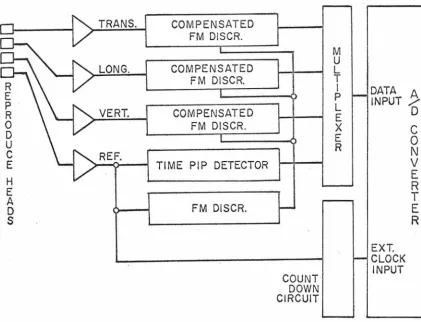
Circuits which accomplish the desired change in gain are available
and are not prohibitively complicated. A block diagram of such a
compensated system is shown in Fig. Al located in Appendix A.
Certain practical difficulties remain, however. In the output
circuitry of an FM discriminator it is necessary to provide a low-pass
filter in order to suppress the carrier frequency of the input wave.
A low pass 2nd order linear filter which is designed for minimum
distortion of complex wave forms has a time delay between input and
output which is nearly independent of frequency within its pass band
and whose magnitude is given approximately by:
where: ~t
Tr
~t
=
-...-zw--0
= time delay, seconds
W
0 = corner frequency, radians/ second
For example, the 25 Hz filter which was used ill the data channel of the
discriminator used for evaluation of the accelerograph system has a
delay of approximately 10 milliseconds.
Such small delays are significant because the compensation
compensation input of the data channel. It can be easily shown that
the result of such a delay is a residual noise signal which is
propor-tional both to the time derivative of the uncompensated noise signal
and to the time delay. With the 25 Hz filters originally included in
both channels of the discriminator system used in these tests, the
resulting transfer function, rising linearly with frequency, had unit
amplitude at 14 Hz, with noise frequency components higher than that
actually being amplified. Changing the compensation channel filter to
70 Hz corner frequency moved this unit gain frequency to 39 Hz and
improved performance considerably. Further boosts in the filter
frequency appear impractical due to beat frequencies generated when
the data and compensation carriers are allowed to mix. A large order
of improvement is still possible, however, by introducing a time
delay into the data channel, as indicated in Fig. Al. For reasons
which will be seen shortly, the total improvement from such added
complication is limited, and the system appears acceptable without it.
The RMT-280 system introduces a further complication into the
compensation problem by recording the reference signal and data
signals on separate tracks so that they do not necessarily see the
same instantaneous speed variations. The test accelerographs were
originally equipped with two head assemblies of two tracks apiece,
staggered vertically to produce four tracks on the tape. About an inch
of tape separated the point at which the reference signal was recorded
from that at which two of the three data signals were recorded. A
as . 01 lb rms could produce uncompensable errors greater than those
commonly accepted in previous optical recorders. Early testing
proved that excessive tape stretch did indeed occur and the final
version of the accelerograph has a single four element head. This
arrangement is still subject to errors due to tape skew, i. e. tape not
crossing the head at a constant angle, but this error has proved
experimentally to be acceptably small.
All such errors could be avoided by frequency multiplexing
a reference signal and three data signals on a single track, and this is
commonly done. The necessity of separating the four frequency
components applied on the track when the tapes are played back would
preclude the use of the present simple but highly nonlinear recording
process and add substantially to the complexity of individual field units.
Fortunately, this additional complexity is unnecessary in the present
instrument.
The noise output of the system was assessed by introducing
various signals into an FM discriminator and measuring the resulting
noise output with a B&K true RMS voltmeter set for a time constant of
10 seconds. In the case of noises generated within the instrument, a
single discriminator sufficed. In the case of noises generated by the
record/playback process a variety of combinations involving one
"data" channel and one compensation channel were tried.
All record/playback tests were made on the two head stack
version of the instrument. These tests provided the data which
included one set of tests which are val id for either case, so that it
was not necessary to repeat the tests when the heads were changed.
Test tapes were prepared by connecting all four heads of the recording
machine in series with a stable oscillator in order to record four
identical tracks which could then be used in various combinations as
data and compensation tracks. The normal arrangement of tracks
for both head configurations is shown in Fig. A2, Appendix A.
Play-back was always by the same machine: a Viking cartridge tape deck
which is similar in design to the RMT-280 transport mechanisms,
except that it uses a hysteresis synchronous AC motor in place of the
governor controlled D, C. one and has correspondingly better speed
regulation.
In some cases noise outputs were analyzed by passing them
through a Kron-Hite variable active filter used in the low-pass mode.
Band-pass filtering is a more conventional way of assessing noise
spectra, but filters of sufficiently narrow band width to be used in the
2-25 Hz range are not easily obtained, and the low pass filter used
has the advantage of being a realistic simulation of a possible actual
operating condition.
When it seemed desirable to obtain separate values for noise
sources which could only be measured in combination with other
noises, it has been assumed that the noises dealt with are
approxi-mately Gaussian so that their noise powers add algebraically. In
most cases the corrections obtained are of the same order as the
rather reasonable assumption is not critical. An example is the total flutter of the tape transport, which was obtained by deducting the
noise generated during playback from the total noise,
For convenience, noise values are reported as percentages of
1/2 g full scale. One percent thus corresponds to a one Hz frequency
deviation (100 Hz= 1/2 g).
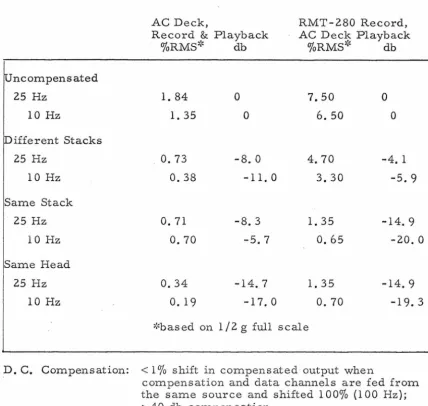
The results of these measurements are summarized in Fig. 5
and in Table 1. The solid curves in the figure represent tapes
prepared on Accelerograph No. 1 and played back on the Viking deck.
Dashed curves represent tapes both prepared and played back on the
Viking de