Volume 3, No. 4, July- August 2012
International Journal of Advanced Research in Computer Science
RESEARCH PAPER
Available Online at www.ijarcs.info
Cyclic Image Denoising Algorithm Using Hybrid Thresholding Function
Sabahaldin A. Hussain*
Electrical & Computer Eng. Department University of Omdurman
Sudan
Sami M. Gorashi
Electrical & Computer Eng. Department University of Omdurman
Sudan
Abstract: In this paper a cyclic denoising algorithm which integrates spatial domain bilateral filter and hybrid thresholding function in the wavelet domain is proposed. The wavelet transform is used to decompose the noisy image into approximation and detail subband. The noisy image is firstly pre-processed using spatial bilateral filter. Secondly, Bayesian based threshold calculation that uses hybrid thresholding function is applied to the detail subband. Thirdly, a sub image is constructed from approximation and detail subband at each level and then cyclically filtered using spatial bilateral filter. The depth of cyclic filtering is equal to the number of decomposition level. The experimental results show that the performance of the proposed denoising algorithm is superior to that of the conventional denoising approach and can deal with both low and high frequency noise components efficiently.
Keywords: Image denoising; Thresholding function; Cyclic filter.
I. INTRODUCTION
Denoising of electronically distorted images is an old, there are many different cases of distortions. One of the most prevalent cases is distortion due to noise. Typical images are corrupted with noise modeled with either a Gaussian, uniform, Rician, or salt and pepper distribution. Another typical noise is a speckle noise, which is multiplicative in nature. Speckle noise [1] is observed in ultrasound images, whereas Rician noise [2] affects MRI images. Mostly, noise in digital images is found to be additive in nature with uniform power in the whole bandwidth and with Gaussian probability distribution. Such a noise is referred to as Additive White Gaussian Noise (AWGN). White Gaussian noise can be caused by poor image acquisition or by transferring the image data in noisy communication channel. In the image denoising process, information about the type of noise present in the original image plays a significant role. Most denoising algorithms use images artificially distorted with well defined white Gaussian noise to achieve objective test results [3-7].
Image denoising is often a necessary and primary step in any further image processing tasks like segmentation, object recognition, computer vision, etc. Among several denoising algorithms, denoising that based on spatial linear filtering techniques, such as Wiener filter or match filter, finds wide range of applications for many years. Generally, the main weaknesses of linear filter are its inability to preserve image fine details and its poor performance in dealing with heavy tailed noise. Due to these facts, an alternative spatial nonlinear filtering techniques are widely used. Many successful works [8-14] have been reported on image denoising using spatial nonlinear filters. Among several spatial non linear filters, the bilateral filter finds wide range of applications [9] due to its robustness in smoothing out noise while preserving image fine details. Besides spatial filters, denoising that based on wavelet transform for cancelling white Gaussian noise finds wide range of applications since the pioneer work by Donoho and Johnstone[15-17]. In wavelet based denoising algorithms,
the noise is estimated and wavelet coefficients are thresholded to separate signal and noise using appropriate threshold value. Since the threshold plays a key role in this appealing technique, variant methods appeared later to set an appropriate threshold value [3-7]. Among various approaches to nonlinear wavelet-based denoising, BayesShrink wavelet denoising based on Bayesian framework has been widely used for image denoising [3]. Unlike the universal threshold [15], which depends only on the number of pixels and the variance of the noise, BayesShrink threshold is a Data-Driven adaptive to the features of the image and provide better results.
part of the proposed denoising algorithm, although any spatial filter can be used, we suggest to use bilateral filter due to its robustness[9]. The rest of the paper is organized as follows. Section 2 and 3 briefly reviews the wavelet and spatial based denoising algorithms. In Section 4, we explain the proposed image denoising algorithm. The results of our proposed denoising algorithm will be compared with BayeShrink[3], bilateral filter[9], and ABF/Bayes[14] in section 5. Finally, the concluding remarks are given in section 6.
II. DISCRETEWAVELETTRANSFORM
Discrete Wavelet Transform (DWT) is a multi-resolution representation algorithm. The DWT decomposes noisy image into four subbands namely LL, LH, HL, and HH. The decomposed noisy image consists of a small number of coefficients with high signal to noise ratio (SNR) named approximation subband (LL) and a large number of coefficients with low SNR named detail subbands (LH, HL, and HH).
A. Hybrid Thresholding Function:
For a given threshold, soft thresholding has smaller variance, however, higher bias than hard thresholding, especially for very large wavelet coefficients. Soft thresholding exhibits smaller error when the coefficients are close to zero. On the other hand, if the coefficients distribute densely close to the threshold, hard thresholding will show large variance and bias. Generally, soft thresholding is chosen for smoothness while hard thresholding is chosen for lower error. To get the benefit of both soft and hard thresholding functions, we suggest to use hybrid thresholding function proposed in [18] which scales the wavelet coefficients according to:-
(1)
Where f is the wavelet coefficient, T is the threshold
value, and β is the parameter that controls the thresholding characteristics .When β→1, the thresholding rule
approaches the soft thresholding function. On the other
hand, when β→∞, the thresholding rule follows hard
thresholding function. Thus, by selecting suitable value for
β, a better thresholding can be achieved that gets the merits
of both soft and hard thresholding functions. So compared with soft and hard thresholding function, the new thresholding function is more flexible.
B. Bayes Threshold Estimation:
Bayesian based threshold calculation was proposed by Chang, et al [3]. The goal of this method is to estimate a threshold value that minimizes the Bayesian risk assuming Generalized Gaussian Distribution (GGD) prior. It has been shown that BayesShrink[3] outperforms SUREShrink[17] most of the times in terms of PSNR values over a wide range of noisy images. It uses soft thresholding and is subband-dependent, which means that thresholding is done at each band of resolution in the wavelet decomposition. From the definition of additive noise we have:-
(2)
where , , and are the observed, original,
and noise signals respectively.
Since the noise and the signal are independent of each other, it can be stated that:-
(3)
Where is the observed signal variance, is an estimate of the original noise free signal variance, and is an estimate of noise variance. The noise standard deviation
is estimated from the formula:-
(4)
Where is the detail coefficients in the diagonal
subband .
The observed signal variance can be estimated using:-
Knowing and , the variance of the signal, can be estimated according to:-
(6)
The Bayes threshold is estimated as[3]:-
(7)
III. SPATIALDOMAINBASEDFILTERING
Bilateral filtering [9] is one of the best spatial domain based denoising algorithm. It is a local, nonlinear, and non-iterative technique which considers both intensity and geometric closeness of the neighboring pixels. Tomasi and Manduchi[9] suggest to use Gaussian weight function for both intensity and geometric closeness of the neighboring pixels as in (8).
(8)
Where, , is the geometric
and intensity absolute distance between the neighboring pixels p of neighboring window size N and the center pixel q (to be denoised) respectively. σs and σi are the parameters that control the fall-off of weights in spatial and intensity domains respectively. Results show that, bilateral filter preserves more accurately image details such as edges while suppressing noise as compared with traditional linear filters[9,13].
IV. PROPOSEDALGORITHM
components. However, this assumption is not always true. To enable dealing with both low and high frequency noise components, a cyclic denoising algorithm is proposed. In this algorithm, the noisy image is decomposed into its different frequency subbands and then filtering each subband separately and collectively to get access and cancelling both low and high frequency noise components. For image decomposition, wavelet transform will be used due to its robustness and low computational cost. The detail subbands (high frequency image subbands) in each decomposition level are thresholded. The threshold value is estimated using (7). Instead of soft or hard thresholding function, hybrid thresholding function will be adopted according to (1).
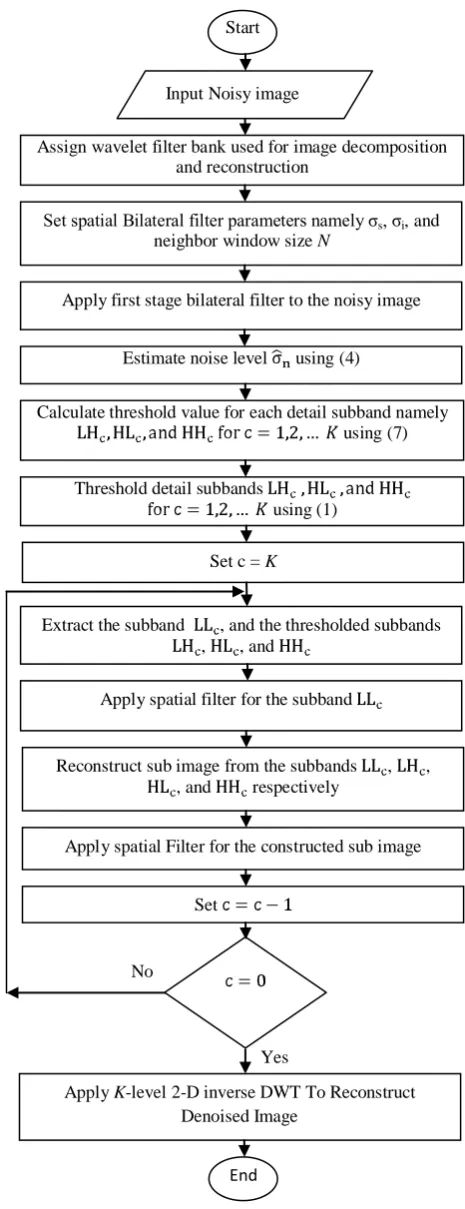
Thereafter, a sub image is constructed from the approximation subband and the thresholded detail subbands at each level in different orientations. The sub image is cyclically filtered together with the approximation low frequency subband using any spatial filter(in our case we will use bilateral filter). The filtering cycle length is equal to the number of decomposition level K. Fig.1, shows the flow chart that describes the implementation steps of this algorithm.
V. RESULTSANDDISCUSIONS
For evaluation purpose, An experiment were conducted to assess the performance of the proposed cyclic denoising algorithm for denoising images corrupted with white Gaussian noise with zero mean and standard deviations 10, 20, 30, and 40. The same wavelet transform that employs Daubechie’s least asymmetric compactly supported wavelet with eight vanishing moments was used. The noise standard deviation is estimated using robust Median Absolute Deviation (MAD) using the highest level wavelet coefficients according to (4). The Peak Signal to Noise Ratio (PSNR) was used as our quantitative measure of the relative denoising algorithms performance.
Extensive simulation tests were performed to set ,
empirically, the parameters σs, σi, N and the hybrid thresholding function parameter β. Results show that the
optimum value for β is a function of noise level and it lies
within the range 1→1.5. Results also show that the
parameter σi has higher effect on denoising performance as
compared with the σs, and N and it has approximately linear
relationship with the noise standard deviation ( i.e σi=λ σn ).
Setting λ= 0.8→1.2, σs=1.7→2 and N=9→11 shown to be suitable choice over a wide range of images and noise levels under test. Refers to [18] for empirical analysis of the effect of these parameters.
In the experiment, we have compared the proposed denoising algorithm with the conventional BayesShrink[3], conventional Bilateral Filter (BF)[9], and Adaptive Bilateral Filter/Bayes(ABF/Bayes)[14]. BayesShrink is frequency domain based denoising algorithm using 4-Level wavelet transform decomposition. BF is spatial domain based denoising algorithm. While ABF/Bayes is a combination of frequency/spatial domain based denoising algorithm arranged according to the recommendation of [14]. The proposed denoising algorithm decomposes the noisy image into its different frequency subbands using 2-Level wavelet transform (i.e K=2). The denoising relative performance in terms of PSNR value for a set of images are recorded in Table1. The data are collected from an average of ten runs.
[image:3.595.324.557.78.683.2]The best denoising algorithm is highlighted in bold font for each test image.
Figure 1. The flowchart of the proposed denoising algorithm.
Referring to the results in Table I, we can clearly observe that the proposed denoising algorithm outperforms other denoising algorithm all the time in terms of PSNR values over the whole scope of noise levels and images under test.
Since PSNR is not always tell the whole story, it is important to compare the performance of the denoised
Assign wavelet filter bank used for image decomposition and reconstruction
Set spatial Bilateral filter parameters namely σs, σi, and
neighbor window size N
Estimate noise level using (4)
Calculate threshold value for each detail subband namely using (7)
Threshold detail subbands using (1)
Apply first stage bilateral filter to the noisy image
Start
Input Noisy image
Set c = K
Apply K-level 2-D inverse DWT To Reconstruct Denoised Image
End
Yes
Extract the subband , and the thresholded subbands , , and
Apply spatial filter for the subband
Reconstruct sub image from the subbands , , , and respectively
Apply spatial Filter for the constructed sub image
Set
images visually. Fig.2, Fig.3, and Fig.4 show the denoising results for Lena, Barbara, and Boat images at different noise levels. Noticeably, the proposed denoising algorithm exhibits higher denoised image visual quality as compared with all other denoising algorithms. It succeeded in distinguishing between low frequency noise components and useful low frequency image information more accurately through cyclic filtering procedure described in Fig.1. This distinguishing property enable the proposed denoising algorithm to (cancel) or at least attenuate both low and high frequency noise component more efficiently as compared with the competitive ABF/Bayes denoising algorithm. Also we can notice that the BayesShrink, and bilateral filter leave considerable amount of residual low frequency noise unaltered which is more prominent in the uniform area especially as noise level increased (as an example see the sky in Fig. 4c-f.)
[image:4.595.317.569.241.400.2]To summarize, Fig.5 shows graphically the relative average PSNR of the different denoising algorithms under test.
Table I. PSNR Results for Denoising Lena, Barbara, and Boat images
VI. CONCLUSIONS
In this paper, a new denoising algorithm was proposed through cyclically filtering the noisy image. The filter cycle length depend upon number of wavelet decompositions. The subjective and objective quality of the proposed denoising algorithm reveals that it outperforms all other denoising algorithms under test and can deal with both low and high frequency noise components efficiently. As an example, for Lena image, the proposed denoising algorithm achieves an average PSNR gain of 1.5125, 1.3100, and 0.7975 dB as compared with BayesShrink, Bilateral filter, and ABF/Bayes respectively.
[image:4.595.31.284.295.507.2]The performance of proposed denoising algorithm can further be improved by replacing the conventional bilateral filter with adaptive bilateral filter and using better detail-subband denoising through adopting neighborhood wavelet based thresholding instead of individual wavelet based thresholding. These issues are left as future work.
Figure 2. (a) Original image, (b) Noisy image(σn=30) (c) BayesShrink (d)
[image:4.595.31.283.297.506.2]Bilateral (e) ABF/Bayes (f) Proposed.
Figure 3. (a) Original image, (b) Noisy image(σn=40) (c) BayesShrink (d)
Bilateral (e) ABF/Bayes (f) Proposed.
Figure 4. (a) Original image, (b) Noisy image(σn=50) (c) BayesShrink (d)
Bilateral (e) ABF/Bayes (f) Proposed.
Figure 5. Relative Performance of Various Denoising Algorithms.
22 24 26 28 30 32
Lena Barbara Boat
A
ver
ag
e P
SN
R
(d
B
)
BayesShrink
BF ABF/Bayes
Proposed
Image σn
Bays Shrink
Bilateral Filter
Adaptive Bilateral/Bayes
Proposed Algorithm
Lena
10 33.38 33.65 33.91 34.58
20 30.27 30.33 31.56 31.59
30 28.60 28.54 28.91 29.81
40 26.25 26.79 26.98 28.57
Barbara
10 30.25 30.37 30.99 32.05
20 27.32 27.02 27.89 28.15
30 25.34 25.69 25.78 25.95
40 21.09 22.34 22.77 24.50
Boat
10 31.98 32.02 32.65 32.73
20 28.55 28.40 29.46 29.58
30 26.71 26.57 27.25 27.69
[image:4.595.318.568.433.591.2] [image:4.595.318.558.623.748.2]VII.REFERENCES
[1] H. Guo, J. E. Odegard, M. Lang, R. A. Gopinath, I.W Selesnick, and C. S. Burrus, "Wavelet based speckle reduction with application to SAR based ATD/R", First International Conference on Image Processing, pp. 75-79, 1994.
[2] R. D. Nowak, "Wavelet based Rician noise removal", IEEE Trans. Image Processing, Vol.8, No. 10, pp. 1408-1419, 1999.
[3] S. G. Chang, B. Yu and M. Vetterli, "Adaptive wavelet thresholding for image denoising and compression" IEEE Trans. Image Processing, Vol.9, No.9, pp.1532-1546, 2000.
[4] S.G.Chang, B.Yu and M.Vetterli, "Spatially adaptive wavelet thresholding with context modeling for image denoising," IEEE Trans. Image Processing, Vo1.9, No.9, pp. 1522-1531, 2000.
[5] J. Portilla, V. Strela, M. J. Wainwright, and E. P. Simoncelli, "Image denoising using scale mixtures of Gaussians in the wavelet domain IEEE Trans. Image Processing, Vol. 12, No. 11, pp. 1338-1351, 2003.
[6] F. Luisier, T. Blu, M. Unser, " A new SURE approach to image denoising: interscale orthonormal wavelet thresholding", IEEE Trans. Image Processing, Vol. 16, No. 3, pp. 593-606, 2007.
[7] Z. Dengwen, C. Wengang,"Image denoising with an optimal threshold and neighboring window", Pattern Recognition Letters, 29, pp.1694-1697, 2008.
[8] S. M. Smith and J. M. Brady, "Susan - A new approach to low level image processing", Int. Journal of Computer Vision, Vol. 23, pp.45–78, 1997.
[9] C. Tomasi and R. Manduchi, "Bilateral filtering for gray and color images", Proc. Int.Conf. Computer Vision, 1998, pp. 839–846.
[10] R. Kimmel, N. Sochen and A.M. Bruckstein, "Diffusions and onfusions in signal and image processing", Mathematical Imaging and Vision, Vol.14, No.3, pp.195– 209, 2001.
[11] R. Kimmel, A. Spira and N. Sochen, "A short time Beltrami kernel for smoothing images and manifolds", IEEE Trans. Image Processing, Vol.16, No.6, pp.1628– 1636, 2007.
[12] H. Phelippeau, H. Talbot, M. Akil, S. Bara,; , "Shot noise adaptive bilateral filter", 9th International Conference on Signal Processing, pp.864-867, 2008.
[13] B.K Gunturk, "Fast bilateral filter with arbitrary range and domain kernels", IEEE Trans. On Image Processing, Vol.20, No.9, pp.2690-2696, 2011.
[14] G. Santhanamari, V. R.Vijaykumar, A.V.V.B. Rao, "Adaptive bilateral filter and Bayesian threshold based image denoising", Computational Intelligence and Computing Research (ICCIC), IEEE International Conference, pp.1-4, 2010.
[15] L. Donoho and I. M. Johnstone, "Ideal spatial adaptation via wavelet shrinkage", Biometrika, 81, pp. 425-455, 1994.
[16] D. L. Donoho, "Denoising by soft thresholding", IEEE Trans. IT, pp. 613–627, 1995.
[17] D. L. Donoho and I. M. Johnstone, "Adapting to unknown smoothness via wavelet shrinkage", Journal of American Statistical Association, 90(432):1200-1224, December 1995.