Volume 5, No. 7, September-October 2014
International Journal of Advanced Research in Computer Science
RESEARCH PAPER
Available Online at www.ijarcs.info
Insights into Production Scheduling Complexity - A Comprehensive Study
R.Sudha
Associate Professor
Department of computer Applications Vasavi College of Engineering(Autonomous)
Ibrahimbagh,Hyderabad Andhra Pradesh, India.
Dr. P.Premchand
Professor
Department of Computer Science & Engg. University college of Engineering
Osmania University, Hyderabad, Andhra Pradesh, India
Abstract: The only permanent and inevitable phenomenon in any manufacturing unit is its dynamic environment which enforces the production manages to accommodate these changes and subsequently re plan and re schedule the tasks. Determining and maintaining a stable, efficient production schedule that quickly respond and adopt to change is not only time consuming but a difficult task. Though the purpose of process scheduling is specific to the class of a process, the conventional methods have scheduled every process equivalently based on some unrealistic assumptions about the shop floor and did not reflect on necessary scheduling parameters. Production scheduling has also become an interesting domain of research in computer science where powerful algorithms and models can be designed. This paper gives a comprehensive list of factors to be addressed for determining an optimal schedule. The complexity of production scheduling is influenced by a package of several factors which is presented in this paper with four dimensions ; scheduling decision parameters, constraints, unexpected events and scheduling objectives. The paper also discusses performance metrics for a schedule.
Keywords: Schedule complexity, Scheduling Dimensions. Decision Parameters, Constraints, Objectives Performance Criteria
I. INTRODUCTION
One of the key factor that contributes to the success of any manufacturing industry is the scheduling policy adopted in the shop floor. Scheduling is a decision making process involving voluminous data about number of tasks of varied nature and functionality, resources and constraints. It comprises of identifying the suitable plan for performing the activities , their sequence and assigning the start times for each of the activity in order to meet a multifaceted criteria such as resource optimization and minimum make span etc. The critical and important issue that attracts the attention of people in any manufacturing unit, is the complexity of a scheduling task.
Research in scheduling is being carried out from the last few decades. Parunak distinguished the five challenges that make scheduling difficult namely Desirability, Stochasticity, Tractability , Chaos and Decidability[1].
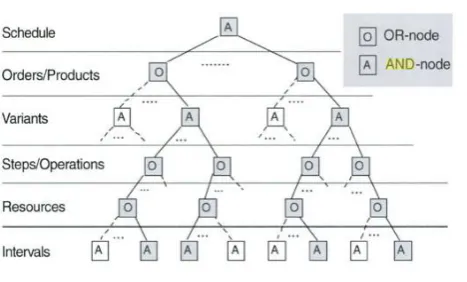
[image:1.595.330.564.340.481.2]Sauer,J [2] formulated the scheduling problem as set of orders, products, resources, soft and hard constraints. The problem space of scheduling problem can be represented by an AND/OR tree which can be constructed by combining the production requirements with given orders and the scheduling horizon. Finding a solution to the scheduling problem is equivalent to finding the solution of AND/OR tree where the constraints are met. If the node belongs to solution, it has the root node, all successors of AND node () and one successor of an OR node. see Figure 1
Figure 1 : problem space of scheduling (source : Sauer [2]
The number of possible solutions for such a tree can be estimated by
((#RI X # R)*s X # V)*o Where
#RI is the number of possible intervals for resources, #R is the number of possible resources per step(operation), #S is the number of steps(operations) per variant,
#V is the number of possible variants for products #O is the number of orders for products
It is understood from the problem space that, , the complexity of a schedule will increase as the number of jobs or resources increase .This can be represented in the following graph
Figure : 2
[image:1.595.317.561.645.742.2]machines. Each product has a given route and given processing requirements on the various machines.[3].
Every machine can do multiple tasks and each process (may be product) need multiple sequence of steps that needs multiple machines. So, allocation of machines to proper processes is increasingly demand in manufacturing system since revenue is completely around in scheduling mechanism. But the major problem here is that handling of real time constraints and criteria such sequential order, set up selection and machine selection.[4].
A good schedule can reduce the efforts in manufacturing, thus improving the competitiveness of products [5].In general, the complexity of scheduling problem are due to limited resources, un certainty in the environment, complex job mix, numerous complex and sometimes conflicting objectives, and constraints. The complexity of production scheduling is influenced by a package of several factors having four dimensions ; scheduling decision parameters, constraints, unexpected events and scheduling objectives.
a. Scheduling parameters b. Unexpected events c. Constraints
d. Scheduling objectives
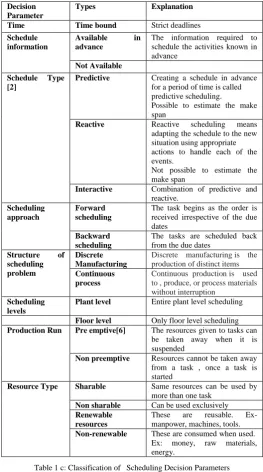
[image:2.595.305.569.68.541.2]The inputs to be considered for a production schedule originate from multiple sources and available with many forms which makes the scheduling really a tough task . The following table illustrates various options available for each of the schedule input and it is indeed a challenging task to carefully understand, analyze various permutations and combinations of given options and choosing an Optimal possible option. Ref Table 1 a,b,c.
Table 1 a: Classification of Scheduling Decision Parameters
Table 1 b: Classification of Scheduling Decision Parameters
Decision Parameter
Types Explanation
Time Time bound Strict deadlines
Schedule information
Available in
advance
The information required to schedule the activities known in advance
Not Available
Schedule Type [2]
Predictive Creating a schedule in advance for a period of time is called predictive scheduling.
Possible to estimate the make span
Reactive Reactive scheduling means
adapting the schedule to the new situation using appropriate actions to handle each of the events.
Not possible to estimate the make span
Interactive Combination of predictive and reactive.
Scheduling approach
Forward scheduling
The task begins as the order is received irrespective of the due dates
Backward scheduling
The tasks are scheduled back from the due dates
Structure of
scheduling problem
Discrete Manufacturing
Discrete manufacturing is the production of distinct items
Continuous process
Continuous production is used to , produce, or process materials without interruption
Scheduling levels
Plant level Entire plant level scheduling
Floor level Only floor level scheduling Production Run Pre emptive[6] The resources given to tasks can
be taken away when it is suspended
Non preemptive Resources cannot be taken away from a task , once a task is started
Resource Type Sharable Same resources can be used by
more than one task Non sharable Can be used exclusively Renewable
resources
These are reusable. Ex-manpower, machines, tools. Non-renewable These are consumed when used.
[image:2.595.31.286.443.772.2]Ex: money, raw materials, energy.
Table 1 c: Classification of Scheduling Decision Parameters
Decision Parameter Types Explanation
Product batch size Fixed batch size Variable batch size
Product type Part Single part production
Assembly Assembly of multiple parts Product process
type
Single stage Multi stage
Simple process style Complex process style SPT-Shortest Processing Time
LPT-Longest Processing Time
SSTF-Smallest Slack Time First
SCRF-Smallest Critical Ratio First
SPS- Shortest Processing Sequence
LPS- Longest Processing Sequence[7]
STPT-Shortest Total Processing Time
LTPT- Longest Total Decision
Parameter
Types Explanation
Time Time bound Strict deadlines
Schedule information
Available in advance
The information required to schedule the activities known in advance Not Available
Schedule Type [2]
Predictive Creating a schedule in advance for a period of time is called
predictive scheduling.
Possible to estimate the make span Reactive Reactive scheduling means adapting
the schedule to the new situation using appropriate
actions to handle each of the events.Not possible to estimate the make span
Interactive Combination of predictive and reactive.
Scheduling approach
Forward scheduling
The task begins as the order is received irrespective of the due dates Backward
scheduling
The tasks are scheduled back from the due dates
Structure of scheduling problem
Discrete Manufacturi ng
Discrete manufacturing is the production of distinct items
Continuous process
Continuous production is used to , produce, or process materials without interruption
Scheduling levels
Plant level Entire plant level scheduling Floor level Only floor level scheduling Production
Run
Pre emptive The resources given to tasks can be taken away when it is suspended Non
preemptive
[image:2.595.321.559.545.783.2]Processing Time
Dynamic ECT-Earliest Creation Time SWT_-Shortest Waiting Time LWT- Longest Waiting Time LTWR-Least Total Work Remaining
MTWR-Most Total Time Remaining
workload Static Fixed workload
Dynamic Varied workload
Practically, it is very difficult to optimise a Schedule over all these characteristics. From most production schedules one is chosen for emphasis depending on current production objectives. Generally, a trade off must be made to reach a balance among the objectives[8].
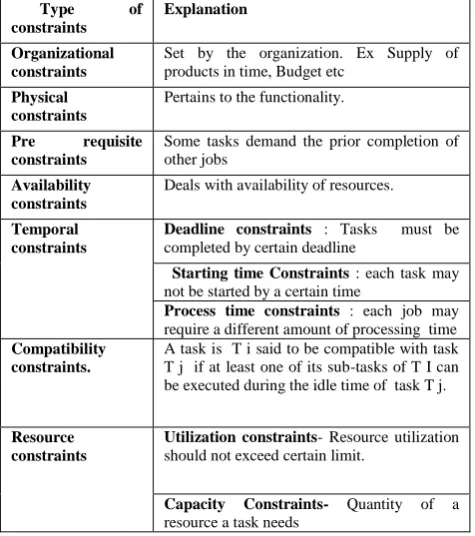
[image:3.595.36.280.57.151.2]The second important dimension deals with the constraints. Constraints are anything that prevents the organization from reaching its goal. In manufacturing processes, constraints are often called as bottlenecks. As shown by the abstract model of OZONE, constraints can be imposed on activities, products, resources, demands etc [9].
[image:3.595.42.283.303.462.2]Figure -3 : Abstract domain model of OZONE The constraints can be classified as follows
Table 2 : Categories of Constraints
Type of
constraints
Explanation
Organizational constraints
Set by the organization. Ex Supply of products in time, Budget etc
Physical constraints
Pertains to the functionality.
Pre requisite
constraints
Some tasks demand the prior completion of other jobs
Availability constraints
Deals with availability of resources.
Temporal constraints
Deadline constraints : Tasks must be completed by certain deadline
Starting time Constraints : each task may not be started by a certain time
Process time constraints : each job may require a different amount of processing time Compatibility
constraints.
A task is T i said to be compatible with task T j if at least one of its sub-tasks of T I can be executed during the idle time of task T j.
Resource constraints
Utilization constraints- Resource utilization should not exceed certain limit.
Capacity Constraints- Quantity of a resource a task needs
State constraints- Task may require a resource to be in a particular state at beginning of task
Priority constraints
jobs may have priorities, with higher priority jobs to be done first
Interrupt ability constraints
jobs may not be interruptible
Quality constraints Imposed by quality control people
Customized constraints
Customers may demand additional product features and ease of use.
Government Rules Constraints on power supply, Working Hrs etc
Previously, scheduling process involved making the following assumptions[10].
a. Resources are always available b. No unexpected events
c. Every order must be manufactured by the available resources.
d. Static environment i.e. all jobs arrive at same time. However, the manufacturing environment is stochastic in nature and several unexpected events occur that disturbs the normal functionality and leads to chaos in the manufacturing unit effecting the performance. These un expected events are enlisted in table 3
Table 3 : Types of unexpected events
Few of these unexpected events such as machine break downs can be anticipated by using some preventive maintenance S/W. However the events that are external to the manufacturing environment has to be dealt dynamically (Just In Time basis .)
S.No Type of event Examples
1 Job related Cancelled jobs
New jobs
2 Machine related Delayed operations due to poor
maintenance of machines Machine breakdowns
3 Operation related Delayed operations due to preemption of resources
4 Operator related Some operators go absent.
Operators begin working below average performance
5 Time related Due date change
Over or under estimation of processing times
Variance in processing and set up times
6 Demand related Urgent orders
cancelled orders
7 Priority related Changes in priority of jobs
8 Cost Unacceptable cost of late jobs
Unacceptable cost of adding additional capacity (i.e. out sourcing).
9 Quality Poor quality of raw materials
10 Resource related Delay in arrival of raw materials
Unavailability of resources or substituted resources
11 Quality Checks Quality controllers decide re-work is necessary.
12 Strikes Man power not available due to strike
13 Accidents Short circuits, Fire, Damaged Goods
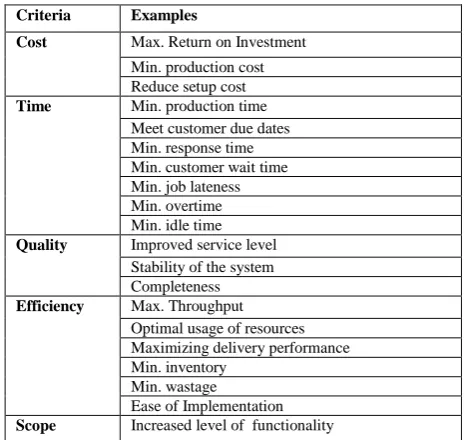
[image:3.595.40.278.512.780.2]All problems must be resolved to achieve an intended goal and objectives. The domain of Scheduling is no exception. It involves satisfying a multifaceted optimization criteria that can be categorized as in Table 4.
Table 4: Classification of Optimization Criteria
Determining and designing an efficient scheduling strategy is a tough task and identifying its performance metrics is yet another challenging task. The performance criteria can vary among manufacturing units and mean different to different people.
The operational performance criteria determined by Rahan [11] as , 1.Throughput ,the rate at which the manufacturing system generates revenue. 2- Inventory (IN) defined as the investment made to generate revenue. 3- Operating expense (OE) defined as the cost of transforming inventory into throughput
[image:4.595.41.276.119.339.2]Brah identified three categories for measuring the performance i.e, in terms of completion time, due dates , cost and resource utilization[12]. Ref Table 5
Table 5 : Category Measures
Basis Examples
completion time
Max. flow time,Total completion time,Total flow time,Mean completion time,Mean flow time, Weighted sum of completion time,
Weighted sum of flow time, Jobs waiting time,Weighted job waiting time
Due dates Max. lateness, Max. tardiness, Max. earliness,Total lateness, Total tardiness,Total earliness, Mean lateness,Mean tardiness,
Mean earliness,Weighted sum of lateness,Weighted sum of tardiness,
Weighted sum of earliness, No. of tardy jobs, No. of early jobs, No. of jobs in the system, Cost &
utilization
Machine idle time, Weighted machine idle time, Manpower idle time,Manpower weighted idle time, Utilization setup time
The criteria of a schedule are focused on either on scheduling product or on the scheduling process
The scheduling product is the actual schedule to be implemented and the scheduling process involves set of activities to develop, adapt and communicate schedules. [ 13] Ref Table 6
Table 6 : Performance Criteria for a schedule
Performance Focus Criterion
product
Minimum schedule errors
Minimum cost of schedule execution Fulfillment of constraints
Schedule robustness
Process
Timely execution Reliability Flexibility
Speed of schedule adaptation
Cost and efficiency of scheduling process
[image:4.595.329.558.246.390.2]De Snoo[13] presented a scheduling performance focus matrix that shows the relatively decreasing importance of scheduling product performance criteria and the relatively increasing importance of scheduling process performance criteria if uncertainty increases.
Figure 4 : scheduling performance focus matrix (Source [13])
A holistic approach is needed to improve production scheduling, given the limitations of applying information technology or analyzing problems mathematically[14]
It is understood from that the performance of a schedule depends on the issues addressed in four dimensions and change in performance criteria
Subsequently triggers changes in selecting some of these parameters which can be shown as
[image:4.595.321.563.516.670.2]Figure 5.
Figure 5 : Scheduling Dimensions
It is understood from that the performance of a schedule depends on the issues addressed in four dimensions and change in performance criteria
Subsequently triggers changes in selecting some of these parameters which can be shown as Figure 5.
The elements in four dimensions are closely coupled and any change in any of these dimension subsequently results some change on the other elements
Criteria Examples
Cost Max. Return on Investment
Min. production cost Reduce setup cost
Time Min. production time
Meet customer due dates Min. response time Min. customer wait time Min. job lateness Min. overtime Min. idle time
Quality Improved service level
Stability of the system Completeness Efficiency Max. Throughput
Optimal usage of resources Maximizing delivery performance Min. inventory
[image:4.595.41.277.525.704.2]Great amount of research is being carried out in production scheduling and various scheduling algorithms have been designed to enhance the performance of scheduling using many techniques . These techniques vary in their perception about the problem space and the performance criteria. Though the list of scheduling strategies is very extensive some strategies used in recent times are genetic algorithms[18], Hybrid cuckoo and Genetic Algorithms[4], heuristics[15], Expert systems[16], simulated annealing[17] and Agent based[19].
II. CONCLUSION
Scheduling is an ever challenging research area as the production scheduling encompasses a large number of problems, and within this continuum there are solutions which are more efficient than others. Any scheduling problem , enforces us to know whether a best or optimal solution can be obtained in minimum time considering the level of complexity in the problem space. The various issues contributing to the complexity of production schedule design are extensively discussed that help the production schedulers, researchers to design an efficient approach to improve production scheduling performance. Despite a great deal of research has been done about scheduling , there is still much scope for improvement and many approaches have been evolving that addresses and overcomes the bottlenecks in scheduling process. However, searching for a feasible schedule is combinatorially explosive.
III. REFERENCES
[1]. Parunak, H.V.D. (1991). Characterizing the manufacturing scheduling problem. Journal of Manufacturing Systems, 10(3), 241.259
[2]. Jurgen Sauer(1999), Knowledge based systems Techniques and applications in scheduling, knowledge based systems techniques and applications, Four volume set edited by Cornelius T. Leondes
[3]. Pinedo et al,(2004) ,Planning and Scheduling in Supply Chains:An Overview of Issues in Practice, Production And Operations Management Poms,Vol. 13, No. 1, Spring 2004, pp. 77–92
[4]. Sudha et al, (20014),An Intelligent Hybrid Scheduling Algorithm for Computer Aided Process Control of Manufacturing System,IJITR,Volume no.2, issue no. 4, pp. 1089-097.
[5]. Jun Sun, et al(1999), “An intelligent production scheduling mechanism considering design and manufacturing constraints,” Third International Conference on Industrial Automation, vol.18, no.12, pp.651-667.
[6]. Vora et al(2012), Design of Real Time Scheduling Algorithms for Efficient Mass Production in various Industrial Applications.IJDI-ERET,vol 1
[7]. Kaban et al(2012),Comparison of dispatching rules in job-shop scheduling problem using simulation-A case study, International journal of simul model , 3, Pg No 129-140.
[8]. peter bubeník*, dariusz plinta(2005) Interactive Scheduling System, Management, Vol 10,pp 89-98.
[9]. Smith, S. F., and Becker, M. A. (1997). An ontology for constructing scheduling systems. AAAI Spring Symposium on Ontological Engineering, Palo Alto, CA, 120-129.
[10]. Niem-Trung, Comparison of scheduling algorithms for a multi product batch chemical plant with a generalized serial network, thesis submitted to Virginia polytechnic and state university.
[11]. Rahan, S., (1998). "Theory of constraints: A review of the philosophy and its applications". International Journal of Operations and Production Management, vol. 18, no. 4, pp. 336-355.
[12]. Brah et al(1991). “Mathematical modeling of scheduling problems”. Journal of Information & Optimization Sciences, v 12, n1, P 113-137.
[13]. De Snoo et al(2011), An empirical investigation of scheduling performance criteria, Journal of Operations Management.
[14]. Herman(2007),The legacy of Taylor , Gantt & Johnson and how to improve production scheduling, ISR Technical Report.
[15]. Muthukumaran(2012), A Heuristic Scheduling Algorithm for Minimizing Makespan and Idle Time in a Nagare Cell, Advances in Mechanical Engineering, Volume 2012 (2012), Article ID 895463, 13 pages
[16]. Bo Guo et al(2011) A Production Scheduling Method Based on Interactive Simulation and Expert System. ICTE 2011: pp. 482-487.
[17]. Ashwani Dhingra et al(2010) "Multi‐objective flow shop scheduling using hybrid simulated annealing", Measuring Business Excellence, Vol. 14 Iss: 3, pp.30 - 41
[18]. Pongcharoen et al(2004), The development of genetic algorithms for the finite capacity scheduling of complexproducts, with multiple levels of product structure. European journal of operational research, 152, 215 – 225.