Volume 8, No. 5, May – June 2017
International Journal of Advanced Research in Computer Science REVIEW ARTICLE
Available Online at www.ijarcs.info
Encryption Schemes in Cloud Computing – A Comprehensive Study
Lakshmi L PG Student
Department of Computer Science & Engineering Fisat Engineering College
Angamaly, Ernakulam, India [email protected]
Abstract: Cloud computing is an emerging computing area which enables users to remotely store data in a third party and then provides services on demand. The cloud users as well as the cloud service providers will be mostly from different trust domains. As the sharing of confidential data to the cloud servers have become common, it is important to adopt measures to efficiently encrypt the outsourced data. The data in the network is prone to attack by different spy wares. The security of the data sent over a network is critical. The encryption schemes are those schemes that are used to wrap the messages transmitted over the network in a non-readable format. The notable issues for the remote data storage are data security and privacy. This paper presents a survey on the various encryption algorithms used in the cloud computing are explained. A study on all those methods are done and the advantages and disadvantages of those are listed.
Keywords: Attribute-based encryption, Identity-based encryption, Cloud computing, Encryption schemes, Cloud services
I. INTRODUCTION
Cloud computing is a type of Internet-based computing that provides shared computer processing resources and data to computers and other devices on demand(Source: Wikipedia).It has now become a widely adopted paradigm for delivering services over the Internet. As sensible and valuable data are being stored on the clouds the service providers are responsible for providing the trust and the security. For improving the security and confidentiality of the data stored in the cloud, it must be encrypted by using some cryptographic algorithms before uploading the same to the cloud. So the need of the encryption algorithms thus arosed. The computing method provides enterprises and users with various capabilities to store and process data in privately owned or remotely placed third-party data centers. There are different types of clouds based on their location:
• Public Cloud : A public cloud is one in which the services and infrastructure are provided off-site over the Internet. Standardized workload for applications is used by lots of people, such as e-mail. Need to test and develop application code. It has SaaS (Software as a Service) applications from a vendor who has a well-implemented security strategy. Need incremental capacity (the ability to add computer capacity for peak times).
• Private Cloud : A private cloud is one in which the services and infrastructure are maintained on a private network. Therefore, control and security are inevitable. Business is part of an industry that must conform to strict security and data privacy issues. Company is large enough to run a next generation cloud data center efficiently and effectively on its own.
• Community Cloud : The benefits of a public cloud are multi-tenancy and pay-as-you-go billing structure. The community cloud uses all these benefits as well as the private cloud features such as privacy, security and policy compliance. The community cloud can governed by the participating organizations or by a third-party managed service provider (MSP).
• Hybrid Cloud : A type of cloud that has multiple service providers with a variety of features of the other two clouds. This is the most efficient platform to keep the data for a company that use a SaaS application but is concerned about security. The SaaS dealer can create a private cloud just for a company inside their firewall. They can provide with a virtual private network (VPN) for more security.
The encryption is the method used to convert the data over the network in a non-readable format as well as will be accessible by the users authorized to it. The encryption is done based on the keys used to encode the message. Based on that there are two types of encryption scheme:
• Public key encryption • Private key encryption
All the encryption schemes available now falls in either of these two categories. The public key encryption scheme uses key pairs for the encoding of the message. It uses the receiver’s public key to encode the data and the same could be decoded with the receiver’s private key which is known only to the owner. Whereas in the latter only a single key is used for both encryption as well as decryption. The cryptographic technologies are used in the cloud computing in order to secure the data getting tampered from the unauthorized accesses. So the data is encrypted before it is uploaded to the cloud. Only the authorized users will be able to decrypt and download the file. The main security goals of any system include the following:
• Confidentiality : ensures that the authorized users will be only able to access the files
• Integrity: ensures that the data sent by the sender is same as that received by the receiver
• Authentication: Verify the identity of the entities that communicate over the network.
© 2015-19, IJARCS All Rights Reserved 171 II. ENCRYPTIONSCHEMES
• Attribute based Encryption (ABE)
The attribute based encryption is a one to many public key encryption technique[15][16] which performs encryption and decryption based on some user attributes that are selected by the one who performs encryption form the attribute set. In this scheme the secret key as well as the cipher text are dependent upon attributes. A user will be able to decrypt the cipher text only when user key matches with the attributes of the cipher text [2].The encryption schemes that comes under the mentioned one are listed below:
1) Key-Policy Attribute Based Encryption (KP-ABE)
This is a modified version of classical ABE[3]. Here users are assigned with an access tree structure over the data attributes. The nodes of the access tree represents the threshold gates. The leaf nodes denote the attributes. The cipher texts are marked with set of attributes whereas the private keys are associated with monotonic access structures which decides which all users will be able to decrypt the cipher text. The scheme is designed for one-to-many communications. In a KP-ABE scheme, cipher texts are labelled with sets of attributes and access policies over these attributes are associated with users’ private keys.
2) Cipher Text Policy Attribute Based Encryption (CP-ABE)
CP-ABE[3] is also a modified form of the classical ABE. In this scheme, every users' private key is associated with a set of attributes and every cipher text is associated with an access policy. The decryption of the cipher text is possible only when the set of attributes associated with the users' private key satisfies the access policy associated with the cipher text. The access structure of the scheme inherits the same method used in the KP-ABE scheme. The access structure provides the encrypted data decide which key can recover the data. The encryptor is the one who can set the access controls while encrypting a message. Currently, most existing ABE schemes are derived from CP-ABE schemes.
3) Attribute-based Scheme with Non- Monotonic Access Structures
The prior ABE methods fail to express monotonic access structures and there are no particular methods to represent negative constraints in a key’s access formula. This method can use negative word to define every attribute in the message, whereas the monotonic access structure cannot[7]. It enables non-monotonic policy which is the policy with negative attributes.
4) Hierarchical attribute-based Encryption
The scheme satisfies properties such as fine grained access control[11], full delegation and scalability. The method is
capable of sharing data for users in the cloud in an enterprise environment. Also, it can be used to achieve proxy re-encryption[4]. This scheme uses the property of hierarchical generation of keys in HIBE scheme to generate keys.
5) Multi-Authority Attribute Based Encryption (MA-ABE)
The scheme uses multiple parties to distribute attributes for users [2]. The system is composed of one central authority and K attribute authorities and the attribute authority is also assigned with a value dk. It consists of many authorities to manage the attributes and the distribution of the secret keys. The user who wish to download the information will request the decryption keys from the attribute authority.
• Identity Based Encryption (IBE)
IBE is a public key encryption system which uses an arbitrary string as the public key[8]. The security demand is semantic security against an adaptive chosen cipher text attack. No polynomial bound adversary wins the following game with non-negligible advantage. The sender who has access to the public parameters of the system can encrypt a message.
• Hierarchical Identity Based Encryption (HIBE)
It has two level scheme [6], that consists of a root private key generator(PKG), users and domain PKGs, which all are associated with the primitive Ids(PIDS) which are arbitrary strings. The scheme also includes a trusted third party and allows a hierarchy of certificate authorities: the root certificate authority will issue certificates for other certificate authorities, who can in turn issue certificates for users in their respective domains.
• Hierarchical Attribute Set Based Encryption (HASBE)
In HASBE, fine grained access control in cloud storage services is obtained by combined hierarchical identity based encryption(HIBE) and CP-ABE. It follows a hierarchical structure to the scheme. HASBE[5] being an extension of cipher-text attribute set-based encryption (ASBE)[9] derives the features such as access control and flexibility.
• Homomorphic Encryption
The method [13] allows computations on the cipher text to get the encrypted result. When the same is decrypted, the result will be a set of computations that are applied on the plain text. It allows the chaining of different services without exposing the data to each other. The fully homomorphic scheme is built upon the lattice cryptography[14].
III. LITERATURESURVEY
© 2015-19, IJARCS All Rights Reserved 172 phase a random input is given to the algorithm to get the
Master key as well as public parameters as output. In the encryption phase the set of attribute is taken as input along with the outputs from the first phase to generate the encrypted message. In the key generation phase, it outputs a key for the decryption phase. And in the final stage ie, the decryption phase the original message is retrieved from the cipher text by using the decryption key.
Collusion resistance is one of the crucial security feature of the ABE system. If one user has multiple keys then one of the keys should be matched in-order to grant access to data. The drawback of the ABE scheme is that the data owner needs to use every authorized public key to encrypt data. The application of the scheme is restricted in the real environment since it use the access of monotonic attributes to control user's access in the system .
Bettencourt, Sahai and Waters [3] proposed two methods that are derived from attribute based encryption based on the difference in the deployment. Both works with the same algorithms as in the case of attribute based encryption. The algorithm has four phases as explained in the previous method. Setup, Encryption, Key Generation and Decryption. The key policy based attribute based encryption scheme can attain fine-grained access control and flexibility than ABE. The drawback with the scheme is that the encryptor cannot decide who can decrypt the encrypted data. The same is unsuitable for some application as the data owner need to trust the key issuer.
With the case of cipher text policy based attribute based encryption, the scheme overcomes the drawbacks of KP-ABE ie, the encrypted data could choose who can decrypt. The user’s private key is a combination of a set of attributes. The flaws of the existing CP-ABE schemes are not fulfilling the enterprise requirements of the access control that need efficiency and flexibility. In CP-ABE decryption keys only support user attributes that are organized logically as a single set so that users could use all the possible combinations of the same. The CP-ASBE consists of recursive set of attributes. There is challenge for preventing users from combining attributes from multiple keys.
R. Ostrovsky and B. Waters [7] proposed another ABE scheme with non-monotonic access structure. The can use negative word to define every attribute in the message, whereas the monotonic access structure cannot. The mentioned scheme being ABE works as same as the classical ABE scheme consisting of the four algorithms. Being non monotonic ABE the encryption phase as well as the decryption phase are slightly different from that of the classical ABE. In the encryption phase, rather than taking the access structure as input the algorithm takes non-monotonic access structure as input. And in the decryption phase, the plain text is derived from the cipher text based on the same non-monotonic access structure.
The problem with ABE scheme over non- monotonic access structures is that there are many negative attributes in the encrypted data. It can cause the encrypted data overhead to huge. It is inefficient and complex that each cipher text needs to be encrypted with d attributes, d is a system-wise constant.
Wang et al.[8] proposed the hierarchical attribute based encryption in which it uses the property of hierarchical generation of keys. Also, it can be used to achieve proxy re-encryption[4]. Proxy re-encryption schemes are the cryptosystems that are used to alter the cipher text that has been encrypted by one user so that the same could be decrypted by another user. The method employs two algorithms instead of key generation. The algorithms are Setup, Create domain masters, Create users, Encryption and Decryption. But the same is impractical to implement. As all of the attributes in one conjunctive clause in this scheme may be managed by the same domain authority, the same attribute may be managed by multiple domain authorities.
V Bozovic, D Socek, R Steinwandt, and Vil-lanyi [2] proposed Multi-Authority Attribute Based Encryption in which the scheme employs the following algorithms. Setup, Attribute Key Generation, Central key generation, Encryption and Decryption. The setup algorithm is a randomized algorithm run by a third party and it gives a master key as output. In the attribute key generation phase the secret key is generated as output taking the users’ GID, the authority’s value dk and a set of attributes in the authority’s domain and the randomized algorithm is run by the attribute authority. The algorithm in the next phase is run by the central authority- Central key generation. The algorithm gives the secret key for the user as the output taking the master key as well as user’s GID as input. The encryption phase runs as same as that of in the classical ABE and is run by the sender. The decryption algorithm is a deterministic algorithm run by the user. Takes as input decryption keys for an attribute set Au and a cipher text, which was encrypted under attribute set AC. Outputs a message m if |Ak C ∩ Ak u| > dk for all authorities k. Complication in multi-authority scheme requires that the authority’s attribute set be disjoint.
Adi Shamir in 1984 [8] introduced a new concept- Identity based encryption. No polynomial bound adversary wins the following game with non-negligible advantage. The encryption scheme is based on the identities of the user such as the email ID etc. The receiver obtains its decryption key from a central authority(private key generator), which needs to be trusted as it generates secret keys for every user. The scheme employs four algorithms in its four phases: Setup, Encrypt, Extract and Decrypt.
In the setup phase takes the security parameter and outputs the master key and the set of public parameters The algorithm is run by the Private key generator (PKG). The next phase algorithm is run by PKG on user request for the private key. The outputs from the first phase is given as the input to the second phase and it provides the private key as output. The encryption and decryption phases works as it is ie, the encryption phase generates the cipher text as output whereas in the decryption phase the plain text is retrieved, The IBE scheme with view the attribute values to be descriptive is fuzzy IBE[10]. The two main applications of fuzzy IBE are it can be used in the scheme that uses biometric identities[11] and can be used in ABE.
© 2015-19, IJARCS All Rights Reserved 173 domain PKG. It can compute the private key of any user in
their domain. The scheme also includes a trusted third party and allows a hierarchy of certificate authorities: the root certificate authority will issue certificates for other certificate authorities, who can in turn issue certificates for users in their respective domains.
The scheme comprise of four algorithms. The first phase is the Setup phase in which the algorithm which takes random parameter as input and give master key and public parameters. The next phase is the key generation phase to generate private key for the identity it takes the public parameters and a random number from the integer set. The next phase being the encryption phase, the algorithm takes the parameters, identities as well as the message as input to give the cipher text as output. The decryption phase takes private key as well as the cipher text as input to give the plain text as output. HIBE is a scheme that has good efficiency and access control compared to IBE. But it is high in case of computational overhead.
Z. Wan, J. Liu, and R. H. Deng [5] introduced the concept of Hierarchical Attribute Set Based Encryption which combines the concept of the HIBE as well as CP-ABE schemes. . It comprises of five types of parties: data owners, data consumers, a cloud service provider, a number of domain authorities and a trusted authority. Cloud service provider is to provide a data storage service. Data owners will encrypt their data files and store them in the cloud. Data consumers will download the encrypted data files to access shared data files. Each domain authority is responsible for managing the data owners/consumers in its domain or the domain authorities at the next level. Root authority is the trusted authority and is responsible for managing top-level domain authorities. ASBE’s capability of assigning more values to the same attribute enables it to solve the user revocation problem efficiently, which is not capable in CP-ABE.
The above desirable feature and the recursive key structure is implemented by four algorithms: Setup phase takes the depth of the key as the input to provide the public key and the master key as the output. The next phase is the keygen phase which take the identity, the master key and the key structure as the input to give the secret key for the user as the output. The encryption and decryption phases work as is that is for providing the cipher text and the plain text respectively. The HASBE scheme can easily and efficiently manage the user revocation as it employs multiple values for access expiration time. The scheme is easily scalable due to the hierarchical structure whereas on the other hand, the computation overhead is high as the data decryption keys are disclosed only to authorized keys.
C Fontaine, F Galand [13] discusses about homomorphic encryption. Homomorphic encryption is the encryption scheme which is used to apply operations on the encrypted data. It can be applied in any system by using various public key algorithms. The Homomorphic encryption is a scheme with four functions. It can be represented as H = {Key Generation, Encryption, Decryption, Evaluation }. Key generation is used to generate a key pair of secret key and public key used for the encryption of the plain text. Encryption and decryption phases works as normal. Evaluation is used by
the server which has a function f to evaluate the cipher text using the public key pk.
There are many encryption schemes that come under the Homomorphic encryption. The various schemes include Paillier, RSA, BGV encryption scheme, Gorti’s Enhanced Homomorphic Cryptosystem (EHC), Non-interactive Exponential Homomorphic Encryption Scheme [NEHE], Algebra Homomorphic Encryption Scheme Based On Updated ElGamal (AHEE)etc. Paillier can be used for preserving the additive property of homomorphic encryption while ElGamal and RSA can be used for multiplicative property. Each of the above mentioned schemes could be used in various applications like-voting system, Banking, For the security of integer polynomials, Efficient Secure Message Transmission in Mobile Ad Hoc Networks, Active networks and e-commerce based on mobile agent, electronic voting and mobile cipher respectively.
IV. COMPARISON OF ENCRYPTION SCHEMES
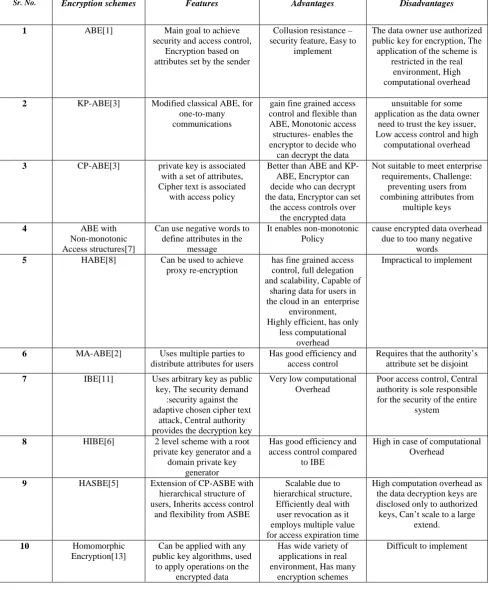
In the schemes mentioned above, the Attribute-based methods are widely used. The attribute based encryption are easy to implement and it can efficiently handle the complex cipher texts easily. The comparative study of all the encryption schemes used in cloud computing is given in Table I. The least commonly used scheme is the identity based one. As it is based on identities the mentioned one cannot efficiently handle the encryption. In the case of the attribute based scheme the encryption is based on the access policy that is derived from the attribute list set by the sender. HASBE is not commonly used as it is difficult to implement.
V. CONCLUSION
© 2015-19, IJARCS All Rights Reserved 174 Table I : Comparative Study
VI. REFERENCES
[1] V. Goyal, O. Pandey, A. Sahai, and B.Waters, ”Attibute-based encryption for fine-grained access control of encrypted data,”in Proc. ACM Conf. Computer and Communications Security (ACM CCS), Alexandria, VA, 2006.
[2] V Bozovic, D Socek, R Steinwandt, and V. I. Vil-lanyi, ”Multiauthority attribute-based encryption with honest-but-curious central authority” International Journal of Computer Mathematics, vol. 89,pp. 3,2012.
[3] J. Bettencourt, A. Sahai, and B.Waters ”Ciphertext-policy attribute based encryption ”in Proceedings of IEEE symposium on Security and Privacy, pp. 321V334, 2007.
Sr. No. Encryption schemes Features Advantages Disadvantages
1 ABE[1] Main goal to achieve security and access control,
Encryption based on attributes set by the sender
Collusion resistance – security feature, Easy to
implement
The data owner use authorized public key for encryption, The application of the scheme is
restricted in the real environment, High computational overhead
2 KP-ABE[3] Modified classical ABE, for one-to-many communications
gain fine grained access control and flexible than ABE, Monotonic access structures- enables the encryptor to decide who
can decrypt the data
unsuitable for some application as the data owner
need to trust the key issuer, Low access control and high
computational overhead
3 CP-ABE[3] private key is associated with a set of attributes, Cipher text is associated
with access policy
Better than ABE and KP-ABE, Encryptor can decide who can decrypt the data, Encryptor can set
the access controls over the encrypted data
Not suitable to meet enterprise requirements, Challenge:
preventing users from combining attributes from
multiple keys
4 ABE with
Non-monotonic Access structures[7]
Can use negative words to define attributes in the
message
It enables non-monotonic Policy
cause encrypted data overhead due to too many negative
words 5 HABE[8] Can be used to achieve
proxy re-encryption
has fine grained access control, full delegation and scalability, Capable of
sharing data for users in the cloud in an enterprise
environment, Highly efficient, has only
less computational overhead
Impractical to implement
6 MA-ABE[2] Uses multiple parties to distribute attributes for users
Has good efficiency and access control
Requires that the authority’s attribute set be disjoint
7 IBE[11] Uses arbitrary key as public key, The security demand
:security against the adaptive chosen cipher text
attack, Central authority provides the decryption key
Very low computational Overhead
Poor access control, Central authority is sole responsible for the security of the entire
system
8 HIBE[6] 2 level scheme with a root private key generator and a
domain private key generator
Has good efficiency and access control compared
to IBE
High in case of computational Overhead
9 HASBE[5] Extension of CP-ASBE with hierarchical structure of users, Inherits access control
and flexibility from ASBE
Scalable due to hierarchical structure,
Efficiently deal with user revocation as it employs multiple value for access expiration time
High computation overhead as the data decryption keys are disclosed only to authorized keys, Can’t scale to a large
extend.
10 Homomorphic Encryption[13]
Can be applied with any public key algorithms, used
to apply operations on the encrypted data
Has wide variety of applications in real environment, Has many
encryption schemes
© 2015-19, IJARCS All Rights Reserved 175 [4] Q. Liu, G. Wang, and J. Wu, ”Time based proxy
re-encryption scheme for secure data sharing in a cloud environment,” Information Sciences .In Press, 2012. [5] Zhiguo Wan, Jun’e Liu, and Robert H. Deng,Senior
Member, IEEE, ”HASBE: A Hierarchical Attribute-Based Solution for Flexible and Scalable Access Control in Cloud Computing”in Proc.IEEE Transactions on Information Forensics and security, vol.7,No.2, April 2012.
[6] Yanli Ren and Dawu Gu,”Efficient Hierarchical Identity Based Encryption Scheme in the Standard Model”in Proc. Informatica 32 (2008),pp 207?211.
[7] R. Ostrovsky and B. Waters. ”Attribute based encryption with nonmonotonic access structures”.In Proceedings of the 14th ACM conference on Computer and communications security, pages 195203. ACM New York, NY, USA,2007.
[8] G.Wang, Q. Liu, and J.Wu, ”Hierachical attribute-based encryption for fine-grained access control in cloud storage services,” in Proc. ACM Conf. Computer and communications Security (ACM CCS), Chicago, IL, 2010.
[9] R. Bobba, H. Khurana, and M. Prabhakaran, ”Attribute-sets: A practically motivated enhancement to attribute-based encryption,” in Proc. ESORICS, Saint Malo, France, 2009.
[10] A. Sahai and B. Waters, ”Fuzzy identity based encryption,” in Proc. Advances in Cryptology-Eurocrypt, 2005, vol. 3494,LNCS, pp. 457?473.
[11] Adi Shamir. Identity-based cryptosystems and signature schemes. In Proceedings of CRYPTO 84 on Advances in cryptology,pages 47?53. Springer-Verlag New York, Inc.,1985.
[12] S. Yu, C. Wang, K. Ren, and W. Lou,”Achieving secure, scalable, and fine-grained data access control in cloud computing,” in Proc. IEEE INFOCOM 2010, 2010, pp. 534-542.
[13] Fontaine C, Galand F. A survey of homomorphic encryption for nonspecialists. EURASIP Journal on Information Security 2007. 2007 Jan; 1?15
[14] Daniele Micciancio, Oded Regev ,” Lattice-based Cryptography”,Jul 2008
[15] Mr. Anup R. Nimje, “Attribute-Based Encryption Techniques in Cloud Computing Security : An Overview”, International Journal of Computer Trends and
Technology-
volume4Issue3-2013,http://oaji.net/articles/2015/2028-1433398925.pdf [16] R.Nitya Lakshmi, “Analysis of Attribute Based