Binding Theory in LTAG
Lucas Champollion
Department of Linguistics
619 Williams Hall
University of Pennsylvania
Philadelphia, PA 19104-6305
[email protected]
Abstract
This paper provides a unification-based implementation of Binding Theory (BT) for the English language in the framework of feature-based lexicalized tree-adjoining grammar (LTAG). The grammar presented here does not actually coindex any noun phrases, it merely outputs a set of con-straints on co- and contraindexation that may later be processed by a separate anaphora resolution module. It improves on previous work by implementing the full BT rather than just Condition A. The main technical innovation consists in allowing lists to appear as values of semantic fea-tures.
1
Introduction
BT (see B¨uring (2005) for a recent overview) ac-counts for the distribution of reflexives, pronouns, and full noun phrases.1
The focus of this paper is on implementing all binding conditions in the classical formulation by Chomsky (1981) in a toy LTAG grammar of En-glish. At first sight, this poses a problem for LTAG since at least Condition C makes reference to po-tential antecedents that may lie outside LTAG’s lo-cal domain (the verbal elementary tree, see Frank (2002)). Even in the case of Conditions A and B, the local domains of BT and of LTAG do not al-ways correspond: a local domain for the purposes
1
This paper uses the termreflexiveto denote a word like
himselfsubject to Condition A (excluding reciprocals, which are not treated in this paper). The termpronounis used for words likehimthat are subject to Condition B.
of BT may encompass more than just a verbal el-ementary tree, as shown by binding into adjuncts and binding of ECM subjects.
In all these cases, information on potential an-tecedents has to be transmitted across several ele-mentary tree boundaries. This is analogous to the “missing link” problem well known in LTAG se-mantics. The analysis advocated here adopts the solution to the missing link problem introduced in Gardent and Kallmeyer (2003), in that information is transmitted across tree boundaries by repeated use of feature unification, as opposed to e.g. mul-ticomponent sets.2 Features also provide the ex-pressive power required to encode cases in which the structural configuration does not correspond to classically defined c-command at the surface level (the only syntactic level available in LTAG), such as binding into PPs that adjoin at VP (John saved Maryi from herselfi) (Pesetsky, 1995) or
topical-ization (Himselfi, heilikes.).
2
Previous Work
There are two previous attempts at implementing BT in LTAG syntax: Ryant and Scheffler (2006) and Kallmeyer and Romero (2007). Both restrict themselves to Condition A.3
Ryant and Scheffler (2006) propose a multi-component lexical entry for reflexives and recip-rocals. One of the components is the reflexive and
2
(Kallmeyer and Romero, 2004; Kallmeyer and Romero, 2008) analyze a wide variety of semantic phenomena in En-glish, using a notational variant of Gardent and Kallmeyer (2003). Once list-valued features are adopted (see below), the present analysis is compatible with all incarnations of their framework.
3See also Steedman (2000) for an early account that mixes
the other one is a degenerate NP tree which has no phonological content and which adjoins into its antecedent. Tree-local MCTAG (Weir, 1988) together with flexible composition (Joshi et al., 2007) and a number of specialized constraints con-cerning subject interveners and c-command ensure that the structural configuration in which the two components stand corresponds exactly to the local domain of standard BT.
Kallmeyer and Romero (2007) use almost the same approach but allow the degenerate tree to tree-locally adjoin directly into thehost tree (i.e. the tree into which the reflexive and its antecedent substitute). This is achieved by changing the la-bel of the degenerate tree from “NP” to “VP” and making sure that the host tree will always con-tain a VP node for each potential antecedent. Fea-tures on the relevant places of the host tree propa-gate the individual variable from the antecedent to the reflexive via the degenerate tree. This move is an attempt to avoid flexible composition and to show that “tree-local MCTAG display exactly the extended domain of locality needed to account for the locality of anaphora binding in a natural way” (Kallmeyer and Romero, 2007).
3
This Proposal
This analysis uses the standard framework of feature-based LTAG (Vijay-Shanker, 1987), that is: Each nodenhas (possibly empty) top and bot-tom feature structures. If nis a substitution slot, then its bottom feature structure must be empty. Substituting a tree with rootr into nwill trigger unification of the top feature structures on nand
r. Ifnis an adjunction site, then adjoining a tree with rootr and foot nodef intonwill unify the top features on nand r, and separately, the bot-tom features onnandf. Finally, for any noden
on which neither substitution nor adjunction takes place throughout the derivation, the top and bot-tom feature structures onnare unified.
The only way in which this analysis extends the standard framework consists in using lists as values of features (as in HPSG, Pollard and Sag (1994)), as well as simple list operations such as creating a list from one (h· i) or two (h·,· i) el-ements, adding elements (::), and appending a list to another one (∪). All these operations can be given computationally tractable implementations. Allowing lists (or sets) as values of features may
(A) NPBot"!
I x
?A local #
himself
if local 6=h i then x∈ local
(B) NPBot"!
I x
?B local #
he
x /∈ local
(C) NPBot2
6 6 4
!I x ?A local ?
C nonlocal
3 7 7 5
John
x /∈ local ∪nonlocal
Figure 1: Noun phrases
perhaps look like a theoretically undesirable step. But this move seems unavoidable if potential an-tecedents of a noun phrase are to be encoded com-pactly in the output of the grammar. This in turn is necessary in order to avoid a combinatorial explo-sion of indexations (see Section 7).
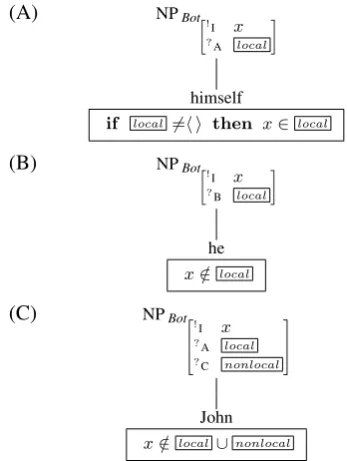
Through the features on its root node, every noun phrase receives several items from the tree it attaches to (Branco, 2002): a list A of potential local antecedents for the purpose of condition A, a list B of potential local antecedents for the pur-pose of condition B, and a list C of potential nonlo-cal antecedents. (Keeping two separate lists A and B is necessary since there exist environments in which reflexives and pronouns are not in comple-mentary distribution, as will be discussed later.)4
As is independently needed for semantic pur-poses (Gardent and Kallmeyer, 2003; Kallmeyer and Romero, 2008), every noun phrase provides a different I(NDIVIDUAL VARIABLE) to its
envi-4
STop
h !C h ii
Both ?
C nli
NP↓Top
2 6 6 6 6 6 4 ?
I sbj
!
A h i
!
B h i
!
C nl
3 7 7 7 7 7 5
VP
V
introduces
VP
NP↓Top
2 6 6 6 6 6 6 4 ?
I obj
!
A h sbj i
!
B h sbj i
!
C nl
3 7 7 7 7 7 7 5
PP
P
to
NP↓Top
2 6 6 6 6 6 6 4
?I indobj
!A h sbj, obj i
!B h sbj, obj i
!
C nl
3 7 7 7 7 7 7 5
Figure 2: Finite ditransitive verb
ronment. Note that these variables do not corre-spond to BT indices, as each of them is assumed to be unique to its noun phrase even if another noun phrase ends up having the same referent. (This can be achieved by renaming before parsing starts.) They are thus more comparable to the reference markers of DRT (Kamp and Reyle, 1993). Finally, every noun phrase is associated with pseudocode that states the applicable BT condition (Fig. 1).5It is assumed that a separate resolution module will interpret this pseudocode in the obvious way. Take for example the statement for reflexives:
if local 6=h i then x∈ local (1)
This statement constrains the resolution module to equate the variablexwith one of the members of the value of local, provided that that value is not the empty list.6(This analysis does not use the order of the lists, but the grammar could be set up
5Metavariables in the feature structures have been given
names likesbj, rather than just numbers as usual. Also, the direction of information flow has been indicated by annotat-ing features thatreceiveinformation from another tree with
?and features thatsendinformation to another tree with!. These annotations are only there for clarity of exposition and have no formal significance.
6This formulation implements the idea of exemption
(Pol-lard and Sag, 1992; Pol(Pol-lard and Sag, 1994): A reflexive has to be bound locally only if its local domain is not empty. Reflex-ives whose domain is empty are argued there to fall outside of the scope of syntactic BT. Examples are reflexives within pic-ture NPs in subject position. The following example is from Pollard and Sag (1992):
to use it to rank potential antecedents according to recency or grammatical prominence for the benefit of the resolution module.)
The rest of the grammar is responsible for pro-viding the correct A, B and C lists to the noun phrase substitution slots. The next two sections describe how this is done in the verbal and nomi-nal domains, respectively.
4
The Verbal Domain
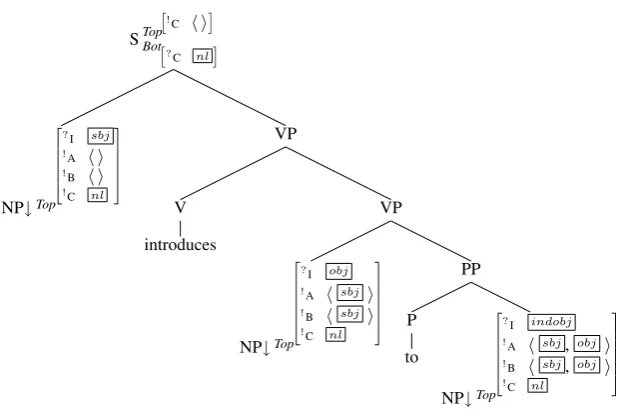
In the standard case, the verb tree will collect the variables from its substitution slots and include them into A and B lists at these same substitution slots as appropriate (Fig. 2).
C lists are transmitted across clauses via their root nodes. If a verbal tree is a subordinate clause, then its C list is supplied by the matrix verb via the bottom feature on its S node. If it is a matrix clause, then the top and bottom features on its S node will unify and cause its C list to be empty. If
(2) a. Johniwas going to get even with Mary. That picture
of himselfiin the paper would really annoy her, as
would the other stunts he had planned.
b. Mary was quite taken aback by the publicity Johni
was receiving. *That picture of himselfiin the paper
had really annoyed her, and there was not much she could do about it.
SBoth
Figure 3: Sentential complement verb
a verbal tree subcategorizes for a sentential com-plement, then it appends its own argument(s) to its C list and makes the result available to the senten-tial complement (Fig. 3).
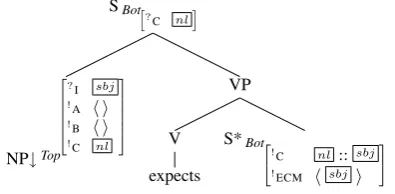
A special case are ECM verbs. The subject of an ECM verb is in the local domain of the subject of the verb’s complement clause (Johni believes
himselfi to be the best candidate). However, due
to the LTAG version of the theta criterion (Frank and Kroch, 1995), the subject of the complement clause belongs to the LTAG local domain of the lower clause. ECM verbs therefore make their sub-ject available via a special ECM feature (Fig. 4). In non-ECM verbs, the value of the ECM feature is the empty list (Fig. 3).
SBoth
Figure 4: ECM verb
Nonfinite verbs (Fig. 5) function like finite verbs except for their subject position: If the matrix clause is headed by an ECM verb, its subject will be added to their A and B lists via the ECM fea-ture. This gets the desired effect inJohniexpects
himselfi/*himito win the game.
LTAG’s local domain only encompasses the ar-guments of a verb, not its adjuncts nor any rais-ing verbs, because all recursion is factored away into separate elementary trees (Frank, 2002; Joshi,
STop
Figure 5: Nonfinite transitive verb
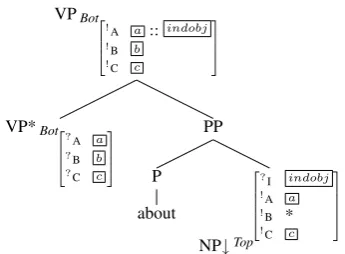
2004). Verbs therefore have to extend their lo-cal binding domain by propagating their A, B and C values to trees that adjoin on the VP spine,7. This includes raising verbs with PP com-plements (Fig. 6) in order to derive Johni seems
to himselfi/*himito be a decent guy8, and PP
ad-juncts (Fig. 7), in order to deriveJohnisaved Billj
from himselfi/j.
For those prepositions that take both reflexives and pronouns as locally-referring complements (Johni wrapped a blanket around himselfi/himi),
differing A and B lists are made available. In these PP trees, the value of the B feature on the NP node (the asterisk in Fig. 7) will be b, while in those PP trees that do not allow pronouns in this posi-tion (Johnispeaks with himselfi/*himi), the value
of that feature will be a.9 Finally, the PP adjunct tree carries an additional set of features on its root node that enables local binding from one adjunct to another, as inMary spoke to Billiabout himselfi.
7
For clarity of exposition, the feature structures on the VP spine have been omitted in the figures other than Fig. 5.
8See also Storoshenko (2006) for the syntax of this
con-struction in LTAG. 9
NPBot2
Figure 8: Picture NP components
I0Top
Figure 6: Raising verb with PP complement
VPBot2
Figure 7: PP adjunct. See text for an explanation of the asterisk.
5
The Nominal Domain and Picture NPs
Complex NPs (Fig. 8) allow possessors (“John’s friend”). Following the syntactic analysis of (Kallmeyer and Scheffler, 2004; Kallmeyer and Romero, 2007), the “possessed” argument
substi-tutes into a tree anchored in ’s, which in turn ad-joins into the possessor. The possessed argument may, for example, be a simple noun10, or a con-stituent that contains an NP complement, such as “picture of X”, where X can be any NP. Following the same authors, this constituent is analyzed as an NP tree whose yield is X, and into whose root a “picture of ”tree is adjoined.
Both possessors and picture NP complements behave nonuniformly with respect to the different binding conditions.11 Possessors count as locally bound within their clause only for the purpose of condition A, but not B (Huang, 1983):
(3) a. Theyisaw each otheri’s friends.
b. Johnisaw hisifriend.
As for picture NP complements, for the purpose of condition A, their local domain includes the c-commanding arguments of the verb (here: the sub-ject) and the possessor:12
(4) a. Johnifinally saw Mary’s picture of
himselfi.
b. Mary finally saw Johni’s picture of
himselfi.
For the purpose of condition B, however, the lo-cal domain of a picture NP complement only in-cludes the possessor:
10
Because the label of the argument slot is NP and not N, this possibility is actually wrongly ruled out. This defect is a part of the syntactic analysis imported here from the litera-ture.
11So-called exempt reflexives likeJohn
ithinks that the
pic-tures of himselfiare horridare discussed in fn. 6.
12
(5) a. Johnifinally saw Mary’s picture of himi.
b. *Mary finally saw Johni’s picture of himi.
These facts are straightforwardly represented by the values of the A and B features on the NP com-plement node of the “’s” tree.
Of course, picture NPs can also occur without a possessor. Again, the local domain of the picture NP complement includes the c-commanding argu-ments of the verb for the purpose of condition A, but not condition B.
(6) Johnifound a picture of himi/himselfi.
In other words, whether or not a possessor is present, both pronouns and reflexives may be the complement of a picture NP and be bound by the subject.13 This is modeled by letting the deter-miner trees pass on only the A but not the B list.
6
Other Constraints on Anaphora
Apart from the Chomskyan binding conditions, there are other syntactic constraints on anaphoric relations, including agreement (7) and accessibil-ity relations when the antecedent is a quantifier (8).
(7) *Johnilikes myselfi/themselvesi/herselfi.
(8) Every man loves [a woman]i. Heriname is
Mary. (∃>∀, *∀>∃)
The implementation of these constraints is out-side of the scope of BT and is therefore not treated in this paper. Note, though, that the existence of these constraints does not mean that the number of lists passed around needs to be multiplied, as long as the constraints apply in addition to the bind-ing conditions and can be locally computed and passed on to the anaphora resolution module.14 For example, it is not necessary to keep separate lists of potential first, second, and third person an-tecedents since it is possible to check locally on the antecedent whether it has a given person fea-ture. As for accessibility constraints of quantifiers,
13It is possible to make the pronoun less acceptable in this
position by changing the sentence so that the subject is more likely interpreted as a creator of the picture NP, for exam-ple by using a verb of creation: Johnipainted a picture of
himselfi/#himi.As (Jaeger, 2004) shows by experiment, this
effect also occurs if a possessor is present, and it can even be triggered by merely changing the subject to a salient creator. Thus, it is not (or at least not primarily) syntactic in nature.
14
Thanks to an anonymous reviewer for raising this point.
these constraints interact with scope, and can be integrated with scope resolution by using under-specified dynamic semantics in the style of Koller and Niehren (2000).
7
Improvements on Previous Work
The present account improves on previous BT implementations in LTAG (Ryant and Scheffler, 2006; Kallmeyer and Romero, 2007) in a number of ways:
1) All conditions are implemented. The pre-vious approaches only implemented Condition A and do not generalize well to the other conditions. For example, consider Condition B: The degener-ate tree that picks out the antecedent of a pronoun would have to adjoin nonlocally and be barred from adjoining locally.
2) It is well known (Fong, 1990) that a sentence withn(independent) noun phrases corresponds to an exponential number of referentially distinct in-dexations. Therefore, it becomes crucial to avoid producing a separate parse tree for every possi-ble indexation. Unlike the previous approaches, a parser that uses the present grammar on unindexed input will return a compact set of constraints on co- and contraindexation, rather than an exhaustive forest of indexed trees. This constraint set can then be sent to an anaphora resolution module. Thus, the present approach integrates well with compu-tational approaches to coreference resolution. This insight has been taken from Branco (2002), who provides an HPSG implementation similar to the present one.
3) Mismatches between BT’s and LTAG’s local domains are encoded using the feature mechanism. There is no need to resort to nonstandard exten-sions of the framework such as flexible composi-tion or subject intervencomposi-tion constraints, as Ryant and Scheffler (2006) do. Two examples of such mismatches are ECM verbs and binding into ad-juncts. The latter poses a problem for Kallmeyer and Romero (2007), who would have to introduce flexible composition to handle it – the very same operation that their analysis was designed to avoid. 4) Binding from possessors into picture NPs (Johni’s picture of himselfi) is problematic for the
adjoin into it. But apart from stipulation, no such node is present in the’stree. For the present anal-ysis, this case raises no particular problem.
5) Each noun phrase introduces only one tree. Previous approaches stipulated that every reflex-ive introduces a set of two trees, one of which is degenerate and lacks independent syntactic moti-vation. Cf. an analogous move in the analysis of quantifiers (Gardent and Kallmeyer, 2003).
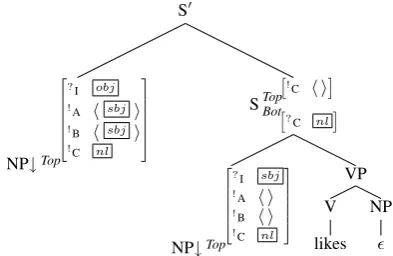
6) Finally, there is no need to stipulate any lex-ical ambiguity. Previous approaches required two separate lexical entries for each reflexive in order to handle special cases of ECM (Kallmeyer and Romero, 2007) or extraction (Ryant and Scheffler, 2006). ECM has been discussed above. As for ex-traction, (Himselfi, hei likes.), due to the inverted
c-command relation, it could previously (Ryant and Scheffler, 2006) only be handled by anad hoc lexical entry for the reflexive. In contrast, in the present analysis, object slots can simply be made to carry identical features in base (e.g. Fig. 5) and extraposed (Fig. 9) position. More generally, the notion of c-command plays no role in the present implementation. This is actually an advantage, given that c-command as classically defined is not empirically adequate for BT purposes (Pollard and Sag, 1992; Pollard and Sag, 1994), even less so in a system like LTAG which does not make D-Structure or LF available as additional levels on which c-command relationships could be checked.
S0
NP↓Top
2 6 6 6 6 6 6 4 ?
I obj
!
A h sbj i
!
B h sbj i
!
C nl
3 7 7 7 7 7 7 5
STop
h !
C h i
i
Both ?
C nli
NP↓Top
2 6 6 6 6 6 4 ?
I sbj
!
A h i
!
B h i
!
C nl
3 7 7 7 7 7 5
VP
V
likes NP
Figure 9: Transitive verb with extraposed object
8
Conclusion
The analysis presented in this paper implements binding conditions A, B, and C in LTAG. The non-local behavior of Condition C, as well as
mis-matches between the LTAG and BT local domains, do not align well with LTAG’s notion of locality. The solution adopted here addresses this problem by using feature unification to pass information across boundaries of elementary trees. Following Branco (2002), specification of binding constraints has been kept apart from anaphora resolution.
This solution achieves descriptive adequacy at the cost of stipulating a great number of features. Admittedly, this method does not restrict the range of crosslinguistic options very much. For exam-ple, it would be easy to write a nonsensical gram-mar in which reflexives must c-command (!) their antecedents. Future work might look for concise statements of the possible positions and values of the features used here. The feature lists might also provide the right kind of structure to define a notion analogous to HPSG’s o-command (Pollard and Sag, 1994). It appears promising to formulate such statements within a metagrammar framework (Kinyon et al., 2006).
Acknowledgements
I am grateful to the members of the XTAG group at Penn for helpful comments and discussion, and in particular to Josh Tauberer for proofreading. I also thank the anonymous TAG+9 reviewers for exten-sive feedback.
References
Branco, Ant´onio. 2002. Binding machines. Computa-tional Linguistics, 28:1–18.
B¨uring, Daniel. 2005. Binding theory. Cambridge University Press, Cambridge, UK.
Chomsky, Noam. 1981. Lectures on Government and Binding. Dordrecht: Foris.
Fong, Sandiway. 1990. Free indexation: Combinato-rial analysis and a compositional algorithm. In Pro-ceedings of the 28th annual meeting of the Associa-tion for ComputaAssocia-tional Linguistics (ACL’90), pages 105–110.
Frank, Robert and Anthony Kroch. 1995. Generalized transformations and the theory of grammar. Studia linguistica, 49:103–151.
Gardent, Claire and Laura Kallmeyer. 2003. Seman-tic construction in feature-based TAG. In Proceed-ings of the Tenth conference of the European Chap-ter of the Association for Computational Linguistics (EACL03), pages 123–130, Budapest.
Huang, C.-T. James. 1983. A note on the binding the-ory.Linguistic Inquiry, 14:554–561.
Jaeger, T. Florian. 2004. Binding in picture NPs revis-ited: Evidence for a semantic principle of extended argument-hood. In Butt, Miriam and Tracy Hol-loway King, editors,Proceedings of the Ninth Inter-national Conference on Lexical Functional Gram-mar (LFG04), Christchurch, New Zealand, pages 268–288, Stanford, CA. CSLI Publications.
Joshi, Aravind K., Laura Kallmeyer, and Maribel Romero. 2007. Flexible composition in LTAG: Quantifier scope and inverse linking. In Bunt, Harry, editor,Computing Meaning, volume 3, pages 233– 256. Springer.
Joshi, Aravind K. 2004. Starting with complex primi-tives pays off: Complicate locally, simplify globally.
Cognitive Science, 28:637–668.
Kallmeyer, Laura and Maribel Romero. 2004. LTAG semantics with semantic unification. InProceedings of the Seventh International Workshop on Tree Ad-joining Grammar and related formalisms (TAG+7), volume 155-162, Vancouver, BC.
Kallmeyer, Laura and Maribel Romero. 2007. Reflex-ives and reciprocals in LTAG. In Geertzen, Jeroen, Elias Thijsse, Harry Bunt, and Amanda Schiffrin, editors, Proceedings of the Seventh International Workshop on Computational Semantics (IWCS-7), pages 271–282, Tilburg.
Kallmeyer, Laura and Maribel Romero. 2008. Scope and situation binding in LTAG using semantic uni-fication. Reseach on Language and Computation, 6(1):3–52.
Kallmeyer, Laura and Tatjana Scheffler. 2004. LTAG analysis for pied-piping and stranding of wh-phrases. InProceedings of the Seventh International Workshop on Tree Adjoining Grammar and related formalisms (TAG+7), pages 32–39, Vancouver, BC.
Kamp, Hans and Uwe Reyle. 1993. From discourse to logic. Kluwer, Dordrecht.
Keller, Frank and Ash Asudeh. 2001. Constraints on linguistic coreference: structural vs. pragmatic fac-tors. In Erlbaum, Lawrence, editor,Proceedings of the 23rd annual conference of the Cognitive Science Society, Mahawa.
Kinyon, Alexandra, Owen Rambow, Tatjana Scheffler, Sinwon Yoon, and Aravind K. Joshi. 2006. The metagrammar goes multilingual: A crosslinguistic look at the V2-phenomenon. InProceedings of the
Eighth International Workshop on Tree Adjoining Grammar and related formalisms (TAG+8), Sydney.
Koller, Alexander and Joachim Niehren. 2000. On underspecified processing of dynamic semantics. In Proceedings of the the 18th International Con-ference on Computational Linguistics (COLING-2000), Saarbr¨ucken.
Marantz, Alec. 1984. On the nature of grammatical relations. MIT Press, Cambridge, MA.
Pesetsky, David. 1995. Zero syntax: Experiencers and cascades. MIT Press, Cambridge, MA.
Pollard, Carl and Ivan A. Sag. 1992. Anaphors in En-glish and the scope of binding theory. Linguistic In-quiry, 23:261–303.
Pollard, Carl and Ivan A. Sag. 1994. Head-driven Phrase Structure Grammar. University of Chicago Press.
Reinhart, Tanya and Eric Reuland. 1993. Reflexivity.
Linguistic Inquiry, 24(4):657–720.
Runner, Jeffrey T., Rachel S. Sussmann, and Michael K.Tanenhaus. 2002. Logophors in possessed pic-ture noun phrases. InProceedings of the 21st West Coast Conference on Formal Linguistics (WCCFL 21), pages 401–414.
Runner, Jeffrey T. 2003. Insights into binding and el-lipsis from head-mounted eye-tracking experiments. InProceedings of the Chicago Linguistic Society 39, Chicago, IL. Chicago Linguistic Society.
Ryant, Neville and Tatjana Scheffler. 2006. Binding of anaphora in LTAG. InProceedings of the Eighth International Workshop on Tree Adjoining Grammar and related formalisms (TAG+8), Sydney.
Steedman, Mark. 2000. Implications of binding for lexicalized grammars. In Abeill´e, Anne and Owen Rambow, editors, Tree adjoining grammars. CSLI Publications, Stanford.
Storoshenko, Dennis Ryan. 2006. Reconsidering rais-ing and experiencers in English. In Proceedings of the Eighth International Workshop on Tree Ad-joining Grammar and related formalisms (TAG+8), pages 159–164, Sydney. Association for Computa-tional Linguistics.
Vijay-Shanker, K. 1987. A study of Tree Adjoining Grammars. Ph.D. thesis, University of Pennsylva-nia.
Weir, David Jeremy. 1988. Characterizing mildly context-sensitive grammar formalisms. Ph.D. thesis, University of Pennsylvania.