Learning to Transform Linguistic Graphs
Valentin Jijkoun and Maarten de Rijke
ISLA, University of Amsterdam
Kruislaan 403, 1098 SJ Amsterdam, The Netherlands
jijkoun,[email protected]
Abstract
We argue in favor of the the use of la-beled directed graph to represent various types of linguistic structures, and illustrate how this allows one to view NLP tasks as graph transformations. We present a gen-eral method for learning such transforma-tions from an annotated corpus and de-scribe experiments with two applications of the method: identification of non-local depenencies (using Penn Treebank data) and semantic role labeling (using Propo-sition Bank data).
1 Introduction
Availability of linguistically annotated corpora such as the Penn Treebank (Bies et al., 1995), Proposition Bank (Palmer et al., 2005), and FrameNet (John-son et al., 2003) has stimulated much research on methods for automatic syntactic and semantic anysis of text. Rich annotations of corpora has al-lowed for the development of techniques for recov-ering deep linguistic structures: syntactic non-local dependencies (Johnson, 2002; Hockenmaier, 2003; Dienes, 2004; Jijkoun and de Rijke, 2004) and se-mantic arguments (Gildea, 2001; Pradhan et al., 2005; Toutanova et al., 2005; Giuglea and Moschitti, 2006). Most state-of-the-art methods for the latter two tasks use a cascaded architecture: they employ syntactic parsers and re-cast the corresponding tasks as pattern matching (Johnson, 2002) or classifica-tion (Pradhan et al., 2005) problems. Other
meth-ods (Jijkoun and de Rijke, 2004) use combinations of pattern matching and classification.
The method presented in this paper belongs to the latter category. Specifically, we propose (1) to use a flexible and expressive graph-based represen-tation of linguistic structures at different levels; and (2) to view NLP tasks as graph transformation prob-lems: namely, problems of transforming graphs of one type into graphs of another type. An exam-ple of such a transformation is adding a level of the predicate argument structure or semantic argu-ments to syntactically annotated sentences. Further-more, we describe a general method to automati-cally learn such transformations from annotated cor-pora. Our method combines pattern matching on graphs and machine learning (classification) and can be viewed as an extension of the Transformation-Based Learning paradigm (Brill, 1995). After de-scribing the method for learning graph transforma-tions we demonstrate its applicability on two tasks: identification of non-local dependencies (using Penn Treebank data) and semantic roles labeling (using Proposition Bank data).
The paper is organized as follows. In Section 2 we give our motivations for using graphs to encode linguistic data. In Section 3 we describe our method for learning graph transformations and in Section 4 we report on experiments with applications of our method. We conclude in Section 5.
2 Graphs for linguistic structures and language processing tasks
Trees and graphs are natural and common ways of encoding linguistic information, in particular,
VP
to seek NP
seats VP
planned S
directors S
NP−SBJ this month
NP−TMP
* NP−SBJ
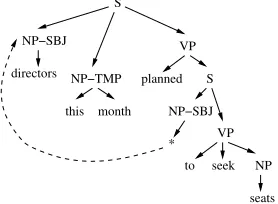
Figure 1: Local and non-local syntantic relations.
VP
using NP S
stopped Lorillard Inc
in
cigarette filters
NP in NP
1956 ARG0 head ARG1 ARGM
feature=TMP pred
crocidolite S
PP PP
NP VP
Figure 2: Syntactic structure and semantic roles.
tactic structures (phrase trees, dependency struc-tures). In this paper we use node- and edge-labeled directed graphs as our representational formalism. Figures 1 and 2 give informal examples of such rep-resentations.
Figure 1 shows a graph encoding of the Penn Treebank annotation of the local (solid edges) and non-local (dashed edges) syntantic structure of the sentencedirectors this month planned to seek more seats. In this example, the co-indexing-based im-plicit annotation of the non-local dependency (sub-ject control) in the Penn Treebank (Bies et al., 1995) is made explicit in the graph-based encoding.
Figure 2 shows a graph encoding of linguistic structures for the sentenceLorillard Inc stopped us-ing crocodolite in sigarette filters in 1956. Here, solid lines correspond to surface syntactic structure, produced by Charniak’s parser (Charniak, 2000), and dashed lines are an encoding of the Proposition Bank annotation of the semantic roles with respect to the verbstopped.
Graph-based representations allow for a uniform view on the linguistic structures on different layers. An advantage of such a uniform view is that ap-parently different NLP tasks can be considered as
VP
to seek NP
seats VP
planned S
directors S
this month NP
NP
Figure 3: Output of a syntactic parser.
manipulations with graphs, in other words, as graph transformation problems.
Consider the task of recovering non-local depen-dencies (such as control, WH-extraction, topicaliza-tion) in the surface syntactic phrase trees produced by the state-of-the-art parser of (Charniak, 2000). Figure 3 shows a graph-based encoding of the output of the parser, and the task in question would consist in transforming the graph in Figure 3 into the graph in Figure 1. We notice that this transformation can be realised as a sequence of independent and rela-tively simple graph transformations: adding nodes and edges to the graph or changing their labels (e.g., fromNPtoNP-SBJ).
Similarly, for the example in Figure 2, adding a semantic layer (dashed edges) to the syntactic struc-ture can also be seen as transforming a graph.
In general, we can view NLP tasks as adding ad-ditional linguistic information to text, based on the information already present: e.g., syntactic pars-ing takpars-ing part-of-speech tagged sentences as in-put (Collins, 1999), or anaphora resolution tak-ing sequences of syntactically analysed and named-entity-tagged sentences. If both input and output lin-guistic structures are encoded as graphs, such NLP tasks become graph transformation problems.
In the next section we describe our general method for learning graph transformations from an annotated corpus.
3 Learning graph transformations
directed edges and their attributes (labels). Con-stants used in the predicates representobjects(nodes and edges) of graphs, as well as attribute names and values. Atomic predicates node(·), edge(·,·,·) and
attr(·,·,·) define nodes, edges and their attributes. We refer to (Sch¨urr, 1997; Jijkoun, 2006) for formal definitions and only illustrate these concepts with an example. The following set of predicates:
node(n1),node(n2),edge(e, n1, n2),
attr(n1,label,Src),attr(n2,label,Dst)
defines a graph with two nodes, n1 and n2,
hav-ing labelsSrcandDst(encoded as attributes named
label), and an (unlabelled) edgeegoing fromn1 to
n2.
Apatternis an arbitrary graph and an occurence of a patternP in graphGis a total injective homo-morphismΩfromP toG, i.e., a mapping that asso-ciates each object ofP with one objectGand pre-serves the graph structure (relations between nodes, edges, attribute names and values). We will also use the termoccurenceto refer to the graphΩ(P), a sub-graph ofG, the image of the mappingΩonP.
A graph rewrite rule is a triple r =
hlhsr, Cr,rhsri: the left-hand side, the constraint
and the right-hand side ofr, respectively, wherelhsr
andrhsrare graphs andCris a function that returns
0 or 1 given a graphG, patternlhsrand its occurence
inG(i.e.,Crspecifies a constraint on occurences of a pattern in a graph).
To apply a rewrite rule r = hlhsr, Cr,rhsri to
a graph G means finding all occurences oflhsr in Gfor which Cr evaluates to 1, and replacing such
occurences oflhsrwith occurences ofrhsr.
Effec-tively, objects and relations present inlhsrbut not in rhsr will be removed fromG, objects and relations
inrhsrbut not inlhsrwill be added toG, and
com-mon objects and relations will remain intact. Again, we refer to (Jijkoun, 2006) for formal definitions.
As will be discussed below, our method for learn-ing graph transformations is based on the ability to compare pairs of graphs, identifying where the two graphs are similar and where they differ. An align-mentof two graphs is a partial one-to-one homomor-phism between their nodes and edges, such that if two edges of the two graphs are aligned, their re-spective endpoints are aligned as well. A maximal
alignmentof two graphs is an alignment that maxi-mizes the sum of (1) the number of aligned objects (nodes and edges), and (2) the number of match-ing attribute values of all aligned objects. In other words, a maximal alignment identifies as many sim-ilarities between two graphs as possible. Given an alignment of two graphs, it is possible to extract a list of rewrite rules that can transform one graph into another. For a maximal alignment such a list will consist of rules with the smallest possible left- and right-hand sides. See (Jijkoun, 2006) for details.
As stated above, we view NLP applications as graph transformation modules. Our supervised method for learning graph transformation requires two corpora: input graphsIn = {Ink} and
corre-sponding output graphsOut = {Outk}, such that Outk is the desired output of the NLP module on
the inputInk.
The result of the method is an ordered list of graph rewrite rulesR=hr1, . . . rni, that can be applied in
sequence to input graphs to produce the output of the NLP module.
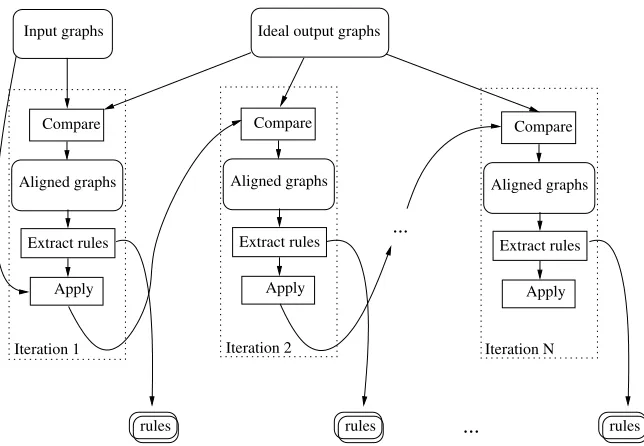
Our method for learning graph transforma-tions follows the structure of Transformation-Based Learning (Brill, 1995) and proceeds iteratively, as shown in Figure 4. At each iteration, we compare and align pairs of input and output graphs, identify possible rewrite rules and select rules with the most frequent left-hand sides. For each selected rewrite rule r, we extract all occurences of its left-hand side and use them to train a two-class classifier im-plementing the constraint Cr: the classifier, given an encoding of an occurence of the left-hand side predicts whether this particular occurence should be replaced with the corresponding right-hand side. When encoding an occurence as a feature vector, we add as features all paths and all attributes of nodes and edges in the one-edge neighborhood from the nodes of the occurence. For the experiments de-scribed in this paper we used the SVM Light classi-fier (Joachims, 1999) with a standard linear kernel. See (Jijkoun, 2006) for details.
4 Applications
Compare
Apply Extract rules Aligned graphs
Compare
Apply Extract rules Aligned graphs
rules rules rules
Ideal output graphs Input graphs
...
Iteration 1 Iteration 2 Iteration N
Compare
Apply Extract rules Aligned graphs
...
Figure 4: Structure of our method for learning graph transformations.
NLP problems: identification of non-local depen-dencies (with the Penn Treebank data) and semantic role labeling (with the Proposition Bank data).
4.1 Non-local dependencies
State-of-the-art statistical phrase structure parsers, e.g., Charniak’s and Collins’ parsers trained on the Penn Treebank, produce syntactic parse trees with bare phrase labels, (NP, PP, S, see Figure 3), i.e., providing surface grammatical analysis of sen-tences, even though the training corpus, the Penn Treebank, is richer and contains additional gram-matical and semantic information: it distinguishes various types of modifiers, complements, subjects, objects and annotates non-local dependencies, i.e., relations between phrases not adjacent in the parse tree (see Figure 1). The task of recovering this in-formation in the parser’s output has received a good deal of attention. (Campbell, 2004) presents a rule-based algorithm for empty node identification in syntactic trees, competitive with the machine learn-ing methods we mention next. In (Johnson, 2002) a simple pattern-matching algorithm was proposed for inserting empty nodes into syntactic trees, with patterns extracted from the Penn Treebank. (Dienes, 2004) used a preprocessor that identified surface lo-cation of empty nodes and a syntactic parser incor-porating non-local dependencies into its
probabilis-tic model. (Jijkoun and de Rijke, 2004) described an extension of the pattern-matching method with a classifier trained on the dependency graphs derived from the Penn Treebank data.
In order to apply our graph transformation method to the task of identifying non-local dependencies, we need to encode the information provided in the Penn Treebank annotations and in the output of a syntactic parser using directed labeled graphs. We used a straightforward encoding of syntactic trees, with nodes representing terminals and non-terminals and edges defining the parent-child relationship. For each node, we used the attribute type to specify whether it is a terminal or a non-terminal. Ter-minals corresponding to Penn empty nodes were marked with the attribute empty = 1. For each terminal (i.e., each word), the values of attributes
pos,wordandlemmaprovided the part-of-speech tag, the actual form and the lemma of the word. For non-terminals, the attribute label contained the la-bel of the corresponding syntactic phrase. The co-indexing of empty nodes and non-terminals used in the Penn Treebank to annotate non-local dependen-cies was encoded using explicit edges with a distinct
corre-sponding parent-child edge, and the lexical head of each non-terminal was explicitly indicated using ad-ditional edges with the attributetype =lexhead. We used a heuristic method of (Collins, 1999) for head identification.
When Penn Treebank sentences and the output of the parser are encoded as directed labeled graphs as described above, the task of identifying non-local dependencies can be formulated as transform-ing phrase structure graphs produced by a parser into graphs of the type used in Penn Treebank annota-tions.
We parsed the strings of the Penn Treebank with Charniak’s parser and then used the data from sec-tions 02–21 of the Penn Treebank for training: en-coding of the parser’s output was used as the cor-pus of input graphs for our learning method, and the encoding of the original Penn annotations was used as the corpus of output graphs. Similarly, we used the data of sections 00–01 for development and section 23 for testing. Using the input and output corpora, we ran the learning method as described above, at each iteration considering 20 most frequent left-hand sides of rewrite rules. At each iteration, the learned rewrite rules were applied to the current training and development corpora to create a cor-pus of input graphs for the next iteration (see Fig-ure 4) and to estimate the performance of the system at the current iteration. The system was evaluated on the development corpus with respect to non-local dependencies using the “strict” evaluation measure of (Johnson, 2002): the F1 score of precision and
recall of correctly identified empty nodes and an-tecedents. If the absolute improvement of the F1
score for the evaluation measure was smaller than
0.1, the learning cycle was terminated, otherwise a new iteration was started.
The learning cycle terminated after 12 iterations. The resulting sequence of 12 × 20 = 240 graph rewrite rules was applied to the test corpus of in-put graphs: Charniak’s parser outin-put on the strings of section 23 of the Penn Treebank. The result was evaluated against the original annotations of the Penn Treebank.
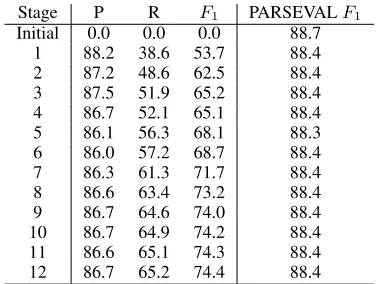
The results of the evaluation of the system on empty nodes and non-local dependencies and the PARSEVAL F1 score on local syntactic phrase
structure against the test corpus at each iteration are
Stage P R F1 PARSEVALF1 Initial 0.0 0.0 0.0 88.7
1 88.2 38.6 53.7 88.4
2 87.2 48.6 62.5 88.4
3 87.5 51.9 65.2 88.4
4 86.7 52.1 65.1 88.4
5 86.1 56.3 68.1 88.3
6 86.0 57.2 68.7 88.4
7 86.3 61.3 71.7 88.4
8 86.6 63.4 73.2 88.4
9 86.7 64.6 74.0 88.4
10 86.7 64.9 74.2 88.4
11 86.6 65.1 74.3 88.4
12 86.7 65.2 74.4 88.4
Table 1: Evaluation of our method for identification of empty nodes and their antecedents (12 first itera-tions).
shown in Table 1.
As one can expect, at each iteration the method extracts graph rewrite rules that introduce empty nodes and non-local relations into syntactic struc-tures, increasing the recall. The performance of the final system (P/R/F1 = 86.7/65.2/74.4) for the task
of identifying non-local dependencies is compara-ble to the performance of the best model of (Di-enes, 2004): P/R/F1=82.5/70.1/75.8. The
PARSE-VAL score for the present system (88.4) is, however, higher than the 87.3 for the system of Dienes.
Another effect of the learned transformations is changing node labels of non-terminals, specifically, modifying labels to include Penn functional tags (e.g., changingNPin the input graph in Figure 3 to
NP-SBJin the output graph in Figure 1). In fact, 17% of all learned rewrite rules involved only changing labels of non-terminal nodes. Analysis of the results showed that the system is capable of assigning Penn function tags to constituents produced by Charniak’s parser with F1 = 91.4 (we use here the
evalua-tion measure of (Blaheta, 2004): theF1 score of the
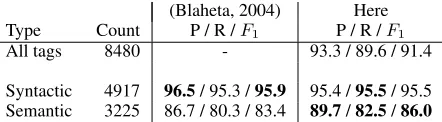
precision and recall for assigning function tags to constituents with surface spans correctly identified by Charniak’s parser). Comparison to the evalua-tion results of the funcevalua-tion tagging method presented in (Blaheta, 2004) is shown in Table 2.
The present system outperforms the system of Blaheta on semantic tags such as -TMP or -MNR
(Blaheta, 2004) Here Type Count P / R /F1 P / R /F1 All tags 8480 - 93.3 / 89.6 / 91.4 Syntactic 4917 96.5/ 95.3 /95.9 95.4 /95.5/ 95.5 Semantic 3225 86.7 / 80.3 / 83.4 89.7/82.5/86.0
Table 2: Evaluation of adding Penn Treebank func-tion tags.
respectively. Note that the present method was not specifically designed to add functional tags to con-stituent labels. The method is not even “aware” that functional tags exists: it simply treatsNPandNP-SBJ
as different labels and tries to correct labels compar-ing input and output graphs in the traincompar-ing corpora.
In general, of the 240 graph rewrite rules ex-tracted during the 12 iterations of the method, 25% involved only one graph node in the left-hand side, 16% two nodes, 12% three nodes, etc. The two most complicated extracted rewrite rules involved left-hand sides with ten nodes.
We now switch to the second application of our graph transformation method.
4.2 Semantic role labeling
Put very broadly, the task of semantic role labeling consists in detecting and labeling simple predicates: Who did what to whom, where, when, how, why, etc. There is no single definition of a universal set of semantic roles and moreover, different NLP appli-cations may require different specificity of role la-bels. In this section we apply the graph transforma-tion method to the task of identificatransforma-tion of semantic roles as annotated in the Proposition Bank (Palmer et al., 2005), PropBank for short. In PropBank, for all verbs (except copular) of the syntactically anno-tated sentences of the Wall Street Journal section of the Penn Treebank, semantic arguments are marked using references to the syntactic constituents of the Penn Treebank. For the 49,208 syntactically anno-tated sentences of the Penn Treebank, the PropBank annotated 112,917 verb predicates (2.3 predicates per sentence on average), with a total of 292,815 se-mantic arguments (2.6 arguments per predicate on average).
PropBank does not aim at cross-verb semantically consistent labeling of arguments, but rather at anno-tating the different ways arguments of a verb can
be realized syntactically in the corpus, which re-sulted in the choice of theory-neutral numbered la-bels (e.g.,Arg0, Arg1,etc.) for semantic arguments. Figure 2 shows an example of a PropBank annota-tion (dashed edges).
In this section we address a specific NLP task: identifying and labeling semantic arguments in the output of a syntactic parser. For the example in Figure 2 this task corresponds to adding “semantic” nodes and edges to the syntactic tree.
As before, in order to apply our graph transfor-mation method, we need to encode the available in-formation using graphs. Our encoding of syntactic phrase structure is the same as in Section 4.1 and the encoding of the semantic annotations of PropBank is straightforward. For each PropBank predicate, a new node with attributestype=propbankandlabel= predis added. Another node withlabel =headand nodes for all semantic arguments of the predicate (with labels indicating PropBank argument names) are added and connected to the predicate node. Ar-gument nodes with labelARGM (adjunct) addition-ally have a feature attribute with valuesTMP, LOC, etc., as specified in PropBank. The head node and all argument nodes are linked to their respective syn-tactic constituents, as specified in the PropBank an-notation. All introduced semantic edges are marked with the attributetype=propbank.
As before, we used section 02–21 of the Prop-Bank (which annotates the same text as the Penn Treebank) to train our graph transformation system, section 00-01 for development and section 23 for testing. We ran three experiments, taking three dif-ferent corpora of input graphs:
1. the original syntactic structures of the Penn Treebank containing function tags, empty nodes, non-local dependencies, etc.;
2. the output of Charniak’s parser (i.e., bare syn-tactic trees) on the strings of sections 02–21; and
3. the output of Charniak’s parser processed with the graph transformation system described in 4.1.
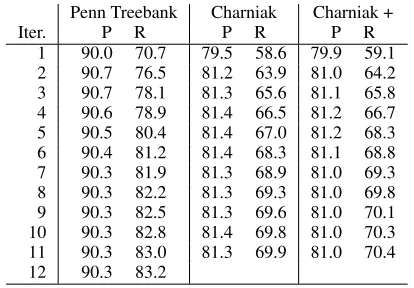
Penn Treebank Charniak Charniak +
Iter. P R P R P R
1 90.0 70.7 79.5 58.6 79.9 59.1 2 90.7 76.5 81.2 63.9 81.0 64.2 3 90.7 78.1 81.3 65.6 81.1 65.8 4 90.6 78.9 81.4 66.5 81.2 66.7 5 90.5 80.4 81.4 67.0 81.2 68.3 6 90.4 81.2 81.4 68.3 81.1 68.8 7 90.3 81.9 81.3 68.9 81.0 69.3 8 90.3 82.2 81.3 69.3 81.0 69.8 9 90.3 82.5 81.3 69.6 81.0 70.1 10 90.3 82.8 81.4 69.8 81.0 70.3 11 90.3 83.0 81.3 69.9 81.0 70.4 12 90.3 83.2
Table 3: Evaluation of our method for semantic role identification with Propbank: with Charniak parses and with parses processed by the system of Sec-tion 4.1.
Penn Treebank and PropBank as the corpora of out-put graphs (for the experiment with bare Charniak parses, we dropped function tags, empty nodes and non-local dependencies from the syntactic annota-tion of the output graphs: we did not want our sys-tem to start recovering these annotations, but were interested in the identification of PropBank informa-tion alone).
For each of the experiments, we used the corpora of input and output graphs as before, at each itera-tion extracting 20 rewrite rules with most frequent left-hand sides, applying the rules to the develop-ment data to measure the current performance of the system. We stopped the learning in case the perfor-mance improvement was less than a threshold and, otherwise, continued the learning loop. As our per-formance measure we used theF1score of precision
and recall of the correctly identified and labeled non-empty constituents—semantic arguments.
In all experiments, the learning stopped after 11 or 12 iterations. The results of the evaluation of the system at each iteration on the test section of Prop-Bank are shown in Table 3.
As one may expect, the performance of our se-mantic role labeler is substantially higher on the gold Penn Treebank syntactic structures than on the parser’s output. Surprisingly, however, adding extra information to the parser’s output (i.e., processing it with the system of Section 4.1) does not significantly improve the performance of the resulting system.
In Table 4 we compare our system for semantic
System P R F1
(Pradhan et al., 2005) 80.9 76.8 78.8
Here 81.0 70.4 75.3
Table 4: Evaluation of our methods for semantic role identification with Propbank (12 first iterations).
roles labeling with the output of Charniak’s parser to the state-of-the-art system of (Pradhan et al., 2005). While showing good precision, our system per-forms worse than state-of-the-art with respect to re-call. Taking into account the iterative nature of the method and imperfect rule selection criteria (we simply take the most frequent left-hand sides), we believe that it is the rule selection and learning termi-nation condition that account for the relatively low recall values. Indeed, in all three experiments de-scribed above the learning loop stops while the recall is still on the rise, albeit very slowly. It seems that a more careful rule selection mechanism and loop termination criteria are needed to address the recall problem.
5 Conclusions
In this paper we argued that encoding diverse and complex linguistic structures as directed labeled graphs allows one to view many NLP tasks as graph transformation problems. We proposed a general method for learning graph transformation from an-notated corpora and described experiments with two NLP applications.
to see how the details of encoding linguistic in-formation in graphs affect the performance of the method.
Acknowledgements
This research was supported by the Netherlands Organization for Scientific Research (NWO) un-der project numbers 017.001.190, 220-80-001, 264-70-050, 354-20-005, 600.065.120, 612-13-001, 612.000.106, 612.066.302, 612.069.006, 640.001.501, 640.002.501, and by the E.U. IST programme of the 6th FP for RTD under project MultiMATCH contract IST-033104.
References
Ann Bies, Mark Ferguson, Karen Katz, and Robert Mac-Intyre. 1995. Bracketing guidelines for Treebank II style Penn Treebank project. Technical report, Uni-versity of Pennsylvania.
Don Blaheta. 2004. Function Tagging. Ph.D. thesis, Brown University.
Eric Brill. 1995. Transformation-based error-driven learning and natural language processing: A case study in part-of-speech tagging. Computational Lin-guistics, 21(4):543–565.
Richard Campbell. 2004. Using linguistic principles to recover empty categories. In Proceedings of the 42nd Annual Meeting on Association for Computa-tional Linguistics, pages 645–653.
Eugene Charniak. 2000. A maximum-entropy-inspired parser. InProceedings of the 1st Meeting of NAACL, pages 132–139.
Michael Collins. 1999. Head-Driven Statistical Models
for Natural Language Parsing. Ph.D. thesis,
Univer-sity of Pennsylvania.
Diane J. Cook and Lawrence B. Holder. 2000.
Graph-based data mining. IEEE Intelligent Systems, 15(2):32–41.
P´eter Dienes. 2004. Statistical Parsing with Non-local Dependencies. Ph.D. thesis, Universit¨at des Saarlan-des, Saarbr¨ucken, Germany.
Daniel Gildea. 2001. Statistical Language
Understand-ing UsUnderstand-ing Frame Semantics. Ph.D. thesis, University
of California, Berkeley.
Ana-Maria Giuglea and Alessandro Moschitti. 2006. Se-mantic role labeling via framenet, verbnet and prop-bank. In Proceedings of the 21st International Con-ference on Computational Linguistics and 44th Annual Meeting of the Association for Computational Linguis-tics, pages 929–936.
Julia Hockenmaier. 2003. Parsing with generative mod-els of predicate-argument structure. InProceedings of the 41st Meeting of ACL, pages 359–366.
Valentin Jijkoun and Maarten de Rijke. 2004. Enrich-ing the output of a parser usEnrich-ing memory-based learn-ing. InProceedings of the 42nd Meeting of the Asso-ciation for Computational Linguistics (ACL’04), Main Volume, pages 311–318, Barcelona, Spain, July.
Valentin Jijkoun. 2006. Graph Transformations for Nat-ural Language Processing. Ph.D. thesis, University of Amsterdam.
Thorsten Joachims. 1999. Making large-scale svm
learning practical. In B. Sch¨olkopf, C. Burges, and A. Smola, editors,Advances in Kernel Methods - Sup-port Vector Learning. MIT-Press.
Christopher R. Johnson, Miriam R. L. Petruck, Collin F. Baker, Michael Ellsworth, Josef Ruppenhofer, and Charles J. Fillmore. 2003. FrameNet: Theory and
Practice. http://www.icsi.berkeley.edu/
∼framenet.
Mark Johnson. 2002. A simple pattern-matching
al-gorithm for recovering empty nodes and their an-tecedents. InProceedings of the 40th meeting of ACL, pages 136–143.
Martha Palmer, Daniel Gildea, and Paul Kingsbury. 2005. The proposition bank: An annotated corpus of semantic roles.Computational Linguistics, 31(1).
Sameer Pradhan, Wayne Ward, Kadri Hacioglu, Jim Mar-tin, and Dan Jurafsky. 2005. Semantic role label-ing uslabel-ing different syntactic views. InProceedings of
ACL-2005.
A. Sch¨urr. 1997. Programmed graph replacement
sys-tems. In Grzegorz Rozenberg, editor, Handbook of
Graph Grammars and Computing by Graph Transfor-mation, chapter 7, pages 479–546.
Kristina Toutanova, Aria Haghighi, and Chris Manning. 2005. Joint learning improves semantic role labeling. InProceedings of the 43rd Meeting of the Association for Computational Linguistics (ACL).
Xifeng Yan and Jiawei Han. 2002. gspan: Graph-based substructure pattern mining. In Proceedings of the 2002 IEEE International Conference on Data Mining