Proceedings of the Workshop on Cognitive Aspects of Computational Language Acquisition, pages 89–96,
Learning to interpret novel noun-noun compounds: evidence from a
category learning experiment
Barry Devereux & Fintan Costello
School of Computer Science and Informatics, University College Dublin, Belfield, Dublin 4,IRELAND
{barry.devereux, fintan.costello}@ucd.ie
Abstract
The ability to correctly interpret and pro-duce noun-noun compounds such as WIND FARMorCARBON TAX is an important part
of the acquisition of language in various do-mains of discourse. One approach to the interpretation of noun-noun compounds as-sumes that people make use of distributional information about how the constituent words of compounds tend to combine; another as-sumes that people make use of information about the two constituent concepts’ features to produce interpretations. We present an ex-periment that examines how people acquire both the distributional information and con-ceptual information relevant to compound interpretation. A plausible model of the in-terpretation process is also presented.
1 Introduction
People frequently encounter noun-noun compounds such as MEMORY STICK and AUCTION POLITICS
in everyday discourse. Compounds are particu-larly interesting from a language-acquisition per-spective: children as young as two can comprehend and produce noun-noun compounds (Clark & Bar-ron, 1988), and these compounds play an important role in adult acquisition of the new language and ter-minology associated with particular domains of dis-course. Indeed, most new terms entering the English language are combinations of existing words (Can-non, 1987; considerFLASH MOB,DESIGNER BABY, SPEED DATINGandCARBON FOOTPRINT).
These noun-noun compounds are also interest-ing from a computational perspective, in that they pose a significant challenge for current computa-tional accounts of language. This challenge arises
from the fact that the semantics of noun-noun com-pounds are extremely diverse, with comcom-pounds uti-lizing many different relations between their con-stituent words (consider the examples at the end of the previous paragraph). Despite this diversity, peo-ple typically interpret even compeo-pletely novel com-pounds extremely quickly, in the order of hundredths of seconds in reaction time studies.
One approach that has been taken in both cog-nitive psychology and computational linguistics can be termed the relation-based approach (e.g. Gagn´e & Shoben, 1997; Kim & Baldwin, 2005). In this approach, the interpretation of a compound is rep-resented as the instantiation of a relational link be-tween the modifier and head noun of the compound. Such relations are usually represented as a set of taxonomic categories; for example the meaning of
STUDENT LOANmight be specified with aPOSSES
-SORrelation (Kim & Baldwin, 2005) orMILK COW
might be specified by a MAKES relation (Gagn´e & Shoben, 1997). However, researchers are not close to any agreement on a taxonomy of relation cate-gories classifying noun-noun compounds; indeed a wide range of typologies have been proposed (e.g. Levi, 1977; Kim & Baldwin, 2005).
In these relation-based approaches, there is often little focus on how the meaning of the relation inter-acts with the intrinsic properties of the constituent concepts. Instead, extrinsic information about con-cepts, such as distributional information about how often different relations are associated with a con-cept, is used. For example, Gagn´e & Shoben’s CARIN model utilizes the fact that the modifier
MOUNTAIN is frequently associated with the LO
trinsic properties such asis largeandis a geological feature: features which may in general precipitate theLOCATIONrelation.
An approach that is more typical of psycholog-ical theories of compound comprehension can be termed the concept-based approach (Wisniewski, 1997; Costello and Keane, 2000). With such the-ories, the focus is on the intrinsic properties of the constituent concepts, and the interpretation of a compound is usually represented as a modification of the head noun concept. So, for example, the com-pound ZEBRA FISH may involve a modification of the FISH concept, by asserting a feature of the ZE -BRAconcept (e.g. has stripes) for it; in this way, a
ZEBRA FISHcan be understood as a fish with stripes. Concept-based theories do not typically use distrib-utional information about how various relations are likely to be used with concepts.
The information assumed relevant to compound interpretation is therefore quite different in relation-based and concept-relation-based theories. However, neither approach typically deals with the issue of how peo-ple acquire the information that allows them to in-terpret compounds. In the case of the relation-based approaches, for example, how do people acquire the knowledge that the modifier MOUNTAIN tends to be used frequently with the LOCATED relation and that this information is important in comprehend-ing compounds with that modifier? In the case of concept-based approaches, how do people acquire the knowledge that features of ZEBRA are likely to
influence the interpretation ofZEBRA FISH?
This paper presents an experiment which exam-ines how both distributional information about re-lations and intrinsic information about concept fea-tures influence compound interpretation. We also address the question of how such information is ac-quired. Rather than use existing, real world con-cepts, our experiment used laboratory generated concepts that participants were required to learn dur-ing the experiment. As well as learndur-ing the meandur-ing of these concepts, participants also built up knowl-edge during the experiment about how these con-cepts tend to combine with other concon-cepts via re-lational links. Using laboratory-controlled concepts allows us to measure and control various factors that might be expected to influence compound compre-hension; for example, concepts can be designed to
vary in their degree of similarity to one another, to be associated with potential relations with a certain degree of frequency, or to have a feature which is associated with a particular relation. It would be ex-tremely difficult to control for such factors, or in-vestigate the aquisition process, using natural, real world concepts.
2 Experiment
Our experiment follows a category learning para-digm popular in the classification literature (Medin & Shaffer, 1978; Nosofsky, 1984). The experiment consists of two phases, a training phase followed by a transfer phase. In the training phase, partic-ipants learned to identify several laboratory gener-ated categories by examining instances of these cat-egories that were presented to them. These cate-gories were of two types, conceptual and relational. The conceptual categories consisted of four “plant” categories and four “beetle” categories, which par-ticipants learned to distinguish by attending to dif-ferences between category instances. The relational categories were three different ways in which a bee-tle could eat a plant. Each stimulus consisted of a picture of a beetle instance and a picture of a plant instance, with a relation occurring between them. The category learning phase of our experi-ment therefore has three stages: one for learning to distinguish between the four beetle categories, one for learning to distinguish between the four plant categories, and one for learning to distinguish be-tween the three relation categories.
pairs of category names (rather than pairs of cat-egory items), presented as noun-noun compounds, and were asked to rate the appropriateness of each relation for each compound.
In the experiment, we aim to investigate three is-sues that may be important in determining the most appropriate interpretation for a compound. Firstly, the experiment aims to investigate the influence of concept salience (i.e. how important to participants information about the two constituent concepts are, or how relevant to finding a relation that information is) on the interpretation of compounds. For example, if the two concepts referenced in a compound are identical with respect to the complexity of their rep-resentation, how well they are associated with vari-ous alternative relations (and so on), but are of dif-fering levels of animacy, we might expect the rela-tion associated with the more animate concept to be selected by participants more often than a different relation associated equally strongly with the less an-imate concept. In our experiment, all three relations involve a beetle eating a plant. Since in each case the beetle is the agent in theEATS(BEETLE,PLANT) sce-nario, it is possible that the semantics of the beetle concepts might be more relevant to relation selection than the semantics of the plant concepts.
Secondly, the experiment is designed to inves-tigate the effect of the ordering of the two nouns within the compound: given two categories named
A and B, our experiment investigates whether the compound “A B” is interpreted in the same way as the compound “B A”. In particular, we were in-terested in whether the relation selected for a com-pound would tend to be dependent on the concept in the head position or the concept in the modifier posi-tion. Also of interest was whether the location of the more animate concept in the compound would have an effect on interpretation. For example, since the combined concept is an instance of the head concept, we might hypothesize that compounds for which the head concept is more animate than the modifier con-cept may be easier to interpret correctly.
Finally, were interested in the effect of concept similarity: would compounds consisting of similar constituent categories tend to be interpreted in simi-lar ways?
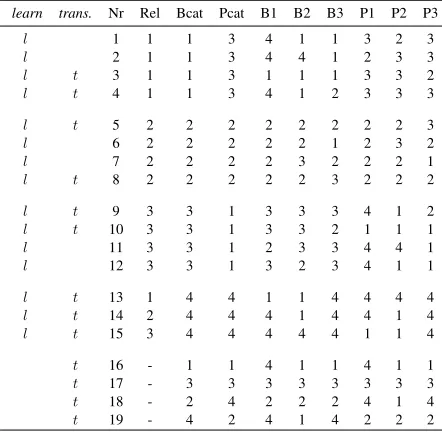
learn trans. Nr Rel Bcat Pcat B1 B2 B3 P1 P2 P3
l 1 1 1 3 4 1 1 3 2 3
l 2 1 1 3 4 4 1 2 3 3
l t 3 1 1 3 1 1 1 3 3 2
l t 4 1 1 3 4 1 2 3 3 3
l t 5 2 2 2 2 2 2 2 2 3
l 6 2 2 2 2 2 1 2 3 2
l 7 2 2 2 2 3 2 2 2 1
l t 8 2 2 2 2 2 3 2 2 2
l t 9 3 3 1 3 3 3 4 1 2
l t 10 3 3 1 3 3 2 1 1 1
l 11 3 3 1 2 3 3 4 4 1
l 12 3 3 1 3 2 3 4 1 1
l t 13 1 4 4 1 1 4 4 4 4
l t 14 2 4 4 4 1 4 4 1 4
l t 15 3 4 4 4 4 4 1 1 4
t 16 - 1 1 4 1 1 4 1 1
t 17 - 3 3 3 3 3 3 3 3
t 18 - 2 4 2 2 2 4 1 4
[image:3.612.315.536.72.288.2]t 19 - 4 2 4 1 4 2 2 2
Table 1: The experiment’s abstract category struc-ture
2.1 Method
2.1.1 Participants
The participants were 42 university students.
2.1.2 Materials
The abstract category structure used in the exper-iment is presented in Table 1. There are 19 items in total; the first and second columns in the table indicate if the item in question was one of the 15 items used in the learning phase of the experiment (l) or as one of the 13 items used in the transfer stage of the experiment (t). There were four beetle cate-gories (Bcat), four plant catecate-gories (Pcat) and three relation categories used in the experiment. Both the beetle and plant categories were represented by fea-tures instantiated on three dimensions (B1, B2 & B3 and P1, P2 & P3, respectively). The beetle and plant categories were identical with respect to their ab-stract structure (so, for example, the four exemplars of Pcat1 have the same abstract features as the four exemplars of Bcat1).
instances of these categories in the learning phase appeared once with each of the three relations. The features of beetles and plants were sometimes diag-nostic of a category (much as the featurehas three wheelsis diagnostic forTRICYCLE); for example, a particular feature associated with Bcat1 is a 1 on the B3 dimension: 3 of the 4 Bcat1 training phase exem-plars have a 1 on dimension B3 while only one of the remaining 11 training phase exemplars do. Also, the intrinsic features of beetles and plants are sometimes diagnostic of a relation category (much as the intrin-sic featurehas a flat surface raised off the groundis diagnostic for the relational scenariosit on); values on dimensions B1, P1, B2 and P2 are quite diag-nostic of relations. Participants learned to identify the plant, beetle and relation categories used in the experiment by attending to the associations between beetle, plant and relation categories and feature di-agnosticity for those categories.
The beetle and plant categories were also de-signed to differ in terms of their similarity. For ex-ample, categories Bcat1 and Bcat4 are more simi-lar to each other than Bcat3 and Bcat4 are: the fea-tures for Bcat1 and Bcat4 overlap to a greater extent than the features for Bcat3 and Bcat4 do. The aim of varying categories with respect to their similarity was to investigate whether similar categories would yield similar patterns of relation likelihood ratings. In particular, Bcat4 (and Pcat4) occurs equally often with the three relations; therefore if category simi-larity has no effect we would expect people to select each of the relations equally often for this category. However, if similarity influences participants’ rela-tion selecrela-tion, then we would expect that Relarela-tion 1 would be selected more often than Relations 2 or 3.
The abstract category structure was mapped to concrete features in a way that was unique for each participant. Each beetle dimension was mapped ran-domly to the concrete dimensions of beetle shell color, shell pattern and facial expression. Each plant dimension was randomly mapped to the concrete di-mensions of leaf color, leaf shape, and stem color. The three relations were randomly mapped to eats from leaf,eats from top, andeats from trunk.
2.1.3 Procedure
[image:4.612.320.542.73.215.2]The experiment consisted of a training phase and a transfer phase. The training phase itself consisted
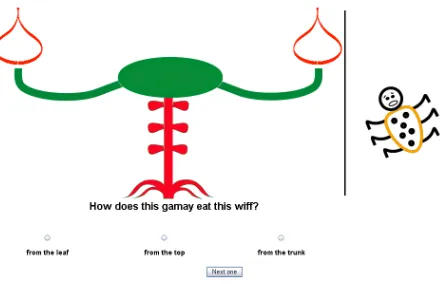
Figure 1: Example of a relation learning stimulus
of three sub-stages in which participants learned to distinguish between the plant, beetle and relation categories. During each training sub-stage, the 15 training items were presented to participants sequen-tially on a web-page in a random order. Underneath each item, participants were presented with a ques-tion of the form “What kind of plant is seen in this picture?”, “What type of beetle is seen in this pic-ture?” and “How does thishBcatieat thishP cati?” in the plant learning, beetle learning, and relation learning training sub-stages, respectively (e.g. Fig-ure 1). Underneath the question were radio but-tons on which participants could select what they believed to be the correct category; after participants had made their selection, they were given feedback about whether their guess had been correct (with the correct eating relation shown taking place). Each of the three substages was repeated until participants had correctly classified 75% or more of the items. Once they had successfully completed the training phase they moved on to the transfer phase.
The transfer phase consisted of two stages, an exemplar transfer stage and a compound transfer stage. In the exemplar transfer stage, participants were presented with 13 beetle-plant items, some of which had appeared in training and some of which were new items (see Table 1). Underneath each picture was a question of the form “How does this
hBcati eat this hP cati?” and three 5-point scales for the three relations, ranging from 0 (unlikely) to 4 (likely).
compounds consisting of a beetle and plant category label. Participants were presented with a sentence of the form “There are a lot ofhP cati hBcatis around at the moment.” and were asked “What kind of eat-ing activity would you expect a hP cati hBcati to have?”. Underneath, participants rated the likeli-hood of each of the three relations on 5-point scales. One half of participants were presented with the compounds in the form “hBcati hP cati” whereas the other half of participants saw the compounds in the form “hP cati hBcati”.
2.2 Results
2.2.1 Performance during training
Two of the participants failed to complete the training phase. For the remaining 40 participants, successful learning took on average 5.8 iterations of the training items for the plant categories, 3.9 itera-tions for the beetle categories, and 2.1 iteraitera-tions for the relation categories. The participants therefore learned to distinguish between the categories quite quickly, which is consistent with the fact that the cat-egories were designed to be quite easy to learn.
2.2.2 Performance during the exemplar transfer stage
Participants’ mean ratings of relation likelihood for the nine previously seen exemplar items is pre-sented in Figure 2 (items 3 to 15). For each of these items there was a correct relation, namely the one that the item was associated with during training. The difference between the mean response for the correct relation (M = 2.76) and the mean response for the two incorrect relations (M = 1.42) was sig-nificant (ts(39) = 7.50, p < .01; ti(8) = 4.07,
p < .01). These results suggest that participants were able to learn which relations tended to co-occur with the items in the training phase.
[image:5.612.315.544.72.179.2]Participants’ mean ratings of relation likelihood for the four exemplar items not previously seen in training are also presented in Figure 2 (items 16 to 19). Each of these four items consisted of a proto-typical example of each of the four beetle categories and each of the four plant categories (with each bee-tle and plant category appearing once; see Table 1 for details). For these four items there was no cor-rect answer; indeed, the relation consistent with the beetle exemplar was always different to the relation
Figure 2: Participants’ mean responses for the ex-emplar transfer items.
suggested by the plant exemplar. For each trial, then, one relation is consistent with the beetle exemplar (rb), one is consistent with the plant exemplar (rp)
and one is neutral (rn). One-way repeated measures
ANOVAs with response type (rb,rporrn) as a fixed
factor and either subject or item as a random factor were used to investigate the data. There was a signif-icant effect of response type in both the by-subjects and by-items analysis (Fs(2,39) = 19.10,p < .01;
Fi(2,3) = 24.14, p < .01). Pairwise differences
be-tween the three response types were investigated us-ing planned comparisons in both the by-subject and by-items analyses (with paired t-tests used in both cases). The difference between participants’ mean response for the relation associated with the beetle exemplar,rb (M = 2.68), and their mean response
for the neutral relation, rn (M = 1.44) was
sig-nificant (ts(39) = 5.63, p < .001; ti(3) = 5.34,
p = .01). These results suggest that participants were strongly influenced by the beetle exemplar when making their category judgments. However, the difference between participants’ mean response for the relation associated with the plant exemplar,
rp (M = 1.62), and their mean response for the
neutral relation was not significant (ts(39) = 1.11,
p = .27; ti(3) = 0.97, p = .40). These
re-sults suggest that participants were not influenced by the plant exemplar when judging relation like-lihood. Since the beetle and plant categories have identical abstract structure, these results suggest that other factors (such as the animacy of a concept or the role it plays in the relation) are important to interpre-tation.
cat-egory similarity, a repeated measures ANOVA with beetle category and response relation taken as within subject factors and subject taken as a random fac-tor was undertaken. There was a significant effect of the category that the beetle exemplar belonged to on participants’ responses for the three relations (the interaction between beetle category and response re-lation was significant;F(6,39) = 26.83,p < .01. Planned pairwise comparisons (pairedt-tests) were conducted to investigate how ratings for the cor-rect relation (i.e. the relation consistent with train-ing) differed for the ratings for the other two rela-tions. For Bcat1, Bcat2 and Bcat3, the ratings for the relation consistent with learning was higher than the two alternative relations (p < .01in all cases). However, for the Bcat4 items, there was no evi-dence that participants we more likely to rate Re-lation 1 (M = 2.09) higher than either Relation 2 (M = 1.97; t(39) = 0.54, p = .59) or Relation 3 (M = 1.91; t(39) = 0.69, p > .50). Though the difference is in the direction predicted by Bcat4’s similarity to Bcat1, there is no evidence that partici-pants made use of Bcat4’s similarity to Bcat1 when rating relation likelihood for Bcat4.
In summary, the results suggest that participants were capable of learning the training items. Partici-pants appeared to be influenced by the beetle exem-plar but not the plant exemexem-plar. There was some evi-dence that conceptual similarity played a role in par-ticipants’ judgments of relation likelihood for Bcat4 exemplars (e.g. the responses for item 19) but over all Bcat4 exemplars this effect was not significant.
2.2.3 Performance on the noun-noun compound transfer stage
In the noun-noun compound transfer stage, each participant rated relation likelihood for each of the 16 possible noun-noun compounds that could be formed from combinations of the beetle and plant category names. Category name order was a be-tween subject factor: half of the participants saw the compounds with beetle in the modifier position and plant in the head position whilst the other half of participants saw the reverse. First of all, we were interested in whether or not the training on exem-plar items would transfer to noun-noun compounds. Another question of interest is whether or not par-ticipants’ responses would be affected by the order
in which the categories were presented. For exam-ple, perhaps it is the concept in the modifier position that is most influential in determining the likelihood of different relations for a compound. Alternatively perhaps it is the concept in the head position that is most influential.
To answer such questions a4×4×3×2repeated measures ANOVA with beetle category, plant cate-gory and response relation as within subject factors and category label ordering as a between subject fac-tor was used to analyze the data. The interaction between beetle category and response relation was significant (F(6,38) = 59.79, p < .001). There-fore, the beetle category present in the compound tended to influence participants’ relation selections. The interaction between plant category and response relation was weaker, but still significant (F(6,38) = 5.35, p < 0.01). Therefore, the plant category present in the compound tended to influence partic-ipants’ relation selections. These results answer the first question above; training on exemplar items was transferred to the noun-noun compounds. However, there were no other significant interactions found. In particular, the interaction between category order-ing, beetle category and response relation was not significant (F(6,38) = 1.82, p = .09). In other words, there is no evidence that the influence of bee-tle category on participants’ relation selections when the beetle was in the modifier position differed from the influence of beetle category on participants’ rela-tion selecrela-tions when the beetle was in the head-noun position. Similarly, the interaction between noun or-dering, plant category and response relation was not significant (F(6,38) = 0.68, p = .67); there is no evidence that the influence of the plant category on relation selection differed depending on the location of the plant category in the compound.
p=.041) and between Relation 2 and Relation 3 for Pcat2 (t(39) = 3.08, p = .004), although the dif-ferences for Pcat1 and Pcat3 are also in the expected direction.
In summary, the results of the noun-noun com-pound stage of the experiment show that partici-pants’ learning of the relations and their associa-tions with beetle and plant categories during training transferred to a task involving noun-noun compound interpretation. This is important as it demonstrates how the interpretation of compounds can be derived from information about how concept exemplars tend to co-occur together.
2.3 Modelling relation selection
One possible hypothesis about how people decide on likely relations for a compound is that the men-tion of the two lexemes in the compound activates stored memory traces (i.e. exemplars) of the con-cepts denoted by those lexemes. Exemplars differ in how typical they are for particular conceptual cat-egories and we would expect the likelihood of an exemplar’s activation to be in proportion to its typ-icality for the categories named in the compound. As concept instances usually do not happen in isola-tion but rather in the context of other concepts, this naturally results in extensional relational informa-tion about activated exemplars also becoming acti-vated. This activated relational information is then available to form a basis for determining the likely relation or relations for the compound. A strength of this hypothesis is that it incorporates both inten-sional information about concepts’ features (in the form of concept typicality) and also extrinsic, dis-tributional information about how concepts tend to combine (in the form of relational information asso-ciated with activated exemplars). In this section, we present a model instantiating this hybrid approach.
The hypothesis proposed above assumes that ex-tensional information about relations is associated with exemplars in memory. In the context of our experiment, the extensional, relational information about beetle and plant exemplars participants held in memory is revealed in how they rated relational like-lihood during the exemplar transfer stage of the
ex-1
This is not significant if Bonferroni correction is used to control the familywise Type I error rate amongst the multiple comparisons
periment. For each of the 13 beetle and plant exem-plars, we therefore assume that the average ratings for each of the relations describes our participants’ knowledge about how exemplars combine with other exemplars. Also, we can regard the three relation likelihood ratings as being a 3-dimensional vector. Given that category ordering did not appear to have an effect on participants’ responses in the compound transfer phase of the experiment, we can calculate the relation vector~rB,P for the novel compounds “B
P” or “P B” as
~ rB,P =
X
e∈U
(typ(eb, B) +typ(ep, P))α·~re
X
e∈U
(typ(eb, B) +typ(ep, P))α
where e denotes one of the 13 beetle-plant ex-emplar items rated in the exex-emplar transfer stage,
typ(eb, B) denotes the typicality of the beetle
ex-emplar present in item e in beetle categoryB and
typ(ep, P)denotes the typicality of the plant
exem-plar present in item e in plant category P. U is the set of 13 beetle-plant exemplar pairs andα is a magnification parameter to be estimated empirically which describes the relative importance of exemplar typicality.
In this model, we require a measure of how typical of a conceptual category an exemplar is (i.e. a mea-sure of how good a member of a category a partic-ular category instance is). In our model, we use the Generalized Context Model (GCM) to derive mea-sures of exemplar typicality. The GCM is a success-ful model of category learning that implements an an exemplar-based account of how people make judg-ments of category membership in a category learn-ing task. The GCM computes the probabilityP rof an exemplarebelonging in a categoryCas a func-tion of pairwise exemplar similarity according to:
P r(e, C) = X
i∈C
sim(e, i)
X
i∈U
sim(e, i)
transforma-tion of distance:
sim(i, j) =e−cdist(i,j) (1)
where c is a free parameter, corresponding to how quickly similarity between the exemplars diminishes as a function of their distance. The distance between two exemplars is usually computed as the city-block metric summed over the dimensions of the exem-plars, with each term weighted by empirically esti-mated weighting parameters constrained to sum to one. According to the GCM, the probability that a given exemplar belongs to a given category in-creases as the average similarity between the exem-plar and the exemexem-plars of the category increases; in other words, as it becomes a more typical member of the category. In our model, we use the proba-bility scores produced by the GCM as a means for computing concept typicality (although other meth-ods for measuring typicality could have been used). We compared the relation vector outputted by the model for the 16 possible compounds to the rela-tion vectors derived from participants’ ratings in the compound transfer phase of the experiment. The agreement between the model and the data was high across the three relations (for Relation 1,r = 0.84,
p < 0.01; for Relation 2, r = 0.90, p < 0.01; for Relation 3,r= 0.87,p <0.01), using only one free parameter,α, to fit the data2.
3 Conclusions
The empirical findings we have described in this pa-per have several important implications. Firstly, the findings have implications for relation-based theo-ries. In particular, the finding that only beetle exem-plars tended to influence relation selection suggest that factors other than relation frequency are rele-vant to the interpretation process (since the beetle and plants in our experiment were identical in their degree of association with relations). Complex inter-actions between concepts and relations (e.g. agency in the EATS(AGENT,OBJECT) relation) is informa-tion that is not possible to capture using a taxonomic approach to relation meaning.
Secondly, the fact that participants could learn to identify the relations between exemplars and also
2
In the GCM,cwas set equal to 1 and the three dimensional weights in the distance calculation were set equal to1/3
transfer that knowledge to a task involving com-pounds has implications for concept-based theories of compound comprehension. No concept-based theory of conceptual combination has ever adopted an exemplar approach to concept meaning; mod-els based on concept-focused theories tend to rep-resent concepts as frames or lists of predicates. Our approach suggests an exemplar representation is a viable alternative. Also, distributional knowledge about relations forms a natural component of an ex-emplar representation of concepts, as different cept instances will occur with instances of other con-cepts with varying degrees of frequency. Given the success of our model, assuming an exemplar repre-sentation of concept semantics would seen to offer a natural way of incorporating both information about concept features and information about relation dis-tribution into a single theory.
References
G. Cannon. 1987. Historical change and English word formation. New York: Lang.
E. V. Clark and B.J. Barron. 1988. A thrower-button or a button-thrower? Children’s judgments of grammati-cal and ungrammatigrammati-cal compound nouns. Linguistics, 26:3–19.
F. J. Costello & M.T. Keane. 2000. Efficient creativity: Constraint guided conceptual combination.. Cognitive Science, 24(2):299–349.
C. L. Gagn´e and E.J. Shoben. 1997. Influence of the-matic relations on the comprehension of modifier noun combinations. Journal of Experimental Psychology: Learning, Memory, and Cognition, 23:71–78.
S. N. Kim and T. Baldwin. 2005. Automatic Interpreta-tion of Noun Compounds Using WordNet Similarity.
Lecture Notes in Computer Science, 3651:945–956. J. N. Levi. 1978.The Syntax and Semantics of Complex
Nominals.New York: Academic Press.
D. L. Medin & M.M. Schaffer. 1978. Context the-ory of classification learning. Psychological Review, 85:207–238.
R. N. Nosofsky. 1984. Choice, similarity, and the con-text theory of classification.. Journal of Experimen-tal Psychology: Learning, Memory, and Cognition, 10(1):104–114.